
From: Lineage 4172 of Akkad Kuri
- Slot: Shoulder
- Rank: Tier 1, Common
- Armor Check: +2
- Attunement: Simple, one minute
- Weight: 3 pounds
- Item health points: Resilience 10
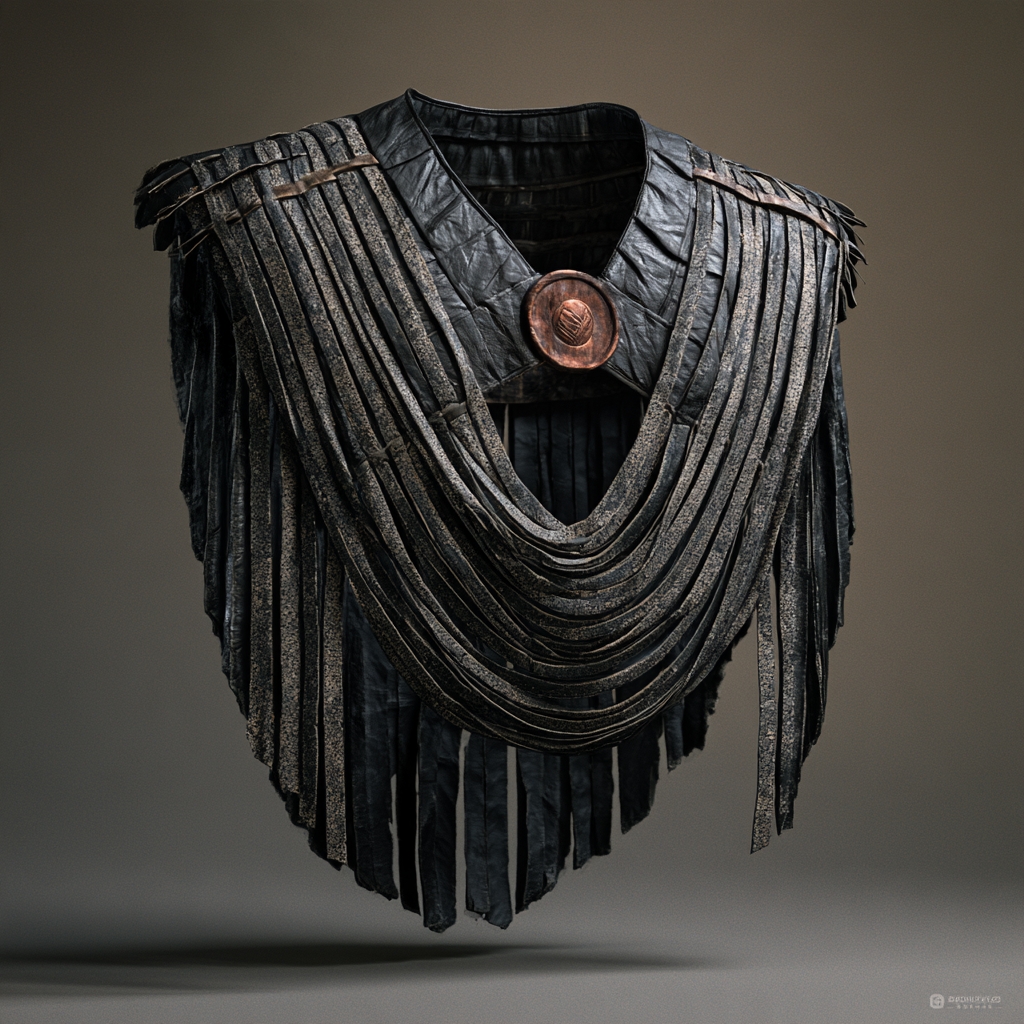
- Description: A short mantle of dark leather covering both shoulders and the upper back, stiffened with strips of grey Kalhu granite cut thin as a fingernail. A copper clasp at the throat bears the mason’s mark of Balawat.
- Abilities:
- Scholar’s Poise: While attuned and openly worn, the wearer gains 1 temporary skill point in Library Research.
- Stone Shoulder (reaction): Once per day, when the wearer is hit by a physical attack, the granite strips harden and reduce the damage taken by 1d4.
- Suggested value: 35 silver
Lore
The archive hall of Balawat is cut into the mountain beneath the Flamecitadel, and its lower vaults are older than the temple above them. In the early years of the hall, tablets were carried between levels by runners, the youngest members of the scribe houses, who bore the clay in padded frames across their shoulders. The vault stairs are steep and the ceilings are low. A runner who slipped lost a day’s copying, and a runner who was struck by falling stone could lose far more.
The mantles came from the masons. The story kept by the stonecutters’ lodge of Balawat says that a section of ceiling in the fourth vault gave way during a tremor, when magma shifted far below the mountain and the rock rippled. Three runners were on the stair. A mason named Durul-Kesh, who was setting a lintel nearby, put his own shoulders under the falling slab and held it long enough for them to pass. He lived, though he never raised his arms above his head again. The scribes asked what they owed the lodge, and the lodge answered that it wanted no coin. It wanted the runners to stop dying on its stairs.
The masons cut the fallen slab into strips as thin as a fingernail, a skill they normally reserved for inlay work on temple doors. They sewed the strips into dark leather, shaped to cover the shoulders and the upper back, and fastened each with a copper clasp bearing the lodge’s mark. The first forty mantles were made from that one slab. Later ones were cut from other Kalhu granite, and those who can read stone through the Mind’s Eye say the difference shows. This mantle is one of the later ones. Its granite came from the same quarry face where Nin-Tuppi’s grandfather kept tally.
A mantle is issued to a runner on the first day of service and stays with the archive hall when the runner moves on. Nin-Tuppi wore one for her two years in the vaults and returned it. The mantle she wears now was given to her after the spring flood, when she spent three years carrying damaged charters up from the lower levels. The vault keeper Iltani chose it from the rack and noted in the hall’s register that it was released from service. Such a release is uncommon, and it marks the wearer as someone the hall trusts to enter the lower vaults unescorted.
The masons and the scribes still exchange an obligation over these mantles. Once a year the lodge inspects every one in the hall and replaces cracked strips without charge. In return the scribes copy the lodge’s contracts and boundary records at no cost. Neither side has written the arrangement down, and both sides consider that a point of honor.
Among the townsfolk, the mantle is recognized on sight. A person wearing one is assumed to know the way through the mountain. Visitors lost in the upper halls will ask a mantle-wearer for directions before they ask a guard.
Assigned Values
- Specific slot: Shoulder (covers both shoulders and the upper back, worn over a chest garment and under a backpack)
- Tier one stats:
- Armor Check: +2
- Endurance: +1 while attuned
- Strength: +1 for the purpose of carrying loads on the back or shoulders
- Item health points: 10 plus the wearer’s maximum health points
- Charges: 2, regaining 1 at each Helios up
- Skills gained while openly worn:
- Library Research: +1 temporary skill point
- Stonework: +1 temporary skill point
- Navigation (underground and built passages): +1 temporary skill point
Passive Magics
- Scholar’s Poise: While attuned and openly worn, the wearer gains the Library Research point listed above and keeps a calm, upright bearing that others notice.
- Level Load: A backpack or carrying frame worn over the mantle counts as half its weight for the wearer.
- Stone-Kin: While attuned, the wearer feels faint vibration through worked stone underfoot and has advantage on saves against falling rock, collapsing floors, and earth tremors.
- Dry Shoulders: Water, dust, and dripping lime run off the leather. Tablets and papers carried on the back stay dry in damp vaults and light rain.
- Vault Memory: The wearer always knows the direction of the last doorway or stair passed through within the past hour.
Activatable Magics
- Stone Shoulder (reaction, 1 charge): When the wearer is hit by a physical attack, the granite strips harden and reduce the damage taken by 1d4 plus 1.
- Bearer’s Brace (action, 1 charge): For 10 minutes the wearer can hold up or carry a load on the shoulders as though Strength were 3 points higher. This can be used to brace a door, a beam, or a falling slab.
- Mason’s Tap (action, no charge, once per hour): The wearer taps the copper clasp twice. For one minute the wearer senses hollow spaces, cracks, and hidden seams in stone within 30 feet as a faint pressure across the shoulders.
- Lodge Mark (free action, no charge): The wearer presses the clasp against soft clay or wax and leaves the mason’s mark of Balawat, which the stonecutters’ lodge and the archive hall accept as proof of the wearer’s standing.
Tags
Shoulder Armor, Tier 1, Common, Mantle, Dark Leather, Kalhu Granite, Balawat, Archive Hall, Stonecutters’ Lodge, Load Bearing, Reaction Ward, Copper Clasp, Vault Runner, Library Research, Stonework, Underground Navigation, Charged Item, Tremor Sense, Released From Service, Assyria, Renaissance, Mason’s Mark
Obtaining, Buying, and Selling the Archive Mantle of Balawat 7204
How the item might be obtained
- Issued for service: The archive hall of Balawat issues a mantle to each vault runner on the first day of service. The mantle belongs to the hall and is returned when the runner moves on.
- Released from service: A vault keeper may release a mantle to a scribe or runner who has done long or dangerous work in the lower vaults. The release is written in the hall’s register, and the mantle then belongs to the wearer.
- Gift of the lodge: The stonecutters’ lodge of Balawat may present a mantle to an outsider who has saved a mason’s life, shored up a failing tunnel, or settled a boundary dispute in the lodge’s favor.
- Quest reward: The archive hall or the lodge may offer a mantle as payment for recovering tablets from a collapsed vault or escorting a shipment of records along the mountain road.
- Possession of an avatar: A character who possesses a vault runner, scribe, or mason who owns a mantle acquires it with the avatar’s other belongings.
- Combat or salvage: A mantle may be taken from a fallen wearer, dug out of a cave-in, or found among goods stolen from the hall.
- Commission: A mason skilled in thin-cut stone and a leatherworker can make one to order. The lodge’s mark on the clasp may only be struck by a lodge member.
Shops where the item might be bought and sold
All prices are suggested amounts based on a value of 35 silver. Sellers set their own prices, and the amounts change with distance from Balawat and with what the buyer appears willing to pay.
- Stonecutters’ lodge workshop in Balawat:
- What it is: A family-run cutting shed beside the lodge hall, where two generations of inlay masons cut thin granite and a leatherworker cousin does the sewing.
- Buying: A new mantle with the lodge mark costs about 35 silver and takes five days. A member of the lodge or the local guild pays about 31 to 32 silver. A mantle without the mark costs about 28 silver.
- Selling: The workshop pays about 18 to 21 silver for a sound mantle and less for one with cracked strips. It will not buy a mantle still listed in the archive hall’s register and will send word to the hall.
- How: Coin or World Bank transfer. The lodge records each clasp it strikes.
- Leatherworker and harness maker in a Kalhu quarry town:
- What it is: A small shop serving miners and carters, selling straps, carrying frames, aprons, and shoulder pads.
- Buying: About 33 to 38 silver when one is in stock. Quarry crews buy them for load bearing and care little about the archive.
- Selling: About 17 to 20 silver. The owner tests the strips by flexing the leather and listening for grit.
- How: Coin is usual. Haggling of around 10% either way is expected.
- Guildhall quartermaster in Balawat:
- What it is: The supply counter in the town’s guildhall, stocked with gear that members have turned in or traded.
- Buying: About 31 to 32 silver for a guild member and 35 silver for a non-member.
- Selling: About 21 silver. The quartermaster logs the seller’s name and where the mantle came from.
- How: World Bank transfer, with the 1% bank fee paid by the account holder.
- Outfitter for delvers and tunnel crews in the capital:
- What it is: A narrow family shop near the city’s lower gates, selling lamps, rope, picks, and protective gear for those who work in the cave systems and steam tunnels.
- Buying: About 40 to 45 silver, which includes the 3% tax on goods sold in the city and the cost of carriage from Kalhu.
- Selling: About 20 to 23 silver. The shop favors mantles with the lodge mark and pays a few silver more for them.
- How: World Bank transfer preferred.
- Black-market dealer in Ashur Dock:
- What it is: A back-room trade behind a ropewalk, dealing in goods lifted from caravans and warehouses.
- Buying: About 35 to 50 silver for an ordinary mantle. One with a clasp that the archive hall still honors may reach 2 to 3 gold, since it helps the wearer pass through the lower vaults unchallenged.
- Selling: About 17 silver for an ordinary mantle and up to 1 gold and 5 silver for one with a registered clasp.
- How: Coin only, with no World Bank transfer and no record kept.
- Import stall on another island nation:
- What it is: A dockside family stall selling foreign armor pieces and curiosities.
- Buying: About 8 silver to 1 gold and 5 silver. Thin-cut Kalhu granite is rare outside Assyria, and the seller prices it as a novelty.
- Selling: About 25 to 40 silver, depending on whether the stall keeper has seen one before.
- How: Local coinage or World Bank transfer. Assyrian citizens pay double the local taxes and fees as foreigners.
Roleplay of the Archive Mantle of Balawat 7204 in Defense and Offense
Archive vaults and underground passages
- Defense:
- Nin-Tuppi turns her shoulder toward a blow so that it lands on the granite strips, and she spends a charge on Stone Shoulder. The strips grind together with a sound like a millstone.
- Stone-Kin gives her a moment’s warning of a collapse or tremor. She describes it as a shiver across her back, and she moves to a doorway before the dust falls.
- Vault Memory lets her retreat in darkness or smoke toward the last stair she passed, without stopping to find her bearings.
- In a guarded archive, a designated safe area, the mantle’s Armor Check of 2 counts as 6.
- Offense:
- She uses Mason’s Tap before a fight to find hollow walls, weak lintels, and hidden seams. She then draws an opponent beneath a cracked lintel or onto a thin floor and strikes the stone with the Quarry Mallet.
- With Bearer’s Brace she holds a heavy vault door shut against pursuers, or drops a shelf of fired tablets across a narrow aisle.
Quarries and mountain roads of Kalhu
- Defense:
- Stone-Kin applies to rockfall on a quarry face. She steps aside from a loosened block while others are still looking up.
- Level Load keeps her steady under a full pack on steep paths, so she does not tire before a fight begins.
- A quarry is a normal area, so the mantle’s Armor Check stands at 2.
- Offense:
- She uses Bearer’s Brace to tip a cut block or roll a cart of rubble down a slope toward attackers below.
- Mason’s Tap shows her where a ledge is undercut. She describes pointing it out to allies and keeping to the sound stone herself.
City streets and guildhalls
- Defense:
- Inside a walled town, a somewhat safe area, the Armor Check counts as 4. The mantle is recognized by guards and townsfolk in Kalhu, who are slower to lay hands on someone the archive hall trusts.
- In a crowd she lets a shove or a thrown stone land on her shoulders and saves her charges for a drawn blade.
- Offense:
- She uses the Lodge Mark in place of a weapon. Pressing the clasp into wax on a contract or a complaint brings the stonecutters’ lodge into a dispute, which is a serious threat to a merchant who needs stone or masons.
- With Bearer’s Brace she can force a jammed door or hold a gate open for allies.
Forge halls and steam tunnels
- Defense:
- The leather and granite do not conduct heat quickly, and she describes the mantle as cool against her neck while the air burns. It offers no fire resistance of its own, so she relies on the Bench-Robe for that.
- Stone-Kin warns her of pressure building behind a tunnel wall before a vent bursts.
- Offense:
- Mason’s Tap finds the thin places in a tunnel lining. She breaks one open to release steam between herself and a pursuer.
Wetlands, rain, and river travel
- Defense:
- Dry Shoulders keeps her tablet case and pack contents dry in rain and marsh mist. She describes water beading and running off the leather.
- Stone-Kin and Mason’s Tap give little on mud, peat, or wooden walkways, and she says the mantle feels deaf there.
- Offense:
- The mantle adds little in this terrain. She uses Bearer’s Brace to pole a flat-bottomed boat faster or to overturn a walkway plank under a foe.
Low-magic and dangerous places
- Defense:
- In an unsafe area the Armor Check is halved to 1, and in a deathly area it gives none. She keeps both charges for Stone Shoulder.
- As an Akkad-Kuri she is already weakening in such places, and she describes the mantle as heavier with each hour.
- Offense:
- She avoids attacking. If she must act, she uses Bearer’s Brace to block a passage and gain time to leave.
Social encounters
- Defense:
- Scholar’s Poise shows in how she stands. Under questioning she keeps her shoulders level and her voice even, and others find it hard to tell when she is afraid.
- Offense:
- Among masons, quarry crews, and vault keepers the mantle speaks for her. She lets them see the clasp before she asks a favor, and she reminds a reluctant clerk that the lower vaults are open to her.
Perception of Activation:
User’s Perspective
- Sight: The wearer sees little of the mantle itself. At the edge of her vision the shoulders pale to grey, and during Bearer’s Brace she sees dust at her feet slide outward in a ring. During Mason’s Tap she notices a brief brightening at one shoulder when she faces flawed stone.
- Sound: Stone Shoulder grinds close behind her ears, like a millstone turning once. Mason’s Tap gives two soft copper tones, followed by a faint returning hum that only she seems to hear.
- Touch: The mantle grows heavy and cold across the shoulders, and the leather stiffens against her neck. During Bearer’s Brace she feels a firm, even pressure, as if a beam had been laid across her back and was holding her up instead of weighing her down.
- Smell: Dry rock dust and cut granite, with a trace of oiled leather.
- Taste: A chalky, flinty taste, like the air of a quarry after a block has been split.
- Extra-sensory perceptions:
- Aetheric Scrutiny: She tastes the mantle’s magic as slow and dense, with none of the fire she knows from the Flamecitadel. It reminds her of deep rock and still water.
- Stone sense: Through Stone-Kin and Mason’s Tap, she feels the stone around her as pressure across her shoulders. Hollows feel like a missing weight, and cracks feel like a thin cold line.
- Mind’s Eye: She knows how many charges remain and is aware of the words “released from service” on the clasp.
- Direction sense: Vault Memory gives a steady pull at the back of her shoulders toward the last doorway or stair she passed.
- Attunement sense: At the moment of Stone Shoulder she feels, very briefly, the impression of a weight being held up by someone else’s back.
Observer’s Perspective
- Sight: An observer sees the scribe’s shoulders turn the color and grain of granite for an instant, or sees pale lines of light form the shape of a lintel across her back. Dust falls from her shoulders after a blow.
- Sound: The grinding of Stone Shoulder carries across a room. The two tones of Mason’s Tap are quiet and clear, like a small bell struck twice.
- Touch: Someone in contact with the wearer during Bearer’s Brace feels her become as immovable as a pillar. The floor nearby gives a slight tremble.
- Smell: Stone dust hangs in the air for a short time around the wearer.
- Taste: Those close by may taste grit if dust is knocked loose.
- Extra-sensory perceptions:
- True sight: The strips give off a dim ultraviolet glow that flares along their length at each activation. Bearer’s Brace shows as a steady bar of light across the shoulders.
- Tremorsense: Stone Shoulder and Bearer’s Brace send a short pulse through the ground that marks the wearer’s position. Mason’s Tap sends two faint pulses that travel outward through stone.
- Aetheric Scrutiny (other Akkad-Kuri): Nearby Akkad-Kuri taste a brief swell of earth-aligned magic and may find it unfamiliar beside the fire magic common to Assyria.
- Blind sight: The grinding sound gives a clear echo of the wearer’s outline. During Bearer’s Brace her shape echoes back as harder and denser than a living body.
- Mind’s Eye: An observer who examines the mantle sees its name, the lodge mark, and the register notation.
Positives
- The wearer always knows the state of the mantle through its weight, its temperature, and the Mind’s Eye.
- The stone sense warns of collapse, hollow walls, and weak floors before they can be seen.
- The pull of Vault Memory works in darkness, smoke, and ash.
- The feeling of support during Bearer’s Brace steadies the wearer under strain.
- Mason’s Tap is quiet and can be used without drawing much notice.
- Allies with tremorsense or true sight can find the wearer underground.
Negatives
- The grinding of Stone Shoulder is loud and reveals the wearer’s position to creatures that hunt by sound or vibration.
- The pulses of Mason’s Tap can be felt by burrowing creatures and others with tremorsense.
- The cold weight across the shoulders is tiring in roleplay, and the flinty taste lingers after each use.
- The stone sense is nearly silent on mud, peat, water, and wooden floors, which leaves the wearer feeling half-deaf.
- The earth-aligned magic stands out among fire-aligned Assyrian gear and may draw questions from Firelords.
- The lintel of light during Bearer’s Brace lasts ten minutes and cannot be hidden.
Recipe: Shoulder Mantle in the Manner of the Balawat Archive
Materials Needed
- Stone:
- 1 slab of fine-grained grey Kalhu granite, about two hands long, one hand wide, and one finger thick, free of veins and cracks
- Enough for 24 strips cut as thin as a fingernail, plus 4 spares
- A slab taken from a fallen ceiling, lintel, or load-bearing stone is preferred, since stone that has carried weight takes the magic more readily
- Leather and thread:
- 1 hide of dark vegetable-tanned leather, enough for an outer layer and a lining across both shoulders and the upper back
- 1 spool of heavy waxed thread
- 2 short leather straps for underarm ties
- Magical components:
- 2 tier 1 magic crystals, each about the size of a coin, as catalysts (one for each charge)
- 1 vial of pine or cedar sap drawn with a fluid collector, to bed the strips
- 1 pinch of granite dust saved from the cutting
- Fittings:
- 1 copper clasp blank with hook and loop
- 6 small copper rivets
- Finishing:
- 1 small pot of neatsfoot oil or beeswax for the leather
Tools Required
- A stone saw with a fine blade and a water trough for wet cutting
- A grinding stone and polishing slate
- A mason’s chisel and a light mallet
- Leather shears, an awl, and two heavy needles
- A wooden shoulder form or a padded carrying frame to shape the mantle
- A small crucible and tongs for warming sap and seating crystals
- A punch or die for striking a maker’s mark into the clasp
- A reading lens or other identification focus for checking the finished work through the Mind’s Eye
Skill Requirements
- Stonework: 4 or higher, for cutting strips this thin without breaking them
- Leatherworking: 3 or higher
- Rune Cutting: 2 or higher, for cutting the binding notch in each strip
- Metalworking: 1 or higher, for the clasp
- Two crafters may share the work, provided each required skill is met by the one performing that step.
- Time: About 5 days of downtime.
- Standing: The mason’s mark of Balawat may only be struck by a member of the stonecutters’ lodge. A crafter outside the lodge strikes a personal mark instead, and the Lodge Mark ability then carries only that crafter’s name.
Crafting Steps
- Select and test the slab:
- Tap the slab along its length with the chisel and listen. A clear ring means sound stone. A dull note means a hidden crack, and the slab is set aside.
- Cut the strips:
- Saw the slab wet into 28 strips, each about a finger wide and as thin as a fingernail. Work slowly and keep the blade cool. Save the dust from the trough.
- Grind and notch:
- Grind each strip smooth on both faces and round its edges. Cut one small binding notch at the midpoint of 24 strips with the chisel. Keep 4 strips unnotched as spares.
- Cut the leather:
- Cut the outer layer and lining to cover both shoulders and the upper back, with a short standing collar. Mark 12 channels on each shoulder, fanning outward from the neck.
- Bed the strips:
- Warm the sap in the crucible and stir in the granite dust. Brush a thin line into each channel on the lining and press one strip into each, notch upward. Let the sap set for one day on the shoulder form.
- Seat the crystals:
- Seat one tier 1 crystal in the notch of the central strip on each shoulder and seal it with a drop of sap.
- Sew the mantle:
- Lay the outer layer over the strips and stitch between each channel with waxed thread, so every strip lies in its own sleeve. Sew on the collar and the underarm ties.
- Fit the clasp:
- Strike the maker’s mark into the copper blank. Rivet the hook and loop to the collar at the throat.
- Oil and shape:
- Work oil or wax into the leather and leave the mantle on the form overnight under a weighted pack, so it takes the curve of a loaded shoulder.
- Wake the stone:
- The crafter puts on the mantle, stands beneath a stone lintel or doorway, and rests both hands against it for a ritual of at least 10 minutes. The strips grow cold and the clasp warms if the work is sound.
- Roll for the result:
- The crafter rolls a d20. On a 1 the strips split along their length, the crystals shatter into shards, and the materials are lost. On a 20 the mantle gains one extra capability chosen by the GM, such as a third charge. Any other result produces a working mantle.
- Check and attune:
- Examine the mantle through the identification focus to confirm its abilities. The wearer attunes over one minute.
Durul-Kesh Who Was a Lintel, and of Stone That Was Cut Into Forty Coats
This is the saying of the stone-men of Balawat. It was first said in the speech of the under-mountain, which is forgotten, and was put into the speech of the fathers of our fathers by one who did not know it well, and from that into ours by one who knew it less. Where the meaning limps, forgive it. A lame saying still arrives.
In the time when the hall of tablets was young under the fire-temple, and the fourth room-below was newly dug, there was among the stone-men one called Durul-Kesh. He was not a master. The saying is firm on this. He was a setter of lintels, which is the stone that lies across the top of a door, and it was said of him in the lodge: “Durul-Kesh is wide and he is slow and he does not talk, and this is all a lintel needs.” He took it as no insult. The old translator writes here: “In their speech the word for lintel and the word for a patient man may be one word. I am not certain.”
Now the clay-women, the scribes, had runners in those days as they have now. They were children only a little past their Quickening, with the marks new on their arms, and they carried the tablets on their shoulders in frames of wood up the stairs and down the stairs. The stairs of the fourth room-below are sixty and three, and they are steep as a ladder is steep. And the runners ran, though they were told to walk. This too the saying is firm on. Children run.
The stone-men did not love the clay-women in that time. The clay-women wrote the contracts, and the stone-men said the contracts were always a finger short on the side of the stone. And the clay-women said the stone-men’s walls were always a finger short on the side of the wall. So they bowed to each other in the passage and did not speak, and each counted the other’s fingers.
On a day in the week called Darkness, when the great planet stands before Helios and the world is cold, Durul-Kesh was at the door of the fourth room-below with his props and his wedges. He was setting the lintel of that door. The stone was up, resting on its timbers, and he was seating it, tapping here and tapping there, and listening to it, as a setter does. And three runners came down the sixty and three stairs with their frames full. Their names are held by the lodge and not by the scribes, which is a strange thing and is told as a strange thing. They were Asharu, and Tebit, and a small one called Mina-the-Late, because she was always behind.
Then the fire-blood under the mountain turned in its sleep. The saying has it so: “the red river rolled over.” It was not a great shaking. Cups did not fall in the town. But in the fourth room-below, the roof over the bottom of the stair was a single slab, grey, long as two men, and the diggers had left it thinner than was right, to save a week. And the slab cracked from the wall with a sound, and the sound was like a word said by something very large.
Durul-Kesh heard it. A setter hears stone before he sees it. He looked up and saw the slab tilt, and he looked down and saw two children on the last stairs and a third still coming, late. And the saying tells what he did, and it tells it without ornament, and so shall I. He stepped out from his door. He put his back beneath the slab where it leaned, and his two hands flat upon his knees, and he became the lintel.
The slab came down upon his shoulders. The weight of it is given in the saying as “nine oxen,” but the translator notes: “Their ox may not be our ox.” It drove his feet into the floor of the room to the depth of a thumb, and the prints are there yet, and the stone-men show them to their apprentices. And he did not fall. He said one word. It is the only word he says in the whole of the saying. He said: “Walk.”
And Asharu walked beneath the slab, and beneath his arm, and out. And Tebit walked. And Mina-the-Late, who was at the top of the stair, stood there and wept and did not move, for she saw the stone and the man under it and her legs were water.
Here the saying slows, as the stone-men slow when they tell it. Durul-Kesh could not turn his head. He could not see the child. He could hear her weeping, far up, sixty stairs away. He could not call to her again, for there was no breath in him for a second word. And he could not set the stone down, for a slab set down across a stair is a door closed forever, and she would be behind it. So he stood. And he listened to her come down. One step. And a stopping. And one step.
The stone-men count the steps when they tell it. They count all sixty and three aloud, and the apprentices must stand with a block upon their shoulders while they are counted. The translator writes: “I have left out the counting. It is very long. I think that is the purpose of it.”
At the fortieth step his shoulders made a sound. At the fiftieth, the blood came from his nose and fell on his hands. At the sixtieth he had shut his eyes, and it is said he was no longer a man thinking but only a stone holding, and that this is why he did not break: for a man can decide to fall, and a lintel cannot. And Mina-the-Late came down the last three steps, and went under his arm, and out, and she touched his hand as she passed. He did not feel it. She told him so, after, many times, all her long life.
Then the other stone-men came running with timbers, and they propped the slab on every side, and they said to him, “Durul-Kesh, come out.” And he did not come out. He could not unbend. They carried him out as one carries a carved figure, still bowed, his hands still on his knees. And his arms, from that day, would not rise above his shoulders. He never set a lintel again.
Now hear the bargaining, for the stone-men think it the best part.
The mother of the scribes came to the lodge. She came herself, which was not done. She brought a tablet with a number pressed on it, and the number was large, and she said: “This is what the house owes for three daughters.” And the master of the lodge, an old woman of the dwarf-kind named Hodra Flint-Reckoner, looked at the tablet and turned it face down. And she said: “You have written it a finger short.” And the scribe-mother said, “Name the finger.” And Hodra said: “Coin is the short finger. We do not want it. We want you to stop sending children under our roofs with nothing on their backs. We are tired of holding up your house.”
The scribe-mother was silent, and then she said a thing the lodge has kept: “We do not know how to make such a garment. We know only clay.” And Hodra said: “Then we will make it. And you will owe us, and we will owe you for the owing, and neither of us will write it down, for the moment it is written one of us will find it a finger short.”
So the stone-men took the fallen slab, the same slab, with the mark of his shoulders worn into its underside. And they cut it. They cut it into strips so thin the lamp showed through them, which is temple-door work and not vault work, and it took a season. And they sewed the strips into dark leather to lie on the shoulders and the back, twelve to a side, spread like the fingers of two hands. Forty coats came from that one stone. And on the clasp of each they struck the mark of the lodge.
And Durul-Kesh, who could not lift his arms, sat in the cutting shed all that season on a bench. He could not saw. But each strip was brought and laid across his palm, and he closed his fingers on it and listened, and he said “yes” or he shook his head. Those he shook his head at were broken and thrown out. The saying holds that this is why the forty have never cracked: each was passed by the one man who knew to the last grain what that stone could bear.
The first coat was put on Mina-the-Late. She wore it down the sixty and three stairs, walking. She was a runner two years, and a scribe three hundred, and a keeper of the fourth room-below after, and it is said she was never once late again, though the name stayed.
And each year since, the stone-men go to the hall and look at every coat, and mend what needs mending, and take nothing. And each year the clay-women copy the lodge’s contracts, and take nothing. And both sides count fingers still. But they speak in the passage now.
When Durul-Kesh died, the stone-men did not burn him wholly in the forge, though the fire-priests asked it. They set his shard in the wall above the door of the fourth room-below, under the lintel he had been seating on that day, which another had finished. And the runners touch the doorpost when they pass beneath. They do not know why. They are told only: “That is where you walk.”
The moral of the story is that the strongest thing a person can do is sometimes to stand still under a weight until the slowest one has passed. The stone-men add a second: a debt both sides refuse to write down will be paid longer than any contract.
Suggested conversions to other systems:
Call of Cthulhu (7th Edition)
The Lintel-Bearer’s Yoke
- Type: Enchanted garment (artifact)
- Origin: A short mantle of dark leather from the archive hall of Balawat in Assyria, on the world of Saṃsāra. Granite strips as thin as a fingernail are sewn across both shoulders and the upper back. A copper clasp at the throat bears an unfamiliar mason’s mark.
- Armor: 1 point against blows to the shoulders, upper back, and neck, and against falling debris
- Weight: 3 lb
- Bonding: The wearer stands beneath a stone doorway for one minute and makes a POW roll. On a success the mantle is bonded and its powers can be used.
- Passive effects while bonded:
- Bonus die on Navigate rolls made underground or inside stone buildings.
- Bonus die on Dodge or Luck rolls to avoid falling rock, cave-ins, and collapsing floors.
- A pack or frame worn over the mantle counts as half its weight.
- Papers carried on the back stay dry in damp and light rain.
- Powers (the mantle draws on the wearer’s magic points):
- Stone Shoulder: Cost 2 magic points. Used when the wearer is struck. Reduce the damage by 1D4+1. A grinding noise is heard by everyone nearby.
- Bearer’s Brace: Cost 3 magic points. For 10 minutes, treat the wearer’s STR as 20 points higher for lifting, carrying, and holding up weight. This does not change damage bonus.
- Mason’s Tap: Cost 1 magic point. The wearer taps the clasp twice. For one minute, hollows, cracks, and hidden seams in stone within 10 yards are felt as pressure across the shoulders. Spot Hidden rolls to find concealed doors in stone gain a bonus die.
- Sanity:
- First bonding: 0/1 Sanity points, as the wearer feels a great weight being held up by someone else’s back.
- First use of Bearer’s Brace: 0/1 Sanity points for the wearer.
- Investigation:
- A Science (Geology) roll identifies the stone as fine-grained granite of no known quarry.
- An Occult roll suggests the garment is a builder’s charm against collapse.
- Cthulhu Mythos: None gained. The mantle is not of the Mythos.
Blades in the Dark (current edition)
The Vault-Runner’s Slab Collar
- Type: Fine arcane garment (unique item)
- Load: 1
- Quality: 2
- Origin: A shoulder mantle of dark leather and thin-cut granite from the archive hall of Balawat in Assyria, on the world of Saṃsāra. Its copper clasp bears the mark of a stonecutters’ lodge.
- Features:
- Stone Shoulder: The mantle has its own armor box. Mark it to reduce harm from a blow, a fall, or a collapse by one level. It does not stack with other armor against the same harm. It clears when your other armor clears.
- Bearer’s Brace: When you push yourself to lift, hold, or brace against great weight, take 1 stress instead of 2.
- Mason’s Tap: When you Survey or Study stonework, tunnels, or buildings, gain +1 effect. When you gather information about a structure, ask one extra question about hidden spaces or weak points.
- Lodge Mark: Pressing the clasp into wax leaves a mark that masons, builders, and archivists respect. Gain +1 effect when you Consort with them.
- Vault Memory: You cannot become lost underground or indoors. You always know the way back to the last door you passed.
- Drawbacks:
- Loud: When you mark the mantle’s armor box, the stone grinds like a millstone. Anyone nearby knows where you are.
- Recognizable: The clasp is known to those who deal in stone and records. A witness who sees it can describe you by it.
- Crafting a copy: Invent the formula as a long-term project, then Tinker during downtime. Arcane, minimum quality 2, with the Loud drawback. Requires a slab of stone that once bore a load.
Dungeons & Dragons (2024 rules)
Mantle of the Standing Lintel
- Wondrous Item, Uncommon (Requires Attunement)
- Weight: 3 lb.
- Description: This short mantle of dark leather covers both shoulders and the upper back and is stiffened with strips of grey granite cut as thin as a fingernail. It comes from the archive hall of Balawat in Assyria, on the world of Saṃsāra, and its copper clasp bears the mark of that town’s stonecutters’ lodge.
- Bearer’s Frame: While you wear the mantle, you count as one size larger when determining your carrying capacity.
- Lodge Training: While attuned, you have proficiency with Mason’s Tools. You also have Advantage on Intelligence (Investigation) checks made to find information in a library or archive.
- Stone-Kin: You have Advantage on saving throws against falling rock, collapsing structures, and earth tremors.
- Vault Memory: You always know the direction to the last doorway or stairway you passed through within the past hour.
- Charges: The mantle has 2 charges and regains 1 expended charge daily at dawn.
- Stone Shoulder (1 charge): When you are hit by an attack that deals Bludgeoning, Piercing, or Slashing damage, you can take a Reaction to reduce the damage by 1d4 plus your Proficiency Bonus. The grinding of stone is audible out to 60 feet.
- Bearer’s Brace (1 charge): As a Magic action, you gain Advantage on Strength checks made to push, pull, lift, or hold up weight for 10 minutes.
- Mason’s Tap: As a Magic action, you tap the clasp twice. For 1 minute you sense the location of hollow spaces, cracks, and concealed doors in stone within 30 feet of you. Once you use this property, you can’t use it again until you finish a Short or Long Rest.
Knave (Second Edition)
Lintel-Bearer’s Shoulder Piece
- Type: Relic armor piece, worn across the shoulders
- Slots: 1
- Armor: +1 Armor Point
- Value: Seldom for sale. Copies fetch whatever a buyer will pay.
- Description: A short mantle of dark leather stiffened with thin strips of grey granite, from Balawat in Assyria on the world of Saṃsāra. A copper clasp at the throat carries a mason’s mark.
- Always in effect while worn:
- The wearer gains 2 additional item slots for a pack or frame worn over the mantle.
- Checks to avoid falling rock, cave-ins, and collapsing floors are made with advantage (+5).
- Checks to search a library or archive are made with advantage (+5).
- The wearer always knows the way back to the last door or stair passed.
- Charges: 2. One charge returns each morning.
- Stone Shoulder (1 charge): When hit, reduce the damage by d4+1. The grinding is heard throughout the room.
- Bearer’s Brace (1 charge): For one turn (10 minutes), STR checks to lift, carry, or hold up weight are made with advantage (+5).
- Mason’s Tap: Once per watch, tap the clasp twice. For the rest of the turn the wearer senses hollow spaces, cracks, and hidden doors in stone within 30 feet.
- Limit: If the wearer takes a wound that fills this item’s slot, the strips split. The mantle keeps its Armor Point and loses all other effects until a mason spends a week recutting the stone.
Fate (Fate Condensed)
The Mantle That Held the Roof
- Type: Extra (service garment)
- Origin: A short mantle of dark leather stiffened with thin strips of grey granite, from the archive hall of Balawat in Assyria on the world of Saṃsāra. Its copper clasp bears the mark of the town’s stonecutters’ lodge.
- Permission: A character aspect showing service in the archive vaults or a debt owed by the stonecutters’ lodge.
- Cost: 2 refresh
- Item aspect: Granite Mantle of the Balawat Archive
- Invoke: To bear a heavy load, to find the way through stone passages, or to be trusted by masons and vault keepers.
- Compel: The stone grinds loudly when it works, it is deaf on mud and timber, and the clasp is recognized by anyone who deals in stone or records.
- Stunts granted while worn:
- Stone Shoulder: Once per session, when you take a physical hit, reduce its shifts by 2 before absorbing stress. Everyone in the zone hears the stone grind.
- Bearer’s Brace: +2 to Physique when lifting, carrying, bracing, or holding up weight.
- Mason’s Tap: Once per scene, when surrounded by stonework, create an advantage with Notice without rolling. Place one aspect such as Hollow Behind the Wall or Cracked Lintel with a free invoke.
- Vault Memory: You never need to roll to retrace your path underground or indoors. If an opponent tries to mislead or trap you in passages, you gain +2 to overcome with Notice.
Numenera and Cypher System (Numenera Discovery and the Cypher System Rulebook)
Shoulders of the Fallen Slab
- Type: Artifact
- Level: 1d6
- Form: A short mantle of dark leather covering both shoulders and the upper back, from Balawat in Assyria on the world of Saṃsāra. Translucent strips of grey stone are sewn inside it, and a copper clasp at the throat bears a mason’s mark.
- Effect:
- Worn over clothing or armor, the mantle grants +1 to Armor and does not count as armor for the purpose of Speed Effort costs.
- The wearer has an asset on tasks to navigate underground or inside structures, and on defense tasks against falling rock and collapse.
- The wearer has an asset on Might tasks to carry or hold up weight.
- Stone Shoulder (enabler): When the wearer takes damage from a physical attack, they can reduce that damage by a number of points equal to the artifact level. Roll for depletion.
- Bearer’s Brace (action): For ten minutes, Might tasks to lift, brace, or hold up weight are eased by two steps. Roll for depletion.
- Mason’s Tap (action): The wearer taps the clasp twice. For one minute they sense hollow spaces, cracks, and concealed openings in stone within short range. This can be used once per hour and requires no depletion roll.
- Depletion: 1 in 1d20. A depleted mantle keeps its +1 to Armor and loses all other effects.
Pathfinder (Second Edition, Remaster)
Lodge-Marked Vault Mantle — Item 4
- Traits: Earth, Invested, Magical
- Price: 90 gp
- Usage: worn cloak
- Bulk: L
- Description: This short mantle of dark leather is stiffened with strips of grey granite cut as thin as a fingernail. It comes from the archive hall of Balawat in Assyria, on the world of Saṃsāra, and its copper clasp bears the mark of that town’s stonecutters’ lodge. While invested, you can carry 1 more Bulk than normal before becoming encumbered, and you gain a +1 item bonus to Perception checks to Seek hidden doors, hollows, and hazards in stonework. You always know the direction to the last doorway or stairway you passed through within the past hour.
- Activate—Stone Shoulder [reaction] (manipulate)
- Frequency: once per day
- Trigger: You take physical damage from a Strike or from falling debris.
- Effect: The granite strips harden with a grinding noise. You gain resistance 4 against the triggering damage.
- Activate—Bearer’s Brace [one-action] (manipulate)
- Frequency: once per day
- Effect: For 10 minutes, you gain a +2 item bonus to Athletics checks to Force Open and to any check to lift, brace, or hold up weight.
- Activate—Mason’s Tap [two-actions] (concentrate, manipulate)
- Frequency: once per hour
- Effect: You tap the clasp twice. For 1 minute, you sense hollow spaces, cracks, and concealed doors in stone within 30 feet. You automatically know their location, though a hidden door’s mechanism must still be found and opened normally.
Savage Worlds (Adventure Edition)
The Stonecutters’ Debt
- Type: Arcane device (armor)
- Armor: +1
- Covers: Torso
- Minimum Strength: d4
- Weight: 3
- Cost: Seldom for sale. Copies sell for whatever the market bears.
- Description: A short mantle of dark leather stiffened with thin strips of grey granite, from Balawat in Assyria on the world of Saṃsāra. A copper clasp at the throat carries a mason’s mark. It may be worn over other torso armor, and its Armor stacks with one other layer as normal for layered armor.
- Passive effects while worn:
- Treat the wearer’s Strength as one die type higher for Encumbrance.
- +1 to Research rolls made in libraries and archives.
- +2 to Agility rolls and Evasion attempts against cave-ins, falling rock, and collapsing floors.
- The wearer cannot become lost underground or indoors and always knows the way back to the last door passed.
- Power Points: 4. The mantle regains 2 Power Points each dawn and cannot be recharged by other means.
- Activation: No roll is needed. The wearer spends the Power Points listed.
- Stone Shoulder (2 Power Points, free action): When the wearer suffers Wounds from a physical attack, they may make a Soak roll without spending a Benny. The stone grinds loudly.
- Bearer’s Brace (2 Power Points, action): For 10 minutes, the wearer’s Strength is one die type higher for lifting, pushing, bracing, and holding up weight. This does not affect damage.
- Mason’s Tap (no cost, action, once per hour): For one minute the wearer senses hollow spaces, cracks, and hidden doors in stone within 5″ (10 yards) and gains +2 to Notice rolls to locate them.
Shadowrun (Sixth World Edition)
Balawat Load-Bearer Mantle
- Type: Armor accessory and bonded focus
- Defense Rating: +1 (stacks with worn armor as a helmet or shield does)
- Capacity: 2
- Force: 1
- Bonding cost: 2 Karma
- Availability: 4(L)
- Cost: 5,000¥ for a copy. The original is seldom for sale.
- Description: A short mantle of dark leather stiffened with strips of grey granite cut as thin as a fingernail, from the archive hall of Balawat in Assyria on the world of Saṃsāra. A copper clasp at the throat bears a mason’s mark. It contains no electronics and has no wireless bonus.
- Passive effects while bonded and worn:
- Treat the wearer’s Strength as 1 higher for carrying capacity.
- +1 die on tests to avoid falling debris, cave-ins, and structural collapse.
- +1 die on tests to search physical libraries and archives.
- The wearer always knows the way back to the last door or stair passed within the hour.
- An Assensing test with 2 hits reveals an earth-aspected enchantment and the phrase “released from service.” A wearer who is not bonded gains only the Defense Rating.
- Charges: 2. One charge returns at each sunrise.
- Stone Shoulder (1 charge, used when hit): Add +3 dice to the Damage Resistance test against that attack. The stone grinds loudly.
- Bearer’s Brace (1 charge, Major Action): For 10 minutes, add +2 dice to Strength-based tests to lift, push, brace, or hold up weight.
- Mason’s Tap (no charge, Major Action, once per hour): For one minute the wearer senses hollow spaces, cracks, and concealed doors in stone or concrete within 10 meters and adds +2 dice to Perception tests to locate them.
- Astral signature: Each activation leaves an earth-aspected signature that lasts for Force hours.
Starfinder (Second Edition)
Slab-Strip Hauler’s Mantle — Item 4
- Traits: Earth, Invested, Magical
- Price: 900 credits
- Usage: worn cloak
- Bulk: L
- Description: This short mantle of dark leather is stiffened with strips of grey granite cut as thin as a fingernail. It comes from the archive hall of Balawat in Assyria, on the world of Saṃsāra, and its copper clasp bears a stonecutters’ mark. It can be worn over armor. While invested, you can carry 1 more Bulk than normal before becoming encumbered, and you gain a +1 item bonus to Perception checks to Seek hidden doors, voids, and hazards in stone, concrete, and similar mineral construction. You always know the direction to the last doorway, hatch, or stairway you passed through within the past hour.
- Activate—Stone Shoulder [reaction] (manipulate)
- Frequency: once per day
- Trigger: You take bludgeoning, piercing, or slashing damage from a Strike or from falling debris.
- Effect: The granite strips harden with a grinding noise. You gain resistance 3 against the triggering damage.
- Activate—Bearer’s Brace [one-action] (manipulate)
- Frequency: once per day
- Effect: For 10 minutes, you gain a +2 item bonus to Athletics checks to Force Open and to any check to lift, brace, or hold up weight.
- Activate—Mason’s Tap [two-actions] (concentrate, manipulate)
- Frequency: once per hour
- Effect: You tap the clasp twice. For 1 minute, you sense voids, cracks, and concealed doors in stone or concrete within 30 feet and automatically know their location. The effect does not pass through metal bulkheads.
Traveller (Mongoose Second Edition, 2022 Update)
Mason’s Relic Mantle of Balawat
- Armour Type: Relic shoulder mantle (anomalous artefact), worn over other armour
- Protection: +1 (adds to worn armour)
- TL: 2 in manufacture. Its effects cannot be reproduced at any known TL.
- Rad: —
- Kg: 1.5
- Cost: Seldom for sale. A collector might pay Cr3000 or more.
- Required Skill: None
- Description: A short mantle of dark leather stiffened with thin strips of grey granite, from the archive hall of Balawat in Assyria on the world of Saṃsāra. A copper clasp at the throat bears a mason’s mark.
- Passive effects while worn:
- Treat the wearer’s STR as 2 higher for encumbrance.
- DM+1 to Navigation checks made underground or inside structures.
- DM+2 to checks to avoid falling rock, cave-ins, and collapsing floors.
- DM+1 to Investigate checks made in physical libraries and archives.
- Charges: 2. One charge returns each local dawn.
- Stone Shoulder (1 charge, reaction): When the wearer is hit, reduce the damage by 1D after armour is applied. The stone grinds loudly.
- Bearer’s Brace (1 charge, Significant Action): For 10 minutes, STR checks to lift, brace, or hold up weight gain DM+2.
- Mason’s Tap (no charge, Minor Action, once per hour): For one minute the wearer senses hollow spaces, cracks, and concealed doors in stone or concrete within 10 metres and gains a Boon on Recon checks to locate them.
- Analysis: Sensors detect only leather, granite, and copper. A Science check (Formidable 14+) finds no mechanism for its effects.
Warhammer (Warhammer Fantasy Roleplay, Fourth Edition)
The Lodge-Bound Shoulder Slab
- Type: Magical armour
- Price: N/A
- Encumbrance: 1
- Availability: Unique
- Penalty: —
- Locations: Body
- Armour Points: 1 (may be worn over one other layer of Body armour)
- Qualities: Flexible
- Flaws: None
- Description: A short mantle of dark leather stiffened with thin strips of grey granite, from the archive hall of Balawat in Assyria on the world of Saṃsāra. A copper clasp at the throat bears a mason’s mark. To those with the Second Sight Talent, it holds a slow, grey-brown glow.
- Passive effects while worn:
- Increase the wearer’s Encumbrance limit by 2.
- +10 to Research Tests made in libraries and archives.
- +10 to Navigation Tests made underground or inside buildings.
- +20 to Tests to avoid falling rock, cave-ins, and collapsing floors.
- Charges: 2. One charge returns at each sunrise.
- Stone Shoulder (1 charge, used when hit on the Body): The mantle counts as having +3 Armour Points against that hit. The stone grinds loudly.
- Bearer’s Brace (1 charge, Action): For 10 minutes, the wearer gains +20 to Strength Tests to lift, brace, or hold up weight.
- Mason’s Tap (no charge, Action, once per hour): For one minute the wearer senses hollow spaces, cracks, and hidden doors in stone within 10 yards and gains +20 to Perception Tests to locate them.
- Notice: Dwarfs and trained masons recognize thin-cut stonework of this quality at a glance and will ask where it came from.