
From: Lineage 4172 of Akkad Kuri
- Type: Tool (identification focus)
- Slot: Held in one hand, hung from a cord on her belt when not in use
- Rank: Tier 1, Common
- Attunement: Handheld, instant when held
- Weight: Half a pound
- Item health points: Resilience 8
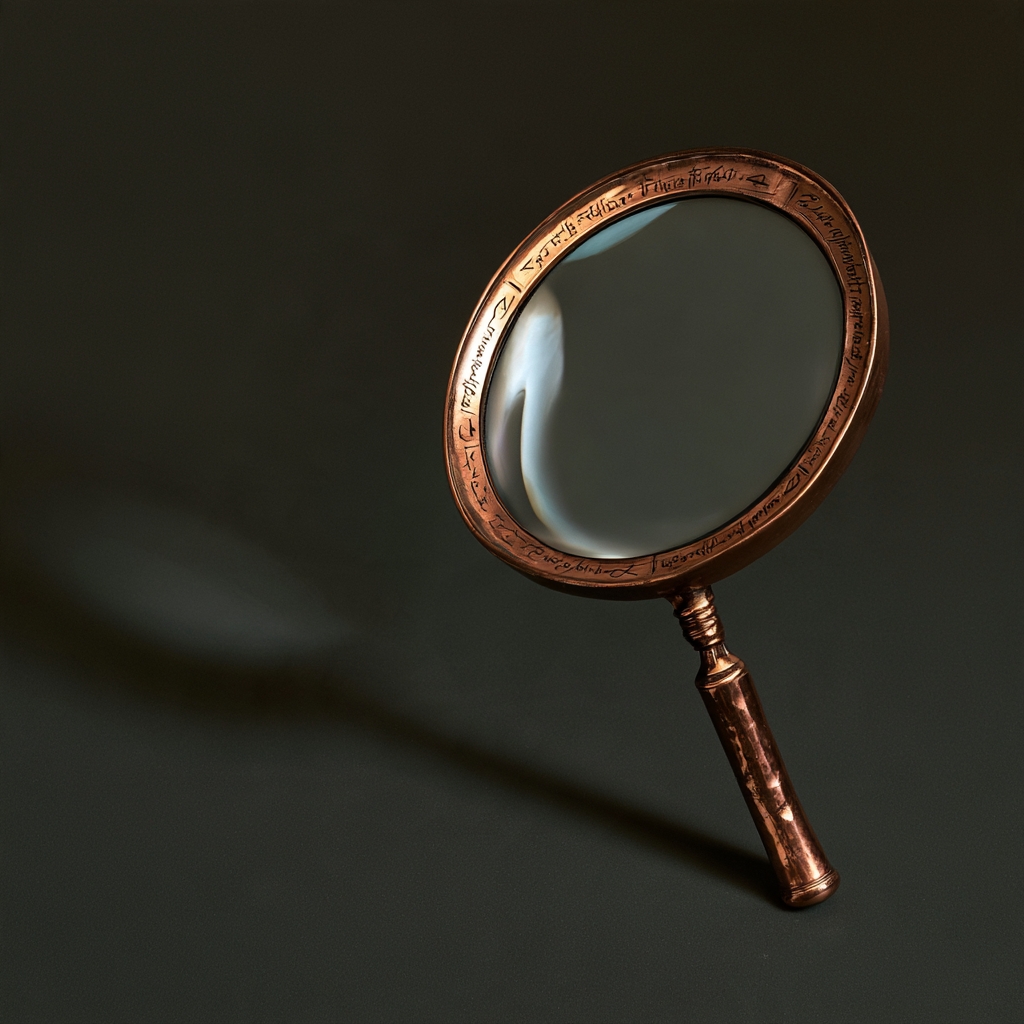
- Description: A disc of clear volcanic glass the width of a palm, ground smooth and set in a copper rim. A row of Sar-Wedge circles the rim, and a short handle of dark wood is wrapped in the red cord of the matriline. When held over an inscription, the wedges on the rim glow faintly copper.
- Abilities:
- Identify: The lens serves as the focus item for active use of the Mind’s Eye. The holder uses an action and concentrates for a few minutes to read deeper information about one object or inscription viewed through the glass.
- Reader’s Aid: While held, the holder gains 1 temporary skill point in Identification.
- Faded Wedge: Script that is worn, melted, or painted over shows through the lens as a faint copper outline, provided some trace of the original marks remains in the surface.
- Cooldown: After three uses of Identify in one day, the glass clouds and the ability does not function until the next Helios up.
- Suggested value: 50 silver
Lore
The Keepers of the Wedge hold that a house needs two kinds of scribe. One presses. The other reads what has been pressed and says whether it is true. The second office began with Sharrat-Ili, who lost the use of her writing hand in the kiln fire and was seated at the ninth bench as its reader. For two hundred years no tablet left that bench without passing under her eyes. The house came to depend on her, and when her sight began to dim in her last century, the bench-mothers faced the loss of the one thing they had gained from the fire.
The first reading lens was made for her. The lens grinders of Balawat tried rock crystal and found it cold and unhelpful. Then a courier brought up from the eastern lowlands a lump of glass as clear as water, picked from the ash beds at the edge of the crater where Zorath had stood. Ordinary volcanic glass is black. This was clear, and the grinders had no explanation for it. Firelords who examined it said that it had formed in the Ashenfall itself, when sand, ash, and whatever lay in the city’s archives were fused in a single hour. The grinders cut a disc from it, set it in copper, and gave it to the old reader.
She found that it did more than enlarge. Wedges that had been rubbed flat showed through it as thin copper lines. A tablet that had been scorched until its face ran still gave up its text. The house’s account is that glass born from the melting of writing remembers what writing looks like, and will show it wherever a trace remains. The house’s readers have used lenses cut from that same lump ever since. It has yielded forty-one, and the grinders say there is enough left for perhaps six more.
A row of Sar-Wedge circles each rim. It is the reader’s oath, the same on every lens, and it translates roughly as: “I read what is pressed, and not what I wished had been pressed.” A reader recites it once, aloud, when she first takes up the lens, and the house says the glass holds her to it. Readers who look for what they hope to find report that the lens shows them nothing useful and clouds early.
The clouding is common to all of them. After a few deep readings in a day, the glass turns milky and will not clear until Helios is next up. Readers call this the glass shutting its eye. They treat it as a mercy as much as a limit, since a reader who has looked hard at three things in one day is no longer fit to judge a fourth.
A lens belongs to the bench and passes from reader to reader. This one was last carried by an elderly reader named Geme-Tirash, who died in the winter before the spring flood. It lay unassigned in the bench-mother’s chest through the three years that Nin-Tuppi spent recopying the damaged quarry charters. Bench-Mother Belet-Nashira handed it to her when the last charter was fired, with the remark that anyone who had looked at three hundred and forty ruined tablets without once guessing at a missing wedge had already been keeping the oath.
It was through this lens that Nin-Tuppi first saw the second row beneath the first on the timber charter. She has sometimes wished that the glass were less honest.
Assigned Values
- Specific slot: Held in one hand (hung from a cord on the belt when not in use, which fills one of the belt’s four slots)
- Tier one stats:
- Perception: +1 while held
- Identify: 3 uses per day before the glass clouds
- Item health points: 8 plus the holder’s maximum health points
- Charges: 2, regaining 1 at each Helios up (separate from the uses of Identify)
- Skills gained while held:
- Identification: +1 temporary skill point
- Forgery Detection: +1 temporary skill point
- Appraisal (judging age, material, and workmanship): +1 temporary skill point
Passive Magics
- Reader’s Aid: While held, the holder gains the Identification point listed above.
- Faded Wedge: Script that is worn, melted, or painted over shows through the lens as a faint copper outline, provided some trace of the original marks remains in the surface.
- Fine Sight: Small details seen through the lens are enlarged and sharp. The holder has advantage on checks to examine tool marks, seal impressions, brushwork, and other fine features.
- Reader’s Oath: When the holder views an object or creature whose stats are shielded or false, the rim’s glow flickers. She has advantage on checks to notice that what the Mind’s Eye shows is not the whole truth. The lens does not by itself reveal what is hidden.
- Cooldown: After three uses of Identify in one day, the glass clouds and Identify does not function until the next Helios up.
Activatable Magics
- Identify (action and a few minutes of concentration, 1 use): The lens serves as the focus item for active use of the Mind’s Eye. The holder reads deeper information about one object or inscription viewed through the glass.
- Second Reading (action, 1 charge): Used on something the holder has already identified today and suspects of misdirection. She makes an Identification check against a difficulty set by the GM. On a success, she learns one true property that had been concealed or falsified.
- Maker’s Hand (action, 1 charge): The holder views a crafted object or inscription. She learns whether its naming tags, such as “originally made by” or “modified by,” are true or false, and she sees how many different hands have worked on it.
- Clear the Glass (action, 2 charges): The holder breathes on the lens and recites the oath on the rim. One spent use of Identify is restored. This cannot raise the uses above three.
Tags
Tool, Tier 1, Common, Reading Lens, Identification Focus, Volcanic Glass, Copper Rim, Mind’s Eye, Reader’s Oath, Tuppi-Sharrat, Balawat, Zorath Glass, Faded Script, Forgery Detection, Appraisal, Daily Limit, Clouding Glass, Red Cord Handle, Bench Property, Charged Item, Assyria, Renaissance
Obtaining, Buying, and Selling the Copper-Rim Reading Lens of the Archive 4382
How the item might be obtained
- Assigned by the bench: A reading lens cut from the clear glass of the Zorath ash beds belongs to a bench of the Tuppi-Sharrat matriline. The bench-mother assigns it to a scribe she judges fit to read, and it returns to the bench when that scribe dies or leaves.
- Newly ground: The lens grinders of Balawat hold the remainder of the original lump, enough for perhaps six more lenses. A new one is cut only at a bench-mother’s order.
- Quest reward: A bench-mother or vault keeper may lend a house lens to an outsider for the length of a task, such as examining a disputed charter or recovering scorched tablets. An outright gift is rare and would follow a major service.
- Possession of an avatar: A character who possesses a reader of the house acquires the lens she carries.
- Combat or salvage: A lens may be taken from a fallen reader or found in a looted archive chest. A house lens that surfaces outside Balawat is assumed stolen.
- Commission: A lens grinder and a rune cutter can make a reading lens from other clear glass or rock crystal. Such a lens serves as an identification focus. The GM may rule that only glass formed by great heat over writing carries the Faded Wedge property.
- Found at the source: Clear glass can still be picked from the ash beds at the edge of the Zorath crater by those willing to go there. The site is sacred, and taking from it without leave of the Firelords carries its own consequences.
- Purchase: Commissioned lenses and the occasional house lens reach the market through the shops below.
Shops where the item might be bought and sold
All prices are suggested amounts based on a value of 50 silver. Sellers set their own prices, and the amounts change with distance from Balawat and with what the buyer appears willing to pay.
- Lens grinder’s shop in Balawat:
- What it is: A family workshop of three benches near the archive hall, with grinding wheels turned by a small steam engine and trays of glass blanks under the window.
- Buying: A reading lens of ordinary clear glass, with the identification focus and no Faded Wedge, costs about 40 silver and takes five days. A lens of Zorath glass is not sold to the public. A member of the local guild pays about 36 silver for the ordinary kind. A plain magnifying glass with no magic costs about 5 silver.
- Selling: The shop pays about 20 to 24 silver for a sound commissioned lens. A house lens is recognized at once by its glass and its rim. The grinder will hold it and send for the bench-mother.
- How: Coin or World Bank transfer. Regrinding a scratched lens costs about 8 silver.
- Scribe and stationery supplier in the capital:
- What it is: A narrow family shop selling styluses, clay, wax tablets, seal blanks, and reading aids to clerks, students, and assessors.
- Buying: About 55 to 62 silver for a good reading lens, which includes the 3% tax on goods sold in the city. The owner lets a buyer test it on a worn seal kept under the counter for the purpose.
- Selling: About 25 to 30 silver. A lens that shows faded script is worth more, and the owner pays up to 45 silver for one with a clean history.
- How: World Bank transfer preferred.
- Assayer and appraiser’s office in Nimrod Quay:
- What it is: A small family office near the trade halls where goods are valued for merchants, tax assessors, and insurers. They buy and sell the tools of their own trade on the side.
- Buying: About 60 to 75 silver. Appraisers prize a focus that warns of false stats, and they price it as a working instrument.
- Selling: About 28 to 35 silver. They ask where the lens came from and write the answer down.
- How: World Bank transfer, with a signed receipt.
- Guildhall quartermaster in Balawat:
- What it is: The supply counter in the town’s guildhall, stocked with gear that members have turned in or traded.
- Buying: About 45 silver for a guild member and 50 silver for a non-member, when one is available. Identification focuses do not stay on the shelf long.
- Selling: About 30 silver. The quartermaster logs the seller’s name and checks the rim.
- How: World Bank transfer, with the 1% bank fee paid by the account holder.
- Black-market dealer in Nimrod Quay:
- What it is: A back room behind a wine merchant’s cellar, supplying forgers, smugglers, and those who need to know what they have stolen.
- Buying: About 70 silver to 1 gold for a commissioned lens. A house lens of Zorath glass runs 3 to 6 gold, since forgers want to see exactly what a reader of the house would see.
- Selling: About 25 silver for a commissioned lens and up to 3 gold for a house lens.
- How: Coin only, with no World Bank transfer and no record kept.
- Curio and import dealer on another island nation:
- What it is: A family shop in a foreign port selling Assyrian goods to collectors and scholars.
- Buying: About 80 silver to 1 gold and 5 silver. An identification focus is useful anywhere, and scholars of old inscriptions pay well for one that shows worn script.
- Selling: About 35 to 50 silver, depending on whether the dealer has tested what it can do.
- How: Local coinage or World Bank transfer. Assyrian citizens pay double the local taxes and fees as foreigners.
Roleplay of the Copper-Rim Reading Lens of the Archive 4382 in Defense and Offense
Archive vaults and libraries
- Defense:
- Nin-Tuppi views an unfamiliar tablet, seal, or box through the lens before she touches it. Identify tells her whether it carries a ward, a curse, or a rune set to discharge, and she leaves it alone or breaks it with the Quarry Mallet accordingly.
- Reader’s Oath warns her when an item’s stats are shielded or false. The flicker on the rim is her signal to stop and think before she trusts what she has read.
- She counts her uses. After the second Identify of a day she keeps the third in reserve unless the need is plain.
- Offense:
- The lens is how she fights in an archive. Faded Wedge and Maker’s Hand let her prove that a record has been altered and how many hands have been at it. She names what she sees in front of a keeper or bench-mother.
- Identify on an intruder’s dropped gear tells her what they can do and who equipped them.
- A gain from the Mind’s Eye stays in memory, so anything she has read once she can recall later in a library, with advantage on research into it.
Courts, guildhalls, and markets
- Defense:
- She examines goods, contracts, and coin offered to her before she accepts them. Fine Sight shows a recut seal or a shaved coin, and Maker’s Hand shows whether an item’s “originally made by” tag is true.
- Inside a walled town, a somewhat safe area, her Armor Check is doubled, and her real danger is being cheated. The lens answers that.
- Offense:
- In a dispute she offers the lens to the magistrate and asks them to look for themselves. A false tag or a painted-over line seen by the judge’s own eye carries more weight than her word.
- Second Reading is her sharpest tool against a seller or diplomat who relies on misdirection. She uses it sparingly, since it costs a charge and may fail.
Before and during combat
- Defense:
- Identify takes an action and a few minutes of concentration, so it is done before a fight and seldom during one. Given time, she reads a foe’s visible gear from cover and tells her party what to expect.
- In the fight itself she lets the lens hang on its cord. It has 8 resilience and is the easiest of her tools to break. A targeted hit unattunes it.
- Offense:
- Knowing a foe’s weakness, the charges left in their items, or which worn piece carries their protection lets her party choose targets. She calls out the item to strike.
- If she has learned a true name through long study and the right skills, the lens is part of how she confirmed it. She treats that knowledge with care.
Ruins, quarries, and the road
- Defense:
- Faded Wedge reads weathered boundary stones, worn warnings over tomb doors, and scorched signboards. She has turned back from more than one passage because of what an old inscription said.
- Fine Sight shows tool marks and fresh scratches around a trap or a hidden door.
- Offense:
- Reading a ruin’s inscriptions tells her what a place was for and what may still be active in it, which lets her party use the site against those who follow them in.
- Maker’s Hand on a bandit’s stolen goods tells her whose they were, which gives her a claim to bring before a guild or lodge.
Forge halls and workshops
- Defense:
- She identifies a device or a rune-cut tool before she agrees to work on it, to learn whether an earlier crafter left a flaw or a trap in it.
- Heat does not trouble glass that was formed in a far greater fire.
- Offense:
- Identify on an enemy’s steam device or construct, done from a safe distance beforehand, shows her its properties and its item health points.
Darkness, smoke, rain, and ash
- Defense:
- The lens needs light and a clear line of sight to the thing viewed. In darkness she holds the Decree Tablet beside it for its glow. In smoke, heavy rain, or her own Ember Shed it is of no use, and she puts it away.
- Offense:
- None in these conditions.
Low-magic and dangerous places
- Defense:
- The copper outlines of Faded Wedge are fainter, and the GM may rule that the glass clouds after fewer uses. Charges return slowly. In an unsafe or deathly area she reads what she must and keeps the lens under her robe.
- Offense:
- Identify still tells her whether a place’s danger comes from an item or mechanism that could be broken or avoided.
Social encounters
- Defense:
- Raising the lens to look at someone’s badge, seal, or gift is understood in Assyria as a polite statement that she will not be taking it on trust.
- If overwhelmed by too many objects or complex concepts at once, the Mind’s Eye can fail her for a time. She limits herself to one thing at a time for that reason.
- Offense:
- Reciting the oath on the rim, “I read what is pressed, and not what I wished had been pressed,” before examining a rival’s document is a challenge. It tells everyone present that she expects to find something.
Perception of Activation:
User’s Perspective
- Sight: Through the glass the object grows sharp and near while everything around it softens. The holder sees copper lines where old script once lay, and the rows of the Mind’s Eye seem to settle into the lens beside what she is reading. When the stats are false, a thin haze drifts across part of the glass.
- Sound: The room seems to quiet as she concentrates. She hears her own breathing and, faintly, a sound like a fingertip drawn around the rim of a cup as the glow circles. When the glass clouds there is a soft tick, like a shutter closing.
- Touch: The copper rim warms under her fingers and the red cord on the handle feels slightly tighter. During Identify the lens grows heavier in her hand, as if what it shows had weight. Clear the Glass leaves it cool and damp for a moment.
- Smell: Clean glass and warm copper, with a very faint trace of old ash that she notices only when the lens is close to her face.
- Taste: None, apart from a mineral note when a charge is spent.
- Extra-sensory perceptions:
- Mind’s Eye: The deeper stats arrive in order and stay. She knows they are committed to memory and that she will be able to recall them exactly. She also knows how many uses and charges remain.
- Aetheric Scrutiny: She tastes the object’s magic more distinctly through the lens, layer by layer. A shielded item tastes smooth and blank where it should have flavor.
- Truth sense: Reader’s Oath comes to her as unease, the feeling a scribe has when a row scans correctly and still reads wrong.
- Hand sense: During Maker’s Hand she perceives each maker’s work as a different pressure of stylus or chisel, some heavy, some light, some hurried.
- Library sense: After an Identify she has an inkling of whether the nearest archive holds more on what she has just read.
- Strain: By the third reading of a day she feels the effort behind her eyes, and the glass’s wish to close matches her own.
Observer’s Perspective
- Sight: An observer sees a scribe holding a clear lens over an object and going very still for several minutes. The script on the copper rim glows, and the glow moves once around the circle. They do not see the copper lines or the rows of stats, only clear glass. At the end of a long day they may see the glass turn milky.
- Sound: Nothing beyond her breathing, and perhaps a quiet word if she recites the oath.
- Touch: None.
- Smell: None at a distance.
- Taste: None.
- Extra-sensory perceptions:
- True sight: The lens gives off a clear, steady ultraviolet light during Identify, directed at the object like a narrow beam. The viewed object’s own magical glow brightens while it is being read.
- Aetheric Scrutiny (other Akkad-Kuri): Nearby Akkad-Kuri taste a thin, exact line of magic passing between the lens and the object and know that something is being identified.
- Mind’s Eye: An observer who examines the lens sees its name and that it belongs to the ninth bench. A creature or the owner of an item being identified may sense that it is under scrutiny, at the GM’s discretion.
- Soul sight: The holder’s outline seems to narrow and lean toward the thing she is reading.
- Tremorsense and blind sight: These senses perceive nothing of the lens at work.
Positives
- What is learned through Identify is kept exactly and can be recalled at any time.
- The lens is nearly silent and gives little outward sign beyond a glowing rim and a still scribe.
- The copper lines and stat rows are visible to the holder alone, so others cannot read over her shoulder.
- The truth sense warns her before she relies on false information.
- The hand sense and the library sense give her leads for further research.
- The clouding of the glass tells her plainly when she has reached her limit for the day.
Negatives
- Identify takes minutes of concentration, during which she is unaware of much around her and easy to approach.
- The glowing rim and her stillness show any watcher that she is identifying something, and those with true sight or Aetheric Scrutiny can tell what.
- A sentient subject may sense the scrutiny and take offense or alarm.
- Viewing too many items or complex concepts in one sitting can overwhelm the Mind’s Eye and leave her briefly unable to use it.
- Reader’s Oath tells her that something is false without telling her what, which can be more troubling than ignorance.
- The strain behind the eyes builds through the day, and after the third reading she is tired and short-tempered.
- She cannot unsee what the lens has shown her, and some of it she would have preferred not to know.
Recipe: Reading Lens in the Manner of the Balawat Archive
Materials Needed
- Glass:
- 1 lump of clear volcanic glass about the size of a fist, free of bubbles and veins
- Glass formed where great heat has passed over writing, such as the clear nodules from the ash beds of the Zorath crater, is needed for the Faded Wedge property. Other clear glass or rock crystal will yield a working identification focus without it.
- Rim and handle:
- 2 ounces of copper strip for the rim
- 1 short length of dark hardwood for the handle
- 1 yard of red waxed cord
- 2 small copper rivets
- Grinding and polishing:
- Coarse, medium, and fine grinding sand
- 1 measure of jeweler’s rouge or fine polishing ash
- Clean water
- Pitch for holding the blank
- Magical components:
- 3 tier 1 magic crystals, each about the size of a coin, ground to powder as the catalyst for the three daily uses of Identify
- 2 further tier 1 magic crystals, left whole and very small, for the two charges
- 1 pinch of dust from a tablet whose text is known to be true and unaltered
- 1 drop of tree sap drawn with a fluid collector, to bed the glass in its rim
- Carrying:
- 1 belt cord and a soft cloth pouch
Tools Required
- A glass saw or scoring tool
- A grinding wheel, or a set of curved iron grinding dishes
- A pitch block and a small brazier to warm it
- A polishing lap of felt or leather
- A jeweler’s hammer, snips, and a small anvil for the rim
- A graver for cutting the oath on the rim
- A drill and knife for shaping the handle
- A lamp and a sheet of ruled lines for testing the lens
- A second, already working identification focus for checking the finished work through the Mind’s Eye
Skill Requirements
- Lens Grinding (or Glasswork, at the GM’s discretion): 4 or higher
- Rune Cutting: 3 or higher, for the oath on the rim
- Metalworking: 2 or higher, for the rim
- Identification: 2 or higher, since the crafter must be able to judge whether the lens reads truly
- Two crafters may share the work, provided each required skill is met by the one performing that step.
- Time: About 5 days of downtime.
- Knowledge: The crafter must know the reader’s oath or compose one of the same meaning: that the reader will see what is there and not what is wished for.
Crafting Steps
- Cut the blank:
- Saw or score a disc the width of a palm and the thickness of a finger from the clearest part of the lump. Hold it to the lamp and reject it if any bubble or vein shows.
- Mount and rough grind:
- Warm the pitch block and fix the blank to it. Grind both faces to a gentle outward curve with coarse sand and water, turning the blank often so the curve stays even.
- Fine grind:
- Repeat with medium and then fine sand until the surface is an even frosted grey with no scratch visible to the eye.
- Polish:
- Mix the three ground crystals into the polishing rouge. Polish both faces on the lap until the glass is clear. This takes most of two days. The crystal powder is worked into the surface as it is polished.
- Test the glass:
- Hold the lens over the ruled sheet. The lines must appear straight and evenly enlarged from center to edge. If they bow, return to the fine grind.
- Form the rim:
- Hammer the copper strip into a channel and bend it to fit the edge of the lens. Set one small whole crystal into the rim on each side of where the handle will join.
- Cut the oath:
- Before closing the rim, cut the reader’s oath around its outer face in a single row of Sar-Wedge with the graver. Make three of the wedges, evenly spaced, slightly deeper than the rest.
- Seat the lens:
- Dust the inside of the channel with the powder of the true tablet. Touch a drop of sap to the edge of the glass, fit the rim around it, and close the joint with a rivet.
- Fit the handle:
- Shape the hardwood to a short handle, slot it to take the rim’s tang, and fix it with the second rivet. Wrap it tightly in red cord.
- Take the oath:
- As a ritual of at least 10 minutes, the one who will carry the lens recites the oath aloud once and then reads three things through it in turn: a text she knows to be true, a text she knows to be false, and a text she has never seen. She says aloud only what she sees. The rim begins to glow if the work is sound.
- Roll for the result:
- The crafter rolls a d20. On a 1 a flaw opens through the glass at the first reading, the crystals shatter into shards, and the materials are lost. On a 20 the lens gains one extra capability chosen by the GM, such as a fourth daily use of Identify. Any other result produces a working lens.
- Check and hang:
- Examine the lens with the second identification focus to confirm its abilities. Hang it from the belt cord in its cloth pouch.
Old Eye and Glass That Would Not Flatter
This is told among those of the house who do not press but read. It is from the old mountain speech, which no one has now. It was put into the temple-writing by a healer of eyes, who was asked because the matter concerned a lens, and who says at the outset: “I know how glass bends light. I do not know how it could bend a conscience. I set down what I was told and I hold no opinion.” His remarks are left in where he could not keep to that.
You have heard of Sharrat-Ili, who put her hand in the kiln for the Queen’s tablets, and was made the first reader, and wore the robe that was fired twice. This is of her age, not her youth. She had sat at the ninth bench two hundred and thirty winters as its eye. In all that time, the telling says, “no crooked wedge had gone out past her,” and the house had grown great on it, for a decree that bore the mark of the ninth bench was known in every court to be exactly what the Queen had said.
And she was proud of this. The telling does not hide it. She had lost the pride of her hand, and she had grown another in its place, and the second was larger. She would say to the young ones, “I have never once been wrong,” and it was true as far as anyone knew.
Now in her two hundred and ninetieth year her eyes began to go. First the small wedges swam. Then she held the tablets nearer, and then farther. The healer who translates writes here with some heat: “This is the common thickening of the eye’s own lens in age. It is no mystery and no judgment. I wish that to be understood.” Mystery or not, the house was afraid. A bench-mother can be replaced, and a presser, but the Eye of the Ninth had no second.
The grinders of the lower street were sent for. They cut her a glass of rock crystal, the best they had. She looked through it and said, “It makes things larger. It does not make them clearer. I can see a big blur now where I saw a small one.” They cut another, and a third. She was polite, and then she was not.
In that season a carrier of the house came up from the eastern lowlands, from the country of the burned city, Zorath, which the god’s fire took in the old time. She had crossed the ash beds at the crater’s lip, where nothing grows, and kicked up a stone that was not a stone. It was glass. But the glass of the fire-mountains is black, as all know, and this was clear as a spring, with only a faint warmth in it, as of a thing that had once been very hot and had not quite forgotten. She carried it up in her satchel for no reason she could give.
The Firelords looked at it and were uneasy. They said: “This was made in the hour of the Ashenfall. There was a hall of records in Zorath, and a hall of the proud. Sand and ash and whatever was written there were melted together. We do not know what it is.” And the eldest grinder turned it in the light and said, “I know what it is. It is the clearest thing I have ever held. Let me cut it.”
He cut a disc as wide as a palm, and rimmed it in copper, and they brought it to the old reader.
She held it over a tablet on her bench. And the telling says she made a sound, and put her closed hand to her mouth. For it did more than enlarge. Every wedge stood up sharp as on the day it was pressed. And more: on that tablet, which was an old one, there had been a correction, a place rubbed smooth and pressed again by some long-dead scribe, and through the glass the rubbed-out wedges showed beneath the new ones as thin lines the color of the rim. She could see what had been there before.
“It remembers writing,” she said. And the house rejoiced, and the Eye of the Ninth read on.
Here the telling turns to the matter of the nine.
You know the count that the bench recites: of the two hundred tablets on the rack, one hundred and forty were saved from the kiln, and nine of those were of Sharrat-Ili’s own pressing, and the nine were perfect. Those nine she had reached for last and deepest, and for those nine, in truth, she had given her hand. They were the Queen’s decrees for the cutting of stone in the southern high-lands. They had been fired, and sealed, and sent out, and for two hundred and thirty years they had been the law of the quarries. And the bench had kept its own copies in the vault, as it keeps all.
In the first month of the new glass, she had those nine brought up to her. No one had asked her to. She said it was to try the lens on good work. The readers who tell this say otherwise. They say: “She was old, and she wished to look once more, clearly, at the thing she had paid for.”
She laid the first under the glass, and it was perfect, row on row, and she smiled. The second, perfect. So to the sixth. At the seventh she stopped.
In the fourth row of the seventh tablet, where the decree set the boundary of the east quarry by a count of paces from a standing stone, there was a wedge. It was a small one. To the bare eye it was a clean wedge like its neighbors. Through the glass she saw that its lower edge had run. The heat of that night, the kiln’s breath on the soft clay before she pulled it clear, had softened that one stroke and let it sag, and in sagging it had closed up, so that a number-sign of three strokes read as a number-sign of two.
The healer writes: “I examined such a tablet. This is possible. Clay will slump so.”
Her own hand had pressed it truly. The fire had changed it. And she herself, in her first year as reader, with young eyes and no glass, had read that tablet through and passed it, because it was one of the nine, and the nine were perfect, and she had not looked at them as she looked at the work of others.
Now see what she did, for the telling is unsparing here.
She looked again. She told herself the glass was new and strange. She turned the tablet to the lamp, and looked, hoping. And the copper lines in the glass grew faint. She looked a third time, harder, willing the wedge to stand up whole, and the glass went white as milk from the center outward, and showed her nothing at all.
She thought it was broken. She sent for the grinder in a fury. He came, and held it up, and it was cloudy, and he could not tell her why. He took it home. In the morning it was clear as before, and he brought it back, and said, “I have done nothing to it.”
She sat with it in her lap a long while. Then she did a thing she had not done in two hundred and thirty years. She called a junior from the next bench, a girl of no standing, and said: “Bring me a tablet from your own work. Any one.” And she read the girl’s tablet through the glass, coldly, as she read all strangers’ work, wanting nothing from it. The glass was clear, and showed every stroke.
Then she drew the seventh of the nine toward her, and she said aloud, to herself or to the glass, “This is some scribe’s tablet. I do not know her. I owe her nothing.” And she looked.
The glass stayed clear. Three strokes, slumped to two. It had always been so.
Hear what one wedge had done. The boundary of the east quarry had stood, by that decree, some forty paces short of where the Queen had set it. And on that strip of forty paces a family of stone-cutters had worked for two hundred and thirty years, and had paid rent for it to the wrong holder, generation upon generation, because a tablet of the ninth bench said so, and a tablet of the ninth bench was never wrong.
Sharrat-Ili went to the bench-mother. She laid the tablet and the glass on the bench between them, and said: “Look at the fourth row. Do not hope while you look, or it will not show you.”
The bench-mother looked. She was silent. Then she said, slowly: “If this is told, the house must make it good. Two hundred years of rent. And worse than the silver: it will be said that the ninth bench has erred, and that its Eye passed the error. Every decree you have read will be looked at again. You are old. It was the fire, and not your hand. The glass is ours, and no other bench has one. No one else can ever see this.”
The telling says the old reader was quiet for a time. The healer adds: “My teller wept here. I record it.”
And Sharrat-Ili said: “For two hundred years I have said, I have never been wrong. I see now what I meant. I meant that no one had caught me. I gave my hand for nine perfect tablets. There were eight. I will not give the other hand to keep the count.” And then she said the words that are on every rim: “I read what is pressed, and not what I wished had been pressed.”
So it was told. The house paid, and it was a heavy year. The strip was restored to the cutters’ family. And every decree she had ever passed was offered up to be read again by any who wished, and for a season the courts murmured.
Then a strange thing came of it, which the bench-mother had not foreseen. When the murmuring ended, the word of the ninth bench stood higher than before. For the courts said: “This is the house that searched its own vault and struck its own tablet and paid for an error two hundred years old that no one living could have found. What they send us now, we need not check.”
Sharrat-Ili had the oath cut around the copper with her own name left off it. She read with the glass for the years that remained to her, and it is said she never again told the young ones that she had never been wrong. She told them: “The glass will show you a stranger’s faults all day. It goes blind the moment you love what is under it. So make everything a stranger’s.”
The healer ends his copy with this, and I leave it: “In the other telling of this woman they still say the nine were perfect. I asked my teller why the house does not mend it. She said that telling was already on the road before the glass was cut, and a telling is not a tablet, and cannot be struck. I find this unsatisfactory. I have written ‘eight’ in my own margin.”
The moral of the story is that the eye sees least clearly what it has paid most dearly for, and that the one who reads must want nothing from the reading. The readers add: an error owned raises a house higher than a record never questioned.
Suggested conversions to other systems:
Call of Cthulhu (7th Edition)
The Reader’s Unflattering Glass
- Type: Enchanted instrument (artifact)
- Origin: A palm-wide disc of clear volcanic glass set in a copper rim, with a short handle of dark wood wrapped in red cord, from the ninth copying bench of Balawat in Assyria on the world of Saṃsāra. A row of wedge-script circles the rim.
- Durability: 4 hit points. If broken, it cannot be repaired by any ordinary means.
- Bonding: The holder recites the oath on the rim aloud, then reads one text she knows to be true and one she knows to be false, and makes a POW roll. On a success the lens is bonded and its powers can be used.
- Passive effects while bonded and held:
- Bonus die on Spot Hidden rolls to examine fine detail, and on Appraise rolls.
- Bonus die on Archaeology, History, or Language rolls to read inscriptions that are worn, melted, defaced, or painted over, provided some trace remains. Such writing shows through the glass as fine copper lines.
- When the holder views an object that is disguised or made to seem other than it is by unnatural means, the rim’s glow falters. She knows something is false and does not know what.
- Powers (the lens draws on the holder’s magic points):
- Identify: Cost 2 magic points and 1D6 minutes of unbroken concentration. The Keeper tells the holder whether the object viewed is enchanted, its general purpose, and what it costs to use. After three uses in one day the glass clouds until the next dawn.
- Second Reading: Cost 3 magic points. Used on an object already identified that day and suspected of concealment. The holder makes an opposed POW roll against the POW of whoever laid the concealment, or a Hard POW roll if that is unknown. On a success, one hidden property is revealed.
- Maker’s Hand: Cost 2 magic points. The holder learns how many different hands have worked on an object or document, and whether any signature, seal, or maker’s mark on it is genuine.
- Clear the Glass: Cost 4 magic points. One spent use of Identify is restored.
- Sanity:
- First bonding: 0/1 Sanity points, as the holder understands that the glass will show her what she would prefer not to see.
- Using Identify on an object of the Mythos: Sanity loss as for a brief study of that object, minimum 1/1D4. The Keeper may award 1 point of Cthulhu Mythos.
- The lens clouds at once if the holder looks through it hoping for a particular answer. No Sanity loss, and that use of Identify is spent.
- Investigation:
- A Science (Geology) roll finds that the glass is of volcanic origin and far clearer than any natural example.
- An Occult roll recognizes the oath on the rim as a seer’s vow of disinterest.
- Cthulhu Mythos: None gained from the lens itself.
Blades in the Dark (current edition)
The Honest Loupe
- Type: Fine arcane instrument (unique item)
- Load: 1
- Quality: 2
- Origin: A palm-wide lens of clear volcanic glass in a copper rim, with a red-corded handle, from the ninth copying bench of Balawat in Assyria on the world of Saṃsāra.
- Features:
- Fine Sight: When you Study a document, seal, object, or inscription through the lens, gain +1 effect.
- Faded Wedge: Writing that has been worn away, burned, scraped, or painted over shows through the glass wherever any trace remains. You can read it as if it were fresh.
- Deep Reading: Three times per score, when you gather information about an arcane object, relic, or device by examining it through the lens, ask one extra question and the GM answers it truthfully. After the third, the glass clouds until the score is over.
- Reader’s Oath: When something you examine has been disguised, forged, or glamoured, the rim falters and you know it is not what it seems. To learn what it truly is, take 1 stress and make a Study or Attune roll.
- Maker’s Hand: When you examine a made thing, you may ask how many hands worked on it and whether its marks of authorship are genuine.
- Drawbacks:
- Slow: A deep reading takes several quiet minutes. It cannot be done in the middle of a fight or a chase.
- Fragile: When you suffer physical harm of level 2 or worse, the GM may rule that the lens is cracked. A cracked lens cannot be mended, only replaced.
- Unflattering: If you examine something hoping for a particular answer, the lens clouds and that reading is wasted.
- Crafting a copy: Invent the formula as a long-term project, then Tinker during downtime. Arcane, minimum quality 2, with the Slow drawback. The glass must have been formed by fire in a place where a great deal of writing burned.
Dungeons & Dragons (2024 rules)
Lens of the Reader’s Oath
- Wondrous Item, Uncommon (Requires Attunement)
- Weight: 1/2 lb.
- Description: This palm-wide disc of clear volcanic glass is set in a copper rim and fitted with a short handle of dark wood wrapped in red cord. It comes from the ninth copying bench of Balawat in Assyria, on the world of Saṃsāra, and a row of wedge script circles the rim. The lens is a Tiny object with AC 13 and 8 Hit Points.
- Fine Sight: While you look through the lens, you have Advantage on Intelligence (Investigation) checks made to appraise an object, examine fine detail, or detect a forgery.
- Faded Wedge: Through the lens you can read writing that has been worn away, burned, scraped off, or painted over, provided some trace of it remains on the surface.
- Reader’s Oath: When you view an object through the lens that is under an illusion or a spell that masks its magical properties, such as Nystul’s Magic Aura, you know that its appearance is false. You don’t learn its true properties.
- Charges: The lens has 3 charges and regains all expended charges daily at dawn. When the last charge is expended, the glass turns cloudy and its Fine Sight and Faded Wedge properties don’t function until dawn.
- Identify (1 charge): You cast Identify using the lens as the focus, with no Material components. The casting time is 1 minute.
- Maker’s Hand (1 charge): As a Magic action, you view one crafted object or document. You learn how many creatures had a hand in making or altering it and whether any signature, seal, or maker’s mark on it is genuine.
- Second Reading (2 charges): As a Magic action, you view an object you know to be falsely presented. Make a DC 15 Intelligence (Arcana) check. On a success, you learn one property that the illusion or masking spell was concealing.
Knave (Second Edition)
Copper-Rimmed Truth Glass
- Type: Relic, held in one hand
- Slots: 1
- Value: Seldom for sale. Copies fetch whatever a buyer will pay.
- Description: A palm-wide lens of clear volcanic glass in a copper rim, with a red-corded handle, from Balawat in Assyria on the world of Saṃsāra. A row of wedge-script circles the rim.
- Always in effect while held:
- Checks to examine fine detail, appraise goods, or spot a forgery are made with advantage (+5).
- Writing that has been worn away, burned, or painted over can be read through the glass if any trace remains.
- When the thing viewed is disguised or glamoured, the rim falters. The holder knows it is false and does not know how.
- Deep Reading: Three times per day, spend a turn (10 minutes) studying one object through the glass. The GM tells the holder what the object is, what it does, and how it is used. After the third reading the glass clouds and nothing above works until the next morning.
- Charges: 2. One charge returns each morning.
- Maker’s Hand (1 charge): Learn how many hands made or altered an object and whether its maker’s marks are genuine.
- Second Reading (1 charge): Make an INT check against a difficulty set by the GM to see through a disguise or glamour on an object and learn one thing it was hiding.
- Clear the Glass (2 charges): Restore one spent Deep Reading.
- Limit: The lens is fragile. If the holder takes a wound that fills this item’s slot, it cracks. A cracked lens cannot be mended.
Fate (Fate Condensed)
The Glass That Would Not Flatter
- Type: Extra (reading instrument)
- Origin: A palm-wide disc of clear volcanic glass set in a copper rim, with a short handle of dark wood wrapped in red cord, from the ninth copying bench of Balawat in Assyria on the world of Saṃsāra. A row of wedge-script circles the rim.
- Permission: A character aspect showing training as a reader, appraiser, or scholar of inscriptions, and the reciting of the oath on the rim.
- Cost: 2 refresh
- Item aspect: A Lens Sworn to Read What Is Pressed
- Invoke: To see fine detail, to read what time or fire has erased, or to know that something is other than it appears.
- Compel: A deep reading takes quiet minutes, the glass is fragile, it clouds when used too often, and it shows nothing to one who looks hoping for a particular answer.
- Stunts granted while held:
- Fine Sight: +2 to Investigate when examining a document, seal, object, or inscription closely through the lens.
- Faded Wedge: You can read writing that has been worn away, burned, or painted over wherever any trace remains. When this reveals something hidden, create an advantage with Investigate without rolling and place one aspect with a free invoke.
- Deep Reading: Three times per session, after a few minutes of study, ask the GM what an object is, what it does, and how it is used. The GM answers truthfully. After the third, the glass clouds for the rest of the session and its stunts cannot be used.
- Reader’s Oath: When something you examine through the lens has been disguised, forged, or glamoured, the GM tells you it is false. Once per scene you may then roll Investigate or Lore against the opposition that hid it, at +2, to learn one true thing about it.
Numenera and Cypher System (Numenera Discovery and the Cypher System Rulebook)
Lens of the Unwished Truth
- Type: Artifact
- Level: 1d6
- Form: A palm-wide disc of clear volcanic glass in a copper rim, with a short handle wrapped in red cord, from Balawat in Assyria on the world of Saṃsāra. A row of wedge-shaped characters circles the rim.
- Effect:
- The holder has an asset on tasks to examine fine detail, appraise objects, and detect forgery while looking through the lens.
- Writing or markings that have been worn away, melted, or covered over can be read through the lens wherever any trace remains.
- When the holder views something that has been disguised or made to appear other than it is, the rim falters. The holder knows it is false and does not learn how.
- Deep Reading (action, then several minutes of study): The holder learns what one viewed object is, what it does, and how it is used. For a cypher or artifact, this identifies it fully with no roll if its level is equal to or lower than this artifact’s level, and eases the identification task by two steps otherwise. This can be done three times per day, after which the glass clouds and all effects cease until the next dawn. No depletion roll is needed.
- Second Reading (action): Used on something already examined today and known to be false. The holder attempts an Intellect task against the level of the concealment, eased by one step. On a success, one hidden property is revealed. Roll for depletion.
- Maker’s Hand (action): The holder learns how many hands made or altered an object and whether its marks of authorship are genuine. Roll for depletion.
- Fragility: The lens is treated as an object two levels lower than the artifact level for the purpose of being damaged. A cracked lens cannot be repaired.
- Depletion: 1 in 1d20. A depleted lens remains an ordinary magnifying glass.
Pathfinder (Second Edition, Remaster)
Oathbound Reader’s Lens — Item 4
- Traits: Magical
- Price: 90 gp
- Usage: held in 1 hand
- Bulk: L
- Description: This palm-wide disc of clear volcanic glass is set in a copper rim and fitted with a short handle of dark wood wrapped in red cord. It comes from the ninth copying bench of Balawat in Assyria, on the world of Saṃsāra, and a row of wedge script circles the rim. While you look through it, you gain a +1 item bonus to checks to Identify Magic on items, to Decipher Writing, and to Perception or Society checks to detect a forgery. Through the lens you can read writing that has been worn away, burned, scraped off, or painted over, provided some trace of it remains. When you view an item that is under an illusion or an effect that masks its magical aura, you know its appearance is false, though you don’t learn its true nature. The lens has Hardness 3, 8 Hit Points, and a Broken Threshold of 4. While broken, it grants no benefits.
- Activate—Deep Reading 1 minute (concentrate, manipulate)
- Frequency: three times per day
- Effect: You attempt to Identify Magic on one item you view through the lens, taking 1 minute in place of the usual 10 minutes. If you fail, you can try again on that item without waiting a day. After the third use in a day, the glass clouds and the lens grants no benefits until your next daily preparations.
- Activate—Maker’s Hand [two-actions] (concentrate, manipulate)
- Frequency: once per day
- Effect: You view one crafted item or document. You learn how many creatures had a hand in making or altering it and whether any signature, seal, or maker’s mark on it is genuine.
- Activate—Second Reading [two-actions] (concentrate, manipulate)
- Frequency: once per day
- Effect: You view an item you know to be falsely presented. Attempt an Arcana, Occultism, or Perception check against the DC of the effect concealing it. On a success, you learn one property that was being concealed.
Savage Worlds (Adventure Edition)
The Bench-Reader’s Clear Eye
- Type: Arcane device
- Weight: 0.5
- Toughness: 4. If the lens takes damage equal to or greater than its Toughness, it cracks and cannot be repaired.
- Cost: Seldom for sale. Copies sell for whatever the market bears.
- Description: A palm-wide lens of clear volcanic glass in a copper rim, with a red-corded handle, from Balawat in Assyria on the world of Saṃsāra. A row of wedge-script circles the rim.
- Passive effects while held:
- +2 to Notice rolls to examine fine detail, appraise goods, or spot a forgery.
- +2 to Research or Academics rolls to read inscriptions that are worn, melted, or painted over. Such writing shows through the glass wherever any trace remains.
- When the thing viewed is disguised or altered by arcane means, the rim falters. The holder knows it is false and does not know how.
- Deep Reading (no cost, several minutes, three times per day): The holder studies one object through the glass. The GM tells her what it is, what it does, and how it is used, including the powers and Power Points of an arcane device. After the third reading the glass clouds and nothing above functions until the next dawn.
- Power Points: 4. The lens regains 2 Power Points each dawn and cannot be recharged by other means.
- Activation: The holder spends the Power Points listed.
- Maker’s Hand (2 Power Points, action): The holder learns how many hands made or altered an object and whether its maker’s marks are genuine.
- Second Reading (2 Power Points, action): Used on something known to be false. The holder makes a Smarts roll, opposed by the arcane skill of whoever concealed it, or at −2 if that is unknown. On a success she learns one thing that was hidden.
- Clear the Glass (4 Power Points, action): One spent Deep Reading is restored.
Shadowrun (Sixth World Edition)
Oath-Rim Reading Lens Focus
- Type: Bonded enchanted item (detection focus)
- Force: 2
- Bonding cost: 4 Karma
- Availability: 5(L)
- Cost: 9,000¥ for a copy. The original is seldom for sale.
- Structure: 2. If the lens takes 2 or more boxes of damage, it cracks and cannot be repaired.
- Description: A palm-wide disc of clear volcanic glass in a copper rim, with a short handle of dark wood wrapped in red cord, from the ninth copying bench of Balawat in Assyria on the world of Saṃsāra. A row of wedge-script circles the rim. It contains no electronics and has no wireless bonus.
- Passive effects while bonded and held:
- +2 dice on Perception tests to examine fine physical detail, appraise goods, or spot a forgery.
- Writing or markings that have been worn away, burned, or painted over can be read through the glass wherever any trace remains.
- +1 die on Assensing tests made on objects viewed through the lens. A holder who is not Awakened may still use the powers below.
- When the object viewed is masked, glamoured, or otherwise disguised by magic, the rim falters. The holder knows it is false and does not learn how.
- Deep Reading (no charge, several minutes of concentration, three times per day): The holder studies one object through the glass. She learns whether it is magical, its type, its Force, and its general function, as if she had scored 3 hits on an Assensing test. After the third reading the glass clouds and the lens is inert until the next sunrise.
- Charges: 2. One charge returns at each sunrise.
- Maker’s Hand (1 charge, Major Action): The holder learns how many individuals made or altered an object and whether its maker’s marks or astral signatures are genuine.
- Second Reading (1 charge, Major Action): Used on an object known to be masked. The holder rolls Force × 2 + Astral (if any) dice against the Force of the masking effect. On a success she learns one property that was concealed.
- Clear the Glass (2 charges, Major Action): One spent Deep Reading is restored.
- Astral signature: Each Deep Reading leaves a faint signature on the object examined that lasts for Force hours.
Starfinder (Second Edition)
Wedge-Rim Archivist’s Loupe — Item 4
- Traits: Analog, Magical
- Price: 900 credits
- Usage: held in 1 hand
- Bulk: L
- Description: This palm-wide disc of clear volcanic glass is set in a copper rim and fitted with a short handle of dark wood wrapped in red cord. It comes from the ninth copying bench of Balawat in Assyria, on the world of Saṃsāra, and a row of wedge script circles the rim. While you look through it, you gain a +1 item bonus to checks to Identify Magic on items, to Decipher Writing, and to Perception or Society checks to detect a forgery. Through the loupe you can read writing or markings that have been worn away, burned, scraped off, or painted over, provided some trace remains. It does not recover deleted or corrupted data. When you view an item that is under an illusion or an effect that masks its magical aura, you know its appearance is false, though you don’t learn its true nature. The loupe has Hardness 3, 8 Hit Points, and a Broken Threshold of 4. While broken, it grants no benefits.
- Activate—Deep Reading 1 minute (concentrate, manipulate)
- Frequency: three times per day
- Effect: You attempt to Identify Magic on one item you view through the loupe, taking 1 minute in place of the usual 10 minutes. If you fail, you can try again on that item without waiting a day. After the third use in a day, the glass clouds and the loupe grants no benefits until your next daily preparations.
- Activate—Maker’s Hand [two-actions] (concentrate, manipulate)
- Frequency: once per day
- Effect: You view one crafted item or physical document. You learn how many creatures had a hand in making or altering it and whether any signature, seal, or maker’s mark on it is genuine.
- Activate—Second Reading [two-actions] (concentrate, manipulate)
- Frequency: once per day
- Effect: You view an item you know to be falsely presented. Attempt an Arcana, Occultism, or Perception check against the DC of the effect concealing it. On a success, you learn one property that was being concealed.
Traveller (Mongoose Second Edition, 2022 Update)
Relic Reading Lens of Balawat
- Item Type: Relic instrument (anomalous artefact)
- TL: 2 in manufacture. Its effects cannot be reproduced at any known TL.
- Kg: 0.25
- Cost: Seldom for sale. A collector might pay Cr5000 or more.
- Required Skill: None
- Description: A palm-wide lens of clear volcanic glass in a copper rim, with a short handle wrapped in red cord, from Balawat in Assyria on the world of Saṃsāra. A row of wedge-shaped characters circles the rim.
- Fragility: The lens has 4 points of structure. If reduced to 2 or fewer, it cracks and cannot be repaired.
- Passive effects while held:
- DM+2 to Investigate or Recon checks to examine fine physical detail, and to Broker or Admin checks to appraise goods or detect a forged document.
- Writing or markings that have been worn away, burned, or painted over can be read through the glass wherever any trace remains. It has no effect on electronic records.
- When the object viewed has been disguised by psionic or anomalous means, the rim falters. The holder knows it is false and does not learn how.
- Deep Reading (several minutes of concentration, three times per day): The holder studies one object through the glass. For an ordinary item, she learns its origin, age, and purpose as if she had succeeded at an Investigate check with Effect 6. For a relic or anomalous artefact, she learns what it does and how it is activated. After the third reading the glass clouds and the lens is inert until the next local dawn.
- Charges: 2. One charge returns each local dawn.
- Maker’s Hand (1 charge, Significant Action): The holder learns how many individuals made or altered an object and whether its maker’s marks or signatures are genuine.
- Second Reading (1 charge, Significant Action): Used on an object known to be disguised. The holder makes an INT check (Difficult 10+). On a success she learns one property that was concealed.
- Clear the Glass (2 charges, Significant Action): One spent Deep Reading is restored.
- Analysis: Sensors detect only volcanic glass, copper, and wood. A Science check (Formidable 14+) finds that the glass has no measurable flaws and no mechanism for its effects.
Warhammer (Warhammer Fantasy Roleplay, Fourth Edition)
The Sworn Glass of the Bench-Reader
- Type: Magical item
- Price: N/A
- Encumbrance: 0
- Availability: Unique
- Description: A palm-wide lens of clear volcanic glass in a copper rim, with a short handle wrapped in red cord, from Balawat in Assyria on the world of Saṃsāra. A row of wedge-script circles the rim. To those with the Second Sight Talent, the glass is a still, colorless point amid the Winds.
- Fragility: If the lens is struck directly for 4 or more Damage, or the bearer suffers a Critical Wound to the arm holding it, it cracks and cannot be mended.
- Passive effects while held:
- +20 to Perception Tests to examine fine detail and to Evaluate Tests.
- +20 to Tests to detect a forged document or seal.
- Writing that has been worn away, burned, or painted over can be read through the glass wherever any trace remains, granting +20 to any Language or Research Test that depended on it.
- When the thing viewed is disguised or altered by magic, the rim falters. The bearer knows it is false and does not learn how.
- Deep Reading (several minutes of concentration, three times per day): The bearer studies one object through the glass. She learns whether it is magical, its general purpose, and how it is used, as if she had passed a Magical Sense Test with +3 SL. After the third reading the glass clouds and the lens does nothing until the next sunrise.
- Charges: 2. One charge returns at each sunrise.
- Maker’s Hand (1 charge, Action): The bearer learns how many hands made or altered an object and whether its maker’s marks are genuine.
- Second Reading (1 charge, Action): Used on an object known to be disguised. The bearer makes a Challenging (+0) Intelligence Test, opposed by the Willpower of whoever laid the disguise if that person is known. On a success she learns one thing that was hidden.
- Clear the Glass (2 charges, Action): One spent Deep Reading is restored.
- Notice: A lens that reads what has been erased is of great interest to magistrates, forgers, and those with secrets in old documents. Word of it travels.