
From: Lineage 4172 of Akkad Kuri
- Type: Tool (copying and sealing kit)
- Slot: Carried in her backpack, set on a flat surface for use
- Rank: Tier 1, Common
- Attunement: Handheld, instant when held or operated
- Weight: 7 pounds
- Item health points: Resilience 10
- Description: A hinged box of dark ash wood with bronze corners, about the size of a loaf of bread. The lid folds back to form a small screw press with a bronze plate. Inside are a sealed tin of damp archive clay, a wire cutter, three blank cylinder seals of grey granite, a pot of alchemical resin, and a folded cloth for rubbings. The mark of the ninth bench is burned into the underside.
- Abilities:
- True Copy: By pressing fresh clay against an inscription, carved surface, or seal for one minute, the user makes an exact impression. The Kiln-Warm Plate then hardens the impression into a durable tablet in ten minutes.
- Kiln-Warm Plate: The bronze plate heats when the press is closed, enough to harden clay or set resin. It does not grow hot enough to cause damage.
- Seal Cutting: The kit counts as a tool for Scribing and Rune Cutting when carving cylinder seals. A finished seal rolled across clay leaves the user’s chosen mark.
- Copyist’s Aid: While operating the press, the user gains 1 temporary skill point in Scribing.
- Limited Clay: The tin holds enough clay for ten palm-sized tablets. It can be refilled with any clean river or quarry clay.
- Suggested value: 55 silver
Lore
For most of its history the Tuppi-Sharrat matriline copied only what could be carried to the bench. An inscription on a cliff, a temple foundation, or a boundary stone had to be copied by eye, on the spot, by a scribe kneeling in the dust with a tablet on her knee. The house accepted the risk because it had no other method. The renaissance ended that tolerance. As the archives of Assyria began to search out lost histories, scribes of the ninth bench were sent farther and more often into ruins, quarries, and the foundations of old Flamecitadels, and the cost of copying by eye became plain.
The case that settled the matter involved a scribe named Ninsun-Aya, called the Walker for the distances she covered. She was sent to copy a long foundation inscription in the Southern Highlands before a new quarry face was opened through it. She worked for nine days and brought back forty tablets. The stone was cut the following month. A year later a reader of the bench, comparing her copy against a fragment of the same text held in another archive, found three places where the Walker had pressed what she expected to see. There was nothing left to check them against. The house’s record of that inscription is marked to this day with three small wedges in the margin, meaning “the copyist may have guessed here.”
The bench-mother of the time ruled that no field copy would again be made by eye where the surface itself could be reached. Her words are kept in the house: “The eye reads. Clay does not read. Clay only takes the shape of what it is pressed against, and so clay cannot guess.” A joiner of Balawat and a bronze founder built the first travelling press to her order. It was a box that a scribe could carry on her back, with a screw press in its lid for taking impressions and a plate that warmed when the press was shut, so that a copy could be hardened in a ruin as well as at a kiln. The warming plate was the difficult part. It took the founder three years and the help of a Firelord to make one that grew hot enough to harden clay and never hot enough to burn a hand.
Every case holds three blank cylinder seals of grey granite, and the custom of the three blanks is as old as the box. The first is to be cut when the scribe earns her own house seal, with the mark she is granted. The second is kept for a daughter or an apprentice, and is cut on the day that person is first seated. The third is never cut. It rides in the case blank for the whole of the scribe’s life, and the house says it stands for the copy not yet made and the error not yet found. When a scribe dies, her third seal goes into the Flame Vault beside her Ember Shard, still smooth.
Until she earns her own seal, an apprentice in the field closes her copies with her thumbprint and a pressed wedge, and they are sealed properly by her verifying scribe when she returns. All three of Nin-Tuppi’s seals are blank. She is conscious of this each time she opens the case.
A case belongs to the bench and is lent to those who travel. This one has been out with at least five scribes before her. Inside the lid, beside the screw, earlier users have pressed a row of very small wedges into the wood with the corner of a stylus, one for every hundred true copies taken. There are sixty-three. Nin-Tuppi was issued the case when she registered with the guild of Balawat as a scribe for hire, and she has added two. The first was for the flood charters she had already recopied at the bench, which the vault keeper insisted should count. The second she earned on the road.
The house holds one firm rule about the press, which is burned into the wood beside the bench’s mark: a copy shows what is there, and the copyist’s opinion goes in the margin.
Assigned Values
- Specific slot: Carried in the backpack (it rides inside the pack and does not fill a worn slot, and it must be set on a flat surface and operated with both hands for use)
- Tier one stats:
- Intellect: +1 while operating the press
- Clay: Enough for 10 palm-sized tablets, refillable
- Resin: Enough for 6 uses, refillable from any alchemist’s stock
- Item health points: 10 plus the user’s maximum health points
- Charges: 2, regaining 1 at each Helios up
- Skills gained while operating:
- Scribing: +1 temporary skill point
- Seal Cutting: +1 temporary skill point
- Kiln Work: +1 temporary skill point
Passive Magics
- True Copy: By pressing fresh clay against an inscription, carved surface, or seal for one minute, the user makes an exact impression. The Kiln-Warm Plate then hardens the impression into a durable tablet in ten minutes.
- Kiln-Warm Plate: The bronze plate heats when the press is closed, enough to harden clay or set resin. It does not grow hot enough to cause damage.
- Seal Cutting: The kit counts as a tool for Scribing and Rune Cutting when carving cylinder seals. A finished seal rolled across clay leaves the user’s chosen mark.
- Witnessed Impression: A tablet made by True Copy shows through the Mind’s Eye as “true copy,” with the name of the user who pressed it. If the tablet is later recut or altered, the notation changes to “altered copy.”
- Limited Clay: The tin holds enough clay for ten palm-sized tablets. It can be refilled with any clean river or quarry clay.
Activatable Magics
- Quick Firing (action, 1 charge): The plate flares for a moment. One impression in the press is hardened in one minute in place of ten.
- Deep Impression (one minute, 1 charge): The user takes a True Copy that also records what lies beneath the surface: wedges that were smoothed over, earlier layers of script, and the pattern of any rune cut there. The copied rune is inert and cannot be activated. It can be studied safely.
- Cast in Resin (ten minutes, 1 charge and 1 use of resin): The user presses a small solid object, such as a seal, a key, a coin, or a carved token, into clay to make a mold, then fills the mold with resin and sets it on the plate. The result is a non-magical resin duplicate of the object’s shape. Through the Mind’s Eye it shows as “cast copy.”
- Mend the Crack (ten minutes, no charge, once per hour, 1 use of resin): The user works resin into a cracked object of clay or ceramic and holds it in the closed press. The object regains 1d4 item health points, up to its maximum. This can restore a Brittle tablet to working order.
Tags
Tool, Tier 1, Common, Clay Press, Seal Case, Ash Wood, Bronze Fittings, True Copy, Field Kit, Ninth Bench, Balawat, Kiln-Warm Plate, Cylinder Seals, Seal Cutting, Impression Copying, Resin Casting, Ceramic Repair, Rune Study, Refillable, Charged Item, Assyria, Renaissance
Obtaining, Buying, and Selling the Scribe’s Clay Press and Seal Case 9156
How the item might be obtained
- Lent by the bench: A travelling press belongs to a bench of the Tuppi-Sharrat matriline and is lent to a senior apprentice or verifying scribe who works in the field. It is returned to the bench stores when she stops travelling.
- Issued for a commission: The archive hall may issue a press to an outsider hired to copy inscriptions at a distant site, with the understanding that the copies and the press both come back.
- Quest reward: A bench-mother, a Flamecitadel, or the guild of Balawat may grant a press outright to someone who has recovered an important inscription or saved a set of records from destruction.
- Possession of an avatar: A character who possesses a travelling scribe of the house acquires the press she carries.
- Combat or salvage: A press may be taken from a fallen scribe, found in an abandoned camp at a ruin, or recovered from a looted wagon. The clay tin is often dry and the resin pot empty in such finds.
- Commission: A joiner, a bronze founder, and a rune cutter working together can build one. The warming plate is the costly part and usually requires the aid of a Firelord or a smith trained in a Flamecitadel.
- Purchase: Commissioned presses and the occasional bench press reach the market through the shops below. Refills of clay and resin are sold far more widely than the press itself.
Shops where the item might be bought and sold
All prices are suggested amounts based on a value of 55 silver. Sellers set their own prices, and the amounts change with distance from Balawat and with what the buyer appears willing to pay.
- Joiner and case maker in Balawat:
- What it is: A family woodshop on the lower street that builds tablet chests, shelving, and scribe’s cases, with the bronze work sent out to the foundry two doors down.
- Buying: A new press with three blank seals, a full clay tin, and a full resin pot costs about 55 silver and takes eight days. A member of the local guild or of the matriline pays about 49 to 50 silver. A plain box with a screw press and no warming plate costs about 12 silver.
- Selling: The shop pays about 27 to 33 silver for a sound press. A case with a bench’s mark burned into the underside is refused and reported to the archive hall.
- How: Coin or World Bank transfer, with half paid at the order.
- Scribe and stationery supplier in the capital:
- What it is: A narrow family shop selling styluses, clay, wax tablets, seal blanks, and copying tools to clerks, students, and surveyors.
- Buying: About 63 to 70 silver for a press, which includes the 3% tax on goods sold in the city. A tin of archive clay costs about 2 silver, a pot of resin about 4 silver, and a blank granite cylinder seal about 3 silver.
- Selling: About 28 to 34 silver. The owner closes the press on a test lump and times the plate before making an offer.
- How: World Bank transfer preferred.
- Surveyor’s and antiquarian’s outfitter in Nimrod Quay:
- What it is: A family shop near the trade halls that equips those who travel to record boundary stones, old monuments, and ruins for wealthy patrons.
- Buying: About 65 to 80 silver. Antiquarians pay well for a tool that copies without guessing and marks its copies as true.
- Selling: About 30 to 38 silver, with a few silver more if the seals are still blank.
- How: World Bank transfer, with a signed receipt.
- Guildhall quartermaster in Balawat:
- What it is: The supply counter in the town’s guildhall, stocked with gear that members have turned in or traded.
- Buying: About 49 to 50 silver for a guild member and 55 silver for a non-member, when one is available.
- Selling: About 33 silver. The quartermaster logs the seller’s name and turns the case over to check the underside.
- How: World Bank transfer, with the 1% bank fee paid by the account holder.
- Black-market dealer in Nimrod Quay:
- What it is: A back room behind a wine merchant’s cellar, supplying forgers, smugglers, and those who need a copy of something they should not have handled.
- Buying: About 80 silver to 1 gold and 2 silver for a commissioned press. Buyers here want Cast in Resin for duplicating seals and keys. A press with a bench’s mark runs 2 to 3 gold, since copies made on it carry more weight.
- Selling: About 27 silver for a commissioned press and up to 1 gold and 5 silver for a bench press.
- How: Coin only, with no World Bank transfer and no record kept.
- Curio and import dealer on another island nation:
- What it is: A family shop in a foreign port selling Assyrian goods to collectors and scholars.
- Buying: About 85 silver to 1 gold and 5 silver. Scholars of old inscriptions abroad have little else that takes an exact impression and hardens it on the spot.
- Selling: About 38 to 55 silver, depending on whether the dealer has seen the plate work.
- How: Local coinage or World Bank transfer. Assyrian citizens pay double the local taxes and fees as foreigners.
Roleplay of the Scribe’s Clay Press and Seal Case 9156 in Defense and Offense
Archive vaults and libraries
- Defense:
- Nin-Tuppi takes a True Copy of any record she fears may be altered, stolen, or destroyed, and hides the copy elsewhere. Witnessed Impression marks it as a true copy under her name, so it stands as evidence if the original later changes.
- She uses Deep Impression on a tablet carrying an unknown rune and studies the inert copy at leisure, leaving the live rune untouched.
- Mend the Crack restores a damaged tablet, including her own Decree Tablet if it has become Brittle.
- Offense:
- The press is how she attacks a forgery. A Deep Impression of the altered timber charter would record both the present row and the smoothed row beneath it on one tablet that any magistrate could hold.
- A true copy of a rival’s seal impression, taken from a document in the hall, lets her compare it against other documents and show which were sealed by the same cylinder and which were not.
Ruins, quarries, and the road
- Defense:
- She copies warnings, boundary inscriptions, and door carvings before her party disturbs them, so that the text survives whatever happens next.
- With Quick Firing she hardens a copy in one minute when there is no time to wait ten, such as when a tunnel is failing or pursuers are near.
- The case weighs 7 pounds and needs a flat surface and both hands. She sets it up only where someone can keep watch.
- Offense:
- Deep Impression on a ward or trap rune gives her party a safe copy to study, which can show how the ward is keyed and how to pass or break it.
- She presses clay against a carved lock plate or a keyhole’s face to record its shape for a locksmith. Where the GM allows, Cast in Resin on a borrowed key produces a duplicate that may turn a simple lock.
Courts, guildhalls, and markets
- Defense:
- She takes a True Copy of any contract she signs and of the seals upon it, before witnesses, and keeps it. If the other party later presents a different text, hers is marked true and dated by her hand.
- Inside a walled town, a somewhat safe area, her Armor Check is doubled and her danger is of being cheated or misrepresented. The press guards against both.
- Offense:
- Setting the case on a magistrate’s table and offering to take an impression of a disputed seal in open court is a challenge few forgers welcome.
- Presenting an “altered copy” notation on a tablet that an opponent swore was untouched can end a case.
Forge halls and workshops
- Defense:
- She copies the rune on a device before attempting a repair, so she can restore it if her cut goes wrong.
- The Kiln-Warm Plate sets resin over a cracked ceramic casing or crystal housing as a field repair.
- Offense:
- A Deep Impression of an enemy device’s rune, taken when she has access to it, lets her or a rune-smith ally work out its weakness away from the device.
During combat
- Defense:
- The press has no use in a fight. True Copy takes a minute and the plate takes ten. She leaves the case in her pack, where items in a container are not counted or usable.
- If the pack is set down, the case is one more thing to protect. A targeted hit unattunes it, and it has 10 resilience.
- Offense:
- None directly. What she has copied beforehand may tell her party how to fight, which is its contribution.
Rain, wetlands, and river travel
- Defense:
- The closed case keeps its clay damp and its resin dry. In rain she works under a cloak or an awning, since water on fresh clay blurs an impression before the plate can harden it.
- River and bog clay can refill the tin if it is clean. She sieves it through the rubbing cloth.
- Offense:
- An impression of a footprint or wheel rut in mud, hardened on the plate, is a record she can carry to a guildhall.
Darkness, smoke, and ash
- Defense:
- True Copy needs no light, since the clay takes the shape by touch. She can copy an inscription in a dark tunnel by feel and read it later.
- Ash in the clay spoils an impression. She keeps the tin shut until the air clears.
- Offense:
- None of note.
Low-magic and dangerous places
- Defense:
- True Copy is mostly a matter of clay and pressure and still works. The Kiln-Warm Plate may be slower and the Witnessed Impression notation fainter, at the GM’s discretion. Charges return slowly. She copies what is essential and moves on.
- Offense:
- A copy of an inscription from such a place may be the only evidence anyone brings out.
Social encounters
- Defense:
- Offering to make a True Copy of an agreement for each party is a courtesy that also protects her. People who refuse are telling her something.
- Her three blank seals are visible whenever the case is open. Those who know the custom see that she has not yet earned her own, and she has learned to let them look.
- Offense:
- Cast in Resin can duplicate a seal’s shape, and she knows it. A scribe of the house who used it to forge would be struck from her bench. The knowledge that she could, and has not, is a kind of standing among those who understand what the press can do.
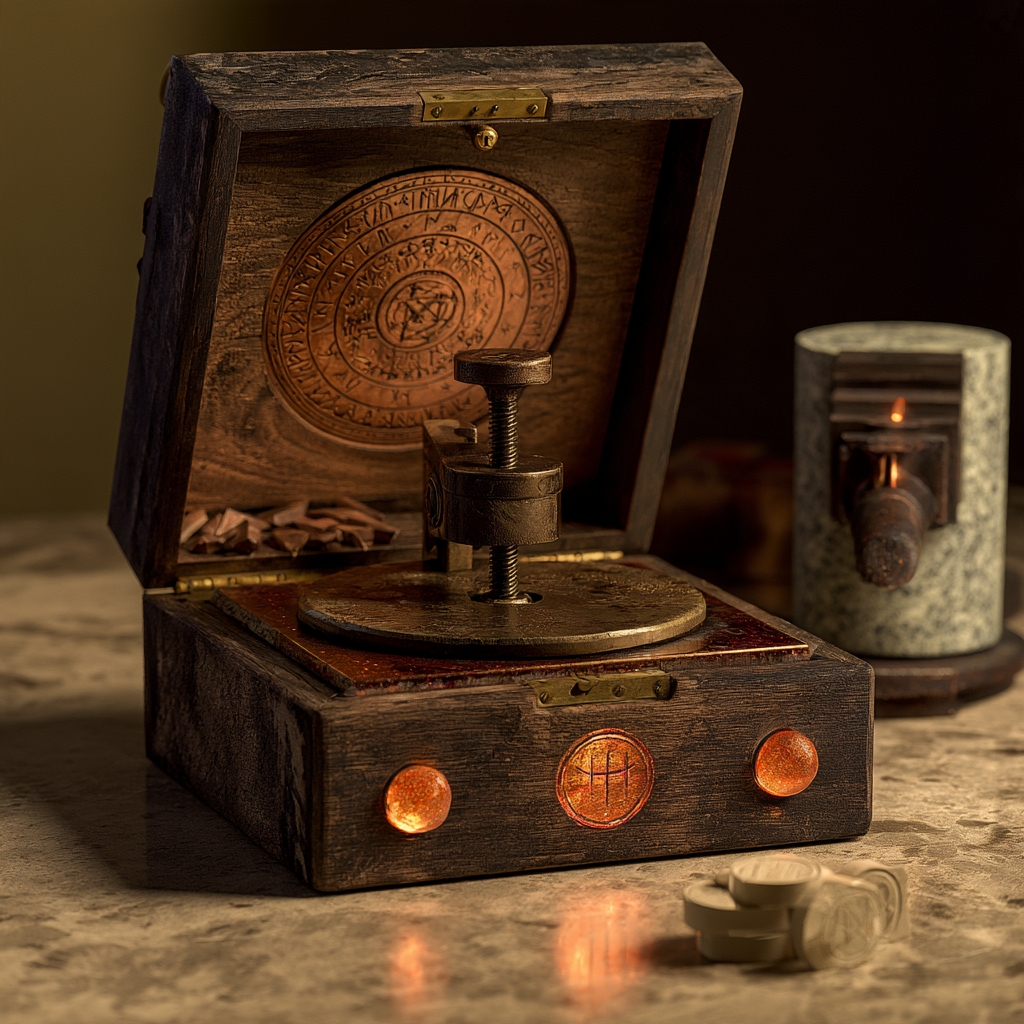
Perception of Activation:
User’s Perspective
- Sight: The user sees a thin copper line run around the edge of the clay as an impression takes. Through the gap of the closed press she watches the clay pale from wet grey to fired buff. On a Deep Impression she sees older wedges appear as fine copper lines beneath the surface script.
- Sound: The lid locks open with a click. The screw turns with a low wooden creak. The plate ticks softly as it warms, like a kiln settling, and wet clay gives a faint hiss at the start of hardening. Quick Firing adds a short, sharp crackle.
- Touch: Fresh archive clay is cool, smooth, and slightly sticky under her palms. She feels the surface beneath give up its shape as she presses, each wedge a small resistance. The case warms under her hands when the plate is working, pleasantly, never enough to burn. A finished tablet comes out dry, light, and faintly warm.
- Smell: Damp clay, warm bronze, and the sharp sweetness of alchemical resin. A hardening tablet gives off the smell of a kiln just opened.
- Taste: A trace of clay dust on the lips after a long session.
- Extra-sensory perceptions:
- Shape sense: While pressing, she perceives the inscription through the clay as a whole, the way one knows the shape of a key by closing a hand on it. She is aware of where the surface is worn and where it has been reworked.
- Aetheric Scrutiny: She tastes the plate’s magic as mild, steady fire, close kin to a banked kiln. On a Deep Impression of a rune, she tastes the rune’s flavor faintly in the clay and notes that it fades to nothing as the copy hardens.
- Mind’s Eye: She knows how much clay and resin remain, how many charges are left, and the count of true copies the case has made. A finished copy registers to her as “true copy” under her own name.
- Bench sense: The burned mark on the underside gives her a quiet awareness of the ninth bench, as a direction more than a distance.
- Predecessors’ tally: Opening the lid, she is briefly aware of the hands that pressed the sixty-three wedges before her two, as a sense of patient, repeated work.
Observer’s Perspective
- Sight: An observer sees a scribe press a slab of clay against a carving, lift it away, and close it in a wooden box whose lid has become a small press. Heat shimmers above the box for ten minutes. She then lifts out a hard, pale tablet bearing an exact copy. A faint red outline of a mark shows on the ground beneath the box.
- Sound: The click of the lid, the creak of the screw, and a soft ticking. Nothing carries beyond the room.
- Touch: The air near the box is warm. The box itself is warm to the hand and not hot.
- Smell: Wet clay and resin, then the smell of fired pottery.
- Taste: None.
- Extra-sensory perceptions:
- True sight: The plate gives off a low, even ultraviolet glow while it works, and the copper line of a True Copy shows brightly for a moment. A Deep Impression draws a visible thread of light from the original surface into the clay.
- Aetheric Scrutiny (other Akkad-Kuri): Nearby Akkad-Kuri taste a small, domestic fire magic, like a hearth, and recognize a travelling press.
- Mind’s Eye: An observer who examines the case sees its name and that it belongs to the ninth bench. One who examines a finished copy sees “true copy” and the name of the scribe who made it.
- Tremorsense: The turning of the screw and the weight of the user leaning on the press register as small, regular vibrations.
- Soul sight: Nothing of note beyond the user’s steady attention to her work.
Positives
- The work is quiet, gives little light, and draws little notice from a distance.
- The shape sense tells the user about wear and reworking in an inscription even before she looks at the copy.
- A true copy carries its own proof, visible to anyone who uses the Mind’s Eye on it.
- The case’s warmth is a comfort in cold vaults and on the road.
- She always knows how much clay and resin she has left.
- A copied rune goes inert in the clay, and she can taste the moment it becomes safe.
Negatives
- The process is slow. One minute to press and ten to harden leaves her kneeling over a box with both hands occupied.
- The smell of resin and fired clay lingers and tells anyone who enters later that a copy was made there.
- Every copy bears her name through the Mind’s Eye. She cannot make a true copy in secret and later deny it was hers.
- The red outline beneath the case and the ultraviolet glow of the plate mark the spot for those with the senses to see them.
- The shape sense can show her alterations she was not looking for, and once the clay has taken them they are on record.
- The predecessors’ tally and the three blank seals remind her, each time the lid opens, how much of the work is behind her and how little of the standing.
Recipe: Travelling Clay Press and Seal Case in the Manner of the Ninth Bench
Materials Needed
- Case:
- 4 board feet of seasoned ash wood, planed to the thickness of a finger
- 1 hardwood block for the screw and its threaded collar
- 2 bronze hinges and 8 bronze corner pieces with pins
- 1 bronze catch to hold the lid upright
- Hide glue and beeswax
- Press plate:
- 12 ounces of bronze for a flat plate the size of two palms
- 2 tier 1 magic crystals, each about the size of a coin, as catalysts for the two charges
- 1 further tier 1 magic crystal, ground to powder, for the warming property
- 1 pinch of ash from a kiln that has been properly banked and let go out
- 1 small measure of resinous tree sap drawn with a fluid collector
- Fittings and contents:
- 1 tin box with a tight lid for clay
- 2 pounds of clean archive clay, or sieved river or quarry clay
- 1 length of fine wire with two wooden toggles, for a cutter
- 3 blank cylinders of grey granite, each the length of a thumb, drilled lengthwise
- 1 small pot of alchemical resin
- 1 square of soft cloth for rubbings
- 1 small wooden vise to hold a seal for cutting
- Finishing:
- Linseed oil for the wood
- Fuel:
- Charcoal sufficient for one bronze pour
Tools Required
- Joiner’s saws, planes, chisels, and a marking gauge
- A wood-threading tap and screw box, or a lathe with thread-cutting tools
- A crucible furnace with bellows, a crucible, and tongs
- A flat sand mold for the plate
- Files, a scraper, and a polishing slate for the bronze
- A graver for the binding marks on the plate
- A stone drill for the seal blanks
- A branding iron or heated stylus for the maker’s mark
- A lump of test clay and a carved test stone
- A reading lens or other identification focus for checking the finished work through the Mind’s Eye
Skill Requirements
- Woodworking (joinery): 3 or higher
- Metalworking (bronze casting): 3 or higher
- Rune Cutting: 3 or higher, for the warming marks on the plate
- Kiln Work: 2 or higher, since the crafter must know how hot is enough to harden clay and how hot is too much
- Stonework: 1 or higher, for the seal blanks
- Three crafters may share the work, provided each required skill is met by the one performing that step.
- Time: About 8 days of downtime.
- Standing: Only a bench of a scribe house may burn its own mark into the underside. A crafter outside such a house burns a personal mark.
Crafting Steps
- Build the box:
- Cut and joint the ash boards into a box about the size of a loaf of bread, with a lid as deep as two fingers. Glue the joints and pin the bronze corners.
- Cut the screw:
- Turn the hardwood block into a short screw with a flat foot, and thread a collar to match. Fit the collar into the lid so that the screw bears down on the center of the box when the lid stands upright.
- Hang the lid:
- Fit the hinges and the catch. The lid should lock upright with a click and fold flat without strain.
- Cast the plate:
- Melt the bronze. Stir in the powdered crystal, the pinch of banked-kiln ash, and a few drops of sap at the last moment. Pour into the flat sand mold and let it cool on its own.
- Dress the plate:
- File and scrape the plate flat, and polish its upper face on the slate. Drill two shallow sockets near one edge and seat the two whole crystals in them with a drop of sap.
- Cut the warming marks:
- On the underside of the plate, cut a ring of small wedges with the graver. This is a short form of the kiln decree: the fire named, its work named, and its end named. Cut the end with particular care, since it is what keeps the plate from growing too hot.
- Seat the plate:
- Set the plate into the floor of the box on four small wooden feet, so that air can pass beneath it. Connect the foot of the screw to the plate by a bronze stud, so that closing the press wakes the marks.
- Prepare the seals:
- Grind three granite cylinders smooth and drill each lengthwise for a cord. Leave them blank.
- Fit the contents:
- Cut slots in the box for the clay tin, the wire cutter, the three seals, the resin pot, the vise, and the folded cloth. Fill the tin with damp clay and seal it.
- Oil and mark:
- Oil the wood. Burn the maker’s or bench’s mark into the underside.
- Take the first hundred:
- As a ritual of at least 10 minutes, the crafter takes one true impression of the carved test stone, closes the press, and waits in silence while the plate hardens it. She compares copy and stone stroke by stroke. Custom then calls for ninety-nine more over the following days, after which the first small wedge is pressed inside the lid. The press is considered proven at the first.
- Roll for the result:
- The crafter rolls a d20. On a 1 the plate overheats at its first closing, scorches the box, and cracks, the crystals shatter into shards, and the materials are lost. On a 20 the press gains one extra capability chosen by the GM, such as a third charge. Any other result produces a working press.
- Check and pack:
- Examine the case through the identification focus to confirm its abilities. Wrap it in cloth and set it in the backpack with the plate side down.
Ninsun-Aya Walker, Who Knew Words Too Well
This is told by the scribes of the house who work away from the bench, in ruins and at quarry faces, and they tell it while the plate is warming and there is nothing to do but wait. It is from the old speech of the high country. It was carried into the temple-writing by a measurer of fields, who was chosen because he could reckon distances, and who objects throughout to the distances. He writes at the head: “No woman walked this far. I have set down the numbers as given and I do not vouch for them.”
In the days when the house first began to send its daughters out to copy what could not be carried home, there was at the ninth bench a scribe named Ninsun-Aya. She was called the Walker. She had the best legs in the house and the best memory, and of the two the memory was the more admired.
For she knew the old forms. Every dedication, every boundary oath, every founding-text of the fire-temples is built from sayings that return, as a wall is built from courses. “So-and-so, daughter of so-and-so, set this stone.” “May the fire keep it and may the fire end it.” The Walker had copied ten thousand such rows and had them all by heart. Show her the first three wedges of a line and she could tell you the rest. On a worn stone, where another scribe would squint for an hour, she would glance, and nod, and press. She was three times as fast as any daughter of the house, and she was never found in error, and the bench-mother sent her to every hard place.
The telling pauses here, and so do the tellers. They say: “Mark that. Never found in error. It is the second-worst thing that can be said of a scribe.”
In a certain year the stone-men of the south meant to open a new face in the high-lands, and across that face, cut into the living rock by hands older than the house, ran a long inscription. Four hundred rows. It was a founding-text of some hall that had stood there before the hall of tablets was thought of. No one had ever copied it. The stone-men gave the house one month.
The Walker went up alone with her clay. She worked nine days, from Helios up to Helios down. The stone was weathered, and in many rows the wedges were soft as old teeth. It did not trouble her. She knew the forms. She brought down forty tablets in a frame on her back, clean, even, complete, not a gap in them. The bench-mother praised her before all eleven daughters. The next month the stone-men cut the face, and the inscription went down the mountain as building-blocks, to wherever blocks go.
A year passed. And there was at the bench a reader, a quiet one named Gashan, who had the habit of comparing. A trader brought her, as a curiosity, a broken slab from an archive in the lowlands. Some traveller of the old days had hacked it from the end of that same inscription, long before, and carried it off: eleven rows only, but sharp, having lain indoors. Gashan set it beside the Walker’s thirty-ninth tablet, for the pleasure of seeing them agree.
In eight rows they agreed. In three they did not.
They did not differ by a slipped wedge or a miscount. In those three places the slab said one thing, strange and particular, a name no one knew, a number that fit no custom, a turn of phrase that was in no other text of the land. And the Walker’s tablet, in those three places, said the usual thing. The thing such texts always say. The thing one would expect.
Gashan sat a long time. Then she carried slab and tablet to the bench-mother, and the bench-mother sent for the Walker.
The Walker looked. The telling says she understood before she had finished the first row, and that the color went out of her patterns. She said: “The stone was worn there. I remember it. I could see the beginning of the line. I knew how it went.”
“You knew how such lines go,” said the bench-mother.
“It is the same.”
“It was the same three hundred and ninety-seven times, perhaps,” said the bench-mother. “Or it was the same three hundred times. Or two hundred. We have eleven rows of four hundred to judge you by, and in three of the eleven you wrote what was in your head. Tell me, Walker. In the other three hundred and eighty-nine, which did you read, and which did you remember?”
And the Walker opened her mouth, and found that she did not know. She had not known at the time. That was the horror of it. To her eye it had all been reading. The measurer of fields writes: “I have seen surveyors do this. They pace a field they have paced before and write the old number. I say nothing further.”
Then the bench-mother said the words that are burned into every case. She said: “The eye reads. And a thing that can read can read wrongly, and worst of all when it reads well. Clay does not read. Clay knows no forms. Clay only takes the shape of what it is pressed against. Clay cannot guess.” And she took a stylus, and in the margin of the house’s record of that text she pressed three small wedges, and they are there today, and they mean: the copyist may have guessed here. The telling says she pressed three and not four hundred out of mercy, and that the Walker would have preferred the four hundred.
Now hear what the Walker did, for it is why she is remembered kindly.
She did not weep at the bench. She went to the stone-men and asked for their tally. And the tally said where the blocks of that face had gone: so many to a granary in the river town, so many to a bridge, so many to a cistern, a stable, a magistrate’s wall, a pigsty. The inscription was in the world still. It had only been taken apart and built into forty buildings in nine towns, mostly face-inward, and upside down.
She set out to find it.
The tellers reckon her walking at eleven years. The measurer writes: “They give a distance for this that is twice the circuit of the island. I record my doubt.” She went to every building on the tally. She begged leave of farmers to look at the back of their stable walls. She lay on her side in a dry cistern with a lamp. And where she found a block with wedges on it, she did not copy it.
She no longer trusted the thing behind her eyes. She would say, “If I look at it, I will know how it goes, and then I am lost.” So she took wet clay from her satchel, and she shut her eyes, and she pressed the clay flat against the stone with the heels of her hands, and peeled it away, and there was the row, backward, exact, with every worn place worn and every strange thing strange. She looked at it only then, when it was already taken and could not be improved.
That was the first true copy. She had found the way by despair, in a pigsty.
But wet clay dries and cracks on the road, and she lost half her impressions before she could get them to a kiln. She came home after the second year with a satchel of crumbs, and went to a joiner of the lower street and a pourer of bronze, and said: “I need a kiln I can carry on my back, that will fire one tablet, and will not burn down a stable.” They laughed. Then they saw her face, and stopped. The box took the two of them three years, and a fire-priest had to be brought to teach the plate when to stop. When it was done it was a box of ash-wood the size of a loaf, with a screw in the lid. She carried it nine years more.
Of the four hundred rows she found, in the end, thirty-one. Thirty-one, pressed and hardened and true. Of those, the telling says, twenty-two agreed with what she had written the first time. Nine did not.
She brought the thirty-one to the bench-mother, who was very old by then, and laid them down. “Nine in thirty-one,” she said. “So I guessed near a third. In the rest of the four hundred there will be a hundred more lies of mine, and they are in walls I cannot find, and they will be read as true for as long as the house stands.”
And the old woman said: “Yes.” For she did not lie to her daughters. Then she said: “And there are thirty-one rows in the vault that no one can ever doubt, and a box that cannot guess, and from this day no daughter of mine will copy a stone by eye again. You have cost the house a hundred rows, Walker. You have saved it every row hereafter. I do not know how to weigh that. I do not think it is mine to weigh.”
Now the matter of the three seals.
The Walker had in her box, as every scribe has, the cylinder with which she sealed her work. On the day she laid down the thirty-one, she took out that seal, and with a mason’s rasp she ground its face smooth, until it was blank grey stone. The bench-mother asked her why. She said: “A seal says: this is finished, this is true, I stand behind it. I sealed forty tablets so. I will carry a blank one, to remember that some of my work is not finished and never can be.”
When she died, that smooth seal was put in the vault beside her shard. And the house made it custom. Every case carries three blanks. One is cut when the scribe has earned her mark. One is cut for whoever comes after her. And the third is never cut. It rides in its slot all her life, for the copy she has not yet made and the error she has not yet found. Young scribes think it a sad custom. Old ones say it is the only one of the three that tells the truth.
And inside the lid of every press, by the screw, there is room for the small wedges that count the hundreds. The Walker began that also. She did not do it for pride. She said: “Let those after me see how many times a thing must be done rightly before it is worth one line in a margin.”
The moral of the story is that the one who knows the words best is the one most apt to write what is not there, and so the surest hand must be the one most willing to shut its eyes and let the clay speak. The field scribes add what is burned into the wood: a copy shows what is there, and the copyist’s opinion goes in the margin.
Suggested conversions to other systems:
Call of Cthulhu (7th Edition)
The Walker’s Unguessing Press
- Type: Enchanted field kit (artifact)
- Origin: A hinged box of dark ash wood with bronze corners, about the size of a loaf of bread, from the ninth copying bench of Balawat in Assyria on the world of Saṃsāra. The lid folds back into a small screw press over a bronze plate. Inside are a tin of damp clay, a wire cutter, three blank stone cylinder seals, a pot of resin, and a cloth for rubbings.
- Weight: 7 lb
- Durability: 10 hit points
- Supplies: Clay for 10 palm-sized tablets and resin for 6 uses. Both can be replenished with ordinary clean clay and a chemist’s resin.
- Bonding: The user takes one impression of a carved surface with eyes shut, hardens it in the press, compares copy and original stroke by stroke, and makes a POW roll. On a success the press is bonded and its powers can be used.
- Passive effects while bonded and operated:
- True Copy: Pressing fresh clay against an inscription, carving, or seal for one minute yields an exact impression. No roll is needed, and no error of transcription is possible. Closing the press hardens it into a durable tablet in ten minutes. The plate warms and never burns.
- Later study of a true copy is treated as study of the original for Archaeology, History, Language, and Library Use rolls.
- Bonus die on Art/Craft (Engraving) rolls to cut a cylinder seal with the kit’s tools.
- A user who takes a True Copy without looking at the original does not read it and suffers no Sanity loss from its content at the time of copying. Reading the copy later has the usual effect.
- A copied sigil, ward, or sign is inert. It reproduces the shape and none of the power.
- Powers (the press draws on the user’s magic points):
- Quick Firing: Cost 1 magic point. One impression hardens in one minute.
- Deep Impression: Cost 2 magic points. The copy also records what lies beneath the surface, including script that was smoothed over or recut. The older layer shows as fine copper-colored lines in the clay.
- Cast in Resin: Cost 2 magic points and one use of resin. Over ten minutes the user makes a clay mold of a small solid object, such as a seal, key, or coin, and casts a resin duplicate of its shape. A duplicated key may open a simple lock at the Keeper’s discretion.
- Mend the Crack: Cost 1 magic point and one use of resin. Over ten minutes a cracked object of clay or ceramic is made whole enough to handle and read.
- Sanity:
- First bonding: No loss.
- Seeing, in a Deep Impression, an earlier text beneath one long trusted: 0/1 Sanity points, at the Keeper’s discretion.
- Investigation:
- A Mechanical Repair roll finds no source for the plate’s heat.
- An Occult roll connects the three blank seals with a custom of leaving one’s work unsigned until it is proven.
- Cthulhu Mythos: None gained from the press itself.
Blades in the Dark (current edition)
The Copyist’s Loaf-Box
- Type: Fine arcane tool kit (unique item)
- Load: 2
- Quality: 2
- Origin: A hinged ash-wood box with bronze corners and a screw press in its lid, from the ninth copying bench of Balawat in Assyria on the world of Saṃsāra. It holds clay, a wire cutter, three blank seal stones, resin, and a rubbing cloth.
- Features:
- True Copy: Given a quiet minute with an inscription, carving, lock plate, or seal, you take a perfect impression in clay. Ten minutes in the closed press hardens it. The copy is exact, and no roll is needed to make it.
- Studied at Leisure: When you Study a true copy later, treat it as if you had the original in front of you.
- Seal and Key: When you Tinker to duplicate a key, or forge a document using a seal you have copied, gain +1 effect.
- Deep Impression: Take 1 stress. The copy also records what was scraped away or written over, and the pattern of any ward or rune on the surface. The copied ward is inert and safe to handle.
- Mend the Crack: With ten minutes and a little resin, you make a broken clay or ceramic object whole.
- Drawbacks:
- Slow and Bulky: The box must be set on a flat surface and worked with both hands. It cannot be used in a hurry or on the move.
- Signed Work: Every copy carries a trace of whoever pressed it. Anyone who Attunes to a copy you made learns that it is a copy and gets a sense of you.
- Crafting a copy: Invent the formula as a long-term project, then Tinker during downtime. Arcane, minimum quality 2, with the Signed Work drawback. The warming plate requires a spark-craft or ritual component at the GM’s discretion.
Dungeons & Dragons (2024 rules)
Press of the True Copy
- Wondrous Item, Uncommon
- Weight: 7 lb.
- Description: This hinged box of dark ash wood with bronze corners is about the size of a loaf of bread and comes from the ninth copying bench of Balawat in Assyria, on the world of Saṃsāra. Its lid folds back to form a small screw press over a bronze plate. Inside are a tin of damp clay, a wire cutter, three blank granite cylinder seals, a pot of alchemical resin, and a cloth for rubbings. The tin holds enough clay for 10 palm-sized tablets and can be refilled with any clean clay. The pot holds 6 uses of resin and can be refilled for 5 SP.
- Tool Kit: The press can be used in place of Calligrapher’s Supplies, Potter’s Tools, or a Forgery Kit for work involving clay tablets and seals. You have Advantage on ability checks made with these tools to duplicate a seal you have copied with the press.
- True Copy: Over 1 minute, you press fresh clay against an inscription, carved surface, or seal within reach and take an exact impression. If you then close the clay in the press for 10 minutes, the warm plate hardens it into a durable tablet. The copy is exact and requires no ability check. A creature that casts Identify on the tablet learns that it is a true copy and who made it, or that it has since been altered.
- Charges: The press has 2 charges and regains 1 expended charge daily at dawn.
- Quick Firing (1 charge): One impression in the press hardens in 1 minute.
- Deep Impression (1 charge): When you use True Copy, the copy also records script that was erased, smoothed over, or recut, and the pattern of any magical glyph or rune on the surface. The copied glyph is nonmagical and can’t be triggered.
- Cast in Resin (1 charge and 1 use of resin): Over 10 minutes, you make a mold of a Tiny nonmagical object, such as a seal, key, or coin, and cast a resin duplicate of its shape. The duplicate is obviously resin on inspection.
- Mend the Crack: Over 10 minutes, using 1 use of resin, you repair one break or crack in an object made of clay or ceramic, as the Mending spell. Once you use this property, you can’t use it again for 1 hour.
Knave (Second Edition)
Field Scribe’s Press-Box
- Type: Relic tool kit
- Slots: 2
- Value: Seldom for sale. Copies fetch whatever a buyer will pay.
- Description: A hinged ash-wood box with bronze corners and a screw press in its lid, from Balawat in Assyria on the world of Saṃsāra. It holds a tin of clay, a wire cutter, three blank seal stones, a pot of resin, and a rubbing cloth.
- Supplies: Clay for 10 tablets and resin for 6 uses. Refill the clay from any clean bank. Resin costs a few coins from an alchemist.
- Always in effect while set up and operated:
- True Copy: Spend a minute pressing clay against an inscription, carving, or seal to take an exact impression. Close it in the press for one turn (10 minutes) and it comes out as a hard tablet. No check is needed, and the copy has no errors.
- Anyone who examines such a tablet with magic learns it is a true copy and who made it.
- Checks to carve a seal or copy a document with the kit are made with advantage (+5).
- Charges: 2. One charge returns each morning.
- Quick Firing (1 charge): The impression hardens in a minute.
- Deep Impression (1 charge): The copy also shows writing that was scraped away or written over, and the pattern of any rune or ward. The copied rune is harmless.
- Cast in Resin (1 charge and 1 resin): Spend a turn making a resin duplicate of a small object such as a key, seal, or coin. A duplicate key opens a simple lock.
- Mend the Crack: Once per watch, spend a turn and 1 resin to repair a cracked clay or ceramic object.
- Limit: The box is heavy and must be set on a flat surface and worked with both hands. If the bearer takes a wound that fills one of its slots, the plate is knocked out of true and warms no longer until a smith spends two days reseating it.
Fate (Fate Condensed)
The Box That Cannot Guess
- Type: Extra (field copying kit)
- Origin: A hinged box of dark ash wood with bronze corners, about the size of a loaf of bread, from the ninth copying bench of Balawat in Assyria on the world of Saṃsāra. The lid folds back into a small screw press over a bronze plate. Inside are a tin of damp clay, a wire cutter, three blank stone cylinder seals, a pot of resin, and a cloth for rubbings.
- Permission: A character aspect showing training as a scribe, surveyor, or antiquarian.
- Cost: 2 refresh
- Item aspect: Clay Takes Only the Shape It Is Pressed Against
- Invoke: To produce an exact copy as evidence, to study an inscription safely and at leisure, or to show that a record has been changed since it was copied.
- Compel: The work is slow and needs a flat surface and both hands, the box is heavy, every copy is known to be yours, and the clay records things you may not have wanted on record.
- Stunts granted while the kit is set up:
- True Copy: Given a quiet minute with an inscription, carving, or seal, you take a perfect impression without rolling. Ten minutes in the press hardens it. Later, anyone examining the tablet treats it as the original for the purposes of Lore, Investigate, and Academics. Once per scene, a true copy you made earlier may be introduced as a situation aspect with one free invoke, such as Exact Copy of the Charter, Dated and Witnessed.
- Deep Impression: Once per session, a true copy also records what was scraped away or written over, and the pattern of any rune or ward. Create an advantage with Investigate at +2 to place an aspect such as The Older Row Beneath. A copied rune is inert.
- Seal and Key: +2 to Crafts when cutting a seal, duplicating the shape of a key or seal in resin, or repairing a cracked clay or ceramic object.
Numenera and Cypher System (Numenera Discovery and the Cypher System Rulebook)
Impression Press of the Ninth Bench
- Type: Artifact
- Level: 1d6
- Form: A hinged wooden box with bronze corners, the size of a loaf of bread, from Balawat in Assyria on the world of Saṃsāra. Its lid folds back into a small screw press over a bronze plate. It holds a tin of clay, a wire cutter, three blank stone cylinders, a pot of resin, and a cloth.
- Effect:
- The press must be set on a flat surface and operated with both hands.
- True Copy (one minute, then ten minutes in the press): The user presses clay against an inscription, carving, or seal and takes an exact impression, which the warm plate hardens into a durable tablet. No roll is needed. Studying the tablet later is the same as studying the original. No depletion roll is needed.
- The user has an asset on tasks to cut seals or copy documents with the kit.
- Quick Firing (action): One impression hardens in one minute. Roll for depletion.
- Deep Impression (one minute): The copy also records markings that were erased or overwritten and the pattern of any inscribed ward, rune, or control glyph of a level equal to or lower than the artifact level. The copied pattern is inert. Roll for depletion.
- Cast in Resin (ten minutes): The user makes a resin duplicate of the shape of one small solid object, such as a key, seal, or token. A duplicate key opens a lock whose level is lower than the artifact level. Roll for depletion.
- Mend the Crack (ten minutes): One cracked object of clay or ceramic is repaired. This can be used once per hour and requires no depletion roll.
- Supplies: Clay for 10 tablets and resin for 6 uses, both replenishable with ordinary materials.
- Depletion: 1 in 1d20. A depleted press still takes impressions in clay by hand, though the plate no longer warms and the other effects are lost.
Pathfinder (Second Edition, Remaster)
True-Copy Clay Press — Item 4
- Traits: Magical
- Price: 95 gp
- Usage: held in 2 hands, set on a flat surface
- Bulk: 1
- Description: This hinged box of dark ash wood with bronze corners is about the size of a loaf of bread and comes from the ninth copying bench of Balawat in Assyria, on the world of Saṃsāra. Its lid folds back to form a small screw press over a bronze plate. Inside are a tin of damp clay, a wire cutter, three blank granite cylinder seals, a pot of alchemical resin, and a cloth for rubbings. The press can be used as artisan’s tools for Crafting checks involving clay tablets and seals, and it grants a +1 item bonus to such checks and to Society checks to Create a Forgery using a seal you have copied with it. The tin holds enough clay for 10 palm-sized tablets, and the pot holds 6 uses of resin. Both can be refilled for 5 sp.
- Activate—True Copy 1 minute (manipulate)
- Effect: You press fresh clay against an inscription, carved surface, or seal within reach and take an exact impression. If you then close the clay in the press for 10 minutes, the warm plate hardens it into a durable tablet. The copy is exact and requires no check. A creature that succeeds at a check to Identify Magic on the tablet learns that it is a true copy and who made it, or that it has since been altered.
- Activate—Quick Firing [one-action] (manipulate)
- Frequency: once per day
- Effect: One impression in the press hardens in 1 minute.
- Activate—Deep Impression 1 minute (concentrate, manipulate)
- Frequency: once per day
- Effect: You use True Copy, and the copy also records writing that was erased, smoothed over, or recut, and the pattern of any magical rune or inscribed spell on the surface. The copied rune is nonmagical and can’t be triggered. You gain a +2 circumstance bonus to checks to Identify Magic on the original rune by studying the copy.
- Activate—Cast in Resin 10 minutes (manipulate)
- Frequency: once per day
- Effect: Using 1 use of resin, you make a mold of one nonmagical object of negligible Bulk, such as a seal, key, or coin, and cast a resin duplicate of its shape. A duplicate key opens the same lock if you succeed at a DC 18 Thievery check, and it breaks after one use.
- Activate—Mend the Crack 10 minutes (manipulate)
- Frequency: once per hour
- Effect: Using 1 use of resin, you restore 5 Hit Points to one object made of clay or ceramic of 1 Bulk or less.
Savage Worlds (Adventure Edition)
The Travelling Bench
- Type: Arcane device (tool kit)
- Weight: 7
- Toughness: 6
- Cost: Seldom for sale. Copies sell for whatever the market bears.
- Description: A hinged ash-wood box with bronze corners and a screw press in its lid, from Balawat in Assyria on the world of Saṃsāra. It holds a tin of clay, a wire cutter, three blank seal stones, a pot of resin, and a rubbing cloth.
- Supplies: Clay for 10 tablets and resin for 6 uses. Both can be replenished with ordinary materials.
- Passive effects while set up and operated:
- True Copy: One minute of pressing clay against an inscription, carving, or seal yields an exact impression. Ten minutes in the closed press hardens it into a durable tablet. No roll is needed. Research and Academics rolls made on the tablet later are treated as if made on the original.
- +1 to Repair and Academics rolls to cut a seal or copy a document with the kit, and +2 to rolls to forge a document using a seal copied with the press.
- A character who examines a tablet by arcane means learns that it is a true copy and who made it.
- Power Points: 4. The press regains 2 Power Points each dawn and cannot be recharged by other means.
- Activation: No roll is needed. The user spends the Power Points listed.
- Quick Firing (2 Power Points, action): One impression hardens in one minute.
- Deep Impression (2 Power Points, one minute): The copy also records writing that was scraped away or written over, and the pattern of any rune or ward. The copied rune is inert. Occult rolls to understand the original gain +2 when made from the copy.
- Cast in Resin (2 Power Points and 1 resin, ten minutes): The user makes a resin duplicate of the shape of a small object such as a key, seal, or coin. A duplicate key grants +2 to a Thievery roll against the matching lock and breaks after one use.
- Mend the Crack (no cost, ten minutes, once per hour, 1 resin): One cracked object of clay or ceramic is repaired.
Shadowrun (Sixth World Edition)
True-Copy Press Kit Focus
- Type: Bonded enchanted tool kit
- Force: 1
- Bonding cost: 2 Karma
- Availability: 4(L)
- Cost: 8,000¥ for a copy. The original is seldom for sale.
- Structure: 4
- Weight: 3 kg
- Description: A hinged box of dark ash wood with bronze corners, about the size of a loaf of bread, from the ninth copying bench of Balawat in Assyria on the world of Saṃsāra. The lid folds back into a small screw press over a bronze plate. Inside are a tin of damp clay, a wire cutter, three blank granite cylinder seals, a pot of alchemical resin, and a cloth for rubbings. It contains no electronics and has no wireless bonus.
- Supplies: Clay for 10 palm-sized tablets and resin for 6 uses. Both can be replenished for 20¥.
- Passive effects while bonded, set up, and operated:
- True Copy: One minute of pressing clay against an inscription, carving, physical seal, or lock plate yields an exact impression. Ten minutes in the closed press hardens it into a durable tablet. No test is needed. Tests made later to study the tablet are treated as if made on the original.
- +1 die on tests to cut a seal or copy a physical document with the kit, and +2 dice on Con (Forgery) or Engineering tests to duplicate a physical seal or mechanical key that has been copied with the press.
- An Assensing test with 2 hits on a tablet reveals that it is a true copy and the astral signature of who made it.
- Charges: 2. One charge returns at each sunrise.
- Quick Firing (1 charge, Major Action): One impression hardens in one minute.
- Deep Impression (1 charge, one minute): The copy also records markings that were scraped away or covered over, and the pattern of any ward anchor, formula, or inscribed preparation of Force 2 or less. The copied pattern is inert. Tests to analyze the original gain +2 dice when made from the copy.
- Cast in Resin (1 charge and 1 use of resin, ten minutes): The user makes a resin duplicate of the shape of a small solid object, such as a mechanical key, a signet, or a token. A duplicate key opens the matching mechanical lock once and then breaks. It has no effect on maglocks.
- Mend the Crack (no charge, ten minutes, once per hour, 1 use of resin): One cracked object of clay or ceramic is repaired.
- Astral signature: Each copy carries the user’s signature for as long as the tablet exists.
Starfinder (Second Edition)
Archivist’s Analog Impression Press — Item 4
- Traits: Analog, Magical
- Price: 950 credits
- Usage: held in 2 hands, set on a flat surface
- Bulk: 1
- Description: This hinged box of dark ash wood with bronze corners is about the size of a loaf of bread and comes from the ninth copying bench of Balawat in Assyria, on the world of Saṃsāra. Its lid folds back to form a small screw press over a bronze plate. Inside are a tin of damp clay, a wire cutter, three blank granite cylinder seals, a pot of alchemical resin, and a cloth for rubbings. The press can be used as a tool kit for Crafting checks involving physical tablets, inscriptions, and seals, and it grants a +1 item bonus to such checks and to Society checks to Create a Forgery using a physical seal you have copied with it. It has no effect on digital records or biometric locks. The tin holds enough clay for 10 palm-sized tablets, and the pot holds 6 uses of resin. Both can be refilled for 5 credits.
- Activate—True Copy 1 minute (manipulate)
- Effect: You press fresh clay against an inscription, carved or engraved surface, or physical seal within reach and take an exact impression. If you then close the clay in the press for 10 minutes, the warm plate hardens it into a durable tablet. The copy is exact and requires no check. A creature that succeeds at a check to Identify Magic on the tablet learns that it is a true copy and who made it, or that it has since been altered.
- Activate—Quick Firing [one-action] (manipulate)
- Frequency: once per day
- Effect: One impression in the press hardens in 1 minute.
- Activate—Deep Impression 1 minute (concentrate, manipulate)
- Frequency: once per day
- Effect: You use True Copy, and the copy also records markings that were erased, ground down, or re-engraved, and the pattern of any magical rune or inscribed spell on the surface. The copied rune is nonmagical and can’t be triggered. You gain a +2 circumstance bonus to checks to Identify Magic on the original rune by studying the copy.
- Activate—Cast in Resin 10 minutes (manipulate)
- Frequency: once per day
- Effect: Using 1 use of resin, you make a mold of one nonmagical, non-technological object of negligible Bulk, such as a mechanical key, signet, or token, and cast a resin duplicate of its shape. A duplicate key opens the same mechanical lock if you succeed at a DC 18 Thievery check, and it breaks after one use.
- Activate—Mend the Crack 10 minutes (manipulate)
- Frequency: once per hour
- Effect: Using 1 use of resin, you restore 5 Hit Points to one object made of clay or ceramic of 1 Bulk or less.
Traveller (Mongoose Second Edition, 2022 Update)
Relic Impression Press of Balawat
- Item Type: Relic tool kit (anomalous artefact)
- TL: 2 in manufacture. The plate’s heating cannot be reproduced at any known TL.
- Kg: 3
- Cost: Seldom for sale. A collector or xeno-archaeologist might pay Cr4000 or more.
- Required Skill: None for True Copy. Other uses as noted.
- Description: A hinged wooden box with bronze corners, the size of a loaf of bread, from Balawat in Assyria on the world of Saṃsāra. Its lid folds back into a small screw press over a bronze plate. It holds a tin of clay, a wire cutter, three blank stone cylinders, a pot of resin, and a cloth.
- Supplies: Clay for 10 palm-sized tablets and resin for 6 uses. Both can be replenished for Cr5.
- Passive effects while set up and operated:
- True Copy: One minute of pressing clay against an inscription, carving, or physical seal yields an exact impression. Ten minutes in the closed press hardens it into a durable tablet. No check is needed. Science, Language, or Investigate checks made later on the tablet are treated as if made on the original.
- DM+1 to Art or Profession checks to cut a seal or copy a physical document with the kit, and DM+2 to Deception or Admin checks to forge a document using a physical seal copied with the press.
- Charges: 2. One charge returns each local dawn.
- Quick Firing (1 charge, Significant Action): One impression hardens in one minute.
- Deep Impression (1 charge, one minute): The copy also records markings that were erased or covered over. A Boon is granted on later checks to interpret the original from the copy.
- Cast in Resin (1 charge and 1 use of resin, ten minutes): The user makes a resin duplicate of the shape of a small solid object, such as a mechanical key, signet, or token. A duplicate key opens the matching mechanical lock once and then breaks. It has no effect on electronic locks.
- Mend the Crack (no charge, ten minutes, once per hour, 1 use of resin): One cracked object of clay or ceramic is repaired.
- Analysis: Sensors detect only wood, bronze, clay, and plant resin. A Science check (Formidable 14+) finds no power source for the plate, which reaches a steady temperature sufficient to fire clay and no higher.
Warhammer (Warhammer Fantasy Roleplay, Fourth Edition)
The Honest Box of the Road Clerks
- Type: Magical trade tools
- Price: N/A
- Encumbrance: 2
- Availability: Unique
- Description: A hinged box of dark ash wood with bronze corners, about the size of a loaf of bread, from Balawat in Assyria on the world of Saṃsāra. The lid folds back into a small screw press over a bronze plate. Inside are a tin of damp clay, a wire cutter, three blank stone cylinder seals, a pot of resin, and a rubbing cloth. To those with the Second Sight Talent, the plate holds a low red warmth.
- Supplies: Clay for 10 palm-sized tablets and resin for 6 uses. Both can be replenished for a few brass pennies.
- Passive effects while set up and operated:
- True Copy: One minute of pressing clay against an inscription, carving, or seal yields an exact impression. Ten minutes in the closed press hardens it into a durable tablet. No Test is needed. Language, Lore, and Research Tests made later on the tablet are treated as if made on the original.
- The box serves as Trade Tools for Trade (Engraver) and Art (Calligraphy), granting +10 to Tests to cut a seal or copy a document.
- +20 to Tests to forge a document using a seal that has been copied with the press.
- A character who passes a Magical Sense Test on a tablet learns that it is a true copy and gains an impression of who made it.
- Charges: 2. One charge returns at each sunrise.
- Quick Firing (1 charge, Action): One impression hardens in one minute.
- Deep Impression (1 charge, one minute): The copy also records writing that was scraped away or written over, and the pattern of any rune or petty ward. The copied rune is inert. Tests to understand the original gain +20 when made from the copy.
- Cast in Resin (1 charge and 1 use of resin, ten minutes): The user makes a resin duplicate of the shape of a small object such as a key, signet, or coin. A duplicate key grants +20 to a Pick Lock Test against the matching lock and breaks after one use.
- Mend the Crack (no charge, ten minutes, once per hour, 1 use of resin): One cracked object of clay or ceramic is repaired.
- Notice: A tool that duplicates seals and keys is of keen interest to forgers and thieves, and its owner may be suspected of both.