
Magical Powers: Voryx possesses dynamic magical properties that enhance competitiveness, drive, and the spirit of rivalry. When spoken or signed with intent, it can boost physical and mental performance, sharpen instincts, and increase determination. The language can also be used in rituals to invoke competitive spirits, bless participants in contests, and enforce the rules of fair play.
Linguistic Attributes and Characteristics:
- Phonetics: Voryx is characterized by sharp, energetic sounds and brisk, rhythmic intonations. The language is spoken with a confident, assertive voice, projecting enthusiasm and readiness. It incorporates many staccato consonants and lively vowels, creating an invigorating and dynamic auditory experience.
- Syntax and Structure: The language uses a Verb-Subject-Object (VSO) structure, emphasizing actions and outcomes before the actors. This structure reflects the language’s focus on results and the drive to achieve goals.
- Grammar: Voryx has a precise grammatical system with numerous affixes and particles to denote intensity, urgency, and the nature of competition. It employs a variety of motivational phrases and exclamations to inspire and challenge. The grammar is designed to be concise and impactful, ensuring that messages convey a sense of urgency and drive.
Cultural Identity and Users:
- Cultural Significance: Voryx is primarily spoken by the Ryzans, a culture known for their emphasis on excellence, competition, and achievement. The language is central to their culture, reflecting their values of ambition, perseverance, and the pursuit of victory.
- Users: While it is the native language of the Ryzans, Voryx is also learned by athletes, warriors, and competitive individuals who seek to enhance their performance and drive. It is spoken in regions and communities where competition and excellence are highly valued.
Rarity, Type, Script, Source, and History:
- Rarity: Voryx is moderately rare, known primarily to those who prioritize competition and achievement or who have close interactions with the Ryzans.
- Type: It is a spoken, written, and sign language, with a telepathic component for those skilled in mental fortitude and motivation. The telepathic form often involves sharing vivid images of goals and victories.
- Script: The written form of Voryx consists of angular, bold characters that resemble the sharp edges of trophies or the swift movements of competitors. These symbols are often inscribed with quick, decisive strokes, using materials that evoke a sense of speed and precision.
- Source and History: Voryx originated from the ancient Ryzan communities, who developed it to enhance their natural competitive instincts and drive for excellence. Over centuries, it has evolved to incorporate magical elements that strengthen its competitive nature.
Sensory Experience:
- Auditory: Hearing Voryx feels like being in the midst of an intense competition. The language sounds brisk and energizing, often inducing feelings of excitement and determination in the listener.
- Visual: The written script of Voryx appears sharp and dynamic, like the symbols of victory or the marks of a swift competitor. When signed, the language involves quick, assertive hand movements and body postures that convey speed and agility.
- Telepathic: When communicated telepathically, Voryx conveys not just words but the drive and ambition behind them. It creates a mental image of goals, challenges, and victories, enhancing the feeling of competitiveness and determination.
Voryx is a language of competition, with dynamic magical properties that enhance performance, drive, and the spirit of rivalry. It is structured to be concise and impactful, reflecting its connection to ambition and achievement. Culturally significant to the Ryzans, it is also used by athletes, warriors, and competitive individuals. Its rarity and unique characteristics make it a respected and influential language in the world of Saṃsāra. The auditory, visual, and telepathic aspects of Voryx all contribute to its distinctive sensory experience of energy and determination.
Tags: Competitive, Magical, Energetic, Rhythmic, Assertive, Action-Oriented, Motivational, Impactful, Ryzan, Rare, Telepathic, Angular Script, Ancient, Dynamic, Performance-Enhancing, Tribal, Inspirational
Inscriptions
These concise phrases would be etched onto weapons, armor, trophies, and the gates of arenas to magically enhance focus and performance.
- Zyra tor-un. (Sharpen my blade.)
- Vexo kael. (Conquer the contest.)
- Teva-ix tev-un. (Endure fiercely, my will.)
- Gora-vo gor. (Rise towards victory.)
- Kaelo-ix spyr-un. (Strive greatly, my heart.)
- Vexo nex-et. (Win your challenge.)
- Zyra zyr. (Focus the mind.)
- Kaelo Ryzan-an. (Compete, we the Ryzan.)
- Nexa kael-ix. (Begin the great struggle.)
- Vexo tev-et. (Conquer, your spirit.)
- Teva-un voryx. (Endure I in the spirit of competition.)
Political Oaths
These phrases are used in formal ceremonies where leaders and officials swear allegiance, emphasizing their duty to lead the Ryzan people to greater heights through strength and determination.
- Jexa tev-un vo kratos. (Bind my spirit to the people.)
- Kaelo-un vo lex. (Strive I for the law.)
- Vexo-un kael vo Ryzan. (Conquer I all threats to the Ryzan.)
- Gora-ix kratos-an. (Rise fiercely, we the people.)
- Teva-un vo gor-kratos. (Endure I for the victory of the state.)
- Jexa-un spyr vo nex. (Swear I my heart to the challenge.)
- Zyra tev-an vo gor. (Focus our will on achievement.)
- Kaelo-an vo Ryzan-ix. (Compete we for a greater Ryzan.)
- Jexa-un lex-vo kael. (Swear I fairness in the struggle.)
- Vexo-an gor vo kratos-an. (Win we victory for all our people.)
- Jexa spyr-an vo spyr-an. (Bind our hearts to one another.)
Cultural Ceremonies
These motivational phrases are chanted during rituals, such as coming-of-age trials, blessings for athletes before a game, or festivals celebrating achievement.
- Nexa nex, et’a. (Begin the trial, be blessed.)
- Kaelo-an voryx. (Strive we together in the spirit of competition.)
- Gora tev-et vo gor. (Rise your spirit towards the peak.)
- Zyra zyr-et, kael’et’a. (Sharpen your instincts, blessed competitor.)
- Teva spyr-et vo kael. (Endure your heart through the struggle.)
- Jexa kael vo lex, et’a. (Bless the contest with fairness.)
- Vexo nex-et, gora gor-et. (Conquer your challenge, find your victory.)
- Kaelo-an vo tev-lex. (Compete we with honorable spirit.)
- Vexo tev-ix, et’a. (May the greatest spirit win.)
- Nexa-an nex-vo-gor. (Challenge we the path to the future’s victory.)
- Gora tev-an voryx. (Find we strength in rivalry.)
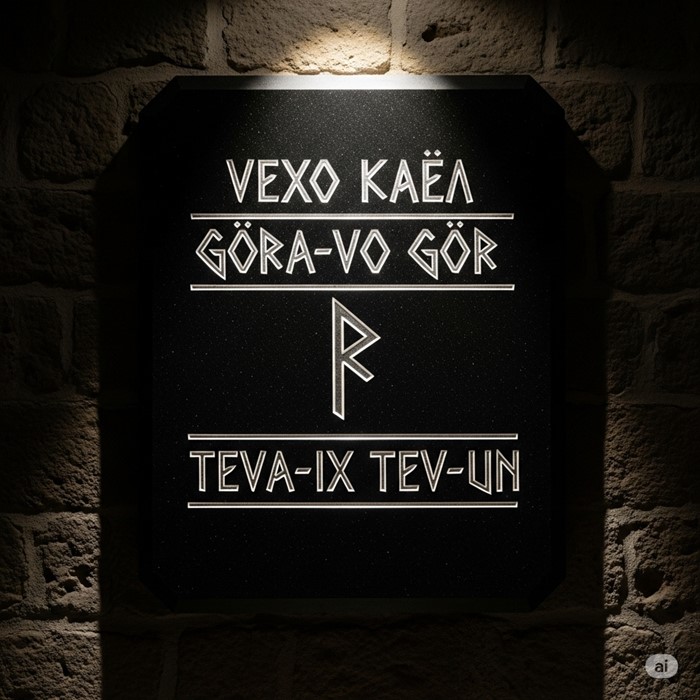
Forging of the Contending Tongue
It is written, or perhaps it is sung, for the oldest tablets are fractured and their meanings shift like desert sands, that in the age before reckoning, the people who would become the Ryzans were not as they are. They were a people of stillness, of quiet acceptance. Their spirits were like placid pools, reflecting the sky but never moving of their own accord. They knew no ambition, for there was no concept of victory; they knew no rivalry, for there was no prize to be won. The world, for them, was a thing that happened, and they were merely in it.
Then came the First Rivalry. Here the texts are most broken, the language most obscure. Two great spirits, it is said, held dominion over the world. One was the Spirit of the Mountain, of unyielding stone and eternal stasis. Its nature was silence and its strength was in its refusal to move. The other was the Spirit of the Storm, of crackling lightning and relentless action. Its nature was sound, and its strength was in its refusal to be still. For an age that cannot be measured, they existed in opposition, a perfect balance of inaction and deed.
But the balance, as is its way, was broken. A great contest began between them. Struck the storm the mountain with a bolt of fire. Stood the mountain against the storm with a heart of granite. Roared the wind in fury. Groaned the stone in defiance. This was the first competition, and the world trembled with the force of it.
And there was one among the still-people, whose name is rendered as Ryz, the First-Mover. This Ryz, who some say was a man and others a woman, and still others a union of both, did not hide from the contest. Ryz watched. Ryz listened. And Ryz began to understand. The sounds of the First Rivalry were not mere noise. They were words. The sharp crack of the lightning was a verb, an action. The deep groan of the stone was a subject, a being. The hiss of the rain was an object, a consequence.
Ryz perceived that the language of this conflict was a language of power. It was a grammar of pure action. The deed was spoken first, for it was the most important thing. Then came the actor, defined by the deed they had just committed. Last was the result, the world changed by the action.
Strike! said the lightning. Endure! said the mountain. Challenge! said the wind.
Ryz, the First-Mover, opened their mouth, and for the first time, spoke not with the placid tongue of their people, but with the language of the First Rivalry. The words were sharp, energetic, and full of staccato rhythm, like a rockslide, like a thunderclap. When Ryz spoke, the listless spirit of the still-people was stirred. The words did not just describe the contest; they were the contest, and to speak them was to partake in its energy.
Ryz taught the words to the tribe. He taught them the shape of the sound Kaelo, which means to strive as the storm strives. He taught them the form of the word Teva, which means to endure as the mountain endures. He taught them the Voryx, the Echoing Word of the First Rivalry. And as they learned, they changed. Their placid spirits became raging rivers. Their eyes, once dull, gained a competitive fire. They began to see the world not as a thing that happens, but as a grand arena, filled with challenges to be met and victories to be won.
They carved the sharp, angular words into their tools, and the tools became extensions of their will, striking truer and lasting longer. They chanted the phrases before a hunt, and their instincts grew sharp, their bodies filled with vigor. They swore oaths in Voryx, and the magic of the First Rivalry itself bound them to their word, for to break an oath was to cheapen the contest and insult the spirits of both mountain and storm. This, the texts say, is why the language enforces fair play: the First Rivalry was a pure test of strength, with no room for deceit. The language remembers this, and punishes those who would win through treachery.
The still-people were no more. In their place stood the Ryzans, a culture forged in the crucible of a language born from conflict. They became a people defined not by what they had, but by what they could achieve.
The Moral of the Story: A soul without a rival is like a blade without a whetstone; it is sharp only at its forging and grows dull with every passing moment. To strive is to live, and to contend is to know the shape of your own spirit.