
Original Life Forms:
Kingdom Animalia, Phylum Arthropoda, Class Malacostraca: Mantis Shrimp
Kingdom Animalia, Phylum Arthropoda, Class Arachnida: Scorpion
Kingdom Animalia, Phylum Mollusca, Class Bivalvia: Razor Clam
Kingdom Animalia, Phylum Chordata, Class Aves: Vulture
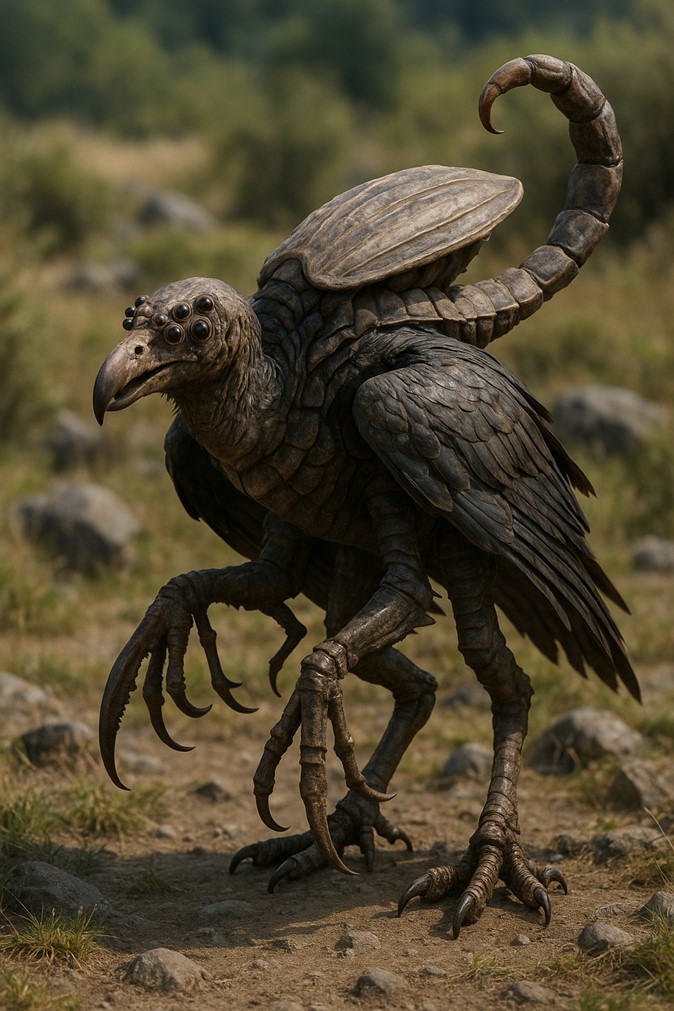
- Appearance: The Scorpiostracan Razorbeak is a horrifying amalgamation of its progenitors. It has the general bipedal stance and feathered wings of a large vulture, but its body is covered in a segmented, chitinous exoskeleton of mottled brown and grey. Its featherless, vulture-like head is equipped with a powerful, hooked beak designed for tearing flesh, but instead of two eyes, it has multiple pairs of stalked, compound eyes that move independently, granting it a wide field of vision. Its two primary, bird-like legs are thick and powerful, ending in sharp talons. Sprouting from its thorax are two smaller pairs of arachnid-like walking legs that provide stability. Its most formidable weapons are a pair of raptorial forelimbs, like those of a mantis shrimp, kept folded tightly against its chest and capable of striking with blinding speed. A long, segmented scorpion tail, tipped with a venomous barb, curls menacingly over its back. Fused to its dorsal side is a large, elongated bivalve shell, similar in shape to a razor clam, into which it can partially retract for defense.
- Size: This creature stands roughly 4 to 5 feet tall at the shoulder, with a wingspan of 10 to 12 feet. Its tail adds another 5 to 6 feet to its length. It weighs between 150 and 200 pounds.
- Speed:
- Land: 30 ft. It moves with an unsettling, scuttling gait using its four smaller legs, while its main avian legs provide powerful bursts of speed.
- Fly: 50 ft. Despite its weight, its large wings allow for decent flight, though it prefers to glide on thermals like a vulture.
- Burrow: 15 ft. It can use its sharp forelimbs and clam-shaped shell to quickly dig into sand or loose soil, leaving only its eyes exposed.
- Stat Modifiers:
- Strength: +3
- Dexterity: +2
- Constitution: +4
- Intelligence: -4 (Animalistic)
- Wisdom: +2
- Charisma: -3
- Skills:
- Perception: +5 (Excellent eyesight from its multiple eyes)
- Stealth: +3 (Effective at ambushing from a burrowed position)
- Survival: +4 (Adept at finding carrion and hunting in harsh environments)
- Behavior: The Scorpiostracan Razorbeak is a highly aggressive and territorial predator and scavenger. It combines the patient, circling observation of a vulture with the ambush tactics of a mantis shrimp. It will often burrow into the sand or soil along game trails or near carrion, erupting from the ground to strike with its powerful forelimbs and venomous tail. They are solitary creatures, only gathering in small, temporary groups when a large carcass is present, where they will engage in aggressive displays to establish a pecking order.
- Diet: Primarily a carnivore and scavenger. It prefers to hunt small to medium-sized prey but is more than happy to feast on the dead. Its powerful beak can splinter bone, and its digestive system is robust enough to handle rotting flesh.
- Emotions: The creature operates on base instinct. Its primary emotional states are aggression when its territory or a meal is challenged, cunning patience when hunting, and a general state of predatory awareness. It is incapable of complex emotions like empathy or affection.
- Environment Where Found: Arid deserts, rocky canyons, and barren coastlines. It thrives in open, desolate areas where it can spot prey from the air and where the loose ground is suitable for burrowing.
- Tags: Feral, Beast, Monstrosity, Venomous, Flyer, Burrower, Amalgamation, Chimeric, Chitinous, Predator, Scavenger, Desert, Territorial, Ambusher, Multi-limbed, Arid
Life Cycle
The life of a Scorpiostracan Razorbeak is a brutal and solitary journey from birth. It begins when a female lays a clutch of 10 to 20 small, ovoid eggs in a deep burrow dug into sun-hardened sand or soil. The eggs are jet black and possess a glossy, rock-like texture, making them difficult to spot. The mother guards the clutch with extreme aggression for a few weeks but, driven by hunger, will eventually abandon them to fend for themselves.
After a gestation period of several months, the eggs hatch, and Scorpiostracan nymphs emerge. These nymphs are roughly the size of a human hand and are wingless, with a softer, pale exoskeleton. For the first year of their lives, they are extremely vulnerable and spend most of their time burrowed, hunting insects, lizards, and other small creatures that wander too close. They molt multiple times during this stage, each time growing larger and their chitin hardening.
Upon reaching their second year, they enter the adolescent stage. They are now roughly half their adult size, and small, stubby wing buds have formed on their backs. Their venom begins to gain potency, and their raptorial forelimbs become strong enough to shatter stone. They become more nomadic, leaving their birth burrow to establish their own small hunting grounds. Their diet expands to include rodents and large birds.
By the age of five, the Razorbeak is a fully mature adult. Its wings are fully developed, its exoskeleton is as tough as iron, and its venom is at its most lethal. This stage is defined by the establishment and violent defense of a large territory, which it patrols from the sky and from its hidden burrows. The adult’s life is a continuous cycle of hunting, scavenging, and defending its domain from rivals. When it dies, being a feral creature without a possessed soul, its body is simply left to decay or be consumed by other scavengers, becoming part of the natural cycle of the world.
Mating
Reproduction for these intensely territorial creatures is a dangerous and infrequent event. A female Scorpiostracan Razorbeak only becomes receptive to mating for a very short period every few years. During this time, she will emit a low-frequency clicking sound from her forelimbs that can travel for miles across the desert floor.
Males in the surrounding territories will pick up on this signal and converge on her location. However, they do not approach her directly. Instead, they engage in ritualistic combat with one another at the edge of her territory. These duels are not typically to the death but are violent displays of dominance. The males will face off, flaring their wings, raising their venomous tails, and striking their powerful raptorial appendages together to create deafening cracks that echo through the canyons. The victor is the one who can force the other to retreat. The strongest male will then earn the right to approach the female. He must do so cautiously, often presenting her with a fresh kill as an offering. If she accepts the gift, mating occurs quickly, after which the female will violently drive the male away. He plays no part in the raising of the young and will be treated as a threat if he enters her territory again.
Tactics
The Scorpiostracan Razorbeak is a master of ambush and attrition. Its primary hunting strategy is the Earthen Ambush. It will dig itself into sand, loose soil, or scree, leaving only its multi-faceted compound eyes exposed. These eyes can move independently, allowing it to maintain a near 360-degree view of its surroundings without moving its head. It can lie dormant in this state for days, waiting for suitable prey to wander into its strike zone. When a target is in range, the Razorbeak erupts from the ground in a shower of earth and rock, striking with its stinger and raptorial limbs before its victim can react.
Alternatively, it employs an Aerial Search pattern. It uses its large wings to ride thermal updrafts, circling for hours high above the landscape. Its vision is exceptionally keen, allowing it to spot movement or the dark shape of a carcass from miles away. For living prey, it will either land a significant distance away and stalk it on foot, using terrain for cover, or perform a Diving Strike. This tactic involves a steep, silent dive, ending with it slamming its full body weight into the target, digging in with its talons, and unleashing a flurry of attacks with its beak, tail, and forelimbs. Against tougher or larger foes, it utilizes its venomous stinger early in the fight, retreating to a safe distance and waiting for the poison to weaken its adversary before closing in for the kill.
Actions
- Multi-Attack: The creature makes three attacks: one with its Beak, one with its Stinger, and one Resonating Strike with its raptorial forelimbs.
- Beak: A vicious tearing attack. On a successful hit, it deals piercing damage and can rip away chunks of armor or flesh, potentially causing a bleeding effect.
- Stinger: A swift jab with its venomous tail. It deals piercing damage, and the target must make a Constitution saving throw. On a failure, the target takes additional poison damage and suffers from a debilitating effect, such as reduced speed or disadvantage on attack rolls for a short period.
- Resonating Strike: The Scorpiostracan unleashes a devastatingly fast and powerful blow with one of its mantis-shrimp-like forelimbs. The strike is so fast it creates a concussive shockwave. It deals heavy bludgeoning damage, and the target must succeed on a Constitution saving throw or be stunned until the end of its next turn.
- Shell Fortress: As an action, the creature can retract its limbs and head into its dorsal bivalve shell and hunker down. While in this stance, its speed is reduced to zero, but it gains a significant bonus to its Armor Class. It cannot take this action if it is prone or grappled.
- Earthen Eruption: If the creature is burrowed and emerges to attack a target that was unaware of its presence, its first attack roll is made with an advantage.
Other Interesting Information
- Valuable Components: The remains of a Scorpiostracan Razorbeak are highly sought after by skilled artisans and alchemists. Its primary exoskeleton plates can be fashioned into exceptionally resilient yet lightweight armor. The venom from its stinger can be carefully harvested and diluted to create potent anti-paralysis elixirs or, if refined, incredibly deadly poisons. The tightly wound bundles of sinew within its raptorial forelimbs store immense kinetic energy, making them a core component in the construction of masterwork heavy crossbows and siege weapons.
- Unique Sound: The creature is largely silent when stalking, but the sound of its Resonating Strike is unmistakable. The speed of the limb breaks the sound barrier, producing a sharp, loud CRACK like a gunshot, followed by the sound of the impact itself. Experienced desert travelers know to fear this sound, as it almost always signals that the creature has just successfully struck its prey.
- Ecological Niche: As both predator and scavenger, the Scorpiostracan Razorbeak is a vital keystone species in its arid environment. It prevents the overpopulation of herbivores and efficiently disposes of carcasses, preventing the spread of disease. Their massive, abandoned burrows often become homes for entire ecosystems of smaller desert creatures, from insects and reptiles to small mammals seeking shelter from the unforgiving sun.
Adventurers on the world of Saṃsāra might cross paths with a Scorpiostracan Razorbeak for a multitude of reasons, ranging from calculated hunts driven by necessity and greed to sudden, violent encounters born of misfortune. These creatures, while feral and operating on pure instinct, are deeply embedded in the arid ecosystems they inhabit, making interaction with them a significant possibility for any who travel through their domains.
Reasons for Actively Searching for a Scorpiostracan Razorbeak
Parties would intentionally seek out these dangerous monstrosities when the potential rewards outweigh the considerable risks. In a world where advancement is tied to the quality of one’s gear, the components harvested from such a unique and powerful creature are immensely valuable.
- The Artisan’s Commission: A master armorer in a steam-powered metropolis has received a lucrative contract to craft a suit of armor for a noble or a wealthy guild leader. Standard metals and materials are insufficient for the client’s demands for something both incredibly durable and unusually lightweight. The armorer discovers that the chitinous plates and the fused bivalve shell of a mature Scorpiostracan Razorbeak possess the exact properties required. Unable to risk their own life, the artisan posts a commission, seeking a party of adventurers to hunt a Razorbeak and bring back its exoskeleton, specifying that the dorsal shell must remain as intact as possible, presenting a significant challenge beyond simply killing the beast.
- The Alchemist’s Panacea: A remote mining settlement is suffering from a mysterious ailment that causes gradual paralysis, believed to be the result of a magical toxin seeping from the earth. A traveling alchemist determines that the only known antidote requires a potent counter-agent found exclusively within the venom of a Scorpiostracan Razorbeak. The party is hired to retrieve the venom gland, a delicate harvesting operation that must be performed shortly after the creature’s death before the complex compounds decay. The quest becomes a race against time to save the afflicted miners.
- A Rite of Passage: A nomadic tribe of desert warriors or a secluded martial order considers the solo hunt of a Razorbeak to be the ultimate test of a warrior’s skill, cunning, and courage. To gain the respect of the tribe, to be taught a legendary combat technique, or to earn a place within the order’s ranks, the adventurers are tasked with tracking and slaying one of these creatures. They must return with a specific trophy—such as one of the raptorial forelimbs or the creature’s hooked beak—as undeniable proof of their prowess.
- Securing a Trade Route: A newly established trade route that promises to bring immense wealth to a city-state is plagued by an unusually large and aggressive Razorbeak, which has made its lair near a critical canyon pass. Its ambushes have destroyed caravans and killed numerous merchants, grinding trade to a halt. A substantial bounty is placed upon the creature’s head by the merchant’s guild. The party is contracted not just as exterminators, but as protectors of commerce, tasked with making the vital pass safe for travel once more.
Reasons for an Unplanned Encounter
More often than not, adventurers will encounter a Scorpiostracan Razorbeak not by choice, but by unknowingly treading into its territory. The creature’s predatory nature and ambush tactics make it a terrifying and unpredictable environmental hazard.
- The Unwitting Trespass: A party of adventurers is on a completely unrelated quest, perhaps seeking a forgotten ruin, escorting a scholar, or simply traveling between cities. Their path takes them across a vast, seemingly lifeless desert or through a series of rocky badlands. Unbeknownst to them, they have entered the hunting grounds of a Razorbeak. As they make their way across a sandy wash, the ground suddenly erupts in a shower of sand and stone, and the creature attacks with the full, devastating advantage of surprise. The encounter is sudden, violent, and a desperate fight for survival.
- The Unlikely Guardian: The adventurers carry a map leading to an ancient temple or a long-lost tomb rumored to hold powerful artifacts. Upon arrival, they discover that the entrance to the site is situated in the center of a large, crater-like depression. They soon realize that this depression is the lair of a massive Scorpiostracan Razorbeak, which has burrowed a network of tunnels around the structure. The creature is not a deliberate guardian of the ruin’s secrets; it has simply chosen this defensible and secluded location as its home. The party must now figure out how to either defeat the powerful beast or find a way to repeatedly sneak past it to explore the site’s interior.
- Drawn to the Carnage: Following a difficult battle where the adventurers have defeated another large monster or a group of bandits, they are left injured and exhausted. The scent of blood and death is carried on the wind, attracting any scavengers in the area. Before the party has a chance to rest and recover, a circling shadow descends from the sky—a Scorpiostracan Razorbeak, drawn to the promise of an easy meal, viewing the weary adventurers as nothing more than carrion that still happens to be breathing.
- An Ecological Investigation: A small, oasis-adjacent village reports that the local ecosystem has fallen into chaos. Herbivore populations have exploded, devouring all plant life, or a foul pestilence is sweeping through the wildlife. A local wise person or scout determines that the region’s apex predator, the Razorbeak that kept the natural order, has vanished. The party might be hired to investigate its disappearance, a quest that could lead them to a more formidable predator that has moved into the area, a band of poachers, or a source of magical corruption that has poisoned the creature’s ancestral home.
Beyond the more obvious components like chitin, venom, and sinew, the unique chimeric biology of a Scorpiostracan Razorbeak offers a wealth of specialized ingredients and materials for discerning and skilled harvesters. A thorough dissection of the creature’s corpse can yield several rare and valuable items.
- Razorbeak Gizzard Stones
- Description: These are a collection of smooth, unnaturally dense stones found within the creature’s powerful gizzard. Over years of grinding bone and chitin, the stones have been worn into perfect spheres and have absorbed trace magical energies from the creature’s diet and physiology. They possess a remarkable resistance to physical and alchemical erosion.
- Use: Alchemists prize these gastroliths as the perfect tools for grinding volatile or corrosive substances, using them as pestles that will not break down or contaminate their mixtures. When used as sling bullets, they strike with the force of lead shot and release a small concussive burst on impact. An artificer can incorporate a gizzard stone into the core of a shield to grant it the ability to absorb and negate a portion of a crushing, bludgeoning impact.
- Raptorial Knuckle
- Description: This is the incredibly dense, club-like bone structure at the “elbow” of the creature’s raptorial forelimbs. It is the point of impact for its Resonating Strike, and its internal lattice structure is uniquely adapted to withstand and amplify immense kinetic force without shattering.
- Use: A blacksmith can forge this knuckle into the head of a warhammer or mace. Weapons crafted this way are known as “Resonators” and have a chance to stun a target on a solid hit, releasing a low-frequency hum. Magitech engineers study the knuckle’s structure to design more efficient steam-powered pistons and industrial hammers, capable of shaping metal with fewer impacts.
- Dorsal Nacre
- Description: The interior lining of the creature’s large, razor-clam-shaped dorsal shell is coated in a thick layer of shimmering, iridescent mother-of-pearl. This nacre shifts in color from oily black to silver-blue and seems to ripple with a faint, internal light. It possesses innate, though subtle, abjurative properties.
- Use: The nacre can be carefully flaked off and ground into a fine powder. This powder is a key ingredient in the ink used to scribe defensive scrolls and in the creation of potions that grant temporary resistance to psychic or force-based attacks. When inlaid into armor, shields, or helmets in intricate patterns, it provides a minor but constant ward against mental intrusion and spells that seek to charm or frighten the wearer.
- Arachnid Book Lungs
- Description: The creature breathes through a series of modified arachnid book lungs located along its thorax. These organs consist of stacks of extremely thin, air-filled plates that resemble the pages of a book. When carefully removed and cured, these plates become a semi-translucent, vellum-like material that is both lightweight and surprisingly durable.
- Use: The delicate sheets from the book lungs are highly valued as a medium for magical scrolls, particularly for spells involving air, silence, or poison, as they seem to hold these enchantments with exceptional clarity. Alchemists also use the sheets as magical filters capable of separating substances on a molecular level or for creating specialized breathing masks that can neutralize airborne toxins.
- Hooked Beak Head
- Description: The creature’s formidable beak is a single piece of sharpened bone, harder than steel and honed to a razor’s edge at the tip. It is perfectly shaped for punching through armor and tearing flesh.
- Use: The entire upper mandible can be detached and mounted onto a haft, creating a brutal and effective war pick or short-handled battle axe. Such a weapon excels at piercing armored targets. Alternatively, shards of the beak can be knapped and used as arrowheads or spear tips that cause vicious, bleeding wounds and are difficult to remove.
- Primary Flight Feathers
- Description: The longest feathers from the creature’s wings are thick-shafted and surprisingly rigid, feeling more like carved wood than typical feathers. They are naturally aerodynamic and hold their shape even under extreme stress.
- Use: These feathers are the preferred choice for the fletching of high-grade arrows and crossbow bolts, granting them a straighter flight path and increased effective range. An enchanter can weave subtle levitation magic into the feathers, causing the ammunition to drop less over long distances or even allowing a skilled archer to fire shots with a slight curve to bypass cover. When bundled together, they can be used to create the core of a magical cloak that slows the wearer’s descent from great heights.
Shifting Scourge of Sun-Scorched Sands
From fragments etched onto sun-bleached bones, from whispers carried on the sirocco winds, from the half-remembered chants of desert hermits whose minds have mingled too long with the shimmering heat, comes a fractured tale. It is a narrative worn smooth by the grinding teeth of time, its original cadence lost, its precise meaning obscured by layers of retelling and misinterpretation across forgotten epochs. Yet, the core of the story persists, a chilling echo of the creature now known as the Scorpiostracan Razorbeak.
Long, long before the seven kingdoms rose from the shifting dunes, before the sky-ships charted their wind-lanes, even before the whispering monoliths were swallowed by the encroaching sands, there was a terror that stalked the endless wastes. It was not born of flesh as we understand it, but was a thing woven from the very essence of the desolate places. Some say it was a fragment of a fallen god, shattered in a primordial war and cursed to forever haunt the lands that knew its defeat. Others claim it was a thought given terrible form by the sun’s relentless gaze upon the barren earth, a manifestation of hunger and the cruel indifference of the desert.
The earliest accounts, scrawled on cave walls using pigments ground from ochre and the blood of unknown beasts, depict a figure both bird and insect, predator and shell. It possessed the soaring wings of the great carrion birds that circled the dying world, yet its body was encased in the jointed armor of the burrowing horrors that tunneled beneath the cracked earth. Its head, bare and cruel, held eyes like a thousand facets, seeing all, and a beak that could rend stone as easily as flesh. From its tail, a venomous barb dripped with a poison that could still the heart of the mightiest behemoth. And upon its back, it carried a shield not forged in any mortal smithy, but grown from the very rock of the desert floor.
This being, known in those forgotten tongues by names that sound like the hiss of wind through broken ruins and the clicking of chitin in the darkness, was not merely a beast. It was a force, an embodiment of the desert’s harsh judgment. It did not hunt for sustenance alone; it seemed to seek out those who dared to trespass upon the sacred emptiness, those who sought to extract life where life was not freely given.
The story tells of a proud king, his name now lost to the ceaseless erosion of time, who sought to conquer the vast desert, believing its mineral wealth would secure his dynasty for eternity. He marched with a legion of armored warriors, their banners rippling in the scorching wind, their water skins heavy with the precious liquid. But the Shifting Scourge watched from the swirling heat haze. It did not confront them directly. Instead, it moved like a phantom, striking at the edges of their camp, stealing their scouts, poisoning their meager water supplies with the faintest touch of its barbed tail. It burrowed beneath the sand and erupted in the heart of their formations, its raptorial claws tearing through steel and bone.
Panic took hold of the king’s army. The familiar laws of battle meant nothing against this creature that seemed to melt into the sand and rise from the air at will. The king, in his hubris, believed his enchanted blade could defeat any foe. He rode out to confront the Scourge, but it was like trying to grasp a mirage. It darted and weaved, its multiple eyes tracking his every move, its beak snapping with impossible speed. The king’s mighty blows struck only empty air, while the Scourge’s attacks were precise and deadly. The tale ends with the king’s shattered armor lying half-buried in the dunes, his reign of conquest ended before it truly began.
Another fragment speaks of a band of cunning thieves who sought to plunder a hidden oasis, a place of life and respite in the heart of the desolation. They believed their stealth and their knowledge of desert lore would protect them. But the Shifting Scourge seemed to possess an uncanny awareness of their presence, as if the very sands whispered their secrets. It set traps for them, collapsing hidden tunnels, creating phantom sandstorms to disorient them, and picking them off one by one with terrifying efficiency. The last of the thieves, crawling through the darkness, his throat parched and his hope extinguished, saw only the glint of multiple eyes in the gloom before the final, agonizing sting.
Yet another tale, barely legible on a fragment of treated beast hide, tells of a lone hermit, a woman who had sought solitude in the deepest reaches of the desert, seeking enlightenment through hardship. She offered no threat to the harsh lands, taking only what she needed and treating the desert with reverence. The Shifting Scourge watched her for many seasons, its multifaceted eyes observing her quiet rituals and her respectful interactions with the fragile ecosystem. One day, as a pack of jackal-like scavengers threatened her meager shelter, the Scourge descended, not with fury, but with a swift and decisive violence that drove the scavengers away. It then regarded the hermit for a long moment before taking flight, leaving her unharmed. Some interpretations of this fragment suggest that the Scourge was not a mindless destroyer but possessed a primal sense of balance, punishing those who sought to dominate the desert but tolerating, even protecting, those who lived in harmony with it.
As the ages turned, the stories of the Shifting Scourge became less frequent, perhaps because those who encountered it rarely lived to tell the tale, or perhaps because the changing world brought new threats and new wonders to the forefront of mortal consciousness. The creature faded into legend, a terrifying myth whispered around desert campfires to warn against greed and disrespect for the unforgiving sands. Yet, the echoes of its form and its fearsome abilities persisted, resurfacing in the modern era as the creature we now identify by the less evocative, more scientific name: Scorpiostracan Razorbeak. The fear it inspires is a faint but persistent memory, a primal recognition of a power that once held sway over the very heart of the wilderness.
The Moral of the Story: The desert yields its secrets and its bounty only to those who approach it with respect and humility. Those who seek to dominate or exploit the wild, who fail to understand its harsh beauty and its inherent dangers, will ultimately face the wrath of the sands themselves, often in forms they could never have imagined.
Suggested conversions to other systems:
Call of Cthulhu (7th Edition)
The Sun-Scoured Horror A horrifying chimeric predator that haunts the desolate, sun-blasted wastes.
STR: 90 (18) CON: 80 (16) SIZ: 95 (19) DEX: 70 (14) INT: 30 (6) POW: 50 (10) HP: 17 Move: 8 / 12 flying Build: 3 Damage Bonus: +2d6 Armor: 4 points of chitinous exoskeleton and dorsal shell.
Attacks
- Fighting (Brawl): 65% (32/13), damage 1d3 + DB
- Resonating Smash (2 attacks): 55% (27/11), damage 1d8 + DB. A target struck must make a successful CON roll or be stunned, losing their next action. If an attack roll is an Impale (1/5th of skill or less), the target is knocked prone and stunned.
- Venomous Stinger: 45% (22/9), damage 1d6 + potent venom. A victim must make a Hard CON roll to resist the venom.
- Failed Roll: The victim takes an additional 1d8 damage immediately as their tissues begin to necrotize. They take a further 1d8 damage at the start of each of their subsequent turns. The victim must make another Hard CON roll at the end of each turn; a success ends the effect.
- Fumbled Roll: The venom ravages the victim’s system. They take 2d8 damage immediately and for the next 1d4 rounds with no further resistance rolls.
Special Abilities
- Earthen Eruption: When attacking from a burrowed position, it gains one bonus die on its first-round attack rolls. All who witness it erupt from the ground must make a SAN roll.
- Shell Fortress: The Horror can spend a full turn to hunker down, increasing its Armor to 8. While in this state, it cannot move or fly, but can still make Stinger attacks against adjacent targets.
Skills: Dodge 35%, Stealth 50% (75% when burrowing), Track 60%.
Sanity Loss: 1/1d8 SAN points for seeing the Sun-Scoured Horror. 0/1d4 for seeing it erupt from the earth.
Blades in the Dark
The Ash-Wastes Terror A legendary predator of the Deathlands, a living engine of violence and hunger. It is a terrifying amalgam of things that should not be, its form a violation of natural law.
Threat Level: Tier III, Quality III, Scale 1 (a single, terrifying specimen)
Drive: To guard its desolate territory; to consume all trespassers.
Clocks
- [ ][ ][ ][ ][ ] Isolate and Overwhelm Prey
- [ ][ ][ ][ ] Driven Off by a Superior Threat
Moves
- Erupt from the ash: The Terror bursts from a hidden position, creating chaos and blinding dust. The PCs are immediately put in a Desperate position.
- Strike with concussive force: Its raptorial limbs lash out with stunning power. Inflict Level 2 Harm “Winded” or “Shattered Ribs.” A PC can Resist to lessen the harm, but they are still knocked off their feet.
- Inject debilitating venom: The stinger delivers a potent toxin that wracks the body with agony. Inflict Level 2 Harm “Poisoned.” Create a 4-segment clock labeled “Venom Overcomes”; it ticks once every few minutes. When it fills, the victim suffers Level 3 Harm “Incapacitated.”
- Hunker behind its shell: The Terror withdraws into its dorsal shell, becoming immune to most harm from one direction. It becomes a formidable obstacle; any action to bypass or harm it is Desperate and has limited effect.
- Screech of Challenge: A horrifying sound that unnerves all who hear it. Everyone in earshot takes 1 Stress.
Dungeons & Dragons (5th Edition)
Scorpiostracan Ravager Large monstrosity, unaligned
Armor Class 16 (natural armor) Hit Points 136 (16d10 + 48) Speed 30 ft., burrow 20 ft., fly 50 ft.
STR 18 (+4) | DEX 14 (+2) | CON 17 (+3) | INT 3 (-4) | WIS 14 (+2) | CHA 7 (-2)
Skills Perception +5, Stealth +5 Senses Darkvision 60 ft., Passive Perception 15 Languages — Challenge 7 (2,900 XP)
Traits
- Earthen Ambush. On the first turn of combat, the ravager has advantage on attack rolls against any creature that hasn’t taken a turn yet, provided the ravager emerged from being burrowed this round.
- Keen Sight. The ravager has advantage on Wisdom (Perception) checks that rely on sight.
Actions
- Multiattack. The ravager makes three attacks: one with its Beak, one with its Resonating Claw, and one with its Stinger.
- Beak. Melee Weapon Attack: +7 to hit, reach 5 ft., one target. Hit: 11 (2d6 + 4) piercing damage.
- Resonating Claw. Melee Weapon Attack: +7 to hit, reach 5 ft., one target. Hit: 13 (2d8 + 4) bludgeoning damage. If the target is a creature, it must succeed on a DC 14 Constitution saving throw or be stunned until the end of its next turn.
- Stinger. Melee Weapon Attack: +7 to hit, reach 10 ft., one target. Hit: 8 (1d8 + 4) piercing damage, and the target must make a DC 14 Constitution saving throw, taking 14 (4d6) poison damage on a failed save, or half as much damage on a successful one.
Reactions
- Shell Defense. When the ravager is hit by an attack, it can use its reaction to add 3 to its AC against that attack, potentially causing the attack to miss.
Knave (2nd Edition)
Chitin-Clave Horror A monstrous desert predator cobbled together from the parts of nightmares.
HD 8 | Armor 17 | Morale 10 Attacks: 2 Claws (+8, 1d10), 1 Stinger (+8, 1d6 + venom)
Qualities
- Territorial Predator: Will attack any creature its size or smaller that enters its hunting grounds.
- Fearsome Appearance: PCs must make a successful Will save upon first seeing it or be unable to act for one round.
Special Abilities
- Concussive Claws: A PC hit by a claw attack must save vs. Constitution. On a failure, they are stunned for one round and cannot act, defend, or move.
- Necrotic Venom: A PC hit by the stinger must save vs. Constitution. On a failure, they are poisoned. A poisoned PC takes an additional 1d6 damage at the start of their turn for the next 3 rounds.
- Burrow Ambush: When attacking from a hidden, burrowed position, its first round of attacks are made with advantage.
- Shell Defense: As a full-round action, the Horror can increase its Armor to 20. It cannot move while using this ability, but can still attack with its stinger.
Fate Core
The Scuttling Sundoom A chittering, territorial nightmare that erupts from the sand to claim any who trespass in its domain. It is a living testament to the world’s harshest realities.
Aspects
- High Concept: Territorial Amalgam Predator
- Trouble: Aggressive and Instinct-Driven
- Other Aspects: Blindingly Fast Strikes; Chitinous Armored Shell; Venom that Liquefies Flesh
Skills
- Great (+4): Fight
- Good (+3): Physique, Notice
- Fair (+2): Athletics, Stealth
- Average (+1): Provoke (through intimidation)
Stunts
- Resonating Strike: When The Scuttling Sundoom succeeds with style on a Fight attack using its raptorial claws, it can choose to inflict the Stunned and Reeling situation aspect with a free invocation on the target instead of taking a boost.
- Earthen Eruption: Once per scene, The Scuttling Sundoom can spend a Fate point to burst from the ground anywhere within its zone. When it does, it may immediately make a Fight attack against any one target in the zone before the first turn of the exchange begins.
- Shell Fortress: Once per conflict, The Scuttling Sundoom may hunker down, gaining Armor: 2 against physical attacks for one entire exchange.
Stress & Consequences
- Physical Stress: [ 1 ] [ 1 ] [ 1 ] [ 1 ]
- Consequences:
- Mild (2):
- Moderate (4):
- Severe (6):
Numenera & Cypher System
The Chitin-Plated Abomination This creature is an abomination of biology, a fusion of multiple organisms from a long-dead era, now perfectly adapted to the harsh wastelands. Its compound eyes scan for intruders while its armored body lies in wait beneath the shifting sands.
Level: 6 Health: 27 Damage: 6 Armor: 2
Motive: Defend territory, hunt for food. Environment: Almost exclusively in arid deserts, rocky badlands, and barren coastlines. Combat: The Chitin-Plated Abomination attacks with a terrifying flurry of strikes. As a level 6 creature, it can attack two PCs as a single action; one with its Resonating Slam and another with its Stinger. It often begins a fight with its Burrowing Ambush, erupting from the ground to surprise its foes. Its first attack in combat is eased by two steps (as if it were level 8). Its Resonating Slam is a powerful blow that dazes the target; a PC struck by this attack must make a Might defense roll. On a failure, the difficulty of their next action is increased by one step. Its Stinger injects a potent necrotic venom. Instead of taking normal damage, a PC struck by the stinger takes 3 points of damage immediately and must make a Might defense roll. On a failure, they take an additional 3 points of damage per round for the next three rounds. The creature can use an action to hunker down behind its shell, increasing its Armor to 4 until its next turn, but it cannot move. GM Intrusion: The creature’s Resonating Slam shatters a PC’s held item (or a random piece of gear). Alternatively, the venom is particularly virulent, and its duration is extended by two rounds. Loot: The creature’s corpse may contain salvageable parts that can be used to craft armor (a plan that reduces Speed-based costs), or its venom can be harvested for 1d6 cypher-level poison doses.
Pathfinder (2nd Edition)
Scorpiovultur Amalgam | Creature 7 Uncommon, Large, Aberration
Perception +16; darkvision, tremorsense (imprecise) 30 feet Skills Acrobatics +15, Athletics +17, Stealth +15, Survival +13 Str +6, Dex +4, Con +5, Int -4, Wis +2, Cha -2
AC 25; Fort +18, Ref +15, Will +13 HP 115 Defensive Abilities Shell Defense [reaction]
Speed 25 feet, burrow 20 feet, fly 40 feet Melee [one-action] Beak +18 (reach 10 feet), Damage 2d8+8 piercing Melee [one-action] Claw +18 (agile), Damage 2d6+8 bludgeoning plus Staggering Strike Melee [one-action] Stinger +18 (reach 10 feet), Damage 1d10+8 piercing plus Scorpiovultur Venom
Offensive Abilities
- Earthen Ambush The Scorpiovultur Amalgam can use its Burrow speed to move just beneath the surface. If it Burrows to a space where it threatens a creature, it can make a Stinger Strike against that creature as a free action.
- Staggering Strike When the Amalgam hits a creature with its Claw strike, that creature must attempt a DC 25 Fortitude save.
- Critical Success The creature is unaffected.
- Success The creature is flat-footed until the start of its next turn.
- Failure The creature is stunned 1.
- Critical Failure The creature is stunned 2.
- Scorpiovultur Venom (poison); Saving Throw DC 25 Fortitude; Maximum Duration 6 rounds; Stage 1 1d6 poison damage and slowed 1 (1 round); Stage 2 2d6 poison damage and slowed 1 (1 round); Stage 3 2d6 poison damage and slowed 2 (1 round).
Defensive Abilities
- Shell Defense [reaction] Trigger The Amalgam is targeted with a Strike; Effect The Amalgam hunkers down, gaining a +2 circumstance bonus to AC against the triggering Strike.
Savage Worlds Adventure Edition (SWADE)
Wasteland Razorwing A heavily armored predator that combines the deadliest aspects of a vulture, scorpion, and crustacean. It is the undisputed apex predator of the badlands.
Attributes: Agility d8, Smarts d4 (A), Spirit d6, Strength d12, Vigor d10 Skills: Fighting d10, Notice d8, Stealth d8 Pace: 6; Parry: 7; Toughness: 11 (4) Edges: —
Special Abilities
- Armor +4: Hard chitinous plates.
- Burrow (10″): The Razorwing can tunnel through sand and loose earth. It may not attack on a turn that it burrows.
- Flight: Pace 12″, Climb 0.
- Multi-Attack: The Razorwing makes one Fighting attack with its claws and another with its stinger at a –1 penalty to each roll (instead of the standard –2).
- Size 3 (Large): Its Toughness is increased by 3.
- Claws/Beak: Str+d6. A target hit with a raise must make a Vigor roll at -1 or be Stunned.
- Stinger: Str+d4; A target hit must make a Vigor roll. Failure means they are Fatigued; a Critical Failure means they are Exhausted. Fatigue from the venom recovers after one hour.
- Surprise: When attacking from a burrowed position, foes suffer a –4 penalty to their Notice rolls to detect the ambush.
Shadowrun (6th World)
Gobi Man-Ripper
A terrifying Awakened predator native to the arid and magically irradiated wastes of the Gobi Desert. Corporate and academic interest in the creature is high due to its unique chimeric biology and potent venom, but few have successfully captured a live specimen. It is classified as a paracritter of the highest threat level, known for its aggression and ambush tactics.
Attributes
- Body: 7
- Agility: 5
- Reaction: 4
- Strength: 8
- Willpower: 4
- Logic: 1
- Intuition: 4
- Charisma: 1
- Edge: 2
- Essence: 6.0
- Initiative: 8 + 1d6
Derived Stats
- Condition Monitors: 12 Physical, 10 Stun
- Defense Rating: 10
- Armor: 8 (Natural Armor)
Skills: Exotic Melee (Claws/Stinger) 5, Perception 4, Stealth 5, Unarmed Combat 4
Critter Powers
- Burrow: Can move through sand and loose earth at half its normal speed.
- Enhanced Senses: Low-light vision, Thermographic vision.
- Natural Weapon (Claws): Attack Rating 13, DV 10P, AP -2.
- Natural Weapon (Stinger): Attack Rating 13, DV 9P, AP -1, plus Venom.
- Venom: Vector: Injection; Speed: Immediate; Power: 8; Effect: 8P Physical Damage, -2 Dice Pool Penalty to all actions.
Special Abilities
- Concussive Strike: The Man-Ripper can make a Called Shot (Take Aim + Two-Edge cost) to a target’s torso with its claws. If the attack deals damage, the target must resist 8 Stun damage in addition to the normal Physical damage.
- Earthen Ambush: When attacking from a burrowed position, the Man-Ripper gains 4 bonus Edge for its first attack.
Starfinder
Dune Scyther | CR 7 XP 3,200 N Large magical beast Init +4; Senses blindsense (vibration) 60 ft., darkvision 60 ft.; Perception +14
DEFENSE HP 105 EAC 19; KAC 21 Fort +11; Ref +11; Will +8 Defensive Abilities shell defense
OFFENSE Speed 30 ft., burrow 20 ft., fly 40 ft. (Ex, average) Melee claw +18 (1d10+12 B; critical stagger), or Melee stinger +18 (2d6+12 P plus Dune Scyther Venom) Multiattack claw +12 (1d10+12 B), stinger +12 (2d6+12 P plus Dune Scyther Venom) Offensive Abilities earthen ambush
STATISTICS STR +5; DEX +4; CON +3; INT -4; WIS +2; CHA -2 Skills Acrobatics +14, Athletics +19, Stealth +14
ECOLOGY Environment warm deserts and badlands Organization solitary or pair
SPECIAL ABILITIES
- Dune Scyther Venom (Ex) Type poison (injury); Save Fortitude DC 15; Frequency 1/round for 6 rounds; Effect progressive Constitution damage (1d3 Con); Cure 2 consecutive saves.
- Earthen Ambush (Ex) If the Dune Scyther starts its turn burrowed, its first melee attack made that turn is made with a +4 circumstance bonus to the attack roll.
- Shell Defense (Ex) As a move action, the Dune Scyther can hunker down, gaining a +2 circumstance bonus to its AC and to saving throws until the start of its next turn. While hunkered, its speeds are reduced to 0.
- Stagger (Ex) The critical hit effect of the Dune Scyther’s claw attack is Staggered (Fort DC 15). A staggered creature is always flat-footed and can only take a single move or standard action each turn.
Traveller (Mongoose 2nd Edition)
(Psammos) Terebro Avis This is a large, chimeric ambush predator found in the temperate desert regions of remote worlds. It is an evolutionary enigma, combining avian, insectoid, and crustacean features into a terrifyingly efficient hunter. Imperial xenobiologists theorize it is the result of ancient genetic manipulation, but no evidence of a precursor civilization has been found in its native habitats.
Terebro Avis 150kg Pouncer 10p (Claw, Stinger) 4 (Chitin) 15 (Burrower, Flyer, Feathers, Temperate, Desert, Hunter, Carrion-eater, Territorial)
Characteristics: STR 8, DEX 10, END 7 Skills: Athletics (flying) 2, Melee (natural) 2, Recon 1, Stealth 2
Attacks
- Claws (x2): Melee (natural) check; Damage 3d6. On an attack with an Effect of 4 or more, the target is stunned and may not act on their next turn.
- Stinger: Melee (natural) check; Damage 2d6 plus venom.
Special Abilities
- Venom: A target hit by the stinger must make an END (10) check. If they fail, they suffer 1d6 damage and a -2 penalty to all physical checks for 1d6 hours.
- Burrower: Can move through sand or soft earth at a speed of 5 meters.
- Flyer: Can fly at a speed of 20 meters in an atmosphere.
- Ambush: The creature often attacks from a burrowed position. When doing so, targets must make a Recon (10) check to avoid being surprised.
Behavior: The Terebro Avis is a solitary and highly aggressive creature that will attack any large lifeform entering its territory. It hunts by burrowing near game trails or water sources, erupting from the ground to ambush its prey. It will also scavenge large carcasses, using its immense strength to drive off other predators.
Warhammer Fantasy Roleplay (4th Edition)
Wasteland Pincer-Maw A foul beast of the Badlands, the Pincer-Maw is a creature so unnatural it is believed by many to be a Spawn of Chaos, though it bears no specific mark of the ruinous powers. It is a thing of nightmare, a scuttling, flying horror that embodies the savage cruelty of the wastes.
CHARACTERISTICS
- WS 55
- BS 0
- S 50
- T 55
- I 45
- Ag 40
- Dex 30
- Int 10
- Fel 10
- WP 45
Traits
- Armour: 4 (Exoskeleton)
- Burrow: Can move through sand and soil as a Move Action.
- Fear: 2
- Fly: Speed 8
- Monstrous: A truly unnatural and terrifying creature.
- Size: Large
- Terror: Causes Terror in creatures that are not immune.
- Venom: A character wounded by the stinger must make a Challenging (+0) Endurance Test or suffer the effects of a Virulent Poison.
- Virulent Poison: Suffer 3 Poisoned Conditions. At the end of each round, make another Challenging (+0) Endurance Test to lose 1 Poisoned Condition.
- Weapons: Claws +9 (Damage S+4, Pummel), Stinger +9 (Damage S+2, Venom)
Optional Abilities
- Earthen Ambush: If the Pincer-Maw begins combat by emerging from a burrowed position, it gains the Surprised condition on all its targets for the first round.
- Shell Defence: The Pincer-Maw can spend 1 Resolve point to increase the Armour on its Body location by +2 until the start of its next turn.