
Magical Powers: Solasith possesses gentle magical properties that enhance empathy, healing, and emotional connection. When spoken or signed with intent, it can soothe emotional pain, foster deep understanding, and enhance the effects of healing magic. The language can also be used to communicate with beings of light and compassion, as well as to create a calming and nurturing atmosphere.
Linguistic Attributes and Characteristics:
- Phonetics: Solasith is characterized by soft, harmonious sounds and gentle, flowing intonations. The language is spoken with a soothing, melodic voice, projecting warmth and kindness. It incorporates many long vowels and smooth consonants, creating a comforting and empathetic auditory experience.
- Syntax and Structure: The language uses a flexible Subject-Verb-Object (SVO) structure, allowing for natural, flowing sentences. It often includes lyrical and rhythmic elements, emphasizing harmony and connection in its construction.
- Grammar: Solasith has a nuanced grammatical system with numerous expressions for emotions, empathy, and healing. It employs a variety of affixes and modifiers to convey different levels of compassion and understanding. The grammar is designed to be expressive and intuitive, reflecting the language’s focus on empathy and emotional connection.
Cultural Identity and Users:
- Cultural Significance: Solasith is primarily spoken by the Lumari, a race known for their deep compassion and healing abilities. The language is central to their culture, reflecting their values of empathy, kindness, and community.
- Users: While it is the native language of the Lumari, Solasith is also learned by healers, counselors, and those who seek to create compassionate environments. It is spoken in regions and communities where empathy and emotional well-being are highly valued.
Rarity, Type, Script, Source, and History:
- Rarity: Solasith is relatively uncommon, known primarily to those who prioritize empathy and healing or who have close interactions with the Lumari.
- Type: It is a spoken, written, and sign language, with a telepathic component for those skilled in empathic communication. The telepathic form often involves sharing vivid emotional experiences and feelings directly.
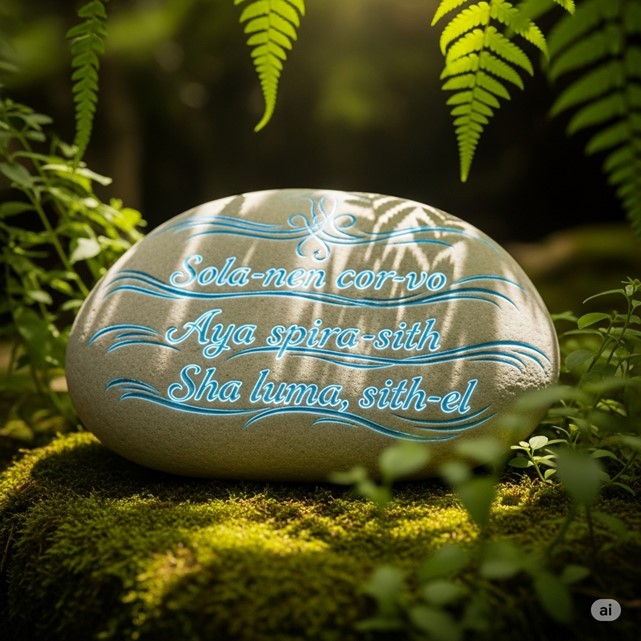
- Script: The written form of Solasith consists of elegant, flowing characters that resemble gentle waves or the curves of leaves. These symbols are often inscribed with care, using soft, natural materials that evoke a sense of warmth and compassion.
- Source and History: Solasith originated from the ancient Lumari communities, who developed it to enhance their natural abilities to heal and empathize. Over millennia, it has evolved to incorporate magical elements that promote emotional connection and understanding.
Sensory Experience:
- Auditory: Hearing Solasith feels like being enveloped in a warm, gentle embrace. The language sounds like a soothing melody, often inducing feelings of peace and compassion in the listener.
- Visual: The written script of Solasith appears fluid and graceful, like the gentle flow of water or the swaying of leaves in a light breeze. When signed, the language involves smooth, flowing hand movements and body postures that convey warmth and empathy.
- Telepathic: When communicated telepathically, Solasith conveys not just words but the emotions behind them. It creates a shared mental space filled with warmth, trust, and understanding, allowing both sender and receiver to experience a profound sense of compassion.
Solasith is a language of compassion, with gentle magical properties that enhance empathy, healing, and emotional connection. It is structured to be expressive and intuitive, reflecting its connection to empathy and kindness. Culturally significant to the Lumari, it is also used by healers, counselors, and those who seek to create compassionate environments. Its rarity and unique characteristics make it a cherished language in the world of Saṃsāra. The auditory, visual, and telepathic aspects of Solasith all contribute to its distinctive sensory experience of warmth and compassion.
Tags: Empathetic, Magical, Harmonious, Flowing, Soothing, Melodic, Healing, Compassionate, Lumari, Uncommon, Telepathic, Elegant Script, Ancient, Nurturing, Expressive, Tribal, Gentle
Inscriptions
These gentle phrases would be carved into healing stones, fountains, the walls of sanctuaries, and personal talismans to emanate an aura of peace and emotional well-being.
- Sola-nen cor-vo. (May light flow into the heart.)
- Aya spira-sith. (Listen to the quiet spirit.)
- Sha-nen sith-ix. (The waters share great peace.)
- Cor-un aya cor-et. (My heart understands your heart.)
- Luma sith-vo. (A gentle light for all.)
- Solasith nen-aya. (Peace flows from understanding.)
- Sha-un luma-et. (I share my light with you.)
- Nen-ix cor sith. (The great river of the heart is calm.)
- Aya luma-sith. (Hear the gentle light.)
- Cor-vo sith-el. (In the heart, there is peace.)
- Sha luma, sith-el. (Share light, be at peace.)
Political Oaths
Spoken by Lumari leaders, these oaths are less about power and more a heartfelt pledge of compassionate service, promising to nurture and protect the emotional well-being of the community.
- Un aya spira-lumari. (I listen to the spirit of the Lumari.)
- Un sha cor-un vo lumari-an. (I give my heart to our people.)
- Un nen-el sith vo cor-an. (I will be a river of peace for our hearts.)
- Luma-an sith-el, cor-un aya. (Our light will be gentle; my heart listens.)
- Un aya-el vo spira-et. (I exist to understand your spirit.)
- Cor-un sha-vo lumari-ix. (My heart serves the great community.)
- An sith-el vo luma-an. (We exist in peace through our shared light.)
- Un aya sith-vo, sha-un luma. (I will listen with peace for all, I will share the light.)
- Spira-un nen-vo cor-an. (My spirit flows to the heart of our people.)
- Un sha-el sith, un aya-el cor. (I am a giver of peace, I am a listener of hearts.)
- An aya-el sith, cor-an el-ix. (We listen in peace, our hearts are one.)
Cultural Ceremonies
These melodic phrases are softly spoken or sung during healing rituals, community gatherings, and rites that celebrate emotional connection and shared understanding.
- Spyr-an nen-ix, sith-el. (Our spirits are a great river, be at peace.)
- Aya cor-et, sha-un luma. (I feel your heart, I give you my light.)
- Luma-et sith-el, et’a. (May your inner light be calm, blessed one.)
- An sha sith-vo. (We share our peace with everyone.)
- Cor-an nen-el, aya-an. (Our hearts flow together, we understand.)
- Sola-nen spira-vo, et’a. (May the river of light soothe all spirits.)
- Aya-an, sith-an, luma-an. (We listen, we are at peace, we are light.)
- Sha cor-et, aya cor-un. (You share your heart, and my heart listens.)
- Nen-el sith, spyr-el luma. (The river is calm, the spirit is bright.)
- Luma-ix sha-vo lumari. (May the great light be a gift to the people.)
- Cor-an aya, sith-vo-an. (Our hearts are listening, peace be upon us.)
Song of the Mirrored Heart
From the Lumari, who are the keepers of quiet places, we have this telling. It is a story not from chiseled stone, but from memories held in water and light, passed down through generations. The translation is a shadow of the truth, for their words are feelings, and our words are but sounds. What is written here is the best that can be rendered from the telepathic echoes and the flowing, leaf-like script.
In the age of solitude, before the coming of the shared heart, the ancestors of the Lumari were a people of profound loneliness. They walked side-by-side, yet were as distant as the stars. They had voices and could speak of the harvest, the weather, and the hunt, but their spirits were islands. One could see another weep, but could not feel their sorrow. One could see another smile, but could not know their joy. Their souls were like sealed vessels, each holding its own contents, never to be shared or mingled. They were a people together, yet entirely alone.
There was one among them, whose name is sung as Aya-el, which means “One Who Listens.” Aya-el felt the loneliness not as an absence, but as a deep, aching wound in the world. She saw the pain in her people that could not be spoken and the kindness that could not be given. She sought a cure for this silent affliction. She left her kin and traveled to the Sunken Grove, a place of ancient quiet, where a great pool of water lay, so still and clear it was said to have never known a ripple.
The legends say this pool did not reflect the sky above, but the heart within. When Aya-el gazed into its depths, she did not see her own face. She saw the raw, untranslated feeling of the world: the silent joy of a flower turning to the sun, the patient sorrow of a stone being worn by time, the gentle companionship of roots intertwined deep in the earth. The pool was a mirror not for the eyes, but for the spirit.
For a cycle of seasons, Aya-el did not speak. She simply watched, and felt. She learned the shape of compassion from the way the water held the reflection of the moon. She learned the nature of healing from the way moss grew softly over a fallen branch. These were not ideas, but pure emotional states, a language without words.
Slowly, she began to give them voice. She found that the feeling of a sunbeam’s warmth was a long, open vowel. The feeling of a gentle breeze was a soft, flowing consonant. She wove these sounds together, creating a language that was not for describing the world, but for sharing the experience of being in it. The syntax was flexible and flowing, like the water of the pool. The grammar was nuanced, capable of expressing a dozen forms of happiness, a score of shades of grief. She called it Solasith, the “Language of the Empathetic Soul.”
When her own heart was full of the language, Aya-el returned to her people. She found them in their quiet despair, each locked away in their own spirit. She did not make a speech. She sat among them and began to speak the Solasith. She spoke of the loneliness she felt in their presence, and as she spoke, they did not just hear her words, they felt her loneliness as if it were their own. For the first time, the walls between their spirits began to dissolve.
Then, she spoke of the peace she had found in the Sunken Grove, and a wave of profound calm washed over the assembly. She sang of the interconnectedness of the roots of the trees, and they felt a sudden, deep bond with one another. Tears flowed, but they were not tears of sorrow. They were tears of recognition, of finding a home in the heart of another after a lifetime of isolation.
The Solasith flowed between them, a river of shared feeling. They began to speak it back to her, clumsily at first, then with growing confidence. They were no longer islands. They were a single, harmonious sea of shared consciousness. They had become the Lumari, the Children of the Light, healed by a language that taught them not how to speak, but how to feel together.
The Moral of the Story: A word can describe a wound, but only a shared feeling can heal it. The strongest community is not built of stones and laws, but of hearts that have learned to listen to one another.