
Magical Powers: Fidhal possesses potent magical properties that enhance steadfastness, resilience, and the fulfillment of pledges. When spoken or signed with intent, it can fortify one’s resolve, ensure the completion of tasks, and reinforce bonds of duty and responsibility. The language can also be used in rituals to sanctify commitments and to imbue objects or people with the essence of unwavering dedication.
Linguistic Attributes and Characteristics:
- Phonetics: Fidhal is characterized by firm, resonant sounds and steady, rhythmic intonations. The language is spoken with a clear, unwavering voice, projecting determination and purpose. It incorporates many deep vowels and strong consonants, creating a sense of firmness and stability.
- Syntax and Structure: The language uses a Subject-Verb-Object (SVO) structure, emphasizing the clarity of action and intent. This structure reflects the language’s focus on straightforward, decisive communication, suitable for commitments and promises.
- Grammar: Fidhal has a robust grammatical system with numerous affixes and particles to denote degrees of commitment, intensity, and timeframes. It employs a variety of formal constructs to convey respect, seriousness, and the weight of promises. The grammar is designed to be clear and authoritative, ensuring that commitments are precise and understood.
Cultural Identity and Users:
- Cultural Significance: Fidhal is primarily spoken by the Stalwarts, a culture renowned for their unwavering dedication and sense of duty. The language is central to their culture, reflecting their values of perseverance, honor, and unyielding commitment.
- Users: While it is the native language of the Stalwarts, Fidhal is also learned by knights, guardians, and leaders who seek to formalize vows and reinforce their commitments. It is spoken in regions and communities where duty and perseverance are highly valued.
Rarity, Type, Script, Source, and History:
- Rarity: Fidhal is relatively uncommon, known primarily to those who prioritize duty and commitment or who have close interactions with the Stalwarts.
- Type: It is a spoken, written, and sign language, with a telepathic component for those skilled in mental fortitude and binding. The telepathic form often involves sharing vivid images of the tasks and responsibilities being committed to.
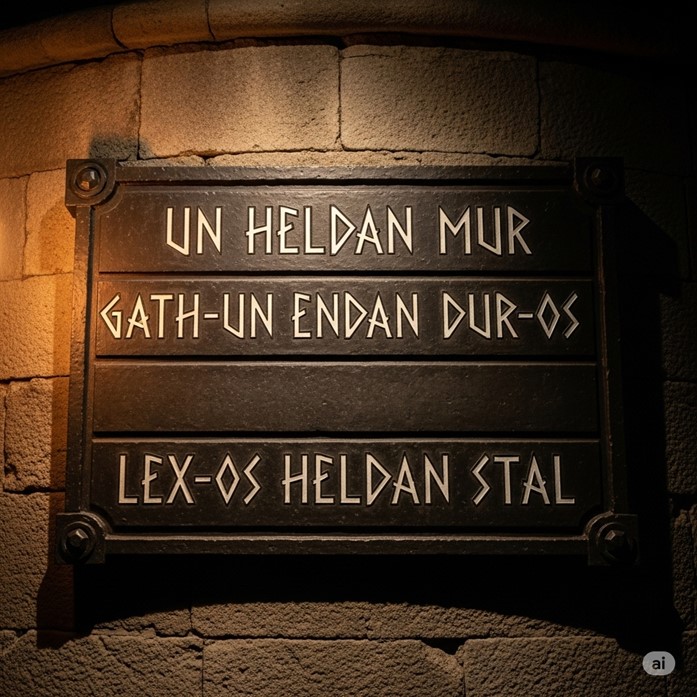
- Script: The written form of Fidhal consists of bold, angular characters that resemble sturdy pillars or solid foundations. These symbols are often inscribed with care and precision, using durable materials that reflect the enduring nature of the commitments made in the language.
- Source and History: Fidhal originated from the ancient Stalwart communities, who developed it to formalize and reinforce their strict codes of duty and responsibility. Over centuries, it has evolved to include magical elements that enhance the binding nature of promises and commitments.
Sensory Experience:
- Auditory: Hearing Fidhal feels like listening to a solemn, steadfast pledge. The language sounds firm and resolute, often inducing feelings of trust and reliability in the listener.
- Visual: The written script of Fidhal appears strong and enduring, like the pillars of a fortress or the solid lines of a foundation. When signed, the language involves deliberate, steady hand movements and body postures that convey strength and certainty.
- Telepathic: When communicated telepathically, Fidhal conveys not just words but the sensation of firm, unyielding determination. It creates a mental image of solid structures and steadfast resolve, enhancing the feeling of commitment and reliability.
Fidhal is a language of committed dedication, with powerful magical properties that enhance the ability to reinforce and fulfill pledges, duties, and responsibilities. It is structured to be clear and authoritative, reflecting its connection to steadfastness and reliability. Culturally significant to the Stalwarts, it is also used by knights, guardians, and leaders. Its rarity and unique characteristics make it a respected language in the world of Saṃsāra. The auditory, visual, and telepathic aspects of Fidhal all contribute to its distinctive sensory experience of unwavering commitment and reliability.
Tags: Steadfast, Magical, Resonant, Rhythmic, Unyielding, Authoritative, Binding, Resolute, Stalwart, Uncommon, Telepathic, Angular Script, Ancient, Dutiful, Honorable, Tribal, Reliable
Inscriptions
These firm phrases would be carved into fortress gates, shields, guardian statues, and the blades of sentinels to magically reinforce their purpose and resilience.
- Un heldan mur. (I defend the wall.)
- Gath-un endan dur-os. (My resolve endures the great age.)
- Thane-un bindan un. (My duty binds me.)
- Lex-os heldan stal. (The great law protects the people.)
- Kor-et endan. (Your vow will endure.)
- Un heldan thane-un. (I uphold my duty.)
- Mur-os endan. (The great wall endures.)
- Gath-et heldan et. (Your spirit defends you.)
- Lex bindan kor-un. (The law binds my pledge.)
- Un endan vo thane. (I endure for duty.)
- Stal-os heldan an. (The great foundation protects us.)
Political Oaths
These are solemn, magically binding oaths sworn by leaders, knights, and officials, formalizing their unwavering commitment to their people and responsibilities.
- Un bindan gath-un vo stal. (I bind my spirit to the people.)
- Un vowan thane-un vo lex-os. (I vow my service to the great law.)
- Un heldan stal-an vo dur-os. (I will defend our people for a great age.)
- An bindan kor-an vo stal. (We bind our pledge to the people.)
- Un vowan gath-un, thane-un, kor-un. (I vow my resolve, my duty, my pledge.)
- Un heldan lex vo gath-un. (I uphold the law with my spirit.)
- An endan vo stal-an. (We endure for our people.)
- Un bindan un vo thane-os. (I bind myself to the great duty.)
- Un vowan stal vo mur-un. (I vow the people are my shield.)
- An heldan kor-an, thane-an. (We keep our vows, our duties.)
- Un bindan lex-un vo stal-os. (I bind my word to the great people.)
Cultural Ceremonies
These resonant phrases are recited during rites of passage for new guardians, ceremonies sanctifying a public trust, or rituals of remembrance for fallen heroes.
- An heldan kor-an, stal-vo. (We uphold our pledge for the people.)
- Et vowan thane-et, et’a. (You vow your duty, honored one.)
- Gath-an endan vo kor-os. (Our spirit endures for the great vow.)
- An bindan gath-an, stal-os. (We bind our spirits as one great people.)
- Kor-an heldan an, dur-vo. (Our pledge sustains us for all time.)
- Et heldan thane-et, gath-vo. (May you uphold your duty with all your spirit.)
- An vowan dur vo mur-an. (We pledge our time to our defense.)
- Gath-os bindan stal-an. (A great resolve binds our people.)
- An heldan et, kor-vo. (We stand with you, for the vow.)
- Stal-an endan, thane-vo. (Our people endure for the sake of duty.)
- Kor-os bindan an. (The great pledge binds us all.)
Saga of Adamant Word
From the foundational archives of the Stalwarts, transcribed from inscriptions cut deep into the bedrock beneath their oldest fortresses, we attempt a telling of the origin of their tongue. The meaning is difficult, for each glyph is a statement of permanence, and our own fleeting words are ill-suited to capture such weight. What is written here is but a shadow of the true resolve found in the original Fidhal.
In the age of shifting foundations, before the first unyielding vow was made, the people who would become the Stalwarts were a folk of fractured purpose. Their homes were built of unbound stone and their promises were made with uncommitted breath. Their words were like dry leaves, scattered by the first wind of hardship. A wall promised for a season would stand but a moon. A pledge of mutual defense would last only until the first sign of true danger. Their society was built upon crumbling earth and crumbling faith; each tremor in the ground was met by a tremor in their spirit. They were a people without anchor, and their works were transient.
The chronicles speak of a great calamity, the Long Tremor, an age where the very bones of the world were wracked with a ceaseless shaking. The mountains groaned and the plains buckled. What little the people built was thrown down, and their despair was a chasm.
It was in this time of ruin that one called the Oath-Maker, whose true name is inscribed only on the hidden keystone of the First Citadel, saw the truth of their decay. Their weakness was not in their hands, but in their hearts and on their tongues. Their commitments were as unstable as the ground upon which they stood. To build a future that could withstand the Tremor, they first had to forge a will that would not shake.
The Oath-Maker, seeking a source of permanence, did not look to the tumultuous sky or the fleeting life of the surface. They journeyed down, into the deep, silent places of the earth. For a time that the tablets measure in seasons of darkness, they descended, following the roots of the mountains to the core of the world’s stability. There, the story tells, they found the Great Anvil, the immovable heart of the continent, a single, vast stone that knew no tremor and had never shifted.
It did not speak, yet it had a voice. It was the sound of immense pressure, of unyielding existence, a deep, resonant, and unwavering hum. It was the sound of is. This, the Oath-Maker knew, was the phoneme of endurance. The strong consonants were the hard edges of the stone; the deep vowels were its resonant, unwavering soul.
Upon returning to the surface, the Oath-Maker did not just teach these sounds. They taught a new way of building a sentence, a structure as strong as a fortress wall. They explained that a promise, like a building, requires a foundation. First, you must declare the builder, the one who takes responsibility. The Subject. Then, you must state the action, the raising of the walls. The Verb. Finally, you must name the purpose, the roof that completes the structure and gives it meaning. The Object. This clear and authoritative order—Subject-Verb-Object—was the architecture of a true commitment.
The Oath-Maker gathered the scattered people amidst the ruins of their greatest town. They did not shout. They spoke with the firm, resonant voice of the stone, and they made the first vow in the new tongue, Fidhal.
“Un heldan mur.” (I will defend the wall.)
The sentence was not a suggestion or a hope. It was a structure, solid and complete. The magic in the words, the echo of the Great Anvil’s permanence, flowed into the assembled people. They felt the vow not as a sound, but as a settling in their own spirit, a hardening of resolve. They began to speak it with him, and with each utterance, their collective will became a bulwark against the chaos.
They used Fidhal to vow the raising of new walls, and those walls stood. They used it to pledge their duty to one another, and their society became a fortress. The language became their greatest tool, a way to magically imbue their intentions with the unshakeable certainty of the world’s core. They had become the Stalwarts, a people whose promises were as strong as their foundations, and the Long Tremor ceased to be a terror, for they had built a will that would not be shaken.
The Moral of the Story: The strength of a structure is not found in its materials alone, but in the unwavering commitment of the one who lays the first stone. A promise, when truly made, is the most durable foundation in the world.