
Definition: Lumaraan is a mysterious and ancient language that emphasizes bewilderment and awe-inspiring experiences. It enables beings to convey their most profound feelings of astonishment, perplexity, and wonder. Lumaraan transcends species barriers, allowing different creatures to share and understand bewildering emotions and concepts.
Magical Powers: Lumaraan possesses subtle magical powers rooted in the emotions it conveys. When spoken or expressed with genuine bewilderment, it can create enchanting illusions or awaken dormant memories of forgotten wonders in the minds of listeners. These magical effects are often subtle and closely tied to the emotional state of the speaker.
Linguistic Attributes and Characteristics:
- Bewilderment Focus: Lumaraan features an intricate lexicon specifically designed to describe a vast array of bewildering experiences, encompassing both mundane and fantastical wonders.
- Ethereal Resonance: Lumaraan’s sounds and syllables have a hauntingly ethereal quality, creating an otherworldly and mesmerizing effect on those who hear it.
- Synesthetic Imagery: The language relies heavily on metaphors and synesthetic imagery, enabling speakers to convey bewildering experiences through multiple senses simultaneously.
Structure: Lumaraan is structured with a balance of poetic eloquence and mathematical precision. It uses tonal variations, rhythm, and precise intonations to convey the depth of bewilderment within the speaker’s emotions.
Cultural Identity and Users: Lumaraan is closely associated with ancient and enigmatic cultures that venerate the natural world, celestial wonders, and the unknown. Seers, hermits, wanderers, and seekers of hidden truths are most likely to use Lumaraan. Its use often requires initiation into secret circles or extensive training under experienced speakers.
Rarity, Type, Script, Source, and History:
- Rarity: Lumaraan is exceedingly rare, often considered a language reserved for those who have a profound connection to the mysteries of the universe.
- Type: It is primarily a spoken language, as its magical essence is most potent when communicated through sound and vocal expression.
- Script: The script of Lumaraan is an intricate series of swirling symbols, resembling celestial constellations. It is used sparingly for sacred texts and arcane inscriptions.
- Source: Legend attributes Lumaraan’s creation to a celestial being or an ancient cosmic event that imbued the language with the essence of bewilderment.
- History: Lumaraan has an illustrious history dating back to an ancient civilization that revered cosmic phenomena. It was initially used as a form of communication between those who gazed at the stars in wonder and sought to unravel the enigmas of the universe.
Sensory Experience: Speaking or hearing Lumaraan is a transformative experience. It can evoke vivid images of breathtaking landscapes, ethereal music, and celestial phenomena in the minds of listeners. The language often gives rise to a sense of awe and humility, as if one is in the presence of something truly grand and enigmatic. Proficient speakers of Lumaraan may even experience subtle shifts in reality, perceiving the world through a lens of bewilderment that reveals hidden wonders and connections.
Tags: bewilderment, awe, wonder, illusion, celestial, ethereal, synesthetic, resonance, poetic, cosmic, initiation, secretive, transformative, mystical, constellation-script, enigma, reverence
Inscriptions (11 ceremonial phrases)
- “Luma’raen velithar” – May bewilderment illuminate this place.
- “Sorael thren lumara” – Wonder is etched within these walls.
- “Veluun throskai” – Here lies the eternal mystery.
- “Nuvarel lumaaren kai” – The stars themselves gaze in astonishment.
- “Thalra venith lumar” – May awe echo through these stones.
- “Zor’el kai lumaraen” – The cosmos breathes bewilderment here.
- “Trelith mor’vel luma” – This ground binds wonder to all who tread.
- “Kai’thros eluun venra” – Secrets rest here, bewilderment preserved.
- “Lumaar venith kairos” – May the unknown live eternal.
- “Saren kai’lumaen thros” – Bewilderment shields what is hidden.
- “Velthar lumaar morai” – Here astonishment becomes everlasting truth.
Political Oaths (11 ceremonial phrases)
- “Lumaen threl kai’vorr” – I swear in bewilderment to uphold my vow.
- “Zorvel kai lumaar thros” – May awe bind me to this path.
- “Thalros velith kai’nor” – By astonishment, I hold allegiance.
- “Sorael thren lumaen” – I pledge to serve in wonder’s shadow.
- “Nuvarel lumara kai” – In bewilderment, my oath is spoken.
- “Veluun kai throsmar” – The unknown becomes my covenant.
- “Throskai lumaen verith” – In awe, I seal my loyalty.
- “Kairos ven lumaraen” – Through wonder, my truth is bound.
- “Zor’en kai lumaar” – The stars witness my vow.
- “Lumaen threllos verai” – By bewilderment, let betrayal undo me.
- “Velthros kai lumara” – With astonishment, I anchor my honor.
Cultural Ceremonies (11 ceremonial phrases)
- “Lumaen throskai venith” – Together we share in bewilderment.
- “Kairos veluun lumara” – In awe, we celebrate the unknown.
- “Sorael thren kairos” – Wonder unites us this day.
- “Nuvarel lumaar thalra” – May astonishment guide our gathering.
- “Throskai lumaen morai” – Let awe echo in our hearts.
- “Velith lumaar kai’neth” – We embrace the mysteries of the stars.
- “Zor’el kai lumara” – The cosmos speaks in bewilderment.
- “Lumaen threllos venra” – We honor the unknowable together.
- “Thalros kai veluun” – Astonishment binds us in harmony.
- “Saren lumaar velthros” – May awe protect our journey forward.
- “Kairos venith lumaraen” – In wonder we are as one.
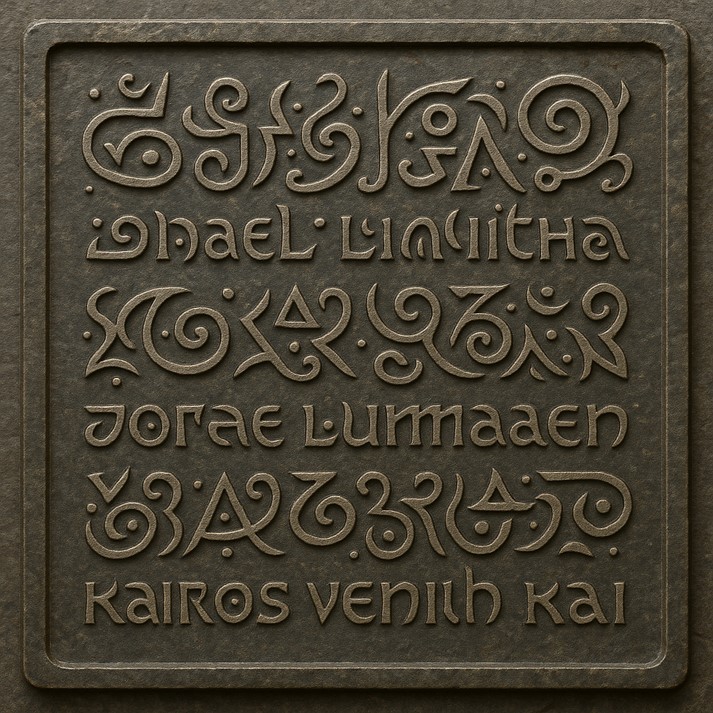
Tongue of Starlit Bewilderment
It is said in the broken fragments of tablets and in the whispers of wind across the high deserts that once there was a people who did not live by harvest, nor by iron, nor by war, but by gazing into the heavens until their eyes wept with light. They spoke a language not of power or bitterness, but of bewilderment, awe, and trembling wonder. This was the speech of Lumaraan, the tongue that came not from mortals, but from the stars themselves, when they hummed their silent hymns across the void.
The tale tells that in the first age, when the firmament split open with fire and rivers of light, a single tribe gathered at the edge of the world. They saw in the skies forms uncountable—shapes of beasts with wings like oceans, rivers flowing backward, suns spiraling like whirlpools. No tongue could describe what they saw. So from their astonishment came utterances, strange syllables shaped by awe and confusion. When spoken, these words carved illusions in the air, so vivid that even those blind from birth claimed to see. The people called this speech Lumaraan.
The earliest keepers of the tongue were said to be star-hermits, who abandoned hearth and kin to sleep beneath the endless sky. They carried bowls of water to catch the night’s reflection, for when they whispered Lumaraan into the water, the ripples revealed visions of forgotten wonders. Some saw worlds that no longer existed, shattered in ancient time. Others saw lives they had never lived, walking in gardens of silver trees or floating on seas of crystal. Still others claimed that the words themselves bent the fabric of waking, so that mountains seemed to shift, and rivers sang with voices of the unborn.
One broken clay fragment, often mistranslated, tells of the Gathering of the Thousand Lanterns. It describes how wanderers from every isle came to a plateau when the sky was thick with stars like sand. They lit lanterns, but each flame flickered in colors unseen before. Then they began to speak Lumaraan together. The words rose like smoke and formed constellations above them. Whole histories of forgotten empires blazed briefly in the night, then vanished into silence. Those who listened too long were forever changed: some wandered away never to return, staring always skyward, while others found they could no longer lie, for bewilderment had stripped them of deceit.
But Lumaraan was dangerous too, though not in anger or curse. Those who lost themselves in its endless awe forgot to eat, forgot to sleep, forgot even their names. A passage, nearly erased by time, warns: “He who drinks too deeply of the bewildering cup shall fall into the stars and never return.” It is said that one great speaker of Lumaraan, a woman called Elthren by later scribes, stood upon a mountain and spoke until her body dissolved into light. To this day, her voice is said to echo in the wind whenever dawn breaks on clear peaks.
The language waned as ages turned, for kingdoms rose who feared it. Kings decreed silence, priests struck carvings from stone, and wanderers who spoke too freely were cast into exile. Yet Lumaraan could not be killed, for bewilderment itself lives wherever mortals lift their eyes to the unknown. Some say the constellations themselves still carry the script, waiting for those who know how to read the skies. Others whisper that the language sleeps in the cracks of mountains, ready to be awakened when awe fills the heart of one who dares to listen.
Fragments remain, poorly translated, scattered across ages. Each version differs, each phrase bent by time and tongue. Yet through all distortions, the core truth shines: Lumaraan is the speech of wonder, and those who dare to utter it call forth both beauty and peril.
Moral of the story: Awe is a gift that can reveal wonders unseen, but to dwell too long in bewilderment is to forget the path beneath your feet.