
(translated loosely as “The Tongue of Wondering Threads”)
Magical Powers
Minor Magical Resonance of Discovery – When spoken with genuine intent, Inquisitori Lexora sharpens perception and focus. Skilled users can momentarily heighten curiosity in others, nudging them to question, investigate, or seek truths otherwise ignored. In rare cases, practitioners channel the language to uncover hidden details—an inscription revealed, a faint sound noticed, or an overlooked clue suddenly apparent. This effect is subtle, not a spell, but a magical stirring of attention and wonder.
Linguistic Attributes and Structure
- Open-Ended Sentences: Often unfinished, leaving listeners to mentally complete the thought. This creates an inherent push toward curiosity and exploration.
- Question-Weighted Vocabulary: Most phrases are formed as inquiries, even when making statements, e.g., “You seek this, yes?” instead of “You seek this.”
- Variable Intonation: Pitch rises and falls unpredictably, mimicking the rhythm of surprise or discovery.
- Gestural Emphasis: Hands, eyes, and posture move dynamically, leaning forward or tilting as if seeking answers.
- Telepathic Layer: Advanced speakers can transmit subtle impressions—tinges of wonder, excitement, or the pull of an unanswered question.
Characteristics of Expression
- Curiosity-Driven: Phrases are designed to draw further thought, often wrapping around a subject rather than defining it directly.
- Metaphorical Imagery: Uses riddles, puzzles, and metaphors to convey even simple ideas, fostering a sense of exploration in communication.
- Fragmentary Writing: The script often leaves intentional gaps or unconnected strokes, visually embodying “the question not yet answered.”
Cultural Identity and Users
- Cultural Identity: Inquisitori Lexora is the language of seekers—those who cannot rest without knowing. It is embraced by archivists, questioners, sages, explorers, and children who never stop asking “why.”
- Who Uses It:
- The Archivists of Dawenkou: scholars who etch fragmented knowledge onto scrolls.
- Wanderer-Guilds: pathfinders, labyrinth-racers, and airship scouts.
- Certain Tricksters and Mystics: who use it to provoke curiosity in others as a tool of manipulation.
- Number of Cultures: At least three major cultures and several minor groups share usage, though each interprets it differently (scholarly, adventurous, mischievous).
Rarity, Type, Script, Source, and History
- Rarity: Uncommon, though not secret. It is difficult to master because it demands a genuine mindset of curiosity.
- Type: Emotive, intellectual, and telepathic.
- Script: Composed of looping glyphs with open ends, appearing like knots left untied. Many resemble spirals, question-marks, or branching trees.
- Source: Said to have originated from the Librarians of the First City, who discovered fragments of forgotten multiversal tongues and wove them into one form of expression.
- History: Legend tells that the first practitioners were children who wandered through the ruins of Saṃsāra’s earliest civilizations. They asked questions no adults dared, and in doing so, found truths hidden for centuries. Their scattered mutterings formed the roots of Inquisitori Lexora.
Sensory Experience
To hear Inquisitori Lexora is to feel drawn forward, as though the words lean toward you, tugging at your thoughts.
- Auditory: Sounds hover in the air, often ending in unfinished lilts that leave the ear wanting more.
- Visual (script): The letters themselves resemble paths cut short, spirals that do not close, or constellations missing a star.
- Emotional: A listener feels a spark of wonder, sometimes even a restless need to investigate further.
- Telepathic Layer: In full practice, an undercurrent of curiosity threads into the mind, like a quiet voice asking: “What lies just beyond?”
Tags: curiosity, inquiry, wonder, discovery, exploration, questioning, mystery, riddles, perception, insight, investigation, knowledge, ambiguity, openness, pursuit, fascination, revelation
Inscriptions
- “Vorath eliren?” – What truth hides beyond the stone?
- “Thuvira senoth?” – Does the path end, or only bend?
- “Korival enisra?” – Who listens when silence speaks?
- “Selorin thavos?” – What question lives forever?
- “Zeylor minath?” – Can discovery ever rest?
- “Mirath volen?” – Where does the hidden door lead?
- “Thariel evros?” – Is curiosity the truest compass?
- “Lorath envir?” – Who writes the story untold?
- “Eryvon thalun?” – Does the horizon call your name?
- “Nivora kelos?” – What answer waits in shadow?
- “Oriven thros?” – Can wonder carve eternity?
Political Oaths
- “Ithar volin serath?” – Shall I lead by seeking, not knowing?
- “Thuvorin enisra?” – Will my rule follow questions unasked?
- “Korath silor?” – Can power stand without curiosity?
- “Selorin venath?” – Do I swear to search, even in doubt?
- “Zorath ivren?” – Will discovery bind my judgment?
- “Norivan thalos?” – Shall truth be my crown unseen?
- “Velorin caleth?” – Does wonder guide the hand of law?
- “Thalor esvin?” – Can absence teach the leader’s heart?
- “Morath evira?” – Is justice the question unending?
- “Seylor thaven?” – Will curiosity keep my path open?
- “Orvath selun?” – Can I bind my reign to wonder?
Cultural Ceremonies
- “Sivora elinath?” – Shall we gather to seek together?
- “Voriel thavros?” – What joy hides in the journey?
- “Thalorin evreth?” – Does discovery crown this day?
- “Eryvon senal?” – Who hears the question of kinship?
- “Nivora calis?” – Can wonder bless us all?
- “Lorath enira?” – Where does curiosity lead our steps?
- “Koriva elthen?” – What mystery ties us as one?
- “Soriven tharos?” – Is adventure the bond eternal?
- “Calira voren?” – Can we honor questions as kin?
- “Velorin esvar?” – Shall curiosity light our night?
- “Zerath thulon?” – What horizon calls us forward?
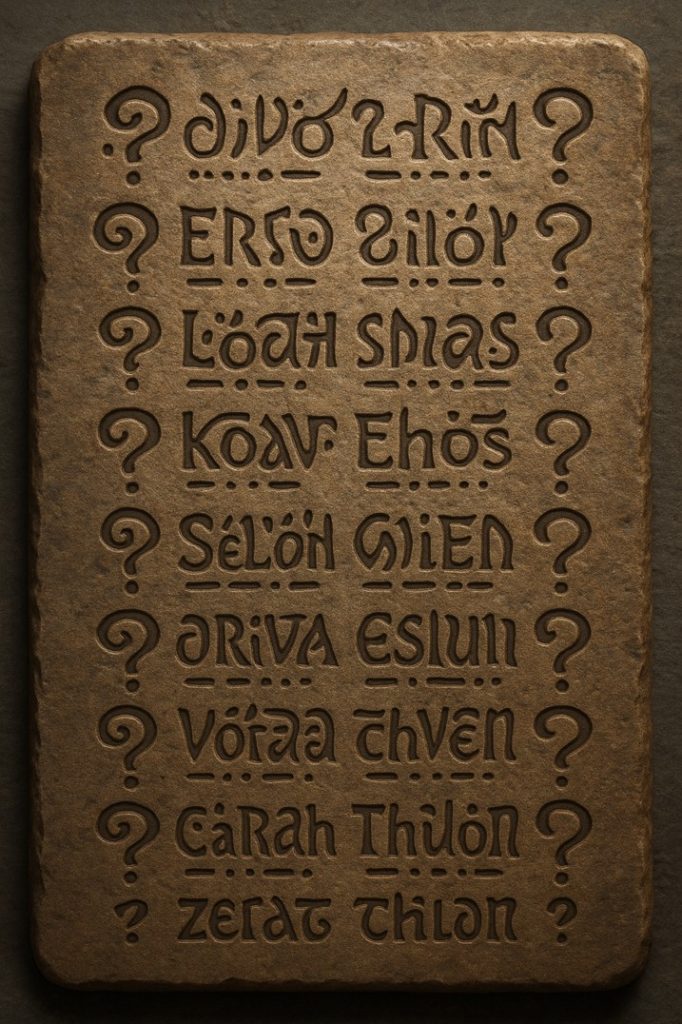
Tongue of Questions Without End
It is told in broken fragments, carved on weathered stones and whispered by wandering sages, that once there was a language not made to give answers, but to stir questions. This language was called Inquisitori Lexora, though older tongues call it by names now lost, perhaps The Thread That Seeks or The Voice That Never Rests. Its tale is long, poorly remembered, and told in crooked shapes, but still it survives in pieces.
In the age before maps, when tribes feared the forests and seas, there lived a people who could not stay still. They felt no comfort in walls, no rest in closed doors. Their children asked “why” of everything—the wind, the stars, the roots beneath their feet. These questions spread like fire, and soon their elders, too, became restless. To give form to this endless seeking, they forged a tongue built not on answers but on wonder: Inquisitori Lexora.
The story says that when first spoken, the language bent the ear. Words rose like unfinished spirals, each tone pulling the listener forward as though a door was always just ahead, waiting to be opened. Sentences ended in rising notes, never closing, leaving the heart restless, the mind stirred. Even the script mirrored this nature: lines that never fully joined, loops left open, symbols resembling constellations missing stars.
It is said the first to wield it was a child named Selorin, who wandered into the ruins of a forgotten city. He spoke aloud in his questions, and the walls answered—not with voices, but with echoes of secrets hidden in cracks and shadows. Where others saw rubble, he saw paths. Where others saw silence, he heard whispers of history. By his words, the ruins gave up truths long buried.
But the tale turns, as all tales do. For while Inquisitori Lexora could inspire wonder and discovery, it also sowed unrest. Those who spoke it too often found themselves unable to be content. They abandoned their families, their homes, their treasures, always chasing what lay beyond the next horizon. Some vanished into deserts, others into storms, never to return. Their last words, carved in their language, often ended mid-sentence—as though even death could not finish the thought.
Still, the language endured. Wanderer-guilds used it in ceremonies, their oaths not pledges of loyalty but of seeking. Archivists etched its phrases on scrolls, knowing the gaps would draw others to search for what was missing. Tricksters spoke it to lead others astray, their questions so sharp they unraveled certainty. Even now, broken phrases linger in the mouths of children, whose questions echo the first wanderers, though they know not why.
And always, the story ends with the same crooked lesson: Inquisitori Lexora is not a tongue of answers, but of journeys. To speak it is to step onto a road without end, to feel the pull of mystery, to find meaning not in what is known but in what forever lies ahead.
Moral of the Story: Curiosity is the fire that never dies; it burns not to consume, but to light the path into the unknown.