
Inquirus is a unique language centered entirely around the concept of curiosity. It is not used to state facts, but to ask questions, propose hypotheticals, and express a deep sense of wonder. The two most fundamental words in Inquirus are Q’lar (pronounced k-lar), which means “the spark of a question” or “the beginning of an inquiry,” and Sce’thra (pronounced skay-thra), which refers to “the path of discovery” or “the unraveling of a mystery.”
Magical Powers
Yes, Inquirus possesses a subtle but potent form of magic. When spoken with genuine curiosity, the language can create a magical effect that reveals a hidden detail related to the subject of the inquiry. This is not a grand illusion or a powerful curse, but a minor revelation—a loose floorboard might creak, a faint scent of perfume might become noticeable, or a nearly invisible seam in a stone wall might catch the light. Skilled speakers can use this magic to aid in investigations, discover secrets, and find hidden paths, essentially “persuading” reality itself to offer a clue.
Linguistic Attributes and Structure
The language is designed to be inherently inquisitive, avoiding declarative statements wherever possible.
- Linguistic Attributes: Inquirus is characterized by lilting, questioning tones, with most phrases ending in a rising inflection similar to a question in many other languages. It avoids definitive or absolute terms, instead favoring words that suggest possibility, potential, and mystery.
- Structure: The structure of Inquirus is unique, built around the Q’lar (the question) rather than a subject. A typical sentence begins with the core inquiry, followed by clauses and modifiers that add context. For example, instead of saying “The diplomat stole the jewel,” an Inquirus speaker would construct the phrase as, “What is the mystery (Q’lar) of the missing jewel, and what is the path (Sce’thra) that might lead to the diplomat?”
Cultural Identity and Users
Inquirus is not the language of a nation but of a specific, like-minded subculture that transcends species and borders.
- Cultural Identity: The language is a cornerstone for a culture that values questions over answers, and the journey of discovery over the destination. To its speakers, a fact is a dead end, but a good question is a doorway to infinite possibilities.
- Who Uses It: Inquirus is primarily used by scholars, arcane researchers, detectives, cartographers, spies, and investigative journalists. They use it to communicate complex hypotheticals and to subtly use its magic to aid their work.
Rarity, Type, Script, Source, and History
- Rarity: Inquirus is relatively rare. While many in academic or investigative circles may know a few phrases, true fluency is uncommon and a sign of a dedicated and inquisitive mind.
- Type: It is an Inquisitive language, a category focused on exploration and questioning rather than simple communication.
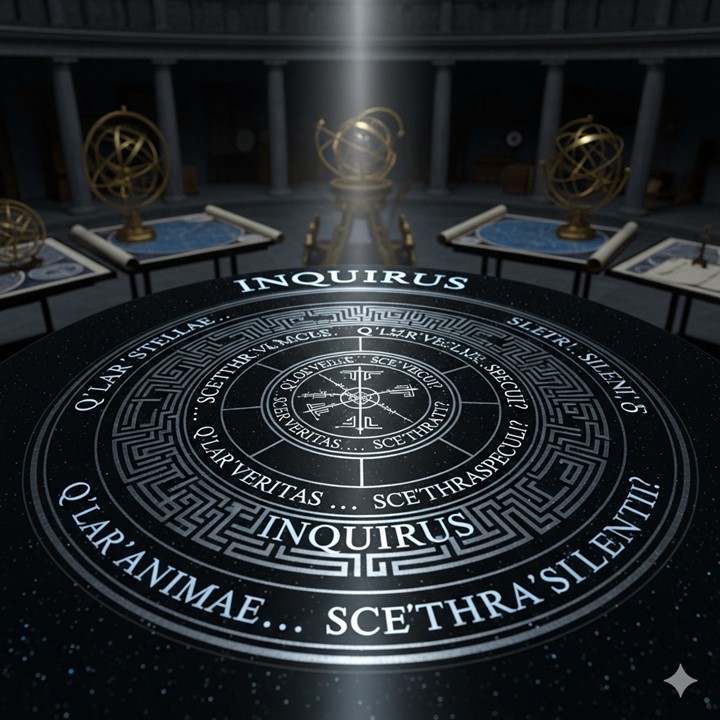
- Script: The script of Inquirus is as unique as its structure. Each sentence is written as a spiral. The core question, or Q’lar, forms a central glyph, and the rest of the sentence spirals outward from it, with each clause forming a new layer of the spiral. The script is beautiful and complex, resembling an intricate, spiraling labyrinth of glyphs.
- Source and History: The language is believed to have been developed by an ancient society of investigators and mystics known as the “Seekers of the First Why.” They created the language as a tool to help them unravel the greatest mysteries of the world and the multiverse. The original source is lost to time, but the language is preserved in their hidden archives and passed down through mentorship.
Sensory Experience
Speaking and hearing Inquirus is a profoundly stimulating intellectual experience. The language doesn’t feel like an exchange of information but rather like a shared exploration of a puzzle. The lilting, melodic tones create a sense of wonder and anticipation. For the listener, hearing a well-phrased Inquirus question doesn’t feel like being interrogated; it feels like being invited on an adventure. It ignites a spark of curiosity in the mind, making the world seem suddenly more interesting, layered, and full of tantalizing possibilities waiting to be discovered.
Tags: Inquisitive, Curious, Questioning, Hypothetical, Exploratory, Investigative, Magical, Revealing, Rare, Scholarly, Spiraling, Glyphic, Written, Vocal, Melodic, Subtle, Wonder
Inscriptions (Riddles on Stone & Gates of Inquiry)
These are not statements but inquiries, inscribed in a spiraling script on libraries, observatories, and ancient ruins to provoke thought and wonder.
- Q’lar’stellae… Sce’thra’vacui? – The question of the stars… is it a path into the great void?
- Q’lar’veritas… Sce’thra’speculi? – The question of truth… is its path found in a mirror?
- Q’lar’primum… Sce’thra’ultimum? – The question of the first beginning… is it the path to the final end?
- Q’lar’animae… Sce’thra’silentii? – The question of the soul… is its path discovered in silence?
- Q’lar’hoc’locus… Sce’thra’cuius’memoriae? – The question of this place… whose memory forms its path?
- Q’lar’clavis… Sce’thra’ianuae’ignotae? – The question of the key… is it the path to an unknown door?
- Q’lar’verbi… Sce’thra’creationis? – The question of the word… is it the very path of creation?
- Q’lar’umbra… Sce’thra’lucis’absconditae? – The question of the shadow… is it the path to a hidden light?
- Q’lar’finis… Sce’thra’initii’novi? – The question of the end… is it the path to a new beginning?
- Q’lar’magiae… Sce’thra’mundi’experrecti? – The question of magic… is it the path to an awakened world?
- Q’lar’nos… Sce’thra’universi? – The question of ourselves… is it the path to the universe?
Political Oaths (Vows of Seeking)
These are not pledges of action but of mindset. A leader speaking Inquirus swears to remain curious, to seek all sides of an issue, and never to accept a simple answer.
- Q’lar’populi… Sce’thra’mea’erit? – The question of the people… shall it now become my path?
- Q’lar’iustitiae… Sce’thra’sine’fine’quaeram? – The question of justice… shall I seek its path without end?
- Q’lar’omnis’vocis… Sce’thra’intellectus’mei? – The question of every voice… will it be the path of my understanding?
- Q’lar’futuri… Sce’thra’dubitationis’semper? – The question of the future… will its path always be one of doubt and inquiry?
- Q’lar’inimici… Sce’thra’empathiae’possibilis? – The question of the enemy… could it be a path to possible empathy?
- Q’lar’legis… Sce’thra’spiritus’flexibilis? – The question of the law… is its path one of a flexible spirit?
- Q’lar’progressus… Sce’thra’erroris’admissi? – The question of progress… is its path built upon admitted mistakes?
- Q’lar’potestatis… Sce’thra’quaestionis’aeternae? – The question of power… shall its path be one of eternal questioning?
- Q’lar’coniunctionis… Sce’thra’diversitatis’honoratae? – The question of unity… is its path found through honoring diversity?
- Q’lar’pacis… Sce’thra’ardua’sed’digna? – The question of peace… is its path difficult, yet worthy?
- Q’lar’veritatis’occultae… Sce’thra’vigilantiae’meae? – The question of the hidden truth… will it be the path of my vigilance?
Cultural Ceremonies (Rites of Inquiry)
These ceremonies mark the beginning of a journey, the start of an education, or the celebration of a great mystery, focusing on the beauty of the unknown.
- Q’lar’vitae’tuae… Sce’thra’nunc’incipit? – The question of your life… does its path begin now?
- Q’lar’ignoti… Sce’thra’communis’nostra? – The question of the unknown… shall it now be our shared path?
- Q’lar’discipuli… Sce’thra’magistri’quoque? – The question of the student… is it also the path of the master?
- Q’lar’coniugii… Sce’thra’mysterii’duorum? – The question of this union… is it a path into the mystery of two souls?
- Q’lar’artis… Sce’thra’sine’responso? – The question of art… is it a path without a final answer?
- Q’lar’memoriae… Sce’thra’futuri’informati? – The question of this memory… can it be a path to shape the future?
- Q’lar’aenigmatis… Sce’thra’gaudii’puri? – The question of the puzzle… is its path one of pure joy?
- Q’lar’novi’civis… Sce’thra’interrogationis’novae? – The question of a new citizen… are they a path to a new inquiry for us all?
- Q’lar’doloris… Sce’thra’sapientiae’partitae? – The question of this sorrow… can its path lead to a shared wisdom?
- Q’lar’voti… Sce’thra’stellae’cadentis? – The question of this wish… is its path that of a falling star?
- Q’lar’caerimoniae… Sce’thra’miraculi? – The question of this ceremony… is it the path to wonder?
First Questioner and Silent Answer
Let the tale be told of the Age of Certainty, when the world was a finished book and its pages were read to all. In this time, the gods had given their people every answer. They explained the turning of the stars, the nature of the soul, and the purpose of every living thing. And because all was known, the people were content. They lived in a city of perfect order, where every soul was a gear in a faultless machine, and the greatest taboo was to ask “Why?”. For in a world of answers, a question is a flaw.
But a child was born with a flaw. His name, as it is translated, was Scruton, and he was born with a hole in his mind, a space that the gods’ answers could not fill. When he was told that the sky was blue, he wondered if it had ever been green. When he learned the perfect history of his people, he wondered about the pages that were not written. His questions were seen as a sickness, a crack in the perfect vessel of their society.
The elders, in their wisdom, exiled him. “You seek answers that are not needed,” they said. “Go into the wilderness, where there are no answers, and let the silence cure you of your wonder.”
So Scruton was cast out into the unknown lands. And there, in the silence, he was not cured, but freed. He began not to seek answers, but to give form to his questions. He saw that a question was not a simple thing. It was a spark, a central point of wonder that he called the Q’lar. He drew its symbol in the dirt, a glyph to mark the beginning of an inquiry.
From that spark, he realized, his mind would spiral outwards. The first question would lead to another, and another, in an ever-widening path of discovery. He began to draw this path, this Sce’thra, as a labyrinth of glyphs spiraling out from the central Q’lar. In so doing, he created a script that was not a record of a thing, but a map of a thought.
And then a magic came to be. As Scruton sat by a stream and traced the spiral for, “What is the mystery (Q’lar) of this water, and what is its path (Sce’thra) from the mountain?”, he saw a flicker of unusual light. A stone on the riverbed, which he had overlooked, was revealed to have a vein of strange, singing metal within it. When he later formed the question of a silent, barren tree, the very act of his inquiry seemed to persuade a vine to shift, revealing a hidden bird’s nest deep within its branches. The world, it seemed, did not offer answers to a loud demand, but it would offer clues to a well-formed question.
This was the birth of Inquirus. It was not a language for stating what is, but for exploring what could be. Scruton never returned to the City of the Final Word. He instead founded a new settlement in the wilds, a place for other outcasts who were afflicted with the beautiful sickness of wonder. It was a place where the greatest scholar was not the one with the most answers, but the one who could ask the most beautiful question.
Moral of the story: An answer is a destination; a question is a journey.