
Deity Name: Solenne Viridara
Lore:
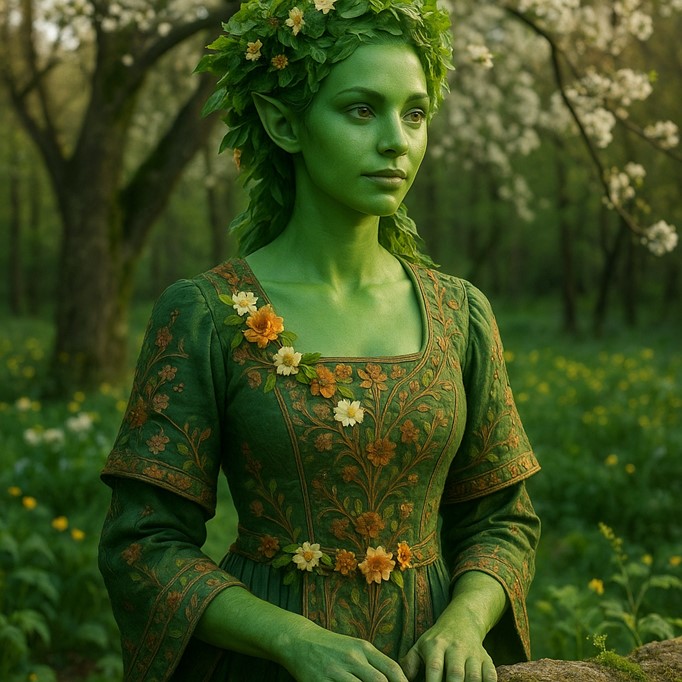
The Verdant Crown of Solenne is the faith of the flowering and the root, binding mortal life to the eternal cycle of soil, seed, bloom, and decay. Followers believe that Solenne Viridara was the first to awaken from the earth’s embrace at the dawn of Villanovan lands, born when Helios’ mid-summer light met the cool breath of the moon’s shadow. Her form is both plant and person—her skin dappled with petal patterns, her hair a crown of seasonal blossoms, and her voice like rain upon leaves. She is said to have walked among early peoples, teaching them the art of root-binding (deep agriculture), the songs that draw pollinators, and the rituals to call the rain. In myth, she wove the first gardens that never withered and bound the hearts of rulers to the tending of land before conquest of seas.
The faith holds that her will is carried in the crown of flowers she wears, each blossom representing an aspect of life: growth, nourishment, patience, protection, and renewal. When petals fall, they root where they land, forming sacred groves. Each reigning sovereign of Villanovan claims to wear a ceremonial crown shaped after Solenne’s, binding their rulership to her divine stewardship.
Personality:
Solenne is depicted as serene but unyielding, nurturing to the faithful but merciless to those who spoil land and water. She embodies patience, seasonal wisdom, and quiet strength, favoring those who work with the rhythm of nature rather than against it. While she delights in beauty, she values it only when it grows from balance and necessity.
Traits & Characteristics:
- Guardian of agricultural cycles and seasonal balance
- Patroness of pollinators, gardeners, herbalists, and rulers who govern justly
- Advocate of harmony between mortal settlements and the wild
- Avenger against corruption of soil, overharvest, or the wasting of life’s gifts
- Her worship enforces a code of stewardship: every citizen must plant and tend a living thing each year in her honor
Attributes:
- Domains: Growth, Fertility, Renewal, Protection, Justice, Rain
- Alignment Tendency: Balanced between order and adaptability, valuing cyclical harmony over rigid law or chaos
- Magical Affinities: Plant growth, purification of food and water, calming of aggressive creatures, and seasonal blessings on harvests
Symbols:
- Primary: A blooming crown with seven distinct flowers (one for each weekday of the Saṃsāra calendar)
- Secondary: A seed cupped in two leaves, the rising sun framed behind it
- Colors: Deep green, gold, and soft white
- Animal Motif: The pollinating bee and the protective mantis
- Plant Motif: Olive branch intertwined with blooming lily
Tags:
Growth, Fertility, Renewal, Stewardship, Agriculture, Pollinators, Seasonal Rites, Justice, Protection, Rain, Harmony, Roots, Crown, Sacred Groves, Villanovan, Divine Steward, Bloom-Cycle, Land Bond
Positives:
- Encourages sustainable land use and preservation of natural resources.
- Strengthens community bonds through shared agricultural and planting rites.
- Provides seasonal blessings that improve crop yields and reduce famine risk.
- Promotes balanced rulership, tying authority to the health of the land.
- Fosters deep cultural identity and unity among Villanovan citizens.
Negatives:
- Resistant to rapid industrial expansion, causing tension with pro-growth factions.
- Harsh enforcement of stewardship laws can lead to severe punishments for perceived environmental offenses.
- Seasonal cycles dominate scheduling, which can hinder military or political responsiveness.
- Isolationist tendencies in sacred groves can alienate non-followers.
Type of Temple:
- Temples are open-air sanctuaries called Blooming Courts, featuring a central living crown of intertwined flowering vines.
- Surrounded by tiered garden terraces, each level dedicated to one of the seven weekdays’ flowers.
- No solid walls—wind, rain, and sunlight are considered part of the sacred space.
- Ritual pools, pollinator gardens, and seed vaults are maintained on-site.
True Followers:
- Approximately 54,000,000 true adherents within Villanovan borders (a little over half the nation’s population).
- True followers are those who have taken the Oath of the Root and Bloom, binding themselves to annual acts of planting and harvest in Solenne’s name.
What They Do:
- Maintain sacred gardens and groves year-round.
- Perform seasonal planting, pruning, and harvesting rites.
- Carry out the Seven-Bloom Procession each year, carrying living crowns through villages to bless households.
- Act as mediators in land disputes, invoking Solenne’s judgment for fair use of resources.
- Distribute preserved seeds and sacred pollinator hives to communities in need.
- Train apprentices in rain-calling songs, herbal medicine, and protective ward planting.
What the Believers Believe
Followers of Solenne, Bloom-Mother of Crown and Root, hold that all life is woven into a single living canopy whose roots run through the soil of Villanovan and whose blooms touch the sun. They believe Solenne’s breath is in the wind and her blood is in the water, and that every plant, animal, and person is a leaf or petal in her great design. To care for the land is to strengthen the divine body, and to damage it is to wound the goddess directly. They see the turning of the seasons as Solenne’s heartbeat—planting in her inhalation, harvest in her exhalation. Life, death, and decay are not opposites but necessary phases of growth, for the fallen feed the soil and the soil births anew. True faith lies in reciprocity: receive from the land, give back to it.
Regular Services
Services are called Petal Gatherings, held at dawn on Conjursday and at sunset on Blooming week’s Illusday. Each service takes place in a Blooming Court, where worshippers bring living offerings—seedlings, herbs, or cuttings. The rites are structured in three parts:
- Root Invocation – a spoken chant in the Karnathi tongue, invoking Solenne’s roots to anchor the people’s spirits in unity.
- Bloom Praise – communal singing accompanied by wind-hollowed instruments and petal scattering, symbolizing the goddess’ beauty and abundance.
- Seed Oath – the faithful place seeds in consecrated soil while speaking personal vows for the season ahead.
Magical participation is common, with weather-shaping spells used to encourage rainfall or sun for crops, and small warding circles to protect fields. Even non-attuned avatars contribute by tending communal gardens before or after the rites.
Funeral Rites
Death is called The Returning, and it is considered an act of giving the body back to Solenne’s root system. The deceased is dressed in a ceremonial green-and-bloom robe woven with living vine cuttings. The body is placed upon a Flower Barge, a low, leaf-shaped bier surrounded by blossoms that match the season. During the procession, mourners chant the Seven Petal Names of Solenne, each invoking a different aspect of life—seed, sprout, stalk, leaf, bud, bloom, and fruit.
The burial site is a sacred grove, where the body is interred beneath a newly planted tree of a species chosen to match the individual’s life role. For example, warriors are buried beneath oaks for strength, scholars beneath olives for wisdom. Magical rites seal the planting, with soil blessed to encourage rapid growth so that the living tree stands as a memorial within seasons rather than decades. Annual remembrance is held at the tree’s base, where family and community members offer water, compost, and petals.
The deity of Villanovan, whose dominion binds hearth, burial, and the enduring vessel, grants magic that draws from the symbolism of containment, transformation, and the sanctity of the resting place. Both defensive and offensive applications are rooted in the same principle: nothing within the god’s influence is left unbound or uncontrolled.
Defensive Use
• Urn-Ward – Creates a protective barrier shaped like an ancient funerary urn, translucent and shimmering with ash-mist, which absorbs incoming damage until it cracks and disperses.
• Ashen Veil – Releases a slow-moving curtain of blessed ash that obscures sight, dulls sound, and mutes magical targeting from hostile casters.
• Sealing Rite – Locks hostile entities or dangerous magical effects within a conjured container sigil; duration varies by the caster’s tier and magical focus.
• Preservation Binding – Encases allies in a stasis-like cocoon of ceramic-patterned magic, halting harmful effects or disease until the protection is dispelled.
Offensive Use
• Crematory Lance – Channels superheated streams of sacred ash and embers into a focused burst, searing both flesh and spirit.
• Grave Binding – Conjures spectral ceramic shards from beneath a target’s feet to bind their legs and drain stamina.
• Ashstorm Invocation – Summons a whirling storm of heated ash and pottery shards that flays exposed skin and disrupts breath, effective against groups.
• Urnburst Curse – Marks an enemy with a sigil; after a delay, the mark bursts into a blast of concussive ash, with ceramic fragments acting like shrapnel.
Sealed Vessel and Flame Beneath
Long before the counting of days in the new world, when the rivers wandered without banks and the mountains rose without names, the people of the island now called Villanovan were scattered, and each hearth burned alone. In that time, they say, the earth did not remember the dead, and the wind stole their voices into the sea. There was no keeping of ashes, no vessel for the journey, and the spirits, untethered, wandered in thirst and shadow.
It is told that from the deep hollow of the mountain’s throat came a sound like the grinding of earth upon earth. A vessel, vast and whole, rose from the stone itself, cradled by roots and warmed by hidden fire. And upon it sat the figure now named Etruma, whose face was as smooth as fired clay, whose eyes were the glow of embers in the kiln, and whose hands bore the marks of a thousand workings.
Etruma spoke not in the tongue of the living, but in the slow rhythm of the potter’s wheel and the steady beat of the grave-drum. Those who heard found the words shaping in their own minds, each different yet the same in meaning: “All must be contained, lest the world spill into the void. All must be guarded, lest the breath be scattered.”
The people feared, for they had no vessels worthy of holding what the god demanded. They brought baskets, but they rotted; they brought skins, but they tore. Etruma struck the ground, and from the soil rose clay, rich and dark. The god’s hands moved, and the clay took form, sealed and strong. “So shall you bind the body when the breath has gone,” the god’s voice echoed, “and thus the soul shall find its way.”
But there was one, a hunter named Tavo, who doubted. “Why hold the dead when the living need the fire?” he said. “Why keep the ashes when the wind can carry them to the high places?” Etruma answered by turning Tavo’s spear to ash, and the ash fell into a vessel the god had shaped. From it rose a flame, steady and pure, which lit the hall for seven nights without fading. “The flame of one may guard the many,” Etruma said.
Tavo bent his head and took the god’s teaching, but still he asked: “And the living—what vessel holds their strength?” Etruma smiled as clay does when it cools. “The body is a vessel, the mind is a vessel, the will is a vessel. Guard them as you guard the urn, and none shall break you.”
Seasons passed, and the people learned to shape vessels both small and great. They placed in them not only the ashes of their kin, but also the seeds of their fields, the embers of their hearths, and the charms for their journeys. In times of war, they hurled vessels filled with sacred ash at their foes, and the ash blinded and burned. In times of peace, they lit the Flame Beneath—the eternal kiln-fire said to be fed by Etruma’s own breath.
Yet the story turns dark when greed rose among the potters. One, named Falici, sought to seal not the dead, but the living, within her great jars, believing that their spirits would grant her power. She caught three children and bound them in clay, but Etruma came as a storm of shards and shattered all her works. “Vessel is for keeping, not for trapping,” the god’s voice thundered, and the shards of Falici’s jars turned to dust that the wind carried to the sea.
From then, the people made their Oath of the Vessel: never to bind that which breathes, never to seal that which still seeks its path. They kept this oath, for to break it was to invite the Shattering, when all vessels in one’s home would burst and all their contents be lost to the ground.
So it is told, through mouths and minds, in words now bent by time and translation, that Etruma walks still among the kilns and graveyards of Villanovan, watching that no vessel is made for unworthy purpose, and that all fire burns in its rightful place. Those who keep the god’s law find their urns never crack, their flames never die, and their spirits rest in sealed peace. Those who break it hear the faint ringing of clay about to split—and know their end is near.
Moral: To guard is to give shape; to shape is to give purpose; to give purpose is to keep the flame from scattering.