
Original Life Forms Referenced:
Mammalia: Dhole (Cuon alpinus)
Aves: Palm Cockatoo (Probosciger aterrimus)
Reptilia: Mata Mata Turtle (Chelus fimbriata)
Actinopterygii: Tripodfish (Bathypterois grallator)
Appearance:
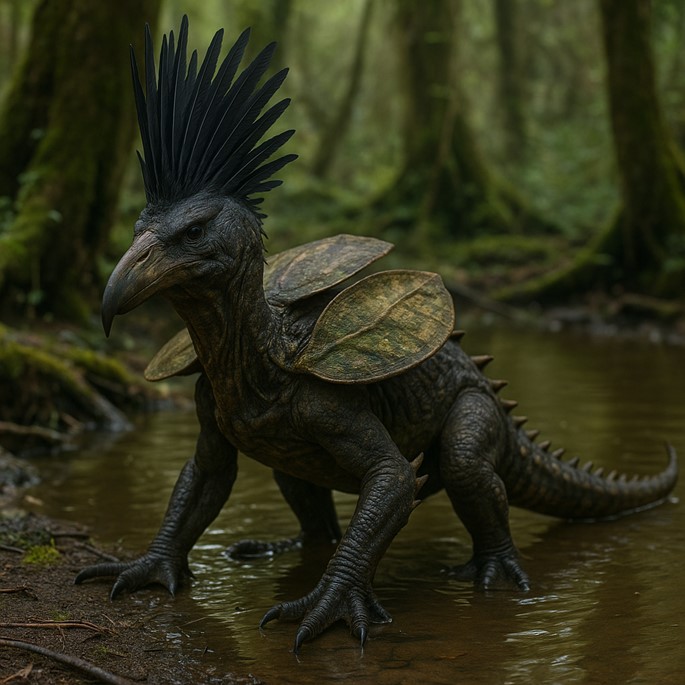
The Prymnocorvifang is a low-slung quadruped, its long and muscular dhole-derived body cloaked in coarse rust-and-black fur streaked with iridescent feathers from the shoulders up. Its head is an unsettling hybrid of cockatoo and mata mata turtle — broad, leaf-like protrusions jut out along the jawline, mimicking rotting vegetation, while a massive, curved beak of keratin sits where the turtle’s mouth would be, perfectly adapted for shearing flesh or cracking shells. Sprouting from the back of the skull is an extravagant black crest of stiff, feather-like plumes that it raises in dominance displays.
Its hind legs are long and stiff like those of a tripodfish, adapted to brace the creature in mud or sand while waiting for prey; these legs can extend vertically to raise its front half out of the water for a better view. The tail is thick, flattened, and edged with small spiny ridges, used for swimming and for rapid side-swipes in combat. Skin between the fur patches is mottled olive and gray, studded with sensory nodules that ripple faintly when detecting vibrations.
Size:
Length 1.8–2.1 m (6–7 ft), shoulder height 0.9 m (3 ft), weight 65–85 kg (143–187 lb).
Speed:
On land: 40 ft per round at full sprint, 20 ft per round in stealthy stalk.
In water: 30 ft per round sustained, 50 ft per round in short bursts.
Stat Modifiers:
+2 Dexterity
+2 Wisdom
−1 Charisma
Skills:
• Stealth (+3 natural bonus in muddy, vegetated, or swampy terrain)
• Perception (+4 natural bonus for vibration detection)
• Survival (+2 bonus when tracking aquatic or amphibious prey)
Behavior:
Ambush predator that alternates between slow, still water-stalking and sudden lunges. Will plant its tripod-like hind limbs into sediment and let currents bring smaller animals within reach of its beak. Social behavior is rare outside of mating or pack-hunting during food shortages. Territorial over prime ambush spots; will chase off even larger creatures.
Diet:
Carnivorous opportunist — fish, amphibians, small mammals, waterfowl, and carrion. Will also scavenge crustaceans and soft-shelled mollusks.
Emotions:
Calculating patience when hunting; explosive aggression when its kill is challenged. Mating pairs exhibit surprising tenderness — mutual crest-preening and gentle beak-touching — but outside of this bond they are wary and solitary.
Environment Where Found:
Dense mangrove swamps, flooded forests, and slow-moving tropical rivers; also found in coastal estuaries with brackish water. Prefers areas with floating vegetation mats and submerged root systems.
Tags:
Feral, Amphibious, Ambush Predator, Crest Display, Tripod-Legged, River-Dweller, Mangrove Hunter, Beak-Weapon, Vibrational Sense, Territorial, Aquatic Camouflage, Pack-Hunter, Estuarine, Solitary, Opportunistic Feeder, Swamp Adapted, Crest Rituals
Life Cycle:
The Prymnocorvifang 642 hatches from leathery, mottled eggs about the size of a human fist, laid in carefully hidden mud-chambers above the high-water mark. Hatchlings are fully mobile within hours but remain under the mother’s protection for the first two weeks, during which she keeps them in a concealed, shallow nursery pool and brings small fish or frogs for food. Juveniles remain with the mother for 4–6 months, learning ambush techniques, before dispersing to find their own territories.
They reach sexual maturity at about 4 years of age and can live 18–22 years in the wild. Growth is steady, with distinct shedding phases — feather molt for the cockatoo crest and partial skin sloughing for the turtle-like jaw frills — occurring twice yearly in sync with local magical ebb cycles.
Mating:
Courtship begins with a loud, resonant drumming made by the male striking submerged roots with his beak, sending vibrations through the water that carry over long distances. Females select mates based on the depth and consistency of these vibrations, believed to signal physical health and magical potency.
Pair bonds may last multiple breeding seasons, though they are not guaranteed; disputes over territory or hunting rights often dissolve the bond. During active pair-bonding, both male and female participate in nest defense and egg-turning. Mating season aligns with the “Passion” week cycles when the water is warmest and prey abundance peaks.
Tactics:
The Prymnocorvifang’s primary hunting method is stationary ambush. It drives its tripod-like hind limbs into sediment, raises its front half partially out of the water, and waits for prey to pass. Once a target is within striking range, it lunges forward with startling speed, using its leaf-like head frills to break up its silhouette until the last instant.
In group hunts — rare but seen during lean seasons — several individuals will take staggered positions along a stream, driving prey downstream into the strike zone of a dominant hunter. Against large or armored prey, they use the spiny tail to distract or unbalance before delivering a crushing beak strike to vulnerable areas.
Actions:
• Ambush Lunge – Close the gap in one explosive movement, striking with beak for a single, powerful blow.
• Tail Sweep – Sweep opponents in a 120° arc behind or to the side, potentially knocking smaller targets prone.
• Crest Flare – Raise the black plumes in an intimidation display, causing hesitation in less aggressive foes.
• Root Drum – Strike submerged wood or stone to create low-frequency vibrations; used for territory marking, courtship, or luring vibration-sensitive prey.
• Tripod Brace – Lock hind limbs into the ground or riverbed, making it much harder to dislodge or topple the creature.
Other Interesting Information:
• The jaw frills are not only camouflage but also serve as sensory extensions, detecting changes in current direction and water temperature.
• Feathers of the crest have mild hydrophobic properties and are traded among some local cultures for use in ceremonial cloaks or rain-resistant charms.
• In areas of high magical flux, individuals have been observed using their beaks to tap certain submerged stones repeatedly — possibly a learned behavior for triggering prey emergence from magically-reactive burrows.
• During the Darkness week cycles of the Saṃsāra calendar, Prymnocorvifangs become more aggressive, possibly due to reduced visibility aiding their ambush style.
• The spines on the tail can deliver shallow puncture wounds laced with a mild anticoagulant, making it easier for the creature to track wounded prey by scent.
Adventurers in Saṃsāra might find themselves seeking out the Shryxmantoleptis 941 for reasons that are as varied as the creature’s strange composition. Encounters may be accidental in its native swamplands, or deliberate for purposes that mix danger with profit.
1. Rare Alchemical Components
Its molted exoskeletal leg plates, when ground and steeped in certain swamp herbs, create a potent stabilizing agent for volatile magical brews. The gelatinous tissues from its siphon head contain trace amounts of mana-reactive proteins, prized for crafting gear that resists magical corrosion. Hunters often hire parties to obtain these materials from deep, dangerous wetlands.
2. Quest Bounties & Local Threat Removal
In regions where settlements push into marshlands, the Shryxmantoleptis becomes a hazard—its burrowing can undermine levees, and its ambushes on livestock have earned it the label of “marsh devil” by locals. Villages or city-states might post rewards for confirmed kills or the removal of nesting pairs.
3. Knowledge & Magical Study
Scholars and arcane biologists covet the chance to observe its blend of four distinct ancestral traits, theorizing it might be an “anchor hybrid” for understanding ancient magical crossbreeding events. Recovering a live specimen or detailed field notes could be part of a larger research contract from a university or magical guild.
4. Spiritual or Cultural Significance
Some swamp-dwelling cultures claim the Shryxmantoleptis is a “veil-walker,” able to detect changes in magic flows before they are visible to avatars. They believe its erratic movements warn of incoming magical surges or dangerous planar thinning. A party could be sent to track one for ritual divination purposes.
5. Trial of Prowess
In certain mercenary companies or martial orders, besting a Shryxmantoleptis in its own territory is considered a rite of passage. Its uncanny ability to vanish into the wetland’s clutter and strike from unexpected angles makes the challenge a test of perception, patience, and teamwork.
6. Defensive Capture
Occasionally, a local ruler or wealthy patron commissions the capture of one to serve as a living deterrent in a moat or enclosed bog within their estate. Adventurers could be tasked with the high-risk transport and containment of the creature, which often ends up being more dangerous than the capture itself.
7. Unintentional Conflict
Its territory overlaps with routes used by treasure hunters, smugglers, and couriers. When disturbed, the Shryxmantoleptis defends its lair aggressively, often forcing adventurers into a fight simply to pass through critical wetland trade corridors.
From the corpse of the Shryxmantoleptis 941, an experienced harvester can extract a number of valuable resources—many of which are difficult or impossible to acquire from any other species in Saṃsāra’s wetlands. These materials are sought by alchemists, artificers, physicians, and even smugglers.
1. Siphon Head Gelatin
- Source: The soft, cone-snail-derived siphon structure fused to the head.
- Use: When distilled with heat and swamp-moss ash, forms a reactive binding medium that improves mana-channel stability in enchanted armor and bracers. Favored by artificers crafting Tier-2 gear for avatars prone to magic surges.
2. Leg Carapace Chitin
- Source: The dense mantis-shrimp-based exoskeletal plates on its legs.
- Use: Polished into flexible, mana-conductive strips for reinforcing magical shields or wands. In powder form, used as an additive in rune-etching ink to make glyphs more resistant to weathering.
3. Bioluminescent Tendon Strands
- Source: Translucent, eel-like connective tissues running through its torso.
- Use: Serve as organic light-filaments in magical lanterns, giving off a steady, low-level glow for years. Also used in certain necromantic wards to detect the presence of life energy.
4. Swamp-Resin Gland Secretion
- Source: Hidden sac near the base of the tail; used for waterproofing its lair.
- Use: When mixed with powdered obsidian, produces a fire-resistant coating for scroll cases, ship hulls, and protective cloaks. Rare among natural sealants for being both hydrophobic and flame-dampening.
5. Bone Spirals of the Inner Jaw
- Source: Hardened spiral-shaped feeding bones that anchor its feeding muscles.
- Use: Ground into talisman beads believed by some cultures to enhance perception against illusions. In warfare, embedded into the pommels of ranged weapons to improve magical sighting stability.
6. Marsh-Veil Fat
- Source: Layer of fatty tissue beneath the skin; translucent and slightly iridescent.
- Use: Rendered down into oil that, when applied to armor or skin, grants short-term scent masking against scent-reliant predators. Alchemists add it to stealth potions to extend duration.
7. Blood-Ink
- Source: The hemolymph-like fluid combining traits of mollusk ink and eel blood.
- Use: Creates a deep green-black pigment used in ceremonial spell inscriptions, particularly for wards of concealment and maritime protective sigils. When fresh, can also be used to reveal invisible ink.
8. Swim-Vein Cartilage
- Source: Segmented cartilage structures running along its body’s lateral line.
- Use: Extremely springy when treated; incorporated into the springs of mechanical traps or in crossbow stocks to enhance firing power without increasing weight.
9. Mucus-Cocoon Residue
- Source: Protective mucus from its nesting sites, sometimes clinging to the corpse.
- Use: Acts as a preservative for perishable magical ingredients, slowing decay for up to a month without refrigeration. Favored by traveling alchemists and bounty hunters transporting rare organs.
Many-Faced Hunger of Reed-Silent Marsh
It is spoken in the days of deep fog, and in the halls where the lamps burn green, that long before the counting of moons was made, the waters between the roots were ruled by the One That Glided Without Splash. The elders in the long reed-boats call it by names whose syllables slither, but the oldest tablets scratched in shell speak instead of the Many-Faced Hunger. It was said to be not born from one mother, nor hatched from one egg, but pieced together by the weavings of the Swamp-Hands, the unseen ones who stitch flesh with moonlight thread.
In the time before the great marsh was silent, the place roared with frogs, the hum of winged gnats, and the splash of fish leaping from danger. Then came the Years of the Thin Mist, when the reed beds would bend without wind and the shallow waters carried no ripples. Hunters went missing in the shallows, fishers returned with lines cut clean as glass, and children told of seeing pale ropes in the water that glowed like fallen stars.
It is told that a boy of the half-vine folk—his name is now lost but the story calls him Green-Knees—followed the sound of reeds clicking like teeth. He came upon a thing that was neither fish nor insect nor snake, its skin bending light like heat over stones. From its head stretched a black siphon, tasting the air for blood, and from its flanks rose legs clad in armor the color of stormwater. Yet it did not rush to him; it only swayed, and in that swaying the boy’s eyes saw other things—a mother calling, a basket of fruit, a safe fire—things not truly there. And when the boy reached for these visions, the water erupted in the clap of claws, and he was no more.
So the people learned the Hunger’s way: it waited without moving, showing the mind what it wished to see, until the mind forgot the body. Then it would take, and in taking it would leave behind nothing but a swirling of silt and a silence that lasted many breaths.
The marshers tried all things to end it—spears tipped with moon-salt, drums of hollow reed to scare it, nets woven with thorn-vine. None held it. The story says the Hunger could break nets as easily as a man’s promise, and that moon-salt turned to mud when it touched its skin. Some prayed to the Verdant Crown for deliverance, but the Crown’s priests said this creature was beyond their bindings, for it was not born of the seed nor the egg but of old magic long unspoken.
At last, a fisher of the bone-hooks—Old Bent-Back—made a bargain with the shadow of the vapor-moon. He gave his voice, his sight in the left eye, and his name to the shadow, and in return the shadow gave him a cord woven of night-water. Bent-Back tied this cord about his boat and drifted into the reed-silent heart of the marsh.
For seven days and nights, the marsh stood still. On the eighth, the waters shook and the reeds rattled like a thousand bones in a box. Bent-Back’s boat returned without him, but the cord was frayed and the water around it carried a black ink that smelled of metal and lightning. They say the Hunger was not seen for three generations after that, though some claim it was never gone—merely watching from deeper water, patient as a stone.
Even now, elders warn the young: when the marsh falls silent and the air smells of lightning, do not follow the visions in the water. And when you see a glow beneath the mud, turn your eyes away, for it is the Many-Faced Hunger tasting the air once more.
Moral: That which is made from many hungers learns only to hunger, and the patient snare is the most dangerous of all.
Suggested conversions to other systems:
CALL OF CTHULHU – “The Many-Faced Hunger”
Mythos Classification: Marsh Entity (Unique)
STR 110 (55), CON 150 (75), SIZ 120 (60), DEX 80 (40), INT 65 (32), POW 95 (47), APP n/a
HP: 18
Move: 7 (land), 10 (water)
Damage Bonus: +1D6
Build: 2
Armor: 5-point chitinous plates
Attacks:
• Claw Strike 65%, damage 1D8+db
• Siphon Strike 55%, damage 1D6+special (see below)
• Illusory Lure (POW vs. POW): Success forces target to follow vision into dangerous position; SAN loss 1/1D4 on failure.
Special:
• Chameleon Hide: −50% to Spot Hidden rolls to notice the creature when stationary.
• Siphon Strike drains 1D4 CON on hit; regains equal HP.
• Amphibious: Moves equally well in water and on land.
Sanity Loss: 1/1D8 to see the Many-Faced Hunger in motion.
BLADES IN THE DARK – “Silt-Lure Horror”
Type: Threat (Horrific) – Tier IV, Strong Hold
Scale: Large (the size of a small skiff)
Features:
• Armor: Heavy chitinous plating.
• Special: Illusory visions that draw victims closer; can be resisted with Resolve.
Threat Moves:
• Lure a character into the reeds with a loved one’s voice.
• Strike from beneath the water with crushing claws.
• Cloak itself in silt and vanish without trace.
Harm:
• Crushing claws (Severe harm: “Shattered limb” or “Collapsed chest”).
• Siphon tube (Severe harm: “Drained strength”).
Clocks:
• “It’s Watching You” (4-segment) – fills when PCs linger near its territory.
• “It’s Under the Boat” (6-segment) – once full, it attacks from below.
DUNGEONS & DRAGONS 5e – “Many-Faced Hunger”
Large monstrosity, unaligned
Armor Class: 17 (chitinous plates)
Hit Points: 142 (15d10+60)
Speed: 30 ft., swim 40 ft.
STR 18 (+4), DEX 16 (+3), CON 18 (+4), INT 6 (−2), WIS 14 (+2), CHA 6 (−2)
Saving Throws: CON +7, WIS +5
Skills: Perception +5, Stealth +7
Senses: Darkvision 60 ft., tremorsense 30 ft., passive Perception 15
Languages: —
Challenge: 7 (2,900 XP)
Traits:
• Amphibious: Can breathe air and water.
• Chameleon Hide: Advantage on Dexterity (Stealth) checks while motionless.
• Illusory Lure: Once per short rest, the Hunger creates a visual and auditory illusion targeting one creature within 60 ft. DC 15 Wisdom save or charmed for 1 minute, compelled to move toward the illusion.
Actions:
• Multiattack: Two claw attacks and one siphon attack.
• Claw: Melee Weapon Attack +7 to hit, reach 5 ft., one target. Hit: 12 (2d6+4) slashing damage.
• Siphon Strike: Melee Weapon Attack +7 to hit, reach 10 ft., one target. Hit: 9 (1d8+4) piercing damage, and the target must make a DC 15 Constitution save or take 9 (2d8) necrotic damage and have their maximum HP reduced by half that amount until a long rest.
Reactions:
• Sudden Lunge: When a creature moves within 10 ft., the Hunger may make a claw attack against them.
KNAVE – “Reed-Silent Maw”
HD: 8
HP: 40
AC: 17 (Heavy chitin)
Attacks:
• Claw (2d6)
• Siphon Bite (1d8 + drain 1 STR)
Special:
• Amphibious: Can operate in water and on land.
• Camouflage: Invisible when still in natural terrain until it attacks.
• Illusory Lure: Once per day, forces WIS save or target approaches it, believing it sees something desirable.
• STR drain recovers to victim after full day’s rest.
Morale: 10
Move: 30 ft., swim 40 ft.
Treasure: 1d4 rare alchemical sacs, valued for vision-inducing compounds.
FATE – “Silt-Lure Horror”
High Concept: Amphibious Ambush Predator of the Reeds
Trouble: Drawn to the Warmth of Life
Aspects:
• Chitinous Armor Like River Stone
• Voice of the Lost to Lead You Astray
• Strike From Below Without Warning
Skills:
• Superb (+5) Stealth
• Great (+4) Fight, Physique
• Good (+3) Notice, Athletics
• Fair (+2) Provoke, Will
• Average (+1) Lore, Crafts
Stunts:
• Illusory Lure – Once per scene, create an advantage on a target in the same zone by invoking their memories; use Provoke vs. Will.
• Amphibious Hunter – Gain +2 to Stealth when hiding in or near water.
• Crushing Claws – When you succeed with style on a Fight attack, you may also inflict the “Crushed” consequence instead of taking a boost.
Stress: 4 boxes
Consequences: Mild (2), Moderate (4), Severe (6)
NUMENERA / CYPHER SYSTEM – “Many-Faced Hunger”
Level: 6 (for all tasks)
Motive: To feed and defend its territory
Environment: Swampy waterways, deep reed-beds
Health: 30
Damage Inflicted: 8 points (claws) or 6 points + STR drain (siphon strike)
Armor: 3 (chitin)
Movement: Short on land, Long in water
Modifications: Stealth 8, Perception 7
Combat: Makes two attacks per round; can replace one with Illusory Lure (target must succeed on Intellect defense roll or approach, believing they see someone familiar).
Interaction: Cannot be reasoned with; territorial and hungry.
Use: Lurks where adventurers cross marshland trade routes.
Loot: 1d3 bioluminescent eye clusters (Numenera level 3 cyphers for sensory enhancement), chitin plates (Armor +1 if crafted).
GM Intrusion: The creature attacks from beneath the surface, capsizing a craft or dragging a PC under.
PATHFINDER 2E – “Many-Faced Hunger”
Creature 8
Unaligned Large Aberration
Perception +16; darkvision, tremorsense 30 ft.
Skills Athletics +18, Stealth +19, Survival +14
Str +6, Dex +5, Con +4, Int −2, Wis +3, Cha −1
AC 28; Fort +16, Ref +17, Will +14
HP 150; Resistances physical 5 (except bludgeoning)
Speed 30 ft., swim 40 ft.
Melee [one-action] Claw +18 (reach 5 ft.), Damage 2d8+6 slashing
Melee [one-action] Siphon Strike +18 (reach 10 ft.), Damage 2d6+6 piercing plus 2d6 negative and DC 25 Fortitude save or 1d4 Con drain
Illusory Lure [two-actions] (illusion, mental, visual) The Hunger creates an illusion within 60 ft. of a creature it can see; Will DC 25 or target is fascinated for 1 round and must spend its next action moving toward the illusion.
Amphibious The Many-Faced Hunger can breathe air and water.
Camouflage The creature can Hide in natural terrain without cover or concealment.
SAVAGE WORLDS – “Reed-Silent Maw”
Wild Card
Attributes: Agility d8, Smarts d4, Spirit d6, Strength d10+2, Vigor d10
Skills: Athletics d8, Fighting d10, Notice d8, Stealth d10+2, Survival d6
Pace: 6; Swim: 8; Parry: 7; Toughness: 11 (3)
Edges: Ambush, Improved Frenzy
Special Abilities:
• Armor +3: Chitinous plating.
• Amphibious: Moves equally well on land and in water.
• Chameleon Hide: −4 to Notice rolls to spot when still.
• Claws: Str+d8 damage.
• Siphon Strike: Str+d6 damage + Fatigue (Vigor roll, −2). Failure also reduces target’s Strength die type by one for 1 hour.
• Illusory Lure: Opposed Smarts vs. Smarts; on a success, victim approaches believing it sees something it desires.
• Large: +2 to be hit.
Hindrances: Territorial (Major)
Gear: None
XP: As appropriate for an 8–10 point monster encounter.
SHADOWRUN 6E – “Many-Faced Hunger”
Metatype: Critter (Aquatic/Aberrant)
Movement: 10/20 (land), Swim x3
Condition Monitor: 12 (Physical) / 9 (Stun)
Armor: 6 (natural chitin)
Attributes: BOD 8, AGI 5, REA 5, STR 9, WIL 4, LOG 1, INT 4, CHA 2, EDG 2
Initiative: 9 + 1D6
Skills: Unarmed Combat 12, Perception 10, Sneaking 11, Survival 8
Powers:
• Amphibious – Can operate equally well in aquatic and terrestrial environments.
• Camouflage – Gain +4 dice on Sneaking tests in natural aquatic terrain.
• Chitin Armor – Natural +6 Armor.
• Illusory Lure – Complex Action; Opposed Willpower + Intuition vs. target’s Willpower + Logic; on net hits, target approaches as though responding to a familiar voice.
• Siphon Strike – Unarmed attack; if successful, inflicts normal DV plus Strength drain (reduce STR by net hits for 1D6 minutes).
Weaknesses: Territorial – Will pursue intruders relentlessly in its domain.
Notes: Often found near smuggling routes or hidden waterways, making it a hazard to shadow ops requiring wet insertion/extraction.
STARFINDER – “Many-Faced Hunger”
CR 8
XP 4,800
N Large Aberration (Aquatic)
Init +8; Senses darkvision 60 ft., blindsense (vibration) 30 ft., Perception +17
DEFENSE
HP 130; EAC 20; KAC 22
Fort +14, Ref +12, Will +11
DR 5/bludgeoning; Resist cold 10
OFFENSE
Speed 30 ft., swim 50 ft.
Melee claw +19 (2d8+11 S) or siphon strike +19 (2d6+11 P plus 1d4 STR damage, DC 21 Fort)
Ranged lure illusion (30 ft., Will DC 21 or target is fascinated 1 round)
STATISTICS
Str +5, Dex +4, Con +3, Int −2, Wis +2, Cha −1
Skills Acrobatics +17, Stealth +21, Survival +17, Athletics +19
Feats Spring Attack, Great Fortitude
Languages —; telepathy 30 ft. (illusory mimicry only)
ECOLOGY
Environment temperate or warm wetlands and rivers
Organization solitary or pair
SPECIAL ABILITIES
Illusory Lure (Su) – Creates a perfect visual/auditory replica of a creature known to the target. Will DC 21 negates.
Siphon Strike (Ex) – On a successful attack, drains muscle strength (STR damage) and heals the Hunger for half the damage dealt.
TRAVELLER (MGT2) – “Many-Faced Hunger”
Animal Encounters Classification: Aquatic Predator
Size: Large (300 kg)
Speed: Fast swimmer (10 m), Land movement (5 m)
Characteristics: STR 14, DEX 10, END 12, INT 4 (animal cunning)
Skills: Athletics (swim) 2, Stealth 3, Recon 1, Melee (natural) 3
Attack:
• Claw: 2D damage; AP 2; can grapple on Effect 6+
• Siphon Strike: 1D+1 damage + 1D STR loss; AP 4; usable once per target per encounter
Traits:
• Amphibious – No penalties for moving between water and land.
• Camouflage – DM+2 to Stealth in aquatic vegetation.
• Illusory Lure – Opposed Recon vs. target’s INT; on success, target approaches willingly.
Behavior: Territorial solitary hunter; ambushes from submerged concealment.
Weapon/Armor: Natural chitin (Armor 5).
Threat: Dangerous predator to small boats and riverside settlements; reward for hunters may include chitin armor crafting materials or rare gland for pharmaceuticals.
WARHAMMER FANTASY ROLEPLAY 4E – “Many-Faced Hunger”
Creature Traits: Aberration, Aquatic, Large
M WS BS S T I Ag Dex Int WP Fel W
8 55 – 55 50 40 45 – 20 40 10 40
Move: 6 (land), Swim 12
Skills: Stealth (Water) 65, Perception 50, Athletics 60, Intimidate 55
Talents: Fear 2, Amphibious, Hardy, Swift, Weapon (Natural)
Traits:
• Armour (3) – Chitinous plates.
• Illusory Lure – Extended Test (Cool) vs. WP; failure causes victim to be drawn toward lure.
• Siphon Strike – Melee attack (Natural Weapon) deals SB+6 and causes Fatigue; Crit on 10+ damage inflicts −10 to Strength for 1D10 Rounds.
• Amphibious – Moves and breathes equally on land and underwater.
• Camouflage – Opposed Stealth vs. Perception to remain hidden without cover.
Attacks: 2 claws (SB+6), bite (SB+4 + Fatigue)
Behaviour: Solitary, attacks perceived intruders or prey; prefers dragging victims underwater.
Advancement: N/A – monster-only profile.