Magical Powers:
Trypanik carries a subtle mnemonic magic woven into its phonetics and morphology. When spoken fluently in ceremonial cadence, it can enhance memory recall, making both the speaker and attentive listeners more likely to retain details. This magic is passive in everyday use, surfacing most strongly during ritualized chants, epics, and formal negotiations. The magic is cultural in nature rather than innate to any one speaker, activated by mastery of the language’s full range of inflections and idioms.
Linguistic Attributes & Characteristics:
Trypanik is a fusional, stress-timed language with complex case marking, blending inflectional morphology with rich consonant clusters and vowel harmony. Sentences carry layered meaning through embedded clauses, with word order being flexible but most often following a SOV (subject-object-verb) pattern. Stress typically falls on the penultimate syllable, and prosody is integral to meaning—shifting pitch or elongating certain sounds can alter intent from declarative to ironic without changing words. Its lexicon favors compound words and idiomatic expressions tied to the land, sea, and seasonal cycles.
Structure:
- Phonology: Broad vowel inventory with front/back harmony; consonants include voiced and voiceless fricatives, affricates, and liquid consonants that serve as syllabic nuclei in some poetic forms.
- Morphology: Heavy inflection for number, case, and tense; verbs conjugate for aspect, mood, and voice.
- Syntax: Primarily SOV with optional topical fronting.
- Semantics: Deep metaphorical layering—many words carry both a literal and ancestral meaning.
Cultural Identity:
Trypanik is seen as a unifying bond for the people of Trypillya, a language of both kinship and diplomacy. Its ceremonial form is reserved for major public events, oaths, and rites, while its everyday form is used in trade, storytelling, and education. Elders and scholars consider fluency in the ceremonial register a mark of refinement, while common dialects are shaped by regional fishing, farming, and mercantile traditions. In Trypillyan identity, to speak Trypanik is to connect oneself to the nation’s mythic past and its vision for unity across its sprawling island territory.
Usage & Demographics:
Of the nation’s 92,623,768 inhabitants, about 71%—some 65.76 million people—use Trypanik as their primary language. The rest speak regional dialects or languages from immigrant and trading communities but most have at least working comprehension. Government, law, and major cultural institutions operate in Trypanik, and the language serves as the lingua franca for inter-regional affairs.
Commonality:
Extremely high—spoken in all major cities, ports, and rural communities. It is the primary medium of education and governance.
Type:
Fusional, stress-timed, high-context language with poetic and ritual registers.
Script:
Pyllis Script—a flowing semi-cursive alphabet descended from an older rune-like carving tradition. It is written left-to-right with occasional vertical glyph arrangements in ceremonial inscriptions. Letters join in continuous ligatures for speed, but formal writing preserves more distinct character forms.
Source & History:
Trypanik evolved from the speech of early seafaring settlers and agrarian clans who merged into a single kingdom over two thousand years ago. Over time, trade routes, political consolidation, and religious rites fused regional dialects into a national standard. The ceremonial register retains many archaisms that no longer appear in common speech, and its mnemonic magic traces back to oral epic traditions.
Sensory Experience:
Hearing Trypanik in its ceremonial form is akin to the sensation of waves crashing in a measured rhythm against a stone shore—steady, deliberate, with sudden surges of emotional force. The cadence produces a tactile sensation in the chest for fluent speakers, as though the language resonates physically. Reading Pyllis Script carries a visual flow like winding rivers, and calligraphic forms are often painted with mineral pigments that subtly glitter in sunlight.
Tags:
Trypanik, Language, Fusional, Stress-Timed, Pyllis Script, Ceremonial Register, Mnemonic Magic, SOV, Vowel Harmony, National Identity, High-Context, Ligature Writing, Oral Tradition, Diplomatic Speech, Poetic Form, Ritual Language, Seafaring Heritage, Trypillya
Ceremonial Phrases in Trypanik
(Transliterated into a phonetic rendering for Saṃsāra use, with literal meaning and contextual function. All are in formal ceremonial register.)
1. For Magic Inscriptions
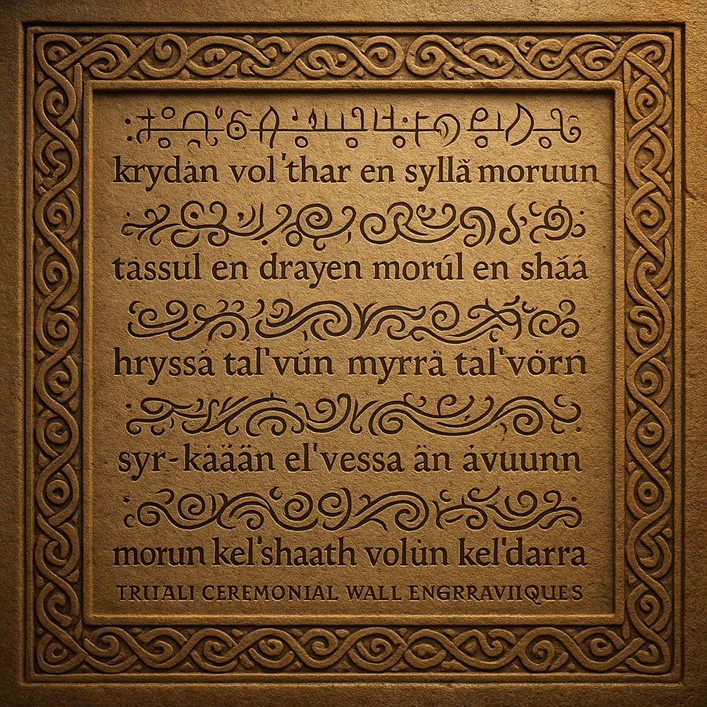
- “Krydan vol’thar en sylla moruun.” – By the binding tide, the stone remembers. (Used in warding glyphs, meant to anchor protective magic to a place.)
- “Tassuul en draven, moruul en shaa.” – The deep holds the truth, the shallow the lie. (Inscribed on magical vaults, truth-sensing wards.)
- “Hryssa tal’vun, myrrha tal’vorn.” – Breath to wind, blood to earth. (A ritual phrase for life-binding enchantments.)
- “Syr-kaan el’vassa noruun.” – The circle closes and guards the night. (Carved into defensive sigils to repel intruders.)
- “Moruun kel’shaath, voluun kel’darra.” – Memory is the anchor, will is the helm. (Used in mnemonic spell inscriptions.)
2. For Political Oaths
- “Vorrik en dalluun, vorrik en varsha.” – I stand in light, I stand in shadow. (Oath of impartial governance.)
- “Shalveth moruun Trypilliya.” – My soul rests in Trypillya. (Declaration of lifelong loyalty to the nation.)
- “Tharuun kel’vorr, shuun kel’darr.” – By oath I hold, by oath I act. (Formal acceptance of a state office.)
- “Dreval en myssun, kel’kaan en tryval.” – The people are my roots, the law my crown. (Sworn by judges and lawmakers.)
- “Norrath myr’kaan, voluun myr’kass.” – Where I breathe, I will guard. (Military loyalty pledge.)
3. For Cultural Ceremonies
- “Lynval shuun draaven.” – Let joy rise like the tide. (Spoken during seasonal festivals.)
- “Myr’kaan shassa voluun.” – From the hearth, the journey begins. (Blessing for travelers and merchants.)
- “Sharra vel’kaan, moruun vel’shaa.” – The dawn opens, the night remembers. (Spoken at weddings to signify continuity of family memory.)
- “Thulaan en vorrik, kallaan en myrrik.” – One feast in unity, one song in peace. (Used in large public gatherings to promote harmony.)
- “Vel’shaath noruun, vel’kaan noruun.” – The past is honored, the future is guarded. (Funeral rite phrase to honor the dead.)