
Original Life Forms Chosen
Class Mammalia – Wolverine (Gulo gulo)
Class Aves – Brown Pelican (Pelecanus occidentalis)
Class Insecta – Orchid Mantis (Hymenopus coronatus)
Class Gastropoda – Giant African Land Snail (Achatina achatina)
Appearance
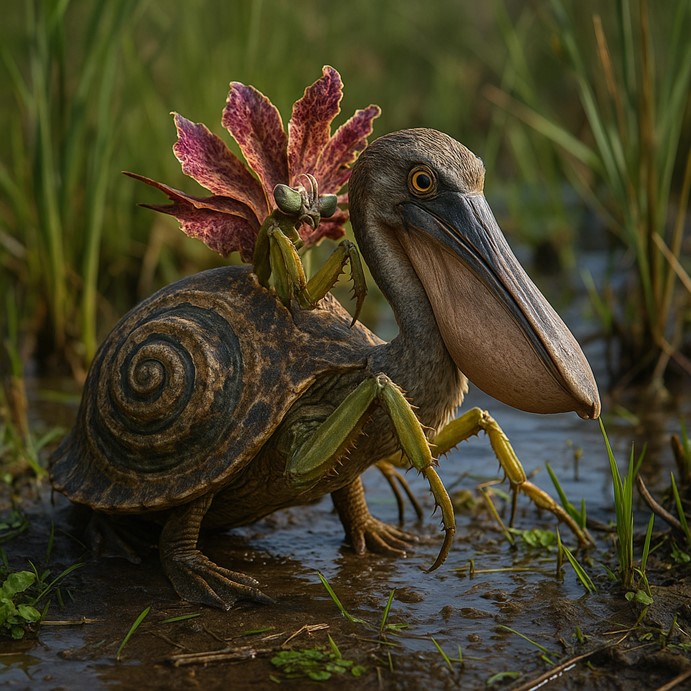
The Gryphopelicanmantiscule 514 is a squat, powerfully built predator-herbivore hybrid, its base frame modeled after a wolverine’s muscular torso and limbs. Its upper body is overlaid with a pelican’s throat pouch—elastic and semi-transparent—capable of expanding into a large, wet net for scooping prey or vegetation. The head bears an unsettling blend of pelican beak and mantis forelimb scythes: the beak opens vertically while two elongated raptorial limbs fold alongside, each lined with serrated chitin. A pair of bright, orchid-like frills frame its head, changing colors to blend with surroundings or flash in threat displays. Its lower body is partly enclosed in a massive snail-like shell, iridescent with mottled greens and bronze, into which it can retract the rear half of its body. Skin and exposed limbs are covered in tough, leathery hide, while the forelimbs are sheathed in chitin.
Size
Length: 1.6 m (from beak to tail end)
Height at shoulder: 0.9 m
Weight: ~80 kg
Speed
Land: 25 ft (slow when fully extended)
Burrowing: 10 ft (uses claws and shell edge)
Swimming: 40 ft (webbed hind feet + pouch propulsion)
Stat Modifiers
Strength: +3
Dexterity: +2
Constitution: +4
Intelligence: −1
Wisdom: +1
Charisma: −2
Skills
• Stealth (camouflage via frill coloration)
• Grapple (mantis limbs and beak coordination)
• Aquatic Hunting (net-scooping pouch)
• Shell Curl Defense (damage resistance while retracted)
• Climbing (clawed forelimbs and shell anchor points)
Behavior
The Gryphopelicanmantiscule alternates between long periods of patient lurking and sudden explosive bursts of activity. When stalking, it keeps frills flat and blends with foliage or shoreline debris. In an ambush, it lunges forward, snapping the beak while pinning prey with mantis claws, then either consumes on the spot or stows it in its pouch. Highly territorial, individuals mark shell ridges with scent and mud patterns.
Diet
Omnivorous opportunist: feeds on small mammals, fish, crustaceans, waterfowl chicks, carrion, soft vegetation, and aquatic plants. Stores food in pouch to transport to safer feeding grounds.
Emotions
Displays cautious patience but violent short-term rage when cornered. Rarely curious—more inclined to observe at a distance. Aggression increases dramatically if shell is damaged.
Environment Where Found
Brackish estuaries, mangrove swamps, tidal rivers, and reed-choked lakeshores of warm, humid climates. Also found inland near large freshwater lakes during seasonal migrations.
Tags
Feral, Amphibious, Shell-Bearing, Ambush Predator, Omnivore, Territorial, Color-Changing, Pouch-Bearing, Chitin-Armored, Semi-Aquatic, Camouflaged, Grappler, Defensive-Retreat, Scythe-Limb, Slow-Land-Fast-Water, Burrower, Estuarine
Life Cycle
The Gryphopelicanmantiscule 514 begins life as a soft-shelled, palm-sized juvenile hatched from a clutch of 6–10 translucent eggs laid in shallow, muddy water near reed beds. The young emerge with disproportionately large frills for camouflage but undeveloped mantis limbs. Their shells begin forming in the first month, starting as thin, pliable keratinous plates that harden into the distinctive mottled spiral by six months. By one year, they reach two-thirds adult size and are capable hunters, but their beaks remain softer and less serrated until two years of age. Sexual maturity occurs between three and four years, with peak physical condition maintained until roughly twelve years. Lifespan in the wild averages 18–20 years, though some individuals in protected wetlands have reached 30 years.
Mating
Breeding occurs during the Warming and Blooming weeks of the months Lathandus and Tyrus, when aquatic vegetation is thickest. Males display by inflating their pelican pouch to near-bursting while flashing orchid frills in a sequence of slow, hypnotic pulses. Successful males gently tap the female’s shell with their mantis limbs—a ritual believed to signal both strength and restraint. Mated pairs stay together for the breeding season, with the female laying her eggs in a partially submerged burrow dug into embankments. The male guards the burrow against predators and rivals until the young hatch, after which both parents may transport food in their pouches for the first few weeks.
Tactics
• Aquatic Ambush: Lies partially submerged near reeds, pouch flat, frills spread to mimic flowers. Strikes with beak and mantis claws simultaneously.
• Shell Wall: Retracts rear into shell and pivots so shell faces attacker, deflecting strikes while slashing with forelimbs.
• Pouch Sweep: In water, uses inflated pouch to create a wave that unbalances prey before striking.
• Frill Hypnosis: Flashes frill colors in rhythmic patterns to confuse smaller or slower prey.
• Retreat-Burrow: When injured, rapidly burrows backward into mud or sand, leaving only shell exposed.
Actions
• Mantiscule Slash: Quick dual strike with serrated mantis limbs.
• Beak Crush: Strong snap capable of piercing small bone or breaking crustacean shells.
• Pouch Net Snare: Expands throat pouch to engulf and trap small to medium prey.
• Shell Slam: Charges short distance, striking with rim of hardened shell.
• Mud Spray: Uses hind feet to kick up silt, obscuring enemy vision for several seconds.
Other Interesting Information
• The species is known to “decorate” its shell with mud patterns, aquatic plants, or shed frill segments, possibly as camouflage or dominance display.
• Their frills, when dried, retain some color-shifting qualities and are sometimes harvested for rare enchantments involving concealment or misdirection.
• Juveniles are occasionally tamed by coastal fishing communities as pest control, though adults are notoriously unpredictable and prone to sudden violent outbursts.
• During high magic ebbs, the frill patterns sometimes pulse in sync with surrounding mana flows, making them prized subjects for arcane naturalists studying ambient magic behavior in wildlife.
• Some inland Trypillyan myths claim that seeing a Gryphopelicanmantiscule shell pattern in a dream foretells an upcoming test of patience and strength.
Adventurers on Saṃsāra might seek out or stumble upon the Quoracern Lumenis 917 for a wide range of practical, mystical, and perilous reasons:
1. Harvest of Rare Alchemical Components
The bioluminescent fringes along the creature’s wing membranes produce a slowly regenerating oily secretion, known as Lumen Oil, prized by enchanters for crafting light-imbued weapon runes and for stabilizing volatile magic circuits in high-tier gear. Apothecaries also use diluted forms as curatives for low-light vision damage.
2. Dangerous Territorial Intrusions
Quoracern Lumenis 917 fiercely defends its nesting cliffs and canyon tunnels. These regions often contain rich deposits of glimmering “star-ore” used in forging magic-conduction alloys, meaning miners and treasure-hunters inevitably provoke encounters.
3. Arcane Resonance Hunting
Its wingbeats produce infrasonic pulses that align with certain ley-line harmonics, temporarily revealing invisible magical boundaries. Adventuring parties tracking hidden ruins, forgotten vaults, or cloaked constructs might follow a specimen for days to exploit this effect—if they can survive its territorial aggression.
4. Apex Predator Control
Local settlements, particularly cliffside trading towns in Trypillya’s wind-cut valleys, will occasionally post high-pay contracts to thin the population after a spike in livestock losses. Though dangerous, a seasoned group might take such a bounty to gain favor with local councils or the monarchy’s tax stewards.
5. Cultural and Religious Rites
Some fringe sects of the Faith of the Loomed Horizon believe that the echo-pattern from its infrasonic calls is a divine cipher. Pilgrims, guarded by mercenary adventurers, sometimes seek to record these calls in deep canyon amphitheaters, putting them in direct danger.
6. Accidental Proximity During Travel
Because the species often soars along the same thermal wind routes used by airships and sky-balloons, a party in mid-flight might be forced into an unexpected sky encounter, especially if a territorial adult perceives the vessel as a rival.
7. Quests for Proof of Valor
Some knightly orders and mercenary companies in Trypillya require aspirants to return with one intact tail-feather ridge plate or the intact carapace plating from a juvenile as proof of skill and survival. These quests are highly dangerous but carry considerable prestige.
From the remains of a Quoracern Lumenis 917, skilled harvesters, alchemists, and artisans can extract a variety of rare and valuable resources. Many require precise timing after death to prevent decay or magical dissipation.
1. Lumen Oil Glands
Located at the wing-root bases, these glands secrete the pale bioluminescent oil used for magical inscriptions, alchemical light reagents, and low-heat illumination crystals. When refined, the oil amplifies certain enchantments related to sight, illumination, or detection, making it sought after by artificers and scouts.
2. Carapace Ridge Plates
The hardened, crescent-shaped plating that runs along the tail and mid-back is naturally magic-conductive. Blacksmith-enchanters integrate it into light armor or wand casings, where it channels stored energy without overheating. Pieces are also worked into ceremonial jewelry for prestige among Trypillyan nobility.
3. Resonance Wing Membranes
The semi-transparent wing material contains lattice-like veins that store sonic resonance. When dried and tensioned into frames, they retain their harmonic vibration for decades. Bards and sonic-mages use them in instruments, while siege engineers have experimented with them for concussive weapon amplification.
4. Infrasonic Bladder
A specialized organ that produces the creature’s sub-audible calls. Once dried and properly treated, it becomes a flexible chamber capable of producing magical vibrations that disrupt illusions or reveal cloaked areas. Diviners in Trypillya value these for detecting concealed runes in ancient ruins.
5. Star-Ore Calcifications
Over years, Quoracern Lumenis 917 accumulates trace mineral nodules in its gizzard-like crop from ingesting metallic grit near ley-line cliffs. These nodules often contain “star-ore,” a bluish-silver alloy that, when smelted, enhances the stability of magic-powered tools.
6. Talon Hooks
The forward claws, naturally serrated and hollow at the tips, can be shaped into lockpicks capable of slipping past magically-reinforced tumblers. Some assassins covet them for weapon tips that deliver venom or alchemical mixtures.
7. Eye-Lens Clusters
Each compound eye contains an intricate multi-lens array, which when polished and set into a focusing ring, enhances clarity through magical fogs and glamour effects. Used in high-end spyglasses, sniper optics, and navigational sextants for airship crews.
8. Crop Stones
Smooth pebbles from the digestive system, often saturated with magical residue from ley-line mineral ingestion. When embedded in staffs or charms, they can store minor spells or increase the chance of critical magical effects.
9. Down-Plume Clusters
Hidden under the primary wing plating, these short, heat-trapping plumes are fire-resistant. Tailors weave them into cloaks worn by airship riggers and volcanic region explorers.
10. Heart Core
The heart is dense with mana channels; once preserved, it can be tapped for a one-time high-output mana surge. Risky to handle, but sometimes used as a last-resort magical battery by desperate mages.
Sky Split for Wanderer of Cliffs
It is told, in words old and cracked as stone, that in the time before the threads were dyed, the air above the sharp cliffs of the South-Eastern teeth trembled with the shadow of one creature, the Quoracern Lumenis. It had no master but the wind, and no land to claim but the narrow rocks where sea spat and sky sang.
In those days, the people below were many in hunger, for the rains fell sideways and the grain bent before it could swell. They sent their strongest to climb the cliffs and beg the clouds for mercy, but none returned with their hands full, only with their hands empty and their eyes hollow. Then came the tale of a glow, a pale light like the moon’s ghost, seen in the high fog, moving between the edges of stone.
The elders, whose mouths carried the taste of the first stories, spoke: “That is the Lumenis, born when sky’s thread and ocean’s thread twisted too tight. It is light’s hunger given talon and wing.” And they told that whoever could take the light from its body would see no hunger again, for the fields would bend toward it, and the night would not hold cold.
A youth named Tolren, neither tallest nor sharpest-eyed, asked the wind how to find the creature. The wind did not answer in words, but in push and pull, leading him to the old cliff path. For seven days he climbed, hands tearing, feet bleeding, and on the eighth, he saw it—its wings stretched like woven glass, veins singing in the low hum of the deep world.
Tolren spoke aloud, “Give me your light, and I will not strike you.” The Lumenis only tilted its head, eyes like many suns set in a single dawn. It opened its wings and loosed a tone so low that the bones in Tolren’s body ached. The cliff cracked beneath them, spilling stones into the sea. Yet Tolren did not fall; the hum held him as the tide holds driftwood.
It carried him to a shelf of rock hidden from the world, where star-ore shone in the crevices. There the Lumenis tore a plate from its own carapace and laid it before him. “Light cannot be taken,” the hum said, though it was not words but the shape of them in his mind, “but it may be given, if it sees purpose.”
Tolren returned with the plate, which became the heart of the first beacon-stone. This beacon burned at night, not with flame but with the ghost-light of the Lumenis, calling the rains back, bending the grain to grow heavy, keeping the cold away. But in the years after, others hunted the creature for its wings, its glands, its heart, thinking to force its gifts from its flesh. Those who took without asking found their beacons turned dark, their fields withered, their nights colder than before.
So it is told that the Lumenis still wanders the cliff-edges, giving only to those who climb without spear, and hums deep enough to break the rocks for those who come with harm in mind. Many have tried to follow Tolren’s path; few have returned with more than broken nails and salt in their lungs.
Moral: Light given is light kept; light stolen is light lost.
Suggested conversions to other systems:
CALL OF CTHULHU
Name: Cliff-Lumen Wanderer
STR 95, CON 85, SIZ 80, DEX 60, INT 35, POW 90
Hit Points: 16 Move: 10 (fly 20)
Build: 2 Damage Bonus: +1d6
Armor: Carapace (4 points)
Attacks:
• Talons (40%), damage 1d8+db
• Sonic Hum (POW vs POW), successful contest stuns target 1d6 rounds and causes 1d4 SAN loss
Skills: Climb 50%, Listen 70%, Spot Hidden 65%, Stealth 55%, Navigate (Coastal Cliffs) 60%
Sanity Loss: 0/1d6 when first encountered
Special:
• Luminescent Gift – On a successful POW × 3 roll, the creature can choose to grant a fragment of its carapace to a willing seeker, bestowing +20% to Navigate and Survival (Coastal) for one year.
• Light Averse – Sudden bright artificial light forces a CON roll; failure causes temporary retreat.
BLADES IN THE DARK
Name: Glasswing Lumenis
Tier: IV Scale: Large
Threat: 2
Harm: Talon Rake (medium), Sonic Disruption (area, loud, debilitating)
Armor: Heavy natural armor (2)
Special Qualities:
• Luminescent Carapace – Radiates ghost-light, counts as potent arcane effect.
• Sonic Hum – Causes level 2 harm (“Disoriented”) unless resisted; can also shatter fragile materials nearby.
• Gift of the Cliffs – Willing PCs who earn its trust may gain a unique temporary asset: “Beacon Plate” (+1d to all navigation rolls for a job).
Clock to Locate: 8-segment “Cliff Ascension”
Clock to Drive Off: 6-segment “Force Back the Lumenis”
GM Notes: Treat encounters as a rare Tier IV faction member. If killed, reduces faction Status by 2 with local cliff-dwelling spirits.
DUNGEONS & DRAGONS (5e)
Name: Quoracern Lumenis
Large monstrosity, neutral
Armor Class 17 (natural armor)
Hit Points 136 (16d10+48)
Speed 30 ft., climb 30 ft., fly 60 ft.
STR 21 (+5), DEX 14 (+2), CON 17 (+3), INT 7 (-2), WIS 15 (+2), CHA 12 (+1)
Saving Throws: Con +6, Wis +5
Skills: Perception +5, Stealth +5, Athletics +8
Senses: darkvision 120 ft., passive Perception 15
Languages: understands Common and Primordial but cannot speak
Challenge: 8 (3,900 XP)
Traits:
• Luminescent Gift – If the Lumenis chooses, it can shed a fragment of its carapace to a willing creature. That creature gains advantage on Wisdom (Survival) and Intelligence (Nature) checks relating to navigation and agriculture for 1 year.
• Sonic Hum (Recharge 5–6) – Emits a deep vibration in a 60-ft. radius. Each creature in the area must succeed on a DC 16 Con saving throw or be stunned until the end of its next turn and take 18 (4d8) thunder damage on a failed save, or half as much on a success.
• Cliffstride – Can climb vertical stone surfaces without needing to make an ability check.
Actions:
• Multiattack – The Lumenis makes two talon attacks.
• Talon – Melee Weapon Attack: +8 to hit, reach 5 ft., one target. Hit: 15 (2d8+5) slashing damage.
• Sonic Hum – As above.
KNAVE (latest)
Name: Lumenis of the Shattered Cliffs
HD: 10 HP: 50 AC: 16 Move: 40’ (Fly 60’) Morale: 9
Attacks:
• Talons 2d8 damage
• Sonic Hum: Once per combat, all creatures within 60’ must save vs CON or be stunned for 1d4 rounds and take 2d8 damage (half on a successful save).
Special:
• Luminescent Gift – If approached without hostility, may bestow a shard that grants +2 to any Navigation or Foraging checks for one year.
• Climber – Moves up sheer rock without tests.
• Armored – Natural carapace counts as plate armor.
Treasure: 1d4 luminescent plates (rare, valuable to mages, ~200 gp each).
FATE
Name: Beaconcliff Lumenis
High Concept: Arcane Cliff Guardian with Sonic and Light Gifts
Trouble: Drawn to High Magic Flows
Aspects:
• “Carapace of the Moonlight” – Gleaming armor plate visible for miles in darkness
• “Voice that Shatters Stone” – Sonic hum that can stun or collapse rock edges
• “Judge of Worthy Climbers” – Aids or hinders based on perceived intent
Skills:
• Great (+4): Athletics, Physique
• Good (+3): Notice, Will
• Fair (+2): Stealth, Lore
• Average (+1): Provoke, Fight
Stunts:
• Luminescent Gift – Once per session, grant +2 to Overcome rolls involving navigation, survival, or finding magical flows to a willing ally.
• Sonic Disruption – Spend a Fate Point to force all in the scene to defend with Physique against a +4 attack or be stunned for 1 exchange.
• Cliffstride – Ignore terrain penalties for climbing or flying near sheer rock.
Stress: 3 boxes Consequences: Mild (2), Moderate (4), Severe (6)
NUMENERA & CYPHER SYSTEM
Name: Lumenis Carapax
Level: 6 (18) Health: 36 Damage: 8 points (talons)
Armor: 3 natural
Movement: Short (climb), Long (fly)
Modifications: Perception as level 8, stealth as level 4
Combat: Talons in melee; Sonic Hum in short range (targets must succeed on a Might defense roll or take 6 points of damage and lose their next turn).
Interaction: Curious but wary; can be placated with rare cliff herbs or sung offerings.
Use: Guardians of certain cliffside ruins, sometimes hired by skyship crews to ward off bandits.
Loot: Luminescent carapace fragments (worth 2d6×50 shins; can be crafted into navigation aids granting +1 asset to exploration tasks for 1 year).
GM Intrusion: The Lumenis’ sonic hum dislodges part of the cliff, creating an immediate environmental hazard or separating the party.
PATHFINDER (2e)
Name: Lumenis of the Skycliffs Creature 9
Rare Large Monstrosity Neutral
Perception +18; darkvision
Languages: understands Common, Auran
Skills: Acrobatics +16, Athletics +20, Stealth +14, Survival +17
Str +6, Dex +3, Con +4, Int -1, Wis +4, Cha +1
AC 28; Fort +18, Ref +15, Will +17
HP 160
Speed 40 ft., climb 30 ft., fly 60 ft.
Melee:
• Talon +20 (reach 10 ft.), Damage 2d10+6 slashing
Ranged:
• Sonic Hum (auditory, evocation, incapacitation) – 60-ft. cone, DC 27 Fort save; failure: stunned 1 round and 4d8 sonic damage; success: half damage and no stun; once every 1d4 rounds.
Special Abilities:
• Luminescent Gift – 10-minute interaction; grants a willing target a shard that gives +2 circumstance bonus to Survival and Nature for navigation in coastal or cliff terrain for 1 year.
• Cliffstride – Ignores difficult terrain caused by rocky surfaces.
• Light Averse – Bright magical light blinds for 1 round on a failed DC 25 Fort save.
SAVAGE WORLDS (Adventure Edition)
Name: Lumenis Cliff-Warden
Attributes: Agility d8, Smarts d6, Spirit d8, Strength d12, Vigor d10
Skills: Athletics d10, Fighting d10, Notice d10, Stealth d6, Survival d8
Pace: 8; Climb 8; Fly 12; Parry: 7; Toughness: 12 (3)
Special Abilities:
• Armor +3: Thick luminescent carapace.
• Talons: Str+d8 damage.
• Sonic Hum (Cone Template, once per 3 rounds): Vigor roll at -2 or suffer Fatigue and become Distracted for 1d4 rounds; also deals 2d8 sonic damage on a failure.
• Luminescent Gift: If befriended, can provide a carapace shard granting +1 to Survival rolls for navigation for 1 in-game year.
• Cliffstride: Ignores penalties for climbing steep rock.
• Large: +2 to hit it, but gains +2 to damage rolls.
• Fearless: Immune to Fear and Intimidation.
SHADOWRUN (6th Edition)
Name: Lumenis Cliff-Warden
Metatype: Unique Critter
Attributes: Body 9, Agility 6, Reaction 5, Strength 8, Willpower 6, Logic 2, Intuition 6, Charisma 3, Edge 3
Initiative: 11 + 2D6 (physical), 9 + 1D6 (astral)
Movement: 10/25 (ground/climb), 40 (flight)
Condition Monitor (P/S): 13/11
Armor: 6 (natural)
Skills: Perception 8, Unarmed Combat 10, Gymnastics 7, Stealth 5, Survival 8, Navigation 6
Powers:
• Enhanced Senses (Low-Light Vision, Thermographic Vision, Ultrasonic Hearing)
• Natural Weapon (Talon Strike, DV 9P, AP –2)
• Sonic Disruption (Complex Action; 20m radius; Opposed Body + Willpower vs. 12 DV Sonic Damage; failures cause Stunned status for 1 Combat Turn)
• Flight (magically-assisted)
• Climbing Claws (ignore climbing penalties on rock/stone)
Weaknesses:
• Light Sensitivity (Bright magical light imposes –2 to all dice pools)
Notes: Known to guard high-value magical nodes; talon and carapace shards valuable for alchemical focus creation.
STARFINDER
Name: Lumenis Cliff-Warden CR 9
XP 6,400 N Large magical beast
Init +4; Senses darkvision 60 ft., low-light vision, blindsense (vibration) 30 ft.; Perception +18
DEFENSE
HP 145 EAC 22 KAC 25
Fort +14 Ref +12 Will +11
Immunities fear effects
Weaknesses light sensitivity
OFFENSE
Speed 40 ft., climb 30 ft., fly 60 ft. (Ex, perfect)
Melee talons +19 (3d8+14 S)
Ranged sonic hum +17 (cone 60 ft.; 6d8 So; DC 20 Fort save or stunned 1 round; usable every 1d4 rounds)
STATISTICS
Str +6 Dex +4 Con +4 Int –1 Wis +4 Cha +1
Skills Acrobatics +18, Athletics +22, Stealth +16, Survival +18
Special Abilities:
• Luminescent Gift (Ex) – Allies gifted a carapace shard gain +2 insight bonus to Survival checks for navigation in coastal/cliff terrain for 1 year.
• Cliffstride (Ex) – Ignores difficult terrain from rocky surfaces.
ECOLOGY
Environment coastal cliffs or high magical ridges
Organization solitary, mated pair, or clutch (3–5)
TRAVELLER (Mongoose 2nd Edition)
Name: Lumenis Cliff-Warden
Type: Animal (Avian/Pouncer hybrid)
Size: Large (300–400 kg)
Speed: 16 m (flight), 8 m (climb)
Endurance: 12 Strength: 15 Dexterity: 11
Instinct: 7 Intelligence: 3 Pack: 1D3+1
Attacks:
• Talons – 3D damage, AP 2
• Sonic Hum – Area 10 m; all in area must roll END 8+ or take 2D damage and lose next action.
Traits:
• Natural Armor (+6)
• Cliffstride – Ignores penalties for rocky terrain movement.
• Flight (perfect maneuverability)
• Light Sensitivity – DM –1 to all checks in bright magical light.
Behaviour: Territorial Hunter – Will swoop on trespassers but may follow non-hostiles for hours before deciding to engage.
Skills: Recon 2, Athletics (dexterity) 2, Survival 2, Melee (natural) 3
WARHAMMER (Age of Sigmar: Soulbound)
Name: Lumenis Cliff-Warden
Creature: Behemoth Order/Unaligned
Attributes:
Melee 6, Accuracy 5, Defence 4, Reflexes 4, Strength 6, Toughness 6, Mind 3, Willpower 4, Fellowship 2
Mettle: 3 Wounds: 54 Armor: 3 (natural carapace)
Traits & Abilities:
• Talon Strike – Melee, Damage 10 + SL, Melee 6, Reach 2.
• Sonic Hum – Action, Area 5; Targets test Toughness (DN 5:2) or suffer 2d6 damage and Stunned condition until end of next turn; usable every 1d4 rounds.
• Cliffstride – Ignores Difficult Terrain from stone or cliff faces.
• Luminescent Gift – Narrative ability; gifting a shard grants allies +1d6 to Survival-related rolls in cliff/coastal terrain for 1 year.
• Fearless – Ignores Fear effects.
• Light Sensitivity – All tests in bright magical light suffer –1d6.