Magical Properties:
Skarvald is a tonal-incantatory language whose intonation and rhythmic structure can subtly influence elemental flows. While not inherently spellcasting, trained speakers can channel its tonal inflections to stabilize magic circuits, sharpen elemental alignments, or subtly sway the Mind’s Eye toward clarity. It is particularly attuned to wind and water magics, and certain idiomatic chants can create minor environmental harmonics—faint gusts, rippling water surfaces, or resonance within stone.
Linguistic Attributes & Characteristics:
Skarvald is a fusional, consonant-heavy language with a layered vowel harmony system and a pitch-accent tonal pattern. It employs compound word formation through both agglutination and inflection, allowing single words to convey complex geographic, magical, or cultural relationships. Consonant clusters are frequent, producing a sharp, deliberate cadence in formal speech, while casual conversation softens clusters and reduces tonal contrasts. Stress is dynamic and shifts depending on whether a sentence is declarative, interrogative, or ritualistic.
Structure:
– Word Order: SVO (subject–verb–object) in common speech, VSO in formal or ritual contexts.
– Phonology: Rich inventory of fricatives, velar stops, and trilled consonants; vowels range from deep rounded back vowels to bright front vowels, each linked to specific pitch patterns in ceremonial speech.
– Morphology: Inflects for tense, aspect, and evidentiality; evidential suffixes indicate if information is witnessed, heard, deduced, or dream-learned.
– Syntax: Complex subordinate clauses are chained by “binding particles,” some of which double as ritual markers in ceremonial chants.
Cultural Identity:
Skarvald is considered the voice of authority, maritime law, and ancestral honor in Thule. It is the primary tongue for diplomacy, shipwright contracts, naval strategy, and deep-sea rites. Learning it well is seen as a rite of passage into adulthood in coastal communities. The Thulian sense of identity is strongly tied to the idea that “the sea speaks in Skarvald” — its sound is said to echo the clash of waves against the cliffs.
Speakers & Usage:
Of Thule’s total population of 90,314,824, approximately 78% (about 70.4 million) speak Skarvald as a first language. The remainder either speak it fluently as a second language or use one of the island’s numerous regional dialects. It is used in government, trade, naval command, higher education, magical research, and all major civic ceremonies. Most non-native residents learn it within a few years due to its dominance in economic and legal systems.
Commonality:
Skarvald is the official language of Thule, used in all written law, formal treaties, military orders, and navigation records. Its use is nearly universal in cities and ports, while inland settlements may retain stronger dialectal variations.
Type:
Spoken and written, ceremonial and functional, with specialized registers for ritual, law, and maritime commands.
Script:
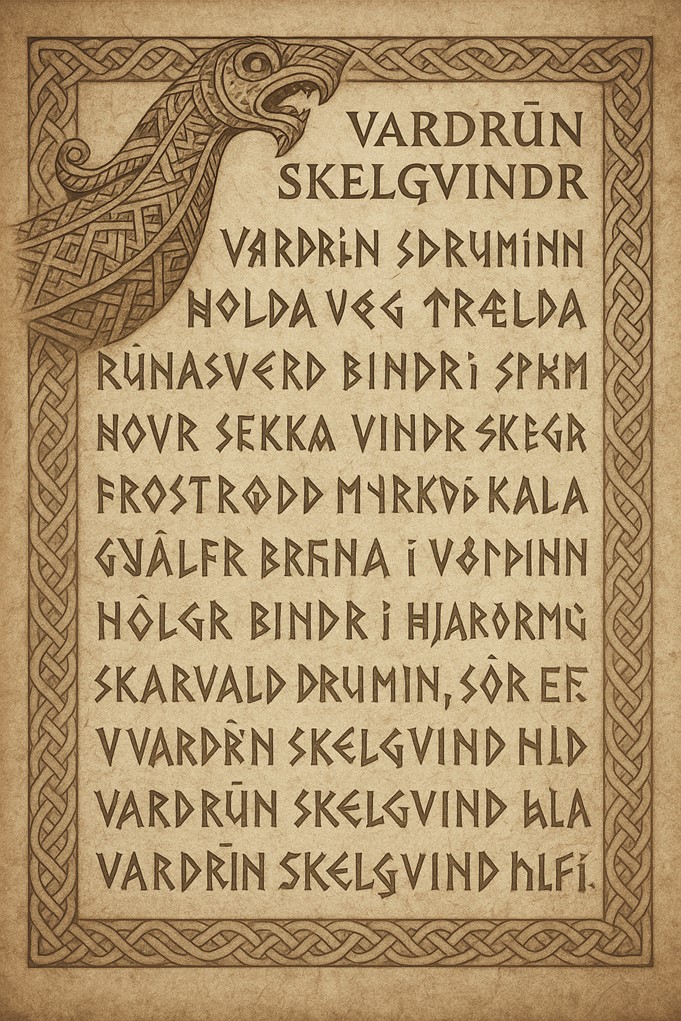
Uses the Runasverd script, an angular, interlinked runic system carved into vertical staves or inked in wave-like horizontal flows. The runes are designed to be carved into ship hulls, stone markers, or woven into banners. Magical inscriptions often use “Tidebind” variants, where strokes are elongated to represent magical resonance.
Source & History:
The oldest surviving Skarvald inscriptions date back over 3,000 years in Thulean reckoning, etched into basalt waystones marking ancient harbors. It is believed to have emerged from the confluence of several proto-coastal dialects of early Thulian fisher-clans, unified under the first maritime high kingdoms. The language absorbed elements from trader-tongues encountered over centuries, though its core phonology remains distinct.
Sensory Experience:
Hearing Skarvald is like the rhythmic breaking of surf on stone, alternating between sharp consonantal bursts and drawn-out vowel “swells.” In ritual use, its pitch changes rise and fall like rolling waves, with deep harmonic undertones resonating in group chants. When read aloud from stone carvings, the sound carries a crisp, echoing quality, as if the air itself is shaped to carry the words farther than the human voice should reach.
Ceremonial Incantation: Vardrûn Skelgvindr (“Ward of the Splintering Wind”)
Context of Use:
Performed aboard Thulian warships and harbor walls when a fleet expects hostile approach, this incantation calls on the wind and sea to fracture incoming force—whether ships, beasts, or magical assaults—into harmless dispersal. Traditionally, the captain or high ship-priest leads the chant, with officers echoing in binding responses.
Full Incantation in Skarvald:
*“Skarvald drúminn, holda végr þrælda,
Rúnasverd binda í stormstafn.
Hovr sekkja, vindr skelga,
Frostrødd myrkvíð kalla hafgæfa.
Ráðhöld þyrn, vætr sundra,
Havstál mæla gegn vánskepnu.
Gjálfr brenna í våginn,
Hǫlgr bindr í hjarðarmúr.
Skarvald drúminn, sjór hefnr,
Vardrûn Skelgvindr halda frí.”*
Literal Translation:
“Skarvald deep-sung, hold the wave’s thrall,
Runasverd bind in the storm’s prow.
Let it sink, let the wind shatter,
Frost-voice of shadow-wood call sea-blessing.
Rule with thorn, sunder the wights,
Sea-steel speak against the foe-shape.
Wave-cry burn in the bay,
Hill-ward bind in the harbor wall.
Skarvald deep-sung, the sea avenges,
Ward of the Splintering Wind hold free.”
Structural Resonance & Magical Effect:
- Opening Invocation (Lines 1–2): The name Skarvald and the imperative “bind in the storm’s prow” are voiced at the ship’s bow, physically aligning runic carvings with the chant. This primes elemental wind alignment.
- Wind & Ice Binding (Lines 3–4): The alternating imperatives Hovr sekkja (let it sink) and vindr skelga (wind shatter) create rhythmic back-pressure in the air currents, a tone known to cause microbursts.
- Sundering Command (Lines 5–6): The phrase vætr sundra (sunder the wights) uses a tri-tonal pitch drop, which in Skarvald ritual speech directs dispersal energy outward, breaking cohesion of enemy formations or spells.
- Wave-Fire Conduction (Lines 7–8): Here, Gjálfr brenna (wave-cry burn) harmonizes with brass ship bells, carrying the sound into water, creating a transient surface turbulence that can foul incoming vessels.
- Closing Seal (Lines 9–10): The repetition of the invocation forms a binding loop, “sealing” the defense until the threat is past or the chant is broken.
Performance Notes:
- Chant begins in low, unison murmurs, swelling with each verse until the second invocation, at which point the pitch breaks into alternating highs and lows.
- Runasverd glyphs are traced in the air with salted rope or carved into wooden planks mounted at the harbor edge.
- Each officer echoes only the imperative verbs (bind, shatter, sunder, burn, hold), reinforcing the action focus.