
Original Life Forms Referenced:
• Arthropoda – Coconut Crab (Birgus latro)
• Mollusca – Flamboyant Cuttlefish (Metasepia pfefferi)
• Chordata – Shoebill (Balaeniceps rex)
• Cnidaria – Portuguese Man o’ War (Physalia physalis)
Appearance:
The Thryochroscalmar 672 is a compact but imposing feral predator, its body a chitinous dome like a coconut crab’s carapace, reinforced with overlapping iridescent plates patterned in the shifting, psychedelic chromatophores of the flamboyant cuttlefish. Rising from the forward dome is the massive, wedge-shaped head of a shoebill, its brutal beak flanked by cuttlefish-like fin-frills that undulate constantly. From beneath the carapace trail a dozen translucent, venom-laden tentacles in a dense curtain, shimmering faintly in the light and drifting like a man o’ war’s sail appendages. Its eight primary legs are armored, jointed, and end in gripping crab claws that can shear through bone, while two of these claws have evolved into long, scything grappling limbs used for hooking prey from a distance.
Size:
Average adult length 2.4 m from beak to posterior carapace; leg span up to 3.1 m; height at resting stance ~1.6 m.
Speed:
• Land: 25 ft equivalent pacing, capable of sudden bursts up to 40 ft equivalent for 2 rounds.
• Water: 35 ft equivalent sustained swim speed, with jet-assisted bursts from siphon-like expulsion.
• Climb: 20 ft equivalent vertical/horizontal.
Stat Modifiers:
• +2 Strength (powerful claws and limbs)
• +1 Dexterity (precise tentacle control)
• +2 Constitution (heavily armored and resilient)
• −1 Charisma (unnerving, alien presence)
Skills:
• Stealth (+2 in aquatic or tidal zones due to color shift)
• Survival (+3 in coastal environments)
• Athletics (+2 for climbing and grappling)
• Perception (+2 from forward-facing shoebill eyes and tentacle pressure sense)
Behavior:
Ambush predator and opportunistic scavenger. Lies in wait along rocky shorelines or within tidal mangrove roots, color-shifting to match surroundings. Uses long grappling limbs to snatch prey into its tentacle curtain, where venom and constriction immobilize before the beak delivers the killing bite. Highly territorial during breeding season, otherwise solitary except for temporary feeding aggregations in high prey-density areas.
Diet:
Carnivorous, favoring fish, seabirds, crustaceans, and small to medium coastal avatars. Can consume carrion but prefers live prey. Venom both incapacitates and begins pre-digestion.
Emotions:
• Primary: calculated patience, alert suspicion
• Secondary: aggressive territoriality, protective instinct toward eggs
• Rare displays of curiosity toward glittering or bright magical effects
Environment Where Found:
Rocky tidal zones, estuaries, coral shallows, mangrove coasts, and partially submerged caves along temperate to tropical shorelines. Found primarily on smaller islands and coastal fringes of larger landmasses, often in areas of strong magic tides.
Tags:
Aquatic, Amphibious, Coastal Predator, Chromatic, Venomous, Armored, Grappler, Ambush Hunter, Tidal Zone, Opportunistic, Solitary, Highly Territorial, Climber, Jet-Propelled, Tentacled, Shoreline Hazard, Magical-Weather Adaptive
Life Cycle:
The Thryochroscalmar 672 hatches from translucent, gelatinous egg clusters anchored deep within tidal caves. Hatchlings are fully aquatic and resemble miniature cuttlefish with faint chitin plates and thin, fragile tentacles. In their first year, they remain in shallow reef pools, feeding on plankton and small crustaceans. By year two, their exoskeleton hardens, and they begin venturing into rocky shallows. Maturity is reached around year six, at which point their tentacles grow to full length and gain the potency of their paralytic venom. Adults can live 45–60 years, with carapace ridges thickening and beak edges sharpening with age. Elder individuals often become near-impervious to lesser weapons.
Mating:
Breeding occurs once every seven years during the Warming Week of the month Lathandus, when magic currents intensify in coastal waters. Males perform slow, hypnotic color-shift dances, displaying intricate patterns on their cuttlefish skin. The most vibrant and steady display usually earns the attention of a female. After pairing, the male transfers a sealed capsule of sperm to the female’s mantle cavity, and the female later lays 200–400 eggs inside a hidden, guarded nesting crevice. Both parents guard the nest, rotating shifts to feed and patrol until hatching occurs three months later. The guarding pair often becomes unusually aggressive toward anything approaching within a 50-foot radius of the nest site.
Tactics:
The Thryochroscalmar 672 is a master of multi-layered ambush:
- Camouflage and Stillness – Uses cuttlefish chromatophores to mimic sand, rock, or coral; holds perfectly motionless until prey is within reach.
- Tentacle Curtain – Once prey is close, unleashes venomous tentacles in a widening spread to ensnare and slow targets.
- Grappling Hook Limbs – Two elongated claws dart forward to hook and drag prey into striking range.
- Finisher – Delivers a crushing beak strike to vital areas or decapitation when possible.
- Aquatic Retreat – If overpowered, uses siphon-jet propulsion to vanish into deeper waters, trailing venom tentacles behind as a parting hazard.
Actions:
• Tentacle Sweep – Sweeps forward with all trailing tentacles in a broad arc, forcing multiple targets to make resistance checks against venom.
• Claw Grapple – Targets one enemy up to twice its body length away, pulls them into striking range.
• Beak Crush – Deals massive puncture and crushing damage, capable of breaking armor seams.
• Ink-Venom Cloud – Expels a thick, purple-black cloud underwater or a choking mist above water; both impair vision and carry light venom irritants.
• Jet Burst – Propels itself up to 40 ft in a straight line in water, smashing into foes or escaping.
Other Interesting Information:
• Magical Weather Sensitivity – The species reacts to magic tides, often becoming more active and aggressive during surges, leading to coastal warnings from nearby communities.
• Tool Use – Some individuals wedge shells or stones in front of their lairs as barriers, moving them aside only when exiting or returning.
• Predator Rivalry – They compete with large coastal drakes and aquatic nagas, often engaging in prolonged territorial disputes.
• Cultural Folklore – In Thulian coastal superstition, a Thryochroscalmar 672 sighting near a harbor is considered a warning of a magical storm. Fisherfolk sometimes leave offerings of fish or bright shells to appease them.
• Trade Value – Venom sacs are highly sought after for alchemical paralysis agents, and patterned chitin plates are used in ceremonial armor by some island cultures.
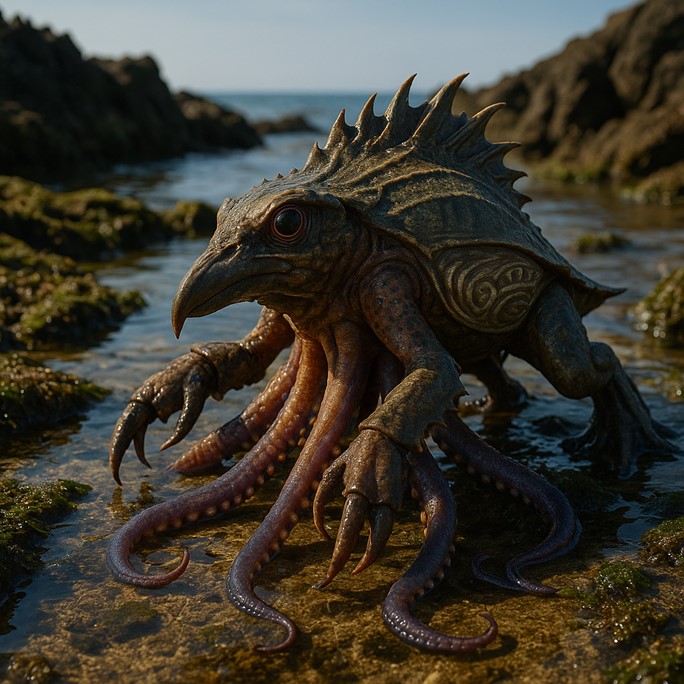
There was a mix-up of naming this creature on different Island Nations. Some locations call it a Thryochroscalmar 672 while others call it a Nerebosque 847.
Adventurers in Saṃsāra might encounter or deliberately seek the Nerebosque 847 for several overlapping reasons, each tied to its ecology, unique physiology, and the cultural or magical economies of nearby civilizations.
1. Harvesting Valuable Organic Components
The creature’s chitin-reinforced manta-ray fins and crocodilian-scale dorsal ridges are prized by armorers and shipwrights for producing lightweight yet durable laminar plates. Its deep-sea sponge-like gland clusters—distributed along its underbelly—hold concentrated bio-fluids that, when distilled, create potent water-breathing potions or high-tier diving suits’ filtration reservoirs. Coastal nations and smugglers’ guilds alike pay richly for these parts, driving expeditions into its hunting grounds.
2. Securing Magical Catalysts
Within the frontal lobes of the Nerebosque 847’s angler-fish–derived cranial mass lies a phosphorescent lobe-pearl, a semi-solid organ that accumulates latent mana from the moon’s tidal cycles. Wizards, artificers, and folk-ritualists believe that consuming or embedding the pearl into a conduit amplifies water-affinity spells, improves night-vision enchantments, and strengthens illusions that rely on reflected light. The scarcity and difficulty of extracting this intact make it a prime quest target.
3. Navigational and Territorial Control
The species is highly territorial, often claiming strategic inlets, tidal channels, or sub-harbor caves that are vital for maritime trade routes. Clearing a Nerebosque from these locations ensures safe passage for fleets, fishing villages, or military deployments. Sometimes, adventurers are hired by merchant leagues, royal harbormasters, or coastal fortresses to either kill or relocate the beast to secure naval dominance.
4. Quests of Proving and Rite of Passage
In Thulian and certain coastal Boian traditions, facing a Nerebosque 847 in its native waters is seen as a demonstration of skill, resolve, and magical adaptability. Initiates—especially from naval or guardian orders—may be tasked to mark or wound the creature as proof of their readiness to serve in elite harbor defense units. Such rites sometimes become political spectacles, drawing crowds, wagers, and reputations.
5. Unintentional Encounters During Exploration
The Nerebosque thrives in biodense kelp forests, volcanic trench systems, and warm estuarine shallows where mana currents are strong. Adventurers searching for sunken ruins, lost cargoes, or rare underwater flora may blunder into its territory. Due to its camouflaging fin membranes and sudden burst-speed lunges, the first sign of danger is often a piercing bite or a sweeping tail strike.
6. Ecological and Research Interests
Scholars and beast-tamers might commission expeditions to capture the creature alive for study. Its combination of aerial glide (via manta-derived wings) and aquatic hunting adaptations fascinates both magical biologists and war-beast breeders. Controlled specimens are rarely kept for long due to their size, aggression, and sensitivity to shifting mana tides, but the attempt draws in specialists and mercenaries alike.
7. Local Superstitions and Prophecies
Coastal fishing hamlets sometimes interpret the arrival of a Nerebosque as an omen—either of impending famine, shifting magical weather, or the death of a prominent local leader. In such cases, folk leaders or religious sects may commission its removal to break a perceived curse, or conversely, demand that it be captured and paraded as a living ward against future misfortune.
From the corpse of the Nerebosque 847, skilled harvesters can extract a variety of rare materials, each with distinctive uses across Saṃsāra’s crafting, magical, and economic systems. Most require specialized tools and knowledge to retrieve without contamination or degradation, and many are perishable unless preserved immediately.
1. Lobe-Pearl of the Tide-Eye
- Source: Cranial phosphorescent organ (angler-fish heritage).
- Uses: Crystalline catalyst for enchanting water- or light-based spells; amplifies moonlight in magical conduits; serves as a focus for illusion magic involving reflection or glow. Powdered form is blended into inks for Skarvald or Runasverd script inscriptions intended for oceanic wards.
- Rarity: Extremely rare, as intact removal requires killing the beast without crushing the skull.
2. Manta-Fin Membranes
- Source: Winglike fins.
- Uses: Dried and layered into glider sails, skyfishing kites, or underwater speed enchantments; when infused with specific aetheric resins, they grant garments or gear temporary hydrodynamic streamlining. Naval assassins sometimes wear strips of this as stealth-swim cloaks.
- Rarity: Rare, but more recoverable from older specimens with thicker membranes.
3. Crocodilian Ridge-Scutes
- Source: Dorsal armor ridges.
- Uses: Forged into laminar plates for lightweight marine armor; ground into powder as a reagent for physical-resistance potions; occasionally carved into ceremonial knife grips for harbor-defense officers. Particularly valued by Thulian shipwrights for prow reinforcement.
- Rarity: Uncommon, but high demand in coastal nations.
4. Abyssal Sponge Nodules
- Source: Gland-like clusters on the underside, resembling deep-sea sponges.
- Uses: Absorb toxins from liquids; used in shipboard alchemy labs for water purification; when magically treated, they can store large volumes of enchanted fluid without degradation. Folk healers dry and crush them into poultices for venom neutralization.
- Rarity: Common on mature adults, perish quickly if not processed within hours.
5. Tail-Spine Harpoon
- Source: Chitin-hardened, barbed tail spine.
- Uses: Crafted into harpoons or spears with exceptional penetration against scale or shell; when left intact with its venom sac, serves as a one-use, high-potency paralytic weapon. Some smiths fuse them into ceremonial tridents for harbor temple guards.
- Rarity: Rare due to breakage during combat.
6. Venom Sac & Ducts
- Source: Base of tail spine.
- Uses: Distilled into paralytic poisons for darts, arrows, or trap coatings; diluted for use in medicinal nerve-blocking salves. Dangerous to handle—requires cold storage and gloves woven with mana-resistant threads.
- Rarity: Rare and volatile.
7. Chromatic Eye-Lenses
- Source: Multi-faceted angler-fish eyes.
- Uses: Integrated into optical devices for enhanced low-light vision; ground into dust for illusionist’s glamour powders; embedded in navigation stones to mark undersea hazards by moonlight reflection.
- Rarity: Uncommon, highly valued by magical cartographers.
8. Myomer Musculature Strands
- Source: Pectoral and tail muscles.
- Uses: Processed into “living rope” that flexes when exposed to small mana pulses; incorporated into prosthetic limbs or clockwork automata for lifelike movement. Dangerous to craft without proper warding, as residual muscle reflexes can trigger unexpectedly.
- Rarity: Rare, requires fresh harvest.
9. Bioluminescent Dorsal Filament
- Source: Angler-like lure.
- Uses: When treated with alchemical stabilizers, retains its light for months; used in lanterns, bait for deepwater fishing, or as a signal beacon for coastal scouts. Can also be tuned magically to pulse specific light patterns for coded communication.
- Rarity: Common on most adults, but brightness fades within days unless preserved.
10. Mana-Rich Blood Slurry
- Source: Circulatory fluid—mix of blood and nutrient gel from sponge glands.
- Uses: In high-tier alchemy for brewing stamina elixirs; powering aquatic golems; or nourishing rare coral colonies in enchanted harbors. The taste is said to be metallic-sweet, and some folk rites require it for moonlit oaths.
- Rarity: Abundant but coagulates within hours, limiting transport distance.
Nerebosque in Days Before Tide Was Bound
And it is said, in the speaking that was before the speakers, there was a wide water where the moon shone too close and the Helios walked slow across the sky. In this water there was no shore and no bottom, only the drifting weeds that whispered to each other in the language of the roots. Among the weeds, the first Nerebosque was born, not from egg nor womb, but from a quarrel between the Night Fish and the Stone That Dreams. The Night Fish gave it teeth of white glass to bite the moonlight, and the Stone gave it bones that were not bones, but bending iron like the hulls of forgotten ships.
In those times, the waters were empty of fear, for the creatures swam without knowing the shape of danger. The Nerebosque swam also, but it swam with the knowing. It carried a lantern on its head that burned with no fire, yet drew all eyes to it. The fish came, the birds came, and even the foolish seals came, thinking the light was the dawn beneath the waves. And the Nerebosque took them into its mouth and carried their voices in its belly, so that its stomach sang in many tongues during the dark.
But the people of the first coasts heard these songs, and they believed them to be the weeping of drowned kin. The elders sent twelve boats made of bound kelp and bone to follow the sound. For three days and three nights they rowed, guided by the lantern’s false dawn. On the fourth morning, they found the Nerebosque sleeping near the place where the moon kisses the sea. Its body was wide like the wings of a shadowed manta, its back rough with the ridges of the crocodile, its tail ending in a spine that dripped the dream-venom of the abyss.
The people did not attack, for they feared its dreaming. Instead, they sang the Song of Asking, which in those days was known to open the ear of all beasts. The Nerebosque awoke and listened, and it told them, “The voices in me are not the drowned; they are the swallowed. If you wish them free, you must bring me the Feather of the Sky Below.” None knew where this was, but the elders pretended they did, for shame of not knowing.
They searched under the water, they searched above the cliffs, they searched in the clouds where the rainbirds live, but found nothing. In the seventh week of searching, one child who was not counted among the boats brought to the shore a feather of strange color, which she said fell from the shadow of a bird swimming in the sun. The elders gave it to the Nerebosque, who took it gently into its mouth. The feather turned to bubbles, and from its gills came the freed voices—fish, bird, and seal—who swam or flew away without thanks.
The Nerebosque said, “Now I owe the world a debt, for the keeping of those I should have let pass.” From that day it guarded the mouth of the deep trench where the drowned fall, striking down all that sought to harm the balance. It would let the harmless pass and shatter the hungry with its tail-spine. The people came to see it not as the devourer, but as the Keeper of the First Depth.
And yet, the oldest tellers say that sometimes the Nerebosque grows restless, hungering for the lightless voices again. In those years, ships vanish without driftwood, and the water glows faintly in the shape of a great wing beneath the waves. The people hang lanterns at the prow, not to see where they go, but so the Keeper knows they have come with respect, not with nets.
Moral: That which holds the voices of the lost may keep them for harm or for care; the choice shapes the deep, and the deep remembers.
Suggested conversions to other systems:
CALL OF CTHULHU (7th Edition)
Name: The Lantern Maw of the First Depth
STR 130, CON 150, SIZ 200, DEX 55, INT 40, POW 90
Hit Points: 35
Move: Swim 10
Build: 4
Damage Bonus: +2D6
Armor: 8-point rough hide and crocodilian ridges
Attacks:
• Bite (50%), damage 2D6+db, on hit may “swallow” Small or smaller target whole (opposed STR roll to resist).
• Tail Spine (35%), damage 1D10 + dream-venom (target must succeed in CON roll or suffer delirium: –20% to all skill rolls for 1D6 minutes).
Powers:
• False Dawn Lantern – Can emit hypnotic light from cranial lure; those who fail a POW vs POW contest must approach in fascination.
• Voice Belly – Absorbs last sounds of swallowed prey; may replay these once/day to lure others (POW vs POW to resist if familiar voice).
• Abyssal Guardian – Immune to fear; swimming in trench currents does not reduce movement.
Sanity Loss: 0/1D8 to behold, 1/1D10 if swallowed and survive.
BLADES IN THE DARK
Name: The Depth-Keeper
Type: Threat (Sea Horror) – Magnitude IV
Features:
• Massive, manta-winged body armored with jagged ridges.
• Lantern-lure hypnotism that draws ships or swimmers near.
• Venomous tail capable of piercing hulls.
Threat Clocks:
• “Lured In” – 4-segment clock before prey is within striking range.
• “Hull Breach” – 6-segment clock to sink medium vessel.
Special Rules:
• Hypnotic Lantern – PCs must resist (Resolve) or be compelled to approach.
• Voice Mimicry – Can perfectly reproduce voices heard in past month.
• Abyss Guardian – Will ignore prey that offers symbolic lantern tribute (tiered fortune roll to determine recognition).
Harm Examples:
• Level 2 Harm: “Pierced by Spine” (–1D to physical actions).
• Level 3 Harm: “Venom-Delirium” (disadvantage on all rolls until treated).
DUNGEONS & DRAGONS (5th Edition)
Name: Nerebosque, Keeper of the First Depth
Huge monstrosity, neutral
Armor Class: 17 (natural armor)
Hit Points: 189 (18d12+72)
Speed: swim 50 ft.
STR 22 (+6), DEX 10 (+0), CON 18 (+4), INT 6 (–2), WIS 15 (+2), CHA 8 (–1)
Saving Throws: Con +8, Wis +6
Skills: Perception +6, Stealth +4 (in water), Deception +2 (voice mimicry)
Damage Resistances: cold; bludgeoning, piercing, and slashing from nonmagical attacks
Condition Immunities: frightened, charmed
Senses: darkvision 120 ft., passive Perception 16
Languages: understands Aquan, Thulian, but cannot speak (except via mimicry)
Challenge: 10 (5,900 XP)
Traits:
• False Dawn Lantern (Recharge 5–6) – Creatures within 60 ft. that can see the lure must succeed on a DC 16 Wisdom saving throw or be charmed until the end of the Nerebosque’s next turn.
• Voice Belly – Can mimic any voice heard in the past 30 days (DC 18 Insight to detect).
• Guardian of the Abyss – Advantage on saving throws against being moved or knocked prone while in water.
Actions:
• Multiattack – The Nerebosque makes one Bite attack and one Tail Spine attack.
• Bite – Melee Weapon Attack: +10 to hit, reach 10 ft., one target. Hit: 25 (3d10+6) piercing.
• Tail Spine – Melee Weapon Attack: +10 to hit, reach 15 ft., one target. Hit: 18 (2d10+6) piercing plus 14 (4d6) poison damage; target must succeed on a DC 16 Constitution saving throw or be poisoned for 1 minute.
• Swallow – On a hit with Bite against a Large or smaller creature, target is swallowed (blinded, restrained, total cover, 21 acid damage at start of its turns).
KNAVE (latest edition)
Name: Abyss-Winged Lantern Maw
HD: 12
Armor: 4 (natural)
Attack: +3
Damage: Bite 2D8, Tail Spine 1D10 + poison (save or confused 1D6 rounds)
Move: 40 ft. swim
Morale: 10
Abilities:
• Lantern Lure – All creatures in sight must save vs WIL or approach.
• Voice Stomach – Can repeat voices of eaten prey; those hearing a familiar voice must save vs WIL or investigate.
• Abyss Guardian – Immune to fear; ignores attacks from ships bearing lit bow-lanterns unless provoked.
Special: On a natural 20 with Bite, target is swallowed whole. Takes 2D6 acid damage per round until freed or creature killed.
FATE CORE
Name: Abyssal Lantern Maw
Aspects:
• High Concept: Guardian Horror of the First Depths
• Trouble: Drawn to False Dawn
• Aspect: Mimics the Lost Voices of the Deep
• Aspect: Wings Like Manta, Tail Like Doom
Skills:
• Great (+4): Physique, Notice
• Good (+3): Fight, Stealth
• Fair (+2): Provoke, Athletics
• Average (+1): Lore (Oceanic)
Stunts:
• Hypnotic Lantern – Once per scene, can use Provoke instead of Fight to create an advantage on all targets in visual range, representing their fascination.
• Voice Lure – +2 to Create Advantage when imitating voices to lure prey into position.
• Abyss Guardian – +2 to Defend against environmental hazards while in water.
Stress: 4 boxes
Consequences: Mild (2), Moderate (4), Severe (6)
NUMENERA & CYPHER SYSTEM
Name: Lantern Maw of the Abyss (Level 7 Creature)
Level: 7 (21 target number)
Motive: Protect the trench and hunt prey
Health: 35
Damage Inflicted: 9 points (bite), 6 points + venom (tail spine; victim must succeed on Might defense or suffer Confused condition for 1 minute)
Armor: 3
Movement: Long swim
Special Abilities:
• Hypnotic Lantern – All creatures within short range must succeed on an Intellect defense roll (difficulty 7) or be compelled to approach.
• Voice Mimicry – Can flawlessly imitate voices heard in the last 30 days; those familiar must make an Intellect defense roll (difficulty 6) to resist.
• Swallow Whole – On a successful bite against a Medium or smaller target, target is trapped inside (5 points damage per round, ignores armor).
• Resistant to Displacement – Difficulty to move or knock prone is increased by 2 while in water.
Interaction: Ignores intruders that present glowing tribute items unless provoked.
Use: As a rare abyssal guardian encountered when delving into deep ocean ruins.
PATHFINDER 2E
Name: Nerebosque, Guardian of the First Depths
Creature 10 – Huge – Neutral – Aquatic – Monstrosity
Perception +18; darkvision, scent (imprecise) 60 ft.
Languages Aquan, Thulian (cannot speak)
Skills Athletics +22, Stealth +14, Deception +16
Str +6, Dex +2, Con +5, Int –2, Wis +3, Cha +1
AC 28; Fort +21, Ref +18, Will +19
HP 200; Immunities fear, paralyzed
Resistances cold 10; physical 10 (except magical)
Speed swim 50 ft.
Melee: Bite +22 (reach 10 ft.), Damage 3d10+6 piercing
Melee: Tail Spine +22 (reach 15 ft.), Damage 2d10+6 piercing plus 4d6 poison (DC 28 Fort save or poisoned 1, slowed 1)
Special Abilities:
• Hypnotic Lantern (aura, mental, visual) 30 ft., DC 28 Will save or fascinated 1 round.
• Voice Belly – Can mimic voices; DC 30 Perception to identify as false.
• Swallow Whole – Medium or smaller, 3d6+6 bludgeoning + 2d6 acid, AC 25, 25 HP to escape.
SAVAGE WORLDS (Adventure Edition)
Name: Abyss-Winged Lantern Maw
Attributes: Agility d6, Smarts d4(A), Spirit d8, Strength d12+2, Vigor d10
Skills: Athletics d8, Fighting d10, Notice d8, Stealth d6, Taunt d6
Pace: 0; Swim: 10; Parry: 7; Toughness: 15 (3)
Special Abilities:
• Armor +3 – Thick hide and armored ridges.
• Bite – Str+d8 damage.
• Tail Spine – Str+d6 damage + venom (Vigor roll at –2 or be Stunned and Shaken from delirium).
• Hypnotic Lantern – Targets in line of sight must make a Spirit roll at –2 or be compelled to move toward the Maw.
• Voice Mimicry – Can perfectly copy voices heard in the past month; Notice roll at –4 to detect falsehood.
• Swallow Whole – On a Raise with a Bite, may swallow Small or smaller creatures; victim suffers 2d6 damage per round.
Size: Huge (+4)
Special: Immune to Fear effects.
SHADOWRUN (6th Edition)
Name: Abyssal Lantern Maw
Attributes:
Body 10, Agility 4, Reaction 5, Strength 9, Willpower 5, Logic 1, Intuition 4, Charisma 2
Initiative: 9 + 2D6 (waterborne)
Movement: Swim 20 m/turn
Condition Monitor: Physical 16, Stun 11
Armor: 8 (natural plating)
Skills: Unarmed Combat 8, Perception (Hearing) 7 (+2), Swimming 8, Con (Imitating Voices) 5 (+2)
Powers:
• Hypnotic Lantern (Complex Action, LOS, Willpower + Logic [Mental] (4) Test or approach creature)
• Tail Spine (Melee, DV 8P, AP –3, Neurotoxin: Toxin Resistance Test, 6S damage + Nausea)
• Swallow Whole (Capture on Called Shot with 3+ net hits; DV 6P/turn internal damage, ignores armor)
• Voice Mimicry (Opposed by Perception + Intuition; can reproduce exact voices for 30 days after hearing)
Tactics: Ambushes from concealment, lures targets, disables strongest threats first.
STARFINDER (2nd Edition)
Name: Nerebosque, Abyssal Guardian – CR 13
XP 25,600
NE Huge aberration (aquatic)
Init +7; Senses darkvision 120 ft., blindsense (vibration) 60 ft., low-light vision; Perception +24
DEFENSE
HP 260; EAC 28; KAC 30
Fort +20, Ref +16, Will +18
Resistances cold 20, physical 10 (except magic)
Immunities mind-affecting effects from fear
OFFENSE
Speed swim 60 ft.
Melee bite +27 (5d8+15 P)
Melee tail spine +27 (4d8+15 P + poison; Fort DC 24, 1d4 rounds confused)
Special Attacks Hypnotic Lantern (30-ft. emanation, Will DC 24 or fascinated for 1 round), Swallow Whole (3d8+10 B + 2d6 acid, KAC 25, 25 HP to cut free)
Space 15 ft.; Reach 15 ft.
STATISTICS
Str +8, Dex +3, Con +6, Int –2, Wis +4, Cha +1
Skills Athletics +27, Stealth +22, Disguise (mimicry) +22
Languages Aquan (cannot speak)
TRAVELLER (Mongoose 2nd Edition)
Name: Abyssal Lantern Maw
Traits: Aquatic Predator, Large (10 m length), Mimicry, Bioluminescence, Venomous
Characteristics:
STR 18 (+3), DEX 8 (+0), END 16 (+2), INT 2 (–2), EDU 0 (–3), SOC 0 (–3)
Attacks:
• Bite – 4D6 damage, AP 4
• Tail Spine – 3D6 damage + venom (END check 8+ or Confused for 1D6 minutes)
• Swallow Whole – On Effect 6+ with Bite against human-sized or smaller target; internal damage 3D6 per round
Armor: 8 (natural plating)
Endurance: 40
Skills: Athletics 2, Recon 2, Stealth 2, Survival 3
Tactics: Lures vessels or divers with false lights and sounds; ambushes from cover; retreats only if reduced below 25% Endurance.
WARHAMMER FANTASY ROLEPLAY (4th Edition)
Name: Nerebosque, Abyssal Maw – Sea Monstrosity
Species: Monstrous
Size: Enormous
Movement: Swim 8
Main Profile:
WS 55, BS –, S 70, T 65, Ag 35, Int 10, WP 45, Fel 05
Secondary Profile:
A 4, W 85, SB 7, TB 6, M 8, Mag 0, IP 0, FP 0
Traits: Amphibious, Armour (5), Bite (SB+6 Damage), Tail Spine (SB+4 Damage + Poison: Average (+20) Endurance or Stunned 1 round), Swallow Whole (Average (+20) Strength to escape; 2D10 Damage/round), Terror (2), Night Vision, Mimic Voice (Hard (–20) Perception to detect)
Special Rules:
• Hypnotic Lantern – Any creature within 12 yards must pass a Cool Test or become Entranced for 1 round.
• Abyss Guardian – Will never leave trench territory; gains +20 to opposed Strength when resisting forced movement underwater.
Additionally… full set of environmental hazards and encounter hooks:
1. Saṃsāra (Original System)
Environmental Hazards:
• Mana-Flux Upwellings – Sudden surges of magic in trench waters can overload attuned worn items, forcing a Tier test or temporarily disabling gear.
• Lightless Abyss – Absolute darkness beyond Mind’s Eye range; predators can see you, but you cannot see them without magic.
• Bone-Crushing Pressure Zones – Staying too long imposes HP loss per 2d4 minutes unless gear grants deepwater protection.
Encounter Hooks:
- The monarchy issues a royal bounty for the beast’s luminous organs—vital to lighthouse magic.
- A coastal city’s fishing fleet is being decimated by something imitating the voices of lost sailors.
- An uncharted ruin in the beast’s territory holds relics from the First People.
2. Call of Cthulhu (7th Edition)
Environmental Hazards:
• Eldritch Currents – SAN check (0/1D4) when viewing the abyssal lights that seem to form runes in the dark.
• Crushing Blackness – Extreme darkness imposes disadvantage on Spot Hidden and Navigation.
• Venom Clouds – Inhalation requires CON roll or lose 1D4 HP + temporary paralysis.
Encounter Hooks:
- Deep-sea researchers vanish after sending garbled phonetic recordings in an unknown tongue.
- A cult believes the beast is a herald of a Great Old One—ritual sacrifices feed it.
- Recovery of a sunken idol is interrupted by the Nerebosque guarding its resting place.
3. Blades in the Dark
Environmental Hazards:
• Haunted Depths – Ghosts of drowned sailors cause +1 Heat if disturbed.
• Pressure Leaks – Damage to hulls and diving gear increases harm by one level.
• Voice Mimicry – NPC allies may be lured away into darkness by false calls.
Encounter Hooks:
- A Leviathan hunter hires the crew to harvest luminous glands for arcane lamps.
- Rivals sabotage your submersible, leaving you in the creature’s territory.
- Smuggling route passes through a trench claimed by the beast.
4. Dungeons & Dragons (5e)
Environmental Hazards:
• Crushing Depths – Start of each turn at depth requires DC 15 Con save or gain 1 level of exhaustion.
• Bioluminescent Ambush – The glow imposes DC 14 Wis save or be charmed for 1 round.
• Trench Currents – DC 15 Strength (Athletics) check to avoid being pulled into hazards.
Encounter Hooks:
- A temple offers gold for the venom sac to brew holy poison.
- An adventuring ally is swallowed whole—rescue them before they suffocate.
- Abyssal cultists are escorting the beast to a coastal city for destruction.
5. Knave
Environmental Hazards:
• Suffocating Depths – Lose 1 STR every 3 rounds without air.
• Phantom Lights – Save vs. WIL or wander toward danger.
• Tangled Kelp Forests – Half movement and –2 to attack rolls.
Encounter Hooks:
- Rumor speaks of a pearl the size of a helm inside its gullet.
- A shipwreck treasure map leads into its lair.
- Locals offer safe harbor only if you slay the “Lantern Demon.”
6. Fate
Environmental Hazards:
• Compel: Abyssal Darkness – Apply Aspects like Lightless Waters or Voice of the Dead to hinder navigation.
• Zone Hazard: Crushing Pressure – Creates situational Aspect that can be invoked for +2 against intruders.
• Boost: Bioluminescent Dazzle – Temporarily blinds or distracts foes.
Encounter Hooks:
- A faction wants proof the beast exists—bring back its spine.
- Merchant shipping lanes are losing vessels to mysterious trench lights.
- A magical artifact embedded in the beast’s shell must be recovered.
7. Numenera & Cypher System
Environmental Hazards:
• Environmental Effect (Level 6) – Pressure crush deals 6 damage per round without protection.
• Illusionary Calls (Level 5) – Intellect defense to avoid lures.
• Toxic Dispersal (Level 6) – Venom cloud inflicts Speed damage over time.
Encounter Hooks:
- A numenera device swallowed by the beast is distorting local gravity—recover it.
- The organs glow with a pattern matching an ancient cipher.
- A deepwater community offers rare cyphers for its elimination.
8. Pathfinder (2e)
Environmental Hazards:
• Extreme Cold (Severe) – Fortitude DC 22 or 1d6 cold damage per 10 min.
• Crushing Depths – Fortitude DC 24 or 1 stage of fatigue.
• Bioluminescent Hypnosis – Will DC 23 or fascinated 1 round.
Encounter Hooks:
- The venom is needed for an anti-kraken serum.
- Ruins in the trench floor can only be reached after driving off the beast.
- A magical pearl in its gullet contains trapped souls.
9. Savage Worlds (Adventure Edition)
Environmental Hazards:
• Hazard: Crushing Depth – Vigor roll at –2 or suffer a Fatigue level.
• Hazard: Ensnaring Kelp – Athletics at –2 to escape.
• Hazard: Blinding Glow – Spirit roll or distracted for 1d4 rounds.
Encounter Hooks:
- Salvage crew hires you to clear the beast from a sunken treasure site.
- Naval officers offer a bounty for its hide to armor their flagship.
- The glow matches coordinates to a lost vault.
10. SHADOWRUN (6th Edition)
Environmental Hazards:
• Bioluminescent Dead Zones – The Nerebosque nests in submerged ruins where glowing algae distort sensor readings, imposing a –2 dice pool penalty to Perception (Visual) and Electronic Warfare tests.
• Sonic Reverberation Trenches – Deep crevices amplify sounds, granting +2 dice pool to the creature’s Mimicry tests but imposing +1 Noise rating on all commlink and drone operations.
• Neurotoxin Plumes – Invisible venom clouds linger for 1D6 combat turns after a tail spine strike, requiring a Body + Willpower [3] Test or suffer Nausea (-2 to all dice pools).
Encounter Hooks:
- A corporate research submersible vanished after reporting “strange voices in the dark.” The Johnson wants a recovery team, dead or alive—payment doubles if the bioluminescent organ is intact.
- An undersea smuggling route is blocked by something that imitates the crew’s voices, luring divers to their deaths.
- The Nerebosque’s venom is a key component in a prototype drug. A shadow clinic hires runners to harvest it—but the buyer is another corp’s black-ops lab.
11. STARFINDER (2nd Edition)
Environmental Hazards:
• Gravity-Shear Currents – Unstable trench edges create pockets of microgravity that throw combatants 1D4 × 5 ft. per round in random directions unless they succeed at an Athletics or Acrobatics check (DC 22).
• Photonic Bloom Clouds – Dense clouds of magical plankton emit disorienting light, forcing a Fortitude save (DC 21) or gain the dazzled condition for 1D4 rounds.
• Silent Zone – Magical null regions suppress comms and spells with the language-dependent or auditory descriptors for 2D4 rounds.
Encounter Hooks:
- A pact world’s navy offers a bounty for any team that clears the Nerebosque from a vital abyssal communications cable route.
- Ancient alien ruins at the trench floor require exploration, but the guardian beast has claimed the area for breeding.
- A high-value relic inside the Nerebosque’s gullet must be retrieved intact—before digestion destroys it.
12. TRAVELLER (Mongoose 2nd Edition)
Environmental Hazards:
• Pressure Cracks – Sudden shifts in trench rock walls cause implosive shockwaves; all within 10 m take 2D6 damage unless they succeed at a Dex check (8+).
• Cold Trench Water – Ambient temperature near freezing requires END check (6+) each 10 minutes or take 1D6 Fatigue.
• False Echo Chambers – Narrow tunnels reflect sonar pings, giving Recon checks –2 DM unless aided by advanced sensors.
Encounter Hooks:
- The Nerebosque has swallowed a black box from a crashed scout ship—recovery means diving deep into predator territory.
- Colonists report their fishing mechs are being destroyed by “ghost lights” in the abyss.
- A pirate clan offers a fortune for live capture of the Nerebosque to guard their hidden base.
13. WARHAMMER FANTASY ROLEPLAY (4th Edition)
Environmental Hazards:
• Maelstrom Pits – Strong whirlpools drag swimmers into rocky mouths; Swim Test at –20 or be pulled under and take 1D10+4 Damage ignoring armour.
• Black-Kelp Forests – Dense weeds entangle legs and weapons; Movement halved and attacks at –10 WS until a full action is spent cutting free.
• Cursed Lantern Glow – The beast’s light draws in hexed fish whose contact causes Fatigue tests at –10 for 1 round.
Encounter Hooks:
- Fishermen whisper of a “sea demon” stealing their voices—when nobles start disappearing from coastal parties, a witch-hunter calls for assistance.
- A cult worships the Nerebosque as an avatar of their sea god, sabotaging attempts to hunt it.
- A priceless relic, blessed by a saint, is lost at sea—last seen clutched by a drowned knight swallowed whole.