
Deity Name: Aegvildr the Ever-Rooted
Lore:
The Deep Crown of Aegvildr holds that all land rises from the unseen roots beneath the waves, and that those roots are the limbs of Aegvildr, the Ever-Rooted One. In the oldest stone chants, Aegvildr is said to be a figure both above and below, wearing a crown of black coral and ice-spined kelp. His body is the invisible lattice that binds shore to sea floor, and his breath is the tide. When storms take ships or famine sweeps the coasts, it is believed that Aegvildr is testing the hold of the roots upon his people.
Worship centers on the harbors, where tide-mark stones are carved with spirals and hooked lines representing the Root Crown’s grip on the land. Pilgrims cast offerings into tidal pools at the change of moon—usually woven lengths of seal sinew, small silver scales hammered into disks, or salted bone charms—to bind their fortunes to the deity’s unseen network.
Ancient myth tells that the ruling line of Thule’s harbor cities were chosen by Aegvildr in the Drowned Era, when the ice barriers cracked and the sea came in for fifty days. Those who survived claimed they heard the voice of the Root Crown in the booming of the waves, promising safety if they guarded the harbors and kept the crown’s shape alive in stone and ritual.
Personality:
Aegvildr is viewed as patient but unyielding, a presence that erodes over decades rather than striking in moments. He rewards vigilance, discipline, and long-term service but scorns recklessness and greed that weakens the roots of community. His voice is imagined as deep and slow, carrying the cold of the sea.
Traits & Characteristics:
- Dual-Domain Deity: Commands both sea and land as one body.
- Silent Judge: Answers not to sudden prayer but to the consistency of offerings and oaths.
- Binder of Communities: Symbolic roots link kin, ship, and shore.
- Harbor Sentinel: Guardian of moorings, seawalls, and coastal safety.
- Seasonal Tides: Manifestations occur strongest at solstices and equinoxes when root and wave align.
Attributes:
- Elemental Affinities: Water (depths, tides), Earth (roots, stone), Cold (ice, snow).
- Domains: Protection, Binding, Endurance, Navigation.
- Favored Animals: Walrus, black seabird, deep-sea lanternfish.
- Ritual Colors: Black, white, deep green, silver.
Symbols:
- The Root Crown: A circular crown of branching coral or root-like kelp fronds.
- The Tidal Spiral: A spiral with anchoring hooks along its length, representing both water’s pull and the grip of roots.
- The Harbor Stone: A flat stone with tide notches and drilled anchor holes, used in mooring rites.
Tags:
Aegvildr, Root Crown, Tidal Spiral, Coral Crown, Harbor Faith, Maritime Guardian, Sea and Stone, Endurance, Binding, Patience, Thule Culture, Cold-Water Deity, Ice and Depths, Navigation Blessing, Harbor Protection, Ancient Oathkeeper, Coastal Lore
Positives of the Faith:
- Strong Maritime Defense: Harbors and fleets under Aegvildr’s protection maintain superior mooring, navigation, and storm-resistance through blessings and rituals.
- Civic Unity: The binding oaths and symbolic “roots” strengthen loyalty among crews, merchants, and port guards, reducing internal strife.
- Long-Term Stability: The deity’s focus on endurance over time fosters steady governance and preservation of traditions, especially among the ruling families.
- Cultural Cohesion: Festivals, tidal offerings, and shared rituals provide a common identity linking inland and coastal Thulians.
- Navigational Guidance: Skilled navigators trained in the faith’s rites often outperform secular mariners in reading sea and sky.
Negatives of the Faith:
- Slow to Act: The deity’s nature and priesthood’s process-based approach can delay responses to sudden crises.
- Rigid Tradition: The requirement to maintain ancient rites exactly as prescribed can limit innovation in maritime engineering or governance.
- Isolationist Tendencies: A belief in guarding harbors “from within” may cause suspicion of foreign ships and crews, restricting trade opportunities.
- High Ritual Demands: The cost and labor for tidal offerings, harbor carvings, and seasonal ceremonies can burden poorer coastal communities.
- Maritime Dependence: Inland followers may find fewer tangible benefits, leading to uneven devotion across the nation.
Type of Temple:
Temples, called Root Sanctums, are massive stone structures built into harbor walls, docks, and breakwaters. They often extend below sea level, with partially submerged sanctuaries accessible only during low tide. The inner sanctum contains the Harbor Stone, a great flat slab carved with the Root Crown motif, tide notches, and anchor holes, upon which major rituals are performed. The outer courtyards double as warehouses for ceremonial anchors, ropes, and tide markers.
Number of True Followers:
Out of the Island Nation’s population of 90,314,824, roughly 46 million are active and devout followers who participate in all major rites, maintain personal offerings, and adhere to the faith’s behavioral codes. These include most of the ruling family, a majority of coastal populations, and many harbor-based guilds.
What They Do:
- Maintain Harbor Integrity: Followers serve as wardens, engineers, and tide-watchers, ensuring all moorings, seawalls, and breakwaters remain intact.
- Conduct Tidal Rites: At each moon change, they lead or join in offerings to bind their fortunes to the Root Crown’s protection.
- Train Navigators: Aegvildr’s priests run schools teaching star-lore, tide charts, and root-binding prayers to mariners.
- Bless Ships: Before a voyage, ships are brought to a Root Sanctum where priests trace the Root Crown spiral in saltwater along the keel.
- Guard Coastal Communities: Faith-led militias patrol waters near harbors, repel sea raiders, and escort merchant convoys.
- Preserve Ritual Stones: Followers restore and replace carved tide-mark stones, ensuring their lines remain true to the original measures.
Beliefs of the Faithful
Followers of Aegvildr, the Root Crown of the Deep Mooring, hold that all life—landbound and seafaring—is anchored to an unseen chain stretching into the depths beneath the world. This chain is bound to the Root Crown, a living, coral-wreathed anchor said to rest in the abyss below Thule’s central harbor. They believe that storms, shifting tides, and the fate of ships are swayed by the Root Crown’s mood, and that neglecting its rites loosens the nation’s spiritual moorings, inviting chaos, invasion, or ruin. Loyalty to community is considered as binding as a ship’s mooring rope, and betrayal is likened to cutting a line in foul weather. The faithful also believe that each soul has a “keel-mark” etched upon it at birth by Aegvildr, dictating how it should navigate life’s currents; proper living aligns one’s keel with the eternal tide.
Regular Services
Services, known as Tidebindings, occur twice weekly—once on the high tide nearest dawn and once on the low tide nearest dusk. The congregation gathers at a Root Sanctum’s outer pier or seawall, barefoot to feel the water’s touch. Priests in kelp-dyed robes and salt-crusted sashes chant Skarvald verses in the Runasverd script while moving in synchronized, anchor-shaped patterns. Incense made from dried kelp and whale fat is burned, and ritual saltwater is sprinkled in spiral arcs over those present. Offerings of ropework charms, carved driftwood, and small metal tokens are cast into the tide. The Tidebinding always ends with the Mooring Chant, a deep, rhythmic call-and-response meant to mimic the pull and release of waves against a hull.
Funeral Rites
Funerals, called Casting Off, are performed at the edge of the harbor or upon a ship anchored just beyond the breakwater. The deceased is washed in saltwater, their body wrapped in sailcloth stitched with the Root Crown symbol. A small anchor-shaped charm of stone or bronze is tied over the heart to “weight the soul” so it will sink to the Root Crown and be moored there until reborn. Family and shipmates gather in a circle, each holding a rope connected to the body’s shroud. At the priest’s signal, they release the rope together, letting the tide take the body—either into deep water or into a burning boat set adrift. As the vessel or shroud disappears beyond sight, the priest marks each mourner’s forehead with a spiral of saltwater, sealing them from the grief tide’s undertow.
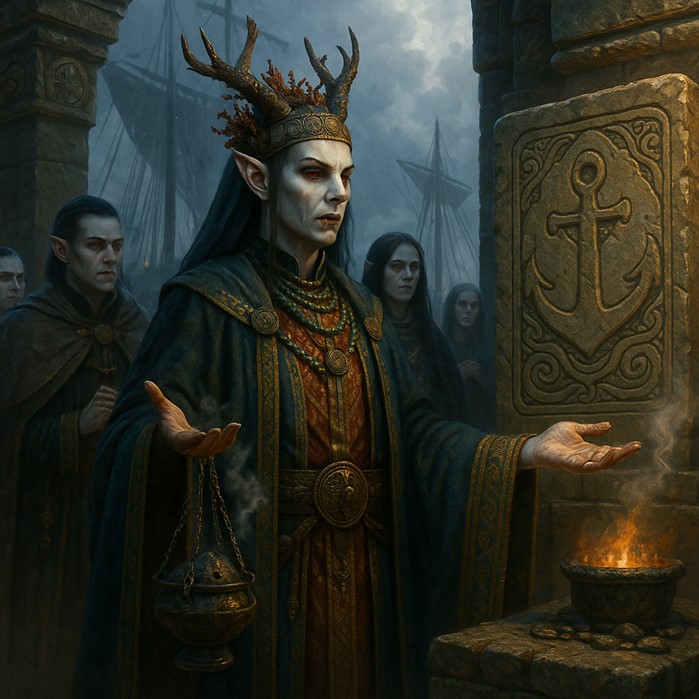
The divine magic of Tuurvaldr, the Guardian at the Edge of the World, manifests through the faith and rites of the Thulian people as both a bulwark and a weapon. Its application depends heavily on the ceremonial form, the focus item used, and the skill of the avatar channeling it through appropriate gear.
Defensive Uses
• Runes of the Storm Wall – Inscribed on harbor stones, ship hulls, or worn talismans, these call up barriers of wind, sleet, and spindrift, obscuring vision and deflecting missiles. In personal combat, a skilled practitioner can raise a localized gust that slows arrows or destabilizes charging foes.
• Tide-Binding Chant – A long-voiced incantation over coastal waters or aboard a vessel, which quiets and flattens the sea surface within sight, preventing dangerous swells or enemy ramming maneuvers. In land engagements, it can be adapted to root an advancing force in slickened, heavy ground.
• Aegis of the Whale’s Back – A ritual cloak of protective force modeled after the deity’s symbolic sea-beasts; it reduces incoming force and impact damage and grants cold resilience, useful in both naval and tundra warfare.
• Horizon Veil – Invoked through polished obsidian lenses or mirrored shields, this bends light and mist to conceal a harbor, camp, or fleet from distant observers.
Offensive Uses
• Hammer of the Breakers – A concentrated tidal surge projected outward, striking with the blunt force of a storm wave; capable of capsizing smaller ships or scattering massed infantry on a shoreline.
• Spear of the Frozen Current – A sharpened lance of magically condensed seawater, hurled by hand or launched from a warded siege device; on impact, it can shatter into icy shards that pierce armor gaps.
• Maelstrom’s Call – A dangerous, high-cost invocation requiring multiple chanters, which can create a localized whirlpool or water funnel to disrupt enemy vessels, coastal siege towers, or floating bridges.
• Rime-Wind Breath – Channeled through horn or conch focus, this exhales a gale laden with sleet and ice crystals, freezing exposed surfaces and hindering enemy weapon use.
Both defense and offense in Tuurvaldr’s magic draw upon maritime and polar imagery—winds, tides, frost, and the living power of the sea. The most skilled Thulian chanters can fuse these into mixed techniques, such as defensive fogs carrying corrosive brine, or tidal walls that crash forward as counterattack once struck.
Song of Wave-forged Shield and Spear
Opening Invocation – The Gathering of Winds
“Rise, O Breath of Tuurvaldr, from the black rim of the sea.
Lift the voice of the prow into the teeth of the gale.
Bind the oars to the heart’s drum,
Bind the heart’s drum to the oars,
That the fleet and the blood may beat as one.”
Defensive Verse – The Wall Before the Storm
“Stone in the water, unbroken,
Ice in the marrow, unshaken,
Hold the tide, O Whale’s Back,
Raise the Storm Wall high!
Let the spray blind the arrow’s eye,
Let the breaker’s roar unman the bold.”
Transition Chant – The Turning of the Tide
“Turn the keel with the turning moon,
Shift the wind with the shifting runes.
From calm we rise, from shadow we strike,
Tuurvaldr’s hand on the helm of our wrath.”
Offensive Verse – The Hammer Upon the Deep
“Crash, O hammer of the breakers,
Smash their prows and split their sails.
Drive the Spear of the Frozen Current
Through the ribs of the foe’s great beast.
Let the Maelstrom’s Call be our laughter,
Let the Rime-Wind Breath be our cry.”
Closing Benediction – The Return to Shore
“When the blood steams in the frost,
When the tide bears the wrecks to our feet,
We shall sing in the harbor stones,
Carve the runes where the gulls wheel wide.
For the Shield has held,
And the Spear has struck true.”
The hymn’s structure is deliberately circular—beginning and ending in the harbor, binding defense and offense into one flow. Each section has an associated rhythm: slow and deep for the defensive verses, quickened and sharp for the offensive, with the transition marked by a change in key and drum pattern.