
Lore
The Island Nation of Thule rises from the northern reaches of Saṃsāra’s endless seas, a vast expanse of fjords, glacier-cut valleys, wind-scoured highlands, and black-stone cliffs crowned with ancient fortresses. The Thulian people trace their lineage to a time before recorded history, when the First Queens, said to have been chosen by the goddess Tuurvaldr herself, sailed from beyond the horizon under banners woven with storm-light. These first rulers established a matrilineal monarchy that has endured unbroken for thousands of years. Every bay and headland bears the weight of carved runestones, telling stories of naval victories, heroic sacrifices, and divine bargains. Warfare, trade, and seafaring are etched into Thulian identity, with the nation’s fleets serving as both merchants and warriors. The monarchy’s rule is absolute in land ownership, but its stewardship is bound by custom to maintain the well-being, infrastructure, and martial readiness of the realm.
Language – Skarvald
Skarvald is the heartbeat of Thulian culture—a deep, resonant tongue whose syllables roll like ocean swells and strike like hammer blows. Its grammar favors compound words that stack meaning upon meaning, enabling precision in law, poetry, and magic. Spoken Skarvald carries an almost ritual cadence, lending weight to even mundane conversation. Its primary written form, Runasverd, uses angular strokes and wave-like curves carved in stone or etched in metal, retaining the visual echo of ship-carvers who once inscribed it on prows to bless voyages. Skarvald is known for its strength in naval incantations and storm-binding rites, its sound carrying magical resonance when chanted in unison.
Religion – Deep Crown of Aegvildr
The Deep Crown of Aegvildr is the most widely followed faith in Thule, devoted to the god Tuurvaldr, Sovereign of Wave and Stone. Believers see Aegvildr’s “crown” as the unseen dominion beneath the waves, a realm of judgment and power. The god’s will is interpreted through priest-navigators who serve both temple and fleet, guiding ships as much through prayer as through charting currents. The Deep Crown binds defense and offense into a single doctrine—protection of harbor and home through overwhelming retaliation. Ceremonies are heavy with sea-salt incense, the sound of war drums, and the rhythmic stamping of boots upon wooden planks to mimic the surge of the tide.
National Sentiment
Thulians are fiercely proud of their homeland. They speak of its icy winds, its storm-lashed coasts, and its deep harbors not as hardships but as blessings that forged their strength. The monarchy is respected not merely for its authority but for its role as guardian of the people’s survival in a land where the sea itself is a rival power. Citizens see themselves as inheritors of an unbroken line of seafarers, warriors, and craftspeople, bound to defend Thule’s honor on every horizon.
Environments
The Island Nation encompasses vast, varied environments:
- Coastal Fjords with towering cliffs and deep-water ports.
- Highland Plains of tough grasses and scattered standing stones.
- Snowbound Ranges with glacier-fed rivers feeding fertile valleys.
- Black-sand Shores rich in iron deposits.
- Dense Conifer Forests harboring both ancient ruins and dangerous Feral beasts.
- Ice-laden Northern Waters dotted with icebergs, dangerous but rich in fishing and trade routes.
Potential Positives
- Strong central authority ensures infrastructure, defense, and economic stability.
- Mastery of shipbuilding and navigation, giving unmatched naval dominance.
- Rich cultural heritage fostering unity and identity.
- Magical tradition integrated seamlessly into daily life.
Potential Negatives
- Harsh climates limit certain crops, increasing reliance on trade.
- Centralized monarchy can suppress dissent if deemed a threat to unity.
- Isolationist tendencies can slow cultural exchange with distant nations.
- Military focus can overshadow civilian needs in times of conflict.
Other Important Information
- Thule’s ruling family belongs to the nation’s predominant race—physically imposing, adapted to cold, and known for heightened senses.
- Seasonal naval tournaments double as religious festivals, reinforcing loyalty to the crown and the Deep Crown of Aegvildr.
- Guilds and ship-clans hold substantial influence, each bound by oaths to the monarchy yet vying for prestige through craftsmanship, magical innovation, and feats at sea.
- The nation maintains a network of “Crown Harbors,” fortified and sanctified docking points that act as both trade hubs and coastal fortresses.
- Most Thulians learn some measure of Skarvald naval incantations before adulthood, a cultural expectation akin to basic literacy.
Event Record: The Binding of the Red Fleet
Date: 6721a5.3.6@14:42
Description: On this day, the Thulian Crown’s naval mage-lords completed the seven-day ritual known as the Skarvald Aegis within the harbor of Væstrvik. The Red Fleet—twelve war-galleons seized from the southern corsairs—was ceremonially bound to the Deep Crown of Aegvildr by iron-rune and blood-salt. Witnesses reported the sea turning the color of molten copper as the prow runes ignited, locking the ships to Thule’s defense until the last hull rots to driftwood.
Participants: Queen-Regent Halvrún Yrsa-Dottir; the Circle of Helm-Bearers; Admiral Skjold Harra’son; three hundred oar-thralls; forty-two harbor wardens.
Outcome: The Red Fleet became the permanent coastal ward of Thule’s western approaches, its enchantments still patrolling even in fog, storm, or moonless night. Enemy sails vanished without wreckage, leading to the fleet’s whispered epithet—The Drowning Silence.
Tags: Thule, Skarvald, Deep Crown of Aegvildr, naval magic, harbor rite, war-galleon, Queen-Regent, rune-binding, maritime defense, corsair suppression.
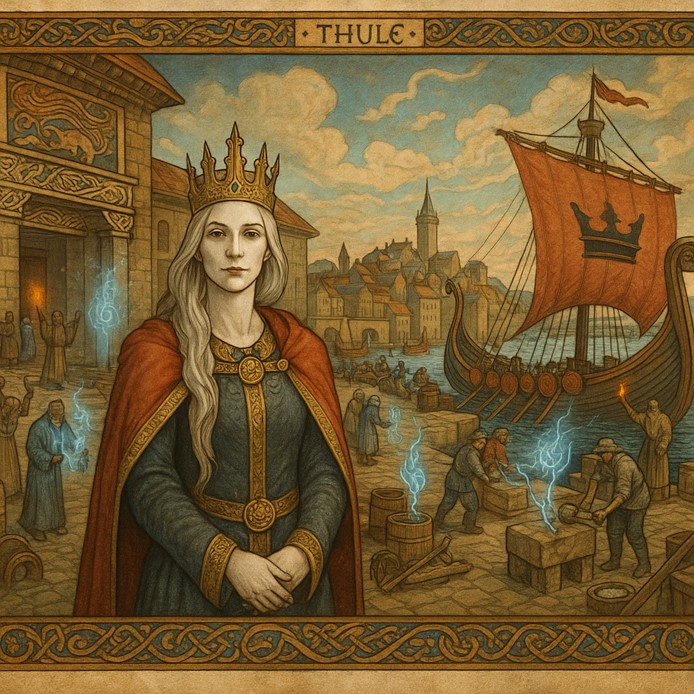
Long Telling of Deep Crown’s Oath
In the days when the stones were yet uncarved and the harbors had no teeth against the sea, there came the First Daughter of the Crown, she whose name is sung in tongues now broken and swallowed by time. The people say she walked from the northern mist wearing the bones of the whale as crown and the light of the deep fires in her eyes. Her shadow was longer than the mast of the greatest ship, and the sound of her steps caused the gulls to wheel and cry without rest.
It is told that she came not alone. With her was the water, walking upright in the form of a great silver man, his beard the falling of rain and his cloak the moving of the tide. His name is now lost, for it is said that to speak it without oath breaks the ear of the sea, and the sea will then take the speaker. This silver man and the First Daughter sat upon the highest rock above the black harbor and saw the island spread before them—forests that bent their backs under the wind, mountains that wept ice, and cities unborn but whispering in the veins of the land.
The First Daughter spoke to the silver man, “The deep will drown the small, the wind will scatter the rest. How then shall the people hold the land against the time when the world shakes?” The silver man answered, “Give me your name, and I will bind it to the salt and to the stone. But you must never leave the sight of the crown, nor shall your daughters after you, lest the sea grow hungry again.”
It was then that the First Daughter took a blade of obsidian and cut her palm, letting the blood run down to the waves. The sea did not drink it, but instead the water rose, lifting the blood into a form like a pearl, which was set into the crown of whale-bone. This became the Deep Crown of Aegvildr, whose light could hold back both storm and sword when lifted in rite.
But the gift had price. For the silver man declared that half the people would belong to the land and half to the deep, and thus would they walk with the thirst that no river could quench, the hunger that no bread could fill. These became the Crowned-Blood, rulers by salt and shadow, whose eyes would see in the dark and whose tongues would know the speech of wind and wave.
The story turns then to the making of the first harbor. The Crowned-Blood called the people, and with them the iron-beaked ships. They carved the harbor stones with the Runasverd script, words bent into the shapes of gull wings and breaker’s spray, each glyph cut with breath held so no mortal voice could break the magic before it was sealed. The silver man stood at the harbor’s mouth, holding back the tide until the last stone was set. Then he vanished beneath the waves, not to be seen again, though his beard of rain still falls when the Crown calls for defense.
It is said that in the Illusday of the Blooming Week, in the month of Tyrus, year 2387a, the First Daughter stood upon the prow of her ship as an enemy armada came. She lifted the Deep Crown, and the sea itself rose into a wall, swallowing the enemy ships whole. From that day, the people of Thule sang the Oath of the Harbor: To the deep we give name, to the land we give blood, to the crown we give all.
In later years, the children of the Crowned-Blood ruled from high keeps of black stone, and the harbors grew teeth of enchanted pillars. Every city kept a shrine to the First Daughter, and in the season of Dimming they poured saltwater and whale-oil upon the stones in her honor. When the Crown passed from mother to daughter, the rite was held before the sea, so the silver man’s unseen eyes could measure the worth of the new bearer.
Some say the First Daughter still walks beneath the deep, her whale-bone crown bright as Helios beneath the water, waiting for the time when the tide will again rise to swallow all who have forgotten the oath. And so, the people keep it close, spoken at the turning of each year, lest forgetting bring the hunger of the waves.
Moral: The land endures only when the name, the blood, and the oath are kept together; to break one is to feed the sea.