
Deity: Xotalzin, the Veiled Radiance
Lore:
The Way of the Sun’s Hidden Face teaches that all visible light is but the shadow of a greater, hidden brilliance that lies beyond mortal sight. Xotalzin, the Veiled Radiance, is said to be the guardian of this unseen sun, sheltering mortals from its unbearable truth until they are ready to ascend beyond the limits of flesh and fur. The oldest temple codices claim Xotalzin descended in the form of a jaguar draped in living sunlight, its rosettes burning like eclipsed stars. The god spoke in layered voices—some deep and slow like stone shifting, others sharp and bright like obsidian slicing water—teaching the first rulers of Teotihuacán to measure time not only in days and seasons, but in the rhythm of light and shadow cast by the god’s eternal cycle.
Followers believe Xotalzin rules from the Celestial Obsidian Court, a realm both above the highest clouds and beneath the deepest stone. There, the god turns the hidden sun through cycles: birth, growth, decline, and return, each bringing changes to magic’s flow, the world’s weather, and mortal fortune.
Personality:
Xotalzin is revered as patient yet absolute. The deity is slow to act, but when it moves, its will reshapes the fate of nations. Xotalzin’s blessings often appear as indirect opportunities—a safe path opening in an enemy’s flank, a hidden water source revealed before a drought, or a sudden break in the clouds during a siege. However, its wrath is subtle but enduring: crops fail slowly, alliances sour without clear cause, and magic ebbs at critical moments. The god values foresight, careful planning, and loyalty to the community above personal ambition.
Traits and Characteristics:
• Embodiment of cycles—light/dark, growth/decay, magic ebb/flow
• Favors rulers who protect their people and prepare for generations ahead
• Dislikes needless haste, arrogance, or squandering resources
• Speaks through layered omens: the sudden silence of birds, rare eclipses, the pattern of rain on stone
• Believers often wear or carry sun-discs over the heart as a symbolic “shield” against seeing too soon
Attributes:
• Domain of Sun, Shadow, Time, and Vision
• Influence over agriculture, celestial navigation, long-term weather patterns, and the slow healing of land after devastation
• Capable of cloaking or revealing truths, both mundane and magical
• Said to lend “Vision of the Hidden Sun” to select rulers—an instinctive awareness of the long-term consequences of their actions
Symbols:
• The Eclipse Sun—half obsidian, half gold
• The Veiled Eye—an open eye obscured by a patterned cloth
• The Twin Jaguar Paws—one in shadow, one in light, stepping toward each other
• Sacred colors: deep gold, shadowed crimson, and obsidian black
Tags:
Sun-Cycle, Hidden-Truth, Foresight, Patience, Shadow-Blessed, Jaguar-Form, Obsidian-Court, Celestial-Guardian, Timekeeper, Eclipse-Disc, Veiled-Eye, Harvest-Protector, Weather-Guide, Light-and-Dark, Ruler’s-Omen, Strategic-Providence, Enduring-Will
Positives:
• Encourages long-term planning, ensuring stable governance and resource management.
• Provides consistent agricultural blessings when rituals are observed, increasing crop yield and protecting against seasonal blight.
• Enhances magical ebb prediction, allowing cities and armies to act during strong magical flow for maximum advantage.
• Creates strong civic unity under a shared celestial calendar and festival cycle.
• Inspires loyalty to the monarchy, reinforcing the idea that rulers are chosen by divine foresight.
Negatives:
• Decisions can be slow due to the cultural emphasis on patience and avoiding haste, leading to missed opportunities in emergencies.
• Belief in subtle omens can cause paranoia, with leaders and citizens seeing sabotage or divine disfavor where none exists.
• Non-believers sometimes resent the temple’s control over timekeeping, festivals, and agricultural schedules.
• The god’s indirect blessings mean immediate prayers often go unanswered, frustrating impatient followers.
• Factional disputes can arise over the interpretation of celestial events or eclipses.
Type of Temple:
Temples of the Way of the Sun’s Hidden Face are monumental stepped pyramids faced with volcanic stone and polished obsidian inlays, crowned with a gold-disc shrine visible for miles. The inner sanctum contains an eclipse chamber where a veiled sun-disc aligns with the rising sun on specific days of the year, flooding the chamber with controlled shafts of light and shadow. The surrounding temple complexes serve as astronomical observatories, storage for agricultural records, and centers for magical flow forecasting.
Number of True Followers:
Out of Teotihuacán’s population of 155,168,000, slightly over half—about 80 million—are full believers who actively practice the faith, observe its rites, and contribute labor or resources to its temples. This includes members of the monarchy, nobility, priesthood, farmers aligned with the agricultural calendar, and urban citizens whose professions depend on the god’s seasonal influence.
What They Do:
True followers participate in seasonal eclipse festivals, solar alignments, and night vigils during certain astronomical events. They maintain temple observatories, assist priests in recording light and shadow cycles, and serve in community roles related to planning—such as architects, navigators, farmers, and strategists. Many take on roles as “Cycle Keepers,” traveling recorders who bring celestial observations from rural regions back to the capital temples. Ritual offerings include carved obsidian masks, woven veils dyed in sacred colors, and symbolic jaguar paw prints pressed into clay, all of which are placed in offering pits or on stepped altars.
Beliefs:
Followers of the Way of the Sun’s Hidden Face hold that the deity, Xilōc Tzān, veils the sun not to conceal its power, but to teach patience and foresight. The visible sun is seen as the present moment, while its hidden face represents all futures yet to come. They believe that every event is part of a larger cycle that can only be understood through careful observation of celestial patterns, magical ebbs, and natural signs. Life is viewed as a path walked between light and shadow, where wisdom lies in knowing when to act and when to wait. The monarchy is believed to be divinely guided through omens that only the high priesthood can fully interpret.
Regular Services:
Services are timed with solar and lunar phases, beginning at dawn with the sounding of conch horns that echo through the streets. Followers gather in the lower temple courts while priests, clad in gold-veiled headdresses and obsidian chest plates, climb to the summit to begin the Invocation of the Veil—a slow, chant-like call in the Nahualté tongue that mirrors the rhythm of a sun’s journey. These ceremonies blend astronomy with ritual magic, using mirrors, smoke, and shadow-casting panels to recreate the god’s veiling act. Offerings—obsidian shards, maize, cacao, and carved stone effigies—are placed in collection basins to be blessed and then either stored in temple vaults or buried in sacred gardens to enrich the soil.
Night services are quieter, often held during significant eclipses or solstices, where participants sit in a circle of torchlight while priests narrate omens from the most recent celestial readings.
Funeral Rites:
When a believer dies, their body is washed in sacred spring water mixed with powdered obsidian, then wrapped in black-and-gold woven veils to symbolize the god’s light and shadow. The deceased is laid upon a bier beneath an open sky at dawn, where priests perform the Rite of the Last Horizon—chanting as the sun rises, allowing its first rays to pass over the body.
Instead of burial or cremation alone, the body is interred within stepped ceremonial platforms or cliffside tombs aligned to the sun’s seasonal positions. A small polished obsidian disc, etched with the person’s birth and death celestial signs, is placed over the heart. Believers hold that, in death, the spirit ascends to join the hidden face of the sun, where it will guide its descendants through whispered omens carried in light and shadow.
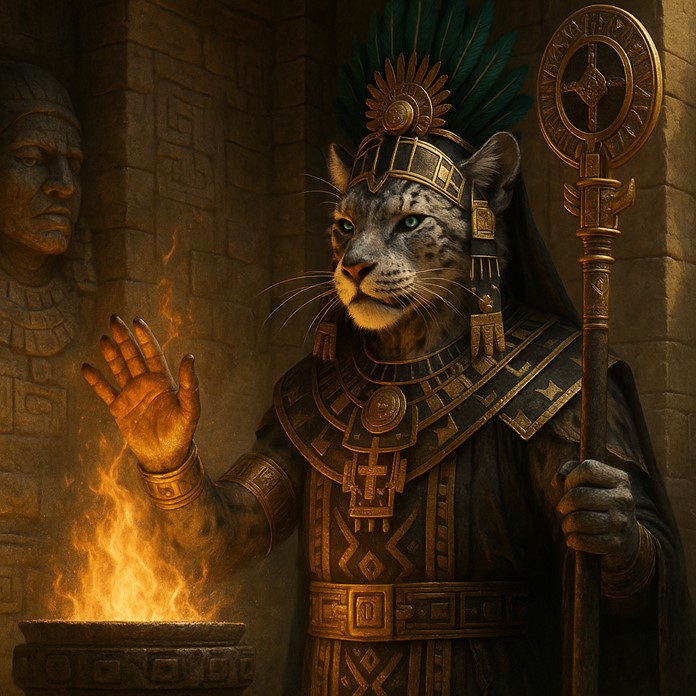
The god of this faith, Huizcātl, channels power through the symbolic forces of solar ascension, obsidian balance, and cosmic alignment, making their magic highly versatile for both defense and offense.
For defense, Huizcātl’s magic can manifest as radiant wards of concentrated sunlight, which sear hostile magic before it reaches its target. Shields of mirrored obsidian can be conjured to refract incoming elemental attacks or scatter illusions, blinding would-be assailants. The god’s power can also fortify structures, turning walls into sun-hardened stone that resists siege and magical corrosion, or envelop allies in a prism-like aura that disperses harmful energy into harmless light. Protective chants spoken in the Nahualté tongue can conceal entire formations from hostile sight until they choose to strike.
For offense, Huizcātl’s sunlight aspect can be weaponized as concentrated lances of golden flame capable of piercing heavy armor or annihilating magical barriers. The obsidian aspect sharpens conjured weapons into unnaturally keen edges, able to slice through both matter and enchantment with equal precision. Solar flares can disorient massed enemies, while ritual invocations timed to celestial alignments can unleash waves of heat and force across the battlefield. In prolonged conflicts, Huizcātl’s power can sap enemy morale by casting their shadows unnaturally long and heavy, filling them with dread.
In both applications, the faithful understand that Huizcātl’s magic is cyclical—its strength peaks during solar zeniths, eclipses, and key astronomical events, rewarding precise timing and patience in its use.
Song of Obsidian Sun
It is said, in the way that old voices say things and young voices forget to repeat them, that in the first days before stone remembered its shape, Huizcātl walked in the half-light between sky’s womb and earth’s breath. The sky was not yet high, nor the ground deep, and the rivers lay in the air like sleeping serpents. In those days, all was the same color, and the people wandered with eyes full but hearts empty, for they could not tell day from night, nor truth from shadow.
Huizcātl, whose face was the bright gold that blinds the hawk’s prey, and whose heart was the black mirror in which all things see themselves, saw that the world was not yet ready for the steps of memory. And so the god set down their twin burdens: in one hand, the shard of night, cold and sharp; in the other, the seed of the sun, warm and growing.
They called the first Tezcamal, and with it cut a channel from sky to soil, letting the rivers fall down into their beds. They planted the second into that wet earth, and from it rose the first great Sun-Tree, whose leaves were pure light, whose roots were pure shadow. The people gathered, for they had never seen a thing that was both many and one, light and dark. They argued about which part was better—some wished for endless day so the fields would never sleep, others for endless night so the hunt would never end.
Huizcātl said nothing, but broke a leaf from the Sun-Tree and cast it into the air. Where it landed, it became the first temple, and the god told the people, “You will live in the turning, not in the stillness. Day must chase night as the hawk chases the hare. Neither catches the other, yet both live.”
The people worked as they had been told, but some grew restless. In the time of the Second Harvest, a war-leader named Quematli desired all light for himself. He believed that with light unbroken, he would see all enemies before they came, and his spear would strike them from far away. He and his followers climbed the Sun-Tree by night, cutting the shadow-roots so no darkness could rise. The sky grew pale and thin, the rivers dried, and the crops shriveled in their thirst. The prey animals wandered until they collapsed, too weary to hide.
Huizcātl returned in great wrath, carrying the Tezcamal shard. They spoke: “The one who eats only sweetness forgets the taste of food. The one who sees only brightness loses the shapes of things.” With the shard, they cut Quematli’s name from the wind, so no one could call him, and scattered his light-greed into shards of glass buried deep in the earth.
The god replanted the shadow-roots and struck the Sun-Tree’s trunk so it would sway forever, tipping light and darkness back and forth across the land. Then Huizcātl commanded the people to mark the days with obsidian and gold, to remember the balance that feeds the world. They built great steps to reach the place where light first touched earth, and there the priests sang in the Nahualté tongue, voices weaving like river and wind.
It is told that each eclipse is Huizcātl’s gaze passing over the world, checking if the people still walk between shadow and flame. If the balance is kept, the gaze passes gently; if not, storms and drought walk together across the land.
And so the followers of Huizcātl hold both a blade and a seed in their rites, both a mirror and a lamp in their temples. They teach their children that to walk in only light is to be blind, and to walk in only dark is to be lost.
Moral: The world is not made whole by choosing one side, but by carrying both and knowing when to set each down.