
Species: Sentient feline-humanoid, descended from ancient predatory lineages adapted to highland jungles and rugged volcanic slopes.
Physical Form and Sensory Traits:
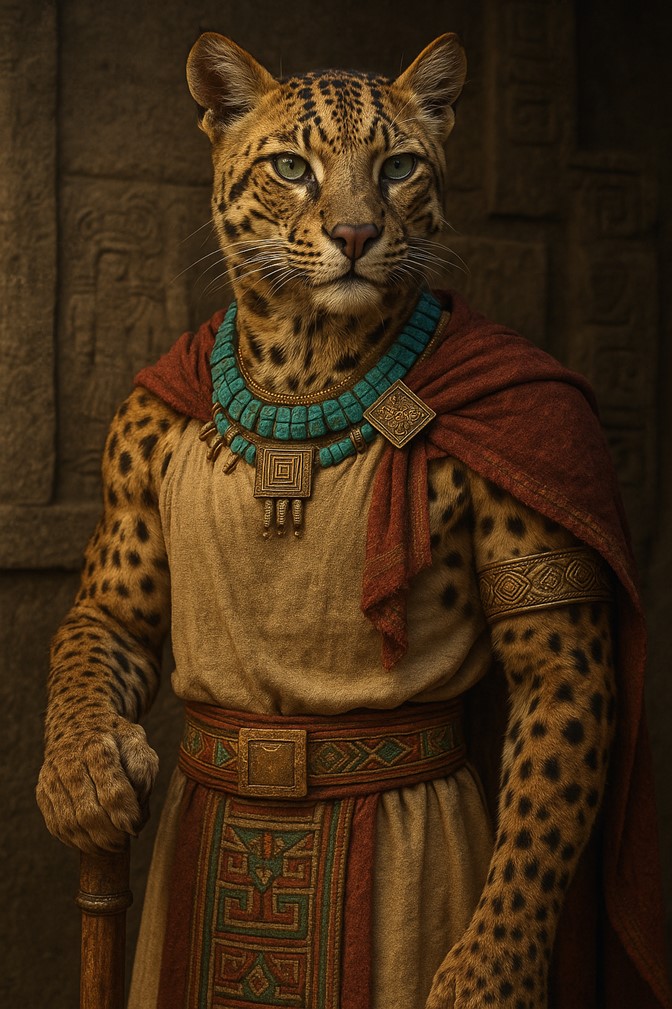
Ocelomé possess a tall, lean-muscled build with elongated limbs for climbing and leaping, averaging 6’6” in height. Their digitigrade legs end in retractable claws capable of gripping stone as well as wood. Fur patterns resemble rosettes and streaks over golden to dark umber coats, adapted for broken sunlight in mountain forests. Their facial structure blends feline grace with humanoid expression—forward-facing amber or green eyes with slit pupils, mobile feline ears, and pronounced cheekbones. Sensory acuity is exceptional: night vision rivals that of great predators, hearing captures the faintest echo of rock-shift or branch-snap, and scent recognition allows individual identification of persons and trails over days. Whisker arrays along the jawline and forearms act as proximity sensors in darkness.
General Size:
Males average 6’6” and 220 lbs; females average 6’4” and 200 lbs, though musculature is dense without excess bulk.
Body Pattern:
Coat markings follow family lineages—nobles often display tighter rosettes and deep black facial stripes, considered a sign of divine favor. Lower status Ocelomé may have more diffuse or broken markings. Seasonal molting subtly alters coat hue between dry and wet seasons.
Life Cycle:
Ocelomé mature physically by 16 years, but are not culturally considered adults until they have completed the “Three Trials” of endurance, cunning, and service to the community. Lifespans average 85 years, though nobles with access to better nutrition and enchanted gear may live beyond 110. Pair bonding is common but not universal, and inheritance follows maternal lines. Cubs are born in litters of 1–3, with the mother as the primary guardian.
Potential Positives Due to Physical Form:
- Exceptional climbing and leaping abilities, enabling rapid vertical movement in complex terrain.
- High endurance in low-oxygen environments.
- Acute sensory awareness makes ambush difficult.
- Flexibility allows squeezing through tight spaces without removing gear.
Potential Negatives Due to Physical Form:
- Requires higher caloric intake to maintain muscle and energy, especially in cold or high-altitude regions.
- Sensitive hearing can be overloaded by loud noise or magical sonic attacks.
- Thick tail for balance can be a grab point in close combat.
- Coat requires regular grooming; parasites or magical afflictions can spread quickly without it.
Tags: Feline, Mountain-Dwelling, Agile, Predatory, Nocturnal-Vision, Teotihuacán-Heritage, Ruler-Bloodline, Camouflage, Hunter, Climbers, Warm-Furred, Culturally-Ornamented, Magic-User, Silent-Step, Territorial, Gear-Adaptable, Sentinel
Specialized Item Slots Available:
- Tail Adornment Slot: rings, weighted chains, or magical balance-stabilizers.
- Ear Mount Slot: ceremonial or sensory-enhancement items.
- Claw Sheath Slot: can be enchanted for climbing, cutting, or combat.
Environmental Adaptability:
- Thrive in steep, forested volcanic slopes, rocky ridgelines, and high-altitude jungle plateaus.
- Can endure rapid temperature changes between hot days and cold nights.
- Naturally adapt to lower oxygen levels but require hydration in thin, dry air.
Other Information Important to This Race:
The Ocelomé see themselves as living extensions of the island’s volcanic heart, their agility and vision symbolic of the divine’s far reach. Nobility is tied to the rare “Moon-Eyed” individuals whose eyes display silver irises; they are believed to be chosen to lead. They maintain an intricate social code where challenges, duels, and displays of skill in hunting or athletic games determine status within a tiered aristocracy. Public festivals often involve scaling the massive temple-pyramids of Teotihuacán at night, carrying torches to “light the stars of the earth.”
Stones That Walked and Sky That Listened
In the time before the mountains had names, when the rivers did not know where they must flow, the People of Fur and Tail came down from the highest peaks to find the wide valleys where the stone towers were being made by the Hands of Many. It was said that the First Mother of the People carried the patterns of snow and shadow upon her back, so that the mountains would always know their children. She walked where the rock was sharp, and her steps made soft echoes that taught the valley how to speak.
It is told that in those days, the sky would lean close to hear the voices of all beings. The First Mother went to the Great Plaza of Unfinished Walls, where stones waited for purpose, and she placed her paw upon the tallest of them. She told the stone, “You are too heavy to dance, but I will teach you to listen.” And so she carved a path upon its surface with claws that sang against the grain. From that path, the people learned to climb higher, and the mountains learned to stand proud.
The rulers of that time were not crowned with gold, but with the trust of the winds. One among them, the Second Daughter of the First Mother, could see far across the land even when her eyes were closed. Her fur carried the colors of dawn—pale fire in the east, cool night in the west. She guarded the passes where the thin air sang, and no enemy could approach without the mountain telling her first.
But the valley grew crowded, and the People of Fur and Tail argued with the People of Feather and the People of Stone over whose shadows were longest in the evening. A great council was called at the River’s Bend, where the waters twisted like a serpent’s back. The Second Daughter listened to the quarrels until the sun turned red, and then she stood upon the smooth boulder in the river. She said, “The mountain does not choose which stream it feeds first. It gives to all, or the snow melts too soon.” The quarrels stopped, for none wished to see the snow vanish.
Many seasons later, when storms from the sky cracked the stones and floods carried away the walls, it was remembered that the Second Daughter had walked both the cliffs and the market squares. In every home, her image was painted beside the hearth, her tail curved like the path of the sun. When the people rebuilt the towers, they carved paw-prints into the foundation stones so the mountains would know who they sheltered.
It is whispered even now that when the wind races down the high passes at dusk, it carries the soft tread of the First Mother, and the watching eyes of her Second Daughter. Those who climb alone into the peaks claim to see a shadow move beside them, stepping where no path lies, guiding them back to safety—or, if their hearts are treacherous, leading them into the clouds where the sky keeps its own counsel.
Moral: The high place belongs to those who honor both stone and sky, and the path endures only for those who share it.