
Deity Name: Zuhuyá – Keeper of the Turning Edge
Lore
The Way of the Shifting Horizon is the primary faith of slightly more than half the 152,864,000 inhabitants of the island nation of Tayacian. It is an ocean-and-sky-centered belief system that teaches the world is balanced on the moving edge where water meets light—never still, always changing, yet eternal. Zuhuyá, the sole deity, is said to walk this edge at dawn and dusk, her footprints becoming the tide and her gaze painting the sky. In the oldest temple manuscripts, she is called “the One Who Never Faces the Same World Twice,” a guardian of change and keeper of the invisible line that separates yesterday from tomorrow.
Legends tell that Zuhuyá first appeared when the island’s earliest voyagers found themselves trapped between storm and reef. She lifted the horizon and moved it forward so their sails caught the wind toward safe harbor. Since then, the faith holds that when one cannot move through the world, the world may be persuaded to move for them—if they understand the nature of change and act in harmony with it.
Personality
Zuhuyá is neither distant nor wholly familiar. She is unpredictable yet never cruel without purpose, favoring those who adapt quickly and punishing those who cling stubbornly to what is gone. She is said to delight in clever navigation—whether of ships, trade, or political intrigue—and to turn her back on the arrogant who believe the horizon belongs to them. Her followers see her as both nurturing and testing, providing calm seas when lessons are learned, and shifting tides when growth is needed.
Traits and Characteristics
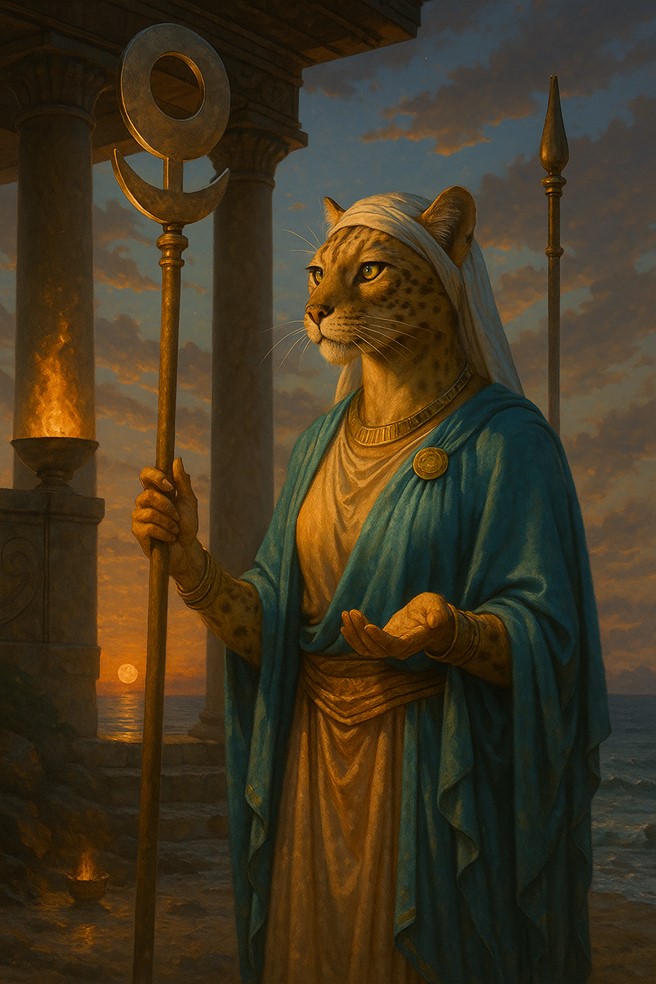
- Dual Aspect: Appears as a towering Ka’ruháni woman at dawn, wearing seafoam-white robes, and as a shadowed figure with a cloak of burning orange at dusk.
- Eyes: Always reflecting the horizon line—sea below, sky above.
- Voice: Soft as breeze when pleased, thunder-crack when angered.
- Presence: Often heralded by a sudden alignment of wind and water, or by the sound of gulls far from shore.
Attributes
- Domains: Change, Navigation, Horizon, Tides, Cycles, Adaptation.
- Favored Element: Water in motion, especially tidal surges and shifting currents.
- Sacred Time: Twilight periods, when land, sea, and sky meet in blended light.
- Places of Power: Natural headlands, tidal pools, and the highest ship masts at sunrise or sunset.
- Favored Offerings: Polished shells, sun-and-moon colored cloth, saltwater poured on polished stone.
Symbols
- Primary Symbol: A divided circle—upper half painted in shifting sunset colors, lower half in rolling wave patterns—joined by a single horizontal line representing the horizon.
- Sacred Object: The Sighting Disk, a palm-sized bronze circle with a slit through the middle used by navigators in ritual and practice.
- Animal Emblem: The frigatebird, a master of wind currents, seen as a messenger of Zuhuyá’s will.
Tags
Zuhuyá, Shifting-Horizon, Change-Deity, Navigation, Ocean, Sky, Tide, Adaptation, Twilight, Horizon-Symbol, Tayacian-Faith, Ka’ruháni-Culture, Maritime-Worship, Frigatebird-Emblem, Sacred-Headlands, Sighting-Disk, Cyclical-Balance
Positives of the Faith
- Adaptability Training: Followers are encouraged to think creatively and adapt to sudden changes, which fosters strong navigation skills, trade acumen, and political maneuvering.
- Community Cohesion: Coastal and inland communities linked by maritime trade share rituals and festivals tied to tides and seasonal shifts, strengthening social bonds.
- Mariner’s Safety Net: Ships flying the symbol of Zuhuyá often receive aid in Tayacian ports, and her clergy maintain weather-forecasting stations that help prevent disasters.
- Cultural Continuity: The faith reinforces Tayacian identity by connecting people to their history, language, and maritime roots.
Negatives of the Faith
- Risk of Overconfidence: Belief that Zuhuyá will “shift the horizon” can lead some followers into dangerous voyages or political gambles.
- Fickle Allegiance: Since the deity embodies change, the faith can seem inconsistent to outsiders; this unpredictability sometimes undermines long-term alliances.
- Exclusivity in High Ranks: Leadership roles in the priesthood are often reserved for Ka’ruháni, limiting upward movement for other races and causing occasional unrest.
- Strain on Resources: Major festivals involve large-scale offerings and public works, which can strain poorer communities trying to match the grandeur of wealthier ports.
Type of Temple
Temples are Horizon Houses, built on high promontories where sea and sky are visible in all directions. These structures are open-sided stone pavilions with rooflines mimicking the curvature of sails. A central Horizon Window—a horizontal slit cut into a large bronze plate—aligns perfectly with the real horizon at both dawn and dusk, flooding the main chamber with colored light during sacred hours. Secondary structures below the main temple house weather instruments, navigational schools, and tide archives.
Number of True Followers
Out of Tayacian’s 152,864,000 population, slightly over half follow the Way of the Shifting Horizon. Of these, roughly 71 million are considered true followers—those who actively practice rituals, attend horizon rites, and adhere to the faith’s ethical teachings daily. The rest may revere Zuhuyá culturally but do not commit to regular worship or service.
What They Do
- Maritime Guidance: Clergy known as Edge Watchers serve as navigators for naval and merchant fleets, combining meteorology, astronomy, and ritual observation.
- Horizon Rites: At dawn and dusk, followers face the horizon and perform the Two Breath Prayer, a slow inhalation toward the sea and exhalation toward the land.
- Seasonal Festivals: Key events include the Day of the Turning Sky at the equinoxes and the Tide-Gift Feast during the highest spring tide.
- Community Arbitration: Priests mediate disputes by metaphorically “shifting the horizon” between conflicting parties—reframing the problem until resolution appears.
- Preservation of Knowledge: Horizon Houses keep extensive tide and current records, making them repositories of centuries of navigational and climate data.
What the Believers Believe
Followers of the Way of the Shifting Horizon hold that all life exists on a moving edge between what has been and what will be. They believe Zuhuyá walks this edge each day, guiding the currents of fate, and that those who learn to adjust their course with the horizon will live in harmony with change. Key beliefs include:
- The Horizon as a Living Boundary: It shifts for those who act with insight and courage, but retreats from the stubborn or fearful.
- Cycles of Renewal: Every ending is a disguised beginning; tides that take will also give.
- Alignment Through Action: Zuhuyá aids those who move toward change, not those who wait for change to come.
- Balance Between Sea and Sky: True wisdom comes from seeing both—the deep, hidden currents of the sea and the open, visible expanse of the sky.
Regular Services
Services, known as Edge Gatherings, occur at dawn and dusk to align worshippers with the horizon’s movement. These are open-air rites held in Horizon Houses or at any place where sea and sky can be viewed together.
- Dawn Service: The First Light Salutation, facing east toward the rising sun, with offerings of polished shells and seawater poured over smooth stones.
- Dusk Service: The Fading Edge Watch, facing west toward the setting sun, where prayers are spoken in unison before the horizon window, and small lanterns are set afloat on the water to carry wishes or burdens away.
- Chants and Intonations: Services feature melodic chants using Kohatlé pitch patterns, believed to help “align breath with horizon.”
- Navigational Blessing: Mariners and travelers receive symbolic line-and-compass marks painted on the palms, said to help guide them.
Funeral Rites for Believers
Funerals, called The Setting Voyage, are always held at the boundary between land and water—on a beach, cliffside, or river mouth—during either sunrise or sunset.
- Preparation: The body is washed in a mixture of fresh and saltwater, symbolizing the unity of sky-born rain and ocean tides.
- Garments: The deceased is dressed in horizon-colored shrouds—blue fading to gold or crimson fading to violet—depending on whether the service is at dawn or dusk.
- The Horizon Farewell: Mourners form two lines leading to the water’s edge. The eldest relative or closest companion recites the Names of Paths, recounting the major journeys and changes in the person’s life.
- Commitment to the Edge: The body may be set adrift in a small ceremonial vessel (often to be recovered and buried inland later) or buried in ground overlooking the sea. A Sighting Disk is placed in the hands or over the heart so Zuhuyá may guide them to their next horizon.
- Closing Act: Attendees turn their backs to the water for a full minute, symbolizing trust that the departed’s voyage will continue without the living trying to follow.
Magical Power of Zuhuyá for Defense and Offense
Defensive Applications
- Tide Reversal: Creates a sudden shift in momentum, akin to an incoming tide turning outward, forcing attackers back or breaking formations. In battle, this can manifest as pushing waves, gusts, or force currents that sweep away projectiles or stagger enemies.
- Horizon Veil: Bends light and atmospheric shimmer to conceal positions, creating mirage-like illusions of empty sea, false coastline, or moving shadows to confuse opponents.
- Anchor’s Blessing: Grants steadfast footing even on shifting or unstable surfaces—deck of a ship in a storm, crumbling cliff edges, or magical tremors.
- Storm’s Shelter: Calls a wall of wind and salt spray to reduce visibility and dull incoming ranged attacks; the spray can also wash away tracking scents or magical residue.
- Current Shift: Subtle manipulation of air and water currents to deflect harmful gases, smoke, or magical mists away from allies.
Offensive Applications
- Razor Surge: Concentrates moving water into cutting streams or arcs, able to slice rigging, armor straps, or lightly protected limbs.
- Sun-Edge Flare: Uses refracted light from the horizon to produce a searing flash that blinds enemies temporarily, timed with sudden strikes.
- Undertow Grasp: Summons a dragging pull beneath an enemy’s feet—waterborne or landborne—mimicking the pull of a strong undertow to unbalance or topple them.
- Wavebreaker Strike: Compresses tidal force into a single impact, shattering shields, barricades, or weakened ship hulls with focused kinetic power.
- Horizon’s Cut: A precision strike spell that extends a thin line of force along the horizon’s alignment, able to pass through multiple foes or sever large structures if unimpeded.
Walk Where Water Meets Fire in Sky
In the age before the counting of tides, when the sea had not yet learned its shape and the sky still argued with the wind, there came a day when the people of the warm stone islands could no longer find the horizon. They looked, and saw only mist that was thicker than walls and heavier than sleep. The fishermen rowed into it and did not return. The sails of traders hung like tired flags, and the gulls circled above the same place until they fell into the water.
It is told that in those days the goddess Zuhuyá had not yet revealed her name to the people. She walked unseen, keeping the balance between water and sky so that each did not swallow the other. But one night, the wind, curious and jealous, stole the line where they touched and hid it under the belly of the world. Without the line, there was no meeting place, and so the people drifted without direction.
Among them was a Ka’ruháni woman whose tail carried no rings and whose fur bore the markings of rain in the sand. She was no ruler, no trader, and no priestess—only a gatherer of sea herbs and shells. Yet, she was the first to speak into the mist and ask for the edge back. Her words were not strong, but they were steady, and they carried the sound of someone who knew tides in her bones.
The mist thickened, and in it appeared the faint outline of a figure walking where the water and the fire in the sky touched. The figure’s steps made ripples that spread outward until they became the old line again, and the people could see both the sea and the far light. The figure stopped, and from her voice came this: “The line is not a gift to hold. It is a road to follow. But when you walk it, remember—both sides wish to take you.”
The woman with the rain-marked fur asked where the line had been hidden. Zuhuyá lifted her hand and showed a small piece of polished bronze with a cut through the middle. “The wind thought it was safe here, in the slit between beginning and end. But I know both sides of that place.” She gave the woman the bronze piece and told her to keep it near her heart, for it would always show where the line lay.
The woman returned to the people, and together they began to sail again, not straight toward where the horizon seemed, but following the way the bronze piece told them. The winds tried to close the way, the water tried to pull them under, and the sky tried to blind them, but each time the woman would speak the words she had spoken in the mist. The ships reached land rich in fruit and fish, and there they built the first Horizon House so that all could see the line at dawn and dusk.
It is said the woman did not become a queen, though the people asked her. Instead, she stood at the horizon every day until her fur turned to the color of the setting sky and her tail became the color of the tide at dawn. Some say she walked out into the horizon one evening and never came back. Others say she still walks there, not as a goddess but as one who knows the road.
Those who keep the faith remember her in the Two Breath Prayer, and they keep a bronze disk with a slit, for it is told that if you look through it at the right time, you will see her walking ahead of you, marking the edge between the worlds.
Moral: The path between two worlds is not owned by either—it belongs to those who can walk it without being claimed.