
Original Life Forms Referenced
Mammalia: Maned Wolf (Chrysocyon brachyurus)
Aves: King Eider (Somateria spectabilis)
Reptilia: Gila Monster (Heloderma suspectum)
Pisces: Leafy Seadragon (Phycodurus eques)
Appearance
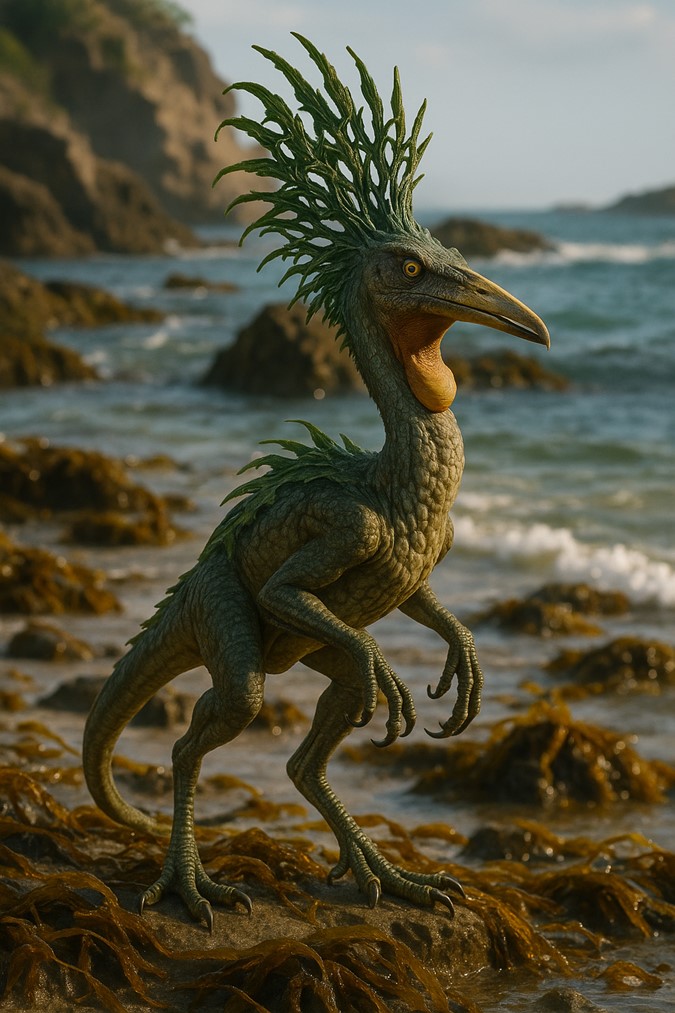
The Velicoraphis 642 is a long-limbed, high-shouldered predator with the rangy silhouette of a maned wolf, though its legs end in semi-webbed, taloned feet adapted for both gripping rocky coasts and paddling through shallow waters. Its body is cloaked in a dense, iridescent plumage patterned like drifting seaweed, with the deep green and brown coloration broken by flashes of copper and gold. Along its spine runs a low, spiny crest patterned like leafy appendages, which sways and ripples in the wind or current, making the creature blend seamlessly with coastal kelp beds or wind-swept dunes. Its head is narrow and elongated, with a hooked, duck-like bill ending in a keratinous point, lined internally with serrated ridges for holding slippery prey. Beneath the bill, a gular pouch can inflate in display or as a resonance chamber for low, carrying calls. The skin beneath its feathers, especially around the neck and flanks, bears bead-like scales with faint, mottled venom glands from its Gila monster heritage.
Size
Length: 2.1–2.5 m from bill to tail tip.
Height at shoulder: 1.2 m.
Weight: 65–85 kg.
Speed
- Land: 35 km/h in bursts, sustained lope at 18 km/h.
- Water: 8 km/h steady swim.
- Climb: Slow but steady on angled rock faces due to taloned feet.
Stat Modifiers
- Strength: +1 (powerful legs and grip strength)
- Dexterity: +3 (long-limbed stride, agile in shallows)
- Constitution: +2 (venom resistance and endurance)
- Intelligence: 0 (animal cunning but not sapient)
- Wisdom: +2 (keen environmental awareness)
- Charisma: −1 (threatening appearance, predatory presence)
Skills
- Stealth: Excellent in coastal vegetation and kelp beds.
- Perception: Superb low-light and movement detection; can sense vibrations in shallow water.
- Survival: Proficient in tracking both land and water prey.
- Intimidation: Inflates gular pouch and rattles leafy spine crests when threatened.
Behavior
Solitary or found in breeding pairs during mating season. Highly territorial along coastal stretches, marking both with scent and distinctive feather-shed patterns. Prefers to stalk prey silently, launching sudden long-stride chases on shore or lunging from shallows in ambush. Displays elaborate crest-waving and gular calls in courtship and territory disputes.
Diet
Carnivorous with an opportunistic streak—feeds on shorebirds, fish, small mammals, large crustaceans, and carrion. Venomous bite is mild but enough to slow or weaken smaller prey.
Emotions
- Calm: Low, resonant purring hum.
- Agitated: Crest ripple and high-pitched whistles.
- Aggressive: Inflated gular pouch, deep bill clacks, and lunging displays.
- Mating Display: Swaying gait with crest spread, pouch pulsing in time with calls.
Environment Where Found
Temperate and subtropical coasts with kelp forests, rocky tide pools, and adjacent grassy highlands. Often seen at the edges of mangrove estuaries or patrolling stretches of driftwood-littered beaches.
Tags
Velicoraphis 642, Coastal-Predator, Venomous-Bite, Leafy-Camouflage, Long-Limbed, Webbed-Talons, Kelp-Forest, Shore-Hunter, Territorial, Iridescent-Plumage, Venom-Glands, Gular-Pouch, Crest-Display, Amphibious, High-Stride, Ambush-Hunter, Carrion-Eater
Life Cycle
- Hatchling Phase (0–6 months): Velicoraphis 642 are born from leathery, elongated eggs laid in hidden shoreline nests among driftwood or within hollowed sandstone cavities. Hatchlings emerge covered in damp, down-like feathers patterned for immediate camouflage among kelp and debris. They are fully mobile within hours, but remain under parental guard for the first 3–4 months.
- Juvenile Phase (6 months–2 years): Growth accelerates, limbs lengthen disproportionately before filling out. Juveniles begin hunting small prey under supervision and practice crest displays on siblings.
- Subadult Phase (2–3 years): Gain full height and primary plumage coloration. Venom glands mature, and territorial instincts develop.
- Adult Phase (3–15 years): Peak hunting ability, breeding behavior begins. Fully developed crest and gular pouch used for displays.
- Elder Phase (15–20+ years): Mobility slows but senses remain sharp. Elders often retreat inland during non-breeding seasons, surviving on easier prey and scavenging.
Mating
Velicoraphis 642 are seasonal breeders, typically mating during the late storm season when fish runs are plentiful.
- Courtship Display: Males and females both inflate their gular pouches in alternating pulses, sway their long limbs in a slow rhythmic pattern, and ripple their leafy crests to catch light.
- Pair Bonding: Monogamous during a breeding season, though partners may change between years. Both parents defend the nest.
- Clutch Size: 2–5 eggs, with a high survival rate due to heavy protection.
Tactics
- Ambush Hunter: Uses kelp-like crest camouflage to blend in shallow water or coastal vegetation before striking.
- High-Stride Chase: On land, closes distance with long, loping strides and sudden lunges.
- Venom Use: Prefers to weaken smaller or agile prey with a quick venomous bite, then pursue at a slower pace.
- Lure Method: In water, may remain still with crest extended to mimic drifting plant matter, drawing fish close enough to snap with the serrated bill.
Actions
- Gular Blast: Sudden expulsion of air from the inflated pouch produces a low-frequency boom underwater, startling schools of fish or disorienting aquatic predators.
- Crest Display Intimidation: Raised spine-leaf crest combined with tail lashing can make the creature appear much larger to ward off rivals or intruders.
- Bill Clack Feint: Rapid snapping of the bill to simulate a strike, often causing prey to freeze in panic.
- Coastal Patrol: Walks long stretches of territory daily, leaving shed crest plumes and scent marks to deter intruders.
Other Interesting Information
- Feather Shedding as Markers: The leafy crest feathers are brittle and often break during combat or molting; these plumes drift to shore and are collected by some coastal cultures for ceremonial wear or trade.
- Venom’s Secondary Purpose: The mild venom also serves as an antibacterial agent in the creature’s own wounds, reducing infection from coastal injuries.
- Echo Recognition: Velicoraphis 642 can identify individuals of their species by the specific tonal patterns of their gular calls, allowing mates or rivals to recognize each other across great distances.
- Adaptive Foraging: During lean seasons, they have been observed cracking open large shellfish with bill strikes or using their talons to pry limpets from rock faces.
Adventurers might encounter or actively seek out Velicoraphis 642 for several reasons tied to its nature, abilities, and the value of its parts:
1. Valuable Crest Plumes and Scales
The leafy, iridescent crest feathers are brittle yet highly prized in coastal markets for ceremonial clothing, magical adornments, and navigational charms tied to maritime traditions. The bead-like venomous scales, once treated, are used in alchemical recipes for mild paralytic agents or medicinal salves.
2. Territorial Hazards in Trade Routes
Velicoraphis 642 fiercely defend stretches of shoreline rich in fish and shellfish—often the same areas used by fishing villages or as landing points for trade skiffs. Adventurers may be hired to clear or drive away aggressive individuals threatening docks, fishers, or coastal caravans.
3. Source of Venom and Gular Resonance Chambers
Its mild venom, while not deadly, is valuable in controlled doses for crafting training toxins used by certain martial orders. The gular pouch’s unique structure can be used as a component in resonance-based sound magic, amplifiers for instruments, or even long-range communication devices.
4. Lure or Decoy Potential
Coastal hunters and seafaring tacticians have learned that a live Velicoraphis, if properly handled, can be used to lure certain predatory sea creatures close to shore by mimicking kelp sways or producing low-frequency gular booms. Adventurers might be tasked with capturing one alive for such purposes.
5. Research and Study
Scholars and naturalists interested in adaptive camouflage, venom hybridization, or coastal predator behavior often commission expeditions to observe or capture Velicoraphis specimens. The combination of avian, reptilian, mammalian, and piscine traits makes it an evolutionary enigma in Saṃsāra’s already strange ecology.
6. Conflict with Cultural Sites
Velicoraphis 642 are known to nest among driftwood piles and rocky alcoves near ancient shoreline ruins or temples. Adventurers exploring these sites may have to contend with the creatures as defensive obstacles before they can retrieve relics or investigate hidden chambers.
From a Velicoraphis 642 corpse, several valuable and distinctive components can be harvested, each with uses in crafting, alchemy, or cultural practices:
1. Leaf-Crest Plumes
- Description: Brittle, kelp-like feather structures along the spine, iridescent and patterned for camouflage.
- Uses:
- Woven into cloaks or mantles that provide minor camouflage in coastal or kelp environments.
- Ground into pigment powders for ceremonial paints and inks.
- Used as ritual fletching in coastal cultures to bless arrows or harpoons with “wave-hiding” properties.
2. Gular Pouch
- Description: Elastic, membrane-lined sac beneath the bill capable of producing deep resonant calls.
- Uses:
- Fashioned into acoustic resonators for wind instruments, horns, or magical sound amplifiers.
- Dried and inscribed with runes for sound-based warding or long-distance signal devices.
- Used in crafting navigation charms believed to “carry” a sailor’s voice over the horizon.
3. Serrated Bill Plates
- Description: Keratinous ridged plates inside the hooked bill.
- Uses:
- Incorporated into saw-toothed weapons or specialized carving tools for processing hides and bone.
- Powdered and mixed into alchemical adhesives or waterproofing agents.
4. Venom Glands
- Description: Bead-like sacs embedded under scaled patches along the body.
- Uses:
- Extracted venom diluted for non-lethal training toxins.
- Concentrated for use in precision paralytic darts.
- Used in creating anti-rot treatments for preserved meat or hides, mimicking the venom’s natural antibacterial effect.
5. Iridescent Scales
- Description: Tough, small scales embedded in skin beneath plumage.
- Uses:
- Incorporated into light armor for added resistance against abrasions.
- Used decoratively in jewelry, giving a “wet sheen” finish prized in coastal fashion.
- Crushed into powder as an alchemical ingredient for potions of aquatic adaptation.
6. Muscular Tail Tendons
- Description: Dense, elastic cords from the tail and leg base.
- Uses:
- Used in bowstring crafting for high-tension coastal hunting bows.
- As components in spring mechanisms for traps or siege devices.
7. Stomach Oil
- Description: A thick, oily substance used to aid digestion of fish and crustaceans.
- Uses:
- Refining into waterproofing oil for sails, boots, and packs.
- Base for certain perfumes designed to mimic the ocean’s scent and calm maritime animals.
One Who Wore the Forest in the Sea
In the years before the counting of waves, before the shore learned where it should stay, there was the time when fish swam in the air and the birds nested under the water. From that time comes the tale of the One Who Wore the Forest in the Sea, the Velicoraphis whose shadow touched both foam and fern.
The old ones say that the creature was not born as it is now, but came from four who were each strong in their own ways: the Long-Legged Red Hunter, the Round-Headed Duck of Bright Ice, the Sand-Spotted Lizard Who Carries Fire in its Teeth, and the Dancing Leaf That is Not a Leaf but Still Lives. The Four quarreled over who could own the meeting place between land and water. They argued with winds, they argued with stones, and they argued with the deep silence below the tides.
In their quarreling, the horizon bent, and the tide forgot to return. Fish died in the pools, and roots dried in the jungle. Then came the Voice-That-Booms, neither god nor mortal, whose words could move the air and the waves together. The Voice said, “If you will not share, you will be made one, and you will guard the place where the forest meets the sea.”
The Four refused, but the Voice spoke a name so old it could not be remembered, and they twisted into one body. Now with long legs, a hooked bill, scaled skin, and a crown of moving leaves, the One walked the beaches, swam the shallows, and climbed the rocks where spray kissed moss.
The people feared it, for it could vanish into the water’s green shadows or step silently among the tide-worn stones. It would take fish from the nets if the fishers grew greedy, or drive out shell-gatherers who left the beaches bare. But if the people left offerings of driftwood carved into the shapes of the Four, the One would stand in the shallows at dawn, shaking its leafy crown so the sunlight would scatter like gold coins on the water. Then the fish would come in numbers too great for the waves to hide.
One tale says a young mariner sought to catch the One, thinking its crest would bring him wealth beyond the horizon. He built traps of rope and iron, baited with fish, but each time the trap closed on nothing but seaweed and water. On the fourth try, the trap caught something heavy, and when he pulled it in, it was not the creature but the Four, walking apart again, each looking at him with all the anger of the tides. They walked into the sea and joined again, but the mariner’s boat was never seen again.
In the seasons after, the people learned to take only what the tide gave and to walk the beaches without greed in their steps. And the One still walks, the crown of the forest swaying on its back, watching for those who would forget the old quarrel.
Moral: The shore belongs to neither the forest nor the sea, but to those who can live between without taking it all.
Suggested conversions to other systems:
CALL OF CTHULHU (7th Edition)
Name: Velicoraphis 642 – “The One Who Wore the Forest in the Sea”
STR 85 | CON 70 | SIZ 70 | DEX 80 | INT 40 | POW 60
Hit Points: 14 | Move: 8 (land), 4 (water)
Damage Bonus: +1D4 | Build: 1
Armor: 2 points (scales and dense plumage)
Attacks:
- Serrated Bill Strike – 50%, damage 1D8 + db, can grapple fish or small prey.
- Venomous Bite – 40%, damage 1D4 + venom (POW vs. POW, success causes 1D6 damage over 1D6 minutes; non-lethal to humans unless untreated).
- Gular Boom – 30%, no direct damage, forces POW vs. POW roll or suffer −20% to actions for 1D4 rounds due to disorientation.
Skills: Stealth 70%, Swim 60%, Listen 70%, Spot Hidden 65%, Track 55%.
Powers: Camouflage (+40% Stealth in coastal vegetation/kelp), Amphibious.
Sanity Loss: 0/1D4 to see a Velicoraphis for the first time.
BLADES IN THE DARK
Name: Kelp-Crowned Hunter (Velicoraphis 642)
Tier: IV | Scale: Large (size of a pony)
Threat: Extreme
Edges: Amphibious, Venomous, Camouflage, Territorial
Harm:
- Serrated Bill (Level 3 harm: crushed limb, deep cuts)
- Venom Bite (Level 2 harm: burning paralysis, slowed movement)
- Gular Boom (Level 2 harm: deafened, disoriented)
Special: - Leafy Crest Camouflage – Automatically counts as having Potency when hiding in coastal terrain.
- Venom – Any harm from bite inflicts the Weakened temporary condition until treated.
Clock Examples: - “Drive it from the Cove” (6-segment)
- “Harvest the Crest” (4-segment)
- “Capture Alive” (8-segment)
DUNGEONS & DRAGONS (5th Edition)
Name: Velicoraphis 642
Large monstrosity, unaligned
Armor Class: 15 (scales and feathers)
Hit Points: 102 (12d10+36)
Speed: 40 ft., swim 20 ft.
STR 18 (+4) | DEX 16 (+3) | CON 16 (+3) | INT 3 (−4) | WIS 14 (+2) | CHA 8 (−1)
Saving Throws: Dex +6, Wis +5
Skills: Perception +5, Stealth +6, Survival +5
Senses: darkvision 60 ft., passive Perception 15
Languages: —
Challenge: 5 (1,800 XP)
Traits:
- Amphibious: Can breathe air and water.
- Camouflage: Advantage on Dexterity (Stealth) checks in coastal vegetation or kelp forests.
- Venomous Bite: Melee Weapon Attack +6 to hit, reach 5 ft., one target. Hit: 10 (2d6+3) piercing damage plus DC 14 Constitution save or take 14 (4d6) poison damage and be poisoned for 1 minute. Save ends the poisoned condition early.
- Gular Boom (Recharge 5–6): Emits a concussive sound. Each creature within 20 ft. must succeed on a DC 14 Constitution save or be deafened and have disadvantage on attack rolls until the end of its next turn.
Actions: - Multiattack: One Serrated Bill and one Venomous Bite.
- Serrated Bill: Melee Weapon Attack +6 to hit, reach 5 ft., one target. Hit: 13 (2d8+4) slashing damage.
KNAVE (Latest Edition)
Name: Velicoraphis 642
HD: 6 | AC: 16 (scaled hide) | Attacks: Serrated Bill (d8), Venomous Bite (d6 + poison) | Move: 40’ (land), 20’ (swim) | Morale: 9
Special:
- Amphibious: Breathes air and water.
- Camouflage: Rolls with advantage when hiding in coastal vegetation or kelp.
- Venom: On a hit with Bite, target must save vs. CON or take 1d6 damage per round for 1d4 rounds.
- Gular Boom: Once every 1d6 rounds, can force all creatures in Near range to save vs. CON or be stunned for 1 round.
Behavior: Ambushes prey from shallows or coastal cover, flees if reduced to half HP unless protecting nest.
Treasure: Crest plumes (worth 2d6 × 10 GP), venom glands (alchemical component), serrated bill plates (crafting).
FATE (Core System)
Name: Velicoraphis 642 – The One Who Wore the Forest in the Sea
High Concept: Amphibious, venomous coastal predator with leafy crest camouflage
Trouble: Fiercely territorial along coasts and estuaries
Aspects:
- “Crown of the Kelp Forest” – near-invisible in water vegetation
- “Boom of the Tide” – concussive gular pouch blast disorients prey
- “Strike and Fade” – ambush hunter with long-limbed burst speed
Approaches: Careful +1, Clever +2, Flashy +0, Forceful +3, Quick +2, Sneaky +3
Stress: 3 boxes | Consequences: Mild (2), Moderate (4), Severe (6)
Stunts: - Leafy Camouflage: Gain +2 Sneaky when creating an advantage by hiding in coastal terrain.
- Venomous Bite: Once per scene, on a successful Forceful attack, also inflict a poison aspect (with free invoke) that lasts until the target overcomes it with a Physique roll.
- Gular Boom: Spend a fate point to force all nearby opponents to defend against disorientation (Overcome action, Physique vs. Forceful). On failure, they take −2 to their next action.
NUMENERA & CYPHER SYSTEM
Name: Velicoraphis 642
Level: 6 (18) | Health: 36 | Armor: 2 (scaled hide) | Damage: 8 points (Serrated Bill)
Movement: Short (land) or immediate (water) per round
Modifications: Stealth 7, Perception 7, Speed defense 5
Combat:
- Serrated Bill: Slashing strike, 8 damage.
- Venomous Bite: 6 damage plus Speed defense or suffer 4 ambient damage for 3 rounds (poison).
- Gular Boom: Level 5 attack against all creatures within immediate range; on failure, victims lose their next turn from disorientation.
Interaction: Predatory and territorial; will defend nesting grounds aggressively.
Use: A dangerous coastal predator guarding territory that contains other valuables or ruins.
Loot: Crest plumes (worth 2d6×10 shins), venom glands (poison crafting), bill plates (sharp tool material).
PATHFINDER (2nd Edition)
Name: Velicoraphis 642
Creature 6 | Unaligned | Large | Amphibious
Perception +15; darkvision, scent (imprecise) 30 ft.
Skills: Athletics +16, Stealth +14, Survival +13
Str +4, Dex +3, Con +3, Int −4, Wis +2, Cha −1
AC 23; Fort +15, Ref +14, Will +12; HP 110
Speed 40 ft., swim 20 ft.
Melee [one-action] Serrated Bill +17 (reach 10 ft.), Damage 2d8+4 slashing
Melee [one-action] Venomous Bite +17, Damage 1d6+4 piercing plus poison (DC 21 Fort; stage 1: 1d6 poison damage and clumsy 1 for 1 round; stage 2: 2d6 poison and clumsy 1 for 1 round; stage 3: 2d6 poison and clumsy 2 for 1 minute)
Special Abilities:
- Camouflage (passive): +2 circumstance bonus to Stealth checks in coastal vegetation or kelp forests.
- Gular Boom [two-actions] (auditory, incapacitation): Once every 1d4 rounds, emit a concussive blast. All creatures in a 20-foot emanation must succeed at a DC 21 Fortitude save or be deafened for 1 minute and take a –2 status penalty to attack rolls and Perception checks for 1 round (critical failure: stunned 1).
SAVAGE WORLDS (Adventure Edition)
Name: Velicoraphis 642
Wild Card: No | Rank: Veteran
Attributes: Agility d8, Smarts d6(A), Spirit d6, Strength d8, Vigor d8
Skills: Athletics d8, Fighting d10, Notice d8, Stealth d10, Survival d6, Swimming d8
Pace: 8; Swim Pace: 4; Parry: 7; Toughness: 8 (2)
Special Abilities:
- Armor +2: Scaled hide.
- Amphibious: Moves easily in water and on land.
- Camouflage: +2 to Stealth rolls in coastal vegetation or kelp beds.
- Serrated Bill: Str+d8 damage, AP 2.
- Venomous Bite: Str+d6 damage plus victim must make Vigor roll or take Fatigue (poison) every minute for 3 minutes; recovery requires Healing roll.
- Gular Boom: Action; all targets within Medium Burst Template must make a Vigor roll at –2 or be Distracted and Vulnerable for 1 round.
- Fleet: Pace 8, increased running die (d8).
Edges/Hindrances: Predator Instinct (Edge), Territorial (Major Hindrance).
SHADOWRUN (6th Edition)
Name: Velicoraphis 642 – “Kelp-Crowned Predator”
Metatype: Paracritter | Threat Level: High
Attributes: BOD 7, AGI 6, REA 5, STR 6, WIL 4, LOG 2, INT 5, CHA 2, ESS 6, EDG 1
Initiative: 10 + 1D6 | Movement: 12/24 m (land), 6/12 m (swim)
Condition Monitor (P/S): 11/10 | Armor: 4 (natural scales)
Skills: Perception 6, Infiltration 5, Unarmed Combat 7, Swimming 5, Tracking 4
Powers:
- Amphibious: Moves and breathes equally well in water and on land.
- Enhanced Camouflage: +3 dice to Infiltration in coastal vegetation/kelp forests.
- Venomous Bite: Unarmed Attack DV 5P + Poison (Speed: Immediate, Power: 8, Effect: Nausea and –2 dice pool penalty for 1 minute).
- Gular Boom: Simple Action; all within 10 m resist (Body + Willpower) vs. 4. On failure, suffer –2 dice to actions for 1 Combat Turn.
- Natural Weapon (Serrated Bill): DV 6P, AP –1.
Tactics: Ambush prey from concealment, disable with venom, finish with bill strikes.
STARFINDER
Name: Velicoraphis 642
CR 7 | XP 3,200 | N Large animal
Init +5; Senses darkvision 60 ft., low-light vision, scent; Perception +16
DEFENSE: HP 105 | EAC 19 | KAC 21 | Fort +11, Ref +9, Will +6
OFFENSE: Speed 40 ft., swim 20 ft.
Melee Serrated bill +17 (2d8+9 S) and venomous bite +17 (1d6+9 P plus poison)
Special Attacks:
- Poison (bite): Injury; Fort DC 18; Track: Dexterity; Frequency 1/round for 4 rounds; Effect 1 Dex damage; Cure 2 saves.
- Gular Boom (Ex): Every 1d4 rounds as a standard action, emits concussive sound in 20-ft. radius; creatures must succeed at DC 18 Fort save or be deafened for 1 minute and off-target for 1 round.
STATISTICS: Str +4, Dex +3, Con +3, Int –4, Wis +2, Cha –1
Skills: Acrobatics +14, Stealth +14 (+20 in coastal terrain), Survival +16, Swim +14
Feats: Multiattack, Mobility
ECOLOGY: Environment temperate/subtropical coasts; Organization solitary or pair; Treasure special (crest plumes, venom glands).
TRAVELLER (Mongoose 2nd Edition)
Name: Velicoraphis 642
Type: Coastal Predator (Amphibious)
Characteristics: STR 12 (+2), DEX 10 (+1), END 11 (+1), INT 3 (–1), EDU 0, SOC 0
Hits: 15 | Speed: 10 m land / 5 m swim
Attacks:
- Serrated Bill (Melee 2D6+2)
- Venomous Bite (Melee 1D6+2 plus Poison, END check or 1D6 extra damage over 3 rounds)
Traits: Amphibious, Camouflage (+2 to Stealth in coastal vegetation), Acute Hearing, Territorial Aggression
Behavior: Ambush predator, drives intruders from territory before engaging in lethal combat.
Habitat: Kelp forests, rocky coasts, estuaries.
Value: Crest plumes (1D6×Cr200), venom glands (Cr500 each), bill plates (Cr300 each).
WARHAMMER (Fantasy Roleplay 4th Edition)
Name: Velicoraphis 642 – Coastal Apex Beast
Species: Monstrosity | Size: Large | M WS BS S T I Ag Dex Int WP Fel W
— 55 — 55 50 40 45 40 20 45 — 38
Movement: 7 (land), 4 (swim)
Traits: Amphibious, Armour 2 (scales), Bite (SB+1, Poison), Bill Strike (SB+2, AP1), Camouflage (+20 to Stealth in coastal vegetation/kelp), Night Vision, Territorial
Poison: Any creature suffering a Critical Wound from the Bite must pass a Difficult (–10) Endurance Test or gain the Stunned Condition and take an extra +4 Damage over 3 Rounds.
Special Attack – Gular Boom: Full Action; all targets within 10 yards make an Average (+20) Endurance Test or be Deafened for 1d10 Rounds and gain the Prone Condition.
Psychology: Causes Fear (1) in creatures unfamiliar with it.
Experience Award: 80 XP for driving it off, 120 XP for slaying it.
Loot: Plumes, venom glands, bill plates (as trade goods or crafting components).