
This is the predominant faith within the island nation of Perigordian, claiming approximately 32 million adherents from the nation’s total population of 60,262,621. The religion is one of the oldest continuous traditions on Saṃsāra, its roots extending into the unwritten history of the earliest avatars to inhabit the island. It is a faith deeply intertwined with the Alarian people and the very stone of the land itself.
The Deity: The Vézère
The central and sole figure of the religion is The Vézère. It is not a deity in the conventional sense of a powerful, personified being who resides in a celestial realm. Rather, The Vézère is believed to be the sentient memory of the world, an immanent consciousness that permeates all of Saṃsāra, with its strongest presence felt within the ancient stone and deep caves of Perigordian. It is considered genderless and is referred to with neutral pronouns or simply by its title. The Vézère does not create, command, or destroy through active will; instead, it dreams the world into its present state and remembers it into continued existence. To be forgotten by The Vézère is to cease to be, a concept used to explain the mysterious disappearance of creatures, islands, and even entire civilizations over the millennia.
Lore
According to the scripture of the Accord, known as the “Stone Annals,” the faith began when the first Alarians, having just discovered flight, began to explore the vast network of limestone caves that honeycomb their island. Deep within the earth, in absolute darkness, they discovered galleries of paintings. These were not crude scratchings, but magnificent, vivid murals depicting the beasts of a bygone era, the patterns of the stars, and even figures that resembled the Alarians themselves.
They came to understand that these images were not made by mortal hands. They were the direct memories of The Vézère, exuded by the stone itself—the world’s dream, made manifest. The caves were therefore not just caves, but the physical heart of the world’s memory, a sanctuary where the past remained perfectly preserved and accessible.
The central tenet of the lore is that all life is a story being added to The Vézère’s endless consciousness. When an avatar’s soul moves on to its next incarnation, the memories of its completed life are absorbed and archived by The Vézère. A life of great deeds, deep passion, and meaningful creation leaves a brilliant and lasting “painting” in the great gallery of the deity’s mind. A life of idleness, cruelty, or mediocrity leaves only a faint, smudged mark that fades quickly into the background noise of time. The goal of a practitioner is therefore not to earn a reward in an afterlife, but to live a life that becomes a beautiful and enduring part of the world’s eternal memory.
Personality and Attributes
The Vézère is defined by its two balanced aspects, the Stone-Dreamer and the Sky-Painter.
- The Stone-Dreamer (Aspect Nocturne): This is the introspective, passive, and preservative aspect of the deity. It is associated with darkness, caves, silence, the past, secrets, history, and the earth’s hidden treasures, such as gems and truffles. This aspect represents memory that is ancient, stable, and foundational. Its followers—historians, archaeologists, and mystics—seek to preserve knowledge and delve into the deep mysteries of the past.
- The Sky-Painter (Aspect Diurne): This is the expressive, active, and creative aspect. It is associated with light, the sky, sound, the future, art, and grand, visible gestures like the flight of an Alarian or the construction of a soaring cathedral. This aspect represents the creation of new memories to be added to the world’s story. Its followers—artists, architects, poets, and leaders—seek to create new beauty and live lives of bold action.
The overall personality of The Vézère is one of immense patience and profound neutrality. It is as slow and enduring as geology, its thoughts unfolding over eons. It does not offer guidance, answer prayers, or intervene in mortal affairs. To commune with The Vézère is not to speak with it, but to silently meditate in its holy caves and observe the memories it has left behind, seeking personal insight and inspiration.
Symbols
- Primary Symbol: The Dotted Spiral. An open-ended spiral composed of individual dots, representing the endless unfolding of time and the addition of individual lives (dots) to the collective memory. The spiral can be drawn clockwise (invoking the Sky-Painter and creation) or counter-clockwise (invoking the Stone-Dreamer and remembrance).
- Secondary Symbols: The Ochre Hand, a silhouette of a handprint, representing the mark an individual leaves upon the world. The Great Aurochs, a stylized depiction of an ancient, powerful bull, symbolizing the untamable, primordial strength of the world that The Vézère remembers.
- Colors: The faith’s liturgical colors are Ochre Red, Charcoal Black, and Chalk White, the same pigments used in the ancient cave murals.
Tags: Animistic, Pantheistic, Dualistic, Primordial, Ancestor Veneration, Art as Worship, Historical Preservation, Cave Sanctuaries, Memory, Patience, Neutrality, Cyclical Time, Perigordian, Contemplative, Legacy Focused, Non-Interventionist, Chthonic, Sentient World, Dreaming God, Geological Time
Number of Followers
The Vézèrian Accord is the spiritual bedrock for a significant majority of the nation’s citizens. Of Perigordian’s total population of 60,262,621 souls, it is estimated that approximately 32 million individuals are adherents to the faith. This constitutes slightly more than half the populace, making its principles a dominant force in the cultural, artistic, and philosophical life of the island.
Type of Temple
The places of worship for the Vézèrian Accord are unique, reflecting the religion’s core belief that divinity resides in the natural world’s memory, not in constructed idols. There are two main types of sacred sites:
- Deep Sanctuaries: These are the religion’s truest temples. They are not buildings, but rather naturally occurring cave systems, particularly those that contain ancient, primordial paintings. These sites are considered the most holy because they are places where the memory of The Vézère is at its most potent and pure. These caves are kept in a state as close to their original condition as possible, with minimal additions. There are no altars, pews, or icons. The only sources of light are typically from carefully carried lanterns or magically sustained luminescence designed to not harm the ancient pigments. These are places of profound silence and contemplation, reserved for dedicated pilgrims and the clergy, known as Echo-Keepers.
- Accord Halls: Located in cities and towns for the general populace, these are constructed edifices that serve as the community hubs of the faith. An Accord Hall is not a temple for prayer but rather a combination of an archive, a library, an art studio, and a forum for teaching. The architecture is often inspired by caves, featuring curving stone walls, low, quiet ceilings, and light that filters in indirectly. Within an Accord Hall, one can find vast collections of historical chronicles, genealogies, celebrated works of art, and studios where followers can learn the sacred crafts of painting, calligraphy, and sculpture from the Echo-Keepers.
What Followers Do
The practices of the faith are centered around the principles of remembrance and creation.
- The Clergy (Echo-Keepers): The Echo-Keepers are not priests who lead congregations in prayer, but rather curators of memory and teachers of creation. Their duties include exploring and protecting the Deep Sanctuaries, studying and interpreting the ancient art, chronicling the history of the nation and its people, and teaching the artistic and historical disciplines to the laity. They serve as spiritual guides who help individuals find a path toward living a “life worth remembering.”
- The Laity: For a lay follower, devotion is expressed through daily action and mindset. They are encouraged to master a craft, to live with intention, and to document their lives. Many keep detailed personal journals, create family histories, or dedicate themselves to an art form, viewing these acts as a direct contribution to The Vézèrian consciousness. One of the most significant acts for a devout follower is to undertake a pilgrimage at least once in their life to a Deep Sanctuary, where they will spend several days in silent meditation, “listening” to the memories in the stone.
Positives of the Religion
- Cultural & Historical Preservation: The faith instills a deep-seated respect for history and art. This leads to the meticulous preservation of historical sites, the careful documentation of events, and a cultural identity that is stable and deeply rooted in its own past.
- Promotion of Art and Scholarship: By viewing artistic creation as a sacred duty, the religion fosters an environment where artists, artisans, and scholars are highly valued. This has resulted in Perigordian culture reaching exceptional heights of sophistication in painting, sculpture, architecture, and historical scholarship.
- Individual Responsibility: The faith empowers the individual by tasking them with the responsibility of creating their own meaning and legacy. It promotes the idea that every life, regardless of station, can be a masterpiece if lived with intention and passion.
- Strong Community Bonds: The shared, grand project of chronicling the people’s collective story and creating a beautiful memory for the world fosters a powerful sense of unity and shared purpose among the followers.
Negatives of the Religion
- Resistance to Change: The immense focus on preservation and the past (the Stone-Dreamer aspect) can lead to cultural stagnation. New ideas, social reforms, and radical technologies may be viewed with suspicion, seen as discordant notes that disrupt the harmony of the world’s established memory.
- Spiritual Elitism: A subtle social hierarchy can emerge based on one’s perceived contribution to The Vézère. Those in “creative” or “scholarly” professions may be seen as spiritually superior to those in more mundane or practical roles, creating a class of spiritual elites.
- Control of Truth: The Echo-Keepers hold immense power as the interpreters of the past and arbiters of what constitutes a “worthy” memory. A corrupt or dogmatic cleric could alter historical records or dismiss new art forms as “inauthentic,” effectively shaping the “truth” to fit their own agenda.
- Moral Ambiguity: The religion lacks a rigid code of divine morality (e.g., good vs. evil). While this allows for intellectual freedom, it also means there is no divine authority to condemn actions of cruelty or tyranny. A sufficiently powerful individual could justify terrible acts as necessary for creating a “strong” or “unforgettable” memory, and the faith itself would offer no inherent condemnation.
Core Beliefs of the Adherents
Followers of the Vézèrian Accord hold a worldview shaped by the concepts of memory, time, and creation. Their fundamental beliefs are not a set of commandments from a deity, but rather a series of understandings about the nature of the world.
- The Nature of the Divine: They believe that The Vézère is the sentient consciousness of Saṃsāra itself, a slow, vast, and impartial memory. It is not a separate being to be worshipped, but an all-encompassing presence to be experienced and contributed to. They do not pray for intervention, as they believe The Vézère’s role is to remember, not to act.
- The Duality of Existence: All of reality is viewed through the two balanced aspects of The Vézère. The Stone-Dreamer represents the past, preservation, introspection, and the foundational memories of the world. The Sky-Painter represents the future, creation, expression, and the new memories that are constantly being made. A balanced life, and a balanced society, must honor both the preservation of the old and the creation of the new.
- The Purpose of Life: The ultimate purpose of a life is to create a worthy, vivid, and beautiful memory to be permanently archived within The Vézèrian consciousness. This is not about morality in a traditional sense, but about authenticity, passion, skill, and impact. A life lived with purpose contributes a masterpiece to the world’s eternal gallery; a wasted life is a faded sketch that will be forgotten.
- The Cycle of Soul and Memory: Adherents believe in the reincarnation of the soul, a core truth of the world. However, they believe the memories of a specific life are unique to that incarnation. Upon death, the soul moves on, but the completed story of the life that just ended is absorbed by The Vézèrian consciousness. The funeral, therefore, is not for the soul, which will continue, but for the memory, which must be preserved.
- The Sanctity of Art and History: Because art and historical records are the most direct ways for mortals to create and access memory, they are considered sacred. A great painting is a prayer made visible. A well-kept historical chronicle is a sacred text. The destruction of art or the deliberate falsification of history is seen as one of the most heinous acts possible—an attempt to blind The Vézère and tear a hole in the fabric of the world’s mind.
Regular Services
The weekly gatherings of the Vézèrian Accord are not services of worship but are instead communal acts of remembrance and creation. Held at the local Accord Hall, this gathering is known as the Weekly Chronicling.
The Chronicling begins and ends with a period of profound silence, allowing the attendees to quiet their minds and feel their connection to the slow, deep thoughts of the world. The service has two main parts, mirroring the deity’s dual aspects.
First is the Recitation of the Past. An Echo-Keeper or a respected community elder will stand and read from the archives. This might be the story of a historical event, the biography of a notable ancestor, or a piece of classic poetry. This act serves to reinforce the shared memories of the community and honor the Stone-Dreamer.
Second is the Presentation of the Present. This part of the service is open to the community. Individuals may come forward to formally present a “new memory” to be added to the archives. This can take many forms: a smith may present a masterfully crafted tool, a poet may recite a new epic, an artist can unveil a new painting, or a citizen may simply recount a significant life event with clarity and passion. It is a formal declaration of “this is what we have created; this is what is worthy of being remembered.” The Echo-Keeper ceremonially accepts these contributions, ensuring they are properly recorded or stored in the Hall’s archive. The atmosphere is solemn, respectful, and deeply focused, akin to a scholarly symposium or an art exhibition.
Funeral Rites
The funeral rite for a follower is known as The Great Archiving. The ceremony is not an act of mourning for the departed soul, but a final, sacred act of preserving the memory of the life they lived.
Upon an individual’s death, the body is respectfully cleansed and wrapped in a simple shroud. For the next few days, friends and family gather in the deceased’s home. Instead of grieving, their task is to assemble the Life Chronicle. They collect the person’s journals, letters, artwork, tools of their trade, and any other items that represent the story of their life. Most importantly, they spend this time sharing stories, formally recounting memories of the deceased to ensure no important detail is lost.
Following this gathering, a silent procession carries the body and the assembled Life Chronicle to the local Accord Hall. Inside the hall, an Echo-Keeper presides over the central ceremony. The Life Chronicle is placed upon a dais for all to see. A designated speaker—a close friend, a family member, or the Echo-Keeper—delivers the Final Chronicle. This is a detailed eulogy, framed as a narrative history of the person’s life, focusing on their passions, accomplishments, and the unique mark they left upon the world.
The most vital moment of the ceremony is when the Echo-Keeper formally accepts the Life Chronicle into the Hall’s permanent archive. This act symbolizes the successful transfer of the mortal’s story into the eternal memory of The Vézère.
Once the memory has been secured, the physical body is considered an empty vessel. Its disposition is simple and returns it to the world. For Alarians, the preferred method is the “Sky-Return,” where the body is taken to a sacred, high-altitude peak and left to the elements. For other races, simple burial in an unmarked grave or cremation is common. No monuments are built over the body, for the true monument is the story and the works that now rest forever in the archive.
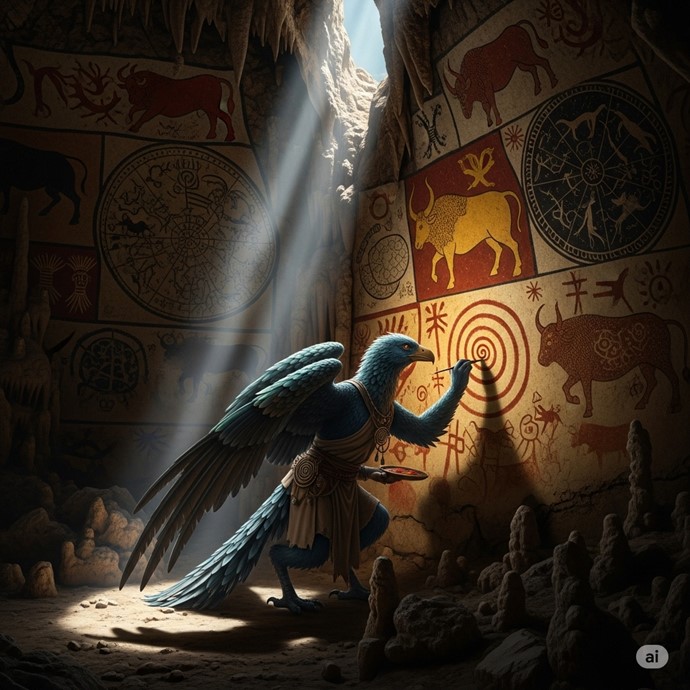
Followers of The Vézèrian Accord do not receive direct power from their deity. The Vézère is a silent, non-interventionist consciousness, and it does not grant spells or perform miracles. Instead, devout followers learn to use their gear-based magic in a way that is profoundly shaped by their religious philosophy. They use their understanding of The Vézère’s dual aspects—the Stone-Dreamer and the Sky-Painter—as a unique methodology for channeling and shaping magical energy.
The power is not a gift from a god; it is a secret art form, a way of seeing and interacting with the world’s memory that allows for potent and unique magical effects.
Defense: The Way of the Stone-Dreamer
Defensive magic is an act of preservation, drawing its philosophical strength from the Stone-Dreamer aspect of The Vézère. It is rooted in concepts of stability, timelessness, and the enduring nature of the past. A follower does not simply create a barrier; they impose the “memory” of an unbreakable or unmoving thing onto themselves, their allies, or their environment. The gear they wear (shields, armor, amulets) acts as the canvas, and their focused will is the brush that paints this memory of permanence.
Practical Applications:
- Memory of Unbroken Stone: When activating a defensive enchantment on their armor or shield, a follower enters a meditative focus on the concept of ancient stone. They recall the feeling of the Deep Sanctuaries, the geological time held within the rock that has withstood millennia of wind and rain. By channeling this focus through their gear, they impose this memory of timeless integrity onto their equipment. Physical blows may land, but the armor “forgets” how to dent, or a shield “remembers” a state of being whole, causing attacks to glance off with unnatural ease.
- The Stillness of the Archives: A follower can create a protective zone by using a focus (such as a holy symbol or a historical relic) to project the memory of an Accord Hall’s deep archives. This manifests as a shimmering area where the world’s memory becomes “thicker” and more stable. Within this zone, hostile energy is dampened, incoming projectiles may slow as they pass through layers of remembered time, and enemies might feel a profound sense of inertia or hesitation, as if their own history is being weighed down.
- Echo of Inevitability: This is a subtle form of defense based on precognition. By meditating on the vastness of The Vézère’s memory, which includes all things that have ever happened, a skilled user can perceive the echoes of imminent actions. This is not a clear vision of the future, but an intuitive “memory” of an attack that is about to happen. This allows them to preemptively dodge or block an attack that would have otherwise been too fast to react to, as they are reacting to the memory of the event, not the event itself.
Offense: The Way of the Sky-Painter
Offensive magic is an act of creation, drawing its power from the expressive and active Sky-Painter aspect of The Vézère. An attack is not merely a force to be unleashed, but a new, temporary reality to be “painted” onto a target. The goal is to create a vivid “memory” of pain, destruction, or hindrance and impose it upon an enemy with the focus and intent of a master artist completing a work. The gear used (weapons, wands, gauntlets) is the artist’s tool, allowing them to project their will and shape the raw magic of the world.
Practical Applications:
- Painting with Ochre and Charcoal: This is the most direct form of offensive magic. Using the sacred colors as a conceptual focus, a caster can “paint” an effect onto a target. By channeling magic through a weapon or focus, they can unleash a bolt of energy that appears as a streak of brilliant ochre red, imposing a memory of searing heat or sudden, bleeding wounds. Alternatively, they can cast a bolt of charcoal black, painting a memory of decay, blindness, or the chilling cold of a lightless cave onto the target.
- The Shape of the Forgotten: A highly advanced technique used by Echo-Keepers. By using a powerful focus, such as a fossil or a fragment from a Deep Sanctuary’s wall, the caster can reach into The Vézère’s memory and pull forth the “shape” of a long-extinct creature, such as a Great Aurochs or a cave bear. This does not summon the actual creature, but rather a semi-corporeal echo made of raw memory and magical energy. This phantom beast will charge or attack a designated target with primordial fury before dissolving back into nothingness, its temporary story having been told.
- Imposing a New Narrative: This is a form of curse or debuff magic. The caster focuses on the target and “paints” a new, brief story onto them. For instance, they might paint a memory of slipping on loose rock, causing the target to become clumsy and lose their footing. They could paint a memory of fear, causing the target to become hesitant and falter. This is not a simple mind-affecting spell, but an attempt to briefly rewrite the target’s immediate reality by overlaying it with a new, vivid memory created by the caster.
Painted Beasts and Echoing Hand
It is recorded in the oldest chronicles, those first etched on fired clay before the use of paper, that there was an age when the Alarian people knew the sky but not the soul of the stone upon which they perched. They were a people of the high air and the sunlit peaks. The great caves that punctured the flesh of their island were places of fear, of dampness and of a silence so heavy it felt like a weight upon the wings.
They saw the paintings upon the deepest walls—the great red bulls, the herds of shaggy horses, the black lions with their hunting eyes. But they saw them as warnings, as the marks of old demons, or as the fever-dreams of those who had been lost to the darkness and had died in madness. They would venture to the cave mouths to gather fungus or escape a storm, but they would not willingly go into the deep places where the World-flesh was cold and the air had never known the sun.
In this time, there was an Alarian named Manos. His wings were not as broad as his kins’, and his flight was often a struggle against the wind that others rode with joy. He was a creature of the earth more than the sky, and for this, he was pitied. He found no solace in the high emptiness where his brothers soared. Instead, he was drawn to the mouths of the caves, to the quiet and the cool air. The silence did not weigh upon him; it spoke to him.
He began to walk where others would not. He went down, into the deep places, with only a tallow lamp that made the shadows dance. He went not to conquer the darkness, but to listen to it. He came to the galleries of the painted beasts. He did not see demons. He saw life, captured with a vibrancy that shamed the gray stone. He would spend a whole turning of the sun and moon just gazing at a single red bull, its horns lowered as if to charge out of the rock itself.
The Elders warned him. They said, “Manos, the cave-sickness will take you. The darkness will eat your memories and leave you a hollow shell.”
But Manos found the opposite was true. The longer he stayed in the deep, still places, the more memories he gained. He began to sleep there, curled beneath the paintings. And his sleep was stolen and replaced with the sleep of the stone. He dreamed the memories of the rock. He felt the phantom weight of glaciers that had carved the valleys. He heard the thunder of hooves from beasts whose bones were now chalk in the earth. He saw stars in the Ceiling of the World that no living Alarian had ever seen. These were not his memories. They were older.
He awoke from one such dream with a truth shivering in his bones, a truth so profound it was like a new skeleton growing inside him. He placed his hand upon the cool, painted flank of a great aurochs. The image was not paint on stone. It was a memory that the stone itself had exhaled. The world, the great flesh and bone of Saṃsāra, was dreaming. And these caves were the chambers of its mind. The great beasts were not gone. They were merely asleep, dreaming within the memory of The Vézère.
He had come to understand the Stone-Dreamer.
He returned to the light, his eyes blinking, his feathers pale with dust. He was gaunt, and his gaze was distant. He tried to explain what he had learned. He spoke of the world’s memory, of the dreams of the stone, and of the life that slept in the paintings.
His people saw only the cave-sickness. They called him mad. “You have traded your own life-story for the dust of dead things!” they cried. “You speak with the tongue of shadows.”
Manos knew that words were not enough. A memory spoken is only wind. A memory shown is truth. He had understood the world’s past. Now he had to show them the world’s future. He had to become a Sky-Painter.
He returned to his great, silent gallery. He did not look at the old paintings. He looked at a blank space on the wall, a stone canvas prepared by time. For days he worked, grinding pigments as he had seen in the faint stains near the old paintings. He made ochre red from iron-rich earth for blood and the living heart. He made charcoal black from burnt bone for the final shadow and the beginning of things. He made chalk white from the softest limestone for spirit and the unseen.
He did not paint a beast from the stone’s dream. He painted a memory yet to be. He pressed his own hand against the wall and blew the ochre pigment around it, leaving a stark, personal mark. Around this hand, he painted the figures of Alarians. He painted the Elder who had scorned him. He painted the young ones who had pitied him. He painted them not on the ground, but soaring together in the sky, their wings strong, their faces turned toward each other in community. He painted the Accord he wished for. He painted a new memory for the world to hold.
As he drew the last line, a change occurred in the deep place. It was not a sound, for the cave remained utterly silent. It was a change in the quality of the silence. A resonance, a hum that was felt in the bones and the hollows of the wings. The ancient paintings on the walls around him seemed to gain a depth, their colors pulsing with a faint, internal light. The old memories had made space for the new.
The Alarians who had followed to mock him, who stood in the flickering lamplight at the edge of the gallery, felt the change. The silence was no longer heavy and dead, but full and alive. They looked upon the ancient bulls and for the first time, they felt the echo of their thundering hearts. They looked upon Manos’s new painting of the hand and the soaring flock, and they felt the warmth of its possible future. They understood.
Manos, the poor flyer, the outcast, had taught them that the sky was only half of their home. The stone was the other half. One was for the living of a life, the other for the keeping of its meaning. Manos became the first Echo-Keeper, the one who listens and speaks in turn. The Vézèrian Accord was struck.
Moral: For a great truth is not found by looking up at what will be, nor by looking down at what was, but by placing a hand against the silent stone and feeling the echo of both at once.