
This feral life form is a terrifyingly effective predator, a fusion of creatures from the deepest waters and most verdant jungles, perfectly adapted to the misty wildernesses of Saṃsāra.
Original Life Forms — The Sepimantis 77 is a magical amalgamation, believed by some sages to be the result of a magical catastrophe or a deliberate, ancient experiment in creature design. It is a fusion of four distinct life forms from different classes of the animal kingdom:
Class Amphibia: The Poison Dart Frog, for its potent skin toxins and vibrant warning coloration.
Class Insecta: The Praying Mantis, for its swiveling triangular head, body segmentation, and ambush posture.
Class Cephalopoda: The Cuttlefish, for its advanced chromatophores granting near-perfect camouflage and its long, grasping tentacles.
Class Malacostraca: The Peacock Mantis Shrimp, for its devastatingly powerful striking appendages and its unique, hyperspectral eyes.
Appearance
The Sepimantis presents a nightmarish visage. Its body is roughly the size of a large wolf hound, with a segmented, insectoid frame covered in a thick, chitinous exoskeleton. Stretched between these plates of chitin is a smooth, moist, and slightly translucent skin that constantly shimmers with shifting colors. While it can alter its appearance to perfectly match the texture and color of rock, mud, or foliage, its default “startled” or “threat” coloration is a vibrant, poison-dart-frog pattern of electric blue and jet black. Two powerful, frog-like hind legs provide explosive leaping power, while a smaller pair of mid-legs offers stability. The front two limbs are its primary weapons: massive, club-like raptorial appendages from the mantis shrimp, folded neatly under its head in the manner of a praying mantis. Its head is triangular and can swivel 180 degrees, and set upon it are two large, stalked eyes that move independently. Each eye is a complex wonder from the mantis shrimp, able to perceive a spectrum of light far beyond that of any avatar. From beneath its head, two long, slender tentacles can be shot out to grasp and retrieve prey.
Size
- Length: Approximately 1.2 meters from head to tail.
- Height: Stands about 0.8 meters tall at the shoulder.
- Weight: A dense 35 to 45 kilograms.
Speed
The Sepimantis is deceptively fast and explosive. On the ground, it can skitter forward with a surprisingly quick insectoid gait. Its primary mode of locomotion, however, is leaping. Its powerful hind legs can propel it in massive, soaring bounds, allowing it to close distances instantly or flee into dense cover. Its most dangerous feature is the speed of its club-like forelimbs, which can strike with the velocity of a firearm’s bullet, capable of shattering bone and shell with an audible crack.
Stat Modifiers
- Strength: +3
- Dexterity: +2
- Constitution: +1
- Intelligence: -2
- Wisdom: +3
- Charisma: -3
Skills
- Perception: Its hyperspectral, independently moving eyes grant it an unparalleled passive perception. It can see polarized light and multiple ultraviolet and infrared spectra, making it nearly impossible to surprise.
- Stealth: The creature is a master of camouflage. Its chromatophore-laden skin allows it to change color and texture in seconds to perfectly blend into its surroundings, making it an apex ambush predator.
- Athletics: Its powerful legs give it a prodigious leaping ability, allowing it to navigate difficult terrain with ease.
- Intimidation: When its camouflage is broken, it flashes its vibrant warning colors and raises its deadly clubs in a terrifying threat display.
Behavior
The Sepimantis is a solitary and highly territorial ambush predator. It will spend hours, sometimes even days, perfectly still and camouflaged, waiting for suitable prey to wander within its strike range. When a target is identified, it strikes with shocking speed. For smaller prey, it may use its long tentacles to snatch them. For larger or armored prey, it uses one of its powerful clubs to deliver a devastating, concussive blow. They communicate with each other only during rare, aggressive territorial disputes or for mating, using complex, hypnotic ripples of color across their skin.
Diet
Strictly carnivorous. It is an opportunistic hunter and will eat nearly any creature it can successfully subdue. Its diet consists of large insects, unwary avatars, fish snatched from the water’s edge, and even other tough, shelled monsters whose defenses it can easily shatter with its powerful clubs.
Emotions
This creature operates almost purely on instinct. It is driven by the primal urges of hunger, territoriality, and survival. It displays no recognizable compassion or social bonding. Its emotional range is limited to raw aggression towards threats and rivals, fear when confronted with a superior force, and an unnerving, patient, predatory focus when hunting.
Environment Where Found
The Sepimantis 77 thrives in damp, temperate, and visually complex environments where its camouflage is most effective. It is most commonly found in the vast, misty wetlands, mangrove swamps, and ancient, moss-draped river jungles of the Perigordian nation. It is an amphibious creature, equally comfortable hiding among the muddy banks of a river or clinging to the underside of a giant jungle leaf.
Tags: Amphibious, Feral, Chitinous, Solitary, Ambush Predator, Camouflage, Poisonous Skin, Territorial, Hyperspectral Vision, Concussive Striker, Chimera, Magical Beast, Insectoid Form, Cephalopoid Traits, Stalked Eyes, Patient Hunter, Grasping Tentacles, Neurotoxic Secretions
Life Cycle
The life cycle of a Sepimantis 77 is a perilous journey of transformation, beginning in the water and culminating on land.
- The Egg Clutch: Following a successful mating, the female Sepimantis seeks out a secluded, heavily vegetated, underwater location in a pond or slow-moving river. There, she deposits a gelatinous, spherical mass containing 20-30 tough, leathery eggs. She provides no parental care, abandoning the clutch to fate. The gel offers some protection from smaller predators and the elements.
- Nymph Stage: After several weeks, the eggs hatch into fully aquatic nymphs. At this stage, they are small, vulnerable, and look more like multi-legged tadpoles with the large, intelligent eyes of a cephalopod. They breathe through gills, are almost translucent, and survive by hiding amongst the riverbed detritus, using their nascent camouflage abilities to hunt for minuscule prey like larvae and water fleas.
- Metamorphosis: Over the course of several months, the nymph undergoes a gradual metamorphosis. It will begin to spend short periods out of the water, during which its gills recede and a more complex respiratory system of spiracles and simple lungs develops. Its chitinous plates harden, its raptorial forelimbs develop their characteristic size and density, and its frog-like legs gain their powerful musculature.
- Juvenile Stage: Once fully terrestrial, the juvenile Sepimantis is a perfect, miniature version of the adult, roughly the size of a house cat. For about two years, it will live a solitary existence, honing its hunting skills on larger insects and small vertebrates. This is the most dangerous period of its life, as it is a target for numerous larger predators before it reaches its full, formidable size.
- Adulthood: A Sepimantis 77 reaches full maturity at around two years of age. Its typical lifespan in the wild is estimated to be between 10 and 15 years.
Mating
Given their solitary and aggressive nature, the mating rituals of the Sepimantis 77 are a tense and often lethal affair. Mating occurs only once a year during a brief season. A male will cautiously enter the territory of a female, who is typically larger and more powerful. From a safe distance, the male will begin an elaborate and hypnotic courtship display. Using his advanced chromatophores, he will create dazzling, complex, and rapidly shifting patterns of light and color across his entire body. This display is a testament to his genetic fitness, speed, and control.
The female will watch this display motionlessly. If the male’s patterns are weak, repetitive, or flawed, she will interpret it as a sign of weakness and is very likely to attack and cannibalize him. If she is impressed by the vibrancy and complexity of the light show, she will respond with a specific, receptive color pattern of her own, a sign that allows the male to approach. The mating itself is brief, after which the male will immediately retreat and flee the territory.
Tactics
The Sepimantis is a creature of cunning instinct, employing a ruthlessly efficient set of tactics to secure its prey.
- The Patient Ambush: Its primary tactic is to find a location with good cover and high traffic of potential prey. It uses its Chameleonic Skin to become virtually invisible, and can remain perfectly motionless for hours on end, its stalked eyes scanning its surroundings in all directions.
- Vulnerability Assessment: It will observe a group of travelers, identifying the weakest, most isolated, or least armored individual as its preferred target. It will wait for the perfect moment when that target is distracted or has strayed from the group.
- Explosive Assault: The attack is a singular, explosive event. It will use its powerful Leap to close the distance in an instant, aiming to land adjacent to its chosen target. Its first and primary goal is to end the fight immediately with a single, overwhelming Shattering Blow.
- Isolate and Annihilate: If the initial strike does not neutralize the target, it will immediately employ its Snaring Tentacles to grapple and drag the victim away from its allies. By isolating the prey, it prevents rescue and can finish its work with a series of further bludgeoning attacks.
- Calculated Retreat: The Sepimantis is a survivor, not a zealot. If it is severely wounded or if the prey’s companions mount a swift and effective defense, it will not hesitate to disengage. It will use its leap to propel itself into dense undergrowth or a body of water, vanishing with its camouflage once more.
Actions
- Multiattack: The Sepimantis makes two attacks: one with its Shattering Blow and one with its Snaring Tentacles.
- Shattering Blow: Melee Weapon Attack. A devastatingly fast and powerful strike with its club-like raptorial forelimb. This attack deals massive bludgeoning damage and is particularly effective against armored foes, often denting, cracking, or shattering non-magical armor.
- Snaring Tentacles: Ranged Grapple Attack. The Sepimantis shoots its two long, sticky tentacles at a target up to 6 meters away. On a successful attack, the target is grappled and pulled several meters closer to the creature.
- Chameleonic Skin: As an action, the Sepimantis can activate its chromatophores to become nearly invisible. This allows it to attempt to hide even when only lightly obscured, granting it a significant advantage on Stealth checks.
- Threat Display: As an action, the Sepimantis flashes its vibrant, aposematic warning colors and raises its clubs in a threatening posture. Creatures that can see it must make a Wisdom saving throw or become frightened for a short period.
Other Interesting Information
- Ecological Keystone: In the wetlands and jungles it inhabits, the Sepimantis is an apex predator within its size class. Its presence is often an indicator of a healthy and diverse ecosystem, as it requires a steady supply of various prey animals to sustain itself.
- Alchemical and Magical Reagents: Several parts of a Sepimantis are highly sought after by alchemists, artificers, and mages.
- Hyperspectral Eyes: The complex crystalline lenses within the creature’s stalked eyes are priceless. When properly extracted and prepared, they can be used as components in lenses for seeing into other spectrums of light, in the creation of powerful scrying devices, or in artifacts that enhance perception.
- Neurotoxic Film: The poisonous secretions on its skin can be carefully harvested. In its raw form, it is a potent paralytic agent. When refined and heavily diluted, it can be used to create powerful muscle relaxants and medicines.
- Chromatophore Hide: The hide of a Sepimantis, if flayed and preserved with extreme care using alchemical tannins, retains some of its color-shifting properties. It is a prized material for crafting lavish, high-tier gear that grants the wearer enhanced stealth or minor illusionary capabilities.
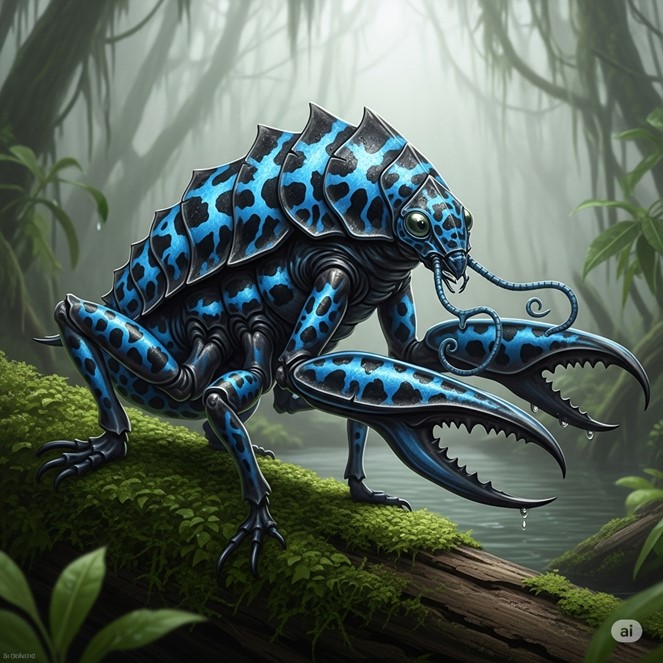
An encounter with a Sepimantis 77 is rarely a simple affair. Given the creature’s lethal efficiency and valuable biological components, parties of adventurers in Saṃsāra might cross paths with one through misfortune or seek one out with deliberate, calculated intent.
Incidental Encounters: The Perils of the Wild
Most encounters with a Sepimantis are sudden, terrifying, and unintentional. These creatures are masters of their environment, and adventurers traveling through their territory are often considered prey.
- The Environmental Hazard: The most common encounter occurs when a party is simply traveling through the dense, humid jungles or misty wetlands of Perigordian. An adventurer might step over what they believe is a moss-covered log, only for the “log” to explode into a riot of color and motion as the camouflaged Sepimantis strikes. The creature’s primary tactic is to wait in perfect stillness along game trails, riverbanks, or any area with frequent traffic, making travel through its habitat an inherently risky proposition. The first sign of its presence is often the sickening, cracking sound of its club-like appendage striking an unlucky party member.
- The Luring Light: Some scholars believe the Sepimantis can consciously control the faint, bio-luminescent properties of its skin. A party traveling at dusk or night might be drawn towards a soft, pulsating light deep in the swamp, mistaking it for a rare alchemical fungus or a lost will-o’-the-wisp. An inquisitive adventurer who moves ahead to investigate may find themselves the target of a perfectly laid ambush, with the light serving as the lure.
- The Contested Kill: A party of adventurers might successfully hunt another beast in the jungle, only to find themselves in a territorial dispute. The scent of blood can attract a nearby Sepimantis, which may view the adventurers not as the hunters, but as scavengers intruding on its rightful kill. It will not hesitate to use its intimidating threat display and explosive force to drive the party away from their prize.
Deliberate Hunts: The Search for a Nightmare
While many would prefer to never see a Sepimantis, its unique physiology makes it a creature of immense value. Various guilds, scholars, and nobles will pay handsomely for parties skilled and brave enough to actively hunt them, often with very specific requirements.
- For Alchemical and Magical Components: This is the most common reason for a deliberate hunt. The creature is a treasure trove of rare reagents.
- Quest: The Seer’s Lens: A high-tier artificer or a sage specializing in optics may post a massive bounty for a pair of pristine, undamaged Sepimantis eyes. The complex crystalline structures within are essential for crafting legendary scrying devices or lenses that can perceive magical auras. The difficulty lies in killing the creature without harming its delicate, stalked eyes.
- Quest: The Living Tincture: An alchemist’s guild might require the potent neurotoxin from the creature’s skin to create powerful paralytic agents. The quest would specify that the toxin must be harvested from a living specimen, as it degrades rapidly upon death. This transforms the hunt into a dangerous “catch-and-release” mission, where the party must subdue the beast, carefully scrape a sample, and then escape before it recovers.
- Quest: The Shifting Mantle: A noble of the Perigordian matriarchy, seeking to make a statement at a royal gala, might commission a lavish cloak made from the creature’s chromatophore-laden hide. The quest would demand the hide of a large, mature specimen, with minimal tears or blemishes, promising a fortune for a party that can deliver such a perfect trophy.
- For Protection and Eradication: Sometimes, the goal is simply extermination.
- Quest: The River Scourge: If a particularly large or aggressive Sepimantis establishes its territory too close to a village or a vital trade route, it can halt commerce and endanger lives. The local mayor or trade guild will issue a straightforward bounty: kill the beast and bring its massive raptorial clubs as proof.
- Quest: Clearing a Path for Faith: The Echo-Keepers of the Vézèrian Accord might hire adventurers as armed escorts. A quest could involve protecting a senior Echo-Keeper on a pilgrimage to a newly discovered Deep Sanctuary, the path to which lies through a wetland infested with a whole colony of Sepimantis. The party’s job would be to scout ahead, neutralize any threats, and ensure the safety of the non-combatant clergy.
- For Scholarly Pursuits: Not all quests are about killing or harvesting. The creature itself is a source of immense scientific interest.
- Quest: The Chromatic Codex: A scholar from a great library or an Echo-Keeper studying the “memories of the wild” might hire a party for a non-lethal mission. The goal would be to track a Sepimantis, get close enough to magically record its complex, hypnotic mating display, and return with the data. This is a mission of pure stealth and patience, testing a party’s ability to observe one of the world’s most perceptive creatures without being detected.
Beyond the previously noted eyes, skin, and toxic film, the corpse of a Sepimantis 77 is a treasure trove of rare and exotic biological components. A skilled adventurer with knowledge of harvesting magical beasts can procure several additional ingredients, each with unique applications in the advanced crafts of Saṃsāra.
1. The Resonant Cuttlebone
Deep within the creature’s torso lies a large, internal, porous shell—a biological remnant of its cephalopod ancestry. Unlike a mundane cuttlebone, this structure is imbued with a faint magical resonance from a lifetime of exposure to the creature’s own bio-electric and chromatic energies. It is surprisingly durable and gives off a low, almost imperceptible hum when held.
Uses:
- Alchemical Catalyst: When ground into a fine, shimmering powder, the Resonant Cuttlebone serves as a powerful catalyst in potions related to sound, vibration, and communication. It is a key ingredient in a “Potion of Stone’s Hearing,” which allows the imbiber to perceive vibrations through solid surfaces, or an “Elixir of the Echo,” which can grant a user’s voice a hypnotically resonant quality.
- Artificing Component: Artificers specializing in communication devices seek out whole, undamaged cuttlebones. They are used as resonant amplifying chambers in the creation of long-range magical message relays and telepathic clarifiers. While the bone itself cannot create a telepathic signal, its unique properties allow it to filter out magical static and focus the energy, dramatically increasing the range and clarity of such devices.
2. Striker Club “Knuckles”
This refers to the dense, uniquely structured cap at the terminus of the Sepimantis’s two raptorial appendages. It is not made of simple chitin, but of a hyper-dense, bio-mineral composite, formed in layers of crystalline structures that give it unmatched hardness and an incredible ability to transfer kinetic energy.
Uses:
- Weapon and Armor Crafting: A master smith can carefully extract these “knuckles” and forge them into the heads of warhammers or maces. Weapons crafted with this material possess a natural “sundering” quality, making them exceptionally effective at damaging armor and shields. They can also be incorporated into the design of heavy gauntlets, creating a weapon that can pulverize stone with a well-placed punch.
- Industrial Applications: Within the magic-tech factories of Saṃsāra, these club-heads are prized for specialized industrial uses. They serve as magically-infused, high-impact pestles for crushing extremely hard materials, such as raw gemstones or rare ores, for alchemical or enchanting processes.
3. Prismatic Ink Sac
While most of its cephalopod traits are external, the Sepimantis retains a tough, membranous ink sac. The ink within is not merely black but is a viscous, swirling, holographic substance. It shimmers with a captive inner light, a liquid manifestation of the creature’s hyperspectral perception.
Uses:
- Master-Tier Scribing: This prismatic ink is considered a legendary-grade material for enchanting and scroll-making. Scribing a rune or a spell onto an item with this ink creates a far more stable and potent magical matrix, allowing the item to hold a stronger enchantment. Scrolls written with it are less prone to failure and can be activated more quickly.
- Illusionist’s Reagent: When diluted and processed by an alchemist, the ink can be used to create powerful illusionary tools. A single drop can be formulated into a potion that allows the user to exhale a cloud of shimmering, disorienting mist, or it can be used to create throwable globes that burst into a display of hypnotic, shifting patterns that can confuse and mesmerize onlookers.
4. Sinew of the Leaping Legs
The primary tendons harvested from the creature’s two powerful, frog-like hind legs are a marvel of biological engineering. They are incredibly elastic, shimmering with a faint blue energy when stretched, and are capable of storing and releasing kinetic potential with almost no loss of energy.
Uses:
- Ranged Weapon Crafting: Sepimantis sinew is considered the ultimate material for the bowstring of a masterwork longbow or the torsion cables in a magically-powered ballista. A bow strung with this sinew has a smoother draw and a faster, more powerful release than one made from any other known material, increasing the weapon’s range and impact force.
- Armor Enhancement: Skilled armorers can integrate treated strands of this sinew into the joints of heavy plate mail. This does not increase the armor’s protective value, but it dramatically improves its flexibility and reduces the feeling of its weight, allowing the wearer to move with greater speed and less fatigue.
5. “Frog’s Kiss” Toxin Glands
While a mild neurotoxin coats the creature’s skin, the pure, concentrated source is found within two small, specialized glands located near the creature’s jaw. These glands are difficult to extract without rupturing, but if successfully harvested, they contain one of the most potent natural poisons in the world.
Uses:
- Masterwork Poisons: A single drop of the pure toxin can be diluted to create dozens of doses of a fast-acting paralytic poison. A weapon coated with this substance can render a target immobile with even a minor scratch.
- Advanced Alchemy (Antitoxin): Paradoxically, this potent neurotoxin is the key ingredient in a rare and powerful elixir known as the “Antidote of the Mind.” A master alchemist can use its properties to create a potion that does not cure physical poison, but rather “paralyzes” foreign magical influences on an avatar’s mind. A dose of this antidote can instantly break powerful charm, compulsion, and domination effects by temporarily severing the magical link between the caster and the victim’s will.
Hubris of Kaeyan and Striking Stone
It is said in the verses of the Elders, passed down from a time when the Vézac Matriarchy was still young, that there lived an Alarian champion named Kaeyan. His plumage was not of the common earth-tones or the deep blues of his kin; his was the color of the midday sun itself, a gold so brilliant it seemed to cast its own light. His gear was the work of master artificers, his shield was a legend, and his spear was said to have tasted the hearts of a hundred great beasts.
Kaeyan was the pride of the Sky-Painters, a living embodiment of action and glory. But his strength was sister to a great pride. He would stand on the highest balcony of Rocamadour and declare, “I have the eyes of the sun! There is no shadow that can hide a foe from me, no trick of light that my gaze cannot pierce. What I cannot see does not exist.”
And it came to pass that tales of trouble arrived from the southern wetlands, a place of tangled roots and cloying mist. Traders and trappers who traveled the banks of the Murk-River were vanishing. Not in pairs or groups, but one by one, taken from the path with no witness, no cry, no sign of struggle save for a single, strange track in the mud and then nothing. The local folk, in their fear, called the unseen thing the Flickering Ghost, the Silent Hunger, the Stone That Strikes.
When these whispers reached the high-perched city, Kaeyan of the Sun-Feathers laughed. His laughter was like the jangling of gold coins. “A ghost that leaves a track?” he said. “A striking stone? These are the tales of ground-bound folk whose eyes are clouded by mist and fear. Their ghost is but a common beast they are too weak to face. I shall go to this Murk-River and bring back the head of this ‘ghost,’ so that all may see the truth of things.”
He took up his legendary gear and flew south, his golden form a comet against the sky. He arrived in the wetlands, a place he disdained. The air was thick and heavy, a great contrast to the clean, thin air of the peaks he loved. He walked the muddy paths, his keen Alarian eyes scanning all. His sight was so true he could count the legs on a water-fly from a hundred paces. He saw the shimmer of fish scales in the dark water. He saw the sleeping lizards coiled on sun-warmed rocks. He saw everything. And because he saw everything, he became certain there was nothing to see.
For three days he walked the riverbank, his pride swelling with each uneventful hour. “The Stone That Strikes is but a stone,” he declared to the silent trees. “The Silent Hunger is but the hunger of fearful minds.” The story of the monster, he concluded, was a lie born of weakness.
On the fourth day, weary of the pointless task, he stopped to rest by the water’s edge. He chose a spot near a lump of mud-caked stone, a thing of no consequence that was half-covered in moss. He laid his spear down and took off his helm, the better to feel the faint breeze. He looked at his own brilliant reflection in the murky water, and his mind told him, “Here is the only thing of consequence in this whole wretched swamp.” His eye saw the leaf, and the beetle upon the leaf, and the vein within the leaf. And so his mind told him, “All is seen.” He mistook the seeing of many small things for the knowing of the one great thing he was missing.
He was looking at the creature he had come to hunt. The Stone That Strikes was the mud-caked stone beside him. Its perfect camouflage had not tricked his eyes—his eyes had seen it perfectly. But his mind, in its arrogance, had dismissed it as a part of the worthless landscape. It was a stone, and he did not concern himself with stones.
The moment he turned his gaze from his reflection back to the path, the stone exploded. It did not move so much as it simply ceased to be a stone and became an action. There was a sound like a thunderclap right next to his ear, a sound of air being broken. It was the Shattering Blow of the Sepimantis. Kaeyan, the great champion, the Sun-Feathered King, was struck before his mind could even register the betrayal of his senses. His famed greave, a masterwork of enchanted steel, crumpled like parchment, and the bone of his leg beneath it was turned to splinters.
Pain, a thing he had given to so many but had rarely felt himself, bloomed white and hot in his mind. Before he could even cry out, a slick tentacle lashed out from the creature and snared his ankle. He, the great flier, was dragged from his feet and pulled down into the mud and the murk.
He fought then, with the fury of a cornered lion. He swung his spear from the ground, a broken king in a muddy court. He managed to land a blow, gouging the creature’s chitinous side. The Sepimantis, wounded and having lost the full advantage of its ambush, released him and dissolved back into the forest with a leap that was too fast to follow.
Kaeyan was left alone, bleeding and broken in the mud. The journey back was an agony that lasted an eternity. He did not fly. He crawled.
He returned to Rocamadour not a conquering hero, but a humbled cripple. His sun-feathers were stained with mud and his own blood. He no longer boasted of his perfect sight. He leaned upon a cane carved of swamp-wood and taught the young fledglings. He did not teach them how to fight, but how to see. He told them his story, the story of the Striking Stone, as a warning against the hubris of the sky and to instill a deep respect for the silent, hidden things that dwell in the earth below.
Moral: For the eye that sees ten thousand leaves can still be blind to the branch they rest upon. True sight is not in counting the stones, but in knowing which stone might strike.
Suggested conversions to other systems:
Call of Cthulhu (7th Edition)
The Prismatic Stalker
It’s a terrifying, chimerical predator that haunts the misty river jungles and swamps of remote islands. This creature’s a product of impossible biology, blending insectoid, amphibian, and cephalopoid features into a ruthlessly efficient killing machine. Its most unsettling feature is its skin, which can shift color and texture to perfectly match its surroundings, making it an invisible threat until the moment its devastating, club-like arms strike.
STR 85 CON 70 SIZ 75 DEX 65 INT 35 POW 60 HP: 14 Damage Bonus: +1D6 Build: 2 Move: 8 / 12 (Leap)
ATTACKS Fighting (Brawl) 65% (32/13), damage 1D3 + Damage Bonus or special. Shattering Blow: The Stalker’s main attack. On a successful hit, it deals 1D10+1D6 damage. A target can try to Dodge. On an Extreme success (a roll of 13 or lower), the Stalker strikes a specific location; a limb is shattered and useless, or the target’s armor is destroyed. Snaring Tentacles 50% (25/10), damage Grapple. The Stalker can target a victim up to 5 yards away. If successful, the victim is entangled and must win an opposed STR roll on their turn to escape. The Stalker can use its action to pull a grappled victim 5 yards closer.
Armor: 4 points of tough, chitinous exoskeleton. Skills: Dodge 40% (20/8), Stealth 85% (42/17), Spot Hidden 70% (35/14). Spells: None.
Special Powers
- Chameleonic Skin: The Prismatic Stalker’s skin lets it blend perfectly into its surroundings. Spot Hidden rolls to notice a motionless Stalker are made at Extreme difficulty (requiring two penalty dice).
- Poisonous Secretions: Anyone touching the Stalker or striking it with a bare-handed attack must make a Hard CON roll or be overcome with violent muscle spasms, suffering a penalty die to all physical actions for 1D6 rounds.
- Terrifying Visage: The first sight of the Prismatic Stalker, a nightmare of mismatched anatomy and shifting colors, requires a Sanity roll (1/1D6).
Blades in the Dark
The Glass-Strike Phantom
This is a whispered tale from the muck-diggers and smugglers who brave the untamed wetlands outside the city. They say it’s a spirit of the swamp, a thing that looks like a rock or a log until it strikes with the sound of breaking glass and drags you under. It’s silent, impossibly fast, and utterly alien. Its motives are unknown, but its hunger is legendary.
Threat Level: Dangerous supernatural predator (Magnitude 5) Qualities: Armored, Terrifying, Ambusher, Incredibly Fast, Silent, Amphibious.
Clocks
- The Hunt is On: (8-segment) When the crew enters its territory.
- Victim is Isolated and Doomed: (6-segment) When it focuses on a single character.
- Its Chitinous Carapace Cracks: (8-segment) Harm clock to defeat or drive it off.
- Vanishes Back into the Murk: (4-segment) When it decides to flee.
GM Actions / Moves
- Vanish into the scenery without a trace. It’s there one moment, and gone the next. Start a clock for its next ambush.
- Strike with impossible speed, shattering gear or bone. Inflict level 3 Harm “Shattered Limb” and destroy one of the character’s items.
- Lash out with ensnaring tendrils. Separate someone from the group, entangle them, and drag them toward a more dangerous position (e.g., into deep water, away from the light).
- Reveal its terrifying, shifting visage. A character facing it must resist with Resolve or take 2 Stress, or they can freeze and hesitate for a crucial moment.
- Unleash a concussive force. The strike sends out a shockwave. All nearby characters are knocked off their feet and must resist the consequences.
Dungeons & Dragons (5th Edition)
Prismatic Ambusher Large monstrosity, unaligned
Armor Class 17 (natural armor) Hit Points 114 (12d10 + 48) Speed 30 ft., swim 30 ft.
STR 18 (+4), DEX 15 (+2), CON 18 (+4), INT 5 (-3), WIS 16 (+3), CHA 7 (-2)
Skills Perception +6, Stealth +8, Athletics +7 Damage Immunities poison Condition Immunities poisoned Senses darkvision 60 ft., passive Perception 16 Languages — Challenge 6 (2,300 XP) Proficiency Bonus +3
Amphibious. The Prismatic Ambusher can breathe air and water.
Chameleonic Carapace. The ambusher has advantage on Dexterity (Stealth) checks made to hide. As a bonus action, it can take the Hide action.
Poisonous Skin. A creature that touches the ambusher or hits it with a melee attack while within 5 feet of it takes 5 (1d10) poison damage.
Standing Leap. The ambusher’s long jump is up to 40 feet and its high jump is up to 20 feet, with or without a running start.
ACTIONS
Multiattack. The ambusher makes two attacks: one with its Shattering Claw and one with its Snaring Tentacle.
Shattering Claw. Melee Weapon Attack: +7 to hit, reach 5 ft., one target. Hit: 15 (2d10 + 4) bludgeoning damage. If this attack roll is a natural 19 or 20, the strike is a critical hit, and any non-magical armor or shield worn by the target is damaged, taking a permanent and cumulative -1 penalty to the AC it offers. If the penalty drops to -5, the item is destroyed.
Snaring Tentacle. Ranged Weapon Attack: +7 to hit, range 20 ft., one target. Hit: 7 (1d6 + 4) bludgeoning damage, and the target is grappled (escape DC 15). Until this grapple ends, the ambusher can’t use its Snaring Tentacle on another target. As a bonus action, the ambusher can pull a creature it is grappling up to 20 feet straight toward it.
Knave
The Chitin-Frog A large, predatory chimera that lurks in swamps and river jungles. It can change its skin color to match its surroundings, making it a deadly ambusher. It strikes with two heavy, club-like claws with enough force to shatter bone.
HD 6 Armor 16 Attack Club-claws (d10) Morale 10 Saves Strength, Constitution
Special Abilities
- Ambush: When hidden or camouflaged, its first attack against a target is made with advantage and inflicts double damage.
- Camouflage: When motionless, it’s invisible. Characters must succeed on a Wisdom saving throw to spot it.
- Shattering Blow: On a critical hit (20), the target’s shield or armor (GM’s choice) is destroyed. This has no effect on magical armor.
- Explosive Leap: As its move, the Chitin-Frog can leap up to 60 feet to any surface it can stand on.
- Grappling Tentacles: The Chitin-Frog can make an attack roll against a target within 20 feet. If successful, the target is grappled. The Chitin-Frog wins all ties in opposed Strength checks to maintain or escape the grapple.
- Poison Skin: Any character who strikes the Chitin-Frog with a melee attack must make a Constitution saving throw or take 1d6 damage.
Fate Core System
The Thing That Was A Stone
This is a narrative obstacle, a living embodiment of a hostile environment. It’s less a monster to be fought and more a dangerous situation to be overcome. Its threat comes from its ability to impose Aspects on the scene and the characters, and its stunts make it a formidable physical opponent.
ASPECTS
- High Concept: Perfect Ambush Predator
- Trouble: Instinct-Driven and Territorial
- Other Aspects: A Living Mosaic of Alien Parts, The Sound of Shattering Glass, Invisible Until it Strikes
SKILLS
- Good (+3): Fight, Stealth
- Fair (+2): Athletics, Provoke
- Average (+1): Notice
STUNTS
- Chameleonic Skin: Gain a +2 bonus to Stealth to create an advantage or overcome an obstacle when remaining motionless or in complex terrain like a jungle or swamp.
- Shattering Blow: When you succeed with style on a Fight attack, you can choose to place the Broken Gear situational Aspect on an opponent’s armor or shield instead of taking a boost.
- Snaring Tentacles: You can use Fight to make physical attacks against targets in an adjacent zone, representing its long, grasping tentacles.
STRESS & CONSEQUENCES
- Stress: [1] [2] [3]
- Consequences: One Mild, one Moderate.
Numenera & Cypher System
Chromatic Ambusher
A bizarre predator found in the swamps and wet jungles of Saṃsāra, the Chromatic Ambusher is a creature perfectly adapted to its environment. It is a level 5 threat due to its combination of potent offensive power and nearly perfect camouflage.
Level: 5 Health: 15 Damage: 5 points. Armor: 2 Movement: Short; can leap a long distance as a single action.
Modifications:
- Stealth as level 7.
- Perception as level 7.
Combat:
- Shattering Strike: The ambusher’s primary attack is with its heavy, club-like claws. This attack deals 2 additional points of damage that ignore Armor, representing the devastating concussive force that bypasses physical defenses.
- Snaring Tentacles: As its action, the ambusher can make a grapple attack on a target within short range. The target must make a level 5 Might defense roll to escape. On its next turn, the ambusher can pull the grappled target adjacent to itself as part of its movement.
- Camouflage: When motionless, the Chromatic Ambusher is effectively invisible. Its first attack made from this state is modified by two steps in its favor. After it attacks, it becomes visible but can attempt to hide again.
- Poisonous Skin: Any character who strikes the ambusher in melee must succeed on a Might defense roll or take 3 points of poison damage (this damage ignores armor).
Interaction: The Chromatic Ambusher is a feral creature of instinct. It does not communicate or negotiate. It views other creatures as either threats to be driven off or prey to be eaten.
Loot: A successful character might be able to harvest its hide (useful for creating gear with stealth properties), its club-like claws (which could be fashioned into a weapon), or its toxic secretions.
Pathfinder (2nd Edition)
Sepulchral Mantis Creature 6 Unaligned, Medium, Amphibious, Beast
Perception +15; darkvision, wavesense 30 feet Skills Acrobatics +15, Athletics +16, Stealth +17 Str +6, Dex +5, Con +4, Int -4, Wis +5, Cha -2
AC 24; Fort +16, Ref +15, Will +13 HP 95
Poisonous Skin (aura, poison) 5 feet. A creature that enters the aura or ends its turn there takes 2d6 poison damage (DC 22 basic Reflex save). A creature that touches the mantis or hits it with an unarmed attack takes 2d6 poison damage (DC 22 basic Reflex save).
ACTIONS
- Speed 25 feet, swim 25 feet
- Melee [one-action] Claw +17 (Reach 10 feet), Damage 2d10+8 bludgeoning.
- Melee [one-action] Tentacle +17 (Agile, Grapple, Reach 15 feet), Damage 2d6+8 bludgeoning.
- Ambush [two-actions] The Sepulchral Mantis Leaps or Strides, then makes a Claw Strike. If it was hidden from the target at the start of this action, the target is flat-footed against the attack.
- Shattering Critical: When the mantis critically hits with its Claw Strike, the target’s armor or shield (the mantis chooses) is damaged. If the item is non-magical, its Hardness is reduced by 5. If it is magical, it becomes broken.
- Perfect Camouflage: The mantis can Hide without cover or concealment in natural terrain. It can move up to 5 feet while Hidden without needing to make a new Stealth check.
Savage Worlds (Adventure Edition)
Swamp Stalker
Attributes: Agility d8, Smarts d4 (A), Spirit d6, Strength d10, Vigor d8 Skills: Athletics d8, Fighting d10, Notice d10, Stealth d10 Pace: 6; Parry: 7; Toughness: 8 (2)
Special Abilities
- Armor +2: Tough chitinous plates.
- Aquatic: Pace 6 in water.
- Camouflage: +4 to Stealth rolls when in wetlands or jungles and remaining still. Opponents suffer a –4 penalty to Notice rolls to spot it.
- Claws: Str+d6, AP 2.
- Leap: The Stalker can leap up to d10” in a single action. This is a “double move” in a straight line that ignores intervening terrain or characters.
- Poisonous Skin: When struck by a melee attack, the attacker must make a Vigor roll or become Distracted.
- Size 1: Roughly the size of a large dog.
- Tentacles: Reach 2″. If the Stalker gets a Raise on its Fighting roll with its tentacles, instead of dealing extra damage, the target is automatically Entangled.
- Wild Card: A Swamp Stalker is a Wild Card and uses a Wild Die as normal.
Shadowrun (6th World)
Chameleon Striker This paracritter is a nightmare of gene-splicing, believed by some to be an escaped prototype from an Aztechnology or Ares black site specializing in biological weapons. It is a highly efficient ambush predator, combining natural camouflage with terrifying speed and concussive force. Shadowrunners encountering one in the wilds of a corporate-owned jungle or an abandoned sewer system are advised to engage from extreme range.
ATTRIBUTES Body: 6 Agility: 5 Reaction: 5 (7) Strength: 7 Willpower: 3 Logic: 2 Intuition: 4 Charisma: 2 Edge: 3 Magic: 6 Essence: 6
DERIVED STATS Initiative: 9 + 2D6 Defense Rating: 10 Armor: 10 Condition Monitor: 11/10
SKILLS Perception: 5 (7) Stealth: 7 Unarmed Combat: 6
POWERS
- Chameleon Skin (Concealment): This power is always active. Any Perception test to spot the Striker suffers a -5 dice pool penalty.
- Enhanced Senses (Low-Light, Thermographic): The Striker can see in dim light and perceives heat signatures.
- Natural Weapon (Clubs): The Striker’s club-like claws deal (STR + 2)P damage with an AP of -3.
- Sunder: When the Striker gets 3 or more net hits on an Unarmed Combat test, it may choose to damage the target’s armor instead of dealing extra damage. The target’s Armor rating is permanently reduced by 1.
- Toxic Secretion: A contact vector toxin (Speed: 1 Combat Turn, Power: 8, Effect: -2 to all actions, -1 Initiative per turn; see Paralysis).
- Wall Running & Leaping: The Striker can move on vertical surfaces as if they were ground and can leap up to 20 meters as a single Major Action.
Starfinder
Sepimantis Xenoform (CR 6) NE Large magical beast
Init +4; Senses blindsense (vibration) 30 ft., darkvision 60 ft., polychromatic vision; Perception +13
DEFENSE HP 90 EAC 18; KAC 20 Fort +10; Ref +10; Will +5 Defensive Abilities poisonous skin
OFFENSE Speed 30 ft., swim 30 ft. Melee concussive slam +16 (1d8+10 B; critical stagger) Ranged snaring tentacle +13 (grapple) Space 10 ft.; Reach 10 ft. (20 ft. with snaring tentacle) Offensive Abilities ambush strike
STATISTICS STR +4; DEX +4; CON +2; INT -4; WIS +1; CHA -2 Skills Acrobatics +13, Athletics +18, Stealth +13 Other Abilities amphibious, explosive leap
SPECIAL ABILITIES
- Ambush Strike (Ex): When the Sepimantis makes an attack against a target that is unaware of its presence, it gains a +4 bonus to its attack roll and the attack ignores the target’s Dexterity bonus to AC.
- Chameleoflage (Ex): The Sepimantis can change its coloration to match its surroundings, granting it a +4 racial bonus to Stealth checks. It can use Stealth to hide even when it is only lightly obscured by foliage, mist, or dim light.
- Concussive Slam (Ex): The Sepimantis’s slam attack has the sunder weapon property. On a critical hit, the target is staggered for 1 round.
- Explosive Leap (Ex): As a full action, the Sepimantis can move up to four times its speed in a straight line by jumping. This movement does not provoke attacks of opportunity.
- Poisonous Skin (Ex): A creature that hits the Sepimantis with a melee attack must succeed at a DC 14 Fortitude save or take 2d6 poison damage.
- Polychromatic Vision (Ex): The Sepimantis can see in multiple spectra of light, making it immune to visual illusion effects like displacement and invisibility.
- Snaring Tentacle (Ex): The Sepimantis can make a grapple combat maneuver against a target up to 20 feet away. If successful, it pulls the target 10 feet closer to itself.
Traveller (Mongoose 2nd Edition)
Vetala Striker Amphibious Ambush Predator
UPP: A982A2 Hits: 20 (Large) Speed: 10m (land), 10m (water) Skills: Stealth 3, Recon 2, Melee (natural) 2 Attacks:
- Claw Strike: 2D+2 damage, AP 4
- Tentacle Grapple: Grapple
Traits:
- Armour (Chitin +4): Its hide provides 4 points of protection.
- Camouflage (Swamp, Forest): When in its native terrain and motionless, a character must succeed on a Difficult (10+) Recon check to spot the Striker.
- Jumper (2): The Striker can leap up to 20 meters.
- Poison: A character struck by the Striker’s claw must make an Average (8+) Endurance check or suffer 1D damage and be paralysed for 1D minutes.
- Tentacles (2): The Striker has two tentacles it can use to Grapple targets up to 4 meters away.
BEHAVIOUR (D6) 1-2: Observe and Hide. The creature remains perfectly camouflaged, observing the intruders. It will not attack unless threatened or a target becomes isolated. 3-4: Threat Display. The Striker breaks its camouflage, flashing vibrant colors and raising its claws. Make an Average (8+) Leadership or Survival check to avoid it attacking. 5-6: Ambush. The Striker uses its Jumper and Camouflage traits to launch a surprise attack on the most vulnerable-looking target.
Warhammer Fantasy Roleplay (4th Edition)
Reikland Glass-Mantis These terrifying chimeras are the subject of grim folk tales in the river lands of the Reik. Fishermen and barge-hands whisper stories of logs that suddenly sprout legs or rocks that shatter with the sound of breaking glass, dragging men to their doom. They are solitary ambush hunters of prodigious strength and cunning.
M 4 | WS 55 | BS – | S 50 | T 50 | I 35 | Ag 45 | Dex 30 | Int 10 | WP 40 | Fel –
Traits: Armour (2), Amphibious, Chameleon Skin, Fear (2), Size (Large), Poison (Debilitating), Tentacles (2), Tracker, Weapon (Clubs) +10 Skills: Athletics 55, Endurance 60, Melee (Brawling) 65, Perception 50, Stealth (Rural) 65
SPECIAL ABILITIES
- Amphibious: A Glass-Mantis can breathe water as easily as air.
- Chameleon Skin: When in natural, visually complex terrain (swamps, forests, riverbeds), the Glass-Mantis gains a +20 bonus to its Stealth tests.
- Poison: Anyone wounded by the Glass-Mantis must make a Challenging (+0) Endurance Test or suffer a Stunned Condition as their muscles seize.
- Shattering Blow: The Glass-Mantis’s club attacks have the Impact and Damaging Qualities. On a Critical Hit with its club, it inflicts the Broken Bone (Leg) Critical Wound in addition to any other effects.
- Tentacles: The Glass-Mantis has a Reach of 4 yards with its Tentacles. If it hits with a tentacle attack, it may immediately attempt to Grapple its opponent as a free action with a +20 bonus.
- Sudden Leap: The Glass-Mantis can use its full Move to leap, ignoring intervening characters and difficult terrain. This does not count as a Charge.