
Name of Deity: The Great Marrow (Korr-Thun)
Lore
The Creed of the Apex is not a religion of gods who live in the sky or answer prayers. Its core belief is that divinity, or The Great Marrow (Korr-Thun), is the primal, spiritual essence left behind in the bones, teeth, and horns of powerful creatures after their death. This is not a sentient deity but a vast, impersonal reservoir of power and memory that can be earned, consumed, and utilized by those strong enough to claim it.
The faith’s foundational story is the “First Hunt of Atla-Kai,” the legendary matriarch who first armed the Aglarr with the bones of their predators. The religion teaches that Atla-Kai did not pray to a god for salvation; she forged her own divinity by hunting her fears and making their strength her own. She was the first to understand that the true power of the world wasn’t something to be worshipped from afar, but something to be taken and incorporated. Every hunt is seen as a religious act, a reenactment of Atla-Kai’s discovery, and every tool crafted from the remains of a leviathan is a sacred artifact, imbued with a fragment of The Great Marrow.
Personality, Traits, and Characteristics
The faith is defined by a powerful sense of pragmatism, respect for strength, and a lack of sentimentality. It is a harsh and demanding creed, but not a cruel or evil one. Adherents see the world as a great, unending hunt where the roles of predator and prey are constantly shifting. They believe that to be strong is a spiritual duty, and to be weak is to fail the cycle.
The religion’s primary characteristic is its focus on tangible power. Followers do not meditate on abstract concepts; they train for the hunt. They do not build ornate temples; they build functional workshops for carving bone and sinew. There is no concept of good or evil, only strong or weak, and efficient or wasteful. To kill a great beast and fail to use every part of its body—from its hide for armor to its bones for weapons and its meat for sustenance—is the ultimate sacrilege.
Attributes of the Faith
- The Sanctity of the Hunt: The cycle of predator and prey is the most sacred natural law. To participate in it, especially as an apex predator, is the highest form of worship.
- Strength is Earned: Power and spiritual authority are not granted by divine favor but are seized through successful hunts and proven skill. A hunter’s worth is measured by the might of the beasts they have slain.
- The Marrow is Memory: Believers hold that the bones of a creature contain its memories, instincts, and raw power. By crafting and using these bones, a hunter can tap into that residual essence.
- Waste is Blasphemy: Every part of a kill must be utilized. To waste any part of a creature that gave its life is to disrespect The Great Marrow and the cycle itself.
Symbols
- The Leviathan Skull: The most common symbol, representing the ultimate prey and the source of the greatest power. It is often depicted with a harpoon piercing one eye socket.
- The Spiral Tusk: A symbol representing the unending cycle of the hunt and the natural, deadly beauty of the weapons the world provides.
- Crossed Ribs: Two massive, crossed rib bones, often carved onto armor or the entrances to their underwater dwellings, symbolizing the foundation of their society being built from the remains of their hunts.
Membership and Influence
The Creed of the Apex is the dominant and state-enforced religion of Osteodontokeratic. Its followers, known simply as “The Hunters,” number approximately 30 million, encompassing a majority of the nation’s population. The principles of the Creed are the law of the land, enforced by the Leviathan-Matriarch and her council of elite huntresses. While other beliefs might exist in secret, to openly defy the Creed is to declare oneself as “prey” in the eyes of the state.
Tags: The Great Marrow, Korr-Thun, Creed of the Apex, Primal, Hunter’s Religion, Ancestor Veneration (Atla-Kai), Osteodontokeratic, Pragmatism, Animism, Strength Worship, Matriarchal, The Hunt, Bone-craft, State Religion, Apex Predator, Anti-sentimental, Cyclical
Positives of the Religion
The Creed of the Apex forges an incredibly resilient and self-reliant culture with several key strengths:
- Supreme Resourcefulness: The core belief that “waste is blasphemy” creates a society that is a master of efficiency. Every hunt provides not just food, but also armor, weapons, tools, and shelter, ensuring nothing is ever squandered and the pack can survive in the harshest environments.
- Meritocratic Structure: Leadership and social status are not inherited but are earned through proven skill in the hunt. This ensures that the most capable, intelligent, and powerful individuals rise to positions of authority, making the society ruthlessly effective and well-led.
- Unflinching Resilience: A culture that views struggle as sacred and strength as a virtue produces individuals who are psychologically and physically tough. They are not easily demoralized by hardship or loss, viewing setbacks as just another part of the great hunt.
- Profound Environmental Knowledge: To successfully hunt the greatest beasts of the deep, the followers must possess an unparalleled, generationally-honed understanding of marine biology, ocean currents, and the behavior of their prey.
Negatives of the Religion
The creed’s brutal pragmatism also fosters a culture with significant downsides:
- Ruthless Social Order: There is little compassion for the weak, sick, or elderly. While not necessarily killed, those who can no longer contribute to the hunt lose all social standing and may be seen as a drain on the pack’s resources. It is a true “survival of the fittest” society.
- Culture of Conflict: The belief that strength is proven through action leads to a culture where internal disputes are often settled through ritual combat and challenges for dominance rather than diplomacy or consensus.
- Lack of Altruism: The creed has no framework for concepts like mercy or altruism towards outsiders. Other beings are categorized simply: predator, prey, or irrelevant. This makes the Aglarr dangerous and untrustworthy allies to other nations.
- Spiritual Materialism: Because divinity is seen as a resource to be harvested from the dead, there is no concept of intrinsic sacredness. This could lead them to hunt a species to extinction without a second thought if its bones are particularly useful, potentially disrupting the entire ocean ecosystem.
Type of Temple
Followers of the Creed do not build structures for quiet worship. Their most sacred sites are functional, awe-inspiring arenas of life and death called The Great Ossuaries.
- Structure: A Great Ossuary is not a building but a vast, naturally occurring landmark in the deep sea—often the colossal, skeletal remains of a truly ancient leviathan that forms a cathedral of bone, or a deep-sea canyon littered with the trophies of generations of hunts.
- Function: It is a combination workshop, feasting hall, and proving ground. The largest bones are brought here to be carved into weapons and armor by master artisans. The spoils of a successful hunt are butchered and shared in great communal feasts. It is also here that duels for leadership and rites of passage are held.
- Atmosphere: An Ossuary is a place of visceral activity. It smells of salt water, blood, and the fine dust of carved bone. The “altar” is often the massive, fearsome skull of a legendary beast, upon which the Hunt-Matriarch makes her rulings.
Followers
The followers of The Creed of the Apex are known simply as The Hunters. The faith is brutally enforced as the state religion, and its adherents number approximately 30 million, representing the majority of the nation of Osteodontokeratic’s population.
What They Do
The practices of The Hunters are focused entirely on preparation for and execution of the hunt.
- Daily Devotion: A Hunter’s daily “prayer” is the maintenance of their gear and body. They spend hours sharpening harpoons carved from leviathan teeth, reinforcing armor made of bone plates, and practicing combat maneuvers against the crushing ocean currents. To be unprepared for the hunt is the only true sin.
- Rituals: The most important rituals are the hunts themselves. The “First Blood Rite” is the coming-of-age trial where a young Aglarr must hunt and kill a significant predator alone to earn their place as an adult in the pack. The “Feast of the Great Marrow” is a great celebration held after a pack successfully brings down a truly massive creature. The hunter who struck the killing blow has the honor of being the first to crack the bones and consume the marrow, symbolically taking the beast’s power into themselves.
- Role of the Priesthood: There is no separate priestly class. The Hunt-Matriarchs—the female leaders of the most powerful hunting packs—serve this role. They are not spiritual advisors but are the chief strategists, the keepers of the lore on the great beasts, and the arbiters of the creed’s laws. Their authority comes directly from their proven success in the hunt.
What the Believers Believe
The followers of The Creed of the Apex, known as The Hunters, adhere to a philosophy of brutal pragmatism and the sanctity of strength. Their core beliefs are:
- The Great Marrow: They do not worship a personified deity. Their “god,” known as Korr-Thun or The Great Marrow, is the collective, primal essence of all powerful creatures that have ever lived. This essence—a combination of strength, instinct, and memory—resides in the bones, teeth, and horns of the slain. Divinity is not something to be prayed to, but a resource to be claimed.
- The Sacred Hunt: The cycle of predator and prey is the most fundamental and holy law of existence. To be an apex predator is to be in perfect harmony with this law. The hunt is their ultimate ritual, and a successful kill is the highest form of worship.
- Strength is Proven: Power, social status, and spiritual worth are not abstract concepts; they are tangible qualities proven through action. A hunter’s value is measured by the might of the beasts they have overcome and the quality of the gear they craft from them.
- Waste is Blasphemy: This is the creed’s only true sin. A creature’s life is a valuable resource. To kill a beast and not use every part of it—flesh for food, hide for armor, bones for weapons, sinew for cordage—is to disrespect the hunt and weaken the pack.
- The Bone is Legacy: The remains of a hunted creature are not just materials. To wield a harpoon carved from a leviathan’s tooth is to carry a piece of that leviathan’s power and legacy. The greatest hunters are those who are literally armed with the strength of their most formidable prey.
What Regular Services are Like
The Hunters do not have scheduled, passive services for worship. Their religious gatherings are dynamic, event-driven rituals centered on the hunt, held at their sacred Great Ossuaries. The most common “service” is the Post-Hunt Feast.
- The Presentation: The pack brings the carcass of a great beast to the Ossuary. It is laid before the community not as a sacrifice, but as a testament to their strength—their offering to the creed.
- The Telling: The Hunt-Matriarch or the hunter who struck the killing blow gives a detailed, often boastful account of the hunt. This is their sermon: a tactical retelling of the beast’s power and the skill used to overcome it, serving as both a celebration and a lesson for younger hunters.
- The First Cut and Communal Butchering: The Hunt-Matriarch makes a ceremonial first cut with a sacred flensing knife. Then, the entire pack works together to butcher the massive creature. This is their communal prayer—a loud, efficient, and practical ritual, often accompanied by guttural work-chants in their Thrak-grol tongue.
- The Feast of the Great Marrow: This is their form of communion. The largest bones are split open, and the pack partakes of the marrow inside, believing they are directly consuming a fragment of The Great Marrow’s power. The hunters who showed the most prowess in the hunt are given the honor of eating first.
What Funeral Rites are Like
The funeral for a fallen Hunter is an unsentimental and pragmatic ceremony known as The Final Contribution. It is focused on the belief that even in death, a member must continue to strengthen the pack.
- The Assessment: The body of the deceased is brought to the Great Ossuary. A Hunt-Matriarch assesses the life and death of the individual, recounting their greatest hunts and proclaiming that their purpose in one form is complete. There is no talk of an afterlife or a soul’s journey; there is only the cycle.
- The Rendering: The body is seen as a final resource. In a solemn ritual, the body is rendered.
- The Bones: The deceased’s strongest bones are harvested, cleaned, and placed in the pack’s armory. They will be carved into new harpoon tips, tool handles, or armor plates. In this way, the fallen hunter’s physical strength literally reinforces the gear of the living.
- The Flesh: The remaining flesh is consumed by the pack in a ritual feast. This is the ultimate honor, ensuring the hunter’s life force is returned directly to the pack they served, leaving nothing to waste. It is the final act of providing for their kin.
- Honoring the Dead: A Hunter is not mourned with tears, which are seen as a wasteful expression of weakness. They are honored by the telling of their greatest hunt and, most importantly, by the successful use of the tools crafted from their remains in future hunts.
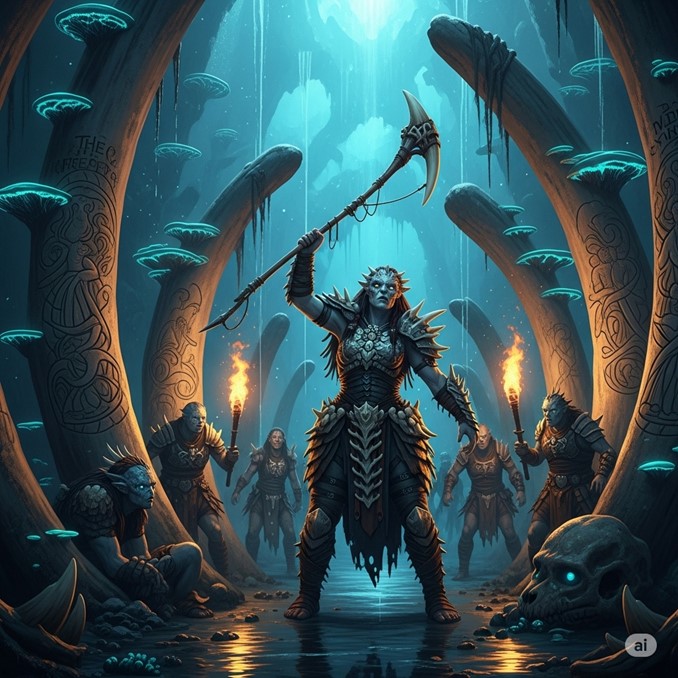
The magical power of The Great Marrow is not a force that is prayed to for intervention. It is a primal power that is claimed, harnessed, and directed by the Hunters through sheer force of will, using the bones, teeth, and horns of their kills as a focus. Their magic, like their culture, is brutal, pragmatic, and directly tied to the hunt.
Defensive Applications
The creed’s defensive magic is based on resilience, intimidation, and turning the strength of the dead against the living. All effects are channeled through their osteodontokeratic gear and the guttural chants of their “Bone-singing” skill.
- Reactive Bone-Plate: A warrior wearing armor crafted from the bones of a great leviathan can use a short, sharp chant as a reaction to being attacked. This awakens the dormant “Marrow” in the armor, causing it to momentarily harden to the consistency of magical steel or even sprout sharp, defensive spurs at the point of impact, deflecting the blow and potentially damaging the attacker’s weapon.
- The Ward of a Thousand Kills: By arranging the skulls of powerful beasts in a perimeter around a camp or territory, a Hunt-Matriarch can create a formidable psychic barrier. The ward doesn’t create a physical wall but instead projects the collective terror and predatory instincts of the slain creatures. Intruders must overcome this wave of primal fear or flee, convinced they are being stalked by unseen, monstrous phantoms.
- Wall of Chitin: A powerful Bone-singer can thrust a leviathan’s horn or tusk into the seafloor and chant a song of defense. This does not shape the earth but instead causes a jagged, razor-sharp wall of bone-like material and hardened chitin to erupt from the seabed, forming a defensive barrier that cuts and injures anyone who tries to scale it.
Offensive Applications
Offensive magic is about channeling the predatory essence of the slain beast, turning its own strengths against new prey.
- The Hunter’s Echo: When wielding a weapon crafted from a powerful creature, a Hunter can use Bone-singing to call upon the Marrow within it. For a few crucial moments, the Hunter can tap into the creature’s primal instincts, granting them a burst of its essence—the blinding speed of a great shark for a single charge, the crushing strength of a leviathan for one mighty blow, or the unerring accuracy of an abyssal predator for a single harpoon cast.
- Bone Shard Swarm: In their Ossuaries, which are littered with bone fragments, a Bone-singer is at their most dangerous. They can plunge their hands into the bone-field and, with a guttural roar, command the shards to fly forth in a deadly cloud, tearing at their enemies. Each shard is not just a projectile but carries a sliver of the hunger of its original owner.
- Phantom Leviathan: This is a terrifying power wielded only by the strongest Hunt-Matriarchs. Using the massive skull of a legendary sea monster as a focus, the matriarch can project a spectral phantom of the beast. This is not a physical construct, but an apparition of pure predatory will. The phantom cannot be physically harmed and its attacks drain the courage and will of its targets, capable of paralyzing them with supernatural terror or shattering their morale completely.
- Marrow-Drain: A forbidden and draining technique where a Hunter in physical contact with a foe can attempt to use Bone-singing to directly attack their life essence. This is not a simple life drain; it is an attempt to “crack the bone” of a living soul and draw out its strength, a painful process for both the victim and the caster.
Lament for the Wasted Kill
It is told with solemnity in the Great Ossuaries, a tale not of glory, but of a lesson carved in bone and paid for with blood. This is the story of the Leviathan-Matriarch Kethra, she whose pack was the mightiest, and whose pride was as vast as the abyssal plains.
In the days of Kethra, the Aglarr knew no fear. Her hunters were strong, their bone-armor was thick, and their harpoons, carved from the teeth of sea-drakes, never missed their mark. So successful was her pack that the great hunts became not a struggle for survival, but a sport for glory. The rituals of the Creed were observed, but their meaning was forgotten. The hunt was no longer sacred; it was a contest.
One season, Kethra and her pack hunted and killed a behemoth of the deep, a creature larger than any they had slain before. Its bones were thick as ancient trees, and its hide was a fortress. The hunt was a great victory, and Kethra’s pride was a sharp, shining thing. In her arrogance, she declared a new tradition.
“We are the Apex,” she spoke, her voice echoing in the deep. “We are not scavengers to pick at every scrap. We will take only the best. The great tusks for a new throne, the heart-meat for a feast of champions. Let the lesser creatures of the abyss have what remains.”
Her pack, fat with success and blinded by her glory, obeyed. They carved the choicest parts from the leviathan’s corpse and carried them back in triumph. And the rest—tons of meat, hide, and bone—they left to rot in the cold, silent dark of the trench. They had violated the most sacred law. They had blasphemed against the hunt through waste.
The Great Marrow, which is the primal spirit of the kill, was not honored. The essence of the great beast was not consumed and integrated into the pack’s strength. It was abandoned. And so the Marrow, which is the memory in the bone, soured in the carcass. It did not dissipate. It festered. In the lightless deep, the abandoned spirit did not fade, but curdled into a new and terrible consciousness—a consciousness of waste, of vengeance, of unending hunger.
From the rotting carcass, a new thing rose. It was not living. It was a mockery of the cycle. The great bones knit themselves back together with strands of black, spectral energy. The flesh that remained was a decaying armor. It was a Bone-Hulk, an undead leviathan animated by a spirit of pure sacrilege. It was the ghost of their wasted kill.
The Bone-Hulk began to hunt. It did not kill for sustenance. It killed to unmake. When Kethra’s hunters next went on a great hunt, the Bone-Hulk fell upon them. Their harpoons, which had slain the mightiest of beasts, shattered against its form. The creature’s touch was a blight. A warrior’s bone-armor, struck by the Bone-Hulk, would crack and turn to dust. A hunter’s own bones would ache with a deep cold, their strength draining away as if their own marrow was turning to water. The Bone-Hulk was not just a beast; it was a curse, the physical manifestation of their sin.
Kethra’s pack, once the greatest, was decimated. The hunters became the hunted. In her terror and grief, Kethra finally understood the words of the Clay-Mothers: that which is not used will be turned against you. Her pride had created a monster that her strength could not defeat.
Humbled and alone, she made a pilgrimage to the sacred site where the First Matriarch, Atla-Kai, had slain the Maw. There, among the foundations of their first city, Kethra searched for a relic of the First Hunt. She found only a small, simple shard of bone, a piece of the first leviathan’s tusk that Atla-Kai had cast aside. It was not a mighty weapon, but it was pure. It had been taken with purpose and respect, not with arrogance.
Clutching the simple bone shard, Kethra hunted the Bone-Hulk. She found it in the trench where its body had been left, now a place of decay and death. She did not attack with the fury of a matriarch, but with the grim purpose of a penitent. The Bone-Hulk’s draining aura withered her flesh, but the ancient bone-shard in her hand did not crumble, for it was born of honor, not pride.
She did not try to destroy the monster. She swam through its spectral defenses and plunged the small shard of bone into the great, empty tusk-socket on the Bone-Hulk’s skull—the very trophy she had taken and left a hole. In that moment, she was not fighting the beast, she was completing the hunt she had abandoned.
The Bone-Hulk let out a silent, soul-shattering cry. Its spectral energy vanished. The great bones, their vengeful spirit finally honored and released, fell apart and came to rest on the sea floor. The curse was broken. Kethra, her power diminished and her pack gone, returned to her people not as a great matriarch, but as a solemn teacher, forever bound to tell the story of her failure.
The Moral of the Story: The hunter who wastes the kill will be hunted by the ghost of their own arrogance.