
The Aglarr, a name that in their guttural tongue means “Those of the Crushing Deep,” are a formidable race of sentient, aquatic avatars. They are the rulers and predominant race of the island nation of Osteodontokeratic, a domain they define not by its landmass, but by the vast and dangerous waters that surround it. The Aglarr are the ultimate survivors, a race of primal hunters who have built a sophisticated culture not with stone or metal, but with the fundamental materials of life and death in the deep ocean: the bone, tooth, and horn of the great sea leviathans they hunt.
Physical Form and Sensory Traits
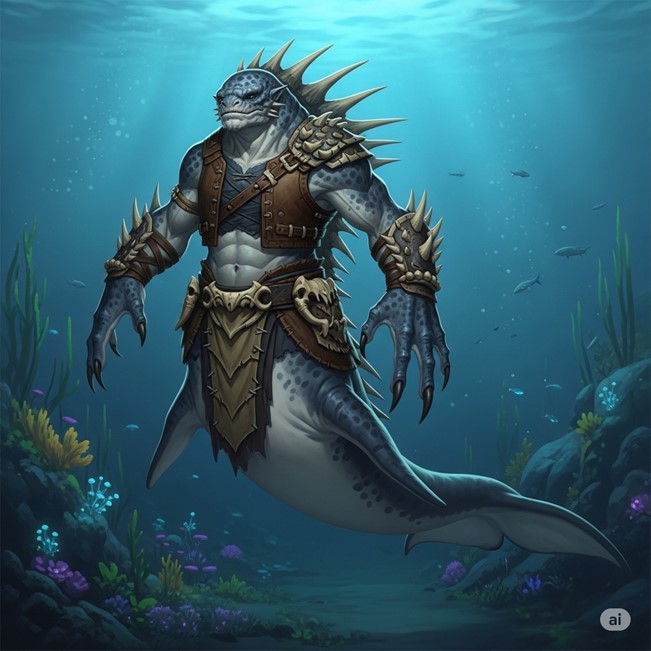
The Aglarr have a powerful, amphibious humanoid form that is brutally adapted to life in the crushing pressures of the deep sea. Their upper torso is humanoid but powerfully built, with thick, tough skin rather than scales. This skin is similar in texture to that of a shark or seal, and its coloration provides camouflage, ranging from the dappled greys of a reef to the abyssal blues and blacks of the deep. Their hands are webbed, and their knuckles and forearms feature natural, bony spurs and ridges which they often sharpen or adorn.
Their lower body is not a simple fish tail, but a long, muscular, cetacean-like fluke that provides incredible bursts of speed. A ridge of sharp, dorsal spines, reminiscent of a fish’s fin but made of solid bone, runs from the base of their skull down their spine to their tail. They breathe water through a series of gill slits on their neck and torso.
Their sensory traits are honed for underwater hunting. They have large, dark eyes capable of seeing in the near-total darkness of the abyss. Along their jawline and torso is a highly sensitive lateral line, allowing them to feel the faintest pressure changes and movements in the water around them. They also possess a form of echolocation, a trained skill of producing a series of clicks and whistles to navigate and locate prey in murky or dark conditions.
General Size
Aglarr are larger and more dense than a typical human, built to withstand the immense pressure of the deep. Adult males average between 2.1 and 2.4 meters (about 7 to 8 feet) from head to tail-tip, and weigh between 130 and 180 kilograms. The females are typically larger and more powerful, in keeping with their matrilineal society.
Body Pattern
The skin of an Aglarr is not uniform. It is covered in mottled, dappled, or striped patterns that mimic the camouflage of the ocean’s greatest predators, such as whale sharks or moray eels. These patterns are unique to each family line. The bony spurs and dorsal spines are a key part of their appearance; individuals with larger and more numerous spines are often seen as having a stronger lineage.
Life Cycle
The Aglarr are live-bearers, with females giving birth to one or two pups after a long gestation period. A newborn Aglarr is self-sufficient within hours, able to swim alongside its mother. They grow slowly, and their youth is a long apprenticeship in the arts of the hunt. Cultural adulthood is granted only after an individual successfully leads their first solo hunt against a significant deep-sea predator and crafts their first set of tools from its remains. Their natural lifespan is long, often exceeding two centuries. As with all avatars, they become sterile upon being possessed by a character’s memories.
Potential Positives and Negatives
Positives:
- They are unparalleled swimmers, capable of incredible speed and agility underwater.
- Their bodies are naturally adapted to survive the crushing pressures and freezing temperatures of the deep ocean.
- Their keen senses make them almost impossible to ambush in their native aquatic environment.
- The natural bony spurs on their bodies can be used as effective weapons even when unarmed.
Negatives:
- They are obligate water-breathers. An Aglarr cannot survive out of the water for more than a few minutes without powerful magical assistance. This is their single greatest physical limitation.
- Their size and physiology make them clumsy and ineffective if magically transported onto dry land.
Tags: Aglarr, Humanoid, Avatar, Aquatic, Merfolk-like, Osteodontokeratic, Primal Hunter, Deep Sea Dweller, Cetacean Tail, Bony Spurs, Dorsal Spines, Ruling Class, Matrilineal, Echolocation, Pressure Resistant, Water-breather, Leviathan Hunter
Specialized Item Slots Available
Aglarr gear is crafted exclusively from the remains of their prey, designed for the unique rigors of underwater combat.
- Knuckle Horns (2 Slots): These are not traditional gauntlets. The Aglarr take the sharpened teeth or horns of their prey and lash them directly onto the natural bony spurs of their knuckles, effectively creating integrated punching daggers or knuckle dusters.
- Leviathan’s Harness (1 Slot): A specialized Chest slot. This is a robust harness made of braided leviathan sinew and articulated plates of bone, designed to hold tools, carry weapons, and anchor the wearer to terrain during strong undersea currents.
- Resonance Helm (1 Slot): A unique Head slot. This is a helmet carved from the dense, acoustically-resonant skull of a great sea creature. It is designed to protect the head while amplifying the user’s echolocation clicks, allowing for more precise navigation and hunting.
Environmental Adaptability
The Aglarr are masters of aquatic environments. They are equally at home in warm, shallow coral reefs, the open ocean, and the crushing, lightless abyss. Their entire culture and biology is predicated on life beneath the waves.
Other Information Important to this Race
The Aglarr rule the nation of Osteodontokeratic from below. Their capital city is not on the island’s surface but is a vast metropolis built into a deep-sea trench, carved from bone and coral. Their “hunter-gatherer” culture is applied to the ocean’s megafauna; they live in nomadic packs that follow the migratory patterns of leviathans. Their society is strictly matrilineal, with the most powerful and successful huntress, the Leviathan-Matriarch, leading the ruling family. They view the “air-breathers” of the surface world with a mixture of detached curiosity and pity, sometimes trading priceless materials from the deep (pearls, leviathan bone, rare corals) for items they cannot craft themselves.
First Hunt of Atla-Kai
It is sung in the silent deeps, in the echoes that bounce from the walls of bone-carved cities, the story of the time before the Aglarr were hunters. The telling says that in the beginning of days, the Aglarr were a scattered people, hiding in the dark crevices of the sea floor. They were the scavengers, the hiders, the ones who fled from the shadows of the great leviathans.
In this age of fear, there was one shadow greater than all others. It had no proper name, for to name it was to invite its attention. It was called only the Maw, the Unseeing Deep, a beast of such size that it displaced the currents of the abyss when it moved. Its passing was not marked by a sound, but by the sudden and absolute silence as all life fled or was consumed into its gullet, a darkness from which not even light returned. The Aglarr lived their lives by the one great rule: when the silence comes, you do not swim, you do not breathe, you become a stone until it passes.
There was a young female named Atla-Kai. Her pack hid in a great, hollowed-out coral formation. One cycle, the silence came. It was deeper and longer than any before. Atla-Kai, young and small, pressed herself into the smallest crack she could find. She watched as the shadow of the Maw fell over their home. It did not hunt; it simply drifted, and the coral reef that had been their sanctuary for generations cracked, groaned, and was inhaled into the darkness. Her pack, her family, all were gone, returned to the crushing pressure in the belly of the beast.
When the currents returned to normal, Atla-Kai emerged alone into the empty water. The poorly translated texts say that her heart was not filled with fear or sorrow, but with a cold and hard purpose, like a stone from the abyss. She would no longer be the hunted. She would no longer hide.
She swam for many days, seeking not a new hiding place, but a weapon. She came upon a leviathan’s boneyard, a place where the Maw had fed and left the remains. She saw the colossal skeleton of a lesser sea dragon. For a full turning of the season, Atla-Kai did not hunt for food. She hunted for knowledge. She studied the great bones. She learned how they joined, where they were strongest, and where they were weak. Using a sharp shard of volcanic rock, she worked the bone. From a great tusk, she carved the first harpoon, its point harder than any spur on her own body. From the beast’s shoulder plate, she fashioned a shield. From its smaller ribs and sinew, she made the first suit of armor. She, Atla-Kai, was the first to practice the Osteodontokeratic way. She was the first to wear the strength of her fallen enemies.
Armed, Atla-Kai did not seek the Maw. That was a fool’s hunt. Instead, she began to hunt the other great beasts of the sea, the very ones her people had hidden from. She stalked the armored Dunkleosteus and learned how to pierce its shell. She stalked the great sharks and learned their patterns. With every kill, she took a tooth, a bone, or a horn. Other Aglarr, living in fear, saw her. They saw her clad in the remains of their predators. They saw she did not hide. Drawn by her cold purpose, they joined her, and she taught them what she had learned. She armed them with the bones of their former fears, and her pack became the first great hunting party.
Finally, after many years, when their armor was thick and their harpoons were many, Atla-Kai declared the time had come. They would hunt the Maw.
They tracked the great beast not by sight, but by the silence it left in its wake. They found it sleeping in the deepest trench, a place of no light and crushing pressure where none had dared to swim. The fight was not one of brute strength. Atla-Kai and her hunters were but minnows to this beast. They fought with knowledge. They used their echolocation, which they had trained for the hunt, to map the beast’s form in the darkness. They darted in, striking not at its hide, but at the softer flesh around its many gills, using the hit-and-run tactics of the shark. They used the canyon walls, luring the Maw into narrow passages where its great size was a weakness, not a strength.
For a day and a night, they fought in the crushing black. The Maw, in its rage, swallowed whole sections of the trench, but the hunters were too swift. At last, Atla-Kai saw her moment. The beast, enraged and confused, reared its great head. From studying the bones of its lesser kin, she knew there was a soft spot, a place where the skull did not fully join, just behind its unseeing eyes. With all the force of her powerful tail, she drove her great tusk-harpoon, the first weapon ever made, into that single, vital point.
The Maw did not cry out. It simply stopped. And the silence it created in its death was greater and more final than any it had made in its life.
The Aglarr were no longer the hiders. They were the hunters. With the passing of the great fear, they became the masters of the deep. They took the colossal ribs and jawbone of the Maw itself, and from them, they carved the foundations of their first great city in that deep trench. Atla-Kai, she of the first harpoon, she who wore the bones of her enemies, became the first Leviathan-Matriarch, and her daughters, and their daughters after them, have ruled the crushing deeps ever since.
The Moral of the Story: True strength is not found in hiding from your fears, but in taking them apart, piece by piece, and wearing them as your armor.