
The Qillqaruna, which translates from their native Qillqan as “Inscribed People,” are a race of sentient avatars who are the founders and marginally predominant race of the island nation of Nazca. Their identity, biology, and culture are inextricably linked to the principles of inscription and the flow of magic, making them the living embodiment of the glyph-based power that defines their homeland. The royal family of Nazca is composed entirely of Qillqaruna, and their lineage is traced through the complexity and distinction of their unique body patterns.
Physical Form and Sensory Traits
The Qillqaruna have a humanoid form that is elegantly adapted to an arid environment. They are typically lean and well-muscled, with a wiry strength rather than bulky power. Their skin tones range from a warm tan to deep, rich browns, and their hair is most often black or dark brown, thick and straight. Eye colors are almost universally dark, ranging from shades of brown to a piercing, onyx-like black.
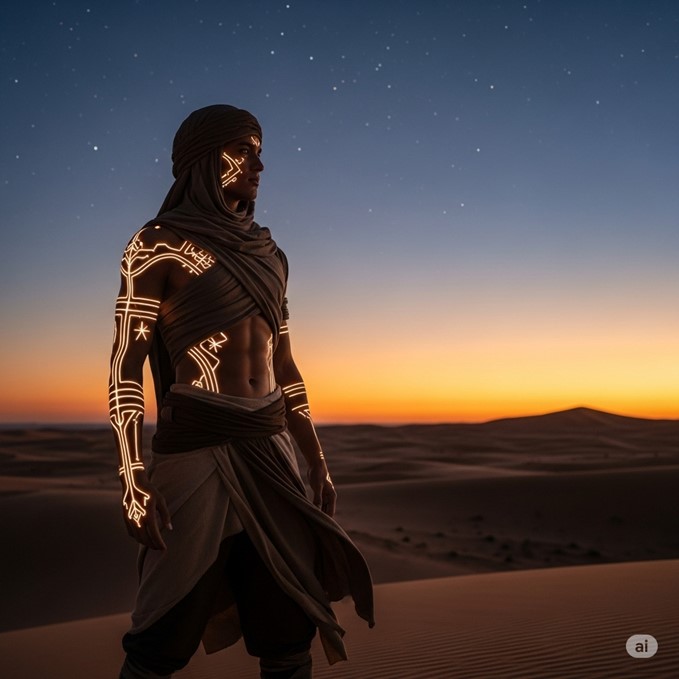
Their most defining feature is that they are born with intricate, bio-luminescent patterns on their skin. These are not tattoos, but natural, genetic markings that resemble the complex geoglyphs and magical circuits fundamental to Nazcan culture. These lines are typically a shade darker or lighter than their base skin tone and are smooth to the touch. When a Qillqaruna channels magical energy through worn or held items, these patterns can pulse with a soft, internal light, the color of which often corresponds to the type of magic being used.
Their sensory traits are subtly enhanced for their environment. They possess exceptional long-distance vision, allowing them to spot details across wide, sun-drenched plains. They have a high tolerance for heat and bright light. While they have no innate magical senses, they possess a highly developed, instinctual knack for pattern recognition. This makes them naturally gifted at deciphering complex designs, identifying flaws in inscribed magical circuits, and navigating by the stars.
General Size
Adult Qillqaruna males typically stand between 1.7 and 1.9 meters tall, with a weight ranging from 65 to 85 kilograms. Females are slightly shorter on average, ranging from 1.6 to 1.8 meters in height, and weigh between 55 and 75 kilograms. Their lean builds are deceptive, hiding a dense musculature and a high degree of physical endurance.
Body Pattern
The skin patterns of a Qillqaruna are as unique as a fingerprint. They cover the entire body, with the most dense and complex markings appearing on the back, shoulders, and forearms. These patterns are inherited but manifest in unique combinations for each individual, meaning a child’s patterns will have thematic similarities to their parents’ but will be entirely their own.
The patterns of the ruling family are said to be the most complex and symmetrical, often containing rare and powerful glyph forms that are a mark of their direct lineage. The patterns become more defined and can grow in complexity as an individual gains experience and advances in tier, reflecting the avatar’s increasing attunement to more powerful magical gear.
Life Cycle
Qillqaruna are born after a gestation period of approximately ten months. Infants are born with very faint, simple line patterns on their skin, which darken and develop in complexity as they mature, reaching their full initial intricacy by adolescence. A significant rite of passage in their culture involves an adolescent inscribing their first permanent magical item, an act that is believed to fully awaken their “inner inscription.” They reach full physical maturity around the age of 20 and have a natural lifespan of 90 to 120 years. As with all avatars, once possessed by a character’s memories, they become sterile.
Potential Positives and Negatives Due to Their Physical Form
Positives:
- The intricate patterns on their skin provide excellent natural camouflage in the rocky, arid, and scrubland environments of Nazca.
- Their physiology grants them remarkable stamina and resistance to dehydration and heat-related ailments.
- The soft glow of their patterns when using magic can be used to signal others silently in low-light conditions or to intimidate foes.
- Their innate skill for pattern recognition gives them an advantage when learning skills related to engineering, cartography, astronomy, and glyph-based magic.
Negatives:
- Their distinct patterns make them highly conspicuous in environments foreign to Nazca, such as dense jungles or urban centers of other nations.
- Their adaptation to dry heat makes them more susceptible to extreme cold and damp conditions, which can cause their skin to become painfully dry and their joints to ache.
- The bio-luminescent nature of their skin patterns makes it difficult for them to hide completely in the dark if they are actively using magical gear.
Tags: Qillqaruna, Humanoid, Avatar, Nazca, Desert Dweller, Arid Adapted, Glyph-Marked, Bioluminescent, Living Conduit, Inscribed Skin, Ruling Class, Royal Lineage, High Stamina, Heat Resistant, Pattern Recognition, Wiry Build, Geomancer
Specialized Item Slots Available
Due to their unique physiology and the way their skin patterns interact with magical items, the Qillqaruna have access to several specialized item slots that other races may not.
- Arm Glyphs (2 Slots): These slots are for items worn on the forearms. Rather than standard bracers, these slots are designed for thin, flexible bands of metal or leather that are inscribed to precisely follow the avatar’s natural skin patterns, allowing for more efficient magical conduction.
- Mantle of the Inscribed (1 Slot): This is a specialized Back slot for cloaks, capes, or mantles that have been tailored with patterns that complement the wearer’s own back and shoulder glyphs. Such an item can create a larger, more powerful synergistic magical circuit.
- Focus Brow (1 Slot): A unique Head slot, separate from a helmet or circlet slot. This slot is for a small, singular item like a focus gem, a metal plate, or even a painted glyph applied directly to the forehead, designed to aid in concentration for activating the Mind’s Eye or casting complex spells.
Environmental Adaptability
Qillqaruna are masters of survival in hot, arid, and semi-arid environments. They are well-suited to deserts, savannahs, rocky badlands, and plateaus. Their bodies naturally conserve water more efficiently than those of many other races. They would be at a disadvantage in polar, tundra, or consistently cold and wet climates.
Other Information Important to this Race
The Qillqaruna believe their bodies are a living extension of the land and a physical manifestation of the Qillqan language. They view their skin patterns as a sacred text that charts their destiny and their connection to the gods. Proper care for the skin is a cultural imperative, with many individuals using special oils infused with herbs to keep their patterns vibrant and healthy. When a Qillqaruna avatar is possessed by a character’s memories, the character gains the avatar’s body, patterns and all, and must learn to live with the cultural significance and physical realities of being one of the Inscribed People.
Aran and Silence of the Sand
It is told, from tablets of clay broken and remade, that there was a time when the land of Nazca fell sick. In those days, the sun did not give life but took it, and the sky became a bowl of brass without pity. The great lines upon the land, which were the writing of the gods and the source of order, began to fade into the dust. The sand fell silent, and did not speak to the conduits worn by the people. The magic of the gear grew weak, for the ground which was its greater partner had forgotten its own name.
The Inscribed People, the Qillqaruna, saw this fading upon the land and felt it in their own skin. The patterns that marked them, the bright lines of their lineage and their soul’s shape, grew dim. They were a people of the sun, but now the sun was their enemy. They were a people of the patterns, but the patterns were vanishing.
In the high city, the rulers, the family of the Glyphed Throne, gathered. They brought forth their most powerful items, circlets that held the memory of starlight and bracers that knew the songs of deep earth. Yet their efforts were like whispers in a great wind. The land would not answer. The magic would not hold. Despair was a dry dust in the mouths of all.
But there was one of the royal line, young Aran, who was not yet a great ruler and held no mighty gear of office. His only distinction was the pattern upon his own skin. From his birth, his lines were called the Unbroken Line, for they flowed from his brow to his feet without a single break, a sign of great and strange destiny. While the glyphs of others grew faint, his own seemed to hold their light, a stubborn ember in a dying fire.
Aran watched the elders and their failing rituals. He saw them try to command the land with the power of their items, but he felt this was a mistake. One does not command a dying parent, he thought. One offers them water. He went to the chamber of scrolls, a place of deep dust and fading knowledge. He looked upon the ancient tablets, those poorly copied from a time even before. He read, with his great skill for seeing patterns where others saw only cracks and dust, a fragment of a story. It spoke of a place, the Navel of the World, the Heart-Chamber, where the first gods had placed a great stone to teach the land how to be. The translation was bad, and the words were confused. It said the stone was a seed, and also a memory, and also a thirst.
And so Aran, he of the Unbroken Line, went before his king. He spoke not of power, but of pilgrimage. He would seek this Heart-Chamber. He would not take with him a great host, nor the mighty gear of the treasury. He would wear only simple leather and carry a water skin, and on his arms he would wear the plainest copper bracers to guide his path. For he believed the answer was not in what he could bring to the Heart-Chamber, but what the chamber could bring to him.
Great was the doubt, but greater was the despair, and so he was allowed to go.
Aran walked into the sun’s anger. He crossed the Ashen Wastes, where the heat was a solid thing that beat upon the soul. The leather of his sandals cracked, but his skin, the skin of the Qillqaruna, did not. He felt the sun not as an enemy, but as a forge, and the heat seemed to burn away the despair clinging to his spirit, leaving only the hard purpose beneath.
He came then to the Whispering Canyons, a maze where the fading magic had curdled. The rock walls showed false paths, and the air spoke with the voices of lost travelers. Many had entered this maze and never left. Aran did not trust his eyes, for they could be lied to. He did not trust his ears, for they could be deceived. He closed them, and trusted the patterns. With his innate skill, he read the true lines of the rock, the ancient grammar of the stone itself. He saw where the patterns were twisted into lies, and where they flowed with truth. He walked the path of the true lines, and the maze could not hold him.
At last, he came to a hidden valley, and in its center, a single, monolithic tor of black stone that drank the light. This was the Heart-Chamber. As he entered the darkness within, a shape rose from the dust and shadows. It was a guardian, a great construct of stone and forgotten words. It was not living, but it was not dead. It was the thought of the mountain given form, and its purpose was to protect the Heart-Stone. But with the land’s magic broken, the guardian was confused. It saw Aran as another broken thing, another error in the pattern, and it moved to erase him.
Aran knew his simple bracers held no power that could challenge such a being. To fight was to be ground into dust. He looked upon the construct and saw the fading, fractured glyphs that covered its form. It was suffering the same sickness as the land. It was not a monster. It was a prayer that had forgotten its words.
In that moment, Aran understood the final, confusing line from the ancient text. The stone was a thirst. It was not a source of power to be taken, but a vessel that needed to be filled.
He did a thing no Qillqaruna had done in a time beyond memory. He unclasped his copper bracers, the very tools that focused his magic. He stood bare before the guardian and the Heart-Stone, with no gear between him and the world. He was vulnerable, a circuit with no machine. He approached the great, dark Heart-Stone that pulsed with a faint and dying rhythm. He placed his bare hands upon it.
And he gave the stone his own pattern.
He did not push. He did not command. He simply stood, a conduit of last resort, and let the stone read the Unbroken Line upon his skin. He offered his own life, his own light, his own memory of the true shape of things, to the thirsty stone. His patterns began to burn, not with the soft glow of channeled magic, but with the searing white fire of his own life force. It was a pain beyond all telling, but he did not pull away. The Unbroken Line upon his body became the template, the memory that the land had lost.
The light flowed from his skin into the Heart-Stone. The stone, which had been a dull void, began to pulse with a deep and vibrant light. The light flowed out from the stone, not through the air, but through the bedrock of the world. Across the nation of Nazca, a tremor was felt. From the ground itself, the great geoglyphs, the writings of the gods, began to glow anew. They drank the light from the Heart-Stone and blazed with power and purpose. The land began to hum.
The guardian construct stopped its advance. The fractured lines on its body sealed and shone with a gentle, amber light. It looked upon Aran, and in a voice like stone grinding on stone, it spoke a single word of the Old Tongue, a word of gratitude. Then it settled back into the earth, its long duty done.
Aran, drained but alive, his own patterns now brighter and more vivid than any had ever seen, walked out of the Heart-Chamber. As he did, the sky, which had been brass for so long, turned a deep and glorious grey. The first drop of rain fell upon his forehead. The Silence of the Sand was over. The land began to sing again.
The Moral of the Story: When the tools of power fail, remember the power that lies in the shape of who you are.