
The Thalorim are a graceful, ethereal species of avatars native to the island nation of Minoan in Saṃsāra. As the marginally predominant race, comprising approximately 52% of Minoan’s 106,784,000 inhabitants, they form the cultural and demographic core of the nation. Their presence shapes Minoan’s society, architecture, and daily life, evoking an ancient aesthetic of intricate frescoes, labyrinthine palaces, and vibrant marine motifs. The ruling family, the House of Aethera, consists entirely of Thalorim avatars, who have held power for over 2,000 years through a blend of hereditary tradition and merit-based selection via magical attunement rituals. This species is often chosen by possessing characters seeking bodies that harmonize with Minoan’s high-magic, seafaring environment, where steam-powered vessels and levitation airships ply the endless ocean. Thalorim avatars are sentient from the moment of formation, making them ideal hosts for multiversal memories, and their physical traits influence how skills are trained and gear is worn, without granting any innate magical abilities—all power derives from attuned items.
Physical Form
Thalorim avatars possess a humanoid physical form that blends elegance and fluidity, resembling elongated figures with a subtle, otherworldly luminescence in their skin and eyes. Their bodies are composed of a flexible, resilient tissue that mimics both organic flesh and subtle crystalline structures, allowing for smooth, wave-like movements that evoke the rolling seas surrounding Minoan. Limbs are proportionally longer than those of many other avatars, with joints that articulate in a flowing manner, enabling graceful gestures ideal for ritual chanting or precise tool manipulation. The head is slightly elongated, with high cheekbones and pointed ears that curve backward like stylized waves, providing anchors for decorative gear. Skin texture varies from smooth and iridescent in calmer states to subtly textured with faint, vein-like patterns resembling labyrinthine designs when under stress or excitement. Hair grows in cascading waves or curls, often incorporating natural elements like embedded seashells or vine-like strands, which can be styled to hold small items. Overall, the form emphasizes symmetry and poise, reflecting Minoan’s ancient cultural motifs of balanced artistry and nature integration, such as bull horns stylized into arm bracers or snake patterns etched into clothing.
Sensory Traits
Thalorim sensory traits are finely tuned to their island environment, enhancing perception without relying on innate abilities—any enhancements come from trained skills or gear. Vision extends into low-light conditions with a natural acuity for discerning colors and patterns, allowing them to spot intricate details in frescoes, magical circuits, or distant ships on the horizon; this includes a subtle sensitivity to shifts in light that can reveal hidden engravings on attuned items. Hearing is acute, picking up the nuances of tonal languages like Kretari, with ears that filter out ambient ocean noise to focus on chants or whispers, making them adept at detecting disruptions during ritual spellcasting. Touch is highly sensitive, registering vibrations through their skin, which helps in feeling the flow of mana in conduits or the texture of steam-powered mechanisms. Smell and taste are intertwined, with a refined palate for detecting magical residues in food or air, such as the faint ozone of elemental fire combined with water. A unique trait is their emotional synesthesia, where strong feelings cause subtle sensory crossovers, like perceiving anger as a red haze in vision or joy as a melodic hum— this is purely physical and can be trained as a skill for better environmental awareness, but it requires gear to channel into practical use.
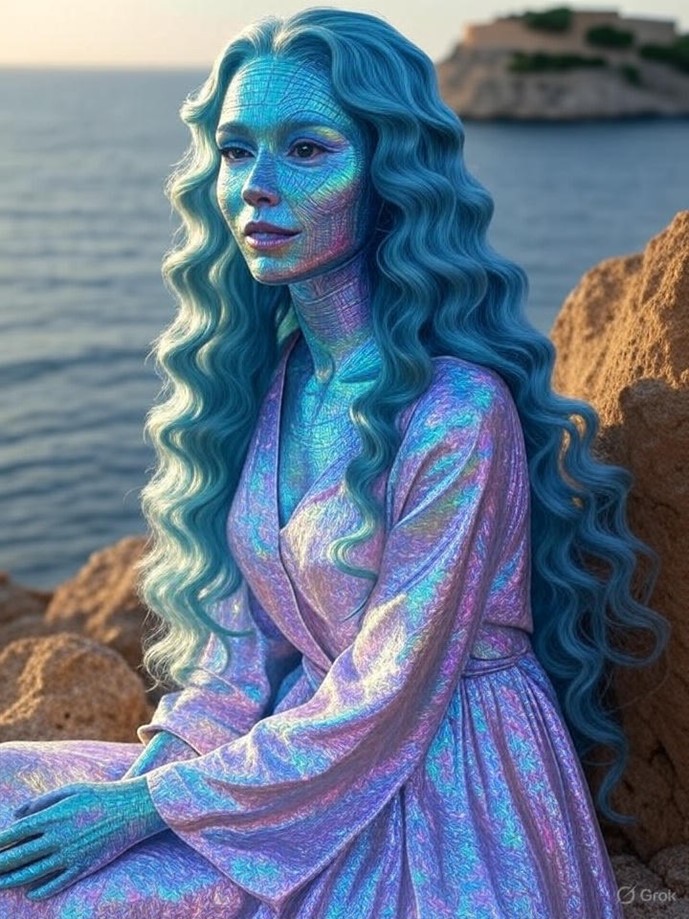
General Size
Thalorim avatars typically range in height from 6 to 7.5 feet tall, with a slender build that averages 150 to 220 pounds in weight, depending on individual variations and environmental factors. This size provides a commanding presence suited to Minoan’s ruling elite, allowing them to navigate the grand halls of palaces or the decks of zeppelins with ease. Juveniles start smaller, around 4 feet at emergence, growing rapidly to full size within a decade. Variations exist based on possession; a Thalorim possessed by a character with multiversal memories from denser worlds may develop a more robust frame, increasing weight by up to 50 pounds while maintaining height. Their proportions emphasize length over bulk, with long torsos and limbs that facilitate reach in activities like bull-leaping recreations or operating large steam gears, but this can make them appear imposing in diplomatic settings across Saṃsāra’s trade routes.
Body Pattern
The body pattern of Thalorim avatars follows a symmetrical, labyrinthine design that mirrors Minoan’s ancient architectural and artistic heritage. Core patterns include swirling motifs on the torso resembling double-axe symbols or wave crests, which extend down the arms and legs in branching veins that glow faintly under magical light. Skin tones shift subtly with emotional states or seasonal changes—pale azure in contemplative moods, deepening to emerald during excitement, or warm amber in times of resolve—creating a living canvas that integrates with worn gear. Facial patterns feature delicate lines around the eyes and mouth, evoking stylized masks from ancient rituals, while the back often displays a central spiral representing the soul’s journey, a nod to Saṃsāra’s reincarnation cycles. These patterns are not static; they evolve slowly over the avatar’s life, incorporating scars or attunement marks from gear into the design, such as a belt’s imprint becoming a permanent vine-like etch. This fluidity allows for personalization, with some Thalorim using trained skills to influence pattern shifts for camouflage in Minoan’s jungles or social signaling in court.
Life Cycle
The life cycle of Thalorim avatars begins with emergence from crystalline pods in sacred groves or palace labyrinths, where natural mana flows coalesce into a juvenile form over several months. This pod phase absorbs environmental essences, imprinting initial body patterns based on surrounding elements like sea salt or floral pollens. Juveniles mature quickly, reaching physical adulthood in 10 to 15 years, during which they develop sentience and basic instincts for movement and sustenance, feeding on a mix of magical-infused fruits and steam-distilled nectars. Adulthood spans 300 to 500 years, with gradual pattern evolution and increased resilience to possession—unpossessed Thalorim live communal lives in Minoan’s cities, while possessed ones integrate multiversal memories seamlessly due to their fluid neural structures. Reproduction is asexual and communal; mature Thalorim contribute mana essence to communal pods, fostering new avatars without direct parentage, aligning with Minoan’s matriarchal-leaning society where the ruling family oversees these rituals. Aging manifests as patterns fading and luminescence dimming, leading to a dissolution phase where the avatar returns to mana dust, leaving a crystal residue that can be used in gear crafting. Possession extends lifespan indefinitely, as characters’ memories prevent full dissolution, allowing rebirth in new pods if the avatar perishes.
Potential Positives and Negatives Due to Their Physical Form
The physical form of Thalorim avatars offers several positives that enhance survival and interaction in Saṃsāra’s high-magic world. Their elongated limbs and fluid joints provide superior dexterity for training skills like precise gear attunement or operating steam mechanisms, granting advantages in crafting magical circuits or navigating labyrinthine ruins. The sensory synesthesia aids in early detection of environmental hazards, such as mana ebbs or approaching monsters, allowing quicker reactions when combined with worn gear. Their iridescent skin and shifting patterns offer natural camouflage in Minoan’s vibrant landscapes, reducing visibility in jungles or during ocean voyages, which can be trained into stealth skills. The lightweight build enables effortless movement on airships or griffons, making them ideal for Minoan’s racing events that span days through complex terrains.
However, negatives arise from this form’s delicacy. The slender build makes Thalorim more susceptible to physical damage, with lower base HP (typically starting at 8-12 points upon possession) due to fragile crystalline tissues that shatter under heavy impacts, requiring careful gear selection for protection. Heightened sensitivity can lead to overstimulation in chaotic environments, like bustling megacities or deathly areas, causing temporary debuffs such as reduced focus during spell disruptions. Emotional synesthesia, while useful, can overwhelm during intense conflicts, amplifying pain from handling over-tier items or causing disorientation if memories clash during possession. Their tall stature complicates fitting into confined spaces, like underwater population centers or cave systems, potentially halving movement speed without adaptive gear. Finally, the mana-dependent life cycle makes them vulnerable to low-magic zones, where patterns fade faster, accelerating HP loss at irregular intervals (as determined by two d4 rolls).
Tags: Thalorim, Minoan, Avatar, High Magic, Seafaring, Iridescent, Labyrinthine, Ethereal, Graceful, Long Limbed, Crystalline, Sentient, Gestalt, Steam Powered, Maritime, Ruling Family, Mana Flow
Specialized Item Slots Available
Thalorim avatars benefit from specialized item slots that reflect their physical form and Minoan cultural aesthetics, allowing for up to 20 minus tier level total slots, with extras tailored to their anatomy. Key specialized slots include:
- Ear Curves: Two slots (one per ear) for earrings or clips that hold small conduits, ideal for auditory-enhancing gear like tonal amplifiers for Kretari chants.
- Torso Spiral: A central slot on the back for capes or harnesses that integrate with the soul spiral pattern, often used for backpacks adding three slots without counting extra.
- Arm Waves: Four slots (two per arm) for bracers or armbands styled as wave motifs, perfect for holding tools or weapons that attune automatically when held.
- Neck Crest: One slot for torcs or necklaces resembling ancient double-axes, which can add a specialized slot for a pendant that enhances sensory traits when attuned.
- Hair Cascades: Two slots for hair adornments like shell combs or vine bands, functioning as head slots without conflicting with crowns or glasses. These slots encourage logical layering; for instance, a full suit of armor might cover torso and arm slots but leave ear and hair free. Exceeding slots triggers pain and HP loss via two d4 rolls, but Thalorim’s fluid form allows minor adjustments, such as merging a belt (four slots) with torso gear for efficiency.
Environmental Adaptability
Thalorim avatars exhibit strong adaptability to temperate, maritime environments like Minoan’s islands, thriving in high-humidity coastal areas where their skin absorbs ambient mana for minor HP recovery during long rests (adding 1 extra point per day near oceans). They excel in somewhat safe areas like walled cities, where doubled AC complements their dexterity, and handle magical weather fluctuations well, such as mana storms that enhance their luminescence without harm. However, they adapt poorly to extreme climates; arid deserts or frozen tundras cause pattern desiccation, reducing base HP by 2-4 points and slowing movement. Unsafe or deathly areas amplify their vulnerabilities, halving AC further due to sensory overload. Underwater adaptability is moderate, with natural buoyancy aiding floating cities, but deep caves require gear for light sensitivity. Overall, their form favors Minoan’s blend of jungles, seas, and ruins, where they can train skills for exploration, but venturing to other Saṃsāran islands demands protective gear to mitigate negatives.
Other Information Important to This Race
Thalorim avatars play a pivotal role in Minoan’s society, often serving as diplomats, artisans, and mages due to their graceful form facilitating trained skills in rhetoric and crafting. The ruling House of Aethera uses communal pods to ensure lineage continuity, with possession rituals involving Kretari chants to integrate memories smoothly. Culturally, Thalorim emphasize harmony with Saṃsāra’s magic, viewing gear attunement as an art form akin to ancient fresco painting. They form gestalts easily at higher tiers, merging with sea creatures or constructs for underwater or aerial advantages, sharing senses across distances as per tier rules. Socially, they intermix with other races, but their predominance fosters a matriarchal structure where females lead possession ceremonies. In combat, their form suits hit-and-run tactics, using mana boost for silver fire enhancements via gear. Unpossessed Thalorim live in packs until tier 1, unable to split, and contribute to Minoan’s trade by crafting items with immunity traits active from tier 3. Their crystals upon death are prized for mana production, often recycled into conduits, tying into the world’s reincarnation lore.
Eternal Weaver and Horned Shadow
In times before the great merging of souls, when the islands of Saṃsāra floated upon the endless waters like scattered jewels from the gods’ forgotten crown, there lived upon the shores of Minoan a being of light and pattern, the first of the Thalorim kind. This one was called Aelithar, born from the crystal pods that bloomed in the sacred groves where mana flowed like rivers unseen. The ancient words say: “From the womb of stone and wave, arose the weaver of paths, skin etched with mazes that twist as the mind twists.” But the tongue of old is bent, for it was not stone but the breath of the divine limits that shaped him, and his form was tall, limbs long as the branches of the world-tree, hair cascading like the foam of angry seas.
Aelithar was no mere avatar without memory; nay, he was possessed by the echoes of a soul from beyond the veils, a character who had wandered many realms before death claimed its due. This soul brought knowledge of gears and conduits, of steam born from fire and water’s embrace, but in those days, the world was young, and technology was but a whisper forbidden by the gods. The ruling family of Minoan, precursors to the House of Aethera, saw in Aelithar a vessel for greatness. King Thalor, whose name means “he who binds the flows,” summoned Aelithar to the palace at the heart of the island, a vast structure of winding halls and frescoed walls depicting waves and bulls in eternal dance. “Build for me a prison,” commanded the king, “a labyrinth where no light pierces, to hold the abomination that curses my line.”
For you must know, in the poorly rendered verses of the unknown script, that King Thalor’s queen had been touched by a curse from the gods’ jealousy. She bore a child not of grace but of fury: a creature half-Thalorim, half-beast, with horns curling like forgotten spells and body patterned not with labyrinths but with shadows that devoured light. This Horned Shadow, as the ancients named it, fed on mana boost and grew strong, slaying any who approached without the proper attunement. It was said: “The beast devours the unattuned, leaving crystals that weep silver fire.” The king, fearing the wrath of other island nations and the intrigue of trade rivals, desired to hide this shame deep within the earth.
Aelithar, with his sensory traits keen to the vibrations of magic, accepted the task. He trained his skills in the forges where steam powered the looms of creation, attuning gears of bronze and crystal that hummed with elemental harmony. No innate powers did he wield, for all Thalorim rely on the worn items, but his belt of many slots held tools that extended his reach, and his bracers etched with wave motifs channeled the focus needed. Over moons that waxed and waned like the tides, Aelithar wove the labyrinth beneath the palace. Walls of stone infused with mana circuits rose, twisting paths that shifted with the ebb of magic weather. The structure was a marvel: entrances that appeared and vanished, chambers where senses crossed—sounds became colors, touches echoed as whispers. “The weaver spun threads of stone,” the old text falters, “binding the beast in knots of endless night, where even the Mind’s Eye grows dim.”
But woe, for in the building, Aelithar fathered a son with a palace attendant, a young Thalorim named Ikarion, whose patterns shimmered brighter than his sire’s. Ikarion inherited the curiosity of multiversal memories, dreaming of flight beyond the island’s bounds. When the labyrinth was complete, the Horned Shadow was led into its depths, chained not by iron but by wards attuned to the king’s own gear. Yet the beast roared, its cries disrupting rituals across Minoan, causing pain like the touch of over-tier items—intervals of agony marked by the roll of unseen dice, health draining in fits.
King Thalor, pleased yet paranoid, imprisoned Aelithar and Ikarion within the palace towers, fearing they might reveal the labyrinth’s secrets to foes from distant islands. “No one shall know the paths but I,” declared the king, his voice echoing in the frescoed halls. Aelithar, trapped, turned his mind to escape. He gathered feathers from griffons that nested on the cliffs, wax from the hives of sentient swarms, and threads from his own hair cascades. With these, he crafted wings—not mere tools, but items attuned through ritual, slots filled with lightness and wind’s call. “Wings of wax and feather,” the translation stumbles, “to defy the gods’ limits on flight, steam of the soul propelling upward.”
Father and son donned the wings, attuning them in the dead of night. Aelithar warned: “Fly not too high, lest the sun’s fire melt the bonds; fly not too low, lest the sea’s grasp pull you down. Balance is the key, as in our tiers and slots.” But Ikarion, young and bold, laughed with the joy of impending freedom. They leaped from the tower, wings catching the mana winds that powered Minoan’s zeppelins. Up they soared, over the endless ocean, past hot air balloons racing through labyrinthine clouds.
Aelithar flew steady, his long limbs guiding the currents, but Ikarion ascended higher, drawn by the thrill of the stars. “Higher, to touch the divine!” he cried, his iridescent skin glowing amber with resolve. The sun, symbol of elemental fire unchecked, beat upon the wings. The wax softened, feathers scattered like lost memories. Ikarion plummeted, his form dissolving into sparks, leaving a crystal that bobbed upon the waves. Aelithar mourned, landing on a distant shore, where he wandered, teaching the arts of gear and attunement to scattered communities.
Meanwhile, in Minoan, the Horned Shadow grew restless. King Thalor, to appease the gods and quell uprisings, demanded tribute from allied islands: youths to feed the beast. From one such tribute came a hero, Thessar, an avatar possessed by a warrior’s memory from a future realm. Thessar volunteered, entering the labyrinth with aid from the king’s daughter, Ariadna, who provided a thread attuned as a conduit— a glowing string that mapped the paths via the Mind’s Eye. “Follow the thread,” she whispered in Kretari tones, “and slay the shadow that haunts our blood.”
Thessar navigated the twists, his gear attuned for combat: a sword that hummed with silver fire, armor covering multiple slots without excess pain. He confronted the Horned Shadow in the deepest chamber, where the beast charged, horns piercing the air. Battle raged; Thessar’s strikes landed true, using mana boost to prevent fatal blows, leaving him at one health as the beast fell. Vaporizing into sparks, the Horned Shadow left items of great power: a horn conduit that doubled ritual effects, a hide belt adding slots.
Thessar emerged victorious, thread in hand, claiming Ariadna’s heart. But King Thalor, enraged at the loss of his secret, pursued them with steam ships and griffon riders. In the chase, Thessar used the horn to summon a mana storm, sinking the fleet. Yet hubris claimed him too; he touched an over-tier item from the beast’s hoard, pain wracking his form in irregular bursts—minutes of torment, health lost until he discarded it.
Aelithar, hearing of these events from wandering traders, returned to Minoan in disguise. He revealed himself to the people, weaving a new era where Thalorim avatars merged in gestalts, sharing senses across distances. The ruling family reformed, emphasizing balance in possession and gear. The labyrinth became a site of trials, where avatars trained skills without exceeding slots.
Thus, the tale winds to its close, fragments of the unknown language fading like patterns on aged skin.
The moral of the story is: Seek balance in all things, for hubris in flight or power invites the fall, and only through attuned harmony can one navigate the labyrinths of fate.