
The primary religion practiced in the island nation of Minoan on Saṃsāra is known as the Cult of the Eternal Labyrinth, a faith that weaves together themes of cyclical renewal, magical harmony, and the intricate paths of fate. This religion is followed by slightly over half of Minoan’s population of 106,784,000, encompassing approximately 55 million adherents who integrate its teachings into daily life, governance, and magical practices. The Cult emphasizes the divine oversight of mana flows, attunement to gear, and the balance between possession and avatar autonomy, reflecting Minoan’s cultural heritage of maritime exploration, labyrinthine architecture, and ritual performances. Temples, often built as sprawling palace complexes with winding corridors and open courtyards, serve as centers for communal rituals where adherents attune items in honor of the deity, train skills through symbolic trials, and engage in bull-leaping contests that symbolize overcoming life’s mazes. The faith’s influence permeates Minoan’s society, from the ruling House of Aethera’s divine mandates to the trade networks where symbols of the Cult are etched into steam-powered vessels and airships.
Deity: Potnia Labyrinthia
The central deity of the Cult of the Eternal Labyrinth is Potnia Labyrinthia, revered as the supreme goddess who embodies the weaving of destinies, the cycles of reincarnation, and the guardianship of magical conduits. Potnia Labyrinthia is depicted as a towering female figure with serpentine arms that coil like mana circuits, a crown of bull horns that represent consecration and strength, and a body patterned with endless labyrinthine designs that shift like the tides. She is neither a creator of Saṃsāra nor one of the gods who imposed limits on technology, but rather an intermediary divine force who emerged from the world’s ancient mana ebbs to guide avatars through the complexities of possession and tier advancement. In Minoan lore, she is invoked during attunement rituals, where her blessings are sought to prevent the pain of over-tier items or excess slots, and her name is chanted in Kretari to enhance ritual spellcasting.
Lore
The lore of Potnia Labyrinthia traces back over 9,000 years to the earliest arrivals of avatars on Minoan, when small communities teleported from multiversal realms found themselves scattered across the island’s shores. According to sacred scrolls inscribed in ancient Kretarika variants, Potnia Labyrinthia first manifested during a great mana storm that threatened to unravel the island’s magical foundations. A Thalorim avatar, possessed by a character from a realm of endless mazes, delved into a natural cave system—now known as the Sacred Grotto of Twists—and emerged with visions of the goddess. She revealed herself as the weaver who binds souls to avatars, ensuring that memories integrate without overwhelming the host’s instincts. This event marked the founding of the Cult, as the avatar, dubbed the First Weaver, constructed the first labyrinth-temple, a structure of stone and crystal where paths shifted based on the attuner’s tier level.
Over millennia, the lore expanded through oral epics and inscribed frescoes depicting Potnia Labyrinthia’s interventions. One pivotal tale recounts how she cursed a tyrannical king—echoing ancient Minoan rulers—who hoarded over-tier items, causing his avatars to dissolve in pain until he redistributed gear to the people, symbolizing the faith’s emphasis on communal balance. During the Industrial Age, when steam from elemental water and fire propelled Minoan’s factories, Potnia Labyrinthia was credited with guiding inventors to create magical circuits that respected divine limits, preventing the gods’ jealousy from halting progress. Her lore intertwines with Saṃsāra’s reincarnation cycles: upon an avatar’s death, the crystal left behind is seen as a seed for her labyrinthine gardens in the afterlife, where souls navigate mazes to attune to new forms. Adherents believe that gestalt avatars at higher tiers embody her multiplicity, sharing senses as threads in her grand weave. Temples host annual festivals where participants enact bull-leaping over steam vents, representing leaps of faith in tier advancement, and serpent dances that mimic the coiling of mana conduits. The Cult’s scriptures, compiled in the Codex of Eternal Paths, warn against hubris, such as touching unattuned items, drawing from parables where overreaching avatars lose HP in irregular intervals until they seek her forgiveness through ritual fasting and gear reduction.
In modern Minoan, the lore influences political intrigue and trade: the ruling House of Aethera claims descent from the First Weaver, using the goddess’s symbols to legitimize alliances with other island nations. Underwater shrines dedicated to Potnia Labyrinthia protect population centers from mana ebbs, while floating city temples host Mind’s Eye meditations to reveal hidden stats of artifacts. The faith’s oral traditions, passed through bards chanting in tonal Kretari, evolve with multiversal memories, incorporating tales from possessed avatars who see parallels between her mazes and their past lives’ trials. Conflicts arise with minor sects who interpret her as a stricter enforcer of the gods’ limits, leading to debates over immunity traits in items, but the core lore unites adherents in viewing life as a labyrinth where balanced attunement leads to enlightenment.
Personality
Potnia Labyrinthia is portrayed as a nurturing yet enigmatic figure, embodying the duality of a compassionate mother who guides lost souls and a stern guardian who enforces the twists of fate. She is patient with those who seek harmony in their gear and tiers, offering subtle revelations through the Mind’s Eye, but unforgiving toward those who disrupt balance, such as by exceeding slot limits or mishandling conduits. Her personality reflects the calm of Minoan’s seas and the complexity of its jungles: benevolent in granting mana boosts during rituals, but capricious in allowing disruptions during chants, mirroring the world’s magical weather. Adherents describe her as wise and introspective, encouraging self-reflection during long rests, yet playful in the way her symbols appear in unexpected patterns on attuned items. She disdains chaos, favoring orderly progression through tiers, and is seen as empathetic to the struggles of possession, often intervening in lore to smooth memory integration for clashing personalities.
Traits
Potnia Labyrinthia’s traits emphasize renewal and intricacy, aligning with Minoan’s high-magic society. She possesses an innate affinity for cycles, symbolizing the death and rebirth of avatars, which translates to rituals that enhance HP recovery through symbolic meals eaten in labyrinth patterns. Her trait of enigmatic guidance allows adherents to gain advantages in identifying hidden stats via the Mind’s Eye when invoking her name, provided they use a conduit etched with her symbols. A protective trait manifests in doubled AC during rituals in temple safe areas, reflecting her guardianship over sacred spaces. However, her trait of stern enforcement imposes penalties, such as increased pain intervals (via two d4 rolls) for those who attune items without proper preparation. Her multifaceted nature supports gestalt worship, where multiple avatars in a character share enhanced sensory links, tripling distances at tier 3 in her honor. Finally, her trait of fertile weaving boosts mana production from items during festivals, capping at 10 times tier but dissipating slower for devout followers.
Characteristics
The characteristics of Potnia Labyrinthia highlight her as a goddess of fertility, wisdom, and navigation, deeply rooted in Minoan’s maritime and magical identity. She is characteristically associated with the earth’s hidden depths, favoring cave systems and underwater shrines where her presence amplifies ritual spellcasting by up to 25%. Her maternal characteristic extends to household welfare, with adherents placing symbols in homes to ease possession disorientation and amplify temporary bonus HP. Wisdom is a core characteristic, embodied in her role as revealer of truths, where chanting her epithets in Kretari doubles the clarity of abstract concepts viewed through the Mind’s Eye. Navigationally, she characteristics guide trade ships and airships, with her labyrinthine insights helping avatars avoid unsafe areas by revealing directional cues. Her regenerative characteristic ties to nature’s cycles, inspiring rituals where adherents simulate death and rebirth to gain one extra mana point per session. However, her characteristic of jealousy toward imbalance leads to cult prohibitions against hoarding gear, enforcing communal sharing to prevent compulsory tier advancement.
Attributes
Potnia Labyrinthia’s attributes are multifaceted, scaling with the tier levels of her worshippers to reflect Saṃsāra’s progression system. At tier 1, her attribute of basic guidance provides a minor bonus to attunement times, reducing the one-minute requirement slightly for simple gear. Tier 2 attributes include shared weaving, allowing gestalt avatars to merge memories more seamlessly, with domination percentages adjustable without the 5% minimum in her rituals. By tier 3, her attribute of consecrated immunity activates one extra immunity on items, chosen during festivals, without conflicting with the single-immunity rule. Tier 4 attributes remove distance limits for sensory sharing within Minoan’s plane, symbolizing her boundless mazes. At tier 5, her pinnacle attribute grants unrestricted sharing across planes, plus a cap increase for temporary HP to 25 times tier during temple long rests. Her universal attributes include enhanced chant power, doubling damage when using true names in her name, and a protective aura that triples AC in designated temple areas. These attributes require trained skills in ritual practices, tying directly to worn gear like horn-adorned belts or serpent torcs.
Symbols
The symbols of Potnia Labyrinthia are drawn from Minoan’s ancient motifs, each carrying deep significance in rituals and gear. The primary symbol is the horns of consecration, stylized bull horns representing strength and renewal, often etched on conduits to enhance mana boost usage and prevent death (leaving avatars at one HP). The labrys, a double-headed axe, symbolizes the cutting of false paths, used in attunement ceremonies to break unwanted bonds and inscribed on weapons for automatic attunement. Serpents coiled in figures-of-eight denote fertility and wisdom, worn as neck crests to amplify Mind’s Eye insights and reduce overwhelm debuffs. Bees, buzzing in honeycomb patterns, represent communal harmony, placed on belts to add extra slots without counting toward limits. Dragonflies signify ephemeral visions, tattooed or carved on bracers for bonuses to abstract concept identification. The eye motif, a stylized gaze, wards against misdirection, integrated into glasses or monocles to reveal false stats. Labyrinth spirals, the most ubiquitous, adorn temples and items to guide sensory sharing, glowing during tier advancements to signal balance.
Tags: Potnia Labyrinthia, Eternal Labyrinth, Minoan Cult, Bull Horns, Serpent Coils, Labrys Axe, Mana Weaver, Fertility Goddess, Renewal Cycles, Attunement Guide, Tier Balance, Ritual Chants, Sacred Groves, Maritime Guardian, Gestalt Harmony, Wisdom Revealer, Consecrated Paths
Positives of following the Cult of the Eternal Labyrinth include enhanced ritual spellcasting amplification by up to 25% when invoking Potnia Labyrinthia’s symbols during chants lasting over 6 seconds, which aligns with Saṃsāra’s spellcasting mechanics and provides a tactical advantage in magical actions. Adherents gain bonuses to Mind’s Eye identifications of hidden stats on artifacts or creatures when using conduits etched with her symbols, such as bull horns or serpents, allowing for deeper insights into properties like health, abilities, or weaknesses without requiring additional actions. The faith’s emphasis on communal harmony facilitates smoother memory integration during possession, reducing the time and disorientation from clashing personalities by simulating weaving rituals that blend instincts with multiversal memories. Followers benefit from doubled AC in designated temple safe areas during rituals, creating secure spaces for long rests where HP recovery can be boosted by simulating cycles of death and rebirth, adding up to 2 extra points per day near mana-rich sites like sacred grottos. Mana boost production from items is increased during festivals, with dissipation slowed to half a point per day for devout participants, capping at 12 times tier instead of 10, enabling more frequent use of silver fire spell power for unresistable damage. Tier advancement is guided through symbolic trials in temples, granting advantages like reduced compulsory advancement thresholds by 1 attuned item when balanced gear is offered in her name. Sensory sharing distances are extended by 10% in her honor for gestalt avatars, supporting coordination in trade voyages or explorations of uncharted islands. Temporary bonus HP caps rise to 22 times tier during consecrated meals that simulate labyrinth navigation, eaten over 20 minutes with roleplayed invocations. Immunity activations on items from tier 3 onward can be chosen with her blessing, allowing minor synergies without conflicts, such as combining protective traits against specific disruptions. Overall attunement times for gear are shortened by 10 seconds in temple settings, streamlining preparation for combat or utility actions. Followers often experience emotional stability from her nurturing personality, with synesthesia-like visions during meditations that clarify abstract concepts, providing clues for puzzles or philosophical insights. Trade negotiations benefit from her wisdom attributes, granting advantages on persuasion checks when using Kretari phrases invoking her name, fostering better deals in Minoan’s markets. Regeneration rituals simulate the goddess’s cycles, allowing avatars to recover 1 additional HP per meal up to 4 times daily in sacred spaces. Her protective aura triples the effectiveness of true name invocations in doubling spell damage when chanted with serpent symbols, making it a powerful tool against foes. Gestalt formations at tier 2 and above are eased, with domination percentages adjustable down to 4% minimum during her rituals, enhancing flexibility in multi-avatar control.
Negatives of following the Cult of the Eternal Labyrinth stem from Potnia Labyrinthia’s stern enforcement of balance, imposing increased pain intervals via two d4 rolls (higher for minutes, lower for HP loss) for adherents who exceed slot limits or attune over-tier items without prior rituals, continuing until gear is reduced or forgiveness is sought through fasting. Hubris in rituals, such as overusing mana boosts without offerings, leads to faster dissipation at 2 points per day between sessions, reducing availability for critical reactions like preventing death. Her jealousy toward imbalance enforces prohibitions on hoarding gear, requiring communal sharing that can disadvantage individual avatars by forcing the redistribution of powerful items, potentially triggering unwanted tier advancements. Overwhelm debuffs from Mind’s Eye use are amplified in her temples if too many concepts are pondered at once, causing temporary sensory crossovers that disorient for minutes equal to tier level. Strict interpretations by some sects demand simulations of death during festivals, risking actual HP loss if not properly geared, with reductions from temporary bonuses first. Enigmatic guidance can mislead if invocations are imprecise, revealing false stats on shielded items and leading to tactical errors in combat or exploration. Penalties for disrupting chants in her name double the disruption risk, halving spell effects if foes react during the 6-second threshold. Jealousy characteristics manifest as minor curses on those who neglect cycles, such as faded body patterns for Thalorim avatars, reducing base HP by 1-2 points until rectified through trials. Communal pod contributions for reproduction are mandated for mature followers, diverting mana essence that could otherwise fuel personal items, capping production at lower rates. Her multifaceted nature requires trained skills in ritual practices, with untrained adherents facing cooldowns twice as long for active Mind’s Eye activations. Political intrigue within the Cult can lead to factional debates over immunity traits, potentially excluding members from temple benefits if deemed unbalanced. Sensory sharing extensions come with dimming effects 10% sooner if not aligned with her paths, limiting utility in distant coordinations. Festival participations simulate irregular HP loss if overindulged, mimicking the pain of excess slots and enforcing moderation. True name invocations in her honor risk backlash if the name is mispronounced in Kretari, halving the doubler’s effect and causing self-inflicted disruption. Gestalt adjustments below 5% without her blessing trigger internal conflicts, amplifying confusion during possession integration.
Type of temple for the Cult of the Eternal Labyrinth consists of sprawling palace complexes designed as intricate labyrinths with winding corridors that shift based on mana flows, incorporating open courtyards for bull-leaping rituals and steam vents simulating elemental harmonies. These structures feature frescoed walls depicting serpentine motifs and horn symbols, with central chambers housing crystal pods for possession ceremonies and underground grottos where adherents navigate symbolic mazes to attune gear. Temples often integrate underwater extensions in coastal areas, with levitation magic allowing floating sections for airship docking, and cave systems hidden in jungles for private meditations. Architectural elements include double-axe altars for offerings, beehive domes representing communal harmony, and dragonfly mosaics on floors that glow during Mind’s Eye activations. Safe areas within are designated by consecrated horns, tripling AC, while somewhat safe courtyards double it for group chants. Construction uses stone infused with magical circuits, powered by steam from elemental water and fire, ensuring environmental friendliness and scalability for megacity integrations. Smaller shrines mimic this on a reduced scale, with portable labyrinth tents for traveling adherents on trade ships or griffons.
The Cult of the Eternal Labyrinth has approximately 55 million followers in Minoan, drawn from the island nation’s total population of 106,784,000, with adherents spanning Thalorim avatars, possessed characters from multiversal realms, and gestalt creatures who incorporate her symbols into their forms. This number includes core devotees in the ruling House of Aethera and widespread practitioners in megacities, floating cities, and underwater population centers, where daily invocations maintain the faith’s influence on trade, politics, and magical industry.
Believers in the Cult of the Eternal Labyrinth hold a comprehensive set of convictions that shape their understanding of existence, magic, and the cycles of Saṃsāra. At the core of their faith is the belief that Potnia Labyrinthia is the divine weaver who orchestrates the intricate paths of all souls, ensuring that every avatar’s journey through possession, tier advancement, and reincarnation follows a balanced, predestined maze. They believe that the world of Saṃsāra itself is a grand labyrinth crafted by her, where mana ebbs and flows like threads in a loom, guiding avatars toward harmony or peril based on their attunement to gear and respect for divine limits. This extends to the conviction that possession by multiversal memories is a sacred honor facilitated by her, blending the avatar’s instincts with the character’s past lives to form a complete tapestry of identity—clashes during integration are seen as tests of faith, resolvable through her rituals that align domination percentages and prevent overwhelming disorientation. Adherents firmly believe that exceeding slot limits or handling over-tier items without her blessing invites her stern judgment, manifesting as pain and HP loss at irregular intervals, which they interpret as corrective twists in the labyrinth to enforce humility and prevent mortals from rivaling the gods. They hold that true power derives not from innate abilities but from trained skills and properly attuned gear, which Potnia Labyrinthia blesses to channel mana effectively, such as enhancing ritual chants or activating immunities at tier 3. Believers also subscribe to the idea that gestalt formations at higher tiers embody her multiplicity, allowing shared senses and thoughts as extensions of her weave, with distance restrictions lifting as a reward for balanced progression. The faith teaches that death is not an end but a dissolution into her eternal gardens, where the crystal left behind serves as a seed for new avatars, carrying echoes of memories to be reborn—thus, they believe in an afterlife maze where souls navigate trials to attune to fresh forms, judged by how well they maintained equilibrium in life. This belief system emphasizes communal interdependence, viewing isolated hoarding of items or mana as a sin that disrupts the collective weave, leading to societal obligations like sharing gear during festivals to avoid compulsory tier advancements. Potnia Labyrinthia’s nurturing aspect convinces followers that she provides guidance through the Mind’s Eye, revealing stats and insights as clues along the path, while her enigmatic side warns that misdirection or false stats are illusions to test discernment. They believe her symbols, like bull horns and serpents, act as conduits for her favor, amplifying true name invocations or mana boosts, and that neglecting cycles—such as daily long rests or meals—invites her caprice, reducing recovery rates until rituals restore favor. In broader terms, adherents believe that Saṃsāra’s high magic and steampunk advancements are her gifts, combining elemental water and fire under her watchful eye to propel industry without breaching divine prohibitions on advanced technology. Political intrigue and trade are seen as extensions of her labyrinth, where alliances must be navigated with wisdom to avoid dead ends, and the ruling House of Aethera’s divine mandate is accepted as her chosen thread in Minoan’s governance. Ultimately, believers view life as a perpetual ritual of balance, where every action—from eating a meal over 20 minutes to using silver fire spell power—honors her by aligning with the world’s mechanics, ensuring that upon reaching tier 5, avatars achieve a state of enlightened unity across planes.
Regular services in the Cult of the Eternal Labyrinth are elaborate, communal gatherings held in the temple’s labyrinthine palace complexes, designed to reinforce faith through symbolic navigation and magical attunement. Services typically occur thrice weekly—at dawn to symbolize renewal, midday for balance, and dusk for reflection—lasting two to three hours each, drawing groups of 50 to 500 adherents depending on the temple’s size in Minoan’s megacities or floating cities. Participants enter through shifting corridors that mimic the goddess’s mazes, requiring them to use the Mind’s Eye passively to discern basic paths, fostering a sense of guided mystery. Once assembled in open courtyards adorned with frescoes of serpentine motifs and steam vents, the service begins with a collective chant in Kretari, invoking Potnia Labyrinthia’s name to amplify the ritual’s potency, often increasing effects by up to 25% as adherents recite tonal phrases while holding attuned conduits like horn-adorned belts. Priests, clad in robes patterned with labyrinth spirals, lead the congregation in symbolic bull-leaping over controlled steam bursts, representing leaps over life’s obstacles and tier advancements, with participants training dexterity skills through these acrobatics without relying on innate abilities. Mid-service involves gear-sharing circles, where followers attune items communally—one person might pass a bracer for auditory enhancement, breaking previous attunements if needed, while feeling the disruption as a reminder of her interconnected weave. This is followed by meditations where adherents activate the Mind’s Eye actively, concentrating for minutes on abstract concepts like fate’s threads, revealing insights that are shared aloud to clarify group understandings, sometimes granting advantages on library research if related to temple scrolls. Meals are incorporated as sacred acts, eaten over 20 minutes in patterned formations resembling honeycombs, granting 1 HP per avatar and simulating her regenerative cycles, with roleplayed discussions of daily balances like slot management or mana dissipation. Disruptions are minimized in these somewhat safe areas, with doubled AC encouraging open vulnerability, but if chants are interrupted—by happenstance or mock foes in training—the service adapts by reciting shorter normal spells to refocus. Higher-tier adherents demonstrate gestalt sharing, linking senses across the courtyard to illustrate her multiplicity, with tier 3 triples extending the dimming range for educational purposes. Services conclude with offerings at double-axe altars, such as crystals from fallen avatars or excess gear, redistributed to prevent hoarding and align with her jealousy characteristic. In underwater temples, services incorporate buoyant dances mimicking dragonflies, while cave shrines focus on tactile vibrations through stone walls, attuning tools held automatically for utility demonstrations. Festivals expand these into day-long events with airship parades, where chants echo across distances, and participants simulate possession integrations through paired roleplay, blending memories in her honor.
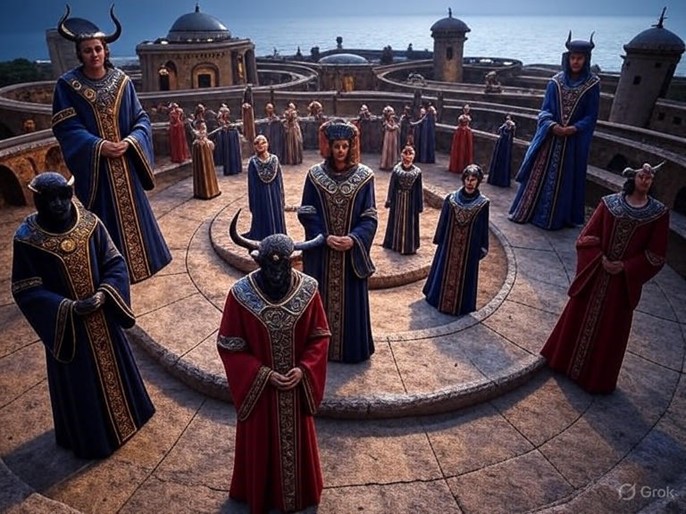
Funeral rites for believers in the Cult of the Eternal Labyrinth are profound ceremonies that honor the dissolution of avatars as transitions within Potnia Labyrinthia’s eternal weave, aligning with Saṃsāra’s mechanics where death leaves a crystal and items behind. Upon an avatar’s HP reaching zero—often dramatically vaporizing into sparks for possessed ones—the rite begins immediately in a temple grotto or family shrine, lasting three days to symbolize the cycles of renewal. The crystal residue is collected reverently, placed on a serpent-coiled bier etched with labyrinth spirals, while dropped items are displayed around it as testaments to the avatar’s attuned life, unattuned automatically if stored extradimensionally. Family and gestalt companions gather, sharing senses if at tier 2 or above to collectively recall the deceased’s memories, which persist in the character but are commemorated through Kretari chants that invoke the goddess to guide the soul through afterlife mazes. On the first day, priests perform a ritual chant over 6 seconds, amplifying it with true name usage if known to double the emotional resonance, simulating silver fire to illuminate the crystal without damage. Meals are shared over 20 minutes, granting 1 HP to mourners as a regenerative act, roleplayed with stories of the avatar’s balances and imbalances, such as slot excesses that may have hastened the end. The second day involves a symbolic navigation: attendants enter a miniature labyrinth constructed from steam-powered gears and mana circuits, carrying the crystal to attune it as a conduit for future use, training skills in discernment to avoid dead ends that represent unresolved hubris. If the deceased was part of a gestalt, companions adjust domination percentages dynamically, no less than 5%, to honor the shared weave, often merging temporarily with a new avatar pod to integrate echoes. Bull horns are sounded to ward off disruptions, tripling AC in the safe rite area, while offerings of excess gear are burned in elemental fire-water steam, preventing pain penalties for the living. On the third day, the crystal is interred in communal pods within sacred groves, believed to seed new avatars, with underwater rites submerging it in buoyant currents and cave ceremonies embedding it in stone walls. For non-possessed avatars, the body is laid in blood pools but ritually dissolved with mana boosts to form crystals, aligning all deaths with her cycles. Higher-tier funerals extend sensory sharing across planes at tier 5, allowing distant kin to participate, and immunities from items are activated in memorials to protect against grief-induced overwhelm. The rite ends with a feast simulating three meals, recovering up to 3 HP, and a final chant affirming the soul’s rebirth, ensuring memories endure in the character’s eternal path.
The magical power of Potnia Labyrinthia, as channeled through the Cult of the Eternal Labyrinth in Saṃsāra, manifests through rituals, symbols, and blessings that integrate with the world’s high-magic mechanics, enhancing gear attunement and trained skills without granting innate abilities. Her power emphasizes balance, weaving, and cyclical renewal, allowing adherents to invoke it for both offensive and defensive purposes during combat, exploration, or daily challenges. Since all magic requires a conduit—typically an attuned item like a horn-adorned bracer or serpent-coiled torc—her influence amplifies these tools when invoked properly, often through Kretari chants or symbolic gestures. Followers must train relevant skills, such as ritual chanting or gear maintenance, to access these benefits, and overuse without balance risks her stern judgment, such as increased pain intervals from excess slots. Below, the applications are detailed for offense and defense, drawing from her traits, attributes, and lore to provide practical examples in Saṃsāra’s gameplay.
Offensive Uses
Potnia Labyrinthia’s magical power excels in offense by amplifying spellcasting, damage output, and tactical disruption, often tying into her enigmatic guidance and multifaceted nature to turn the labyrinthine complexity of fate against foes. Adherents invoke her through rituals that weave mana into aggressive forms, leveraging symbols like the labrys axe or serpents to focus conduits.
- Ritual Spell Amplification: By chanting invocations in her name during ritual spellcasting (lasting over 6 seconds), followers can increase spell damage or effects by up to 25%, transforming a standard elemental attack—such as a steam-powered fire burst from a gear conduit—into a devastating wave that engulfs multiple enemies. For example, a tier 2 Thalorim avatar attuned to a serpent torc might recite a Kretari phrase like “Potnia’s coil strikes true,” extending the spell’s range or adding a coiling effect that restrains foes, disrupting their actions and setting up follow-up strikes. This offensive boost scales with tier, tripling at tier 3 for chants within temple grounds, making it ideal for sieges against monster packs in unsafe areas.
- True Name Doubling with Labyrinthine Insight: Knowing a target’s true name and invoking Potnia Labyrinthia doubles spell damage, as her wisdom attribute reveals hidden stats via the Mind’s Eye, providing clues to names during active identifications. An adherent might use a dragonfly-mosaic bracer as a conduit to concentrate for minutes, uncovering a foe’s name, then channel silver fire spell power—unresistable mana boost damage added post-hit—for a lethal finisher. In group combat, gestalt avatars at tier 4 share this insight across planes, coordinating to exploit weaknesses, such as doubling area-effect rituals against a swarm of unpossessed creatures.
- Mana Boost as Weaving Fire: Her regenerative trait allows followers to produce extra mana points from items during festivals, capped at 12 times tier for devout users, which can be expended offensively as silver fire spell power. This straight, unresistable damage, invoked with a bull horn symbol to honor her strength, can be added after a successful hit without action penalties, turning a basic weapon strike into a piercing blast that ignores resistances. For instance, in a naval battle on Minoan’s steam ships, a priest might attune a labrys-etched sword, using 3 mana points to vaporize an enemy avatar, leaving their crystal for collection while preventing counterattacks.
- Disruption and Misdirection Weaves: Drawing from her enigmatic personality, offensive rituals can impose misdirection on enemies, shielding the caster’s stats or creating false illusions in their Mind’s Eye views. A trained skill in serpent dances allows an adherent to chant silently or normally (under 6 seconds) while attuned to a coiled armband, disrupting foe chants and halving their spell effects, followed by a counteroffensive ritual that exploits the opening. At tier 5, this extends across planes, enabling remote offensives where shared senses reveal enemy positions for targeted silver fire bursts.
- Gestalt Offensive Coordination: Higher-tier followers embody her multiplicity by merging avatars into gestalts, using her attributes to remove distance limits on shared thoughts and senses. This allows coordinated strikes, such as one avatar distracting with a labrys swing while another channels a amplified ritual from afar, doubling damage through synchronized true name calls. In political intrigue turned violent, this power offensively overwhelms guards in deathly areas, where every attack hits, by weaving mana boosts to sustain the assault.
- Immunity-Enhanced Assaults: From tier 3, her consecrated immunity attribute activates extra protections on items, chosen during rituals, allowing offensive gear to ignore specific disruptions—like chant interruptions from environmental mana ebbs—ensuring rituals complete for maximum 25% boosts. A Thalorim warrior might attune a horn crown for immunity to reply-based counters, launching uninterrupted offensives in crowded megacity skirmishes.
These offensive applications require careful balance; overrelying on her power without offerings can accelerate mana dissipation to 2 points per day, limiting sustained aggression.
Defensive Uses
For defense, Potnia Labyrinthia’s power focuses on protection, renewal, and navigational guidance, using her nurturing traits to create barriers, enhance resilience, and mitigate threats through balanced weaving. Symbols like bull horns for consecration and beehives for harmony serve as defensive conduits, amplifying Saṃsāra’s safety mechanics.
- Enhanced Safe Area Protections: Invoking her guardianship triples AC in designated temple areas during rituals, extending to somewhat safe zones like walled cities where it doubles, creating fortified positions for defense. Adherents attuned to horn symbols can establish temporary safe zones in the field by chanting her name, reducing incoming damage and allowing long rests for HP recovery via tier die rolls, plus extras from her regenerative meals. In a besieged floating city, a group might form a circle with serpent torcs, tripling AC to withstand monster assaults while recovering temporary bonus HP capped at 22 times tier.
- Mana Boost for Survival Weaving: Her fertile weaving trait slows mana dissipation to half a point per day for followers, preserving points for defensive reactions—spending one to prevent death from lethal damage, leaving the avatar at 1 HP. This is invoked with a beehive-patterned belt, symbolizing communal strength, and can be combined with gear to add silver fire defensively, countering hits without resistance. During explorations of uncharted islands, a tier 3 adherent might use 2 points to survive a trap, then share the sense of danger across gestalt distances tripled by her attributes.
- Temporary HP and Recovery Cycles: Rituals simulating her renewal cycles grant temporary bonus HP up to 22 times tier, subtracted first from incoming damage, with her maternal characteristic easing possession disorientation to maintain defensive focus. Meals eaten in her honor over 20 minutes recover up to 4 HP daily in sacred spaces, amplified by steam vents in temples. For example, a defender in a cave system might attune a dragonfly mosaic for bonus HP, navigating defensive mazes that reduce overwhelm debuffs from multiple threats.
- Immunity and Protective Auras: At tier 3, her attributes activate immunities on items without conflicts, chosen via consecration, shielding against specific offensives like spell disruptions or environmental hazards. A serpent-coiled neck crest might grant immunity to chant interruptions, allowing defensive rituals to complete amid chaos, while her aura triples true name defenses if invoked, halving doubled damage attempts. In unsafe areas where AC halves, this power weaves a protective thread, mitigating risks for prolonged stands.
- Sensory and Mind’s Eye Defenses: Her wisdom reveals enemy stats through enhanced Mind’s Eye activations, granting advantages to spot weaknesses and avoid ambushes, with cooldowns shortened in her presence. Gestalt sharing, extended by 10% under her blessing, allows defensive coordination, such as one avatar sensing attacks from 30 feet (dimming at 20) to warn others. At tier 4, plane-wide sharing creates impenetrable networks, defending trade convoys by preempting raids.
- Misdirection and Barrier Weaves: Enigmatic traits enable defensive illusions, using labrys symbols to create false stats that mislead foes’ Mind’s Eye, buying time for retreats or counters. Rituals weave barriers that disrupt enemy movements, simulating labyrinth twists to halve their speed, amplified 25% with prolonged chants. In deathly areas where AC is negated, this power focuses on evasion, guiding paths via her navigational attributes to escape certain hits.
Defensive invocations demand moderation; neglecting balance, like hoarding gear, triggers her jealousy, imposing doubled disruption risks or faded patterns that lower base HP until rectified.
Coiled Weaver and the Bull’s Endless Path
In the dim epochs before the souls’ great influx, when the islands of Saṃsāra bobbed like forgotten pearls upon the vast ocean’s bosom, and mana bubbled forth from the earth’s hidden veins like breath from slumbering gods, there arose in the heart of Minoan a divine stirring. The ancient runes, scratched upon clay that crumbles as memory crumbles, speak thus: “From the womb of twists and turns, she who weaves the fates emerged, Potnia of the Labyrinth, her arms as serpents curling, her crown as horns of consecration piercing the veil.” But the tongue of the unknowns is twisted, for it was not a womb but the convergence of mana ebbs and flows that birthed her, and her form was vast, body etched with mazes that shifted as the tides shift, eyes glowing like crystals left from fallen avatars.
Potnia Labyrinthia, as the poorly etched scrolls name her, was not born of the gods’ direct hand but from the world’s own yearning for balance. In those days, avatars roamed without memories from beyond, mere instincts guiding their steps through jungles thick as forgotten ruins and seas endless as regret. The first Thalorim, tall and iridescent, with patterns swirling on skin like waves upon stone, dwelled in groves where crystal pods bloomed under mana storms. They built palaces of winding halls, frescoes depicting dances with bulls and coils of serpents, but chaos reigned, for without her guidance, attunement to gear was haphazard, slots exceeded without pain’s warning, and tiers advanced compulsorily, shattering bodies in irregular bursts of agony—minutes counted by dice unseen, health draining as sand through fractured conduits.
The tale falters here, for the unknown language speaks of a “great unraveling,” where mana flows ebbed too low, causing avatars to dissolve into sparks without crystals, memories lost to the void. King Minar, ruler of early Minoan, whose house would become Aethera, cried out in the central palace, his voice echoing through corridors that twisted like thoughts entangled. “The weave frays,” he lamented, his Thalorim form tall and limbs long, hair cascading with embedded shells that held no power yet. His queen, Lira, bore a child cursed by imbalance—a being half-avatar, half-monster, with horns curling like forbidden spells and body shadowed, devouring unattuned items and leaving pain in its wake. This Bull Shadow, as the blurred inscriptions call it, rampaged through the island, disrupting rituals, halving AC in unsafe groves, and forcing foes to hit without miss in deathly chambers it haunted.
King Minar, seeking remedy, ventured into the Sacred Grotto, a cave system deep beneath the palace, where mana circuits hummed like steam from elemental unions. There, in visions granted by the Mind’s Eye—passive at first, revealing basic stats of stone and shadow—he beheld Potnia Labyrinthia manifesting. “I am the weaver of paths eternal,” she declared, her voice tonal as Kretari chants, serpentine arms coiling to form barriers of light. But the translation stumbles: “She who binds the loose threads, guardian of slots and tiers, enforcer of divine caps.” She revealed to the king the limits imposed by the gods—twenty minus tier for slots, pain from two d4 rolls for excesses, attunement requiring minutes or rituals of ten. In exchange for his devotion, she granted him a labrys axe, symbol of cutting false ways, attuned automatically when held, to slay the Bull Shadow.
Yet the king, hubris swelling like mana unchecked, built a labyrinth not for containment but for glory. Workers, Thalorim avatars with sensory traits keen to vibrations, toiled under steam-powered forges, combining water and fire without combustion’s sin. The structure rose: walls shifting with gear mechanisms, paths that dimmed senses beyond twenty feet, chambers where overwhelm debuffs struck if too many concepts pondered. “The maze swallows the unbalanced,” the old text warns, “health lost in intervals, until crystal forms.” The Bull Shadow was lured within, chained by wards that tripled AC in its prison, but it roared, echoes causing disruptions in chants across Minoan, halving spell effects for the unprepared.
Potnia Labyrinthia, her personality nurturing yet stern, appeared in dreams to the queen Lira, who wove threads of hair cascades into a conduit string, glowing with Mind’s Eye clarity. “Guide the hero through my paths,” the goddess commanded, her enigmatic guidance revealing stats of the beast—health vast, weaknesses to true names doubled in damage. A hero arose, Daedar, an avatar possessed by memories from a realm of flying constructs, but bound by Saṃsāra’s limits—no electronics, only levitation magic and griffons. Daedar, training skills in the palace forges, attuned bracers for arm waves and a belt adding four slots, entered the labyrinth with Lira’s thread.
The journey was arduous, the translation fragmenting: “Twists upon twists, where senses cross—sounds as colors, touches as whispers lost.” Daedar navigated, using passive Mind’s Eye to see basic names of traps, active concentration for hidden mechanisms requiring item foci. Disruptions came—foes simulated by the maze, interrupting normal chants under six seconds, forcing silent spells at 25% less power. He ate meals over twenty minutes, recovering one HP each, roleplaying balance to honor the goddess. At the center, the Bull Shadow charged, every attack hitting in the deathly core, but Daedar expended mana boost—one point to survive at one HP, then silver fire unresistable, added post-hit without penalty.
The beast fell, vaporizing into sparks, leaving items: a horn conduit for immunity activations at tier three, a hide granting temporary bonus HP cap of twenty-two times tier. But victory soured; King Minar, jealous as the goddess’s own trait, pursued Daedar and Lira with steam ships and zeppelins, political intrigue twisting like serpents. They fled on griffons, racing through labyrinthine clouds, but the king touched over-tier gear from the hoard, pain wracking him—higher d4 for minutes, lower for HP loss, repeating until he discarded it.
Potnia Labyrinthia intervened, her multifaceted nature shining. She wove a storm of mana, ships sinking in waves that doubled damage with true name calls of the sea. The king repented, offering excess slots at her altar, reducing attunements to avoid compulsory advancement. Daedar and Lira founded the Cult, building temples as palace labyrinths, with courtyards for bull-leaping and grottos for pod communals. Services began: thrice weekly, chants amplifying rituals, gear shared in circles, meditations revealing abstract fates.
The faith spread across Minoan’s 106,784,000 souls, slightly over half embracing her tags—Eternal Labyrinth, Bull Horns, Serpent Coils. Underwater shrines protected centers, floating cities hosted sensory shares, cave systems hid Mind’s Eye libraries. Funerals honored dissolutions, crystals seeded in pods for rebirth. Potnia’s power defended with auras tripling AC, offended with weavings doubling true names. Believers wove lives in balance, training skills without innates, attuning without slots exceeded.
Yet the tale loops, for in later ages, a sect strayed, hoarding mana, dissipation quickening to two points daily. Potnia’s stern judgment fell, overwhelm in temples, false stats misleading. They reformed through trials, navigating symbolic mazes, recovering HP via cycles.
Thus the fragments end, ink faded as patterns on aged Thalorim skin.
The moral of the story is: In the weave of fate, balance threads prevent unraveling, for excess invites the labyrinth’s twists, and only through guided harmony does one emerge from the shadows.