
Deity Name: The Sun-Forged Earth
Adherents: The Path of the Unbroken Circle is the dominant spiritual belief system in the Magosian nation. It is deeply ingrained in the culture, with slightly more than half of the nation’s 102,176,000 people identifying as active followers.
Lore
The Path of the Unbroken Circle is not a religion of worship, but one of active participation. Its followers do not pray to The Sun-Forged Earth; they see themselves as a living part of it. The core belief is that the sun and the earth are two halves of a single, life-giving entity. The earth provides the substance—the stone, the metal, the clay—and the sun provides the energy—the heat, the light, the fire—that allows for creation and life.
The religion’s foundational story is that of Ashu, the first Matriarch. When she carved the great basin from the heart of the Sun-Mountain, she was not just finding water. The believers say she was performing the first and greatest ritual: using her strength (a gift of the earth) and her endurance under the relentless sun (a gift of its fire) to create a vessel that would sustain her people. She demonstrated that the divine is not a distant being to be begged for aid, but a partnership to be joined. Every act of creation, from forging a spear to building a home, is seen as a continuation of Ashu’s first act, a small echo of the great work of shaping the world.
Personality of the Deity
The Sun-Forged Earth has no personality in the mortal sense. It is a dualistic entity of immense, impartial power.
- The Earth aspect is seen as patient, enduring, strong, and providing. It is the source of all material wealth and physical strength.
- The Sun aspect is seen as relentless, energetic, life-giving, and unforgiving. It is the source of all energy, passion, and the harsh reality that only the strong survive.
Followers do not seek to please this deity. Instead, they seek to balance its two aspects within themselves and their community. A warrior with too much of the Sun’s fire and not enough of the Earth’s patience is just a reckless brute. A builder with only the Earth’s substance and none of the Sun’s creative energy is just a person with a pile of rocks. True success comes from balancing strength with energy, patience with passion.
Traits and Characteristics of the Religion
- Action as Worship: The primary form of devotion is meaningful labor. A K’a-Gora blacksmith chanting Ushma verses as she hammers a red-hot ingot is performing a sacred rite. A farmer tending their crops under the hot sun is in communion with the divine. The quality of one’s work is the truest measure of their faith.
- The Unbroken Circle: The central tenet is that all things are connected in a great cycle. The sun nourishes the plant, the animal eats the plant, the people eat the animal, and when the people die, their bodies return to the earth to one day be part of the stone and soil again. This belief fosters a deep respect for the environment and a pragmatic approach to life and death.
- Community Focus: The individual is important, but the strength of the clan—the community—is paramount. Great deeds are celebrated not just for the individual’s glory, but for how they strengthen the Unbroken Circle of the people.
- No Priests, Only Guides: The religion has no formal clergy. Instead, they have “Sun-Stone Guides,” who are respected elders, master artisans, and wise matriarchs. They do not interpret divine will, but offer guidance on how to live a balanced and productive life in harmony with the Path.
Attributes of the Deity
- Domains: Sun, Earth, Fire, Strength, Craft, and Community.
- Manifestation: The deity does not appear in a physical form. Its presence is the heat of the sun on one’s back and the solid feel of the earth beneath one’s feet. Sacred places are not temples, but locations where this duality is most apparent: the mouth of a volcano, a sun-drenched canyon with a river at its bottom, or a forge where fire and metal meet.
Symbols
- The Forged Circle: The primary symbol is a simple, imperfect circle of dark metal or stone with a single, sun-like bead of amber or gold set within it. It represents the Unbroken Circle of life, forged by the partnership of Earth and Sun.
- The Crossed Hammer and Sun-Ray: A blacksmith’s hammer crossed with a stylized ray of sunlight. This symbol is often worn by artisans and warriors, representing the application of energy and will upon the substance of the world.
- The Geodermic Spiral: A spiral pattern that mimics the geodermic markings on a K’a-Gora’s skin. It represents the individual’s life journey as a part of the greater whole.
Tags: Path of the Unbroken Circle, The Sun-Forged Earth, Dualistic, Animistic, Action-Based Faith, Ancestor Veneration, Pragmatic, Community-Centric, Creation Myth, Earth-Worship, Sun-Worship, No Clergy
Followers The Path of the Unbroken Circle is the cultural and spiritual bedrock of the Magosian nation. It claims the devotion of slightly more than half of the country’s population, which translates to approximately 52 to 55 million followers. While nearly everyone in the nation respects its principles, these are the individuals who actively participate in its rituals and live by its tenets.
Type of Temple
Adherents to the Path do not construct buildings for the sole purpose of worship. They believe that their deity, The Sun-Forged Earth, is not a being that resides in a temple, but a force that is most present in locations where its dual aspects—the creative energy of the Sun and the enduring substance of the Earth—meet in dramatic fashion. Their “temples” are therefore functional or natural sites.
- The Great Forge: The heart of every Magosian city is its Great Forge. These are massive, open-air industrial areas where smiths and artisans work. With their roaring, sun-hot furnaces (the Sun) and anvils of solid stone or iron (the Earth), these forges are considered the most sacred of spaces. Major community events, announcements, and legal judgments are often delivered here, amidst the ringing of hammers and the heat of creation.
- Sunken Canyons: In the wilderness, deep canyons with rivers running through them are revered. The tall, sun-baked canyon walls represent the Earth’s substance, while the life-giving water, warmed by the sun, represents the energy that sustains the world. These are places of pilgrimage and solitary meditation.
- Sunstone Circles: On high plateaus, the K’a-Gora build massive, open-air circles of dark, heat-absorbing rock. At the center of the circle is a single, large crystal or a polished obsidian altar. These circles are used for astronomical observation and for festivals tied to the solar calendar. They are designed to absorb the sun’s heat during the day and radiate it back through the cool nights, making them places of balance and power.
Positives
The Path of the Unbroken Circle fosters a culture with several significant strengths that have led to the stability and prosperity of the Magosian nation.
- Exceptional Work Ethic and Craftsmanship: Since meaningful labor is a form of worship, the culture produces some of the most skilled and dedicated artisans in the world. There is immense social and spiritual pressure to create things that are both beautiful and durable. This results in incredibly high-quality goods, from weapons and armor to everyday pottery and textiles.
- Strong Community Cohesion: The belief in the “Unbroken Circle” creates a powerful sense of interdependence. Individuals understand that their actions directly affect the strength and survival of the clan. This leads to a society with strong safety nets, where people readily help their neighbors and work together on large community projects.
- Psychological Resilience: The religion teaches that hardship is a natural part of the cycle, a necessary challenge from the Sun to test the Earth’s endurance. This fosters a stoic, resilient populace that faces adversity with determination rather than despair. They do not wait for miracles; they forge their own solutions.
- Innovation and Pragmatism: The faith encourages the practical application of energy (the Sun) to substance (the Earth). This has made them masters of magic-driven industry and engineering. They see no conflict between their ancient beliefs and technological progress, viewing a well-designed steam engine as a perfect expression of their faith.
Negatives
Despite its benefits, the Path’s worldview also has inherent downsides that can create a harsh and demanding society.
- A Culture of Burnout: The intense focus on “action as worship” and productive labor can lead to a society where there is little room for rest or leisure. Individuals who are not constantly working or creating can be seen as spiritually lazy or a drain on the community, leading to immense social pressure and personal exhaustion.
- Lack of Spiritual Comfort: The deity is impartial and does not offer comfort, forgiveness, or absolution. For individuals suffering from grief, guilt, or spiritual crisis, the Path offers only the cold advice to “endure and work harder.” There is no priesthood to provide counseling or a divine figure to offer solace.
- Social Stratification: While promoting community, the faith can also be harsh on those who are physically unable to contribute through labor. The elderly, the disabled, or the infirm, while cared for out of duty to the Circle, may be seen as lesser members of society because they cannot actively participate in the “great work” of creation.
- Reluctance to Accept Aid: The core belief in self-reliance and enduring hardship through one’s own strength makes the K’a-Gora and other followers intensely proud. This can make them stubbornly refuse help from outsiders, even when it is desperately needed, viewing it as a sign of weakness and a failure to live up to the Path’s ideals.
What Believers Believe
The core tenets of the Path are practical and deeply integrated into the daily life and work of the Magosian people.
- The Divine Partnership: They believe the world is the manifestation of a dualistic deity, The Sun-Forged Earth. The Earth is the silent, enduring, physical substance of all things, while the Sun is the relentless, energetic, and life-giving force that enables action and creation. Neither is superior; they are equal partners in existence.
- Work as Worship: The most sacred act is meaningful labor. The act of creation—forging steel, shaping clay, building a wall, or even farming the land—is the highest form of devotion. It is the practical application of the Sun’s energy to the Earth’s substance. The quality and utility of a person’s work is the truest measure of their spirit.
- The Unbroken Circle: Life is an endless, interconnected cycle. The sun gives energy to the earth, the earth provides substance for life, living things consume one another, and upon death, their bodies decay and return to the earth, providing substance for new life. To harm one part of the Circle (e.g., to poison the land) is to harm the whole, including oneself.
- The Goal of Balance: A follower’s spiritual goal is to achieve a balance between the principles of the Sun and the Earth within themselves. To have only the Sun’s fire is to be reckless and destructive. To have only the Earth’s substance is to be stagnant and unproductive. A balanced individual is patient yet energetic, strong yet creative.
- Strength in Community: The individual is but one small arc in the Unbroken Circle of the community. A person’s true strength is measured by how their actions contribute to the resilience and prosperity of their clan and nation.
Regular Services
Adherents do not have services in the traditional sense of prayer and sermons. Their rituals are acts of creation and community.
- The Daily Forging: The most common service is a personal act that begins the workday. A stonemason will strike their chisel against a new block for the first time, a weaver will thread the first line on their loom, or a farmer will till the first row of soil. This first act of labor is often accompanied by a low, rhythmic Ushma chant, a personal meditation to focus the mind and dedicate the day’s energy to the task at hand.
- The Community Work-Tithe: On a weekly or monthly basis, the community gathers not to pray, but to work on a public project. This might be repairing a city wall, maintaining the Great Forge, or clearing a new field. Led by a Sun-Stone Guide or a master artisan, this collective labor is a social and spiritual event, reinforcing the bonds of the Unbroken Circle and the value of shared effort.
- Solar Festivals: The largest gatherings are tied to the solar calendar—the solstices and equinoxes. These festivals are held at the community’s Great Forge or a Sunstone Circle. They are vibrant celebrations involving massive feasts, athletic competitions that test strength and endurance, and exhibitions where master crafters display their finest work. The central event is the retelling of the story of Ashu, reaffirming their cultural identity and core beliefs.
Funeral Rites
Death is not viewed as a tragedy but as the “Great Return to Substance.” The funeral rites are therefore solemn and respectful, focusing on the deceased’s contributions to the community and their re-entry into the cycle.
- The Final Gift: The body is washed and wrapped in a simple, undyed shroud. The most valued tool the person used in their craft—a smith’s hammer, a weaver’s shuttle, a farmer’s hoe—is placed in their hands. This act symbolizes returning both the hand and the tool it wielded back to the substance of the Earth.
- The Forge-Wake: The deceased is brought to the community’s Great Forge. For one night, the work of the forge does not cease. The sounds of ringing hammers and the intense heat are seen as the highest honor, a final salute to a life of labor. Family and clan members work through the night, symbolically taking up the deceased’s labor to show that the Circle remains unbroken.
- The Forging of the Link: A small metal object personally owned by the deceased (a ring, a buckle, a coin) is brought to a master smith. It is melted in a crucible and forged into a single, unadorned iron link. This link represents the individual’s life being folded back into the great chain of the clan’s history.
- The Final Forging: At dawn, the body is placed in a high-temperature kiln within the Great Forge and cremated. This is seen as the ultimate act of transformation, where the Sun’s fire releases the body’s energy and returns its physical form to ash—its purest substance.
- Closing the Circle: The ashes are collected. A portion is mixed with clay or mortar to be used in a new community building, ensuring the deceased physically contributes to the future. The remainder is given to the family to be scattered on their land. The newly forged iron link is then added to a long chain that serves as the clan’s genealogical record, displayed in a place of honor within the forge.
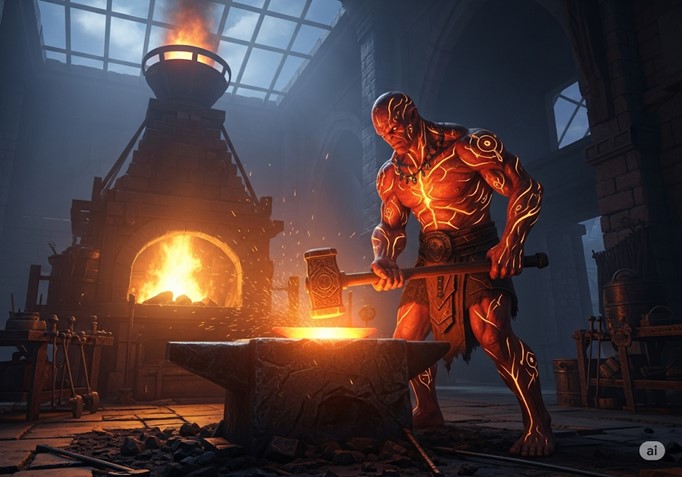
In the Path of the Unbroken Circle, magical power is not a gift requested from a deity but a skill that is mastered. A follower, particularly a K’a-Gora artisan or warrior, learns to channel the dual aspects of their god—the Sun and the Earth—through specially crafted and enchanted gear. Their magic is an extension of their craft, blending immense physical force with raw, elemental energy.
Defense: The Aspect of Earth
Defensive magic channels the Earth’s principles of substance, endurance, and foundation. It is focused on outlasting and overpowering an opponent’s assault through sheer resilience.
- Earthen Resilience: By wearing consecrated stone greaves or a girdle inlaid with rock from a sacred site, a follower can stomp on the ground and channel the Earth’s endurance. For a short time, their skin takes on a granite-like quality, granting them immense resistance to physical damage. They don’t block a blow with a magical shield; they simply become too tough to be meaningfully harmed by it.
- Wall of Strata: Using an enchanted stonemason’s hammer, a practitioner can strike the ground and command it to rise. This doesn’t create a smooth, magical wall, but rather a thick, layered rampart of natural rock strata that erupts from the earth, providing solid cover that is difficult to shatter.
- Sun-Glaze Shield: While defense is primarily the domain of the Earth, the Sun’s energy can be used for protection. An adherent can activate an enchantment on a highly polished shield or bracer. The item flashes with the blinding intensity of the midday sun, forcing any creature attacking in melee to avert its eyes. This defensive flash can blind an opponent or impose a severe penalty on their attack.
- The Unbroken Ward: Channeled through a clan’s forged iron symbol or a matriarchal signet, this ability embodies the strength of community. When an ally is struck by a powerful blow, the user can activate the ward to take a portion of that damage upon themselves, distributing the harm across the “Circle” and preventing a single member from falling.
Offense: The Aspect of the Sun
Offensive magic channels the Sun’s principles of energy, fire, passion, and relentless force. It is direct, destructive, and often resembles the very forces at play in a master blacksmith’s forge.
- Hammer of the Forge-Sun: A smith or warrior using a ritually forged hammer can call upon the heat of the forge. The head of the hammer begins to glow with a white-hot intensity. A successful strike deals not only crushing bludgeoning damage but also severe fire damage, searing the target and potentially igniting flammable materials.
- Eruption of Molten Earth: This attack perfectly balances both aspects of the deity. By striking the ground with an enchanted weapon or stomping with specialized greaves, the user channels the Sun’s energy into the Earth beneath a target’s feet. The ground superheats and explodes upward in a shower of molten rock and shrapnel, dealing both fire and piercing damage in a localized area.
- Solar Brand: Using a gauntlet with a solar symbol forged onto the palm, a warrior can strike an opponent and leave behind a searing, magical brand. This brand does not just burn; it acts as a spiritual beacon. For a short time, all allies attacking the branded creature feel a surge of shared purpose, gaining a bonus to their attacks as they work together to break the enemy’s spirit.
- Sun-Spear: An adherent can use an amber-tipped spear or javelin as a focus to channel a beam of pure solar energy. The attack is not a physical throw but a ranged magical assault, firing a lance of concentrated, white-hot light that can pierce armor and set targets ablaze.
This telling is from the Shumaako knots of the Clan of the Iron Hand, and its meaning is perhaps twisted, for the hands that first translated the knots into words were not as skilled as the hands that first tied them.
And it was in the age after the first Matriarch that the K’a-Gora flourished. Their forges were the heartbeats of their cities, and their strength was the strength of the mountains. In the great city of Oakhaven, there were two smiths, and they were the greatest of their age. One was named Kaelen, and the other was named Malakai.
Kaelen was a smith of the Earth. His arms were as thick as the trunks of ancient trees. His endurance was a thing of legend. He could work the forge for three days and three nights without sleep, his hammer-fall as steady on the last hour as it was on the first. He worked with stone and iron, and the things he made were strong beyond measure. His shields could turn aside the charge of a great beast, and his fortress gates could not be broken by any ram. But his work was without inspiration. It was strong, but it was ugly. It was functional, but it held no light. He honored the Earth, but he forgot the Sun.
Malakai was a smith of the Sun. His spirit was a bright and terrible fire. His mind was filled with visions of impossible beauty. He worked with gold and silver and the gems that were pulled from the deep places. The things he made were so beautiful that people would weep to look upon them. He could craft a circlet so fine it seemed woven from captured starlight, and his blades had patterns like flowing water. But his work was without substance. His beautiful blades would shatter in a real fight. His filigree armor was too delicate to stop a true blow. He honored the Sun, but he forgot the Earth.
The two smiths were rivals, and their rivalry was a stone that split the guild. Some praised the unmatched endurance of Kaelen, and some praised the brilliant creativity of Malakai.
Then the Sun-Matriarch, she who was the granddaughter of Ashu, called a great contest. A horde of beasts, the Chittering Scourge, was coming from the blighted lands to the east. A great champion was needed to lead the army, and this champion would need a weapon and a shield, the greatest ever made. The Matriarch declared that Kaelen and Malakai would each forge one piece. Kaelen, the smith of Earth, would forge the shield. Malakai, the smith of Sun, would forge the sword.
Kaelen went to his forge. He chose the largest ingot of iron, smelted with stone from the heart of the mountain. For seven days he worked. He did not eat. He did not sleep. His hammer-falls were like the slow pulse of the world. He folded the metal a thousand times, chanting the rites of endurance, honoring the substance of the Earth. He quenched the shield not in water, but in the cold, deep mud of the riverbed. When he was done, he had created the perfect shield. It was a great, unadorned slab of dark metal, thick and heavy and without flaw. It was the most defensive thing ever made. It was a piece of a mountain given form.
Malakai went to his forge. He took the star-metal that falls from the sky, and he took gold and amber. He worked in a fever of creation, his mind alight with the fire of the Sun. He did not plan his work. He let his spirit guide his hands. He sang the high, clear chants of making, of energy and of light. He quenched his blade in the first light of the rising sun. When he was done, he had created the perfect sword. Its edge was so sharp it could cut a falling leaf in two. It was inlaid with glowing patterns of gold, and the light of the forge seemed trapped within the blade itself. It was the most offensive thing ever made. It was a ray of sunlight given form.
The two smiths brought their creations before the Matriarch. The people of the city gathered and marveled. No one could say which was greater.
So the champion was chosen, a great warrior named Lyra. She took up Kaelen’s shield and her arm bowed under its immense weight. She could barely lift it. She took up Malakai’s sword, and its beauty was breathtaking, but it felt light and fragile in her grip.
And the Chittering Scourge came. Lyra went to the field of battle. The beasts were a tide of claws and teeth. The first beast charged, and Lyra braced herself behind Kaelen’s shield. The blow was tremendous, but the shield did not dent. It did not scratch. But the force of the blow threw Lyra to the ground, for the shield did not yield and so all the energy was passed to her. Her arm was numb. She could not lift the shield again.
She rose and took up Malakai’s beautiful sword. She swung it at the next beast, a flash of captured sunlight. The blade was so sharp it sliced through the creature’s hide as if it were cloth. But the blade also struck the creature’s bone, and with a sound like shattering glass, the beautiful sword broke into a thousand glittering pieces.
The champion was disarmed, her shield too heavy to lift, her sword a memory. And the people despaired.
But Kaelen and Malakai stood together in the Great Forge, and they watched the disaster. And for the first time, they looked at each other not as rivals, but as two halves of a single failure. Kaelen saw that his strength without inspiration was but a heavy weight. Malakai saw that his inspiration without substance was but a fragile dream.
They did not speak. They did not need to. They went to their forges as one. Kaelen brought forth his strongest iron, and Malakai brought his star-metal. Kaelen began to hammer, his blows giving the new blade its strength, its Earth. Malakai worked the bellows, his breath giving the forge its fire, its Sun. Kaelen would hammer, and Malakai would fold the metal, weaving in threads of gold for lightness. Kaelen would shape the shield, and Malakai would trace patterns on it that were not just for beauty, but to distribute the force of a blow. They worked in a rhythm, one the heavy beat, one the bright melody.
They worked through the day and the night, and when they were done, they had not made two perfect things. They had made one balanced thing. The sword was not as beautiful as Malakai’s first, but it was strong. The shield was not as heavy as Kaelen’s first, but it was resilient.
They ran the new sword and shield to the field of battle. Lyra, who was near death, took them up. The shield was light enough to move. The sword was strong enough to endure. With the balanced shield, she turned aside the blows, its clever patterns scattering the force. With the balanced sword, she cut through hide and bone, its strong edge never faltering. And she drove back the Chittering Scourge and saved the city.
From that day, Kaelen and Malakai worked together, and their forge was the greatest in the history of the K’a-Gora. And the people learned the true meaning of their Path.
The Moral of the Story: For a thing to be truly strong, it must have both substance and vision. A foundation without a spire is but a hole in the ground; a spire without a foundation is but a falling stone.
Comments
One response to “Path of the Unbroken Circle”
[…] From: Path of the Unbroken Circle […]