
The Vespertilio-Aster Electrus 9, often called a “Glimmerbat” by locals, is a bizarre and dangerous creature born from a fusion of wildly different life forms. It is a highly specialized nocturnal predator that haunts the deep caves and shadowed valleys of the world.
Original Life Forms — This creature is a magical amalgam of four distinct animals:
- Mammalia: Vampire Bat (Desmodontinae subfamily)
- Insecta: Bombardier Beetle (Brachinini tribe)
- Actinopterygii: Electric Eel (Electrophorus electricus)
- Asteroidea: Starfish (Asteroidea class)
Appearance
The creature has the main body, leathery wings, and furry torso of a giant vampire bat, but its proportions are unsettlingly alien. Instead of two legs, its lower body splays out into five muscular, starfish-like limbs, each tipped with sharp, chitinous claws. Its back is covered by a segmented, iridescent carapace like that of a bombardier beetle, and a specialized, turret-like nozzle protrudes from the base of its spine. Its skin has the smooth, scaleless quality of an eel and crackles with faint blue sparks of bio-electricity when it is agitated. Its face is bat-like, with large ears and a sharp, needle-like proboscis for feeding.
Details and Traits
- Size: It is much larger than a normal bat, with a wingspan of 10 to 15 feet (3-4.5 meters) and a body length of about 5 feet (1.5 meters).
- Speed: It is a fast and agile flier. On the ground, it moves in a disconcerting, multi-limbed crawl that is surprisingly quick over uneven terrain and allows it to climb sheer rock walls.
- Stat Modifiers:
- Strength: Average (+1)
- Dexterity: Very High (+4)
- Constitution: Average (+1)
- Intelligence: Low (-4)
- Wisdom: High (+3)
- Charisma: Low (-3)
- Skills: Its reliance on echolocation gives it exceptional Perception. It is a master of Stealth in dark environments. Its unique movement and flight capabilities grant it proficiency in Acrobatics.
- Behavior: The Glimmerbat is a nocturnal pack hunter. It roosts in large, dark caverns during the day, often clinging to the ceiling in great clusters. At night, they emerge to hunt. They use their echolocation to navigate and find prey. Their primary tactic is to swarm a target from the air, using their electrical discharges to stun and incapacitate it before landing to feed. They are fiercely protective of their roost.
- Diet: Sanguivore. It feeds exclusively on the blood of large animals and avatars, using its sharp proboscis to create a wound and an anticoagulant saliva to ensure the blood flows freely.
- Emotions: The creature operates on instinct and a collective pack mentality. Its primary emotional states are hunger, territorial aggression, and fear.
- Environment Where Found: They are found exclusively in regions with extensive, deep cave systems or incredibly dense, dark forests that mimic cave-like conditions. They are a particular menace in the megacities in dark cave systems and the deep, unexplored caverns of mountain ranges like Maglemosian’s Spine of the World.
- Tags: Feral, Magical Beast, Swarm Hunter, Flier, Sanguivore, Bio-electric, Chemical Attack, Echolocation, Nocturnal, Regenerative, Carapaced, Pentaradial Limbs, Troglodyte, Stun Discharge, Pack Predator, Bombardier Spray, Anticoagulant Bitem Chimeric
Life Cycle
The Glimmerbat’s life cycle is a strange fusion of mammalian and insectoid stages, adapted to its cavernous environment.
- The Chitinous Egg: A mated female doesn’t give live birth. Instead, she finds a high, inaccessible ceiling in the roosting cavern and secretes a single, tough, chitinous egg, cementing it to the rock. The egg is about the size of a human fist and faintly glows with bio-electric energy.
- The Larval Stage: After several months, a grub-like larva hatches. It has a soft, segmented body and five starfish-like limbs that it uses to cling to the cavern ceiling. It is blind and defenseless, and the pack adults feed it by regurgitating blood.
- Metamorphosis: After growing to a significant size, the larva encases itself in a hardened cocoon of saliva and minerals scraped from the cave walls. Inside this chrysalis, it undergoes a rapid metamorphosis over several weeks.
- The Emerge: A young, winged Glimmerbat emerges from the cocoon. Though smaller than an adult, it is fully capable of flight and hunting. It joins the pack immediately, learning to coordinate its attacks by observing the elders. A Glimmerbat reaches full maturity in about a year and has a lifespan of 15-20 years.
Mating
Glimmerbats live in large roosting colonies that can number in the hundreds, but their social structure is built around a dominant breeding pair. Mating is a rare event, often triggered by seasons of abundant prey.
The alpha male will perform a complex aerial courtship display, using its bio-luminescence to create dazzling patterns of light in the darkness of the cavern. The female will judge the male’s fitness by the complexity and intensity of his electrical display. Once the pair is formed, they are monogamous for life. While the entire pack assists in feeding the young, only the alpha pair is permitted to reproduce, ensuring the strongest genetics are passed on.
Tactics
Glimmerbats are cooperative pack hunters that use a combination of their abilities to overwhelm prey far larger than themselves.
- Echolocation Hunt: The pack spreads out in the darkness, using echolocation to create a complete sonar map of their hunting ground and to find prey without relying on sight.
- The Stunning Swarm: Once a target is identified, the pack silently converges on it from multiple angles. The first wave of the attack is a coordinated electrical discharge. Multiple Glimmerbats will unleash their stunning shocks simultaneously, aiming to paralyze or severely disorient the target.
- Attack and Retreat: After the initial shock, they attack in waves. A few Glimmerbats will swoop in to bite and feed while others circle, providing covering fire with their Bombardier Spray to deter the target from fighting back effectively. They use their superior mobility to stay out of reach, attacking and retreating in a confusing swarm.
- Ground Assault: Once the prey is sufficiently weakened and bleeding, the entire pack will land, using their five starfish-like limbs to crawl over the victim, biting and draining its blood until it is dead.
Actions
In a combat scenario, a Glimmerbat has access to the following actions:
- Multiattack: The Glimmerbat can make two attacks: one with its Bite and one with its Claws.
- Sanguine Bite: Melee Weapon Attack. A piercing bite with its sharp proboscis. A creature hit by this attack takes damage and begins to bleed, suffering a small amount of additional damage at the start of its next turn.
- Claw: Melee Weapon Attack. A slashing attack with the sharp claws on one of its five limbs.
- Stun Discharge (Recharge 5-6): The Glimmerbat unleashes a burst of bio-electricity affecting all creatures in a 10-foot radius around it. Targets must make a Constitution saving throw or be stunned until the end of the Glimmerbat’s next turn.
- Bombardier Spray (3/Day): The Glimmerbat fires a 15-foot line of boiling, noxious chemicals from the nozzle on its back. A creature hit by this spray must make a Dexterity saving throw, taking caustic damage on a failed save, or half as much on a successful one.
Other Interesting Information
- Limb Regeneration: Thanks to its starfish ancestry, the Glimmerbat has remarkable regenerative capabilities. If one of its five legs is severed, it can regrow the limb over the course of a few weeks.
- Alchemical Components: The organs of a Glimmerbat are highly prized by alchemists. The electric organ can be used to create potions of shock resistance or the magical capacitors for a “stun rod.” The glands that produce the bombardier spray are essential for making powerful alchemical explosives or corrosive acids.
- Guano Deposits: The roosting caverns of Glimmerbats are filled with vast deposits of their guano. This substance is incredibly rich in nitrates and bio-electric microorganisms. It is a potent but dangerous fertilizer, and when refined, it can be used as a key component in creating alchemical gunpowder.
- Ecosystem Role: In their subterranean ecosystems, they are apex predators. Their population is a key indicator of the health of the cave systems, as a large and thriving roost means there is a significant amount of other life to be found in the deep dark.
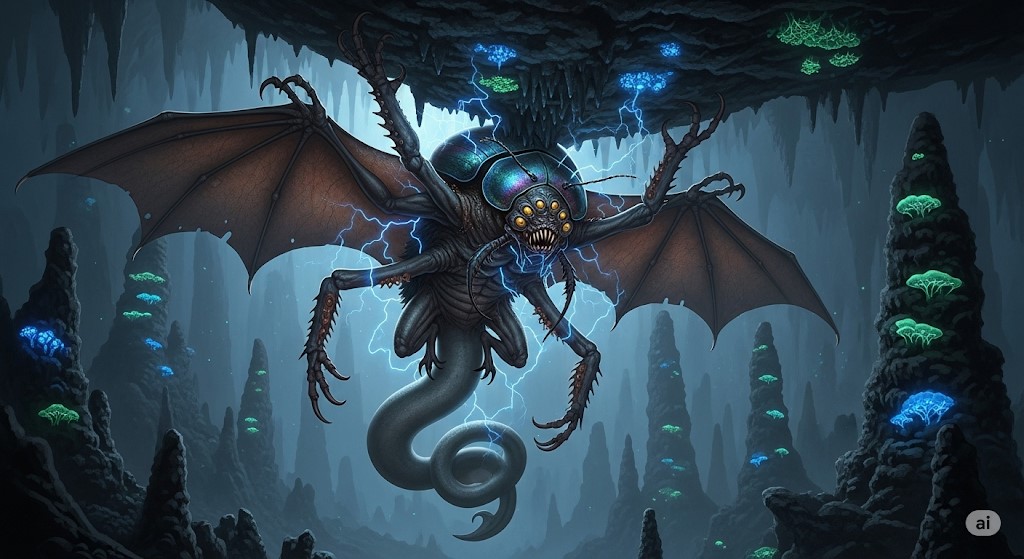
An encounter with a creature as strange and dangerous as the Vespertilio-Aster Electrus 9, or “Glimmerbat,” would likely stem from reasons of extermination, valuable resource harvesting, or accidental intrusion into their territory.
Here are several detailed scenarios explaining why a party of adventurers would encounter or actively search for these feral creatures.
1. The Extermination Mandate
The most straightforward reason for an encounter is a direct conflict of interest between the Glimmerbats and a settlement or corporation.
- The Scenario: A powerful mining guild has discovered a new, incredibly rich vein of magical ore deep within a mountain range. The problem is that the primary access cave is the roosting site for a massive colony of Glimmerbats. The creatures are fiercely territorial and their swarming, bio-electric attacks make any mining operation impossible. The guild posts a high-value bounty, hiring the adventurers as professional exterminators to clear out the entire cavern system so their work can begin.
2. The Alchemical Gold Rush
The unique biological components of a Glimmerbat are a treasure trove for alchemists and magi-tech crafters, making them a target for specialized hunters.
- The Scenario: An alchemist’s guild has put out a call for several rare reagents. They need the electric organs to create powerful shock-resistance potions and magical capacitors; they need the bombardier glands for a new type of corrosive acid; and most importantly, they need a large quantity of the Glimmerbat guano, a uniquely potent fertilizer and a key ingredient in alchemical gunpowder. The party is hired to venture into a known roost, kill enough specimens to harvest the organs, and, most arduously, haul back several hundred pounds of the volatile guano.
3. The Live Capture
For a biologist or a wealthy collector, a live specimen is the ultimate prize.
- The Scenario: A researcher from a prestigious magical university is studying bio-luminescence and magical communication. They have heard tales of the Glimmerbat alpha’s complex aerial light displays during courtship. They hire the party for an incredibly dangerous and high-paying mission: infiltrate a Glimmerbat roost, identify the alpha pair, and capture one of them alive and unharmed. This requires a non-lethal approach against a creature designed for swarm tactics, demanding immense skill and planning.
4. The Unexpected Infestation
Sometimes, adventurers stumble into a nest they never knew existed.
- The Scenario: The party is exploring an ancient, forgotten ruin or a lost subterranean city. As they delve deeper into the darkness, they begin to notice the acrid smell of chemicals and the faint crackle of static electricity. They soon realize the “ruin” is not empty; it has become the sprawling roost for a Glimmerbat colony. Their original quest to find an artifact or uncover a secret now becomes a terrifying survival horror mission, forcing them to navigate the lair of hundreds of nocturnal predators.
5. The Rescue Mission
The Glimmerbats’ feeding habits can lead to desperate, time-sensitive quests.
- The Scenario: A team of prospectors or a fellow adventurer went missing near a mountain pass a week ago. A local tracker found signs of a struggle, a faint smell of ozone, and drag marks leading into a dark cave mouth. The party is hired on the grim assumption that the missing people were swarmed, incapacitated, and dragged back to the Glimmerbat roost to serve as a living larder for the pack. The mission is to infiltrate the cavern, locate the survivors (if any), and get them out before they become the next meal.
A skilled harvester can procure several unique and valuable components from the corpse of a Vespertilio-Aster Electrus 9 beyond its primary organs and guano. These ingredients are prized in various fields, from armor crafting to high-stakes alchemy.
Carapace Plating
- What it is: The segmented, iridescent shell on the creature’s back is not a single piece but a collection of interlocking plates. This material is a lightweight but incredibly durable chitin, similar to that of a bombardier beetle.
- What it is used for: When carefully separated and treated, these plates are perfect for crafting lightweight, non-metallic armor. This armor is highly sought after by scouts and spellcasters who need protection without the weight or magical interference of steel. The armor naturally provides a high degree of resistance to acid and caustic chemicals. A master armorer can also incorporate the plates into heavier metal armor to reduce its overall weight.
Wing Membranes
- What it is: The large, leathery wings of the Glimmerbat are tough, flexible, and have a unique cellular structure that interacts with sonic frequencies.
- What it is used for: The primary use for these membranes is in the creation of sound-dampening gear. When used as the baffle lining in a helmet, they can grant the wearer resistance to sonic-based attacks or magical effects that rely on thunderous sound. Expert crafters can also fashion the membranes into the wing fabric for experimental gliders or personal airships, as they are both durable and unnaturally quiet.
Regenerative Cytoplasm
- What it is: At the core of the creature’s five starfish-like limbs is a gelatinous, greyish substance that contains the key to its regenerative abilities. This cytoplasm is highly unstable and must be harvested quickly and stored in a nutrient solution.
- What it is used for: This is a potent, high-end alchemical ingredient. It cannot be used to make simple healing potions. Instead, it is the primary component in creating extremely rare and powerful Potions of Regeneration. These elixirs do not just heal wounds, but can actually cause the drinker to slowly regrow lost tissue or even severed digits over a period of days.
Echolocation Nodes
- What it is: Located at the base of the creature’s large ears are two small, complex nerve clusters. These are the biological organs responsible for its incredibly precise echolocation.
- What it is used for: A magi-tech artisan can carefully extract these nodes and integrate them into a helmet or circlet. When magically powered, this gear grants the wearer a form of echolocation or blindsight, allowing them to “see” their surroundings in perfect detail even in magical darkness, making them invaluable for subterranean explorers.
Anticoagulant Saliva
- What it is: The glands that produce the Glimmerbat’s saliva contain a powerful anticoagulant, a trait inherited from its vampire bat ancestry. This clear, viscous fluid is what allows it to feed on blood without the wound clotting.
- What it is used for: While it may seem mundane, this saliva is highly valued in both medicine and warfare. Medically, a refined version is used in antidotes for certain magical blood-clotting curses. For more nefarious purposes, assassins and warriors coat their blades with it. A weapon treated with the saliva causes wounds that bleed profusely and are incredibly difficult to staunch, making it excellent for inflicting persistent, non-magical damage over time.
Whisper in the Deep Stone
This tale, it crawls from the dust of forgotten tongues. The shapes of the words are wrong, maybe, bent by the long journey from the first speaker to our ears. But the heart of the telling, that perhaps remains.
It is said that in the ages before the mountains were so high and the caves were even deeper, there was a great hunger in the world below. Not the hunger of an empty belly, but a hunger for all that was different, for all that flew in the air and walked on the land above.
In those lightless places lived things that were neither beast nor spirit, but woven from the dark itself. And one of these, it found a strange longing. It saw the shadows of birds flitting at the cave mouths. It felt the faint vibrations of heavy feet on the ground above. It yearned for the taste of the sun, though it had never seen it.
This creature, it was a patchwork. It had the soft, unseen wings of the night-flyer, but where legs should be, there were five grasping arms, like the arms of the star-wanderer of the deep sea. Its back was hard and segmented, like the armored beetle that spits fire. And its mouth, it was a needle, a straw for drinking the life-blood. It was a thing made of echoes of other beasts, a hungry dream given a terrible shape.
It began to hunt closer to the surface. It would wait in the blackest parts of the caverns, and when the unwary, the lost, the curious came too near, it would unleash a silent storm of unseen force. The air would crackle, and the prey would fall, its limbs frozen. Then the creature would descend, its five arms scrabbling on the stone, and it would drink.
The people of the surface, the early ones who huddled by their flickering fires, they began to speak of a whisper in the deep stone, a silence that struck you down, a shadow with too many hands. They would find their goats and their children lying still, drained and cold, with strange, five-pointed marks in the dust around them.
A brave hunter, they say his name was Korok, lost his only son to this whisper. His heart became a stone of vengeance. He took his spear, tipped with the tooth of a thunder-beast, and he descended into the deepest caves, following the chilling stillness that had taken his child.
He traveled for many days in the blackness, guided only by the feel of the air and the echoes of his own breath. He fought blind worms as long as trees and creatures with eyes that burned with cold fire. But he did not find the whisper.
Then, one night, he saw a strange glow ahead. It pulsed with a faint blue light, and it smelled of bitter stone and ozone. He crept closer, and he saw them. Hundreds of them, clinging to the cave ceiling like grotesque fruit. They were the whisper made flesh, the shadow with too many hands. And in the center, one was larger than the rest, and its carapace gleamed like oil.
Korok knew then that he could not fight them all. But his grief was a fire that gave him courage. He noticed that the creatures slept during the false-night of the deep caves. They hung still, their wings folded, their five arms limp.
He gathered dry moss and the oily stones that burned with a smoky flame. He piled them at the base of the cavern, beneath the sleeping creatures. And he set it alight.
The smoke rose, thick and choking. The blue light of the creatures flickered and grew dim. They stirred, hissing and clicking, their sleep broken by the acrid fumes. The larger one beat its wings, but the space was too tight for flight.
Korok, coughing and weeping, fled from the cave. He did not stop running until he saw the light of the true sun on his face.
Days later, he returned with others from his village, bearing torches. They found the cavern still and silent. The smoke had done its work. The creatures had fallen from the ceiling, their strange bodies twisted and still.
But as they searched the cavern, they found something else. Clinging to the highest reaches of the cave, untouched by the smoke, were leathery sacs that glowed faintly. And within them, they could see the small, curled forms of the next generation of the whisper.
Korok and his people destroyed the sacs, one by one. They cleansed the deep stone with fire and light. And for a generation, the whisper was silent.
But the deep places remember. The darkness breeds in secret. And the hunger for the light, for the life above, it never truly dies. Sometimes, the whisper can still be heard in the deepest caves, a rustling of unseen wings, a crackle in the still air, a shadow with too many hungry hands reaching for the world above.
The Moral of the Story: That which is born of the deep darkness will always yearn for the light, and its hunger may never be truly sated. Vigilance in the bright world is the only shield against the shadows below.
Suggested conversions to other systems:
Dungeons & Dragons (5th Edition)
Glimmerbat Alpha Huge monstrosity, unaligned
Armor Class 17 (natural armor) Hit Points 152 (16d12 + 48) Speed 20 ft., climb 30 ft., fly 60 ft.
STR 18 (+4), DEX 19 (+4), CON 16 (+3), INT 4 (-3), WIS 16 (+3), CHA 9 (-1)
Saving Throws Dex +8, Con +7, Wis +7 Skills Perception +11, Stealth +8 Damage Resistances lightning, poison Senses blindsight 120 ft., passive Perception 21 Languages — Challenge 10 (5,900 XP)
Echolocation. The glimmerbat can’t use its blindsight while deafened.
Flyby. The glimmerbat doesn’t provoke an opportunity attack when it flies out of an enemy’s reach.
Regenerative Limbs. The glimmerbat regrows a severed limb in 1d6 days.
Static Aura. A creature that starts its turn within 10 feet of the glimmerbat takes 5 (1d10) lightning damage.
Actions
Multiattack. The glimmerbat makes three attacks: one with its Sanguine Bite and two with its Claws.
Sanguine Bite. Melee Weapon Attack: +8 to hit, reach 5 ft., one creature. Hit: 11 (2d6 + 4) piercing damage plus 7 (2d6) necrotic damage. The glimmerbat regains hit points equal to the necrotic damage dealt.
Claw. Melee Weapon Attack: +8 to hit, reach 10 ft., one target. Hit: 13 (2d8 + 4) slashing damage.
Bombardier Burst (Recharge 5–6). The glimmerbat sprays boiling chemicals in a 30-foot cone. Each creature in that area must make a DC 16 Dexterity saving throw, taking 36 (8d8) acid damage on a failed save, or half as much damage on a successful one.
Legendary Actions
The glimmerbat can take 3 legendary actions, choosing from the options below. Only one legendary action option can be used at a time and only at the end of another creature’s turn. The glimmerbat regains spent legendary actions at the start of its turn.
- Detect. The glimmerbat makes a Wisdom (Perception) check.
- Wing Attack (Costs 2 Actions). The glimmerbat beats its wings. Each creature within 10 feet of the glimmerbat must succeed on a DC 17 Dexterity saving throw or take 11 (2d6 + 4) bludgeoning damage and be knocked prone. The glimmerbat can then fly up to half its flying speed.
- Command Swarm (Costs 3 Actions). The glimmerbat lets out a screech. Up to three other glimmerbats within 60 feet of it can use their reactions to make one claw attack.
Call of Cthulhu (7th Edition)
The Roost Matriarch A massive, ancient specimen of its kind, the bloated heart of the entire cavern colony.
Characteristics STR 95, CON 110, SIZ 120, DEX 60, INT 30, POW 80
HP: 23 Move: 6 / 12 flying Av. Damage Bonus: +2d6 Build: 3 Armor: 6-point chitinous plates and ancient, tough hide.
Attacks Fighting (Bite) 70% (35/14), damage 1d8 + DB Fighting (Claws) 55% (27/11), damage 1d6 + DB Stunning Discharge 100%, affects all investigators in melee. All must succeed on a Hard CON roll or be stunned, unable to act for 1d3 rounds. Swarm Command: The Matriarch can emit a high-frequency shriek, directing the entire swarm. The Keeper may spend one of the Matriarch’s turns to grant every other Glimmerbat in the scene an immediate extra attack.
Skills: Listen 80% (40/16), Stealth 40% (20/8).
Abilities
- Regeneration: The Roost Matriarch is ancient and resilient. At the start of each round, it regenerates 2 hit points unless it has been damaged by fire in the previous round.
- Potent Bombardier Spray: The Matriarch’s chemical spray is more potent. It requires a Hard Dodge to avoid. On a failure, the investigator takes 2d10 damage and must make a CON roll or suffer a Major Wound.
- Pheromonal Control: The Matriarch’s presence emboldens the swarm. All other Glimmerbats in its presence are immune to effects that would cause them to flee and will fight to the death to protect it.
Sanity Loss: 1/1d8 Sanity points for seeing the Roost Matriarch. 1d4/1d10 Sanity points for witnessing it command the swarm to overwhelm a victim.
Blades in the Dark
The Static Queen A Tier V Threat. Not just a creature, but the heart of an ecosystem. It is a vast, ancient Glimmerbat, semi-permanently attached to the cavern ceiling, its body a living hive for the rest of the swarm. It is a force of nature, a legend that keeps the deep places dark.
Drives:
- To birth the next generation.
- To command the swarm to feed and protect it.
- To be the unmoving, electrical heart of its domain.
Moves:
- Unleash a cascading arc storm that fills the cavern.
- Command the swarm as a single, unified weapon.
- Birth a new wave of hungry young from its pulsating body.
- Shatter stalactites with a focused sonic screech.
- Overload a victim’s mind with a psychic static shriek.
Mechanics: The Static Queen is likely an entire score, not just a single obstacle. It is an apex threat, largely immobile but with control over its environment. Approaching it requires dealing with waves of its Glimmerbat Swarm (a Tier III threat). Damaging the Queen might involve a complex plan—not just fighting, but perhaps overloading its electrical organs (a Tinker action) or using forbidden magic to sever its connection to the swarm (an Attune or Ritual action). A direct assault is suicidal. Clocks would track the swarm’s readiness, the Queen’s anger, and the structural integrity of the cavern itself.
Knave (2nd Edition)
Cavern Tyrant HD 12 | Armor 18 | Morale 12 Attack Bite (d10, drains blood) or 2 x Claw (d8)
- Blood Drain: When the Cavern Tyrant hits with its bite, it latches on. At the start of its turn, it automatically drains 1d6 HP from the target. The target must use their action to make an opposed Strength save to detach it.
- Improved Regeneration: The Tyrant heals 1d6 HP at the start of its turn as long as it is not at 0 HP.
- Caustic Spray: Twice per combat, can spray a 20ft cone of chemicals. All targets must save vs. Poison or take 3d6 damage.
- Massive Stun Discharge: Once per combat, as its action, the Tyrant can release a massive electrical pulse. All creatures within 30ft must save vs. Spell or be stunned for 1d4 rounds.
- Swarm Lord: The Tyrant is always accompanied by 2d6 regular Glimmerbats (HD 4, Armor 14, Bite d6).
- Size: The Tyrant is huge and takes up a 15ftx15ft space. It can be targeted by up to 8 PCs in melee.
Fate Core System
Cavern-Spark Swarmer This represents a single, competent member of a Glimmerbat colony. They are most dangerous in groups.
High Concept: Bio-Electric Flying Leech
Trouble: Instinct-Driven Pack Mentality
Other Aspects: My Hide is a Chitinous Shell; Ceaseless Hunger for Blood; At Home in Absolute Darkness
Skills
- Great (+4):
- Good (+3): Fly (Athletics)
- Fair (+2): Fight, Notice
- Average (+1): Physique, Stealth
Stunts
- Stun Discharge: Once per scene, as an action, the Swarmer can release a burst of electricity. It can Create an Advantage by placing the Stunned and Reeling aspect on every other character in its zone.
- Bombardier Spray: When the Swarmer is hit by a physical attack, it can spend a Fate point to immediately counter-attack by spraying caustic chemicals. This is a Fight attack that, if successful, attaches a Corroding Armor situation aspect to the target’s gear.
- Pack Hunter: Gain a +1 to Fight when attacking the same target as another Swarmer.
Stress & Consequences
- Stress: ◇◇ (2 Physical Stress boxes)
Numenera & Cypher System
Volt-Wing Dracule Level 4 (12)
A common pack-hunting member of a Volt-Wing colony. While one is a threat, a swarm is a catastrophe.
- Health: 12
- Damage: Inflicts 4 points of damage.
- Armor: 1
- Movement: Moves a short distance per round when crawling; moves a long distance per round when flying.
- Modifications: Perception as level 6 due to echolocation in darkness. Resists electrical damage as level 5.
- Combat:
- The Volt-Wing attacks with a piercing bite or by raking with its clawed limbs.
- Stunning Burst: As its action, it can release a burst of electricity. All creatures within immediate range must make a Might defense roll. On a failure, they are stunned and lose their next turn. This typically precedes the pack swarming a target to feed.
- Caustic Jet: Once per encounter, it can fire a jet of corrosive chemicals at a single target within short range. This is a level 5 attack that inflicts 6 points of damage and lowers the Armor of any worn non-cypher armor by 1 permanently.
- GM Intrusion (Regeneration): The GM can intrude when the creature is heavily damaged. It spends its turn fluttering away as one of its severed limbs begins to twitch and slowly regrow, restoring 1d6 health.
- Interaction: The creature hisses and clicks, communicating with its pack. It is hostile to all non-colony life.
- Loot: Its corpse may yield an electric organ (can be jury-rigged into a single-use stun device) or a bombardier gland (one dose of corrosive acid).
Pathfinder, 2nd Edition
Cavern Stalker Bat Creature 3 N, Medium, Aberration, Amphibious
Perception +10; echolocation (precise) 60 feet, low-light vision Skills Acrobatics +11, Athletics +8, Stealth +11 Str +3, Dex +4, Con +2, Int -4, Wis +3, Cha -2
AC 19; Fort +9, Ref +11, Will +8 HP 45 Resistances electricity 5
Speed 20 feet, climb 20 feet, fly 40 feet
Melee [one-action] jaws +12, Damage 1d10+5 piercing plus Grab Melee [one-action] claw +12, Damage 1d8+5 slashing
Blood Drain [one-action] Requirements The cavern stalker bat has a creature grabbed. Effect The bat drains blood from the creature. The creature must succeed at a DC 20 Fortitude save or become drained 1. The bat regains 5 HP.
Caustic Spit [one-action] (Acid) The bat spits a line of caustic chemicals at a single creature within 15 feet. The target takes 2d6 acid damage (DC 20 basic Reflex save).
Stunning Discharge [two-actions] (Electricity) The bat unleashes a pulse of electricity. Each creature within a 10-foot emanation must succeed at a DC 20 Fortitude save or be stunned 1. The bat can’t use Stunning Discharge again for 1d4 rounds.
Swarm Attack The cavern stalker bat deals 1d6 extra damage to creatures that are within the reach of at least two of the bat’s allies.
Savage Worlds Adventure Edition
Glimmerbat A pack-hunting, blood-drinking horror of the deep caverns, known for its ability to stun prey with bio-electricity before the swarm descends.
Attributes: Agility d8, Smarts d6 (A), Spirit d6, Strength d6, Vigor d8 Skills: Athletics d8, Fighting d8, Notice d8, Stealth d8 Pace: 4; Flying: 8; Parry: 6; T toughness: 7 (1)
Special Abilities:
- Armor +1: Hardened chitinous carapace.
- Bite/Claw: Str+d6.
- Blood Drain: Glimmerbats latch on after a raise on a Fighting roll. On subsequent rounds, they automatically inflict 2d4 damage to the victim.
- Flying: Standard flying rules.
- Low Light Vision: Ignores penalties for Dim and Dark light.
- Pack Tactics: Glimmerbats gain a +1 bonus to Fighting rolls when attacking a target that is adjacent to another Glimmerbat.
- Size -1: They are smaller than a human.
- Stun Pulse: As an action, the Glimmerbat can release a pulse of electricity. All creatures in a Medium Blast Template centered on itself must make a Vigor roll or be Shaken.
- Caustic Spray: The Glimmerbat can shoot a jet of chemicals using the Cone Template. Targets in the cone must make an Agility roll. Success means they are Distracted; failure means they suffer a level of Fatigue from the pain and shock.
Shadowrun, Sixth World
Cavern Stalker This paracritter is a dangerous, pack-hunting predator found in deep cave systems and abandoned subterranean arcologies. Its valuable alchemical components make it a target for corporate B-teams and shadowrunners alike.
Attributes
- Body: 4
- Agility: 5
- Reaction: 4 (6)
- Strength: 4
- Willpower: 3
- Logic: 1
- Intuition: 4
- Charisma: 2
- Magic: 5
- Edge: 3
Derived Stats
- Initiative: 8 + 3d6
- Defense Rating: 9
- Condition Monitor (P/S): 10 / 10
- Armor: 6 (Natural Armor)
Skills: Unarmed Combat 3, Perception 4, Stealth 4, Running 2
Powers
- Armor: The creature’s chitinous back provides 6 points of natural armor.
- Corrosive Spit: As a ranged attack (Agility + Athletics), this attack has a DV of (Magic/2)P, AP -4, and the Corrosive status effect.
- Enhanced Senses: Echolocation, Low-Light Vision.
- Natural Weapon (Bite): DV (STR/2)P. The bite has an anticoagulant property; a target who takes damage must make a Body + Willpower (3) test or take 1 box of Physical damage at the start of their next turn.
- Stun Pulse: As an action, the creature can discharge electricity. Any character within 2 meters must resist (Magic/2)S damage with Body + Willpower.
- Wall Walking: The creature can move on vertical surfaces at its normal speed.
Starfinder Roleplaying Game
Volt-Wing Vermin CR 2, XP 600 N Medium magical beast
Init +3; Senses blindsight (echolocation) 60 ft., low-light vision; Perception +7
Defense
- EAC 13; KAC 15
- HP 22
- Fort +6; Ref +6; Will +1
- Resistances electricity 5
Offense
- Speed 20 ft., climb 20 ft., fly 40 ft. (Ex, average)
- Melee bite +10 (1d4+5 P plus bleed 1d4) or claw +10 (1d4+5 S)
- Offensive Abilities Pack Attack, Stunning Discharge
Statistics
- Str +3, Dex +3, Con +1, Int -4, Wis +1, Cha -2
- Skills Acrobatics +12, Athletics +7, Stealth +12
Special Abilities
- Pack Attack (Ex): A volt-wing gains a +1 bonus to attack rolls against a creature if at least one other volt-wing is threatening that creature.
- Stunning Discharge (Ex): As a standard action, a volt-wing can release a pulse of electricity. Each creature within a 10-foot radius must succeed at a DC 13 Fortitude save or be stunned for 1 round. The volt-wing cannot use this ability again for 1d4 rounds.
Warhammer Fantasy Roleplay, 4th Edition
Cave Glider These multi-limbed horrors infest the deepest and darkest caverns of the Worlds Edge Mountains. They hunt in packs, using the crackle of unnatural energy to disorient their prey before swarming them.
Cave Glider Profile
| WS | BS | S | T | I | Ag | Dex | Int | Fel | WP |
| 35 | – | 30 | 30 | 45 | 40 | 35 | 10 | – | 30 |
Traits: Armour (1), Bite +7, Dark Vision, Flyer (8), Size (Small), Skittish, Swarm, Wallcrawler, Weapon +6
- Stunning Burst: As an action, the Cave Glider can force all characters within 2 yards to make a Challenging (+0) Endurance Test. Those who fail gain 1 Stunned Condition.
- Caustic Spit: The Cave Glider’s spittle is a foul, bubbling acid. This attack has a Range of 4 yards and has the Dangerous and Impale Qualities.
Traveller, Mongoose 2nd Edition
Cavern Flitter (Sanguivore Pack Hunter) These creatures are pack hunters found in extensive cave systems. They use a bio-electric pulse to stun prey before swarming to feed on their blood.
UPP: 576433 Hits: 6 Speed: 10m (18m flying) Skills: Athletics (climbing) 1, Recon 1, Stealth 2 Attacks:
- Bite – 7; 1d6 (drains blood)
- Claws – 7; 1d3
Traits:
- Armor: Chitinous Plates (Armor 1).
- Flier: The creature can fly.
- Pack Tactics: Gains DM+1 to attack rolls when an ally is adjacent to the target.
- Sanguivore: On a successful Bite attack, it latches on and drains blood, automatically inflicting 1d3 damage each subsequent round until it is removed.
- Senses: Echolocation (can “see” in total darkness).
- Stun Pulse: Once per encounter, can release an electric pulse. Anyone within 5m must make an Average (8+) END check or be stunned for one round, unable to act. Behavior: Pack Hunter. Pack Size: 3d6