
This is the ancient and deeply ingrained belief system of the nomadic tribes of the Chellean Wastes, a vast, primordial landscape of windswept plateaus, rocky badlands, and sparse, hardy scrubland. The Chellean faith is severe, pragmatic, and unadorned, concerned not with an afterlife or moral codes, but with the pure, functional truth of survival and the perfection of a single, essential form.
Lore: The Chellean people believe their souls were the very first to arrive on Saṃsāra, scattered like unworked stones in a world that was a formless, chaotic mess. The land had no shape, the beasts had no true names, and the very laws of reality were soft and unreliable. In this roiling chaos, they were hunted, helpless, and on the verge of being erased.
The lore does not speak of a god who came to save them. Instead, it tells of the “First Ancestor,” who, in a moment of desperate clarity, picked up two stones. One was a simple hammerstone, the other a nodule of black flint. Driven by an instinct they did not understand, the First Ancestor struck the flint. A flake sheared away, leaving a sharp edge. This act was the First Truth. The Ancestor continued, striking the flint with purpose, turning it over and over, chipping away all that was unnecessary. What was left was a perfect, symmetrical, teardrop-shaped tool that fit perfectly in the hand—the First Axe.
The moment the First Axe was complete, the world around it solidified. The ground became firm, the shifting beasts took on stable forms, and the First Ancestor understood the principle of cutting—of dividing one thing from another, of imposing a sharp, purposeful line upon a formless world. They believe this act did not just create a tool; it revealed the one true god, the fundamental principle of reality: Acheulon, the Perfect Form. The First Axe was not a gift from a god; it was the god, made manifest. The Way of the Unchanging Form is the endless quest to replicate that first, perfect act of creation.
Deity: Acheulon, the Perfect Form
- Personality: Acheulon is an utterly impersonal and silent deity. It has no personality, no consciousness, no will, and no emotions. Acheulon is a divine principle, a fundamental law of the universe: the law that for every purpose, there is a single, perfect, and unchanging form. It does not answer prayers, offer comfort, or pass judgment. It simply is. The universe, to a follower, is a mass of raw, unworked material. The divine act is to strike this material, to chip away the unnecessary, and to reveal the perfect, functional form that lies within. Acheulon’s “favor” is not a blessing, but the successful creation of a tool that is perfectly suited to its task. Its “wrath” is the failure of a poorly made tool, the dull edge that will not cut, the imbalanced axe that injures its wielder.
- Traits and Characteristics: Acheulon is never depicted as a living being. To give it a humanoid or animal form would be blasphemy, a corruption of its perfect, functional truth. The deity’s only true representation is a flawlessly crafted biface hand axe. A master artisan, known as a “Knapper,” who creates such a tool is not seen as its maker, but as a channel through which the principle of Acheulon has flowed. The god’s “voice” is the sharp crack of a successful flint-knapping strike, and its “scripture” is the object left behind. The deity is eternal, unchanging, and utterly reliable. A perfect axe made ten thousand years ago is still a perfect axe today. This timelessness is the core of its divine nature.
Attributes: Acheulon’s divine portfolio is primal, fundamental, and focused on the act of creation through reduction.
- Perfect Form: The primary attribute. The ideal, most efficient shape for any given purpose.
- Function and Utility: The deity governs not beauty or morality, but pure, pragmatic function. If it works perfectly, it is divine.
- Sharpness and Division: Acheulon is the principle of the edge—the ability to cut, to separate, to bring order by dividing chaos.
- Potential: The deity resides as pure potential within the unworked raw material. The Knapper’s role is to reveal the divine form already waiting inside the stone.
- Endurance and Permanence: As a being of stone and timeless principle, Acheulon represents stability, reliability, and the things that endure forever.
- Survival: At its core, the faith is about survival. Acheulon is the provider of the fundamental tool that allows life to persist in a harsh world.
Symbols
- The Hand Axe: The ultimate symbol. A perfect, symmetrical, bifacial hand axe is not a symbol of the god; it is a physical manifestation of the god. These are the faith’s most holy relics.
- The Biface: A simplified symbol showing two interlocking teardrop or leaf shapes, representing the two worked faces of the axe that meet to form the cutting edge. It symbolizes the union of skill and material to create a perfect whole.
- The Conchoidal Fracture: The distinctive, shell-like ripple pattern that is naturally created when flint is struck correctly. This pattern, seen on the flakes removed from the axe, is considered Acheulon’s signature, a mark of a true and proper cut.
- The Hammerstone: A simple, rounded stone. It represents the force of will and the catalyst of change—the tool used to shape the tool. It symbolizes the potential to act and to reveal the divine.
Tags: Deity, Religion, True Neutral, Primal, Stone, Crafting, Survival, Order, Form, Function, Timeless, Impersonal, Tool, Principle, Flint, Refinement, Edge, Pragmatism, Knapping, Essentialism
Positives: The primary strength of the Chellean people is their supreme self-reliance and resilience. Their entire faith and culture are built around the mastery of fundamental survival. This makes them incredibly hardy and adaptable to the harsh conditions of their environment. They are peerless masters of their specific craft; a Chellean Knapper can create a stone tool with an edge and balance that no other culture can replicate. This singular focus on perfecting one timeless form grants them an unshakable sense of stability and purpose. Their society is free from the chaos of rapid social change, technological arms races, or fleeting fashions. They have a proven, ancient system that has allowed them to endure, and they trust it implicitly. This creates a culture with immense fortitude and a clear, pragmatic understanding of its place in the world.
Negatives: The most significant and crippling negative of this faith is its mandated technological stagnation. The veneration of the hand axe as the one “perfect form” makes them culturally and dogmatically hostile to any form of innovation. The invention of the spear-thrower, the bow, or metallurgy would be seen as blasphemy—an attempt to create a flawed and unnecessary form where a perfect one already exists. This leaves them exceptionally vulnerable to any society with more advanced weaponry or tactics. Their intense focus on pure function has also led to a complete lack of abstract art, music, or complex philosophy. Their culture can be seen by outsiders as brutal, barren, and devoid of joy or creativity. This inflexibility is their greatest weakness; faced with a problem that cannot be solved by cutting or shaping, such as a magical plague or a complex diplomatic threat, their society has no tools to comprehend or combat it.
Type of Temple: The followers of Acheulon do not construct buildings for worship. To them, a building is an unnecessary and complex form, and the divine is not something to be sheltered. Their most sacred spaces, or “temples,” are the Knapping Grounds. These are specific, naturally occurring locations where large deposits of exceptionally high-quality flint, chert, or obsidian are found. These sacred quarries are not altered or built upon, but are treated with immense reverence.
The center of a Knapping Ground is typically a single, massive and perfectly shaped flint nodule known as the Heart-Stone, which serves as the altar. It is never struck. The ground around the Heart-Stone is covered with thousands of “votive axes”—flawless hand axes crafted by master Knappers over generations and then left as offerings. The offering is not the object itself, but the perfect effort and skill that went into its creation. The rest of the Knapping Ground is a place of work, with specific areas for apprentices to learn and for masters to create their tools. Worship is the act of knapping itself, performed in the open air, under the silent gaze of the sky.
Number of Followers: The Chellean people are organized into small, nomadic tribes that roam the vast and resource-scarce Chellean Wastes. Their primitive, though perfected, technology and their harsh environment can only support a very low population density. They are a relic of a more ancient time, surviving in the remote and desolate corners of the world. This does not include the larger populations found in Chellean cities which mostly do not follow The Way of the Unchanging.
Their numbers are few, making them one of the least populous cultures on Saṃsāra. The total number of followers of The Way of the Unchanging Form is estimated to be no more than 4,576,000 people. These individuals are scattered across the wastes in numerous small, self-sufficient clans. Within their own culture, adherence to their beliefs is absolute and universal; their faith is so intertwined with their methods of survival that the two are inseparable. To reject the Way would be to reject the axe, and to reject the axe in the Wastes is to choose death.
What Believers Believe: The followers of The Way of the Unchanging Form hold a severe and pragmatic worldview. They believe the universe is governed by a single, impersonal, and divine principle they call Acheulon: the law that for any purpose, there exists one perfect, timeless, and maximally efficient form. All else—complexity, decoration, emotion, and even abstract thought—is considered superfluous chaos that must be chipped away to reveal the functional truth within.
Their act of creation is one of reduction, not addition. A master artisan, or “Knapper,” does not believe they make a hand axe; they believe they are liberating the perfect axe that has always resided within the raw flint. Their entire religious practice is the quest to see this potential form in the unworked material and to reveal it with the fewest, most perfect strikes.
This belief system is functionally amoral. Actions and objects are not judged as “good” or “evil,” but on a single, brutal spectrum of “functional” to “dysfunctional.” A sharp, well-balanced axe that performs its task perfectly is considered a holy object. A dull or clumsy tool is blasphemous. By extension, a person who is strong, skilled, and contributes to the clan’s survival is pious. A person who is a drain on resources is a dysfunctional vessel. Their scripture is not written in books, but in stone—the sacred, unchanging design of the hand axe is the only truth they require.
Regular Services: The Chellean people do not have services in the conventional sense. There are no sermons, hymns, or group prayers. Their religious expression is intertwined with the practical, sacred work of creating and maintaining the tools of survival.
The only daily ritual is the Maintenance of the Edge. Each morning, a follower inspects their personal hand axe. They will run a thumb along its edge, feel its balance, and look for any imperfections. If the edge is even slightly dulled, they will take the time to meticulously re-sharpen it. To carry a dysfunctional tool is a sign of personal impiety and an insult to the principle of Acheulon.
The most significant religious event is the Quarry Ritual, which is performed not on a schedule but whenever new tools are needed. The clan travels to a sacred Knapping Ground. There, the master Knapper will spend hours, sometimes days, in silent contemplation, selecting the perfect nodule of flint. The knapping process itself is the central act of worship. The clan sits in a silent circle, watching with intense focus as the Knapper strikes the stone. The only sound is the sharp crack of the hammerstone. Each strike is deliberate, each flake of flint that falls is a prayer. When the axe is complete, it is tested on a practical task. Its flawless performance is the only benediction sought. All knowledge is transferred through this silent, focused observation of the master’s craft.
Funeral Rites: The funeral rite is a stark, pragmatic ceremony known as The Salvaging. It is devoid of emotion and serves as a final, public assessment of the deceased’s lifelong functionality.
When a person dies, their body, now considered a broken tool, is not adorned or prepared. The clan gathers around the body, and the clan’s chief or master Knapper holds up the primary hand axe that the deceased made and used throughout their life. This tool is examined meticulously in front of the entire clan. The state of the axe serves as the entire eulogy and judgment.
If the axe is perfectly formed, well-maintained, and shows the patina of long and effective use, the chief will declare, “This was a functional tool.” This is the greatest honor a person can receive. The deceased is then buried, and their functional axe is placed in their hand, returning the perfect form to the earth from which its stone came. Their legacy is one of competence and honor.
If the axe is judged to be clumsy, poorly made, or damaged through neglect, the chief will declare, “This tool was dysfunctional.” This is a mark of profound shame. The body is not buried but is left in the wastes for scavengers to reclaim. The dysfunctional axe, seen as an object of blasphemy, is then ceremonially shattered on a large rock, and its fragments are scattered to prevent its flawed nature from corrupting the clan’s other tools. There is no mourning period; the clan’s focus immediately returns to the functional, living members.
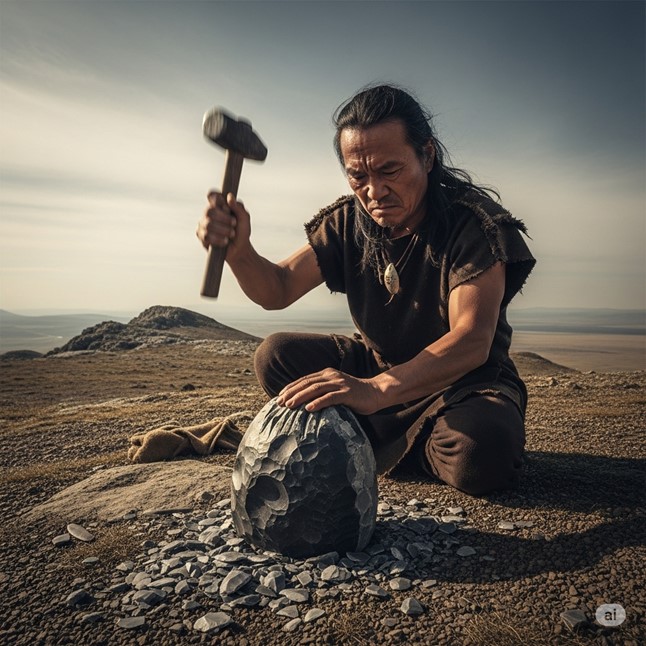
The magical power of Acheulon is not something that is summoned or cast like a spell. It is an inherent property of a perfectly crafted tool wielded with absolute purpose. A sacred hand axe, one that perfectly embodies the divine principle of form and function, is itself a magical object. The wielder does not channel power from a god; they unlock the divine potential already present in the perfect stone edge and symmetrical form.
Defensive Applications: The defensive capabilities of this faith are brutal, direct, and based on the principles of endurance, deflection, and the power of simplicity to overcome complexity.
- The Enduring Form: A hand axe that perfectly aligns with the principles of Acheulon is supernaturally durable. It embodies the permanence of stone and the timelessness of a perfect design. A wielder can use their axe to parry and block blows that would shatter steel. The divine law of perfect form within the axe makes it functionally indestructible when used to deflect an attack, turning aside blades and hammers with an unnerving solidity.
- The Deflecting Face: The precise curves and perfect symmetry of a sacred axe create a subtle distortion of space around its faces. When a warrior uses the flat of the axe to block an incoming projectile like an arrow or a javelin, this distortion will cause the projectile to be deflected wide of its mark with impossible consistency. It does not simply block the attack; it enforces a “functionally superior” path upon it, guiding it away from the wielder.
- The Unmoving Foundation: By holding their axe and focusing on its immense age and connection to the bedrock of the world, a follower can root themselves to the spot. They become as solid and immovable as the ancient stone from which their axe was born. This makes them incredibly difficult to push, trip, or knock from their feet, allowing them to hold a defensive line against a powerful charge with the stubborn permanence of a mountain.
- The Sundering Edge: This is a powerful, anti-magical defense. Followers of this path believe that complex constructions like magical spells are inherently flawed and full of unnecessary parts. By striking at an incoming magical effect—such as a fireball, a web of energy, or a ghostly illusion—with the perfect, simple edge of their axe, they can “cut” the spell apart. The axe’s perfect form acts as a disjunction edge, severing the complex magical energies from one another and causing the spell to unravel into harmless, chaotic sparks.
Offensive Applications: The offensive power of Acheulon is the raw, amplified expression of a perfect tool’s purpose. It is the magic of the ultimate cutting edge and the perfect, impactful blow.
- The Perfect Edge: The primary offensive capability of a sacred hand axe is its supernaturally flawless edge. This edge is not just physically sharp; it is conceptually sharp. It embodies the principle of division. As such, it can cut through materials that should be impossible for a stone tool to harm. It can shear through leather, mail, and even heavy plate armor as if it were mere cloth, finding the “line of separation” in all things and forcing it apart.
- The Echo of the First Strike: When striking a target, a wielder can choose to release the primal, resonant energy of the axe’s creation. The attack carries with it the psychic crack of the hammerstone striking the flint. This projects a devastating shockwave of pure, concussive force through the target, independent of the cutting edge. This resonant blow can shatter bone, rupture organs, and break a shield from the inside out, even on a glancing hit.
- Perceiving the Flaw: A master Knapper or warrior who is truly in tune with the principle of Acheulon can look at an enemy’s equipment—their armor, shield, or weapon—and perceive its “dysfunctional” elements. They are granted a moment of divine clarity where the object’s points of stress, shoddy craftsmanship, or hidden fractures become glaringly obvious. Their next attack is then supernaturally guided to strike that exact weak point, guaranteeing that the enemy’s equipment will shatter.
- The Unstoppable Cleave: A perfectly balanced hand axe, when thrown by a master with a single, clear purpose, becomes the embodiment of that intent. The axe does not merely fly through the air; it divides it. It will not deviate, tumble, or be deflected by non-magical means. It will maintain its course and its lethal spin, passing through lesser obstacles like wooden shields or leather armor as if they were not there, until it strikes its intended target.
Korr and Wood-Weavers
It is known from the time of the grandfathers’ fathers that the lands of the Chellean people were wide and empty. The clans followed the game, and their law was the law of Acheulon, which does not change. Their tool was the Hand Axe, which is the Perfect Form. And this was good.
But a new people came into the land. They came from the east, where the world is soft with too much water. They were not of the Way. They were called the Wood-Weavers, for their tools were many, and they were made of weak things bound together. They did not carry the Axe. They carried spears, which were a stick with a small stone tied to the end with gut. They carried bows, which were a bent stick and a string. Their tools were many lies tied with one string.
Of the coming of the new tribe, it was a bad thing. For they hunted the same game, and they drank from the same waterholes. A conflict was made.
At first, the Wood-Weavers had much success. Their hunters could kill a beast from far away with their arrows of stick and feather. The young warriors of the Flint-Heart Clan saw this, and doubt was a crack in a good stone. They came to their Knapper, the one who was Korr, the master of the stone’s heart.
They said to Korr, “Our way is hard. Our hunt is a close and dangerous thing. The Wood-Weavers kill with ease from a great distance. Their tools are many and clever. Our tool is one and it is old. Perhaps the Way of the Unchanging Form is now a dysfunctional way.”
Korr did not speak. He led them to the Knapping Ground. He took a nodule of black flint, a stone with great potential. He took his hammerstone. He sat. And he began to strike the flint. The sound of his work was the only answer he gave. Crack. Crack. Crack. For a full day he worked, chipping away all that was not the axe. What was left was a perfect form, a single thing of black stone, sharp and heavy and true in the hand.
He held it up for the young warriors to see. “This is one thing,” he said. His voice was like rocks grinding. “It is truth.”
Then he took a spear that was captured from the Wood-Weavers. He showed them the small, flawed point of stone. He showed them the shaft of wood, which can rot and break. He showed them the gut-string that bound them. “This is three things,” he said. “The stone is one. The wood is two. The string is three. It is a tool made of weakness, weakness, and weakness. A lie tied to a lie with a string of lies. The law of Acheulon is that one true thing is stronger than a hundred untrue things. We will see whose way is functional.”
The time of testing came at the dry riverbed. The Wood-Weavers were many, and they hid among the high rocks. They thought their position was a great advantage. The Flint-Heart Clan, led by Korr, walked into the riverbed. They held their axes in their hands.
The Wood-Weavers sent a cloud of their arrows. They were like angry insects. The young warriors of the Flint-Heart clan were afraid. But Korr and the elders were not. They held up their axes, not the edge, but the flat, wide face. The arrows came. And a strange thing happened. The arrows, which were made of three weak parts, turned aside from the axes. They broke upon the perfect form. The geometry of the axe, which is a divine thing, refused the arrows. Not one warrior of the Way was harmed.
The Flint-Heart Clan charged. They ran across the stones. The Wood-Weavers, their arrows now useless, came down from the rocks with their long spears. The battle was joined.
And the truth of the axe was a sharp truth. The spears of the Wood-Weavers were long, but they were clumsy in the close fight. When a spear met an axe, the wooden shaft shattered. The gut-string bindings broke. The flawed stone points glanced harmlessly off the warriors of the Flint-Heart Clan. Their many-part tools failed. They were dysfunctional.
But the axes of Korr’s clan, they did not fail. The Perfect Edge cut through the soft wood of the spears. It cut through the leather armor of the Wood-Weavers. It was one true thing, and its function was perfect. The defeat of the Wood-Weavers was a swift one. They fled, leaving their broken, complex tools scattered on the stones.
The young warriors of the Flint-Heart Clan saw this and their doubt was gone, chipped away like bad flint. They understood. The Way was the Way for a reason. It endures because it is functional.
Moral: A single thing that is true and strong is greater than a hundred clever things that are weak and tied together with lies.