
The Gor-Vak are the predominant race of the island nation of Chellean, a people whose physiology and philosophy are as hard and unyielding as the stone from which they draw their name and identity. They are a race defined by a deep, ideological schism; their inherent traits of endurance and craftsmanship have allowed them to become both master builders of industrial cities and peerless survivalists of the desolate wastes. Whether they are a high-tier artisan in the capital or a nomadic warrior in the badlands, they are all Gor-Vak, their stone-like skin a testament to their shared, ancient heritage.
Species, Physical Form, and Sensory Traits
- Species: Humanoid. The Gor-Vak are a distinct humanoid species whose biology has adapted to the rugged, mountainous terrain of their homeland.
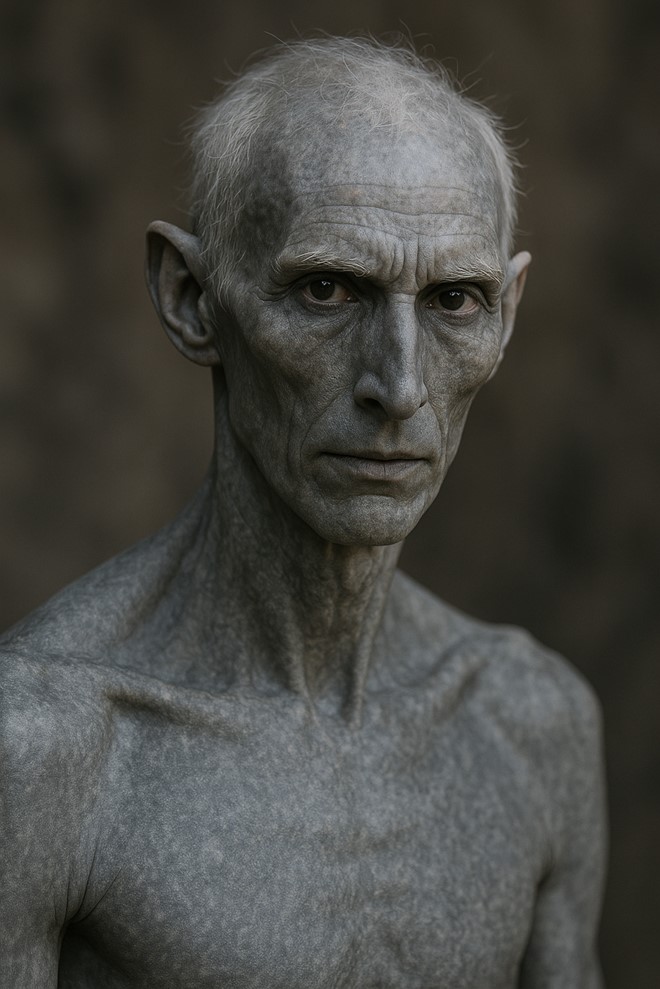
- Physical Form: Gor-Vak are notably tall and slender, with a wiry, high-endurance build. They are not heavily muscled but possess a surprising degree of functional strength. Their most striking feature is their skin, which is completely hairless, smooth, and cool to the touch, with the color and subtle texture of stone. These skin tones range from the pale white of limestone, to the mottled grey of granite, the banded tan of chert, or the smooth, deep black of flint. Their facial features are sharp and elongated, with high cheekbones and dark, piercing eyes like chips of obsidian. Most are naturally bald, though some develop sparse, stiff, white or grey hair in old age.
- Sensory Traits: Their senses are similar to those of other humanoids, but with two exceptional adaptations. They possess a flawless sense of balance, making them natural and fearless climbers on sheer cliffs or the high scaffolding of their cities. They also have a highly developed tactile sense known as Lithic Acuity. By touch alone, a Gor-Vak can read the history of a stone, discerning its composition, internal fractures, and stress points. This trait is invaluable to both the nomad knapper seeking the perfect flint and the city engineer assessing a mountain for quarrying.
General Size
The Gor-Vak are a tall and lean people.
- Average Height: 6’2″ – 6’8″ (188–203 cm)
- Average Weight: 160–220 lbs (73–100 kg)
Body Pattern
The stone-like skin of a Gor-Vak is not a uniform color. It bears subtle, natural, and unique patterns that resemble the veins and inclusions found in a slab of polished rock. A “granite-grey” Gor-Vak might have darker grey and white speckles across their body, while a “flint-black” individual could have faint, smoky grey swirls on their skin. These patterns are unique to individuals and often carry across family lines, with certain matrilineal dynasties being known for their distinctive “marble” or “banded chert” appearance.
Life Cycle
Gor-Vak are born with soft, uniformly grey skin, which slowly hardens and develops its unique stony coloration and pattern as they approach adulthood around the age of 20. As with all peoples of Saṃsāra, they are mundane as children, with their potential for magic awakening in maturity. Their upbringing determines their path; urban children are educated in engineering, architecture, and craft, while the children of the Wastes learn only survival and the sacred, singular art of flint knapping. They are a hardy people with a long lifespan, typically living for 120 to 150 years.
Potential Positives and Negatives
- Positives: Their lean physiology is incredibly efficient, allowing them to travel or work for extended periods with minimal food and water. Their innate balance and climbing skills are unmatched, making them at home in the most precarious environments. Their tough, stone-like skin provides a minor but notable resistance to scrapes, cuts, and abrasions.
- Negatives: Their slender build means they lack the raw, brute strength of more stocky peoples. Their naturally low body fat makes them vulnerable to extreme cold if they are caught without proper gear. Their pale coloration makes them highly visible and poor at camouflage in any environment that isn’t a rocky wasteland.
Tags: Gor-Vak, Humanoid, Stone-Skinned, Tall, Slender, Enduring, Pragmatic, Chellean, Nomad, Survivalist, Artisan, Engineer, Crafter, Knapper, Climber, Wastelander, Dual-Culture
Specialized Item Slots Available
The Gor-Vak’s deep connection to crafting and form allows them to utilize a unique piece of personalized gear.
- Keystone Slot: A Gor-Vak can ritually prepare a specific point on their body—often the sternum, forehead, or the back of a hand—to serve as a Keystone Slot. This area, marked by tattoos or scarification, is designed to fit a specific piece of crafted gear called a Keystone. This item, a precisely cut and inscribed piece of stone, bone, or metal, becomes a focal point for channeling the magic of their other gear. The power comes from the Keystone itself, not the Gor-Vak. An urban engineer’s iron-gear Keystone might allow them to more efficiently control a steam-powered machine, while a nomad’s flint Keystone might help them channel the magical properties of their sacred hand axe.
Environmental Adaptability
The Gor-Vak are masters of arid, rocky, and mountainous terrain. Their endurance makes them well-suited to the harsh badlands and windswept plateaus of the Chellean Wastes, and their climbing skills make them uniquely adapted to life in vertical canyons or among the massive, sky-reaching structures of their own fortified cities. They are less comfortable in lush forests or dense swamps, where their skills are less applicable.
Other Information
The Gor-Vak are a single race divided by a deep ideological rift. A Gor-Vak’s potential is a blank slate of stone; their upbringing and beliefs are the tools that shape them. A child raised in the city of Tek-Gar becomes a pragmatic artisan, seeing their stone-like skin as a mark of their mastery over the material. That same child, if raised in the Wastes, becomes a purist survivalist, believing their skin is a sign that they are the stone—the embodiment of the unchanging, perfect form. This fundamental adaptability is both the race’s greatest strength and the source of the Chellean nation’s most bitter internal conflict.
Two Sisters, Stone and Steel
It is told, from words carved on the oldest canyon walls, that there was a time when the Gor-Vak were one people. They lived under the sky and their law was the law of the stone. This was before the great city of Tek-Gar, before the schism that split the heart of the nation. In this time lived two sisters of a great matrilineal line. The elder was Lyra, whose hands knew the song of flint, and whose soul was as patient and unyielding as the granite of the mountains. The younger was Kaelen, whose eyes saw not what the stone was, but what it could become, and whose mind was a forge of new and dangerous ideas.
And so it was that a great calamity fell upon the land. A magical blight, a creeping sickness of the rock, spread through their territories. The flint, once perfect for knapping, now shattered into useless dust with every strike. The chert grew soft and crumbly. The obsidian was filled with invisible cracks. The stone, the foundation of their entire world, had become dysfunctional. The sacred craft, the Way of Acheulon, was impossible. The people could not make their tools, and without the Perfect Form, their world began to unravel.
A great council was held. Lyra, the elder, spoke with the weight of tradition. “This is a test from the principle of Form,” she said, her voice clear and hard. “The stone has found us unworthy. We have grown complacent. We have forgotten the struggle that birthed the First Axe. The only path is the path of purity. We must abandon these blighted lands, go into the deep wastes where the world is harshest, and find a new Heart-Stone, a quarry untouched by this corruption. We must prove our devotion by enduring, and the stone will reward us.”
But Kaelen, the younger, shook her head. Her skin was the color of dark iron ore, and her eyes held the spark of a new fire. “The tool has failed us because the problem is new,” she proclaimed. “To follow the old path when the world has changed is the true dysfunction! We must make a new tool. There are other stones in the mountains, soft stones that weep metal when touched by great heat. There are trees for scaffolding and rivers to turn wheels. We must not run from the blight; we must build a fortress against it. We must find a new Way.”
A great divide split the people. Those who feared change and trusted in the old truths gathered their meager belongings and followed Lyra. They walked away from their ancestral lands, a long, grim procession into the desolate, windswept plateaus of the Chellean Wastes, seeking a legend.
Those who feared stagnation and trusted in the power of their own hands followed Kaelen. They journeyed deep into the great canyons, seeking not purity, but defensible space and new materials.
Lyra’s journey was one of subtraction. Her people starved. They were hunted by beasts. They were scoured by the wind. With each trial, more of her followers perished or gave up, but those who remained grew harder, their spirits knapped into a resilience as pure as their faith. They learned the language of the wastes, the art of absolute survival. After a long and terrible journey, deep in a hidden caldera, Lyra found it: a new Knapping Ground, a quarry of flawless black flint, untouched by the blight. She had preserved the Way.
Kaelen’s journey was one of addition. Her people faced new and unknown dangers. Mines collapsed. Forges exploded with alchemical fury. Their first walls of stacked stone crumbled. But with each failure, they learned. They learned to brace a tunnel with wood. They learned to control the fire and smelt the iron from the rock. They learned to build not just a tool, but a home, a great settlement of stone that clung to the canyon walls. In time, Kaelen took a piece of refined iron, and with a steam-powered hammer, she forged a new axe—one of steel. It was not the sacred form, but it was sharp and it would not break. She had created a new Way.
Both sisters succeeded. Lyra found the heart of the stone and saved the soul of their tradition. Kaelen forged a new heart of steel and saved the body of their people. They became the founding matriarchs of the two cultures that now define Chellean—the nomadic purists of the Wastes, and the city-dwelling artisans of the mountains. It is said they never saw one another again, for a canyon of belief now lay between them, wider and deeper than any on Saṃsara.
Moral: Survival has two children, and their names are Endurance and Adaptation. One walks the old path and keeps the flame from dying. The other carves a new path and builds a house for the flame to grow. Both are right, and both will walk alone.