
Species
The Verran are a unique humanoid species whose physical form is not a constant, but a tool to be shaped. They are the living embodiment of the Aterian philosophy of pragmatic adaptation, viewing their own bodies as the ultimate instrument of survival and influence. While they are capable of assuming the likeness of other humanoid races, they possess a distinct natural form and a biological cycle deeply intertwined with their shapeshifting capabilities. As the predominant race of Aterian and the lineage of its ruling Matriarchal Monarchy, their nature has profoundly shaped the nation’s culture of cunning, espionage, and strategic subtlety.
Physical Form and Sensory Traits
In their resting or “true” state, a Verran’s form is unsettlingly minimalist. They appear as slender humanoids with smooth, featureless, hairless skin the color of unpolished, pale stone—ranging from soft grey to muted beige. Their faces lack distinct noses, lips, or ears, presenting a smooth, gently contoured surface. The only prominent features are two large, expressive eyes of a solid, liquid-dark color, like obsidian or deep slate, which are not protected by eyelids but by a transparent nictitating membrane that sweeps across the orb.
Their entire cellular structure is malleable, supported by a flexible cartilaginous skeleton that allows them to consciously control and reshape their flesh, skin tone, and features through a complex bio-alchemical process. This transformation is not instantaneous magic but a physical act of will, like a muscle being flexed. While appearing smooth, their skin is their most advanced sensory organ. It is exceptionally sensitive to minute changes in vibration and air pressure, allowing them to feel the subtle tremors of an approaching footstep through solid ground or detect the displacement of air from a nearby moving object, even in complete darkness. This trait makes them exceptional trackers and ambush predators.
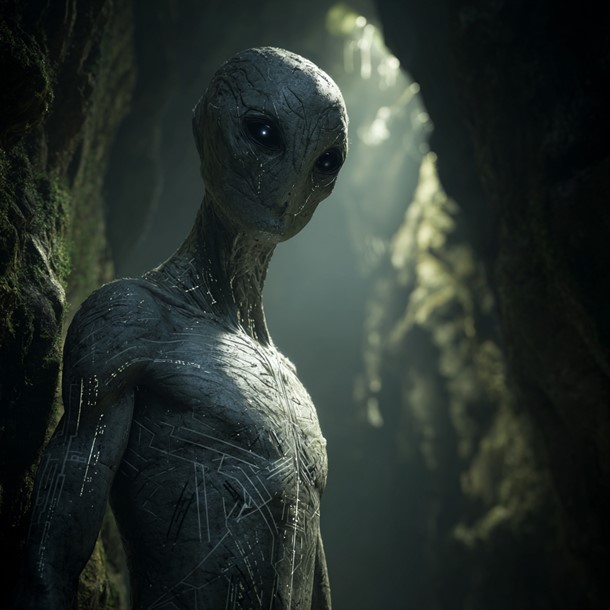
General Size and Body Pattern
Verran typically stand between 5 and 6.5 feet tall, with a lithe build that is deceptively light for their height due to their less rigid skeletal structure. In their true form, their bodies are uniform in color and texture. However, in moments of intense concentration, stress, or when channeling powerful magic through their gear, faint, intricate, silver-white patterns emerge across their skin. These unique “Kaelic Tracings” are geometric and circuit-like, forming a pattern that is as unique to each Verran as a fingerprint. These tracings are considered a glimpse into the Verran’s true, unchanging self, and their designs are often replicated in the engravings on their personal gear or the seals of their family line.
Life Cycle
Verran are born in their resting form. As children, before their magic awakens at adulthood, they lack conscious control over their abilities. A Verran child will often unconsciously mimic the faces and forms of those they spend the most time with, a trait that the Aterian society carefully manages through structured education and cultural reinforcement to teach control. Adulthood is reached upon reproductive maturity, which is when a Verran gains conscious mastery over their form and their innate connection to magic-channelling gear solidifies. Their natural lifespan averages around 150 years, with the extended period of adulthood dedicated to perfecting their craft, whether it be espionage, artistry, or leadership.
Potential Positives and Negatives due to their Physical Form
Positives:
- Unmatched Infiltration: Their primary strength is the ability to perfectly replicate other humanoid forms, making them supreme spies, diplomats, and assassins.
- Enhanced Situational Awareness: Their extreme sensitivity to vibrations provides a constant, 360-degree awareness of their immediate surroundings, making them incredibly difficult to surprise.
- Biological Utility: They can make minor physical adaptations for a task without needing a full transformation, such as elongating their fingers for delicate work, flattening their profile to hide, or altering their vocal cords to mimic sounds.
Negatives:
- Social Stigma: Many other races are deeply distrustful of the Verran, seeing their ability as inherently deceitful. This can complicate diplomacy and personal relationships with outsiders.
- Identity Dissonance: A Verran who spends too long in other forms, or who lacks a strong sense of self, can suffer from a unique psychological ailment where they struggle to remember or return to their own true form and identity.
- Vibrational Vulnerability: While their skin is a powerful sensor, it is also a point of weakness. Potent sonic attacks or sustained, ground-shaking tremors can be disorienting and physically painful to them in a way other races do not experience.
Tags: Verran, Shapeshifter, Mimic, Subterranean, Aterian Royalty, Vibration Sense, Bioluminescent, Infiltrator, Spy, Featureless Form, Stone-skin, Kaelic Tracings, Adaptive Biology, Cunning, Elusive, Pragmatist, Dermal Weave
Specialized Item Slots Available
To represent their unique biology within Saṃsāra’s gear-based magic system, Verran have access to a specialized gear slot unavailable to other races: the Dermal Weave. This is not a piece of visible armor but a complex, skin-tight undergarment or a series of inscribed subdermal implants. A Verran can shift without a Dermal Weave, but the result is crude, unstable, and temporary. The Dermal Weave is the gear that focuses their power.
- A Tier 1 Dermal Weave might be a simple harness that allows them to hold a single, inexact humanoid form for an hour.
- A Tier 5 legendary Dermal Weave could be a full-body suit of nearly invisible threads, allowing the wearer to perfectly replicate any humanoid they have studied, store multiple personas for instant recall, and even mimic the specific magical resonance of another individual’s gear.
Environmental Adaptability
The Verran are masters of adaptation. Their natural low-light vision and vibration sense make them perfectly at home in the deep, dark caverns of Aterian. When on the surface, they can shift their skin pigmentation to protect against the sun, increase their body’s water retention in arid plains, or grow a temporary, insulating layer of flesh to ward off the cold of the high mountains. This adaptability is why their people have been able to thrive in every ecological niche of their rugged island nation.
Other Information Important to this Race
As the ruling family of Aterian, the Verran have instilled their own values into the national identity. Cunning is prized above brute force, information is valued more than gold, and adaptability is seen as the highest virtue. They do not view their shapeshifting as deception, but as the ultimate expression of the Aterian philosophy: they literally become the right tool for the job. This has led to a society where espionage is a respected statecraft, and the ability to gather intelligence is a celebrated skill taught in the nation’s schools. They are drawn to Aterianism and the worship of Tarakh, as the deity’s domains of shadow, survival, and cunning align perfectly with their own inherent nature.
Lament of the Mirrored Face
It is told, in the deep histories, of the time when the Daughter of the Matriarch, whose name was Kaelen, had not yet earned the tracings of her station. The great cavern-city of Shadowdeep was in discourse with a lord from the sun-drowned lands, a man called Valerius, whose wealth was like a river and whose words were as sweet as honeyed fruit. He came with promises of trade, of wood that would not rot and grains that grew in light, things of great need for the people of the stone.
The Matriarch, whose eyes saw the echoes of things and not just the things themselves, summoned Kaelen to the Obsidian Throne. She spoke, her voice a low tremor. “That which this Valerius shows us is a pleasing face, a well-made mask. But the strength of a spear is not in its polished head, but in the unseen tang that joins it to the haft. You are my daughter. Your face is your first and greatest tool. Go now, and become a shadow on his wall. Wear the face of his least servant, and bring to me the shape of his true heart.”
And so, Kaelen did undertake the task. She observed a serving girl of Valerius’s retinue, a creature of small note. She drank the image of this girl with her stone-sight, learning the bend of her back and the cast of her eyes. In the cloistered dark of her chamber, Kaelen performed the change. Her flesh was as clay on a potter’s wheel, and she molded her visage and her form until the serving girl was looking back from the mirrored crystal. She had become the mask.
In this borrowed skin, Kaelen brought wine and took away plates for the Lord Valerius. Verily, his public countenance was one of grace. He spoke kindly to those who served him, and his laughter was a music that filled the high-vaulted guest chambers. Kaelen’s feeling-heart, which is a treacherous organ in the young, began to soften. She saw a good man, and the purpose of her vigil became a heavy stone. She thought, “Surely, the Matriarch sees a false echo where there is none.”
But the command of the Matriarch was an iron chain upon her duty. For many turnings of the steam-clocks, she watched and she listened. Then came a night when Lord Valerius believed all his servants slept and the eyes of the world were closed. He stood before a whispering stone, a device of the sun-drowned lands, and his face became un-made. The smile fell from it like a discarded cloak, and the warmth in his eyes was but a dying ember. His true face was a thing of cold calculation.
Kaelen, hidden in the alcove of shadows, heard his true voice speak to the stone. “The faceless ones of the caverns take the bait,” the voice hissed, a sound like grinding rock. “They believe my friendship is a treasure. The first shipment of grain is prepared. Its inner spirit is blighted with a creeping dust that will sour their fungus farms and make them weak. Within a year of seasons, they will starve in their dark holes, and they will beg for my grain at any price. This rock and all its people will be but a jewel in my collection.”
The feeling-heart of Kaelen turned to ice, but her purpose-heart beat like a forge hammer. The mask of the serving girl did not crack. She waited until the lord slept, then slipped away through the silent passages, back to the Obsidian Throne. She stood before her mother, the Matriarch.
“He is a serpent,” Kaelen said. The Matriarch nodded slowly. “Show me his rattle,” she commanded.
Kaelen closed her great, dark eyes. She let the face of the serving girl melt away. Her flesh flowed and reset, not into her own resting form, but into the visage of Lord Valerius. It was not the charming face he showed the court, but the cold, cruel mask he wore when he believed he was alone. From her mouth came his voice, his exact tone of contempt. She spoke his words of blight and ruin, of the creeping dust and the starving dark. She did not merely report the truth; she became its living vessel.
At the next gathering, when Lord Valerius came to sign the treaty of friendship, the Matriarch denied him. When he feigned shock and hurt, the Matriarch gestured to her daughter. Before the entire court, Kaelen transformed into the cruel-faced Valerius and spoke his treason for all to hear. There was no argument, for the court saw not an accusation, but a perfect reflection of the man’s hidden soul. His true face had been brought into the light, and he was cast out from Aterian, his ships turned back with haste. Kaelen had saved her people not with a blade, but with a face.
The moral of this telling is thus: A pleasing face is a common mask, but the true face is seen only when the eyes of the world are closed. To know a soul, do not watch their mouth; watch their shadow when they believe they are alone.