
Original Life Forms:
- Class Aves: Shoebill Stork (Balaeniceps rex)
- Class Reptilia: Gila Monster (Heloderma suspectum)
- Class Insecta: Praying Mantis (Mantis religiosa)
- Class Cephalopoda: Common Cuttlefish (Sepia officinalis)
Appearance: The Helocēpiman is a stout, low-profile quadruped with a distinctly reptilian build, reminiscent of a Gila Monster. Its body is covered in thick, bead-like osteoderms that give it a rough, armored texture. However, this skin possesses chromatophores derived from its cuttlefish ancestry, allowing it to shift its color and texture with startling speed, blending almost perfectly into its surroundings. Instead of normal forelimbs, it brandishes two large, raptorial legs like those of a Praying Mantis, folded tightly against its body and serrated for gripping prey. Its head is disproportionately large, dominated by the massive, sharp-edged, hook-tipped beak of a Shoebill stork. Its eyes are its most unsettling feature: large and forward-facing, with strange, W-shaped pupils that seem to pulse with a faint, internal luminescence. A short, undulating fin, like a cuttlefish’s, runs along its flanks, aiding in stabilization and subtle movements in water.
Size: The Helocēpiman is a dense, heavy creature, roughly the size of a large boar. It typically stands 3 to 4 feet tall at the shoulder and measures 5 to 7 feet in length from its beak to the tip of its thick, reptilian tail. An adult weighs between 250 and 350 pounds, most of which is solid muscle and bone.
Speed: This creature is not built for pursuit. Its standard movement is a slow, deliberate, and lumbering walk. However, it is capable of explosive bursts of speed over very short distances. From a standstill, it can lunge forward with terrifying quickness to strike with its raptorial limbs, but it cannot maintain this pace for more than a few seconds.
Stat Modifiers
- Strength: High
- Perception: High
- Agility: Low
- Intellect: Low (Feral)
- Charisma: Low
Skills
- Stealth: The creature’s adaptive camouflage makes it exceptionally skilled at hiding and remaining unseen, even in semi-open terrain.
- Perception: Its keen, unblinking eyes and ability to remain motionless for hours make it highly observant of its environment.
- Grapple: Its serrated, mantis-like forelimbs are designed for seizing and holding prey with immense force.
- Intimidation: Its bizarre and monstrous appearance is naturally terrifying to most other life forms.
Behavior: The Helocēpiman is a solitary ambush predator. It spends the vast majority of its time in a state of utter stillness, perfectly camouflaged against rocks, mud, or rotting vegetation, waiting for prey to wander into its strike range. It uses its hypnotic, W-shaped pupils to momentarily mesmerize a target, causing a brief hesitation. In that instant, it strikes, lunging forward to seize the victim with its raptorial legs before dispatching it with its powerful, crushing beak. It is extremely territorial and will aggressively attack any creature that intrudes upon its chosen hunting ground.
Diet: This life form is a hypercarnivore. Its diet consists of any creature it can overpower, including large fish, marsh birds, unwary beasts, and even isolated avatars. Its powerful beak can shatter carapaces and bone with ease. The creature also possesses a mild neurotoxin in its saliva, inherited from its Gila Monster ancestry, which helps to subdue larger or more resilient prey that isn’t killed by the initial strike.
Emotions: As a feral creature, the Helocēpiman operates purely on instinct. Its emotional range is limited to primal states necessary for survival. It displays cold, patient hunger while waiting, explosive aggression when striking or defending its territory, and cautious fear if it encounters a significantly more powerful threat. It does not exhibit complex emotions such as companionship, joy, or sorrow.
Environment Where Found: The Helocēpiman thrives in murky, cluttered, and wet environments where its ambush tactics are most effective. It is most commonly found in swamps, dense jungles with muddy terrain, mangrove forests, and the marshy floodplains of large rivers. It uses murky water and dense vegetation as cover, often submerging most of its body while leaving only its unsettling eyes and beak visible above the surface.
Tags: Feral, Magical Beast, Reptilian, Avian, Insectoid, Cephalopod, Ambusher, Camouflage, Venomous, Hypnotic Gaze, Territorial, Swamp Dweller, Carnivore, Armored Hide, Crushing Beak, Raptorial Limbs, Quadruped, Neurotoxic Bite, Patient Hunter, Chromatophore Hide, Explosive Lunger, Mesmerizing Gaze
Age: The typical lifespan of a Helocēpiman in the wild is between 25 and 35 years. Its life is divided into four distinct stages.
- Hatchling: The creature begins life by hatching from a clutch of 2-3 tough, leathery eggs. As a hatchling, it is roughly the size of a small cat, highly vulnerable, and its chromatophores are not fully developed, providing only mottled, rudimentary camouflage. Most do not survive this stage, falling prey to other swamp predators.
- Juvenile: From its second year until its fifth, the Helocēpiman is a juvenile. During this time, it is highly aggressive and unpredictable as it learns to master its hunting abilities. It is forced to actively hunt smaller, faster prey as it is not yet large enough to effectively ambush bigger targets. Many young Helocēpimans are killed by older, established adults during territorial disputes.
- Adult: From age five onward, the creature is a fully mature adult. It has reached its full size and weight, and its adaptive camouflage is perfected. In its prime, it is a master of its territory, a patient and terrifyingly effective ambush predator.
- Elder: After about 20 years, the creature enters its elder stage. Its explosive speed begins to decline, and its chromatophores may not respond as quickly, making its camouflage less perfect. It relies more on its size, fearsome reputation, and accumulated cunning to hunt, often targeting slower, easier prey. Most elders are eventually killed and supplanted by younger, stronger adults.
Mating: The Helocēpiman is a solitary creature that interacts with its own kind only during a brief, annual mating season, which typically coincides with the height of the rainy season in its swampy environment. The mating ritual is a silent and mesmerizing display of light. A male will find a prominent clearing in its territory and use the chromatophores in its hide to produce complex, strobing, and undulating patterns of light across its body. This display is complemented by the hypnotic, gentle pulsing of its luminescent, W-shaped pupils.
Females are drawn to these displays from surrounding territories. They judge the fitness of a potential mate by the intensity, complexity, and rhythm of his light patterns. Males do not engage in physical combat, as it would be mutually destructive; their competition is purely aesthetic. After a female chooses the most impressive male and they mate, the pair separates immediately. The female then finds a secluded, muddy embankment or a hollowed-out log to lay her clutch of eggs. She guards the nest with extreme aggression until they hatch, at which point she abandons the hatchlings to their fate.
Tactics: The Helocēpiman is the consummate ambush predator, and all of its tactics revolve around this singular strategy.
- Ambush Site Selection: It will select a hunting ground with a high volume of traffic, such as a narrow game trail alongside a bog, a popular watering hole, or a shallow ford in a river.
- Concealment: The creature settles into its chosen position and uses its Chameleonic Hide, remaining perfectly motionless for hours or even days at a time. It matches the color and texture of its surroundings—be it mud, stone, tree bark, or murky water—so flawlessly that it becomes nearly invisible to conventional sight.
- Mesmerizing Gaze: When suitable prey wanders within its strike range (typically 10-15 feet), the Helocēpiman focuses its gaze. It subtly shifts and pulses the light within its alien eyes, creating a disorienting, hypnotic effect that can cause a target to freeze in confusion for a critical second.
- The Strike: In that moment of hesitation, the creature explodes from its position in a devastatingly fast lunge. Its primary aim is to use its Raptorial Snare, seizing the prey with its two serrated forelimbs. The grip is like a vice, preventing escape.
- The Kill: Once the target is immobilized, the massive, sharp-edged beak delivers a single, powerful Crushing Bite, usually aimed at the head or spine to end the struggle instantly. For larger prey, the neurotoxic saliva delivered by the bite ensures a quick and quiet death.
Actions
- Crushing Bite: The Helocēpiman lunges forward to bite a single target with its massive beak. This action is designed to shatter bone and carapace and delivers a debilitating neurotoxin.
- Raptorial Snare: The creature uses its two serrated forelimbs to seize and grapple a target. Once grappled, the target is held fast and drawn closer for a Crushing Bite.
- Mesmerizing Gaze: The creature can focus on a single target within short range. The target becomes momentarily disoriented and confused, unable to act for a brief instant unless it can resist the effect.
- Chameleonic Hide: While stationary, the creature can take a moment to activate its chromatophores, blending into its immediate surroundings and becoming extremely difficult to detect.
- Threat Display: If threatened, the creature can flash a rapid series of startling, aggressive color patterns on its hide while emitting a loud, grating hiss. This is an attempt to intimidate a foe into retreating.
Other Interesting Information
- Prized Reagent: Internally, the Helocēpiman possesses a large, porous spinal plate, an evolutionary holdover from the cuttlebone of its cephalopod ancestor. This “dermal plate” is incredibly light but stronger than wood, and it is highly sought after by alchemists as a potent filter for potions and by artisans as a material for crafting lightweight yet durable magical wands and foci.
- Magical Resonance: The bead-like osteoderms covering its body have a unique property: they subtly resonate with the ambient magic of the environment. This resonance is believed to be what allows its camouflage to be so supernaturally effective, as it not only matches the light and texture of its surroundings but also its faint magical aura.
- Extreme Territoriality: The creature’s territorial instincts are absolute. Outside of the mating season, any encounter between two adults invariably leads to a short, violent confrontation that ends in the death of one. The victor will almost always consume the loser, leaving no part of the valuable biomass to waste.
- Beak Sharpening: A Helocēpiman’s beak grows continuously throughout its life. To maintain its sharp, lethal edge, the creature establishes several “sharpening stones” within its territory. These are typically large, abrasive crystalline rock formations against which it will grind its beak for hours at a time. Locating one of these stones is a sure sign that an adventurer is deep within the lair of one of these dangerous beasts.
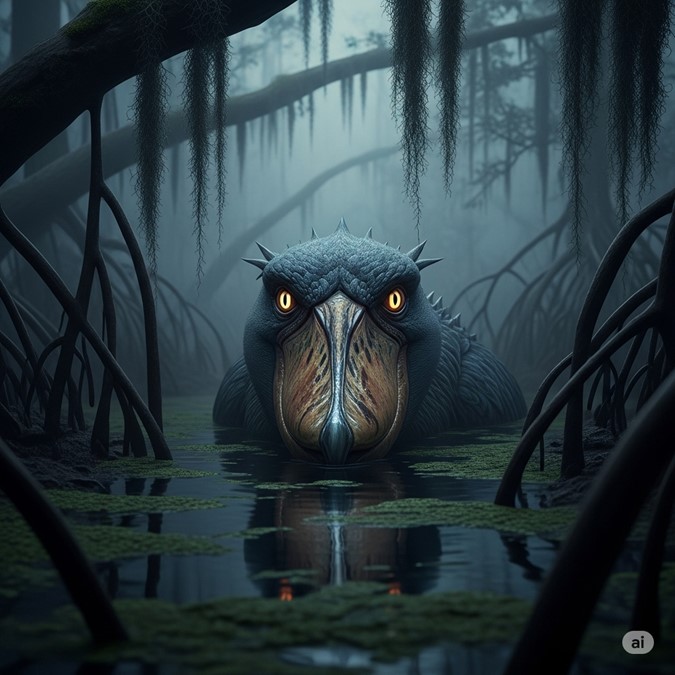
An encounter with a Helocēpiman 41 is never a trivial matter. As a feral, solitary, and supremely effective apex predator, it does not roam or migrate; it claims a territory and eliminates anything within it that it perceives as a threat or food. Therefore, a party of adventurers would face one under two general circumstances: either they have intentionally entered its hunting grounds with the express purpose of finding it, or they have trespassed into its domain unknowingly and are now being stalked.
Quests of the Hunt (Searching)
A party would be hired or motivated to deliberately seek out a Helocēpiman for the rare and potent components that can be harvested from its body. Such quests are notoriously dangerous and command a high reward.
- The Alchemist’s Reagent: An Alchemist’s Guild posts a lucrative contract for an intact “dermal plate,” the creature’s internal cuttlebone-like structure. This plate is a legendary material, prized for its ability to filter magical impurities, making it an essential component for crafting high-tier potions or purifying corrupted ley lines. The quest would require the party to defeat the beast while taking care not to shatter the valuable plate.
- The Assassin’s Cloak: A spymaster or the leader of an assassins’ guild desires the ultimate camouflage. They believe the chromatophore-rich hide of a Helocēpiman can be crafted into gear that offers a near-supernatural ability to blend into surroundings. The party would be tasked with hunting a prime specimen and carefully skinning it, a difficult task given the creature’s aggressive nature and armored skin.
- The Antitoxin Imperative: A noble, a guild master, or perhaps a whole village on the edge of a swamp has been afflicted by a creeping magical paralysis. A healer determines the cause is a lesser creature whose venom has grown more potent due to the magical nature of the swamp. The only known catalyst for a powerful enough antitoxin is the fresh neurotoxic saliva of the swamp’s apex predator—the Helocēpiman. The mission becomes a desperate race to extract the venom from a living creature or one that has just been killed.
- A Weapon of Legend: A master weaponsmith, seeking to create a signature piece for a wealthy client, needs the materials to craft a peerless grappling weapon. The serrated, impossibly hard raptorial limbs of the Helocēpiman are the only material suitable for the design. The party must hunt the creature and return with its two primary forelimbs intact.
Incidents of Intrusion (Encountering)
More often than not, adventurers would find themselves facing a Helocēpiman not by choice, but by misfortune. Stumbling into the territory of a patient, invisible killer is a deadly risk for any who travel through the wilds.
- The Blocked Path: The party needs to reach an ancient ruin, a hidden laboratory, or a sacred grove located deep within a dense swamp or jungle. After days of travel, they find that the only viable path has become the heart of a Helocēpiman’s hunting ground. They can see the tell-tale signs—half-eaten carcasses, strange tracks, and an unnerving silence. Their choice becomes simple and grim: turn back and abandon their quest, or attempt to cross the territory of a monster that is already aware of their presence.
- The Missing Person: A cartographer, a team of alchemists, or a child from a nearby village has wandered into the fens and vanished. The party is hired for a search-and-rescue mission. As they track the missing person deeper into the murky terrain, they begin finding personal effects and signs of a violent struggle. They soon realize they are not just searching for a person, but are being actively stalked by the thing that took them, turning a rescue mission into a desperate fight for survival.
- The Flooded Lair: Adventurers exploring a sunken temple or a flooded cave system might believe they have found a secure place to rest. They make camp, unaware that the ruin is the chosen lair of a Helocēpiman. The encounter begins when the creature returns from a hunt, blocking the only exit and trapping the party inside. It becomes a terrifying game of cat and mouse in a dark, confined space with a monster that can blend in with the watery shadows and stone walls.
- Ecological Disruption: A swampland ecosystem is thrown into chaos. Lesser monsters, beasts, and even sentient swamp-dwellers are fleeing the area in droves, creating problems for nearby settlements. A local warden or shaman hires the party to investigate the source of the disruption. Their investigation leads them to the discovery of an unusually large and aggressive Helocēpiman that has recently claimed the swamp, its voracious appetite upsetting the delicate balance. The party must then act as exterminators to restore order to the region.
Beyond the more commonly sought-after components like the dermal plate or hide, nearly every part of a Helocēpiman 41’s corpse is valuable to skilled artisans, alchemists, and enchanters. A thorough and careful harvest can yield a treasure trove of rare and potent ingredients.
- Item: Crusher Beak Shards
- Use: The beak is too dense to be easily worked, but it can be shattered into smaller pieces. These shards, when ground into a fine powder, create an unparalleled abrasive agent known as “Crusher Dust.” Gemcutters and lens grinders use this dust to shape and polish extremely hard magical crystals without risk of fracture. Alchemically, Crusher Dust is a key ingredient in oils and potions designed to sunder armor or dissolve stone, as its physical properties disrupt structural integrity on a microscopic level.
- Item: Luminescent Lenses
- Use: The unique, W-shaped lenses from the creature’s eyes can be carefully extracted and preserved. These are natural magical-optic components. When set into goggles, visors, or helmets by a skilled artificer, they grant the wearer exceptional clarity in low-light conditions. More importantly, they allow the user to more easily perceive the subtle shimmer of active magical auras and illusions, as the lenses naturally refract and focus ambient magical energy.
- Item: Metachromatic Ink Sac
- Use: The creature retains a potent ink sac from its cephalopod ancestry. The thick, viscous fluid within is not for concealment, but for communication and enchantment. It is filled with dormant chromatophores that react to magical stimuli. Scribes use this “Metachromatic Ink” to write contracts where hidden clauses are revealed only under the light of a specific spell. Enchanters can paint shifting, illusory runes that change their appearance based on who is looking at them or what time of day it is.
- Item: Resonant Osteoderms
- Use: The individual bead-like scales can be carefully pried from the hide. These bony nodules are known to subtly vibrate in sympathy with magical fields. When inlaid into the grips of magical staves, alchemical tools, or the control levers of steam-driven machinery, they provide tactile feedback to the user. An avatar might feel a gentle hum when a spell is cast correctly or a jarring vibration if a magic circuit is about to overload, making them invaluable for delicate work.
- Item: Raptorial Tendons
- Use: The powerful tendons controlling the creature’s explosive forelimbs are incredibly tough and elastic. They are highly valued by both weapon smiths and engineers. A bowyer can fletch a bow with these tendons to create a weapon with a devastatingly fast and powerful draw. In mechanical applications, they are used as superior-quality tension springs in clockwork devices, traps, and alchemically-powered firearms, able to store and release kinetic energy far more efficiently than metal.
- Item: The Patient Heart
- Use: The heart of a creature that can remain perfectly still for days on end is believed to be imbued with an essence of extreme stability and focus. When prepared in a ritual broth or dried and consumed as a powder, it can grant an avatar a temporary but intense resistance to fear, panic, and mental distraction. Alchemists render it into potent “Potions of Focus,” highly valued by marksmen and spellcasters who require unwavering concentration.
- Item: Alkahest-Resistant Stomach Lining
- Use: The lining of the creature’s primary digestive organ is a tough, leathery membrane renowned for its extreme resistance to corrosion. It can withstand the creature’s own neurotoxin and the powerful digestive acids needed to break down shells and bone. Alchemists use this material to create indestructible pouches for carrying volatile reagents, to line beakers used in dangerous experiments, or even as a component in shields and armor to grant resistance against magical acid.
Mud-Witch and Beak of Envy
Hear now the telling, which was scraped from a turtle’s shell, of a truth that was already old. This telling is of the Great Fen, a place where the air is water and the water is earth, and of the village of Reedsollow that sat by its edge, trembling.
In the Fen there lived a creature, and to speak its name was to invite its attention, so the people called it only the Stillness in the Reeds. It wore the skin of the world, and the eye could not find its seam. One moment there was a mossy log, and the next moment that log had eyes of hateful light. One moment there was a patch of dark water, and the next moment that water had a beak that could shatter a man’s bones like dry twigs. The Stillness in the Reeds did not hunt, for hunting is a movement. It simply waited, and the world came to it, and was ended. The fishermen who poled their skiffs too near the mangroves vanished. The children who sought the sweet bog-iron vanished. The Fen grew quiet, for the Stillness had eaten all the sound.
The Elders of Reedsollow, their faces maps of worry, promised a great reward to any who could deliver them from this hunger. First came the brothers Joric and Kal, whose arms were as thick as pythons and whose hearts held great fire. They took their iron spears and pushed their boat into the domain of the Stillness. They did not return. The Fen gave back only a splintered pole, and the silence grew deeper.
Next came a hunter from a far-off city, an avatar who wore gear that shone with tiers of power. He boasted that his eye could see the unseen and his arrows flew faster than thought. He walked into the Great Fen at dawn, promising to return by dusk with the creature’s hooked beak. The sun set, and the moon rose, and the sun rose again. The Fen gave back nothing, and the hunter’s boast was eaten by the silence.
The people despaired. Their world had shrunk to the edge of the reeds, and the Fen, which had fed them, was now their tomb.
There lived in the village an old woman named Melle, whom the children called the Mud-Witch for she spoke more to the frogs and the mud than to people. Her back was bent, and her skin was the color of the riverbank. The villagers had long ignored her, for her wisdom was not of iron or of the shining gear of avatars, but of listening. Melle had watched the brave ones go into the Fen, and she had watched the Fen keep them. She knew you could not stab a shadow or shoot an idea.
She went to the Elders and spoke in a voice like dry leaves skittering. “The Stillness is a king,” she said. “And a king’s greatest flaw is his crown. He cannot bear another king in his land.” The Elders did not understand her words, and they dismissed her.
So Melle did what she knew. She did not take a spear. She took a clay pot sealed with beeswax. She traveled for three days, walking the long way around the Great Fen, to the swamps on the other side of the ridge. It was a foul place, and she knew from the stories of her grandmother that another Stillness lived there. She did not go into that swamp. She was old, but she was not a fool. She crept near the edge, where the air tasted of dread, and she scraped into her pot the mud where this second beast had walked. She gathered the feathers of a heron it had killed, and a scale from a garfish it had left half-eaten. She sealed the pot, which now held the scent of a king, the very proof of another’s dominion.
She returned to Reedsollow, her work a great secret. Under the cover of a moonless night, the old woman crept to the edge of the Great Fen. She did not enter. She only walked the perimeter, from one end of the village’s dread to the other, and with a stick, she smeared the foul, scent-laden mud from her pot onto the trunks of the mangrove trees. She had drawn a line. She had delivered a challenge.
Then she returned to her hut, and she waited.
For a day, there was only the usual silence. But on the second morning, a sound came from the Fen that the people had never heard. It was not a sound of hunger, but of rage. It was a grating, screaming hiss that was the sound of stone being broken. The Stillness in the Reeds, the patient waiter, was no longer still. Its perfect camouflage was abandoned. It thrashed through the water, its great beak snapping at the air. It had smelled the scent of a rival. Its kingdom had been invaded. Its territorial fury, the one emotion stronger than its patient hunger, had consumed it.
The creature, blinded by its royal rage, left the deep Fen. It followed the scent Melle had laid, seeking the challenger who dared to claim its land. It crashed through the reeds, its form fully visible for the first time, a monster of mismatched parts and singular purpose. The warriors of the village, seeing the beast so exposed and so witless with anger, were able to do what the great heroes could not. They ambushed the ambusher. Their arrows found its strange eyes, and their spears found the joints in its armored hide. The beast, which had been an unsolvable riddle, was now just a thing of fury, and it died among the reeds, its beak still seeking the phantom king who had stolen its peace.
The moral of this telling is thus: You cannot defeat a monster by matching its strength, but by understanding its single, secret weakness, for even the greatest king will abandon his castle to fight a shadow he believes is wearing his crown.
Suggested conversions to other systems:
Dungeons & Dragons (5th Edition)
The Fen Mantibill Large monstrosity, unaligned
Armor Class 16 (natural armor) Hit Points 114 (12d10+48) Speed 20 ft., swim 30 ft.
STR 18 (+4), DEX 12 (+1), CON 18 (+4), INT 3 (-4), WIS 14 (+2), CHA 7 (-2)
Skills Perception +5, Stealth +7 Senses Darkvision 60 ft., Passive Perception 15 Languages — Challenge 5 (1,800 XP) Proficiency Bonus +3
Ambusher. The mantibill has advantage on attack rolls against any creature it has surprised.
Chameleonic Hide. The mantibill has advantage on Dexterity (Stealth) checks. When the mantibill is motionless in swampy or jungle terrain for at least 1 minute, it becomes invisible. It remains invisible until it moves, takes an action, or uses a reaction.
Raptorial Grip. The mantibill has two raptorial claws. A creature grappled by the mantibill is also restrained.
Actions
Multiattack. The mantibill makes two attacks: one with its Beak and one with its Claws.
Beak. Melee Weapon Attack: +7 to hit, reach 5 ft., one target. Hit: 11 (2d6+4) piercing damage, and the target must make a DC 15 Constitution saving throw. On a failed save, the target takes 10 (3d6) poison damage and is poisoned for 1 minute. On a successful save, the target takes half as much poison damage and is not poisoned.
Claws. Melee Weapon Attack: +7 to hit, reach 10 ft., one target. Hit: 13 (2d8+4) slashing damage, and the target is grappled (escape DC 14). Until this grapple ends, the mantibill cannot use its claws on another target.
Mesmerizing Gaze (Recharge 5-6). The mantibill targets one creature it can see within 30 feet. The target must succeed on a DC 13 Wisdom saving throw or be stunned until the end of its next turn.
Call of Cthulhu (7th Edition)
Murk-Billed Horror A silent, patient predator of forgotten swamps and stagnant waterways.
Characteristics: STR 90, CON 80, SIZ 85, DEX 45, INT 25, POW 60
HP: 16 Av. Damage Bonus: +1d6 Build: 2 Move: 6 Sanity Loss: 1/1d8 Sanity points to see the Murk-Billed Horror erupt from its camouflage to attack.
Attacks
- Fighting (Brawl) 65%
- Crushing Beak: 65%, damage 1d10+1d6 plus Venom.
- Raptorial Limbs: 65%, damage 1d6+1d6 and Grapple. A creature grappled is held fast; on subsequent rounds, the Horror can automatically inflict damage with its Beak.
- Dodge 25%
Special Abilities
- Perfect Camouflage: When the Horror is motionless in its swampy environment, it is effectively invisible. Investigators must succeed on a Hard Spot Hidden roll to notice any sign of it before it attacks. It always gains one bonus die on its first attack from ambush.
- Hypnotic Gaze: The Horror may fix its gaze on one investigator who can see its eyes. The investigator must succeed in an opposed POW roll. If the investigator fails, they are mesmerized and cannot take any actions for one round. The Horror gains one bonus die on its next physical attack against that investigator.
- Venom: An investigator damaged by the Crushing Beak must make a CON roll. If they fail, they take an additional 1d6 points of damage at the end of each round from a fast-acting neurotoxin. This continues until medical attention is provided or the character succeeds on a CON roll at the end of a round.
Blades in the Dark
The Canal-Claw Horror A terrifying predator whispered to inhabit the deepest, most polluted canals of Doskvol. Some say a mad philosopher created one; others say it slithered out of the Void Sea.
Threat: A Tier III supernatural terror. Dangerous, solitary, and territorial. Qualities: Savage, Stealthy, Patient, Alien.
Drives:
- To defend its chosen canal or cistern territory.
- To ambush and consume anything that intrudes.
- To remain unseen until the moment of attack.
GM Actions / Moves:
- Meld into the Grime: The Horror disappears into the murky water, greasy brickwork, or piles of refuse. It cannot be seen.
- Erupt from Hiding: It attacks from surprise, inflicting terrible harm (e.g., Level 3 Harm “Impaled” or Level 4 Harm “Shattered Limb”).
- Fix with its Dead-Light Eyes: A character who meets its gaze hesitates, overcome with a primal dread. They suffer -1d to their next action unless they resist the consequence with a Resolve roll.
- Seize with Serrated Claws: It pins a character, trapping them against a wall or dragging them underwater. Start a 4-segment clock labeled “Dragged into the Depths.”
- Venomous Bite: Harm inflicted by its beak is toxic. Start a 4-segment clock labeled “Succumbing to Toxin,” representing paralysis or agonizing death.
Knave (2nd Edition)
Mantis-Beak A heavily armored swamp predator that mimics its surroundings before striking.
HD 6 Armor 16 Morale 10 Attack Beak/Claws +4 (1d10)
- Ambush Predator: When attacking a surprised target, its attack deals double damage.
- Perfect Camouflage: When motionless in its swampy environment, it is invisible. Characters must win a contested Wisdom saving throw to spot it before it attacks.
- Venomous Beak: A character taking damage from its beak must pass a Constitution saving throw or take an additional 1d6 damage and suffer disadvantage on all Strength-based actions for the next hour.
- Mesmerizing Gaze: As its action, the Mantis-Beak can force one character that can see its eyes to pass a Wisdom saving throw. On a failure, the character is paralyzed and cannot act for one round.
- Grappling Claws: If its attack roll with its claws succeeds by 5 or more, the target is also grappled.
Pathfinder (2nd Edition)
Bog Stalker This patient, territorial predator blends perfectly into its swampy environs, using a hypnotic gaze to fix its prey before erupting from its cover to attack. Creature 5 N Large Animal Beast
Perception +14; low-light vision Skills Athletics +13, Stealth +15 Str +4, Dex +2, Con +5, Int -4, Wis +3, Cha -2
AC 22; Fort +14, Ref +11, Will +12 HP 85
Speed 20 feet, swim 30 feet
Melee [one-action] Beak +15 (deadly d10), Damage 2d8+6 piercing plus Bog Stalker Venom Melee [one-action] Claw +15 (agile, reach 10 feet), Damage 2d6+6 slashing plus Improved Grab
Bog Stalker Venom (poison) Saving Throw DC 22 Fortitude; Maximum Duration 6 rounds; Stage 1 1d6 poison damage and flat-footed (1 round); Stage 2 1d6 poison damage and slowed 1 (1 round).
Ambush Strike [two-actions] The Bog Stalker Strides up to its Speed and makes a Strike at the end of its movement. If it was hidden from its target at the start of this action, it gains a +2 circumstance bonus to its attack roll, and the target is flat-footed against the attack.
Mesmerizing Gaze [one-action] (enchantment, mental, visual) The Bog Stalker fixes its gaze on a creature within 30 feet. The target must succeed at a DC 22 Will save or be stunned 1. On a critical failure, the target is stunned 2.
Perfect Camouflage The Bog Stalker can Hide without being concealed or having cover as long as it is in swamp or jungle terrain. It gains a +4 circumstance bonus to Stealth checks to Hide in such environments.
Fate Core
The Stillness That Hungers A creature of absolute patience and explosive violence, the apex predator of its domain.
High Concept: Terrifying Swamp Ambush Predator Trouble: Driven by Absolute Territoriality
Other Aspects:
- Perfect, Living Camouflage
- Eyes that Mesmerize and Terrify
- A Beak That Shatters Bone
Skills
- Superb (+5):
- Great (+4): Stealth
- Good (+3): Fight, Physique
- Fair (+2): Notice, Provoke
- Average (+1): Athletics
Stunts
- Erupt from Ambush: Because I have Perfect, Living Camouflage, I get a +2 to my first Fight attack when I break cover to attack a target that was unaware of me.
- Raptorial Snare: When I succeed with style on a Fight attack to Create an Advantage by grappling a target, I can attach the Pinned and Helpless aspect with a second free invoke.
- Venomous Bite: When I successfully inflict a physical consequence with a Fight attack, the target must also overcome a Good (+3) Physique roll or the consequence is infused with a Debilitating Neurotoxin aspect.
Stress ▢▢▢ Consequences Mild, Moderate, Severe
Savage Worlds Adventure Edition
The Fen Horror A chimerical beast that stalks the forgotten fens, its gaze the last thing most trespassers ever see.
Attributes: Agility d6, Smarts d4(A), Spirit d8, Strength d10, Vigor d10 Skills: Athletics d8, Fighting d8, Notice d8, Stealth d10 Pace: 4; Parry: 6; Toughness: 9 (2)
Special Abilities:
- Armor +2: The creature’s hide is thick and beaded like stone.
- Aquatic: Pace 6 in water.
- Camouflage: The Horror gains a +4 bonus to Stealth rolls in its native swamp environment. When attacking from a hidden state, it gains The Drop on its opponents.
- Claws: Str+d6. On a raise with its Fighting roll, the Horror grapples its target.
- Crushing Beak: Str+d8.
- Mesmerizing Gaze: As an action, the Horror can make a Test against a target within 12″. It uses its Spirit for this roll. If successful, the target is Distracted or Vulnerable. On a raise, the target is also Shaken.
- Poison: Any target Shaken or Wounded by the Horror’s Beak attack must make a Vigor roll or suffer a level of Fatigue.
Numenera & Cypher System
Chameleonic Mawslink [Level 5] A bio-engineered predator that has gone feral, perfectly adapted to the swamps and ruins it now calls home. Its hide ripples with shifting colors, and its gaze can lock the mind in place.
Level: 5 Health: 20 Damage Inflicted: 5 points Movement: Short
Modifications: Stealth as level 7. Resists poison as level 6. Combat: The Mawslink can make two attacks (one with its beak and one with its raptorial claws) as a single action. The difficulty of the defense roll for the second attack is decreased by one step. The Mawslink’s attacks are piercing and slashing.
Special Abilities:
- Ambuscade: If the Mawslink attacks a creature that was unaware of it, the difficulty of the defense roll is hindered by two steps.
- Hypnotic Gaze: As its action, the Mawslink can lock its gaze on a target within short range. The target must succeed on a Level 5 Intellect defense roll or be stunned, losing their next turn.
- Venom (5 points of Intellect damage): A creature damaged by the Mawslink’s beak must succeed on a Level 5 Might defense roll or take 5 points of Intellect damage (in addition to the normal physical damage) as a neurotoxin attacks their nervous system.
- Perfect Camouflage: In its natural swampy environment, the Mawslink is invisible when it remains motionless for one round.
Starfinder
Sepian Mantidrake CR 5 XP 1,600 N Large magical beast Init +2; Senses low-light vision, sense through (vision, concealment); Perception +11
Defense HP 75 EAC 17; KAC 19 Fort +9; Ref +9; Will +6
Offense Speed 20 ft., swim 30 ft. Melee bite +14 (1d6+9 P plus mantidrake venom) Melee claw +14 (1d6+9 S plus grab) Multiattack bite +8, claw +8 Space 10 ft.; Reach 10 ft. Offensive Abilities ambush strike, hypnotic gaze
Statistics STR +4; DEX +2; CON +3; INT -4; WIS +1; CHA -1 Skills Athletics +11, Stealth +16
Special Abilities Ambush Strike (Ex) When the mantidrake attacks a creature that is unaware of it, it gains a +4 circumstance bonus on its attack roll. Chameleonic Hide (Ex) The mantidrake’s skin can shift in color and texture to match its surroundings, granting it a +10 racial bonus to Stealth checks. It can use Stealth to hide even when it has only concealment or cover. Hypnotic Gaze (Ex) As a standard action, one creature that can see the mantidrake’s eyes and is within 30 feet must succeed at a DC 13 Will save or be fascinated for 1d4 rounds. This is a mind-affecting, sense-dependent effect. Mantidrake Venom (Ex) Type poison (injury); Save Fortitude DC 13; Track Dexterity (special); Frequency 1/round for 6 rounds; Effect progression track is Stiffened -> Staggered -> Immobilized; Cure 2 consecutive saves.
Shadowrun, Sixth World
Chameleon-Maw (Paranormal Critter) A highly territorial ambush predator found in magically active swamps and polluted marshlands. Its hide shifts to match its surroundings perfectly, and its gaze can lock up a target’s nervous system before its crushing beak strikes.
Attributes Body: 7, Agility: 4, Reaction: 5, Strength: 7 Willpower: 4, Logic: 1 (A), Intuition: 4, Charisma: 2 Edge: 2, Essence: 6, Magic: 6 Initiative: 9 + 2D6 Condition Monitor: 12 Physical, 10 Stun Skills: Athletics 3, Exotic Melee Weapon (Beak & Claws) 4, Perception 4, Stealth 5
Powers
- Armor: 6
- Camouflage (Swamp/Jungle): The critter gains 4 bonus dice on Stealth tests in these environments. If it remains still for one combat turn, it is considered Invisible; requires a Perception + Intuition [Mental] (4) test to spot.
- Hypnotic Gaze: The Chameleon-Maw makes an Opposed Charisma + Magic vs. Willpower + Intuition test against a target within 20 meters. If the critter wins, the target suffers a –2 dice pool penalty to all actions for a number of turns equal to the net hits.
- Natural Weapon (Beak): DV (STR/2) + 2 = 6P, AP -2, plus Venom.
- Natural Weapon (Claws): DV (STR/2) = 4P, AP -1. A target hit may be grappled.
- Venom (Neurotoxin): On a successful Beak attack, the target must resist with a Body + Willpower (3) test. If they fail, they take 6S damage and suffer the Nauseous status effect for a number of rounds equal to the net hits.
Warhammer Fantasy Roleplay (4th Edition)
The Fen-Shearer A hulking, predatory beast of the deep fens and marshes. Its mottled hide makes it one with the mud and reeds, and its massive beak can shear through leather and bone as if they were paper.
Main Profile M 4, WS 55, BS -, S 50, T 55, I 40, Ag 35, Dex -, Int 10, WP 50, Fel 5
Traits: Amphibious, Armor 2, Fear 2, Hardy, Natural Weapons (Beak, Claws), Painless, Poison (Challenging), Size (Large), Territorial, Tracker, Weapon +10 Skills: Athletics 55, Perception 50, Stealth (Rural) 65
Special Abilities:
- Perfect Camouflage: When motionless in its native swamp, the Fen-Shearer is exceptionally difficult to spot, requiring a Very Hard (–30) Perception Test. It automatically achieves Surprise when attacking from this state.
- Hypnotic Greet: As a Full Action, the Fen-Shearer can target one character who can see it. The target must make a Challenging (+0) Cool Test or gain 1 Stunned Condition.
- Shearing Bite: The creature’s Beak attack has the Hack and Vicious Qualities.
- Entangling Claws: If the Fen-Shearer hits with its Claw attack and achieves +2 SL or more, it may inflict the Entangled Condition on the target in addition to normal damage.
Traveller (Mongoose 2nd Edition)
Xylan Swamp Grappler UPP 8A9744 Armor 2 (Tough Hide) Pace 12m Wounds 12/6 Skills: Stealth-3, Athletics-2, Melee (natural)-2
Traits:
- Ambusher (2): When attacking with surprise, gains DM+2 on its attack roll.
- Aquatic: Can move and breathe underwater without penalty.
- Camouflage (Swamp): When motionless in a swamp, imposes DM-4 on any checks to detect it.
- Fear (1): Seeing the creature for the first time requires a Fear check (difficulty 8+).
- Territorial: Will attack any large creature larger than itself that enters its territory.
- Weapon: The creature’s beak and claws are considered natural weapons.
Attacks:
- Crushing Beak 10: 2d6+2 damage. On a hit, target must check for poison.
- Raptorial Claws 10: 1d6+2 damage. If an attack roll has an Effect of 4 or more, the target is grappled.
Special Rules:
- Poison: A target damaged by the beak must make an END 10+ check or suffer 1d6 damage per round for 1d6 rounds.
- Grapple: A grappled target can be attacked by the Grappler’s beak automatically on subsequent rounds without an attack roll.