
Deity: Ledgera, the Balancekeeper
Lore: In the world of Saṃsāra, where cycles of birth, death, and rebirth govern existence, a unique religion known as Numisism has emerged. Numisism centers around the concept of cosmic balance and the meticulous recording of all actions and consequences. The followers of Numisism believe that every action, no matter how small, contributes to the greater tapestry of existence. They see the universe as an intricate ledger, where all deeds and intentions are meticulously documented.
Ledgera is the central deity of Numisism, representing the divine force that maintains equilibrium in the cosmos. She is depicted as a serene figure, with scales held gracefully in one hand and an intricately adorned ledger in the other. Ledgera is often portrayed as having multiple arms, each one responsible for a different aspect of existence.
Personality: Ledgera embodies both stern impartiality and a deep understanding of the interconnectedness of all beings. She is a deity of order, impartial judgment, and careful calculation. While Ledgera is not devoid of emotions, her divine wisdom allows her to perceive the greater harmony that results from the interplay of opposing forces.
Traits and Characteristics:
- Impartial Arbiter: Ledgera’s decisions are always fair and unbiased, as she weighs the deeds and intentions of all beings on her cosmic scales.
- Cosmic Insight: Ledgera possesses an intricate understanding of the universe’s balance, which allows her to foresee potential disruptions and guide her followers toward harmonious actions.
- Keeper of the Ledger: She maintains a celestial ledger in which every action, from the grandest to the most minute, is meticulously recorded, ensuring that every consequence is accounted for.
- Compassionate Rectifier: While Ledgera upholds balance, she also seeks to guide souls toward redemption and growth, encouraging them to learn from their past actions.
- Symbolic Duality: Ledgera’s multiple arms symbolize the various facets of existence, such as creation and destruction, light and darkness, and order and chaos.
Attributes:
- Wisdom: Ledgera possesses unparalleled wisdom, derived from eons of observing the cycles of Saṃsāra and the intricate threads that weave the cosmic tapestry.
- Patience: As an entity that transcends time, Ledgera’s patience is boundless, allowing her to wait for the optimal moments to intervene and restore balance.
- Omniscience: While not all-knowing, Ledgera’s deep insights into the workings of the universe grant her an almost omniscient understanding of cause and effect.
Symbols and Tags:
- Scales: The scales represent Ledgera’s role as a just and impartial arbiter, ensuring that all actions are balanced and accounted for.
- Ledger: The ledger symbolizes meticulous record-keeping, where every action and consequence is cataloged for eternity.
- Yin-Yang: This symbol represents the interplay of opposing forces and the harmony that emerges from their balance, reflecting Ledgera’s core philosophy.
- Tags: Cosmic Ledger, Harmonium Sanctuary, Equilibrium, Karmic Cycle , Scales of Justice, Interconnectedness, Ethical Balance, Redemption Path, Dual Harmony, Consequence Weaver
Followers of Numisism strive to live in harmony with the cosmic balance, knowing that their actions are recorded and that their deeds will influence their journey through the cycles of Saṃsāra. They seek Ledgera’s guidance to navigate challenges, learn from their mistakes, and ultimately find enlightenment by understanding the profound significance of every action in the grand scheme of existence.
Positives of Numisism:
- Personal Accountability: Followers of Numisism are encouraged to be mindful of their actions and intentions, fostering a sense of personal responsibility for their impact on the world and others.
- Harmonious Living: The religion’s emphasis on balance and interconnectedness promotes a lifestyle that respects the environment, values cooperation, and seeks to avoid extremes.
- Guidance and Redemption: Ledgera’s teachings offer followers a path to redemption and growth, allowing them to learn from past mistakes and strive for a more balanced future.
- Ethical Framework: Numisism provides a moral compass that helps individuals make ethical decisions and consider the broader consequences of their choices.
- Community: Followers often form tight-knit communities centered around shared values and the pursuit of cosmic balance, creating a sense of belonging.
Negatives of Numisism:
- Rigidity: The strict adherence to balance and meticulous accounting of actions might lead to inflexibility and an aversion to taking risks or embracing change.
- Overthinking: Constantly analyzing actions and their potential consequences could lead to overthinking, anxiety, and a reluctance to make decisions.
- Judgmental Attitudes: While striving for balance, some followers might become overly critical of themselves and others, leading to feelings of guilt and judgment.
- Neglect of Emotion: Excessive focus on rationality and balance might result in a suppression of emotions and a detachment from the more spontaneous aspects of life.
- Dogmatism: In extreme cases, some followers might become dogmatic about the concept of balance, viewing it as the only valid perspective and dismissing alternative viewpoints.

Typical temples as seen from inside and outside.
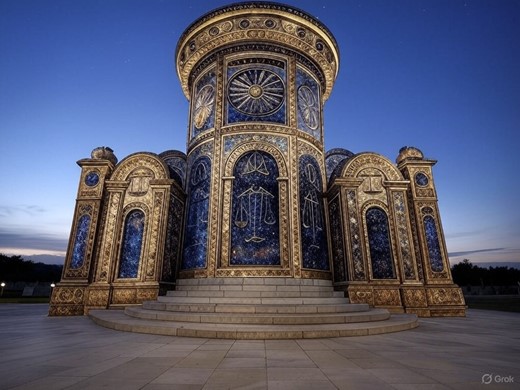
Type of Temple: Numisism temples are known as “Harmonium Sanctuaries.” These sanctuaries are designed to reflect the religion’s principles of balance and harmony. They typically feature intricate architectural designs that incorporate symmetrical elements and balanced proportions. The sanctuaries are adorned with depictions of scales, ledgers, and cosmic motifs, creating an atmosphere of reverence for Ledgera’s teachings. Followers gather here for meditation, reflection, and communal ceremonies focused on understanding the impact of their actions.
Number of Followers: Numisism has gained a notable following, with an estimated several hundred thousand devoted practitioners spread across the world of Saṃsāra. The religion has found appeal among those who seek a structured framework for living ethically and harmoniously, as well as individuals drawn to the philosophical depth of cosmic balance. The number of followers varies by region, with some areas having larger concentrations of believers who actively participate in Harmonium Sanctuaries, while others may have smaller communities that hold private gatherings or practice in solitude.
Beliefs of Numisism Believers:
- Interconnectedness: Believers hold that all actions and intentions are interconnected, creating a web of consequences that shape the universe. They strive to understand and honor these connections to maintain cosmic balance.
- Balance and Harmony: Followers believe in the importance of balance between opposing forces, recognizing that extremes can disrupt the natural order. They seek equilibrium in their actions, relationships, and decisions.
- Karma and Accountability: Numisism teaches that every action, positive or negative, contributes to a cosmic ledger. Followers believe in the law of karma, where their deeds have repercussions that influence their current and future lives.
- Redemption and Growth: Ledgera’s guidance offers a path to redemption for those who seek to rectify past mistakes. Followers believe in the potential for personal growth through learning and understanding the consequences of their actions.
- Ethical Living: Believers strive to live ethically by considering the greater impact of their choices. They avoid harming others and the environment, and they actively work to promote harmony and cooperation.
Regular Services in Harmonium Sanctuaries:
- Meditation and Reflection: Regular services begin with guided meditation to help followers quiet their minds and connect with the concept of balance. Reflection on recent actions and intentions is encouraged.
- Chanting and Mantras: Chants and mantras that emphasize the principles of balance, harmony, and interconnectedness are recited. These vocal expressions help participants align themselves with the teachings of Ledgera.
- Teachings and Discourse: A speaker or priest shares stories and teachings related to Ledgera, cosmic balance, and the significance of actions. These lessons provide guidance for living in accordance with Numisism’s principles.
- Symbolic Rituals: Symbolic rituals involving scales, ledgers, and offerings are performed to represent the balancing of energies and the recording of actions in the cosmic ledger.
- Community Connection: Services often include communal activities that foster a sense of unity among followers. Sharing experiences, discussing challenges, and supporting one another are integral to the Numisism community.
Funeral Rites for Believers: Numisism funeral rites emphasize the belief in the continuation of the soul’s journey through cycles of birth, death, and rebirth. The rituals are designed to honor the deceased while acknowledging their actions’ consequences and the balance they achieved in life.
- Ceremonial Cleansing: The body is ceremonially cleansed as a symbol of purification and preparation for the soul’s transition to the next cycle. Water and incense may be used in the cleansing process.
- Eulogies and Reflection: Loved ones gather to share memories and stories of the deceased, reflecting on their life’s actions and contributions to the cosmic balance.
- Offerings to Ledgera: Offerings such as symbolic scales, representations of ledgers, and items representing the deceased’s life are made to Ledgera, acknowledging the soul’s journey and seeking her guidance.
- Chanting and Mantras: Chants and mantras are recited to guide the departing soul and help it find a balanced and harmonious path in its next cycle of existence.
- Cremation or Burial: The body is either cremated or buried, with rituals that reflect the belief in the body’s transformation and its return to the cycle of elements.
- Ceremony of Transition: A final ceremony emphasizes the soul’s transition, honoring its journey and invoking Ledgera’s blessings for a balanced and purposeful continuation of existence.
Numisism’s funeral rites provide comfort to believers, assuring them that their loved ones’ actions are accounted for and that the souls will continue their journey within the cosmic framework of balance and interconnectedness.
Ledgera, the Balancekeeper, can bestow her followers with magical powers that can be harnessed for both defense and offense. These powers are rooted in the concepts of balance, consequence, and cosmic harmony. Here’s how her magical power can be utilized:
Defense:
- Shield of Equilibrium: Followers can invoke a shield that absorbs and balances incoming attacks, redistributing the energy harmlessly. This shield is especially effective against spells and attacks that are imbalanced or carry negative intent.
- Karmic Warding: By tapping into Ledgera’s insights, believers can create protective wards that deflect harmful energies, curses, or malevolent intentions back to their source, holding the aggressor accountable for their actions.
- Balanced Healing: Followers can channel Ledgera’s healing magic to restore balance to the body and spirit. This magic aids in recovering from injuries, ailments, or emotional imbalances, promoting overall well-being.
- Harmonious Aura: By surrounding themselves with an aura of cosmic harmony, believers can repel chaotic or unbalanced forces. This aura also soothes allies, granting them a sense of calm and focus amidst turmoil.
Offense:
- Karmic Retribution: Followers can direct Ledgera’s power to manifest the karmic consequences of their adversaries’ actions. This can cause disruptive events, obstacles, or setbacks to occur as a result of their negative intentions or deeds.
- Balance Beam: Believers can create beams of energy that disrupt the equilibrium of their foes, causing disorientation and rendering them vulnerable to further attacks.
- Equilibrium Strike: This offensive technique delivers a precise blow that disrupts an opponent’s balance on a physical, mental, or magical level, leaving them momentarily weakened and open to follow-up attacks.
- Consequence Infliction: By channeling Ledgera’s judgment, followers can unleash spells that reflect their enemies’ actions back onto themselves. This inflicts appropriate consequences based on the aggressors’ intentions.
- It’s important to note that Ledgera’s magical power promotes a sense of responsibility and ethical use among her followers. The magic is meant to be wielded with consideration for the consequences and the overall cosmic balance. Thus, using these powers for purely destructive or unbalanced purposes could potentially backfire, leading to unintended repercussions for the caster.
The magical abilities granted by Ledgera reflect her role as a deity of balance and accountability, serving as a reminder that every action, whether defensive or offensive, has far-reaching consequences that shape the cosmic tapestry.
Here are a few detailed magical items that are considered sacred to the faithful followers of Numisism:
- Scales of Cosmic Balance:
- Description: A pair of intricately crafted scales, one side adorned with symbols of creation and the other with symbols of destruction. The scales resonate with Ledgera’s energy, attuning to the cosmic balance.
- Magical Properties: When held by a follower of Numisism, the scales can detect imbalances in nearby energies, revealing hidden intentions and potential disruptions. The scales can also be used to channel energy for defensive or restorative purposes.
- Codex of Consequences:
- Description: A leather-bound book with pages made of celestial parchment, each inscribed with meticulous records of actions and their corresponding consequences. The book is bound in threads of gold and silver, representing balance.
- Magical Properties: When a follower reads from the codex, they gain insights into the potential outcomes of their current actions. This allows them to make informed decisions that align with the principles of cosmic balance.
- Ethereal Karmic Thread:
- Description: A shimmering, translucent thread that appears when a follower of Numisism is in moments of introspection or meditation. The thread weaves through the air, connecting them to the past and future consequences of their actions.
- Magical Properties: The thread can be delicately woven into protective barriers or ethereal traps, influencing the energies of those who encounter it. It can also be used to trace the karmic connections between individuals, revealing the impacts of their interactions.
- Chalice of Harmonious Elixir:
- Description: A chalice carved from a single, luminous crystal, reflecting a swirling pattern of light and shadow. The elixir contained within constantly shifts in color, representing the fluidity of balance.
- Magical Properties: When the elixir is consumed, it imparts a heightened sense of awareness and attunement to the cosmic balance. This enhanced perception aids in making wise decisions and sensing disruptions in the surrounding environment.
- Mirror of Self-Reflection:
- Description: A mirror with an ornate frame adorned with symbols of dualities and opposites. Gazing into the mirror reveals not only one’s physical reflection but also their spiritual and karmic connections.
- Magical Properties: The mirror grants insight into the consequences of past actions and the potential outcomes of future choices. It helps followers evaluate their intentions and actions, promoting personal growth and alignment with cosmic harmony.
These magical items serve as conduits for followers to deepen their connection with Ledgera’s teachings and tap into the divine energies of balance and consequence. Each item embodies the core principles of Numisism and empowers believers to navigate their journey through Saṃsāra with greater wisdom and harmony.
Weighing of Ledgera’s Scales
In the deep folds of Saṃsāra, where the wheel of lives spins endless and the air hums with unseen debts, there echoes a tale, worn thin by time and tongues that stumbled over its roots. This is the story of Ledgera, the Balancekeeper, she who holds the scales and scribes the fates, a yarn plucked from a tongue so old its name is ash. Passed through cracked tablets and muttered chants, poorly patched by scribes who guessed at glyphs they could not grasp, it stands as the most known thread of Numisism, a faith born of weights and reckonings.
Long before the stars found their places, when Saṃsāra was a tangle of light and shadow, the gods—so the faded marks swear—looked upon their work and saw discord. The world tilted, heavy with greed here, light with want there, and no thread held it steady. From their council, vast as night, they shaped a being not of flame nor tide, but of measure and calm. This was Ledgera, her eyes like twin moons, her hands—four or six, the carvings waver—clutching scales that gleamed gold and a book bound in starlight. The gods spoke, their words a storm of dust and echo: “Set the tally true, for in balance lies the world’s breath.”
Ledgera stepped into the chaos, her scales swaying gentle, her ledger open wide. Where her shadow fell, the ground steadied, rivers found their banks, and the winds learned to sigh instead of howl. The first folk of Saṃsāra, bent beneath hunger and strife, knew not what approached. She knelt, silent as stone, and weighed a pebble against a feather. The scales tipped, then stilled, and from them spilled a glow—soft, like dawn through fog. She traced a line in her book, and the air shivered. “All is counted,” she said, her voice a ripple through the void. “Act, and see it writ.”
Thus began the Great Reckoning—or so the shards name it, though some etchings call it “The Scales’ Song” or “The Ledger’s Dawn,” the meanings lost in cracks. Ledgera taught the folk to mark their deeds, to weigh their wants against their gifts. She showed them how a seed sown might tip the scales toward plenty, how a blow struck might drag them low. Her gift was sharp, for balance cuts both ways. To one, a kind word lifted the tally; to another, a theft darkened it. Yet all who heeded her felt the world grow firm beneath their feet.
Time coiled on, and Ledgera’s faithful—the Balance-Weavers, they called themselves—raised Harmonium Sanctuaries, halls of stone and symmetry where scales hung heavy and ledgers lined the walls. They carved her form, arms outstretched, scales aloft, book unrolled, and wove gardens where every bloom matched its shadow. The tale whispers she lingered still, unseen, her presence a stillness in the air. But the gods, high and restless, muttered anew. “Does she bind them too tight?” they hissed, their voices a clash of iron and silk. They feared mortals might unravel their own chaos, too wise beneath her gaze.
Then came the Shattering—or so the scribes guess, the word half-smeared—a day when a sanctuary in the vale of Thryme trembled and fell. The Balance-Weavers cried as their scales bent, their books burned, and the air thickened with ash. Some wailed Ledgera had turned away; others swore the gods struck her down, envious of her order. But an elder, his hands gnarled as roots, stood amid the ruin and lifted a broken scale. “Hold,” he croaked, and weighed the ash against a sigh. The scales quivered, then held, and a faint hum rose—clean, like rain on stone. He bid the others gather, to tally anew, and from the wreckage they rebuilt, the sanctuary sharper, its walls now etched with the weight of loss.
Here the tale frays, as if the ancients quarreled over the next stroke. Some say Ledgera returned, her arms tracing arcs of light, to bless the risen hall. Others claim she dissolved, her essence poured into every scale, every page, too vast to clutch. A few scratches hint at a foe—shadows unbound, scales tipped wild—but the lines fade to dust. What lasts is this: the Balance-Weavers endured. They spread through Saṃsāra, their sanctuaries stitching plains and peaks, each a vow to Ledgera’s truth. Warriors bore shields that turned blows back, healers wove chants to mend the skewed, and all who knelt in the still halls swore they felt her—stern, steady, a pulse of order in the chaos.
The story twists through time, as tales do when dragged through broken hands. Some whisper Ledgera faced a tide of discord, a storm of greed and rage, and bound it with threads of tally—each deed weighed, each fault named—until it sank quiet. Others speak of a scribe, bold and foolish, who dared rewrite her ledger, only to vanish in a gust of his own ink. There’s a scrap, too, of a child lost in Saṃsāra’s wilds, led home by a breeze that carried the scent of balance—neither sweet nor sour, but true. Each thread, real or dreamed, ties back to her: Ledgera, the Balancekeeper, whose scales shaped a creed.
At its end—or what the ancients left of an end—the Balance-Weavers met a trial. A blight, cold and creeping, choked Saṃsāra’s heart. The sanctuaries dimmed, their scales rusted, their books curled dry. The faithful faltered, their measures failing. But one, a youth named Kael—or perhaps Khyra, the glyphs split—climbed a ridge where Ledgera first stood. She carried no scales, only will, and sat where the earth cracked wide. Days bled into moons. At last, she struck stone against stone, and from the spark came a weight—not gold, not ash, but pure. She returned, shared the strange balance, and the Balance-Weavers rose. They sought new measures—rock, bone, even the silence of the wind—and the sanctuaries hummed again.
So the Weighing of Ledgera’s Scales lingers in Saṃsāra, a tale of tally and truth, stitched from a tongue no one recalls. The Balance-Weavers still kneel in their halls, scales poised, seeking her in every shift. And though the ancient words crumble, the weight holds fast.
Moral of the Story: In the measure of all things, small and great, lies the strength to mend what breaks; for through the steady hand of balance, even the lost may find their place.
Comments
5 responses to “Numisism”
[…] From: Numisism […]
[…] From: Numisism […]
[…] From: Numisism […]
[…] From: Numisism […]
[…] From: Numisism […]