
Lore: The Hearth & Home Automata Works No. 117 owes its existence to the visionary, if somewhat eccentric, gnome artisan-enchanter, Madam Elara Cogsworth. Arriving in Saṃsāra with vivid memories of a world where intricate clockwork marvels were commonplace, Madam Cogsworth was quick to recognize the potential of marrying precise mechanics with Saṃsāra’s abundant and malleable magical energies, particularly the burgeoning power of elemental steam. She began her career in a small workshop in the bustling port city of Porthaven, crafting exquisite self-winding chronometers and animated children’s toys that garnered much acclaim.
As the gentle hum of the early magic-steam Industrial Age began to resonate through Saṃsāra, Madam Cogsworth, ever attuned to the needs of a growing populace, shifted her focus. She envisioned a future where the burdens of daily domestic life could be eased by reliable, artfully crafted “automata” – not true sentient constructs, but cleverly designed mechanical and magically-assisted appliances. Thus, the Hearth & Home Automata Works was founded, its charter boldly proclaiming the aim to “Bring Magical Convenience and Clockwork Grace to Every Hearth in Saṃsāra and Beyond!” The No. 117 is one of its earlier, yet still productive, manufactories, known for its sturdy designs and the faint, pleasant scent of cedarwood and ozone that often clings to its products. It employs a diverse workforce, from master enchanters and gear-wrights to diligent laborers and aspiring apprentices, many of whom are Tier 1 avatars finding their first footing in the city’s burgeoning industries.
Environment:
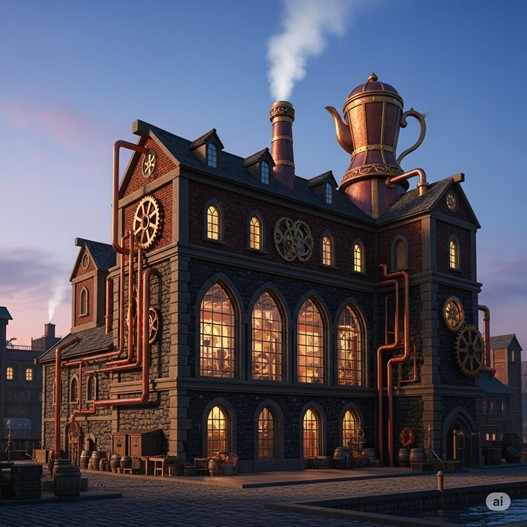
- External: Hearth & Home Automata Works No. 117 is situated on the western fringe of Porthaven’s “Steamwork District,” a sector characterized by the rhythmic hiss of elemental boilers and the distant clang of mechanical workshops. It stands a respectful distance from the more residential areas, bordered on one side by the Azure Canal, which provides a steady supply of elemental water essence for its steam engines and a convenient route for barges carrying raw materials and finished goods. The air around the factory is generally clear, as Saṃsāran steam power is magically derived and environmentally benign, though a perpetual plume of white, clean steam often billows from its main, copper-clad chimney stack. The cobbled yard in front of the main gates is usually busy with deliveries of timber, metal ingots, elemental crystals, and crates of finished automata awaiting shipment.
- Internal: Stepping inside the main manufactory reveals a vast, high-ceilinged hall. Large, magically treated glass windows arch towards the roof, supplemented by softly glowing, ever-burning Coptic-style oil lamps, ensuring the workspace is well-lit day and night. The air is a complex tapestry of scents: the sharp tang of hot metal from the forges, the clean aroma of cut cedar and oak from the woodworking bays, the mineral scent of elemental crystals near the boiler room, the faint ozone from the enchanting alcoves, and the ubiquitous, slightly damp warmth of steam. The workshop is a symphony of controlled industrial sounds: the deep, rhythmic pulse of the central elemental steam boiler, the hiss and clank of smaller steam engines, the whir of overhead drive shafts and leather belts, the rhythmic hammering from the metal shapers, the rasp of saws, and the click-clack of assembling components. Different sections are clearly delineated: a vast raw materials warehouse, a heavily warded boiler room where elemental fire and water essences are combined, a noisy forge and metal-press area, a carpentry and wood-finishing wing, a quieter floor dedicated to fine mechanics and gear assembly, a series of secluded alcoves for enchantment and rune-scribing, bustling assembly lines where workers sit at long benches, and a final inspection and packaging area leading to the dispatch dock on the canal.
Appearance:
- Building: The factory is a robust three-story structure built from dark river stone and reinforced brick, its architecture a blend of stern functionality and whimsical artistry. Copper pipes, gleaming like serpents, trace patterns across the exterior walls, hinting at the steam power within. Decorative brass gears of various sizes are embedded in the stonework around the main entrance and window arches. The aforementioned chimney stack is a local landmark, crafted from polished copper and shaped like a giant, ornate coffee pot, complete with a whimsical “spout” from which the steam gracefully exits.
- Machinery: The heart of the factory is the Great Elemental Boiler, a massive, warded iron and copper vessel where elemental fire and water are magically harmonized to produce immense quantities of steam. This steam powers several large, chugging piston engines, which in turn drive a complex network of overhead iron shafts, belts, and pulley systems that distribute mechanical power to various workstations. One can see steam-driven lathes turning wood and metal, trip hammers shaping components, automated saws cutting lumber with precision, and conveyor belts moving parts between stations. In the enchanting labs, delicate crystal arrays, runic stencils, and tools for inscribing magical circuits are neatly arranged. Assembly stations are equipped with specialized jigs, vices, and fine hand tools.
Work for a Tier 1 Avatar:
A Tier 1 avatar newly employed at Hearth & Home Automata Works No. 117 would likely find themselves in an entry-level position, such as:
- Component Polisher: Tediously polishing metal casings for “Ever-Cool Larder Boxes” or wooden handles for “Precision Pantry Grinders” to a high sheen.
- Simple Press Operator: Under supervision, operating a steam-assisted press that stamps out basic metal components like gear blanks or simple brackets.
- Sub-Assembly Assistant: Attaching pre-made legs to laundry agitator frames, fitting simple hinges, or screwing together basic components of the “Dust-Devouring Floor Turtles.”
- Materials Runner: Transporting bins of raw materials (wood, metal, crystals) or finished components between different work sections.
- Boiler Room Attendant (Junior): Assisting senior boiler-wrights by monitoring basic gauges (under strict guidance), cleaning ash pits (if any from non-magical fuel supplements), or carefully transporting sealed containers of elemental water essence.
- Workshop Sweeper/Cleaner: Maintaining the general cleanliness of common workshop areas.
- Apprentice’s Assistant: Running errands for a journeyman artisan or enchanter, cleaning tools, and observing basic craft processes from a distance.
Positives:
- For the Worker: Offers relatively stable employment in Porthaven’s growing industrial sector. Provides an opportunity to be part of creating modern conveniences that are generally well-regarded. Exposure to various crafts (metalwork, woodwork, basic mechanics, enchantment) could lead to apprenticeships or skill development for a motivated Tier 1 avatar. The factory, under Madam Cogsworth’s influence, generally maintains fair working conditions for its era, with an emphasis on safety protocols around magical and mechanical equipment.
- For the Community: The factory produces genuinely useful home appliances that can reduce domestic drudgery and improve the quality of life for many citizens. It creates diverse employment opportunities and contributes to Porthaven’s reputation as a center of innovation and magical industry. The designs are often considered aesthetically pleasing, blending utility with a touch of gnomish whimsy.
Negatives:
- For the Worker: Much of the entry-level work is highly repetitive, physically tiring, and can be monotonous. The general noise level in most sections of the factory is considerable. Despite safety measures, there is always a low risk of minor injuries from machinery, hot components, or magical mishaps in more specialized areas. The pay for unskilled labor is modest, and social stratification exists between the common workers and the highly skilled artisans, enchanters, and engineers. Production targets can create pressure.
- For the Community: While the steam is clean, the sheer volume of it released can sometimes create localized mist or humidity, particularly in cooler weather. The factory, like any industrial site, contributes to the general noise and bustle of the Steamwork District. There’s a philosophical debate in some circles about whether over-reliance on such “automata” might lead to a decline in traditional domestic skills or a less mindful approach to daily life.
Tags: Industrial, Magical-Steampunk, Factory, Urban, Manufacturing, Home Appliances, Innovation, Clockwork, Elemental Steam, Enchantment, Gnomish Design, Tier 1 Work, Porthaven, Assembly-Line, Artisan-Crafted, Steam-Powered-Mechanisms, Domestic-Convenience, Workshop-Environment, Quality-Goods, Canal-Access, Entry-Level-Jobs, Magical-Engineering
The Hearth & Home Automata Works No. 117, a beacon of Saṃsāra’s burgeoning magic-steam Industrial Age, orchestrates a complex symphony of mundane craft, arcane skill, and organized labor to produce its sought-after domestic automata. Here’s a glimpse into the materials, processes, and timelines involved:
Materials & Ingredients:
The creation of each automaton draws upon a diverse palette of Saṃsāra’s resources:
- Mundane Materials:
- Metals: Robust iron and hardy steel form the structural backbones, gears, and resilient tool components. Gleaming copper is essential for intricate piping, boiler shells, conductive pathways in rudimentary magic circuits, and often lends a warm aesthetic to casings and decorative elements. Brass, valued for its workability and resistance to magical corrosion, is frequently used for finer gears, precise fittings, valves, and polished exterior panels. Tin finds its place in solders and as a protective plating.
- Woods: Strong oak and resilient ash are favored for sturdy frames, load-bearing parts, and durable handles. Fragrant cedar and lightweight pine are often used for casings of items like the “Ever-Cool Larder Box” or internal compartments, sometimes chosen for their natural resistance to pests or their pleasant scent. More exotic or finely grained woods might be used for premium decorative finishes on higher-end models.
- Stone & Ceramics: High-fired, durable clay is shaped into insulating components, certain types of casings, and importantly, the inert ceramic cores that are later infused with elemental magic for items like the Larder Box. Natural slate is precisely cut and smoothed for the “Self-Scribing Message Slates.” Grindstones and polishing stones of various grades are consumed in the finishing processes.
- Textiles & Leathers: Heavy-duty woven canvas and treated leathers are crucial for creating the drive belts that transmit power from steam engines to machinery, as well as for gaskets, seals, and bellows within the automata themselves. Felted wool provides padding, insulation, or sound-dampening within certain devices.
- Binders & Finishers: Natural resins, potent glues derived from animal or plant sources, and durable varnishes (often with minor magical resistances mixed in) are used for assembly and protection. Mundane pigments provide color, while various grades of sand are essential for creating casting molds for metal components.
- Fuels (Supplementary): While elemental magic powers the main boilers, forges for specialized metalwork might also consume high-quality coal or magically treated, quick-burning logs to achieve specific temperatures or effects.
- Glass: Tough, magically clarified glass is used for viewing ports on boilers or delicate machinery, and occasionally as lenses or focusing elements in enchanting tools.
- Magical Materials & Ingredients:
- Elemental Essences & Crystals:
- Ignis Crystals (Fire Shards): These serve as a potent, concentrated source of magical heat for specialized forges, precise soldering work, or as a primary “fuel” for the Great Elemental Boiler if direct elemental binding is not employed. Their consumption rate is carefully monitored.
- Aqua Crystals (Purified Elemental Water Droplets): Essential for generating the vast quantities of steam in the boilers. This might be sourced from magically purified water or from condensed elemental water essences. It’s also used in certain cooling processes and as a component in some enchantments requiring a fluid medium.
- Glacies Cores (Cryo-Crystal Clusters): Specifically prepared or naturally occurring crystals imbued with potent cold energy are used for the “Ever-Cool Larder Boxes.” These are often set within ceramic matrices that are then further enchanted to regulate their cooling effect. These cores require periodic “recharging” or replacement.
- Aer Essences (Captured Zephyrs – Rare): Less commonly used in basic appliances, but might be incorporated into experimental models or high-end “Dust-Devouring Floor Turtles” to create more complex air currents for suction, or in enchantments that require a subtle animating force.
- Enchanting Reagents & Foci:
- Conductive Scribes’ Ink (Silver-laced or Quicksilver-based): Used by enchanters to meticulously draw magical circuits, runes of operation, or binding glyphs onto components.
- Attunement Crystals (Common Quartz, Agate Slivers): Small, polished crystals of common quality are sometimes embedded within automata to act as focal points for enchantments, helping to stabilize or direct the flow of magical energy.
- Ritually Prepared Components: Mundane materials like wood, metal, or fabric may undergo specific blessing rituals (often Coptic-inspired, given Saṃsāra’s diverse soul memories) to cleanse them and make them more receptive to holding specific enchantments related to domestic harmony, efficiency, or protection.
- Symbolic Herbs & Powders: Minor quantities of specific herbs known for certain properties (e.g., heat resistance, cleansing, quietness) might be incorporated into varnishes, infused into wooden parts, or used as incense during the enchantment process to align the item with its intended function.
- Elemental Essences & Crystals:
Labor: The Hands and Minds of the Works
The factory floor is a hive of activity, with labor divided by skill and experience:
- Unskilled Laborers (often Tier 1 Avatars): The backbone of material movement, basic preparation (sanding, deburring), operating the simplest steam-presses under guidance, performing rudimentary assembly (e.g., attaching feet to a frame), cleaning, and assisting in the less hazardous areas of the boiler room.
- Semi-Skilled Workers: Operators of more complex steam-lathes or grinders, assemblers of moderately intricate clockwork sub-components, and basic quality inspectors who check for obvious flaws.
- Skilled Crafters: These are the artisans who bring precision to the mundane components.
- Master Smiths & Metalwrights: Forging unique components, casting intricate parts, machining gears to fine tolerances.
- Journeymen Carpenters & Wood Shapers: Crafting elegant wooden casings, perfectly fitted drawers for larder boxes, and durable handles.
- Gear-Wrights & Clockwork Mechanics: Assembling and calibrating the complex gear trains and spring mechanisms that animate many of the automata.
- Elemental Steam Technicians & Boiler-Wrights: The critical role of operating and maintaining the Great Elemental Boiler and the network of steam engines, requiring both mechanical aptitude and a deep understanding of practical elemental magic safety.
- Highly Skilled Specialists (often with innate or trained magical affinity):
- Enchanters & Rune-Carvers: Working in quieter, dedicated labs, these individuals painstakingly imbue components with their magical properties. This involves ritualistic casting, precise rune inscription, the careful application of magical reagents, and the focusing of their will. Different enchanters might specialize in heating/cooling enchantments, minor animation charms, or communicative spells.
- Chief Artisans & Design Engineers (like Madam Cogsworth herself in the early days): Conceptualizing new automata, drafting the complex schematics, overseeing the quality of both mechanical and magical construction, and solving the most challenging production hurdles.
The Magic of Manufacturing:
Magic is not just an addition to the products; it is woven into the very fabric of the manufacturing process at Hearth & Home Automata Works No. 117:
- Elemental Steam Power: The foundational magic is the magically generated steam from elemental fire and water, providing clean, reliable power for almost all machinery, transmitted via an ingenious system of drive shafts, belts, and gears.
- Magically Assisted Tools: Some tools used by artisans might possess minor enchantments for precision (e.g., a scribe that always draws a perfectly straight line, a chisel that holds its edge supernaturally well) or safety (e.g., gloves with minor heat resistance).
- Component Enchantment: This is a dedicated stage where items receive their specific magical functions. For example:
- The stirring arm of a Clockwork Cauldron Stirrer might be enchanted for minor heat resistance and to follow a simple, consistent stirring pattern.
- The ceramic core of an Ever-Cool Larder Box is infused with elemental cold through a lengthy ritual, then sealed with wards to regulate its temperature.
- The paired slates of a Self-Scribing Message Slate are linked through a sympathetic enchantment that allows the slow transference of script.
- The simple engine or primary spring of a Dust-Devouring Floor Turtle might receive a minor blessing of endurance or a subtle guidance charm to encourage more thorough (if still somewhat random) floor coverage.
- Atmospheric Wards & Blessings: Certain areas of the factory, especially the enchanting labs and the elemental boiler room, are protected by permanent magical wards for safety and to ensure a stable environment for delicate magical work. The entire factory might also receive a periodic general blessing (perhaps Coptic-inspired) for smooth operation and the well-being of its workers.
- Rudimentary Magical Automation: While true AI or complex constructs are beyond this era, some very simple, repetitive tasks might be aided by enchanted mechanisms – for example, a perpetually turning polishing wheel, or a magically guided sorting arm for very basic components.
Equipment Used:
The factory hums with a fascinating blend of robust mechanical devices and delicate magical apparatus:
- Power Core: The Great Elemental Boiler, numerous smaller steam engines, a network of pipes, regulators, and pressure-release valves (often with magical failsafe runes).
- Metal Fabrication: Elemental or coal-fired forges, steam-powered trip hammers, sand casting setups, steam-driven lathes and milling machines, stamping presses, grinders, manual tools like anvils, files, and specialized tongs.
- Wood Fabrication: Steam-powered band saws and circular saws, wood lathes, planers, drills, a vast array of hand tools (chisels, planes, carving knives), glue presses, and ventilated finishing rooms for varnishing.
- Assembly Stations: Long workbenches equipped with vices, specialized jigs for holding components, precision hand tools (screwdrivers, wrenches, riveting tools, gear pullers/setters).
- Enchanting Workshops: Clean rooms, often circular or octagonal for focused energy flow, with warded tables, arrays of various crystals for focusing or amplifying magical energy, delicate styluses and brushes for applying enchanted inks, tools for inscribing runes, alchemical braziers, and collections of magical reagents.
- Testing Bays: Specific areas designed to test the functionality and safety of each type of automaton – water tanks for laundry agitators, heat/cold chambers for larder boxes, smooth floor areas for floor turtles, etc. These often include basic diagnostic tools, some possibly augmented with minor divination magic to check the integrity of enchantments.
Process Duration:
The time to create a single automaton varies dramatically based on its complexity:
- Simpler Items (Clockwork Cauldron Stirrer, basic Dust-Devouring Floor Turtle, Self-Scribing Message Slate): Component fabrication might take a few hours to a day for a batch. Assembly of mechanical parts could be another few hours. The minor enchantment process might take an enchanter 1-3 hours per item or small batch. Allowing for finishing and quality checks, a single unit might effectively take 1 to 3 Saṃsāran workdays to complete if all components are available and work flows smoothly in a batch production system.
- Mid-Complexity Items (Ever-Cool Larder Box, steam-assisted Pantry Grinder): The construction of the insulated box or the more robust grinder mechanics takes longer, perhaps 1-2 days for the physical shell. The enchantment of the ice core for the Larder Box is a more involved process, potentially requiring a full day or more of an enchanter’s time per core or small batch, including ritual “charging.” Total time could be 3 to 6 Saṃsāran workdays per unit.
- Complex Items (Steam-Whirl Laundry Agitator): This is a significant undertaking. Crafting the large copper tub, forging and machining the steam engine components and paddle mechanism, assembling the intricate pipework and valves, and ensuring everything is steam-tight and magically balanced could easily take 1 to 2 Saṃsāran workweeks (7-14 days) per unit, involving multiple skilled artisans and technicians working in concert.
These timelines assume an established production line where components are made in parallel by different sections and then brought together for final assembly and enchantment. A one-off custom piece would naturally take considerably longer. Each automaton emerging from Hearth & Home Automata Works No. 117 is thus a product of many hands, mundane resources, Saṃsāra’s unique magic, and Madam Cogsworth’s enduring vision.
The Hearth & Home Automata Works No. 117, beyond its signature domestic automata, also manufactures a range of standardized components and simpler public goods. These items are distributed to individual consumers, other artisans and manufacturers, and are sometimes exported to different regions of Saṃsāra. Only adult avatars can typically activate or fully benefit from the inherent magical properties of these items, though their mundane utility is often accessible to all. When stowed in a pocket, backpack, or storage container, any magical properties are inert, and they do not count towards an avatar’s carried magical item limit.
Here are details of a few such goods:
- Precision Gear & Cog Set No. 308
- Description & Function: This is a standardized set containing twelve meticulously crafted clockwork gears, primarily made from hardened brass, with some larger cogs optionally available in specially treated ironwood for lighter-duty applications. The gears range in size from a nail’s breadth to a small handspan, featuring common tooth profiles and bore sizes compatible with many emerging mechanical and clockwork devices across Saṃsāra. Each gear is machined with exacting precision, often using steam-powered lathes guided by rudimentary magical comparators, ensuring smooth interoperation. Some premium sets might include a selection of basic axles and tension springs.
- Materials: High-quality brass ingots, steel rods (for axles in premium sets), occasionally blocks of seasoned ironwood, fine polishing compounds.
- Magical Aspects (Subtle): While primarily mechanical, the manufacturing precision is often achieved with magically guided tools. Some very high-quality sets, intended for delicate automata, might bear an almost invisible Coptic-inspired micro-etching on the central hub, a blessing for long wear and silent movement, noticeable only as an unusual resistance to grit and a quieter operation than purely mundane gears.
- Typical Users/Distribution: Independent clockmakers, inventors of new automata, repair artisans servicing existing mechanical devices, apprentice programs in engineering guilds, other smaller manufactories that incorporate clockwork mechanisms into their own products. They are sold through guild suppliers, specialized tool merchants, and directly from the Automata Works’ commercial outlets.
- Tags: Component, Mechanical, Clockwork, Precision-Crafted, Brass, Ironwood, Saṃsāran Industry.
- “SureFlow” Elemental Steam Valve Model K-77
- Description & Function: The Model K-77 is a robust and reliable manual valve designed for regulating the flow of elemental magic-steam in low-to-medium pressure domestic or light industrial systems. Constructed from heavy-gauge copper and brass, it features a finely threaded spindle, a heat-resistant ceramic gland packing, and a sturdy handwheel or lever for adjustment. The valve body is typically inscribed with basic Coptic-inspired runes that enhance its resilience to thermal stress and magical energy fluctuations common in Saṃsāran steam lines.
- Materials: Copper piping sections, cast brass valve bodies, ceramic components, heat-resistant sealing compounds, runic inscription tools, minor warding reagents.
- Magical Aspects (Integrated): The key magical element is the series of Coptic-derived runes etched onto the valve casing. These are not complex enchantments but are imbued during a blessing ritual at the factory to improve heat dissipation, resist magical corrosion from impure steam, and maintain structural integrity under pressure. Adult users familiar with basic magical principles might feel a faint, steady resonance from an installed valve that indicates its proper energetic function.
- Typical Users/Distribution: Plumbers and steam-fitters working on residential or commercial steam installations (for heating, cooking, or powering minor devices), workshops building custom steam-powered contraptions, operators of communal laundries or bathhouses, and as replacement parts for larger Hearth & Home automata. Distributed via plumbing suppliers, industrial outfitters, and the factory itself.
- Tags: Component, Steam-System, Valve, Regulator, Copper, Brass, Runic, Heat-Resistant, Industrial-Support.
- “Silent Glide” Enchanted Bushing Pack No. 42B
- Description & Function: This pack contains a set of six polished bronze bushings, or alternately, bushings crafted from exceptionally dense, self-lubricating Saṃsāran “Slickwood.” They are designed for common axle diameters found in many clockwork devices and light machinery. Each bushing is carefully imbued with a subtle Coptic-inspired enchantment that dramatically reduces friction and operational noise when correctly installed. The enchantment promotes an almost imperceptible layer of “slippery air” or “ethereal grease” around the contact surfaces.
- Materials: Bronze stock or specific Slickwood billets, fine polishing abrasives, minute quantities of specific enchanting oils and powders (e.g., powdered moonpetal for silence, quicksilver dew for smoothness), Coptic prayer scrolls used during imbuement.
- Magical Aspects (Direct Enchantment): The core feature is the enchantment for silence and low friction. An adult artisan installing these can often feel a subtle “rightness” or ease as they fit, and the resulting mechanism runs with an almost preternatural smoothness and quietness. The enchantment is designed for long life but can eventually fade after extensive use, requiring replacement of the bushing.
- Typical Users/Distribution: Manufacturers of high-quality automata (including Hearth & Home itself for its premium lines), clockmakers seeking silent movements, artisans crafting intricate toys or precise measuring devices, and individuals wishing to upgrade or quiet existing mechanical contraptions. Sold in sealed packs through specialized component suppliers and fine tool merchants.
- Tags: Component, Mechanical, Low-Friction, Silent-Operation, Enchanted, Bronze, Slickwood, Precision.
- “HearthGlow” Domestic Kindling Sparker Model P-16
- Description & Function: The HearthGlow Sparker is a popular and reliable daily-use item for safely and quickly igniting hearth fires, kitchen stoves, or workshop forges. It typically resembles a sturdy, pleasantly shaped wooden or ceramic handle attached to a short, insulated copper tube with a protective nozzle. Inside the mechanism, a tiny, magically sustained (but inert until activated) Elemental Fire Shard is housed. When an adult user grips the handle and speaks a simple Coptic prayer-word for “light” or “warmth” (often inscribed on the handle as a glyph), the device emits a brief, focused jet of hot, bright sparks directly from its nozzle, easily igniting prepared kindling. Children or those unable to use the magic can often still use the device if it incorporates a simple mechanical bellows action for a mundane (though less effective) spark.
- Materials: Turned hardwood or molded ceramic handle, copper tubing and nozzle, insulated lining, a minuscule captive Fire Shard, simple trigger mechanism components (if mechanical backup exists), Coptic activation glyph.
- Magical Aspects (Contained Elemental Magic): The device’s core is the magically sustained Fire Shard. The activation glyph and the internal mechanism are designed so that only an adult avatar’s focused intent (often accompanied by the prayer-word) can draw forth the sparks. The casing is warded to prevent accidental discharge or overheating. Its magic is inert when stored.
- Typical Users/Distribution: Widely distributed to households across Saṃsāra as a convenient and safer alternative to flint and steel or unreliable mundane matches. Also used by innkeepers, chefs, and smiths. Sold through general stores, market stalls, household goods suppliers, and directly by the Automata Works.
- Tags: Daily Use, Fire-Starter, Household Item, Elemental Magic (Fire), Safety, Convenience, Coptic Activation.
Enduring Legacy of Hearth & Home Automata Works No. 117
In the heart of burgeoning Porthaven, where the gentle hiss of magic-steam began to harmonize with the rhythmic clang of progress, there arose a visionary spirit: Madam Elara Cogsworth, a gnome artisan blessed with echoes of a more mechanically wondrous age. Gazing upon the earnest faces of Saṃsāra’s diverse souls, each striving to build lives in this vibrant world, Madam Cogsworth perceived a profound need – a yearning for respite from the endless cycle of domestic toil. Her dream was not of grand automatons that mimicked life, but of steadfast, reliable companions for the hearth and home, ingenious devices that would liberate hands and lighten hearts.
From a modest workshop, fueled by her boundless ingenuity and a deep understanding of Saṃsāra’s intrinsic magical energies, Madam Cogsworth began to craft marvels. Her self-winding chronometers chimed with newfound precision, her animated toys sparked joy in young eyes, and whispers of her extraordinary talents spread like the scent of baking bread on a morning breeze. But Madam Cogsworth’s gaze was set on a larger purpose. She envisioned a new era, where the wonders of mechanics and the subtle grace of magic would converge to ease the everyday burdens of all.
Thus, the Hearth & Home Automata Works was conceived, its foundations laid with a fervent commitment to “Bring Magical Convenience and Clockwork Grace to Every Hearth in Saṃsāra and Beyond!” Among its earliest and most enduring manufactories stands No. 117, a testament to Madam Cogsworth’s enduring vision and the tireless dedication of the artisans and laborers within its walls. Built from the very stone of Porthaven and the dreams of its founder, Factory No. 117 became more than just a place of industry; it became a crucible of innovation, a haven for skilled hands, and a source of comfort for countless homes.
Within its walls, a symphony of creation unfolds daily. The deep, steady pulse of the Great Elemental Boiler, a majestic heart of copper and iron, echoes through the vast halls, a testament to the harmonious marriage of elemental fire and water. Overhead, a network of gleaming pipes and whirling belts transmits the lifeblood of magic-steam power to a myriad of ingenious machines. Here, the sharp tang of hot metal mingles with the fragrant aroma of freshly cut cedar, the mineral scent of elemental crystals dances with the faint ozone of enchantment, creating an atmosphere both industrious and subtly magical.
From these workshops emerge not only the celebrated domestic automata that bear the Hearth & Home name, but also a range of essential public goods that underpin the very fabric of Saṃsāran life in this dawning Industrial Age. Consider the Precision Gear & Cog Set No. 308, a collection of twelve perfectly meshed marvels of brass and ironwood. Crafted with meticulous care, often aided by the faintest whisper of guiding magic in the tools themselves, these gears are the very cogs of progress, finding their place in everything from intricate timekeeping devices to the ambitious dreams of fledgling inventors across the land. Their quiet, reliable operation speaks to the dedication poured into their making.
Then there is the “SureFlow” Elemental Steam Valve Model K-77, a sturdy guardian of Saṃsāra’s burgeoning steam networks. Forged from robust copper and brass, each valve is etched with protective Coptic-inspired runes, blessed to withstand the pressures and subtle energies of elemental steam. These valves are the unsung heroes of modern infrastructure, ensuring the safe and efficient distribution of power to homes, workshops, and even the grandest public bathhouses.
For artisans seeking the pinnacle of smooth operation, the “Silent Glide” Enchanted Bushing Pack No. 42B offers a touch of true magic. Crafted from polished bronze or the uniquely silken “Slickwood,” each bushing is imbued with a delicate enchantment that banishes friction and hushes the clamor of turning gears. These small wonders are the secret behind the most elegant clockwork creations, allowing intricate mechanisms to whisper their tales instead of shouting their workings.
And for the simple, yet essential, task of kindling the hearth that warms a family or the forge that shapes the future, there is the beloved “HearthGlow” Domestic Kindling Sparker Model P-16. More than mere flint and steel, this elegant device, with its comfortable wooden handle and copper nozzle, holds a tiny spark of contained elemental fire. With a simple spoken prayer, a flicker of brilliance ignites tinder with effortless grace, a reliable friend on even the coldest Saṃsāran nights.
These are but a few of the countless components and conveniences that flow from the tireless efforts within Hearth & Home Automata Works No. 117. From the hands of diligent laborers to the inspired minds of master enchanters, each item bears the mark of quality, innovation, and a deep-seated belief in the power of ingenuity to improve daily life. The subtle magics woven into these creations are not meant to awe with grand displays, but to quietly enhance, to endure, and to bring a touch of wonder to the mundane.
As the sun sets over Porthaven, casting long shadows across the cobbled streets of the Steamwork District, the rhythmic hum of Hearth & Home Automata Works No. 117 often softens but rarely ceases. For within its walls, the work of crafting a more comfortable and convenient future for Saṃsāra continues, driven by the enduring legacy of Madam Elara Cogsworth and the countless hands that bring her vision to life.
Moral of the Story: True progress is not always found in the grandest spectacles, but often in the thoughtful application of ingenuity to the everyday needs of all. For it is in easing the burdens of the many that true and lasting comfort, and a brighter future, are truly forged.
Comments
4 responses to “Hearth and Home Automata Works 117”
[…] From: Hearth and Home Automata Works 117 […]
[…] From: Hearth and Home Automata Works 117 […]
[…] From: Hearth and Home Automata Works 117 […]
[…] From: Hearth and Home Automata Works 117 […]