
From: Hearth and Home Automata Works 117
Description & Function: The Model K-77 is a robust and reliable manual valve designed for regulating the flow of elemental magic-steam in low-to-medium pressure domestic or light industrial systems. Constructed from heavy-gauge copper and brass, it features a finely threaded spindle, a heat-resistant ceramic gland packing, and a sturdy handwheel or lever for adjustment. The valve body is typically inscribed with basic Coptic-inspired runes that enhance its resilience to thermal stress and magical energy fluctuations common in Saṃsāran steam lines.
Materials: Copper piping sections, cast brass valve bodies, ceramic components, heat-resistant sealing compounds, runic inscription tools, minor warding reagents.
Magical Aspects (Integrated): The key magical element is the series of Coptic-derived runes etched onto the valve casing. These are not complex enchantments but are imbued during a blessing ritual at the factory to improve heat dissipation, resist magical corrosion from impure steam, and maintain structural integrity under pressure. Adult users familiar with basic magical principles might feel a faint, steady resonance from an installed valve that indicates its proper energetic function.
Typical Users/Distribution: Plumbers and steam-fitters working on residential or commercial steam installations (for heating, cooking, or powering minor devices), workshops building custom steam-powered contraptions, operators of communal laundries or bathhouses, and as replacement parts for larger Hearth & Home automata. Distributed via plumbing suppliers, industrial outfitters, and the factory itself.
Lore: The Model K-77 valve is a cornerstone of Saṃsāra’s burgeoning elemental steam-powered age, a testament to Madam Elara Cogsworth’s belief that even the most utilitarian components deserve precision, reliability, and a touch of enlightened design. Before the K-77 and similar standardized parts from Hearth & Home, Saṃsāran steam systems were often a chaotic patchwork of custom-made, frequently failing valves and conduits, leading to inefficiencies and sometimes dangerous malfunctions.
The “K-77” designation is thought by Porthaven locals to refer to the seventy-seventh successful iteration of a Coptic-inspired “Kēmi” (ancient, fertile land) warding sequence for resilience and flow, developed by Madam Cogsworth’s gnomish enchanters and human artisans versed in traditional blessing rites. The valve quickly gained a reputation among steam-fitters and engineers for its robust construction and the surprising longevity of its seals, thanks in no small part to the subtle Coptic runes integrated into its design. These runes, blessed during a specific ritual at the factory involving prayers for safety and harmonious energy flow, set the K-77 apart from purely mundane fittings. It became a symbol of Hearth & Home’s commitment to safe and efficient steam power for all, from the grandest factory to the humblest steam-heated dwelling.
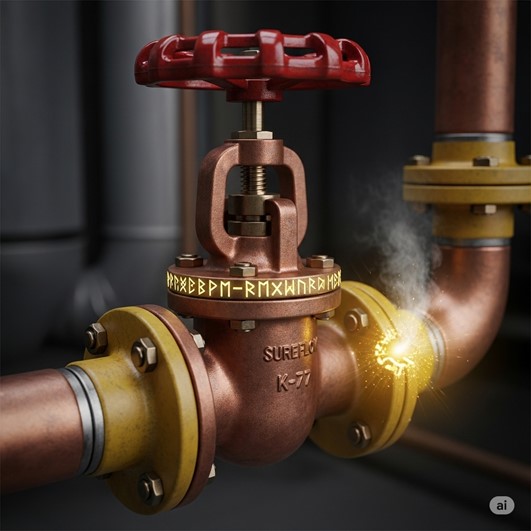
Description: The “SureFlow” Elemental Steam Valve Model K-77 is a substantial and reassuringly solid piece of Saṃsāran engineering. Its body is typically cast from heavy-gauge, reddish-brown copper known for its thermal conductivity, with a core valve mechanism and spindle often precision-machined from durable, yellow brass. The visible surfaces are usually smoothly finished, though not ostentatiously polished, prioritizing function over excessive ornamentation.
A key feature is its sturdy handwheel (often painted a cautionary red or deep blue) or a robust lever handle, ergonomically shaped for a firm grip, allowing for precise manual adjustment of steam flow. The gland packing around the spindle, crucial for preventing leaks, is made from a specially formulated, heat-resistant ceramic compound, sometimes with woven asbestos-like Saṃsāran plant fibers for added resilience.
The most distinctive feature to a knowledgeable eye is the band of faint, neatly etched Coptic-inspired runes encircling the main valve body. These symbols are not merely decorative; they are integral to the valve’s enhanced properties. When newly installed and under pressure with elemental steam, the runes might seem to possess a very subtle, almost imperceptible inner warmth or a faint visual “tightness” to one familiar with such enchantments. A well-maintained K-77 in operation often emits a low, steady, almost inaudible hum if one places an ear very close, a sign of its wards functioning correctly.
Detailed Stats:
- Pressure Rating: Certified for Low-to-Medium Saṃsāran Steam Pressure Units (SSPU), typically up to 150 SSPU for domestic systems and 250 SSPU for light industrial applications.
- Temperature Tolerance: Designed to withstand the typical operating temperatures of elemental magic-steam (which can vary but are considerable), enhanced by its runic blessings for heat dissipation.
- Flow Rate Capacity: Standard models offer a flow capacity suitable for domestic heating, cooking appliances (like steam ovens), powering small Hearth & Home automata, or light workshop machinery. Larger bore versions exist for more demanding applications.
- Connection Type/Size: Commonly produced with “Standard 1/2-inch, 3/4-inch, and 1-inch Cogsworth Threaded Pipe Fittings” (a Saṃsāran standard set by Hearth & Home). Flanged versions are available for higher-pressure light industrial use.
- Weight: A standard 1-inch K-77 valve weighs approximately 3-4 lbs due to its robust copper and brass construction.
- Durability/Lifespan: Engineered for longevity. With proper installation and periodic maintenance (e.g., gland packing replacement), a K-77 is rated for many years of continuous service in typical domestic settings. The Coptic blessings significantly extend its resistance to common steam-related degradation.
- Materials: Cast copper (valve body), machined brass (spindle, valve seat), heat-resistant ceramic/fiber gland packing, specialized heat-resistant sealing compounds, Coptic runic inscription tools, minor warding reagents (used during factory blessing).
Slot:
- Infrastructure Component: This item is not personally worn or carried by an avatar for direct magical effects in the field. It is designed to be integrated into steam plumbing systems, becoming part of the infrastructure of a building, workshop, or larger automaton.
- When uninstalled and carried (e.g., by a steam-fitter en route to a job), its magical properties are dormant and it counts as a mundane item of its weight/bulk for inventory purposes.
Passive Magic Effects (Integrated through Coptic Runes & Factory Blessing – constantly active when installed and under operational conditions):
- Runic Thermal Regulation: The etched Coptic runes on the valve body subtly assist in dissipating excess heat more efficiently than plain metal, reducing the risk of localized overheating, material stress, and accidental burns to those working nearby.
- Ward Against Magical Corrosion: The factory blessing and specific runic patterns provide a notable resistance against the corrosive effects of impurities or residual magical energies sometimes present in less refined elemental steam sources, prolonging the integrity of the brass and copper components.
- Runic Structural Reinforcement: Certain glyphs in the Coptic sequence are designed to enhance the molecular cohesion of the metal under pressure. This subtly increases the valve’s ability to withstand sudden pressure surges or prolonged operational vibrations without developing micro-fractures or leaks at a rate typical for purely mundane valves.
- Steady Energetic Resonance (Perceptible to attuned adults): As noted, an adult user familiar with basic Saṃsāran magical principles, particularly those who work with elemental steam systems, can often feel or sense a faint, steady, harmonious resonance or “hum” from an installed and functioning K-77. This indicates that its protective Coptic wards are intact and the steam flow is stable. A discordant or absent resonance can be an early warning of potential issues.
Active Magic Effects (Requiring specific knowledge/skill from an adult user, typically a trained technician or someone with elemental/Coptic lore):
- Resonance Diagnostic (Technician Activated):
- Activation (by Adult Technician/Artisan): An adult steam-fitter, engineer, or someone with a basic affinity for elemental magic (especially Water or Fire) or knowledge of Coptic warding principles can perform a diagnostic. This involves placing a hand on the operational K-77 valve body, closing their eyes, and focusing for approximately one minute, often humming a specific resonant Coptic tone or prayer. This requires a successful moderate difficulty Mechanics, Engineering (Steam Systems specialty), or a relevant magical skill check (e.g., Lore (Coptic Runes), Minor Elemental Attunement).
- Effect: If successful, the user gains a clearer, more detailed sense of the valve’s energetic state beyond the basic passive resonance. A pure, clear, and strong hum indicates optimal function and ward integrity. A wavering, faint, or discordant hum can provide clues to developing issues: e.g., a “thin” hum might indicate weakening seals, a “rasping” hum might suggest internal corrosion or debris, a “strained” hum could signal it’s operating near its pressure limit. This allows for proactive maintenance before a critical failure.
- Frequency: Can be attempted as needed by a skilled individual, but repeated diagnostics on a perfectly healthy valve yield no new information.
- Emergency Ward Re-energizing (Minor Ritual – Technician Activated):
- Activation (by Adult Technician/Artisan with Coptic Lore): In a critical situation where a minor leak (a slow drip or faint hiss of steam) has developed specifically at the K-77’s seals or casing due to unexpected stress, an adult who deeply understands the meaning and activation of its Coptic runes (requiring a successful challenging difficulty Lore (Coptic Runes) or a related ritualistic Enchanting/Blessing skill check, and 10-15 minutes of focused prayer and ritual gestures directly at the valve) can attempt to temporarily re-energize its protective and sealing wards.
- Effect: If the ritual is successful, the existing Coptic runes on the valve glow faintly for a moment, and the minor leak is often significantly slowed or even temporarily stopped (e.g., for 1d6 hours, or until the system is next shut down). This is a temporary fix, not a proper repair, intended to allow for a safer system shutdown, prevent immediate water damage, or buy time for a proper repair to be effected. It will not fix major mechanical damage or large breaches.
- Frequency: This ritual can typically only be attempted effectively once per significant leak on a given valve. Repeated attempts on the same un-repaired leak yield diminishing or no returns as the underlying physical issue remains.
Tags: Saṃsāran Plumbing, Elemental Steam Component, Safety Feature, Artisan-Blessed, Factory Standard, Pressure Valve, Heat Management, Corrosion Resistance, Infrastructure, Engineering Component, Coptic Runic Blessing, Component, Steam-System, Valve, Regulator, Copper, Brass, Runic, Heat-Resistant, Industrial-Support
The “SureFlow” Elemental Steam Valve Model K-77, a vital and commonly available Tier 1 component manufactured by Saṃsāra’s Hearth & Home Automata Works No. 117, is distributed through channels catering to industry, specialized trades, and significant domestic installations. Its cost in “Shards” reflects its robust copper and brass construction, precision engineering, and the integrated Coptic runic blessings that enhance its performance and durability.
Here are the primary types of establishments and contexts where the Model K-77 valve might be bought and sold:
- Hearth & Home Industrial Supply Depots & Factory Outlets:
- Where: These would be located directly at or near the Hearth & Home Automata Works No. 117 in Porthaven, and as officially sanctioned distribution centers in other major industrial cities across Saṃsāra. They cater specifically to industrial clients, engineering guilds, and large-scale purchasers.
- How Bought/Sold: Primarily through direct sales, often involving bulk orders and established accounts. Technical representatives and engineers employed by Hearth & Home would be on hand to discuss specifications, pressure tolerances, and the benefits of the Coptic runic enhancements. Detailed parchment schematics, installation guides, and compatibility charts for various Saṃsāran steam systems would be provided. Long-term supply contracts for other manufacturers using the K-77 as an original equipment component would be negotiated here.
- Cost:
- Model K-77 (Standard 1-inch domestic/light-industrial grade): 30 – 50 Shards per unit (prices may be lower for very large volume orders).
- Larger Bore or Higher-Pressure Variants (e.g., 2-inch industrial grade): 60 – 100+ Shards per unit, depending on size and pressure rating.
- Guild-Sanctioned Purveyors of Steam & Plumbing Components:
- Where: Found within the precincts of established Artisan Guilds (such as the Plumbers & Steam-Fitters Union, the Guild of Mechanical Engineers, or the Millwrights’ Sodality) in most significant towns and all cities.
- How Bought/Sold: These outlets primarily serve their registered guild members, apprentices, and affiliated workshops. The K-77 valve would be a staple, recommended for its reliability and the implicit safety assurance of the Hearth & Home brand and its Coptic blessings. Guilds might purchase in bulk and offer them to members at fair prices, possibly including them in standardized kits for apprentices. They might also host workshops on best practices for installing and maintaining systems using K-77 valves.
- Cost:
- Model K-77 (Standard 1-inch): 35 – 55 Shards.
- Larger Bore or Higher-Pressure Variants: 70 – 110+ Shards.
- Specialized Industrial Hardware & Millwright Supply Merchants:
- Where: Located in the industrial sectors, docklands, or specialized market streets of cities and larger towns that cater to factories, large workshops, shipwrights (if steam-powered vessels are common), and builders of significant steam-powered civic or commercial installations (such as public baths, large communal kitchens, or early textile manufactories).
- How Bought/Sold: Direct retail and wholesale to tradespeople and businesses. These merchants would stock a diverse range of steam system components from various Saṃsāran manufacturers, with the Hearth & Home K-77 being a reputable, mid-to-high quality offering known for its magically enhanced durability. Staff would be expected to have good technical knowledge.
- Cost:
- Model K-77 (Standard 1-inch): 40 – 60 Shards.
- Larger Bore or Higher-Pressure Variants: 75 – 120+ Shards.
- Traveling Merchant Companies (Specializing in Engineering Goods & Remote Project Supplies):
- Where: These well-equipped and often heavily guarded merchant caravans would traverse major trade routes, specifically catering to outlying industrial ventures (e.g., new mining operations harnessing steam drills, remote agricultural estates using steam pumps for irrigation) or colonial settlements establishing their infrastructure.
- How Bought/Sold: From dedicated wagons within the caravan, showcasing a range of essential industrial components. They would carry common sizes of the K-77 valve, emphasizing its robustness for challenging environments. Prices would be higher due to the considerable costs and risks of transport to remote locations. Barter for significant local resources (e.g., raw metal ores, large quantities of elemental crystals needed by city industries) might be a preferred mode of exchange in some frontier areas.
- Cost:
- Model K-77 (Standard 1-inch): 50 – 80 Shards.
- Larger Bore or Higher-Pressure Variants: Carried less frequently due to bulk, but if available, could command 90 – 150+ Shards.
- Salvage Yards & Reconditioned Industrial Parts Dealers (An Emerging Market):
- Where: Often found in the less salubrious outskirts of major industrial ports or in areas recovering from past industrial accidents or factory closures.
- How Bought/Sold: These dealers acquire components from decommissioned steam systems, dismantled automata, or bankrupt manufactories. A used “SureFlow” K-77 valve might be available here. Its condition would vary significantly – it might be sold “as-is,” caked in grime but fundamentally sound, or superficially cleaned. The Coptic runes might be worn or partially obscured, their magical efficacy potentially diminished. Sales are typically final, with no guarantees.
- Cost: Highly variable based on condition and demand, but significantly less than new.
- Used Model K-77 (condition varies, magical integrity uncertain): 10 – 30 Shards.
Purchasers of new K-77 valves, particularly from official Hearth & Home outlets or reputable guild suppliers, would expect a degree of quality assurance, perhaps even a limited warranty against manufacturing defects. Information regarding proper installation, pressure testing, and the nature of its Coptic runic blessings for optimal performance and safety would also be considered part of a responsible sale for such a critical component in Saṃsāra’s steam-powered society.
The “SureFlow” Elemental Steam Valve Model K-77, while engineered by Hearth & Home Automata Works for the precise and safe regulation of elemental magic-steam in Saṃsāra’s domestic and industrial systems, can be employed in surprisingly diverse defensive and offensive roleplaying scenarios, especially when its control over potent steam power is creatively exploited or its robust physical nature is turned to unconventional ends.
1. Within Industrial Environments (Factories, Boiler Rooms, Steam Tunnels, Workshops):
- Defensive Roleplay:
- Area Denial via Steam Control: “The security constructs are advancing down Corridor B! Elara, get to that K-77 manifold and redirect the boiler overflow! Flood that passage with scalding elemental steam – they’re metal, but let’s see how their joints handle that!” An adult technician avatar might first use the Resonance Diagnostic ability to ensure the chosen valve is sound before risking such a maneuver.
- Creating Obscuring Clouds for Evasion: “We’re cornered in the main gear-works! Find a low-pressure K-77 outlet, crank it open! We need a thick steam cloud to cover our retreat to the maintenance tunnels!” The Coptic runes enhancing heat dissipation might subtly make the resulting steam slightly cooler and thus denser for longer.
- Emergency System Isolation/Shutdown: “That main drive piston is about to shatter – the whole assembly will explode! Someone get to the primary K-77 cut-off for this sector and close it, now!” If the valve itself is slightly damaged but vital for a moment longer, an avatar with the know-how might attempt the Emergency Ward Re-energizing ritual: “The valve casing is cracked and hissing, but I need it to hold for ten more seconds! Spirits of Khem, lend strength to these runes!”
- Improvised Barricade/Brace: A heavy, uninstalled K-77, with its solid brass and copper body, could be quickly used to wedge a heavy door or brace a collapsing support beam in a desperate moment.
- Offensive Roleplay (Manipulating Steam Systems):
- System Sabotage (High Risk): “If we can reach the primary K-77 inflow regulator on their main elemental boiler and force it shut while the core is at full burn, the pressure will build… it’ll be spectacular, and devastating.” This represents a dangerous, often extreme, offensive use targeting an opponent’s infrastructure.
- Directed Steam Jet: “They’ve barricaded themselves in the foreman’s office! That flexible steam conduit has a K-77 nozzle. Pry open the door enough to get the nozzle in and give them a full blast of Porthaven’s finest welcome!”
- Auditory Assault/Diversion: “Need to create a massive distraction? Find a high-pressure steam exhaust line with a K-77. Opening it fully will unleash a deafening roar, panicking their workers and drawing all guards while we access the schematics vault.” The structural integrity runes on the K-77 would help it withstand the sudden release.
2. In Urban Settings (Buildings with Steam Infrastructure, Street-Level Utility Access):
- Defensive Roleplay:
- Makeshift Bludgeon (Uninstalled Valve): An avatar carrying a spare K-77 (perhaps a steam-fitter by trade) might find themselves unarmed. “No blade? Then this thrice-blessed Cogsworth valve will serve to greet these back-alley thugs!” Its weight and solid construction make it a surprisingly effective, if clumsy, impact weapon. The Coptic runes ensuring its durability mean it’s unlikely to shatter on first impact.
- Manipulating Civic Steam for Evasion: “The Watch is closing in! If I can reach that civic heating K-77 junction under the street grating and vent it upwards, the steam cloud will cover our escape into the merchant district.”
- Securing a Location: Using an uninstalled K-77 and some ingenuity to jam a door mechanism from the inside, or disable a steam-powered lift an opponent might use.
- Offensive Roleplay (Environmental Disruption/Sabotage):
- Disrupting an Opponent’s Establishment: “Their fancy teahouse relies on that newfangled steam-samovar system. A ‘malfunctioning’ K-77 in their supply line, perhaps one that sticks open and floods their kitchen with steam, will certainly ruin their afternoon soirée.”
- Improvised Thrown Obstacle: Less a weapon, more a heavy, awkward projectile. “He’s trying to activate that alarm rune! Throw the K-77 – maybe the impact will be enough to disrupt his casting!”
- Creating Hazards: If aware of underground steam tunnels with K-77 access points, one might vent steam into a section beneath an opponent’s known meeting place, making it uncomfortably hot or dangerously unstable.
3. Aboard Saṃsāran Steam-Powered Conveyances (Airships, Riverboats, Land-Crawlers):
- Defensive Roleplay:
- Critical System Management in Crisis: During an attack or mechanical failure, an engineer avatar would be scrambling to K-77 valves. “The port engine’s main steam line is ruptured! Close the K-77 isolation valve before we lose all pressure! I’ll try the Resonance Diagnostic to see if the starboard valves can handle the overload!”
- Emergency Steam Shield/Deterrent: “Sky-reavers attempting to board! Open the K-77 pressure release valves along the port rail! A wall of superheated steam will make for a poor welcome mat!”
- Last-Ditch Repair with Runic Aid: “This K-77 controlling the rudder steam-assist is cracked from that cannon hit! While you hold it together, I’ll attempt the Emergency Ward Re-energizing ritual. We need steering for just a few more minutes!” Its inherent runic heat dissipation might prevent a catastrophic overheat during such a taxed moment.
- Offensive Roleplay (Targeting Vessel Systems or Personnel):
- Crippling Enemy Vessels: If boarding an enemy steam-vessel, a primary objective for an engineer avatar might be to locate and sabotage their critical K-77 valves controlling propulsion or weapon systems, perhaps by forcing them shut, breaking the handwheels, or even using a K-77 taken from their own ship as a tool to smash an exposed enemy valve.
- Using Steam as a Weapon Against Boarders: “They’re on the foredeck! Open all K-77 steam vents in that section! Boil the uninvited guests!” The corrosion resistance of the K-77 ensures it can handle even impure or magically-tainted water used in emergency steam generation.
- Overloading a System: If an enemy system is poorly maintained, rapidly cycling a connected K-77 valve from fully open to fully closed repeatedly could potentially cause a pressure surge or pipe hammer effect, damaging their machinery further down the line.
In all these scenarios, the “SureFlow” K-77 valve’s primary role as a regulator of powerful elemental steam is key. Its defensive and offensive applications are born from the creative or desperate manipulation of this function, or by leveraging its sheer robust physicality. The integrated Coptic runes and blessings, while designed for operational integrity and longevity, indirectly contribute to its reliability even when used in these unintended, often perilous, ways, especially if an adult avatar understands how to interact with its subtle magical resonances.
Perception of Activation: The “SureFlow” Elemental Steam Valve Model K-77 is a robust industrial component whose subtle Coptic-inspired magical properties are primarily interacted with by skilled adult technicians or artisans during diagnostics or emergency procedures. The perception of these “activations” is specific to the context of its operation within a Saṃsāran steam system.
I. Activating “Resonance Diagnostic” (The ~1-minute focused check by a technician on an operational valve)
User’s Perspective (The Technician/Artisan):
- What’s Perceived (Sight): The Coptic runes etched into the valve casing might seem to gain a momentary, almost imperceptible depth or clarity under their focused gaze; the usually turbulent flow of elemental steam visualized internally might appear to momentarily smooth or reveal subtle eddies that indicate its state.
- Description: As the technician attunes their senses, the ancient runes, normally just faint etchings, might appear to “sharpen” or “soften” in their visual presence, subtly shifting as if responding to the valve’s internal condition. They might also form a clearer mental image of the steam’s passage, noting its consistency.
- What’s Perceived (Sound): Their own focused humming or quiet, repetitive Coptic prayer word. The normal operational hiss and thrum of the valve and the steam passing through it subtly transforms into a more defined spectrum of sounds – a clear, steady, resonant tone for a healthy valve, or a wavering, slightly discordant, or “gritty” undertone if issues are present.
- Description: The technician learns to interpret the valve’s “song.” A pure, unwavering hum signifies good ward integrity and smooth flow. A “fluttering” in the hum might indicate pressure instability; a faint “grinding” sound could point to particulate wear despite the wards; a “strained” or high-pitched whine might suggest the valve is operating near its pressure limits or a ward is weakening.
- What’s Perceived (Smell): The typical scent of hot metal, elemental steam (which can have faint mineral or ozone traces), and any ambient workshop odors might be subtly tinged. A perfectly functioning K-77’s magical aura might impart a very clean, sharp, almost “healthy” metallic scent to the steam it regulates. Conversely, a faint acrid, “burnt metallic,” or “stagnant energy” undertone could indicate ward degradation or internal corrosion.
- Description: The technician’s trained nose detects nuances. The clean, energetic scent of well-regulated elemental steam is a good sign. Any hint of bitterness, excessive ozone, or a “dull” metallic odor can be an early warning of the Coptic wards struggling or failing.
- What’s Perceived (Touch): Placing a hand (often gloved for protection) on the valve body allows the technician to feel beyond the mundane vibrations and temperature. They perceive a more distinct energetic “pulse” or signature from the Coptic runes. The quality of this vibration – its strength, evenness, or any erratic fluttering – provides crucial diagnostic information about the warding’s integrity and the valve’s operational stress.
- Description: The valve “speaks” through their hand. A strong, even, warm pulse signifies healthy, active wards. An erratic, weak, overly hot, or “sickly” feeling vibration can pinpoint a failing Coptic ward, an internal blockage affecting steam harmony, or imminent mechanical stress. Specific areas of the valve might feel unusually hot or cool if a ward is failing locally.
- What’s Perceived (Taste): Generally not applicable, though a very strong discharge of stray magical energy due to a failing ward might create a metallic or ozone taste in the immediate air.
- Description: Not a primary diagnostic sense, but a sudden sharp metallic taste in the air near the valve could be an urgent indicator of a significant magical ward breach.
- What’s Perceived (Extra-Sensory): A direct, intuitive connection or empathic link with the K-77’s inherent Coptic enchantments and the “spirit” of its operation. The technician receives clear mental impressions regarding the strength and integrity of the protective wards, the harmony of the energy flow it regulates, and any specific points of stress, weakness, or incipient failure within the valve’s magical structure.
- Description: The technician feels as if they are briefly “in tune” with the valve’s magical essence. They can sense the “health” of the Coptic runes as fields of bright or dim protective energy, perceive the flow of elemental steam as a smooth or turbulent energetic current, and intuitively pinpoint locations where the magical wards are strained, thinning, or beginning to unravel.
Observer’s Perspective (Watching the technician perform the diagnostic):
- What’s Perceived (Sight): The technician placing a hand carefully on the operational valve, often closing their eyes or adopting a look of deep concentration, possibly murmuring or humming softly. There is typically no visible change in the valve itself from an observer’s point of view.
- Description: The observer would note the technician’s intense focus and stillness. The valve would continue its normal operation, hissing or humming with steam flow. Any subtle visual cues on the runes would be too faint for an external observer to notice.
- What’s Perceived (Sound): The usual ambient sounds of the steam system and the workshop. If very close, the observer might hear the technician’s low humming or murmured Coptic prayer words.
- Description: The dominant sound would be the operational noise of the machinery. The technician’s vocalizations, if any, would be quiet and personal.
- What’s Perceived (Smell/Touch/Taste): Not applicable to the observer for this diagnostic.
- What’s Perceived (Extra-Sensory – for magically or psionically sensitive observers): A subtle focusing of the technician’s personal aura and a brief, gentle “pinging” or resonant interaction between their energy and the valve’s own faint, inherent magical signature from its Coptic runes. The valve’s aura might seem to momentarily “ripple” or respond as the technician attunes to it.
- Description: A magically attuned observer might perceive the technician extending a delicate tendril of their own awareness or magical energy to interface with the K-77’s innate Coptic enchantments. The valve’s faint magical aura might pulse or subtly shift in response to this diagnostic “query.”
Positives of “Resonance Diagnostic” Perceptions:
- Technician: Provides highly detailed, nuanced diagnostic information about the valve’s magical and mechanical integrity that mundane senses or tools alone could not reveal. This allows for precise preventative maintenance, enhances system reliability, and deepens their understanding of the Coptic-magical technology they work with.
- Observer: Witnessing the technician’s focused skill and confident assessment (even if the process is unseen) instills confidence in the maintenance of the steam systems, contributing to a sense of safety and operational efficiency.
Negatives of “Resonance Diagnostic” Perceptions:
- Technician: Requires significant focused concentration and time (approximately one minute per valve), during which they might be less aware of other immediate surroundings or hazards in a busy or dangerous industrial environment. The intuitive information received requires experience and skill to interpret correctly; a novice might misread the subtle energetic cues.
- Observer: The entire diagnostic process is largely internal to the technician’s experience. No visible proof or immediate external confirmation of the diagnostic information is available to an observer, who must rely on the technician’s expertise and interpretation.
II. Activating “Emergency Ward Re-energizing” (The 10-15 minute Coptic ritual by a skilled adult to temporarily seal a minor leak)
User’s Perspective (The Technician/Artisan with Coptic Lore):
- What’s Perceived (Sight): The faint Coptic runes etched into the leaking valve begin to visibly glow, often with a soft, steady, warm golden or pure white light. This luminescence intensifies as the ritual progresses. A shimmering, almost tangible aura of the same colored light visibly coalesces around the point of the leak, appearing to “knit” the breach closed or staunch the flow of escaping elemental steam. The escaping steam itself often appears less violent or may diminish significantly as the magical wards re-energize and take hold.
- Description: As the technician chants the Coptic prayers and performs the precise ritual gestures, they witness the ancient runes on the valve awaken with an undeniable inner light. This glow is not dazzling but resolute and steady. A shimmering, visible field of this golden or white energy forms over the leaking seal or crack, and the fierce jet of steam visibly lessens and softens as this magical barrier strengthens and seals the breach.
- What’s Perceived (Sound): Their own continuous, resonant Coptic chants and specific words of power. The harsh, often high-pitched hissing or roaring of the escaping steam gradually lessens in intensity, being replaced by the healthier operational hum of the valve and perhaps a soft, resonant thrumming or a series of faint, almost musical “clicks” from the now-glowing runes as they realign their protective energies.
- Description: The technician hears their own voice leading the complex Coptic ritual. The dangerous, uncontrolled hiss of escaping elemental steam slowly diminishes, giving way to more harmonious operational sounds. As the Coptic wards respond and re-energize, the valve itself might seem to resonate with a low, powerful, and controlled hum, and the glowing runes might emit a series of very faint, almost melodic sighs or clicks as they achieve their renewed seal.
- What’s Perceived (Smell): The initial acrid, often sulphurous or metallic scent of uncontrolled leaking elemental steam is gradually overlaid or replaced by the clean, pure, and often sacred aroma of energized metal, specific Coptic ritual incense (if used, such as frankincense or myrrh), and a distinct ozone-like tang of potent, active magic.
- Description: The sharp, often unpleasant or dangerous smell of the raw escaping steam lessens. In its place, the artisan smells the clean, almost sweet and sacred scent of the re-awakened Coptic wards, often mingled with the rich fragrance of any traditional incense burned during the ritual, and the unmistakable sharp, clean tang of powerful magical energy being actively channeled, shaped, and contained.
- What’s Perceived (Touch): The valve body immediately around the glowing Coptic runes becomes noticeably warm, radiating a steady, contained heat (but not dangerously hot if the ritual is performed correctly). A strong, consistent, containing vibration replaces the erratic, violent shuddering caused by the leak. There’s a palpable feeling of the metal “firming up” or the magical wards actively “gripping” and sealing against the escaping steam pressure.
- Description: Through their hands (often protected by heavy, perhaps ritually prepared gloves), the artisan feels the chaotic and often dangerous vibrations of the high-pressure leak give way to a powerful, controlled, and steady thrum. The metal around the glowing Coptic runes radiates a strong, contained warmth. They can physically feel the immense magical energy they are channeling actively working, a distinct sensation of the valve’s structure “fighting back” against the breach and achieving a seal.
- What’s Perceived (Taste): A strong metallic or ozone taste in the air is highly likely due to the intensity of the active Coptic magic being channeled.
- Description: The significant amount of magical energy being focused and manifested during this Coptic ritual often creates a palpable metallic or sharp ozone taste in the air immediately around the artisan and the valve.
- What’s Perceived (Extra-Sensory): A powerful and direct channeling of their own spiritual will and cultivated magical energy (or the drawing upon and shaping of ambient Coptic-aligned sacred energies from Saṃsāra) directly into the valve’s damaged or failing wards. A profound sense of the ancient Coptic runes “awakening” with renewed potency and actively reasserting their divine protective function. A clear feeling of a tangible magical “patch,” “shield,” or “seal” forming over the point of leakage, containing the elemental steam. The valve’s overall energetic signature becomes significantly stronger, more stable, and radiates a renewed sense of blessed integrity.
- Description: The artisan experiences a significant and demanding flow of directed energy, precisely guided by the ancient Coptic ritual, pouring into the K-77’s compromised warding system. They perceive the ancient runes flare to life with renewed divine purpose, their inherent protective Coptic magic reasserting itself with considerable force, forming a tangible (on an energetic and sometimes even faintly visible level) seal against the escaping elemental steam. The valve’s very “essence” or “spirit” feels bolstered, protected, and infused with renewed sacred resilience.
Observer’s Perspective (Watching the Coptic ritual being performed):
- What’s Perceived (Sight): The technician or artisan engaged in a prolonged, focused, and often intense ritual around the visibly leaking steam valve. This involves continuous Coptic chanting, specific and often intricate hand gestures, and possibly the use of minor ritual components (like anointing oils, smoking incense, or small sacred symbols). The Coptic runes etched on the valve itself begin to glow with a noticeable, often soft golden or pure white light. A shimmering, faintly luminous aura or energy field may become visible around the area of the leak as it gradually lessens or completely stops. The violent jet of escaping elemental steam visibly diminishes or ceases.
- Description: This is a clearly magical and often dramatic event for an observer to witness. They would see the artisan deeply engrossed in a complex ritual. The most striking and undeniable visual would be the ancient Coptic runes on the failing valve itself beginning to shine with an inner light, followed by a visible shimmering energy field forming directly over the point of the leak. They would then witness the actual jet of dangerous steam reduce in force or stop altogether, a clear testament to the ritual’s power.
- What’s Perceived (Sound): The technician’s continuous, often loud and resonant, Coptic chanting or sacred prayers, spoken with power and conviction. The loud, dangerous hissing or roaring of the steam leak gradually reducing in volume or stopping completely, often replaced by the normal operational sounds of the now-stabilized steam system, or even a faint, harmonious hum emanating from the glowing Coptic runes.
- Description: An observer would clearly hear the artisan’s powerful ritualistic vocalizations. The most dramatic auditory change would be the significant lessening or cessation of the leak’s alarming noise, a clear indication of the Coptic ritual’s immediate and successful progress. A faint, almost musical hum from the glowing runes might also become perceptible to a close observer once the primary noise of the leak subsides.
- What’s Perceived (Smell): The initial harsh, often acrid or sulphurous, scent of uncontrolled leaking elemental steam might be gradually replaced by the distinct aroma of any sacred incense being used by the technician as part of the Coptic ritual, and a noticeable ozone or “charged air” smell indicative of potent, active magic as the wards are re-energized.
- Description: The air quality around the valve would undergo a noticeable transformation. The dangerous and often unpleasant smell of the raw escaping steam would diminish, potentially replaced by the rich, sacred fragrance of traditional Coptic incense (frankincense, myrrh) or other ritual herbs. A sharp, clean scent of active magic, similar to ozone after a lightning strike, would also become quite apparent.
- What’s Perceived (Touch/Taste): Not directly applicable for an observer, but they might feel the ambient temperature around the valve change slightly (perhaps becoming warmer due to the channeled energy, or cooler if the steam was superheated and is now contained). They might also taste the distinct ozone or metallic tang of active magic in the air if they are close enough.
- What’s Perceived (Extra-Sensory – for magically or psionically sensitive observers): A significant and focused build-up and powerful application of Coptic ritual magic. The valve’s damaged or failing warding aura would be seen (by their magical senses) to be actively repaired, reinforced, or “patched” by a new, potent layer of luminous protective energy. The chaotic, uncontrolled energy of the leak would be visibly contained, then sealed by the directed force of the Coptic ritual.
- Description: A magically sensitive observer would witness a clear and potent display of focused ritual magic. They would perceive the technician drawing upon and channeling considerable sacred or magical energy, precisely directing it through the Coptic runes on the valve to mend or temporarily but powerfully reinforce its damaged protective wards. The valve’s aura would visibly strengthen, stabilize, and coalesce around the point of the former leak, shining with renewed protective light.
Positives of “Emergency Ward Re-energizing” Perceptions:
- Technician: Provides extremely powerful and direct sensory and extra-sensory confirmation that the demanding Coptic ritual is working effectively and the dangerous wards are being successfully re-energized. This results in a direct, tangible impact on a critical and hazardous situation. There is deep satisfaction from the successful application of their specialized Coptic lore, faith, and magical skill under pressure.
- Observer: Witnessing a dangerous, uncontrolled elemental steam leak being visibly and audibly contained by a potent magical ritual is highly impressive, deeply reassuring, and often awe-inspiring. It clearly demonstrates the practical power and reliability of Saṃsāran Coptic-inspired enchantments and the exceptional skill of the technician, reinforcing trust in both the technology and the individuals who maintain it.
Negatives of “Emergency Ward Re-energizing” Perceptions:
- Technician: The Coptic ritual is lengthy (10-15 minutes or more), physically and mentally exhausting, and requires intense, unbroken concentration as well as profound knowledge of specific Coptic lore and ritual practices. This makes it unusable by just anyone, even if they are an adult avatar. It is a temporary fix designed to buy time, not a permanent repair for underlying mechanical damage. The energy expenditure can be significantly draining for the technician. Performing such an intricate ritual in close proximity to an active, high-pressure elemental steam leak is inherently dangerous, even with protective gear.
- Observer: While the successful outcome is impressive, the fact that such a potent and lengthy Coptic ritual is needed highlights a significant system vulnerability or failure. The temporary nature of the magical fix means the underlying physical problem with the valve or system still needs to be addressed with conventional repairs, which might be costly or time-consuming. The overt and powerful display of Coptic magic might attract unwanted attention, scrutiny, or even fear in certain circumstances or from individuals unfamiliar with or suspicious of such potent Saṃsāran enchantments.
The Steam-Warden’s Craft: Formulary for the K-77 Runic Flow Regulator
This formulary details the meticulous process by which a skilled artisan or a specialized workshop within Saṃsāra might craft a “SureFlow” Elemental Steam Valve, Model K-77, or an equivalent, reliable flow regulator. This component, vital for the burgeoning magic-steam powered infrastructure, combines robust mundane engineering with the subtle protective blessings of Coptic-inspired runic magic.
Materials Needed (per standard Model K-77 Valve, approx. 1-inch fitting):
- Primary Metal Stock:
- One high-quality, refined Copper Ingot or a section of heavy-gauge, seamless Copper Piping Stock (sufficient for the main valve body).
- Length of solid Brass Rod Stock (for machining the spindle, valve seat, gland nut, and handwheel hub).
- Sealing & Packing Components:
- A measure of specially formulated, high-temperature Ceramic Clay (or precisely sized, unblessed ceramic blank seals and gland packing rings).
- A small quantity of “Salamander’s Floss” (a rare, naturally fire-resistant Saṃsāran mineral fiber) OR finely braided, treated Asbestos-Vine Fiber (if local ethics and safety allow its careful handling and sealing).
- Runic Inscription & Coptic Blessing Reagents:
- A set of master templates or precisely calibrated guides for the K-77 Coptic Rune Sequence (specific to heat dissipation, pressure integrity, and corrosion warding).
- A vial of Consecrated Anointing Oil (traditionally a blend of heat-resistant grapeseed oil and sacred Myrrh resin, infused with powdered Sunstone for vitality and blessed over seven days with Coptic chants for enduring strength).
- A tiny measure of thrice-blessed, finely powdered Copper or pure Silver Dust (for inlaying the runes for enhanced conductivity of blessings, or as a key component in the anointing oil).
- Specific Coptic prayer scrolls (or deeply memorized verses) for warding structures against elemental fury, ensuring the harmonious flow of energies, and invoking blessings of resilience and safety.
- Assembly & Finishing Materials:
- High-temperature Brazing Alloy (typically a copper-silver-phosphorus blend for superior strength and steam-tight seals under heat).
- Assortment of fine-grit Lapping Powders (e.g., refined corundum dust) for perfecting valve seat seals.
- Durable, heat-resistant Lacquer or Enamel (often deep blue for “flow” or cautionary red for “stop” on handwheels, as per Saṃsāran Guild of Steamfitters standards).
Tools Required:
- Foundry & Metal Fabrication (Precision Focused):
- A well-maintained Forge or small Foundry capable of achieving and holding precise temperatures for melting copper and brass (often powered by controlled elemental fire or high-grade magical coals).
- Set of high-quality graphite or ceramic Crucibles, heavy-duty Tongs, various specialized Blacksmithing Hammers, and precision Anvils.
- If casting valve bodies: Precisely machined master patterns and durable sand-casting molds or (for higher volume) reusable metal molds.
- If fabricating from pipe: Heavy-duty pipe cutters, bending jigs, swaging tools.
- Machining & Finishing:
- A Steam-Powered Precision Lathe (or an exceptionally accurate, masterfully operated manual equivalent) with a full complement of hardened steel cutting tools for turning, threading, and facing operations.
- Precision Threading Tools (Saṃsāran standard taps and dies for pipe fittings and valve spindles).
- Pillar Drills or sensitive Hand Drills with high-speed steel bits; Reamers for achieving exact internal bore finishes.
- Brazing Hearth with a focused, controllable magical heat source or a high-temperature blowpipe.
- Dedicated Lapping Benches with lapping plates; Polishing wheels (steam or foot-powered).
- Ceramic & Seal Crafting:
- If forming seals from clay: Potter’s wheel or shaping tools, high-temperature Kiln (can be magically augmented for even firing).
- Tools for braiding or compacting sealing fibers.
- Runic Inscription & Ritual Blessing:
- A set of extremely fine-tipped, hardened steel or magically consecrated bronze Engraving Styluses or Chisels for meticulously etching the Coptic runes.
- A Jeweler’s Loupe or a well-lit Magnifying Apparatus of considerable power.
- A dedicated, ritually cleansed and quiet workspace or small altar for the blessing ceremony. This space would include consecrated bowls for oils, brushes made from sacred animal hair (e.g., griffin down, if legends hold true) for anointing, and perhaps a censer for specific Coptic ritual incense.
- General Workshop & Testing Equipment:
- Heavy-duty Workbenches with multiple, strong Vices.
- Full sets of precision Callipers, Micrometers, and other Saṃsāran standard Measuring Devices (some advanced workshops might have rudimentary magical comparators that indicate dimensional accuracy with shifts in light or tone).
- A Hydrostatic Pressure Testing Rig and a separate low-pressure Elemental Steam Testing Bench, complete with calibrated Pressure Gauges and Temperature Sensors (possibly with minor magical readouts for clarity).
- Standard artisan safety gear: heavy leather aprons, reinforced gloves, eye-protective goggles (perhaps with enchanted lenses to reduce glare from forges or magical energies).
Skill Requirements:
- Master Metalsmithing & Precision Founding/Machining (Valvewright Specialty – Masterful): This is the cornerstone. Requires exceptional skill in casting complex, pressure-tight valve bodies (if not fabricated), or expertly forging and shaping them. Most critically, it demands the ability to machine valve seats, spindles, glands, and threads to extremely fine tolerances, ensuring steam-tight seals under dynamic temperature and pressure conditions. A profound understanding of copper and brass metallurgy, thermal expansion rates, and stress mechanics is essential.
- High-Temperature Ceramic Craft & Seal Technology (Adept to Masterful): The ability to create, shape, fire, and finish ceramic components (like gland packings and valve disc seals) that can maintain their integrity and sealing properties under the harsh conditions of elemental steam. This includes knowledge of appropriate mineral fiber reinforcements.
- Sacred Runic Inscription (Coptic Ward Glyphs – Adept to Masterful): Not merely artistic engraving, but the ability to accurately and with proper ritualistic intent inscribe the specific sequences of Coptic-derived runic symbols onto the valve bodies. Each rune’s depth, angle, and placement must be precise to correctly channel and hold the intended magical blessings.
- Minor Sacral Enchanting & Ritual Blessing (Coptic Rites of Industrial Warding – Adept): Deep knowledge of and practiced ability in performing the specific Coptic-inspired blessing rituals. This involves the correct intonation of ancient prayers, the precise application of consecrated anointing oils and symbolic dusts, and the focused channeling of positive, protective magical energy to “awaken” the runes and imbue the valve with its enhanced resilience against heat, magical corrosion, and extreme pressure.
- Elemental Steam Systems Engineering & Mechanics (Proficient to Adept): A comprehensive understanding of the principles of Saṃsāran elemental steam generation, fluid dynamics, pressure regulation, thermal mechanics, and the common operational stresses and failure modes within steam systems. This ensures the valve is not only crafted correctly but also designed to function optimally and safely within its intended applications.
- Advanced Metrology, Quality Assurance & Pressure Testing (Adept): The ability to utilize advanced Saṃsāran precision measuring tools with exceptional accuracy and to conduct rigorous pressure and operational tests on each completed valve to certify its performance and safety according to Hearth & Home and Saṃsāran Guild standards.
Crafting Steps (for a workshop or master artisan producing a batch of K-77 Valves):
- Design Adherence & Sanctification of Materials:
- Strict adherence to the master K-77 schematics (covering all dimensions, material specifications, tolerances, and precise runic placements) is paramount.
- Selected ingots of high-purity copper and brass, along with raw ceramic clays and reinforcing fibers, undergo a Coptic ritual of initial purification. This often involves cleansing with consecrated water (sometimes mixed with a pinch of blessed salt or natron), exposure to sanctified incense smoke, and preliminary prayers to remove any lingering impurities or negative energetic influences and prepare them for sacred inscription and blessing.
- Fabrication of Core Components (Valve Body, Spindle, Seat, Seals):
- Metal Components: Valve bodies are either meticulously cast in pre-blessed molds or expertly fabricated from heavy-gauge copper piping and forged sections. Spindles, valve seats, gland nuts, and handwheel mechanisms are precision-machined from solid brass rod stock on dedicated lathes, with all threads cut to exacting Saṃsāran steam-fitting standards. Each component is deburred and initially polished.
- Ceramic Seals & Packing: The heat-resistant ceramic gland packings and valve disc seals are either custom-formed from the prepared sacred clay (often incorporating the fire-resistant Saṃsāran fibers) and then fired at high temperatures in a ritually tended kiln, or high-quality pre-formed blanks are further refined, blessed, and lapped to achieve a perfect, steam-tight seal.
- The Sacred Art of Runic Inscription:
- Before final assembly, the specific K-77 Coptic runic sequence is painstakingly etched or engraved onto the designated areas of the copper valve body. This is performed by a skilled rune-scribe or an artisan specifically trained in this sacred practice, often in a quiet, consecrated section of the workshop under special lighting. Each rune is inscribed with focused intent, often accompanied by a whispered prayer or mantra corresponding to its protective purpose (e.g., runes for heat dissipation, glyphs for structural integrity under pressure, symbols for warding against magical corrosion).
- Meticulous Assembly & High-Integrity Brazing:
- The precisely machined and inscribed components (spindle, seat, packing gland, ceramic seals, body halves if not single-cast) are meticulously assembled by skilled fitters. Where permanent, high-strength, steam-tight joints are required (such as joining body sections or fitting fixed components), a high-temperature copper-silver-phosphorus brazing alloy is expertly applied using a focused magical heat source or a specialized brazing hearth.
- The Grand Blessing of “SureFlow” (The Core Runic Activation & Imbuement Ritual – often takes several hours for a batch):
- The fully assembled (but not yet painted or finally sealed for dispatch) valves are carefully arranged in a dedicated, ritually prepared and cleansed space.
- The artisan or a specially ordained Coptic-tradition blesser anoints each valve, paying particular attention to the newly inscribed runes, with the consecrated anointing oil (which may contain the hallowed copper/silver dust).
- A lengthy and solemn Coptic prayer, litany, or series of chants for ensuring safety, reliable and steadfast function, harmonious energy flow, and divine protection against the unpredictable fury of raw elemental steam is recited over the assembled valves. Specific verses invoking warding against excessive heat, uncontrolled pressure, and the corrosive touch of magical impurities are emphasized with particular fervor.
- This profound ritual is believed to “awaken” the inscribed Coptic runes, imbuing the entire valve with its subtle but crucial passive magical properties and its ability to resonate harmoniously with skilled adult users who understand its energetic signature.
- Final Finishing, Rigorous Testing, & Quality Attestation:
- Handwheels or operating levers are painted with durable, heat-resistant lacquers (typically deep blue for “flow” or cautionary red for “stop,” adhering to Saṃsāran Guild of Steamfitters safety color-coding standards) and securely attached.
- Each completed “SureFlow” K-77 valve undergoes a series of rigorous tests: hydrostatic pressure testing to well above its rated capacity, then operational testing with low-pressure elemental steam to check for any leaks, smooth and precise operation of the handwheel across its full range, and the integrity of all seals and runic inscriptions. Magically sensitive artisans or quality control specialists might also perform a quick “Resonance Diagnostic” to confirm the proper “hum” and energetic signature of the activated Coptic wards.
- Marking, Sealing, & Preparation for Distribution:
- Each valve that passes all tests is stamped with the official Hearth & Home Automata Works insignia, the “K-77” model designation, and often a unique serial number or batch mark.
- They are then carefully cleaned, sometimes lightly oiled for protection during storage, and prepared for distribution to guild suppliers, industrial clients, or the factory’s own commercial outlets.
The creation of each “SureFlow” Elemental Steam Valve Model K-77 is thus a careful fusion of advanced Saṃsāran industrial precision, dedicated skilled craftsmanship, and the profound, ancient wisdom of Coptic-inspired magical blessing, resulting in a component renowned for its reliability and safety in harnessing the vital elemental steam that powers the new age.
K-Seventy-Seven Wards and the Steam That Did Not Devour
Hark, and incline thine understanding to this chronicle, unearthed from a coffer of much verdigris, its parchment brittle as a winter leaf, and its script a puzzle of characters long faded from the common eye. The telling is of the “SureFlow” Elemental Steam Valve, that which bears the mark K-77, and how it first came to be a bastion against the hot anger of Saṃsāra’s new-found power.
And it was in the days when elemental steam was a fresh marvel and a raw terror in the city of Porthaven. For the great boilers, fed with the essences of fire and water by magical art, they did sigh with mighty power, yes, but oft times they did also shriek and rage. Valves then, they were things of common brass and hopeful iron, but their hearts were weak. Under the full displeasure of the steam – that which some named the Scalding Djinn – they would oft lament, and split, and let loose the white cloud that scalded flesh and tore stout timber asunder. Many were the workshops darkened by such an unruly cloud-breath, and many the artisans who looked upon steam with a sideways glance of fear.
Now, in the Hearth & Home Automata Works of the esteemed Madam Elara Cogsworth, there toiled a Master Steam-Wright. His name, as the scratching tells it, was Borin, perhaps of the Stone-Kin from a life before, for his hands were strong on the hammer and his patience was like the deep earth. Borin, he loved the hum of a well-ordered engine, but his spirit was vexed by the treachery of common valves. “This elemental steam,” he was heard to grumble into his beard, “it is a mighty servant, but a fearsome master if its collar be but flimsy brass!”
And so, Borin, he did ponder. He looked not only to the strength of metals, but to the whispers of old lore that had come to Saṃsāra with the myriad souls. Among these were fragments of Coptic wisdom, tales of sacred words and symbols that could bind unruly spirits and make safe what was dangerous. He sought out a quiet Enchanter, one learned in these Kēmi-land rites, a woman whose eyes held the calm of the desert night. Together, they spoke of warding metal, of blessing conduits, of teaching copper and brass to hold a Coptic prayer against the rage of confined elements.
Then began the great making. Borin, he chose the purest copper for the body, that it might speak truly of the heat within. He selected brass of most honest heart for the spindle and seat, that they might turn true under duress. He forged, and he lathed with the gnomish precision Madam Cogsworth herself had taught, until the parts fit like loving hands. But this was but half the art.
Then came the Enchanter, or perhaps Borin himself, his calloused hands now gentle with the sacred stylus. Upon the cooled copper, they etched the Runes of Seventy-Sevenfold Warding – or so the number K-77 is now believed to signify. These were not mere scratches for show. Each Coptic-inspired line was a prayer against bursting, each dot a seal against insidious corrosion from magical steams, each spiral a path for heat to journey away from the metal’s heart. And as they were inscribed, ancient Coptic words of power, words of binding and balance, were chanted, and the valve was anointed with oils blessed under Saṃsāra’s peculiar moons. “Let this metal remember the Stillness,” the Enchanter might have prayed. “Let it hold the Fire and the Water in just accord.”
Now, it chanced that Porthaven, in its pride, determined to raise a Great Water-Lifter, a colossal steam engine to draw water from the Azure Canal to the high cisterns, that all citizens might have clean water without the toil of the bucket. A noble work, yes, but one of vast power and thus vast danger. The boilers were the grandest yet seen, and the pipes like the gullets of sleeping dragons. Many whispered that no valve could hold such a beast in check.
But Borin, he stood forth. And he said, or words to this effect, “My Warded Valves, those with the K-Seventy-Seven Blessings, they shall be the hearts of this great work. They will not fail.” And though some doubted, Madam Cogsworth, she trusted Borin’s craft and the subtle power of the ancient Coptic rites. And so, the new valves, gleaming with their faint, sacred runes, were set at every crucial nexus of the Great Water-Lifter.
The day of the first firing, it was one of great festival and quiet fear. The elemental crystals were fed to the boilers. The steam, it rose, a low hum, then a growl, then a mighty song of power. The great pistons began to move. Water, it surged towards the high cisterns! Porthaven cheered! But then, a thing unforeseen. A rogue pulse of raw magical energy, some say from a shifting leyline beneath the city, some say from an imbalance in the great elemental crystals themselves, it did flood into the boilers. The pressure, it leaped like a panicked beast! Gauges shattered! Pipes, even those of stoutest make, began to groan and weep hot tears at their seams. Common valves in lesser systems around the port, they began to scream and burst, sending plumes of angry steam to the sky! Panic seized the crowd. “The Scalding Djinn is loose!” they cried.
But Borin and his crew, they stood by the great engine. The K-77 Warded Valves, they smoked and shuddered under the impossible strain. And upon their copper bodies, the Coptic runes, they began to glow! First a faint warmth, then a clear, steady light, gold and silver, pushing back against the raging red heat of the over-pressured metal. The valves, they did not split. The blessings held. The carefully etched words of power spoke a language of calm to the furious steam. And through these glowing sentinels, Borin and his brave fitters, they could vent the terrible excess, they could isolate the maddened boiler, they could, slowly, agonizingly, bring the great engine from the brink of a city-shattering explosion.
When the fury was passed, and a shaken Porthaven looked upon its still-standing Great Water-Lifter, they saw the K-77 valves, scorched and stained, but unbroken. And where the runes shone, the metal was whole. From that day, the “SureFlow” Elemental Steam Valve, pattern K-77, became the trusted guardian of Saṃsāra’s steam. For it was known that its strength was not of metal alone, but of ancient wisdom, sacred words, and the seventy-seven blessings that taught steam to serve, not devour.
Moral of the Story: True mastery over great power comes not merely from brute strength or clever mechanics, but from the wisdom to temper that power with safeguarding spirit and enduring, blessed resilience. For even the strongest metal may fail, but when it is fortified with ancient understanding and sacred intent, it can withstand the most furious storm. Or, as Borin might have put it, a good valve needs a strong body and a well-prayed-over soul.
Suggested conversions to other systems:
Call of Cthulhu (7th Edition)
The K-77 Ward-Valve of Porthaven
An exceptionally robust elemental steam valve of brass and copper, manufactured by Hearth & Home Automata Works. It is distinguished by faint Coptic runes etched onto its casing, which are blessed at the factory to enhance its resilience. These are common in newer or well-maintained Saṃsāran steam installations.
Game Mechanics:
- Enhanced System Reliability (Passive): When a steam-powered system (e.g., a building’s heating, a factory machine, a vehicle’s engine) is properly constructed or retrofitted with K-77 Ward-Valves at critical junctures, it exhibits superior resilience. The Keeper should treat such systems as being one step less prone to common mechanical failures (e.g., a “Regular” chance of breakdown becomes “Hard,” or it might ignore the first instance of a minor malfunction due to pressure or heat stress). The Coptic runes also grant the valve itself (and by extension, the point it regulates) a significant resistance to mundane corrosion and the degrading effects of minor magical impurities in the steam.
- Resonance Diagnostic (Active – Requires Skill & Time): An Investigator with a high skill in Mechanical Repair (50%+) or a relevant Engineering discipline (and ideally some background or a successful Lore roll related to Saṃsāran technology or Coptic symbolism) can attempt a detailed diagnostic on an operational K-77 valve. This takes 10 minutes of careful observation, listening, and tactile examination while focusing on the valve’s energetic resonance. On a successful Hard Mechanical Repair or relevant Engineering roll, the Investigator gains a clear and accurate understanding of the valve’s current structural integrity, the state of its Coptic wards (e.g., strong, stressed, failing), and any impending mundane failures (such as a wearing seal or a hairline fracture) not yet critical. This insight might grant a bonus die to subsequent attempts to perform preventative maintenance or to predict a specific system failure.
- Emergency Ward Re-energizing (Active – Ritualistic, Requires Esoteric Knowledge & Risk): If a K-77 valve is suffering from a minor leak specifically due to magical stress overwhelming its wards or slight damage to the runic enchantments (not gross mechanical failure), an Investigator possessing both Mechanical Repair (30%+) and significant Coptic Lore or a related Occult skill (e.g., 50%+, or by making a successful Cthulhu Mythos roll if the runes unknowingly touch upon older, stranger principles) can attempt an emergency re-energizing ritual. This complex procedure takes 1 hour of uninterrupted work at the valve (which might still be under dangerous pressure), involving specific Coptic prayers, precise gestures tracing the runes, and possibly the application of sanctified oils or other minor ritual components if available. It requires a successful combined roll (e.g., an average of the Mechanical Repair and relevant Lore/Occult/Mythos skill, or a single Lore/Occult/Mythos roll at Hard difficulty).
- Success: The Coptic runes on the valve glow faintly with a warm, steady light for a moment, and the minor leak is temporarily sealed or significantly reduced (e.g., for 1d6+4 hours, or until the system can be safely shut down for proper repairs). This act of interacting with ancient, potent Coptic magic in such a direct manner might cost the Investigator 0/1 Sanity point due to its uncanny spiritual implications.
- Failure: The ritual fails, the leak persists, and an hour has been wasted.
- Fumble: The ritual backfires, potentially worsening the leak, causing a minor steam explosion (inflicting 1d3 Hit Points of scalding damage to those nearby), or temporarily nullifying the valve’s existing Coptic wards, making it behave as a purely mundane (and now likely compromised) valve. This could cost 1/1d3 Sanity points.
Blades in the Dark
The SureFlow Cog-Valve (H&H K-77 Pattern)
A heavy-duty, reliable steam valve, a hallmark of Hearth & Home engineering, easily identified by the faint Coptic runes on its brass casing. These are prized by tinkers and engineers throughout Duskwall’s steam-driven underbelly for their resilience. (Fine Quality component; if blessed/attuned, Exceptional Quality)
Game Mechanics:
- Tags: Mechanical, Steamcraft, Durable, Warded, (Runic – Coptic).
- Reliable Performance (Passive): When a K-77 valve is a critical component in a steam-powered system, device, or vehicle that your crew uses or maintains, that system is less prone to sudden or inexplicable malfunctions under duress. When a Consequence arises from the system failing (e.g., during a chase, or when a machine is pushed to its limits), you might suffer 1 less Stress, or the GM might describe a less severe Consequence than would occur with inferior parts. Its Coptic wards make it resistant to minor ambient magical interference or corrosion.
- Expert Diagnosis (Downtime Activity or Setup Action for a Tinker): A character with the Tinker special ability can dedicate a downtime activity (or perform a setup action during a score if they have direct access to the valve and appropriate tools) to perform a “Resonance Diagnostic” on an operational K-77 valve. They gain precise and actionable information about its current condition, the integrity of its Coptic wards, and any potential near-future problems or vulnerabilities. This might provide a specific advantage for a future action involving that system (e.g., “The K-77’s primary flow ward is stressed; you know exactly how to overload it if you need to create a distraction,” or “This valve is solid; you can push the engine harder without it failing here”).
- Emergency Ward Reinforcement (Risky Action for a Tinker with Occult leanings): If a K-77 valve in a critical system develops a minor leak or shows signs of its Coptic wards failing (perhaps due to magical stress or sabotage), a Tinker (especially one with an understanding of Occult principles or who has studied ancient Saṃsāran/Coptic tech) can attempt a risky action to “Re-energize the Wards.” This would likely be a Desperate Tinker or Occult roll, possibly with a consequence of taking Stress or suffering minor harm from steam/energy.
- Success: The leak is temporarily sealed (it will hold for the current score or until a specific clock ticks down). The Coptic runes might glow faintly for a while.
- Partial Success: The leak is reduced but not fully sealed, or it’s sealed but the valve is now very unstable.
- Failure: The attempt fails, the leak might worsen, or the valve suffers further damage. This could attract unwanted attention or increase Heat.
Dungeons & Dragons (5th Edition)
Cogsworth’s Runic Steam Valve (K-77 Model) Wondrous item component, common (its magical benefits apply to systems it’s installed in by an adult)
This robust valve, crafted from copper and brass, is essential for regulating elemental steam in Saṃsāran devices and infrastructure. Faint Coptic runes on its casing enhance its durability and function. Its magical properties are inert unless installed and part of an active steam system, and its special activations require an adult user with specific knowledge.
- System Resilience (Passive): Any complex mechanical or steam-powered device, structure (like a steam heating system for a building), or vehicle that correctly incorporates one or more K-77 Runic Steam Valves at critical points functions with enhanced reliability. Such a system is considered resistant to mundane heat damage. Furthermore, once per day, when the system would suffer a malfunction due to mundane pressure fluctuations or minor internal corrosion, the K-77’s Coptic wards automatically negate that specific instance of malfunction.
- Resonance Diagnostic (Active – Requires Proficiency & Time): An adult creature proficient with tinker’s tools or smith’s tools, who also has proficiency in either Arcana or Religion (to understand the Coptic runic principles), can spend 1 minute carefully inspecting an operational K-77 valve while touching it. At the end of this time, the creature learns the valve’s current structural condition, the integrity of its magical wards (strong, waning, or failing), and if it is likely to suffer a mundane mechanical failure within the next 8 hours due to wear or stress. This requires a successful DC 14 Intelligence (Investigation) or Wisdom (Insight) check, using the relevant tools and knowledge.
- Emergency Ward Mending (Active – Ritual, Requires Proficiency & Spell Slot or Daily Use): If a K-77 valve within an active system is suffering from a minor leak (e.g., allowing a small but persistent jet of steam to escape improperly due to ward failure, not gross mechanical breakage), an adult creature proficient in Arcana or Religion can perform a 10-minute ritual while in contact with the valve and chanting specific Coptic prayers of mending and sealing. At the culmination of the ritual, the creature must either expend a 1st-level spell slot or use one of this item’s daily charges (if the DM rules it has such, e.g., 1/day). Upon doing so, the valve’s Coptic runes glow with a soft, warm light, and the minor leak is magically sealed for 1d4+1 hours, or until the system undergoes a major pressure change or is shut down. This ritual cannot repair significant mechanical damage (like a cracked casing or a sheared spindle) and can be successfully performed on a specific leak only once before proper mechanical repair is needed.
Knave (1st or 2nd Edition)
K-77 Rune-Etched Steam Valve (A heavy, well-made brass and copper valve with faint Coptic symbols. Not typically carried by individuals, but found installed in steam-works, engines, or advanced Saṃsāran plumbing. Its quality is apparent.)
This valve is a superior component for controlling elemental steam. Adult engineers or those with Coptic lore might interact with its deeper properties.
- Inherent Reliability (Passive): Steam systems built with K-77 valves are notably robust. (Referee: Such systems might ignore the first result on a mishap table that indicates a minor leak or pressure issue, or they might operate for significantly longer periods between required maintenance compared to systems with cruder valves). The Coptic runes also make the valve itself very resistant to heat and normal wear.
- Expert Assessment (Active – for Tinker/Engineer type characters with knowledge): An adult character with significant expertise in Saṃsāran steam mechanics or Coptic runic lore (Referee may require a specific background, a successful INT save at a penalty if lacking direct knowledge, or possession of rare technical scrolls) can spend 10 minutes carefully examining an operational K-77 valve. They will learn its current condition, whether its protective Coptic runes are functioning optimally, and if there’s an impending risk of mundane failure (e.g., “The main seal is weakening,” “The pressure ward is under strain”).
- Runic Ward Reinforcement (Active – for characters with Coptic Lore/Minor Magic – Rare & Difficult): If a K-77 valve is suffering a minor leak due to its Coptic wards being stressed or slightly damaged, an adult character who possesses deep and specific knowledge of the Coptic mending rites (Referee: this would likely require a very rare skill, a unique background, or the discovery of specific ritual instructions, and then a difficult WIS save) can attempt a ritual lasting 10-15 minutes while directly working on the valve. If successful, the Coptic runes glow faintly, and the minor leak is temporarily stopped or significantly reduced for 1d6 hours, buying time for proper repairs or a safe shutdown. This is a demanding act and can likely only be attempted once per significant issue on a valve before it needs full mechanical servicing.
Fate Core / Fate Condensed
The K-77 Cogsworth Flow Ward
A heavy-duty valve of copper and brass, recognized by its faint Coptic runic etchings. It’s a critical component in Saṃsāran steam systems, known for resilience. Its true benefits are often realized when a system incorporates several, or when skilled individuals interact with its subtle magic.
Game Mechanics:
- Aspect (for a system using it or a character possessing spares): A steam-powered system incorporating K-77 valves could have an aspect like “Reliable Cogsworth Steam Regulation” or “Coptic-Warded Conduits.” An engineer character might have “Expert with K-77 Ward-Valves.”
- Inherent Resilience (Passive Benefit): When a steam system predominantly fitted with K-77 valves faces mundane operational stress (like pressure spikes, minor heat fluctuations, or impure steam that might corrode lesser components), the GM should narrate its enhanced durability. It might ignore a minor mechanical complication that would affect standard systems, or a consequence from such a stressor might be one step less severe. An adult character with relevant technical or magical lore (e.g., Crafts, Lore) might feel a comforting, steady resonance from a healthy, installed valve.
- Stunts (for characters with appropriate skills like Crafts, Lore (Coptic Runes/Engineering), or Will for focused rituals):
- Diagnostic Resonance: Because I understand the Coptic warding on a K-77 Cogsworth Flow Ward, once per session, when I spend at least ten minutes carefully examining an operational one (an Overcome action using Lore or a relevant technical skill against Fair (+2) opposition), I can gain a detailed insight into its current condition. I can Create an Advantage like “Precise Valve Status Report” with one free invoke, revealing its ward strength, potential mundane faults, or optimal operating parameters.
- Emergency Runic Seal: Because I know the Coptic mending rites for the K-77 Cogsworth Flow Ward, if one is suffering a minor leak due to magical stress or ward degradation (not catastrophic mechanical failure), once per major crisis, I can spend a Fate Point and dedicate significant time (representing a full scene or a successful challenging Overcome roll with Lore or Will against Great (+4) opposition due to ongoing pressure and danger). If successful, the Coptic runes glow faintly, and the minor leak is temporarily sealed or significantly reduced, preventing a worse immediate outcome and buying time for proper repairs.
Numenera / Cypher System
K-77 Runic Flow Modulator (Elemental Steam Series)
This device is a robust, finely engineered valve of copper and brass, identifiable by the intricate Coptic-derived runes etched onto its casing. These runes are not merely decorative but are imbued with subtle enchantments during its manufacture at Hearth & Home to enhance resilience and safety in Saṃsāran elemental steam systems.
- Level: 4 (as a sophisticated, reliable, and subtly enchanted industrial component).
- Form: Heavy-duty valve with a handwheel or lever, designed for integration into steam pipes.
- Effect (As an Installed Component): Steam-powered systems (vehicles, machinery, environmental controls) that correctly incorporate K-77 Runic Flow Modulators at critical points are known for their enhanced stability and longevity. Any task related to resisting mundane operational failure (e.g., from sudden pressure surges, minor corrosive elements in the steam, or extreme heat stress) for a system predominantly using these valves is eased by one step. The valves themselves are highly resistant to mundane heat damage and common forms of magical corrosion due to their active Coptic runic wards. An adult character with training in Saṃsāran engineering or esoteric technologies might perceive a faint, steady energetic hum from a properly functioning, installed valve.
- Effect (Resonance Diagnostic – for skilled adult users): An adult character with specialized skills in engineering, understanding ancient or esoteric technologies, or specific Saṃsāran magical principles can perform a diagnostic. This requires being in contact with an operational K-77 valve and concentrating for one minute. It is an Intellect-based task (difficulty 3). Success grants the character a clear and accurate understanding of the valve’s current structural integrity, the operational strength of its Coptic wards (e.g., strong, waning, or failing), and any developing mundane faults or points of stress not yet critical.
- Effect (Emergency Ward Re-Energize – for adult users with specific lore/skills): In a situation where a K-77 valve is experiencing a minor leak due to its Coptic wards being temporarily overwhelmed or slightly damaged (not due to major physical breakage), an adult character with specific, perhaps rare, knowledge of Coptic runic magic, advanced Saṃsāran enchanting techniques, or a particular knack for elemental sympathetic magic can attempt an emergency re-energizing ritual. This is an Intellect-based task requiring 10 to 15 minutes of uninterrupted, focused ritualistic interaction with the valve (difficulty 5, due to the complexity of the rites and potential danger from the leaking steam). Success causes the Coptic runes on the valve to glow with a soft, warm light for a moment, and the minor leak is temporarily sealed or significantly reduced. This magical seal will typically last for 1d6 hours or until the steam system undergoes a major pressure change or is properly repaired through mundane means. This ability cannot mend catastrophic mechanical failures.
- Depletion: — (The K-77 valve is a permanent installation component; its specialized active effects are reliant on user skill and specific circumstances, not an internal power source that depletes in the typical cypher sense).
Pathfinder (2nd Edition)
Cogsworth K-77 ‘SureFlow’ Elemental Steam Regulator Item 2+ (The specific Price and Level might scale modestly with larger industrial sizes or higher pressure ratings, but the base domestic/light-industrial version is common enough) Traits Uncommon (due to its specific Coptic-blessed Saṃsāran make), Magical (Abjuration for wards, Transmutation for heat dissipation) Price 45 gp (for a standard 1-inch domestic/light-industrial version suitable for Tier 1 contexts); Usage installed industrial component; Bulk 1 (for a typical uninstalled valve of this size) This robust valve, constructed from heavy-gauge copper and brass and meticulously etched with protective Coptic runes, is a hallmark of Hearth & Home engineering in Saṃsāra. It is designed for the safe and reliable regulation of elemental magic-steam in low-to-medium pressure systems.
- Passive Benefits (when installed in an operational steam system): The K-77 valve itself, and the immediate section of pipe it connects to (within 1 foot), are highly resistant to mundane heat damage and common forms of corrosion (including minor magical corrosion from impure steam). A steam system that incorporates K-77 valves at its critical regulatory points is significantly more stable; once per day, when the system would suffer a common malfunction due to a sudden pressure spike or a minor impurity that a high-quality valve could mitigate (GM’s discretion), that specific malfunction is automatically prevented by the K-77’s inherent Coptic wards. An adult character with proficiency in Crafting, Engineering Lore, or a relevant Coptic/Saṃsāran Magical Tradition Lore might feel a steady, harmonious energetic resonance from a properly functioning, installed valve when touching it.
- Resonance Diagnostic (Exploration Activity, Engineering, Investigation) Requirements You are an adult proficient in Crafting or a relevant Engineering Lore (such as Steamworks or Elemental Conduits), and you have unimpeded access to the operational valve for 1 minute of careful examination, listening, and tactile assessment, focusing on its Coptic runes. Attempt a DC 18 Crafting or relevant Lore check. Critical Success You gain a precise understanding of the valve’s condition, the full integrity of its magical wards, any minor stresses, and can predict its optimal performance parameters or a specific point of likely mundane failure within the next week of similar operation. You also know if its Emergency Ward Mending has been used recently. Success You learn the valve’s general current structural condition, the basic integrity of its magical Coptic wards (e.g., strong, taxed, or failing), and whether it’s likely to suffer a general mundane mechanical failure in the near future (e.g., within the next few days of operation under similar stress). Failure You learn nothing beyond what mundane inspection would reveal. Critical Failure You misinterpret the valve’s condition, perhaps believing it to be more (or less) sound than it truly is.
- Emergency Ward Mending [three-actions] activity (concentrate, manipulate, magical, healing) Frequency once per week per specific K-77 valve, per specific minor leak; Requirements You are an adult, proficient in Religion or Occultism (representing deep Coptic ritual knowledge or a similar Saṃsāran sympathetic magic tradition), and the K-77 valve you can touch is suffering from a minor leak (not catastrophic failure or major physical breakage, but perhaps a hissing seal or a weeping joint where its wards are failing); Effect You engage in a focused Coptic ritual of mending and re-energizing for 10 minutes (this activity effectively spans 100 rounds if used in encounter mode, requiring sustained concentration and barring other significant actions). During this ritual, you trace the Coptic runes, chant the appropriate sacred rites, and channel positive, sealing energy into the valve’s inherent wards. At the end of this period, the runes on the K-77 glow with a soft, warm light for a moment, and the minor leak is temporarily sealed. This magical seal will typically last for 2d4+2 hours, or until the system is shut down and properly repaired through mundane means, or if the valve suffers further significant stress. This cannot mend major mechanical breaks or replace worn-out physical components.
Savage Worlds Adventure Edition (SWADE)
K-77 ‘SureFlow’ Valve (Coptic Pattern Blessing) Weight: 3-5 lbs (depending on specific bore size); Notes: Industrial Component, Runic Wards, High Reliability, Common (for its intended market). Cost: $450 (Saṃsāran Shard equivalent for a standard domestic/light industrial size, reflecting its quality and subtle magic).
This heavy-duty brass and copper valve, a product of Saṃsāra’s Hearth & Home Automata Works, is easily recognized by the faint Coptic runes etched onto its casing. These runes are not merely decorative but are blessed at the factory to grant enhanced resilience and safer operation in elemental steam systems. Only adult artisans or technicians can typically interact with its deeper magical properties.
- Inherent Resilience & Stability (Passive): Steam systems properly fitted with K-77 valves are renowned for their robust performance. When such a system is subjected to stress that might cause a leak, malfunction, or even a minor explosion at a valve point (e.g., from a critical failure on an operator’s roll, a sudden pressure surge, or external impact near the valve), the K-77’s inherent toughness and Coptic runic blessings grant the system a +2 bonus to any roll made to resist that specific valve-related failure (this might be a Vigor roll for the system if the GM abstracts it that way, or a specific resistance check). Furthermore, the Coptic runes make the valve itself highly resistant to mundane heat damage and common forms of alchemical or minor magical corrosion. An adult character with an Arcane Background involving warding or elemental magic, or one with specific technical knowledge of Saṃsāran Coptic-runed devices, may sense a steady, harmonious energetic hum from a properly functioning, installed valve when they are close to it.
- Resonance Check (Active – for skilled adult characters): An adult character with the Repair skill at d8+ or an appropriate Professional Edge (like Engineer, Steamwright, or even a specialized Tinker) can spend 1 minute carefully examining an operational K-77 valve (listening to its hum, feeling its vibrations, observing its runes). With a successful Repair or relevant Knowledge skill roll (such as Knowledge (Engineering) or Knowledge (Coptic Runes)), they get a clear and accurate understanding of its current operational condition, the integrity of its Coptic wards (e.g., “Wards are strong,” “Resonance is weak, suggesting internal wear,” “Corrosion ward is failing on the east seal”), and any imminent mundane problems not yet critical.
- Emergency Ward Seal (Active – Ritualistic Repair, for adult characters with Coptic Lore/Faith or equivalent Arcane Background): If a K-77 valve is suffering a minor elemental steam leak specifically because its Coptic wards have been stressed or slightly damaged (this will not fix major physical breakage like a cracked casing or a sheared spindle), an adult character with the Faith skill (with a trapping representing Coptic Rituals or Prayers of Mending) or a relevant Arcane Background (like Artificer focusing on warding, or a Shaman invoking protective spirits through the runes) at d8+ can attempt an emergency field repair. This is a Dramatic Task typically taking 10-15 minutes (e.g., 3 rounds, requiring 3 successes before 2 failures on the chosen skill roll, possibly at a penalty due to hazardous conditions).
- Success: The Coptic runes on the K-77 valve glow with a soft, determined light, and the minor leak is magically sealed or significantly reduced for 2d6 hours, providing crucial time for a safer system shutdown or for more permanent repairs to be effected.
- Failure: The leak persists or worsens slightly. With a critical failure on any roll during the Dramatic Task, there might be a minor steam burst causing 2d4 damage in a Small Burst Template centered on the valve, or the ritualist gains a level of Fatigue from the strain and dangerous energies.
Shadowrun (6th World Edition oriented)
K-77 ‘SureFlow’ Ward-Valve (Cogsworth Pattern)
A heavy-duty elemental steam regulation valve, primarily copper and brass, recognized by its distinctive Coptic runic etchings. These Hearth & Home factory-blessed runes enhance its operational resilience. It is a critical component in Saṃsāra’s magic-steam infrastructure.
- Type: Industrial Component (Magically Treated, Runic)
- Availability: 8R (specialized industrial supplier or direct from Hearth & Home)
- Cost: 2,500 nuyen (for a standard domestic/light-industrial size)
- Game Mechanics:
- Enhanced System Integrity (Passive): When K-77 Ward-Valves are properly installed at critical junctures within an elemental steam system, that system gains +2 dice to its effective Device Rating for resisting mundane environmental damage (extreme heat, pressure surges not exceeding its design limits by a minor margin, common corrosive elements in steam) that specifically target or would cause failure at the valve points. The Coptic runes also provide 2 points of innate Armor against minor, undirected magical corrosion or elemental energy fluctuations that might degrade lesser components. An adult character with Assensing or a relevant magical Knowledge skill (e.g., Magical Theory, Ancient Symbology at Rank 3+) may perceive a steady, harmonious magical resonance from an installed, operational valve, indicating its wards are active and functioning correctly.
- Resonance Diagnostic (Active – Extended Test, Technical Skill): An adult character with appropriate technical skills (e.g., Engineering skill group with a specialization in Steamworks or Magical Systems at Rank 4+, or a relevant Knowledge Skill like Coptic Runic Engineering at Rank 3+) can spend 10 minutes performing a detailed diagnostic on an operational K-77 valve. This is a Logic + Engineering [Mental] (System’s Device Rating or a default of 3 if unknown, Threshold equal to System’s Device Rating / 2, rounded up, with a minimum of 2) Extended Test. Each net hit provides a specific piece of accurate information regarding the valve’s current structural condition, the integrity and strength of its Coptic wards (e.g., “Primary heat ward at 70% efficacy,” “Corrosion ward showing signs of stress near the north seal”), or any impending mundane mechanical failures (e.g., “Spindle threading shows early wear, recommend replacement within next operational cycle”). A Glitch on this test might provide misleading information or temporarily cause a minor fluctuation in the valve’s warding stability (GM discretion).
- Emergency Ward Re-energizing (Active – Ritualistic, Magical Skill): If a K-77 valve is suffering a minor leak or showing clear signs of its Coptic wards failing under acute stress (but has not suffered catastrophic physical damage), an adult character possessing a relevant magical tradition capable of warding or sympathetic repair (e.g., Hermetic Artificing, a Shamanic tradition focused on binding or placating elemental/machine spirits, or specific Coptic Ritual Sorcery if such a tradition exists and is known) can attempt an emergency re-energizing ritual. This is a Magic + [Tradition Skill, e.g., Enchanting or Ritual Spellcasting] [Astral or Mental, depending on tradition] (Force of the leak or system stress, typically Force 2-5; Threshold equal to Force x 2) Extended Test, requiring at least 15 minutes of uninterrupted ritual work per interval at the valve site (which may be hazardous). Success means the Coptic runes on the valve glow visibly with a restored light (often golden or silvery), and the minor leak is temporarily sealed or significantly reduced, typically lasting for 1d6 hours or until the system pressure normalizes or proper repairs are made. A Glitch during this ritual might cause a backlash of uncontrolled steam or magical energy (e.g., 6S(e) or 6P(e) unresisted Stun or Physical damage to the ritualist, with appropriate elemental effects like heat or pressure). A Critical Glitch could cause the valve’s wards to shatter completely, making it a purely mundane (and now likely failing) component, or even trigger a more severe system malfunction.
Starfinder
K-77 ‘SureFlow’ Runic Steam Modulator Level 2 (as an advanced, magically enhanced industrial component) Price 130 credits (for a standard domestic/light-industrial uninstalled unit); Bulk 1 This robust valve, crafted from heavy-gauge copper and brass, is distinguished by intricate Coptic runes etched onto its casing. These factory-imbued enchantments enhance its durability and safety in Saṃsāra’s elemental steam systems. Adult users with specific knowledge can interact with its deeper magical properties.
- System Enhancement (Passive): When one or more K-77 valves are correctly integrated into a steam-powered system (such as a vehicle’s engine, a building’s environmental controls, or a piece of industrial machinery like those from Hearth & Home Automata Works):
- The system gains a +2 circumstance bonus to all Engineering checks made to repair it after malfunctions specifically related to its steam regulation, pressure containment at valve points, or minor corrosive damage to these valves.
- The K-77 valves themselves, and the immediate pipe connections they secure, gain Hardness 3 and an additional 8 Hit Points specifically against damage from mundane heat, sudden pressure spikes, or common corrosive agents found in Saṃsāran steam.
- An adult character with at least 1 rank in Mysticism or Engineering can, by touching an installed and operational K-77 valve, intuitively sense a steady energetic resonance if the valve and its Coptic wards are functioning correctly. An erratic or absent resonance indicates a problem.
- Resonance Diagnostic (1 minute, Engineering or Mysticism): An adult character can spend 1 minute in careful examination of an operational K-77 valve. With a successful DC 17 Engineering or Mysticism check, they learn detailed information about the valve’s current structural condition, the integrity of its Coptic wards (e.g., strong, taxed, or failing), and whether it is likely to suffer a mundane mechanical failure related to its steam regulation function within the next several hours of operation under similar stress. On a critical success (DC 27), they also gain insight into the specific nature of any potential fault or how to temporarily optimize its current performance within safe limits.
- Emergency Ward Mending (10 minutes, Mysticism, Requires Spell Slot or Resolve): If a K-77 valve is suffering from a minor leak (e.g., a persistent hiss or drip of elemental steam) due to its Coptic wards being stressed or slightly damaged (but not from major physical breakage), an adult character with the ability to cast spells or manifest similar magical effects can perform a 10-minute ritual while in constant contact with the valve, focusing on and invoking the Coptic runic principles. At the culmination of the ritual, the character must either expend a 1st-level spell slot or spend 1 Resolve Point. Upon doing so, the Coptic runes on the valve glow with a soft, determined light (often golden or pure white), and the minor leak is magically sealed or significantly reduced. This temporary seal typically lasts for 1d4+2 hours, or until the system is shut down for proper mechanical repairs, or if the valve suffers further significant stress. This ritual can only be successfully attempted once per specific leak on a given valve before it requires mundane repair.
Traveller (Mongoose 2nd Edition)
Cogsworth K-77 ‘SureFlow’ Regulator (Coptic Runic Pattern) TL: 7 (representing the apex of Saṃsāra’s current magic-steam industrial component technology, blending robust mechanics with subtle, effective enchantments). Weight: 2 kg (for a standard uninstalled domestic/light industrial unit). Cost: Cr 600. Description: A high-reliability elemental steam valve of heavy copper and brass construction, easily identified by the faint, intricate Coptic-style runic patterns etched onto its main body. These runes are imbued at the Hearth & Home factory with blessings for enhanced durability, heat dissipation, and resistance to magical corrosion.
- Enhanced System Performance & Durability (Passive): Elemental steam systems (typically TL 7 or lower Saṃsāran designs) that predominantly utilize K-77 Regulators at critical control points are demonstrably more robust and reliable. They may ignore one minor complication per session of operation related to pressure fluctuations, minor steam impurities, or excessive heat stress that would normally affect valve performance or integrity (Referee’s discretion based on system design). The valve itself is highly resistant to common forms of corrosion (mundane and minor magical) and can withstand higher operational temperatures for longer periods than standard un-warded valves of similar mundane construction. An adult character with appropriate technical skills (e.g., Engineer (steam systems) 1+) or esoteric knowledge (e.g., Lore (Ancient Symbology or Saṃsāran Coptic Traditions) 1+) can, by touching an installed and operational valve, feel a distinct, steady energetic resonance, confirming its Coptic wards are active and functioning.
- Technical Resonance Diagnosis (Active – Requires Skill & Time): An adult character with Engineer (steam systems) or Mechanic skill of 1+ can spend 10 minutes conducting a “Resonance Diagnostic” on an operational K-77 valve. This involves careful tactile examination, listening to its operational hum, and focusing on the feel of its runic resonance. A successful Average (8+) check on the relevant skill provides a clear and accurate assessment of the valve’s current structural condition, the integrity of its Coptic wards (e.g., “Wards are strong and clear,” “Resonance indicates minor stress fractures in the primary seal ward,” “Corrosion warding is becoming notably weak”), and any impending mundane malfunctions (such as advanced seal wear or spindle misalignment).
- Emergency Runic Seal Invocation (Active – Requires Specific Lore/Skill, Time & Risk): In a critical situation where a K-77 valve has developed a minor leak due to its Coptic wards being temporarily overwhelmed or slightly damaged (this cannot repair major physical breaches or sheared components), an adult character with specialized knowledge (e.g., Engineer (steam systems) 2+ and deep Lore (Ancient Coptic Runes or Saṃsāran Esoteric Warding Practices) 1+, or perhaps a unique psionic talent for minor technokinesis or sympathetic warding if the Referee allows) can attempt a 15-minute ritual of re-energizing. This requires a Difficult (10+) check using the most pertinent skill (likely Lore or a specialized Engineer roll reflecting this specific esoteric knowledge).
- Success: The Coptic runes on the valve flare with a brief, warm light, and the minor leak is temporarily sealed or significantly reduced for 1D x 2 hours, allowing crucial time for a proper system shutdown, evacuation, or for more permanent repairs to be initiated.
- Failure: The leak persists, and valuable time is lost.
- Failure by 4+ (or rolling a natural 2 on 2D): The attempt to manipulate the wards backfires, potentially worsening the leak slightly, causing a small burst of scalding steam (inflicting minor injury like 1D-2 damage to the character), or temporarily destabilizing other nearby runic components.
Warhammer Fantasy Roleplay (4th Edition)
The Khemri-Porthaven Steam Gate (K-77 Cogsworth Patent, Runic Ward Pattern) Enc: 30 (for an uninstalled standard valve, reflecting its dense metal construction); Availability: Scarce (typically requiring direct sourcing from Porthaven, major Engineering Guilds, or Gnomish enclaves that trade with Hearth & Home); Price: 5 Gold Crowns Qualities: Magical (Subtle Protective Wards), Reliable (++), Durable (++), Rune-Etched (Coptic Wards) Description: A masterfully crafted valve of heavy copper and brass, its robust body is meticulously inscribed with faint, interlocking Coptic-style runes that pulse with a barely perceptible inner warmth when elemental steam flows through it under pressure. These runes, blessed by Hearth & Home artificer-priests or gnomish rune-scribes versed in ancient Khemri sympathetic magic, grant the valve significantly enhanced resilience against the harsh demands of Saṃsāran steam power.
- Inherent Blessings of Endurance (Passive): When installed correctly in an elemental steam system, this valve (and the immediate sections of pipe it joins, within roughly 1 foot) are highly resistant to mundane heat damage and common forms of corrosion (including minor alchemical or magical corrosion from impure steam). The steam system it regulates is notably less prone to dangerous pressure spikes or catastrophic valve failure; once per day, the GM may choose to negate a single significant mishap or complication (such as a Test failed by only 1 SL) that would normally be caused by such a spike or stress at the point where a K-77 is installed, attributing it to the valve’s superior Coptic warding. Adult individuals with the Second Sight Talent or relevant Arcane Lore (Magick, Engineering, or specific Coptic/Khemri Traditions) can perceive a steady, harmonious magical resonance and a faint protective aura emanating from a well-functioning, installed valve, confirming its wards are active.
- Runic Resonance Attunement (Active – Requires Skills & Time for Detailed Assessment): An adult character with Trade (Engineer or Tinker) and either an appropriate advanced Lore skill (Magick, Ancient Khemri Runes, or specific Coptic Engineering Traditions) or the Second Sight Talent can spend 10 minutes in careful, focused examination of an operational K-77 valve. This involves listening to its internal hum, feeling its vibrations, and attuning to the resonance of its Coptic runes. Make an Average (+20) Perception or relevant Lore Test.
- Success: The character ascertains the valve’s current physical operational condition and the overall integrity of its Coptic protective wards (e.g., “Wards are holding strong, but there’s a minor mundane seal wear,” “Magical resonance is noticeably weak here, suggesting the corrosion ward is failing under the strain of these particular fumes,” “The pressure integrity runes are under extreme stress and may not hold another surge”).
- Impressive Success (2+ SL): The character also gains a precise insight into how long the valve might continue to function reliably under current operational stress, or can pinpoint a specific impending point of mundane failure (e.g., “This valve will likely suffer a major seal failure within the next 1d10 hours if pressure isn’t reduced”).
- Emergency Invocation of the Seventy-Seven Seals (Active – Extended Ritual, Requires Faith or Magic Skill): In a dire situation where a K-77 valve is suffering a dangerous minor leak (e.g., a screaming jet of elemental steam from a failing seal, a crack in the casing where its Coptic wards are being overwhelmed – but not from obvious, catastrophic physical shattering), an adult character with the Pray skill (to an appropriate deity of craft, protection, order, or even a specific Saṃsāran River God if invoking water elemental aspects of steam, such as Verena, Sigmar in his guise as a builder, or a local Porthaven deity of steam) or the Channelling skill (using Dhar carefully, or a subtle Wind of Magic like Aqshy for heat control or Ulgu for sealing, if a magic-user trained in such delicate industrial ward-mending) can attempt an emergency sealing ritual. This is an Extended Test taking 10-15 minutes of continuous, focused effort (e.g., a target SL of 8, using Pray or Channelling at a Challenging (+0) or Hard (-20) difficulty depending on the severity of the leak, the pressure of the steam, and the ambient danger).
- Success: The Coptic runes on the valve glow with a determined, warm light (often golden or silvery-blue), and the minor leak is magically sealed or drastically reduced in intensity for 1d6+2 hours. This allows crucial time for a safer system shutdown, evacuation of the area, or for more permanent mechanical repairs to be initiated. This ritual is exceptionally taxing and inflicts 1 Fatigued Condition on the caster upon completion, regardless of the number of Tests needed.
- Failure: The leak persists, and valuable time (and SL towards success) is lost.
- Critical Failure (Astounding Failure on any Test, or if Chaos Dice/Star of Chaos appears): The attempt to manipulate the potent Coptic wards under such stress backfires dramatically. The leak may worsen considerably, a localized burst of uncontrolled elemental steam might erupt (inflicting 1d10+SL Wounds ignoring Armour Points but not Toughness Bonus to the caster and anyone within 2 yards/1 VFN Rng Band), or the valve’s remaining Coptic wards might completely shatter, rendering it a purely mundane (and now critically failing) piece of metal. The caster might also gain a Mutation Point or suffer other appropriate thematic consequences if dabbling with Dhar or unstable magic.
Comments
One response to “SureFlow Elemental Steam Valve Model K77”
[…] SureFlow Elemental Steam Valve Model K-77 (Tier 1) – Provides the heavy brass regulatory body, the Coptic containment runes, and the mechanical interface. […]