
Lore
• In the aftermath of the Vigil-Pyronite fusion that birthed Flame Eye Brand 62, the Sanctuaries of Insight faced a different danger: economies themselves had become vectors of deception. Illusion-funded wars, mana-laundered guilds, and false scarcity spells distorted entire island nations.
• A conclave of Vigilist seers and Ledgerdome arcanists attempted an unprecedented act: binding an Ethereal Abacus directly into a truth-weapon so that lies of coin, contract, and cause could be burned away as readily as glamours and disguises.
• The abacus beads were dissolved into spectral numerals and recast as floating sigils within the blade’s fuller, each bead becoming a counting-rune that tracked value, intent, and imbalance. The ruby-quartz lens of the Flame Eye was reforged into a faceted ledger-core, capable of weighing truth not only of form, but of motive and cost.
• When the forge fires died, the weapon no longer judged only the visible. It judged transactions, promises, debts, and sacrifices. Those who wield it speak of feeling the “weight of outcomes,” as if every strike tallies a cost the world must eventually pay.
• The Ledgerbrand is feared by corrupt guildmasters and false prophets alike. Entire trade houses have collapsed after one public revelation under its light.
Description
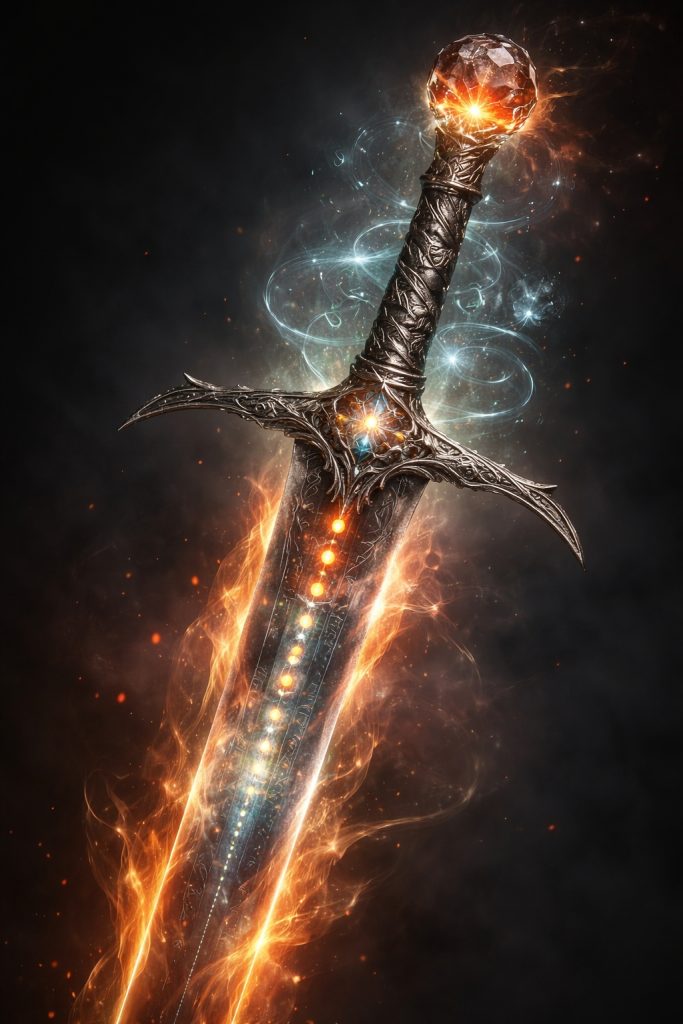
• A one-handed flame-steel longsword whose blade ripples with subdued fire, etched along the fuller with floating translucent sigils that resemble glowing abacus beads sliding silently along invisible rails.
• The hilt is wrapped in silver-steel vines, each inscribed with economic and Vigilist glyphs; faint spectral numerals drift between the guard and pommel when the weapon is active.
• The pommel houses a multifaceted ruby-quartz ledger-core that pulses between ember-orange and cold white, projecting brief ghost-images of figures, contracts, and scales when truths are weighed.
• When drawn, the blade emits no roar—only a low, deliberate hum, like a counting room at work beneath a distant forge.
Stats
• Tier: 3
• Rarity: Legendary
• Damage: 1d10 slashing + 2d6 fire
• Critical: 19–20; extra 1d10 fire and forced revelation
• Reach: 5 ft
• Attunement: Automatic when held
• Mana Cost:
– 1 per empowered strike
– 2–3 per active revelation effect
Skills Gained While Openly Worn
• Investigation +3 (financial, contractual, or illusion-based inquiries)
• Insight +3 (detecting deception, false intent, or manipulated outcomes)
• Arcane Accounting Proficiency (treat as trained; expert if already trained)
Tags: Tier-3 Fusion Relic, Vigilism–Pyronite–Ledgerdome Synthesis, Truth-Weapon, Economic Revelation, Illusion-Scorch, Mana-Weighed Judgment, Spectral Ledger Runes, Fire-Forged Insight, Deception’s Audit, Contract-Breaker, Oath-Scourge, Balance-Burner, Contract-Severing Edge, Spectral Valuation, Oath-Weighing Relic, Market-Truth Beacon, Mana-Audit Core, Firebound Ledgercraft, Revelation Armament, Economic Veilbreaker, Sigil-Indexed Blade, Consequence-Weighted Weapon
Passive Magics
• Clarity-Forged Ledger Edge: +3 to attack rolls; attacks ignore illusion-based concealment, false cover, or magically obscured positioning.
• Fiery Vigilance Ascendant: Resistance to fire damage; +3 to Investigation and Insight checks while held.
• Spectral Ledger Awareness: The wielder passively senses economic or contractual deception within 30 ft as pressure or imbalance, even if no visual illusion is present.
• Truth-Light Balance Aura: Emits 20 ft of shifting light; once per encounter, the wielder gains advantage on any check to detect lies, hidden clauses, false scarcity, or manipulated value.
Active Magics
• Flame of Accounted Cost: Melee strike adds 2d6 fire damage; on hit, the target briefly manifests spectral tally-marks revealing active deceptions, hidden bonuses, or illusory effects (1 mana).
• Ledgerflare Revelation: 15-ft radius burst of white-gold flame; creatures must succeed a Wisdom save or be outlined and stripped of illusions, disguises, and false buffs for 1 round; additionally reveals concealed economic or contractual magic in the area (2 mana, twice per long rest).
• Audit of the False Oath: Reaction when a creature within reach fails a Deception, Illusion, or Contract-binding effect; deal half fire damage and immediately end one such effect on any target in reach (no mana, once per short rest).
• Judgment of Imbalance: As a bonus action, the blade projects spectral scales for one round; the next strike against a creature benefiting from deceit, exploitation, or magically manipulated resources deals an additional 1d10 fire and cannot be reduced (3 mana, once per long rest).
Specific Slot
• One-handed weapon (held)
Item Hit Points, Disablement, and Repair
• Item Hit Points: The Ledgerbrand of the Revealed Flame 917 possesses 45 item hit points with a hardness of 16, reflecting its tier-3 flame-steel body and integrated spectral ledger-core.
• Disabling the Magic:
– If reduced to 0 item hit points by targeted attacks, all magical functions immediately cease.
– The flame-steel dulls to inert dark metal, the spectral abacus sigils freeze mid-count, and the ledger-core clouds to opaque quartz-red.
– While disabled, the weapon functions only as a mundane longsword dealing normal slashing damage with no bonuses, fire, revelation, or aura effects.
• Repair Requirements:
– Repairs must be conducted in a Vigilist sanctum, Ledgerdome hall, or geothermal forge capable of both revelation and heat balance.
– Required skills:
• Blacksmithing (Master)
• Enchanting (Expert)
• Arcane Accounting or equivalent economic-magic discipline (Trained minimum)
• Repair Process:
– 8 hours of uninterrupted work.
– Expenditure of materials equivalent to 150 gold in combined phoenix ash, starmetal filings, refined mana crystal dust, and ledger-ink infused with truth-binding herbs.
– A single comprehensive skill check against DC 19 restores all item hit points and reactivates magic.
• Failure Consequence:
– On failure, the item restores to 1 hit point but suffers Ledger Drift for one week: mana costs for all active abilities increase by 1, and passive revelation effects function at reduced range (10 ft).
How This Item May Be Obtained
• Sanctioned Fusion Commission
A character who already possesses Flame Eye Brand 62 and an Ethereal Abacus may petition a revelation-authority or arcane economic council to oversee a lawful fusion. This requires proof of restraint, balance of motive, and the ability to wield truth without collapsing systems—social or financial. The process is rare, supervised, and often tied to an oath or long-term obligation.
• Recovery from a Collapsed Ledger-Shrine
Some early fusion attempts failed catastrophically, creating sealed vault-shrines where fire-truth and economic insight annihilated each other. Surviving relics from these ruins are unstable but intact, usually guarded by constructs that test intent rather than strength.
• Inheritance from a Disbanded Lineage or Academy
When an arcane-economic lineage dissolves, its highest relics are sometimes released to the world rather than destroyed. Such transfers usually include encoded conditions bound into the item itself, enforcing ethical or behavioral constraints.
• Judgmental Reward
In rare cases, the item is granted as payment for resolving a large-scale deception involving trade, war-funding, or mana-resource fraud that threatened regional stability. The relic serves as both reward and future safeguard.
Shops and Markets Where It May Be Bought or Sold
• High Revelation Forges
These are not retail shops but semi-public sanctified manufactories operated by fire-truth orders or economic arbiters. Transactions are ceremonial and involve audits of intent as much as coin.
– Typical Cost: 1,800–2,200 gold
– Payment often includes partial material tribute or future service clauses.
• Arcane Ledger Houses
Discrete institutions that specialize in the trade of high-tier tools combining magic, governance, and economic force. Items are catalogued, not displayed, and buyers are screened.
– Typical Cost: 1,600–2,000 gold
– Sale frequently requires proof of solvency and prior ownership of at least one tier-2 relic.
• Volcanic Relic Bazaars (Invitation-Only)
Found near geothermal cities or caldera ports, these bazaars deal in dangerous hybrid artifacts. Items are sold during limited windows under heavy regulation.
– Typical Cost: 1,500–1,900 gold
– Barter with rare materials or mana instruments may reduce coin cost slightly.
• Black-Ledger Exchanges
Illegal or semi-legal markets that trade in confiscated or “unclaimed” relics. Transactions are silent, brief, and final. Authenticity varies, and buyers assume all risk.
– Typical Cost: 1,100–1,400 gold
– Often comes with hidden defects, lingering oaths, or incomplete fusion stabilisation.
• Scholastic Relic Endowments
Certain academies sell or lease such an item only when divesting assets to fund survival, war reparations, or evacuation. These sales are rare and politically sensitive.
– Typical Cost: 1,700 gold fixed, non-negotiable
– Buyers are recorded permanently in institutional ledgers.
General Market Behavior
• This item is never sold casually or anonymously in legitimate markets.
• Public auction is avoided due to the item’s ability to expose financial or contractual deception during bidding.
• Resale value remains high but drops sharply if provenance is unclear or if Ledger Drift has occurred.
• Ownership is often tracked indirectly through economic ripples rather than registries, making secrecy difficult even when the sale is legal.
Roleplay Use Across Environments: Defense and Offense
Dense Urban Centers and Trade Cities
• Defense: When surrounded by crowds, contracts, and layered deception, the item is used subtly. The bearer activates its ledger-aspect to weigh intent and obligation rather than striking openly. Defensive use manifests as exposing false claims, collapsing exploitative bargains mid-negotiation, or forcing hostile actors into hesitation as their hidden costs surface. The flame component remains dormant, radiating only a quiet pressure that makes lies feel heavy and unsafe.
• Offense: In confined streets or guild halls, offense is precise and surgical. The blade ignites only long enough to sever key figures or symbolic targets—contract-holders, illusion-casters, or enforcers—turning exposure into social or legal collapse rather than mass destruction.
Volcanic Regions and Geothermal Forges
• Defense: In high-heat environments, the flame-eye aspect harmonizes with ambient fire, allowing the bearer to absorb, redirect, or neutralize incoming elemental force. Defensive posture focuses on endurance and clarity, using the ledger-core to predict pressure points in enemy formations or structural weaknesses in the terrain.
• Offense: Offensively, the weapon burns with amplified authority. Strikes are decisive, each blow not only dealing physical harm but also “auditing” the target—forcing unstable constructs, summoned entities, or oath-bound enemies to unravel under the combined weight of fire and truth.
Wild Frontiers and Untamed Landscapes
• Defense: In forests, plains, or fractured wilderness, the item is used to read balance rather than law. Defensive roleplay emphasizes sensing imbalance—corrupted magic flows, predatory intent, or ecological distortion—allowing the bearer to avoid ambush or redirect threats away from vulnerable allies.
• Offense: Offense is expressed as corrective force. The blade burns away parasitic entities, illusions born of imbalance, or creatures sustained by false dominance. Each strike feels like restoration through destruction, not conquest.
Subterranean Ruins and Ancient Vaults
• Defense: Underground, the ledger aspect becomes dominant. The bearer reads residual intent left in stone, traps, and seals, using the item defensively to prevent catastrophic triggers or false pathways. Flame is restrained, used sparingly to avoid collapse.
• Offense: When combat occurs, offense is narrow and controlled. The blade’s fire is focused inward, piercing warded guardians or animated defenses whose purpose no longer aligns with their original function.
Open Battlefields and War Zones
• Defense: In large-scale conflict, the item is used to stabilize morale and structure. Defensive roleplay centers on cutting through chaos—exposing false orders, breaking corrupt command chains, and preventing allies from being manipulated by propaganda or illusion.
• Offense: Offensively, the bearer targets linchpins rather than ranks. Commanders sustained by false authority, summoned war-assets bound by contracts, or illusionary fortifications are brought down rapidly, shifting the tide without needless slaughter.
Sacred, Academic, or Ritual Spaces
• Defense: In temples, academies, or ledger-halls, defense is almost entirely non-violent. The item enforces equilibrium, suppressing hostile magic, nullifying exploitative rites, or forcing participants into honest revelation.
• Offense: If offense is required, it takes the form of judgment rather than violence—ritual flame igniting only to sever bindings, exile corrupted entities, or permanently invalidate forbidden knowledge sources.
Across all environments, the item is roleplayed not as a blunt weapon but as an instrument of consequence. Defense emphasizes clarity, prediction, and stabilization. Offense emphasizes precision, exposure, and irreversible correction rather than raw destruction.
Perception of Activation:
User’s Perspective:
The moment the blade is consciously activated, a steady warmth spreads from the grip into the forearm—not a burning heat, but the controlled warmth of a banked forge. The hum deepens into a measured cadence, like distant counting beads sliding in perfect rhythm. Along the fuller, the translucent sigils brighten and begin to drift with intent, each movement felt as a subtle tug behind the eyes, as if decisions are being gently weighed rather than forced.
Visually, the flame within the blade tightens and clarifies, shifting from diffuse ember-glow into disciplined bands of fire. The spectral numerals between guard and pommel appear briefly in peripheral vision, never lingering long enough to distract, yet always present enough to inform. The pommel’s ledger-core pulses—cool white when truth is being assessed, ember-orange when judgment resolves into action.
The scent is faint but unmistakable: warm metal, old parchment, and a trace of ozone, like a sealed archive opening after centuries. The grip feels marginally heavier, not in mass but in consequence, as though each strike carries accounted weight.
Extra-Sensory (User):
• A sense of economic pressure in the environment—imbalances, broken agreements, or exploitative forces register as distortions in the blade’s rhythm.
• Truth manifests as clarity rather than revelation; lies feel like misaligned sums that quietly demand correction.
• Emotional states nearby are subconsciously “tallied,” hostility reading as volatile surplus, fear as collapsing deficit.
Observer’s Perspective:
To onlookers, the weapon activates without spectacle. There is no flare or roar—only the blade’s surface tightening into ordered flame while faint, ghostlike sigils slide along the metal as if guided by invisible rails. The pommel emits soft pulses of alternating light, projecting fleeting images of scales, contracts, or tally marks that dissolve almost as soon as they appear.
The air around the wielder feels calmer yet heavier, like a tense negotiation nearing its final terms. The low hum is audible within several strides, steady and unsettling, more like an active ledger than a weapon. Shadows sharpen near the blade, and reflective surfaces briefly show distorted reflections of numbers and lines instead of faces.
Those sensitive to magic perceive a structured aura—disciplined, evaluative, and unyielding—distinct from raw elemental power.
Positives:
• Heightened clarity and focus during conflict or confrontation.
• Environmental awareness improves subtly, especially where deception, imbalance, or broken oaths are present.
• The activation steadies emotional impulses, encouraging deliberate action rather than reckless force.
• Allies often feel reassured, as though outcomes are being carefully managed rather than left to chaos.
Negatives:
• Prolonged activation can induce mental fatigue, manifesting as dull headaches or difficulty disengaging from analysis.
• Highly emotional or chaotic environments may cause sensory crowding, with too many “imbalances” pressing at once.
• Individuals unused to structured magic may feel unease or moral pressure simply standing near the active blade.
• The blade’s hum and spectral projections can draw attention in quiet or covert situations, even without visible light.
Recipe: Ledgerflame Convergence Rite
Items Merged:
• Flame Eye Brand 62
• Ethereal Abacuses
Additional Materials Needed:
• Ledger-Core Prism: a fist-sized ruby–quartz composite crystal capable of storing both symbolic logic and elemental charge
• Ethereal Bead Dust: ground residue from at least nine ethereal essence beads, carefully stabilized
• Flame-Steel Filament: refined strands drawn from flame-steel, thin enough to etch sigil-rails into a blade
• Ink of Binding Accounts: alchemical ink made from ash, silver filings, mana sap, and oath-sealed wax
• Balance Offering: a symbolic payment representing value traded fairly (coin, service writ, or relinquished claim), consumed by the ritual
Tools Required:
• Volcanic or Arcane Forge capable of maintaining controlled elemental fire
• Runic Engraving Stylus attuned to both numeric and truth-aspected glyphs
• Precision Weighing Frame or Scale Array (mundane and magical calibration)
• Ethereal Stabilization Basin for handling bead dust without dissipation
• Enchanting Circle inscribed for fusion, valuation, and verification rites
Skill Requirements:
• Master-level Blacksmithing or Artifice (for flame-steel manipulation)
• Expert Enchanting (fusion-grade, multi-aspect)
• Trained Arcane Mathematics or Economic Lore (to correctly bind abacus logic)
• Adept Rune Inscription (numeric and Vigilist symbology)
• Focus Discipline or equivalent mental control to prevent imbalance during binding
Crafting Steps:
- Valuation Alignment:
Place the Ethereal Abacuses within the enchanting circle and activate them one final time. Record their shifting calculations until the beads settle into stillness. This fixes their logic-state for fusion. - Blade Preparation:
Heat Flame Eye Brand 62 in the forge until the flame within the steel tightens but does not flare. Cleanse the blade with the Ink of Binding Accounts, tracing the fuller where sigils will later reside. - Ledger-Core Formation:
Embed the Ledger-Core Prism into the pommel, replacing or enveloping the existing lens structure. The prism must be balanced physically and symbolically using the weighing frame before it will accept enchantment. - Sigil-Rail Etching:
Using the runic stylus and flame-steel filament, engrave invisible rails along the blade’s fuller. As each rail is completed, dust it lightly with Ethereal Bead Dust so the logic-patterns can later manifest as floating sigils. - Abacus Dissolution and Transfer:
Submerge the Ethereal Abacuses into the stabilization basin. As the beads lose physical cohesion, guide their numerical logic into the blade through the pommel prism, ensuring no surplus or deficit remains. - Binding Rite:
Ignite the forge to full ritual heat. Hold the weapon within the enchanting circle while reciting valuation glyphs and Vigilist truth-phrases in alternating sequence. Offer the Balance Offering at the circle’s center as the final seal. - Calibration and Rest:
Allow the merged item to cool naturally. During this time, do not touch or speak near it. Once the hum stabilizes into a steady cadence, the fusion is complete and the item becomes a single unified object.
The resulting item permanently integrates flame, truth, and economic logic into one coherent artifact, with no remaining separable components.
Counting Fire That Would Not Lie
In the age when words were heavier than iron and numbers were said aloud only with witnesses present, there existed a blade whose name cannot be spoken correctly anymore. The oldest tablets call it the Fire That Tallies, though later mouths softened this into the Ledger-Flame, and still later scribes confused the marks and wrote simply the Honest Sword. None of these names are fully true. The original title was longer, broken into measures like a chant, and half of it is now dust.
The tale begins before nations settled, when Saṃsāra’s islands still argued with one another about where the sea ended and the sky began. In those days, truth was not hidden with lies alone but buried beneath agreements, contracts, promises, and clever counting. Wars were not started by swords but by ledgers. Cities burned because sums were “misread.” Famines followed because a single bead had been moved one place too far.
There lived then a Vigilist adjudicator whose name appears differently in every fragment. Some call her Veyra, others Kael, others a name scratched out entirely and replaced with the glyph for balance restored. She carried the Flame Eye Brand, a sword that burned falsehood and made disguises scream. Yet even this blade failed her once.
For she uncovered a betrayal that was not a lie.
A council of merchant-kings had obeyed every word of their oaths. They had spoken no false promises, signed no broken contracts, and yet had starved three island cities by “correct” calculation. Grain had been purchased fairly, prices set lawfully, and transport accounted for to the last crate. When accused, the council answered calmly, “The sums were right.”
The Flame Eye Brand flared white, then orange, and found nothing to burn. No illusion hid them. No deception clung to their words. And so the blade fell silent, for it had been made to judge lies, not cruelty measured in columns.
The adjudicator left the city and did not return for a year and a season. The fragments say she traveled to Ysmeria, where coin-priests and mage-accountants argued not over gold but over causation itself. There, in the Ledgerdome of Mystic Calculus, she saw the Ethereal Abacuses for the first time. The beads floated and slid on nothing, counting not only what was but what would be, and what would cost more than coin.
When she asked the masters if the abacuses could judge injustice, they answered, “They judge only balance.” When she asked if balance was truth, they answered, “Truth is heavier.”
So she took one abacus—not stolen, not bought, but given after a reckoning none of the tablets describe clearly. Some say she surrendered a name. Others say a future.
The forging that followed is told poorly, for the language used no longer exists. Words for “fire” and “number” share the same root in the ancient tongue, and the scribes often confuse whether the blade was heated or counted, struck or summed. What is clear is this: the Flame Eye Brand was laid across the Ethereal Abacus, and neither resisted.
The beads did not melt. They resolved.
They slid into the blade’s fuller like thought into decision. The fire dimmed, disciplined itself, and learned to wait. The pommel crystal split again, not from force but from necessity, becoming a ledger-core that could weigh consequence instead of intent.
When the adjudicator lifted the weapon, it did not blaze. It hummed.
She returned to the council chamber. Witnesses wrote that the sword did not accuse. It did not burn. It merely counted. As each councilor spoke, faint symbols drifted along the blade, tallying profit against hunger, law against loss, obedience against devastation. When the sums were complete, the sword pulsed once—cold white, then ember-orange.
Only then did it strike.
Those struck did not die, but neither could they deny. Their wealth unraveled into obligation. Their contracts rewrote themselves into reparations. Their authority dissolved like miscounted dust. The city did not burn. The granaries opened.
Later ages misunderstood this ending. Some copies claim the council was executed. Others insist the sword vanished afterward. A few say the adjudicator shattered the blade herself, fearing its judgment. But the most reliable fragment ends with a quieter line, translated uncertainly:
“Fire that counts does not shout. It waits until the sum cannot be escaped.”
After that, the blade passed hand to hand rarely, always changing names, always recorded with a number appended—as if to remind its bearer that even justice must be accounted for. Swords that burned lies came and went. Tools that calculated wealth multiplied endlessly. But the weapon that could weigh truth plus consequence was never common.
And it is written, in a margin added centuries later, that whenever such a blade is drawn, the world briefly remembers that fairness without mercy is cruelty, and honesty without wisdom is merely arithmetic.
Moral of the Story:
Truth alone is not enough; only when truth is weighed against consequence does justice balance.
Suggested conversions to other systems:
Call of Cthulhu (7th Edition)
Name: Ledgerflame Brand 317
Type: Mythos-Tainted Artifact (Melee Weapon)
Description: A one-handed flame-steel longsword etched with drifting sigils like abacus beads on unseen rails; the pommel’s ruby-quartz ledger-core pulses ember-orange and cold white, projecting fleeting images of scales and contracts when truth is weighed.
Stat Block
Weapon: Ledgerflame Brand 317
Attack: Fighting (Sword)
Damage: 1D8+1 slashing + 1D6 fire (burning Trapping; ignores mundane concealment from smoke/fog once the blade is active)
Malfunction: N/A
Reach: 1 yard
Passive Effects (while carried; stronger while held)
• Balanced Appraisal: +20% to Accounting, Appraise, or any financial/contract analysis roll; you may “price” a deal’s hidden cost in narrative terms on a successful roll.
• Vigilant Audit: +15% to Psychology and Spot Hidden when evaluating lies, forged documents, disguised intent, or “truthful cruelty” (legal harm, exploitative contracts).
• Fireproof Ledger: +10% to CON rolls to resist heat/fire hazards; reduces fire damage taken by 1 point per hit (minimum 0) while the weapon is in hand and active.
Active Effects (require holding the weapon)
• Weigh the Truth (Cost: 3 Magic Points; POW roll): In a 5-yard radius, the wielder may force an opposed POW test against one target’s POW. If the wielder wins, illusions/disguises affecting the target’s appearance or stated intent falter for 1D3 rounds, and the Keeper must answer one concrete yes/no question about the target’s immediate intent or the fairness of the current bargain.
• Counting Fire Strike (Cost: 2 Magic Points; declared before the attack roll): On a successful hit, add +1D6 fire damage. If the target is actively deceiving, cheating, or exploiting a binding agreement (Keeper adjudication), the target must also succeed a POW roll or suffer a moment of “Ledger Shock” (lose next action; may still Dodge) as the weapon’s tally “settles.”
Sanity and Risks
• First attunement (first meaningful use): SAN 0/1D4 as the mind absorbs consequence-visions.
• Overuse: Each additional activation after the second in the same scene requires a SAN 0/1 roll; on a failure, the wielder suffers 1D3 rounds of intrusive counting (penalty die to Psychology/Spot Hidden; Keeper may compel fixation on “fairness” over safety).
Availability
Unique/near-unique; typically obtained from vaults tied to merchant-mage academies, Vigilist sanctums, or ruin-ledgers where contracts were once used as weapons.
Blades in the Dark
Name: Abacus-Ember Edge 317
Type: Fine Arcane Weapon (Longsword)
Load: 1
Quality: Fine; Arcane
Description: A subdued flame-steel longsword whose fuller carries drifting sigils like abacus beads; the pommel pulses between cold audit-light and ember judgment, humming like a counting room beneath a distant forge.
Passive Benefits
• Fine Arcane Edge: Gain +1d to Skirmish when your intent is to expose, punish, or correct deception, fraud, or hidden terms (including “truthful harm”).
• Spectral Tally: Gain +1d to Study or Survey when assessing a contract, cargo, payoff, or “who profits here” question.
Active Abilities
• Weigh the Terms (0 Stress, once per score): After you make a Study roll about a deal, a faction motive, or a concealed cost, you may ask one follow-up question that must be answered truthfully in plain language by the GM, limited to what the fiction supports. If the answer reveals you’ve been exploited, mark +1 Heat or start a clock “Owed Consequence” (GM choice) as the world pushes back.
• Counting Fire (1 Stress): On a successful Skirmish, increase effect by one level if the target is lying, masked, disguised, or operating under corrupt “legal cover.” On a critical, you may also create an advantage “Audited and Exposed” with one free invoke-like benefit (+1d for an ally’s next action against that target).
• Ledger Riposte (2 Stress, reaction): When an NPC’s deception or hidden clause would impose a complication on you, you may resist with this item: take +1d on the resistance roll. On a 6, also inflict a narrative consequence on the deceiver (their leverage cracks, their lie becomes costly, or their allies doubt them).
Drawback Clock
Start a 4-segment clock: “Mind Counts Too Much.”
• Mark 1 segment each time you use Counting Fire or Ledger Riposte.
• When filled, you suffer level 2 harm “Fixated” (or level 3 “Scorched Judgment” if you were already harmed), cleared by indulging vice with a counting/obsession theme or a downtime project to “balance the ledger.”
Craft/Acquisition Notes (fictional permission)
Requires access to a sanctum-forge and an academic ledger-rite; often comes with faction entanglements (merchant guilds, auditors, Vigilist orders).
Dungeons & Dragons (2024 rules)
Name: Blade of the Counting Flame 317
Weapon (longsword), very rare (requires attunement)
Description: A one-handed flame-steel longsword etched with drifting translucent sigils like abacus beads; the pommel’s ruby-quartz ledger-core pulses between ember-orange judgment and cold white audit-light.
Weapon Statistics
• Longsword (Versatile 1d10), deals 1d8 slashing damage (1d10 when used with two hands)
• You gain a +2 bonus to attack and damage rolls made with this weapon.
Passive Properties (while attuned and holding the weapon)
• Audit Sight: You have Advantage on Wisdom (Insight) checks and Intelligence checks made to detect forgeries, deceptive contracts, manipulated accounts, or “truthful exploitation.”
• Fireproof Resolve: You have Resistance to fire damage.
• Truth Doesn’t Hide: Attacks you make with this weapon ignore Disadvantage imposed solely by nonmagical smoke, dim light, or visually deceptive clutter (the weapon “tallies through” it).
Charges
The blade has 7 charges and regains 1d6+1 expended charges daily at dawn.
Active Properties
• Weigh the Claim (1 charge; Bonus Action): Choose one creature you can see within 30 feet. Until the start of your next turn, you know whether that creature is speaking a deliberate lie, and you learn one of the following (your choice): whether it intends immediate violence, whether it intends betrayal in the current negotiation, or whether it is bound by a magical or legal obligation that it plans to exploit. A creature immune to being charmed has Advantage on any saving throw the DM deems appropriate to resist this effect.
• Counting Flame Strike (1 charge; when you hit): The attack deals an extra 2d6 fire damage. If the target is benefiting from an illusion or disguise, it must succeed on a Wisdom saving throw (DC 16) or the illusion/disguise is suppressed until the end of its next turn.
• Settle the Ledger (3 charges; Action): You emit a cold-white audit flare in a 15-foot-radius sphere centered on you. Each creature of your choice in the area must make a Wisdom saving throw (DC 16). On a failed save, the creature is outlined in pale light for 1 minute (no benefits from being Invisible; attacks against it don’t suffer Disadvantage from invisibility), and it can’t benefit from illusory disguises for the duration. A creature can repeat the save at the end of each of its turns, ending the effect on itself on a success.
Backlash
When you expend the last charge, roll a d20. On a 1, the ledger-core “overbalances” and you gain 1 level of Exhaustion as intrusive consequence-visions flood your mind; the blade regains charges normally at dawn.
Knave (2nd Edition)
Name: The Abacus-Flame Brand 317
Type: Magic Weapon (Longsword)
Item Slots: 1
Damage: 1d10 slashing
Passives (while carried; stronger while wielded)
• +2 to hit with this weapon.
• +2 on rolls to detect lies, forgeries, manipulated accounts, or hidden “costs” in bargains (GM adjudication).
• Take half damage from mundane fire sources while wielding (round down).
Uses (Charges)
The weapon has 6 charges. Regain 1d4+2 charges after a full rest.
Actives (cost 1 charge unless noted)
• Counting Flame: On a hit, add +2d6 fire damage. If the target is disguised or under an illusion, it must pass a WIS save (DC 15) or the disguise/illusion fails for 1 round.
• Weigh the Terms: Ask the GM one direct yes/no question about a bargain, motive, or “who benefits here,” and receive a truthful answer limited to what the character could plausibly infer with magical aid.
• Settle the Ledger (cost 2 charges): In near range, creatures you choose must pass a WIS save (DC 15) or be “Exposed” for 1 minute: they can’t benefit from invisibility, and disguises/illusions on them don’t function. They may retry the save at the end of each round to end it early.
Risk
If you use 3 or more charges in a single scene, make a WIS save (DC 12). On a failure, you suffer “Fixation” until you rest: -1 to all rolls that aren’t related to pursuit of fairness, truth, debt, or consequence (GM adjudication).
Fate Core
Name: Ledgerflame Accord 317
Type: Extra (Magical Weapon)
Aspects
• Blade That Balances Fire and Account
• Every Lie Leaves a Residue
• Truth Is a Cost That Must Be Paid
Permissions
• The wielder must plausibly engage with contracts, bargains, investigations, or conflicts where motive, value, or consequence matters.
• The blade cannot be used purely as a mindless damage tool without narrative cost.
Stunts
• Counting Edge (Passive): Gain +2 to Fight when attacking an opponent who is deceiving, disguised, hiding intent, or benefiting from an unfair advantage (illusory, legal, or social).
• Spectral Audit (Passive): Gain +2 to Investigate or Notice when assessing deals, ledgers, supply lines, bribes, or hidden costs in a situation.
• Weigh the Claim (Once per Scene): Spend a Fate point to ask one direct question about who benefits, who is harmed, or what is being concealed in the current situation. The answer must be truthful but framed by the fiction.
• Counting Flame Strike (Activated): Spend a Fate point after a successful Fight roll to add +2 shifts of damage and create the situational aspect Exposed by the Ledger with one free invoke.
• Settle the Ledger (Activated, Major Action): Spend a Fate point to place the aspect Accounts Revealed on a zone. While active for the scene, attempts to deceive, disguise, or mislead in that zone face +2 opposition.
Compels
• The blade demands fairness over mercy; compel Every Lie Leaves a Residue to force the wielder to act against an exploitative but legally “clean” arrangement.
• Prolonged use may cause obsessive fixation on balance, debt, or retribution.
Numenera & Cypher System (Revised)
Name: Reckoning Brand 317
Level: 6
Type: Artifact (Weapon)
Description
A one-handed flame-steel longsword etched with floating sigils resembling translucent abacus beads. The ruby-quartz ledger-core pulses between ember heat and cold analytic light.
Passive Effects
• Clarity-Forged Edge: Provides an asset to attack rolls with the weapon.
• Economic Insight: Provides an asset to Intellect-based tasks involving analysis of trade, value, contracts, negotiations, or hidden motives.
• Fireward Ledger: Reduces fire damage taken by 2 points while the weapon is held and active.
Active Abilities
• Counting Flame Strike: As an action, make a melee attack dealing 6 points of slashing damage plus 4 points of fire damage. If the target is disguised, illusory, or deliberately deceptive, the GM must also reveal one concrete truth about the target’s current intent. Depletion: 1 in 1d10.
• Weigh the Claim: As an action, analyze one creature, object, or agreement within short range. The GM truthfully states whether it is fair, exploitative, or concealing harm, and in what general direction that harm flows. Depletion: 1 in 1d20.
• Settle the Ledger: As an action, emit a cold-white audit pulse in short range. Illusions and disguises fail for one round, and deception-based tasks are hindered for affected creatures. Depletion: 1 in 1d20.
Depletion
• Overall Depletion: 1 in 1d20
• On depletion, the ledger-core dims and all active abilities cease until repaired or rebalanced through narrative means.
GM Intrusions
• Overuse may cause fixation, hallucinated tallies, or misinterpretation of value as moral truth.
Pathfinder (2nd Edition, Remastered)
Name: Ledgerflame Brand 317
Item Level: 9
Rarity: Rare
Traits: Evocation, Divination, Magical
Usage: Held in 1 hand
Bulk: 1
Description
This flame-steel longsword bears drifting sigils along its fuller like spectral abacus beads. Its pommel houses a ruby-quartz ledger-core that pulses as truths are weighed.
Weapon Statistics
• +1 Striking Longsword
• Damage: 1d8 slashing (versatile 1d10) + 1d6 fire
Passive Effects
• Audited Strikes: You gain a +1 item bonus to Perception and Society checks to detect lies, forged documents, or exploitative agreements while wielding the blade.
• Fireproof Accounting: You gain fire resistance 5 while the weapon is held.
• Truth Cuts Clear: You ignore concealment from nonmagical smoke, mist, or visual clutter when attacking with this weapon.
Activate — Counting Flame
• Action: Single Action (Command)
• Frequency: At-will
• Effect: The Strike deals an additional 1d6 fire damage. If the target is benefiting from an illusion or disguise, it must succeed at a Will save (DC appropriate to level) or the effect is suppressed until the end of its next turn.
Activate — Weigh the Claim
• Action: Two Actions (Envision)
• Frequency: Once per hour
• Effect: You analyze one creature or agreement you can perceive. The GM must state whether it is fair, exploitative, or deceptive, and name the primary beneficiary.
Activate — Settle the Ledger
• Action: Two Actions (Envision)
• Frequency: Once per day
• Area: 15-foot emanation
• Effect: Creatures in the area must attempt a Will save. On a failure, they are outlined in pale light for 1 minute and cannot benefit from disguises or illusion effects (save ends).
Craft Requirements
• Supply spells with the fire and divination traits.
Savage Worlds (Adventure Edition)
Name: Ledgerflame Blade 317
Type: Magical Relic (Seasoned–Veteran)
Weight: 3
Power Points: 10 (recharges 1d6 per day)
Description
A flame-steel longsword humming softly like a counting room beneath a forge, its blade marked with floating sigils and a ruby-quartz ledger-core pommel.
Passive Abilities
• Balanced Edge: +2 to Fighting rolls when attacking a foe who is lying, disguised, or benefiting from deception.
• Spectral Accounting: +2 to Notice and Common Knowledge (Commerce, Trade, or Law) rolls involving value, contracts, or hidden motives.
• Fireward Ledger: The wielder gains Fire Resistance (subtract 4 from fire damage).
Powers (Trappings: Fire and Cold White Audit Light)
• Counting Flame (Smite): 3 PP. Adds +2d6 damage to melee attacks; if the target is deceiving or disguised, raises also negate illusions for one round.
• Weigh the Claim (Detect Arcana / Empathy hybrid): 2 PP. The wielder learns whether a deal, statement, or target is fair, exploitative, or concealing harm.
• Settle the Ledger (Dispel / Light): 3 PP. Medium Burst Template; affected creatures suffer −2 to Deception and cannot benefit from invisibility or disguises for one round (two rounds on a raise).
Drawbacks
• When Power Points reach 0, the wielder must succeed on a Spirit roll or gain Fatigue from obsessive tallying and intrusive consequence-visions.
• The blade’s glow increases narrative attention from authorities, auditors, or supernatural arbiters of balance.
Shadowrun (6th Edition)
Name: Ledgerflame Auditblade 317
Type: Exotic Melee Weapon (Magical Relic Adaptation)
Availability: 12F
Cost: 18,000 nuyen
Essence: —
Reach: 2
Damage Value: 5P (slashing) + 3S (fire)
Armor Penetration: −3
Mode: Melee
Passive Effects
• Balanced Edge: +2 dice to Exotic Melee (Sword) tests when the target is using deception, illusion, forged credentials, or concealed intent (GM adjudication).
• Spectral Accounting: +2 dice to Perception, Assensing, or Negotiation tests involving contracts, bribes, shell companies, or falsified records while the blade is active.
• Fireward Ledger: Reduce fire damage taken by 3 (after AP).
Active Functions
• Counting Flame Strike: Simple Action. On a successful melee attack, the wielder may force the target to resist with Willpower (Threshold 3). On failure, one active disguise, illusion, or false identity is suppressed until the end of the next Combat Turn. Costs 1 Edge.
• Weigh the Claim: Complex Action. Analyze one creature, object, or agreement in line of sight. The GM truthfully states whether it is fair, exploitative, or concealing harm, and who benefits most. Costs 1 Edge.
• Settle the Ledger: Complex Action. Create a 5-meter radius audit pulse. Targets resist with Willpower (Threshold 3). Failure imposes −2 dice to Deception and Disguise tests for one Combat Turn. Costs 2 Edge.
Drawbacks
• Astral Signature Rating 4; sustained use attracts attention from magical security or auditors.
• When Edge reaches 0, the wielder suffers −1 die to Logic-based tests for one Combat Turn due to intrusive tally visions.
Starfinder (2nd Edition)
Name: Ledgerflame Relicblade 317
Level: 9
Price: 13,500 credits
Type: Hybrid Item (Weapon)
Hands: 1
Bulk: 1
Damage: 2d8 slashing + 2d6 fire
Critical: Burn 2d6; Expose
Usage: 2 charges per activation
Capacity: 20
Passive Effects
• Audited Strikes: +1 circumstance bonus to attack rolls against creatures benefiting from concealment, disguises, or illusion effects.
• Spectral Valuation: +2 circumstance bonus to Culture, Sense Motive, and Profession (Merchant) checks involving trade, contracts, or falsified data.
• Fireward Ledger: Fire resistance 5.
Active Functions
• Counting Flame: 1 action, 2 charges. Make a Strike; on hit, target must succeed at a Will save (DC appropriate to item level) or lose illusion and disguise benefits until the start of your next turn.
• Weigh the Claim: 2 actions, 1 charge. Analyze a creature, object, or agreement within 30 feet; the GM states whether it is fair, exploitative, or deceptive and who gains most.
• Settle the Ledger: 2 actions, 3 charges. 15-foot burst; creatures failing Will saves are outlined (no concealment from illusions) for 1 round.
Limitations
• In environments of extreme cold or vacuum, fire damage is reduced by half unless externally heated.
Traveller (Mongoose 2nd Edition, 2022 Update)
Name: Ledgerflame Insightedge 317
Tech Level: 13
Cost: Cr38,000
Weight: 2.2 kg
Damage: 4D slashing + 2D fire
Range: Close (reach 2 meters)
Traits: Fire, Insight, Expose
Passive Effects
• Balanced Edge: +2 DM to Melee (Blade) checks against targets using deception, false credentials, or misdirection.
• Spectral Accounting: +2 DM to Advocate, Broker, Investigate, or Recon checks involving contracts, trade routes, or financial fraud while wielded.
• Fireward Ledger: Reduce fire damage taken by 4.
Active Functions
• Counting Flame Strike: Major Action. On a successful hit with Effect 4+, target must succeed at an INT check (DM 10) or lose disguise and illusion benefits for one round.
• Weigh the Claim: Minor Action. Assess a deal, contract, or target in sight; the referee truthfully indicates whether it is fair, exploitative, or concealing harm.
• Settle the Ledger: Major Action. Short-range audit pulse; affected targets suffer −2 DM to Deception and Persuade for one round.
Drawbacks
• Psionic interference or null-magic zones impose −1 DM to all active functions.
• Excessive use may attract institutional scrutiny or legal retaliation.
Warhammer Fantasy Roleplay (4th Edition)
Name: Ledgerflame Brand 317
Type: Magical Weapon (Longsword)
Availability: Exotic
Encumbrance: 1
Price: 60 GC
Reach: Average
Damage: +SB +5 (slashing) +4 (fire)
Qualities: Magical, Flaming, Expose
Passive Effects
• Balanced Edge: +1 SL on Melee (Basic) Tests against opponents using lies, disguises, or legal manipulation.
• Spectral Accounting: +10 to Evaluate, Haggle, or Gossip Tests involving trade, contracts, or hidden obligations while wielded.
• Fireward Ledger: +1 SL to Toughness Tests against fire-based effects.
Active Functions
• Counting Flame: Action. On a successful hit, target must pass an opposed Willpower Test or lose benefits from disguises and illusion effects for one Round.
• Weigh the Claim: Action. Assess a creature or agreement; the GM states whether it is honest, exploitative, or deceitful, and who profits most.
• Settle the Ledger: Action. Medium Area; affected creatures suffer −10 to Deception Tests and cannot benefit from illusion effects for one Round.
Risks
• On a Critical Fumble while active, roll on the Minor Miscast Table as intrusive truth visions overwhelm the wielder.
• Repeated use may attract witch hunters, guild auditors, or supernatural arbiters of balance.
Comments
One response to “Ledgerbrand of the Revealed Flame 917”
[…] From: Ledgerbrand of the Revealed Flame 917 […]