
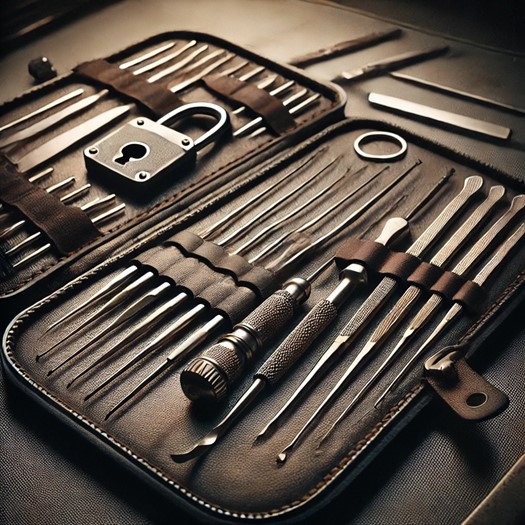
Lore: The Locksmith’s Kit is an essential toolset associated with skilled rogues, thieves, and adventurers who specialize in the arts of infiltration and subterfuge. Crafted by master locksmiths and passed down through generations, this kit embodies the secrets of lock manipulation and security bypassing. Legends tell of legendary locksmiths who possessed an uncanny understanding of locks and were able to open the most intricate mechanisms with ease. The Locksmith’s Kit represents their expertise and dedication to the art of overcoming obstacles and unlocking secrets.
Use: The Locksmith’s Kit contains a comprehensive array of specialized tools specifically designed for picking locks, disabling traps, and bypassing security measures. The kit includes a variety of lock picks, tension wrenches, probes, and other devices that aid in manipulating and overcoming locked doors, chests, or mechanisms.
When faced with a locked door, chest, or other locked objects, the skilled user of the Locksmith’s Kit can carefully select the appropriate tools and employ their expertise to bypass the lock’s defenses. With precision and finesse, they navigate the intricate mechanisms, utilizing the tension wrenches to apply the right amount of pressure while manipulating the pins with the lock picks. The Locksmith’s Kit grants the user the ability to assess the lock’s complexity and select the correct tools for the task at hand.
Aside from picking locks, the kit also includes devices and tools that aid in disabling traps and overcoming security measures. These specialized tools allow the user to detect and neutralize hidden mechanisms, disarming traps and ensuring safe passage through dangerous areas.
Values:
- Level: Tier 1
- Proficiency Bonus: +2 to Sleight of Hand checks when using the Locksmith’s Kit.
- Skill Proficiencies Gained: Sleight of Hand
- Weight: 5 lbs
- Skills Gained: (Sleight of Hand: Proficient)
- Cost: 50 gold pieces
- Tags: Tool, Lockpicking, Traps, Security Bypass, Stealth, Infiltration, Precision, Trap Disarmament, Covert Entry, Dexterity, Security Expertise, Obstacle Removal, Mechanism Mastery, Bypass
The Locksmith’s Kit is a valuable toolset for characters who excel in stealth, infiltration, and overcoming obstacles. Its lore and practical applications make it an essential asset for rogues, thieves, and adventurers who encounter locked doors, chests, or traps. The kit’s specialized tools and the user’s proficiency with them allow for precise and efficient lock picking, enabling the character to access restricted areas or obtain valuable loot. Additionally, the kit’s included tools for disabling traps and bypassing security measures provide the means to overcome various obstacles and ensure the safety of the party. The Locksmith’s Kit is a must-have for those who rely on finesse, cunning, and expertise in the realms of stealth and subterfuge.
In the world of Saṃsāra, the Locksmith’s Kit is a specialized and sought-after toolset, typically found in shops that cater to adventurers, rogues, and those involved in more covert or security-related professions. These kits would be sold in various types of shops depending on the buyer’s needs, location, and connections. Here’s a breakdown of where and how the Locksmith’s Kit might be bought and sold, along with varying costs:
- Guild Artisan Workshops
- Description: Found in large cities or trade hubs, these workshops are run by master locksmiths and artisans who specialize in the crafting of tools for both security and infiltration. These shops provide high-quality, custom-made Locksmith’s Kits designed for serious professionals. The craftsmanship here is impeccable, with some kits even enchanted to improve precision.
- Cost: 60-75 gold pieces. Due to the high level of craftsmanship, the price is elevated, but the kits are top-tier and often come with additional features like magical enhancements or lifetime guarantees.
- Black Market Outlets
- Description: Hidden within shadowy corners of cities or in rogue enclaves, black market outlets offer a more discreet place to purchase a Locksmith’s Kit. These shops cater to those who may not want to attract attention while acquiring such tools, including thieves and criminals. The kits sold here are practical but not always of the highest quality, though occasionally rare or legendary versions might appear.
- Cost: 40-50 gold pieces. While often cheaper, the quality may vary. However, buyers can sometimes haggle or barter for a lower price, especially in desperate times.
- Adventurer Emporiums
- Description: Adventurer-focused shops in towns near dungeons or ruins often carry Locksmith’s Kits among their essential gear. The kits here are practical and durable, meant for adventurers who frequently encounter traps, locks, and other security measures in their travels.
- Cost: 50-60 gold pieces. The price reflects the quality expected by adventurers, as these kits must be able to endure frequent use in harsh environments.
- Magical Item Bazaars
- Description: In mystical regions, such as the Zephyrstone Islands or floating cities, shops that specialize in magical and enchanted items often carry Locksmith’s Kits with arcane properties. These kits may include enchanted tools that provide bonuses to lockpicking or trap disabling and are highly sought after by elite rogues and adventurers.
- Cost: 75-100 gold pieces. The higher cost reflects the magical enhancements added to the kit, allowing users to bypass magical locks or traps with greater ease.
- Thieves’ Guild Supply Rooms
- Description: Within underground thieves’ guilds, the Locksmith’s Kit is a standard tool provided to members. While these kits are often mass-produced for guild use, they are reliable and tailored specifically for stealthy infiltration missions. Non-guild members might acquire one through connections or favors.
- Cost: 30-40 gold pieces. Guild members may receive discounts or even free kits as part of their membership, while outsiders pay a premium or require special favors to access these tools.
- Traveling Merchants
- Description: In more rural or remote regions, traveling merchants sometimes sell Locksmith’s Kits among other rare or hard-to-find goods. These merchants may cater to adventurers or roguish types who can’t easily access larger city markets. The kits may vary in quality, depending on the merchant’s connections.
- Cost: 45-55 gold pieces. The price reflects the scarcity of the item in less populated areas, as well as the added convenience of buying from a traveling merchant.
Costs and Availability Summary:
- Guild Artisan Workshops: 60-75 gold pieces (High-quality craftsmanship)
- Black Market Outlets: 40-50 gold pieces (Discreet, variable quality)
- Adventurer Emporiums: 50-60 gold pieces (Practical and durable)
- Magical Item Bazaars: 75-100 gold pieces (Magically enhanced)
- Thieves’ Guild Supply Rooms: 30-40 gold pieces (Exclusive to guild members)
- Traveling Merchants: 45-55 gold pieces (Dependent on region)
Each shop caters to different types of buyers, offering a variety of Locksmith’s Kits that fit the needs and budgets of adventurers, rogues, or professionals in Saṃsāra.
The Locksmith’s Kit is primarily a tool for bypassing locks, disabling traps, and navigating security mechanisms, but in the right hands, it can also be used creatively for both offensive and defensive purposes in a variety of environments in the world of Saṃsāra. Below are roleplay scenarios where the kit’s utility shines in different contexts.
- Urban Environments
- Offense: In a city teeming with political intrigue and hidden secrets, the Locksmith’s Kit becomes a powerful tool for espionage and infiltration. A rogue or thief might use it to gain access to heavily secured locations, such as noble estates, vaults, or government buildings. The kit allows the user to silently open locked doors, bypass alarm systems, or disable traps guarding treasures or sensitive information. In urban warfare, it could also be used to gain access to enemy strongholds, allowing for strategic sabotage, such as cutting off access to key supplies or releasing prisoners.
- Roleplay Example: During a heist in a nobleman’s mansion, the rogue uses the Locksmith’s Kit to quietly unlock the heavily fortified vault door, gaining access to valuable documents that will expose the noble’s corruption. As the rest of the party creates a distraction, the rogue efficiently bypasses the traps, ensuring the mission’s success without alerting the guards.
- Defense: In a city defense situation, the Locksmith’s Kit can be used to reinforce key locations by locking down gates, doors, or passageways to delay enemy advancement. The kit’s ability to disable traps can also be vital in ensuring that safehouses or escape routes remain secure from sabotage by enemy forces or rival factions. In a quick retreat, using the kit to re-lock doors or activate traps could buy valuable time to escape.
- Roleplay Example: As the party flees from a group of city guards, the rogue uses the Locksmith’s Kit to re-lock a series of doors behind them, slowing the guards’ pursuit. Additionally, they quickly disable a trap in an alleyway that was laid to catch intruders, ensuring the safety of their comrades as they escape to the rooftops.
- Offense: In a city teeming with political intrigue and hidden secrets, the Locksmith’s Kit becomes a powerful tool for espionage and infiltration. A rogue or thief might use it to gain access to heavily secured locations, such as noble estates, vaults, or government buildings. The kit allows the user to silently open locked doors, bypass alarm systems, or disable traps guarding treasures or sensitive information. In urban warfare, it could also be used to gain access to enemy strongholds, allowing for strategic sabotage, such as cutting off access to key supplies or releasing prisoners.
- Wilderness Environments
- Offense: In the wilderness, the Locksmith’s Kit may be used offensively to access hidden or locked structures, such as ancient ruins, forest temples, or bandit hideouts. Often, such locations contain traps set by previous inhabitants to guard treasures or secrets. The kit allows adventurers to bypass these security measures without triggering alarms or unleashing hidden dangers. It can also be used to disable traps that protect enemy supply caches or hidden resources.
- Roleplay Example: The party ventures into a long-abandoned ruin in the heart of the forest. As they approach the ancient gate, the rogue carefully examines the mechanism with the Locksmith’s Kit and swiftly bypasses the complex lock and disarms the magical traps, granting the party access to hidden treasures within the ruin without alerting any lurking dangers.
- Defense: In a wilderness setting, the Locksmith’s Kit can be used defensively by locking down a campsite to protect it from wild beasts or marauding enemies. The rogue can set traps around the perimeter and use the kit to disable or rig existing mechanisms in nearby ruins or caves. If ambushed, the party might retreat into a fortified area where the rogue can secure doors or disable enemy traps, ensuring a defensible position.
- Roleplay Example: While camping in the wilderness, the rogue detects that a group of bandits is closing in. Using the Locksmith’s Kit, they quickly lock the cave entrance they’ve sheltered in and rig a few simple traps to disable any enemies who attempt to break through, ensuring the party’s safe retreat deeper into the cave system.
- Offense: In the wilderness, the Locksmith’s Kit may be used offensively to access hidden or locked structures, such as ancient ruins, forest temples, or bandit hideouts. Often, such locations contain traps set by previous inhabitants to guard treasures or secrets. The kit allows adventurers to bypass these security measures without triggering alarms or unleashing hidden dangers. It can also be used to disable traps that protect enemy supply caches or hidden resources.
- Dungeon Environments
- Offense: In the classic dungeon delve, the Locksmith’s Kit is indispensable for offensive operations, as dungeons are often riddled with traps, locked doors, and hidden treasure rooms. The kit enables rogues or any character proficient with it to bypass these obstacles with finesse. This allows the party to avoid unnecessary combat by sneaking through hidden routes or disabling deadly traps that guard treasure or vital artifacts.
- Roleplay Example: Deep in a dungeon, the party comes across a treasure room heavily guarded by mechanical traps and a reinforced steel door. The rogue quickly assesses the trap mechanisms and uses the Locksmith’s Kit to disarm them. With deft hands, they unlock the door, allowing the party to access the treasure without alerting the dungeon’s guardians.
- Defense: In a defensive scenario, particularly when the party is resting or fortifying their position within a dungeon, the Locksmith’s Kit can be used to secure critical doors and passageways, making it harder for enemies or dungeon-dwelling creatures to follow. The ability to reset or re-arm traps can also be crucial in protecting the party from ambushes, allowing them to create makeshift defensive points.
- Roleplay Example: After a long day of dungeon exploration, the party decides to rest in a secure chamber. The rogue, using the Locksmith’s Kit, resets a series of traps along the hallways leading to their position, making sure any approaching threats will be neutralized before reaching the party. They also lock the heavy iron door to further secure their resting place.
- Offense: In the classic dungeon delve, the Locksmith’s Kit is indispensable for offensive operations, as dungeons are often riddled with traps, locked doors, and hidden treasure rooms. The kit enables rogues or any character proficient with it to bypass these obstacles with finesse. This allows the party to avoid unnecessary combat by sneaking through hidden routes or disabling deadly traps that guard treasure or vital artifacts.
- Naval or Aerial Environments
- Offense: On ships or airships, the Locksmith’s Kit becomes an essential tool for sabotage or piracy. A character might use the kit to break into the ship’s cargo hold, disable security systems, or unlock critical controls to commandeer the vessel. In a boarding situation, it can be used to quickly gain access to secure areas, such as the captain’s quarters or engine room, allowing for the swift capture of the ship or sabotage of its operations.
- Roleplay Example: During a daring heist aboard a skyship, the rogue infiltrates the lower deck and uses the Locksmith’s Kit to bypass the locks on the engine room. With the engine controls unlocked, they sabotage the ship’s altitude system, causing the vessel to descend and allowing their allies to board and take control of the skyship.
- Defense: In a defensive scenario aboard a ship or skyship, the Locksmith’s Kit can be used to lock down key areas of the ship, such as the engine room, cargo hold, or navigation cabin, preventing enemies from gaining control. It could also be used to disable traps or explosives that pirates might plant to sabotage the vessel.
- Roleplay Example: When a pirate boarding party attempts to take over a ship, the rogue uses the Locksmith’s Kit to lock the doors leading to the ship’s helm, preventing the invaders from accessing the controls. They then disarm a trap set by the pirates in the cargo hold, ensuring the crew’s safe passage through the ship.
- Offense: On ships or airships, the Locksmith’s Kit becomes an essential tool for sabotage or piracy. A character might use the kit to break into the ship’s cargo hold, disable security systems, or unlock critical controls to commandeer the vessel. In a boarding situation, it can be used to quickly gain access to secure areas, such as the captain’s quarters or engine room, allowing for the swift capture of the ship or sabotage of its operations.
- Underworld or Subterranean Environments
- Offense: In the dark, sprawling underworld cities or labyrinthine cave systems, the Locksmith’s Kit is a key tool for navigating secure areas without drawing attention. It can be used offensively to disable traps, open locked passages, and gain access to restricted areas guarded by rival factions or creatures. In the underworld, where secrecy and subterfuge are crucial, the kit allows for silent infiltration and covert operations.
- Roleplay Example: In an underground city controlled by rival factions, the rogue uses the Locksmith’s Kit to unlock a hidden passage that leads to a secure vault, bypassing the traps set by underworld guards. Once inside, the party is able to steal valuable resources from the enemy without raising alarms.
- Defense: In subterranean environments, the Locksmith’s Kit can be used to secure tunnels or passageways, creating a defensible position in the depths of the earth. The ability to disable or re-arm traps also makes it useful for protecting the party’s retreat or fortifying a temporary hideout from pursuing enemies or underworld creatures.
- Roleplay Example: While fleeing from a group of underworld creatures, the rogue uses the Locksmith’s Kit to reset a trap they previously bypassed, turning the environment into a deadly defense. As the creatures chase the party through the tunnels, the trap is triggered, allowing the group to make a safe escape.
- Offense: In the dark, sprawling underworld cities or labyrinthine cave systems, the Locksmith’s Kit is a key tool for navigating secure areas without drawing attention. It can be used offensively to disable traps, open locked passages, and gain access to restricted areas guarded by rival factions or creatures. In the underworld, where secrecy and subterfuge are crucial, the kit allows for silent infiltration and covert operations.
The Locksmith’s Kit serves as both a tactical and practical tool in various environments, offering the flexibility needed to overcome challenges with finesse. Its roleplay potential lies in creative applications for both offense and defense, allowing players to shape encounters, avoid unnecessary combat, and manipulate their environment to their advantage.
Perception of Activation:
- Sight
- Perceived: The moment the Locksmith’s Kit is opened, a subtle glint of light reflects off the polished metal tools. The lock, under examination, seems to reveal slight movements, with the pins inside shifting as though in response to the user’s touch.
- Description: The tools gleam in the light, and the lock itself may seem to pulse subtly, as if the mechanisms within come to life, ready to be manipulated.
- Positives: The shining tools help the user focus, enhancing visual precision.
- Negatives: In brightly lit areas, the glinting tools could draw unwanted attention.
- Sound
- Perceived: As the lockpick enters the lock, a series of soft metallic clicks can be heard. Each pin falling into place creates a distinct sound, rhythmic yet subtle. At the moment of unlocking, a faint yet satisfying “snap” is heard.
- Description: The delicate sounds of pins shifting provide important feedback, allowing the user to adjust the picks accordingly.
- Positives: Provides clear auditory clues about the lock’s internal mechanisms.
- Negatives: In extremely quiet environments, these sounds could be detected by nearby observers.
- Touch
- Perceived: The tools provide a gentle resistance as they slide into the lock, and the user can feel each pin lifting and setting into place. The tension wrench provides consistent feedback, subtly changing in resistance as the lock approaches the moment of opening.
- Description: Every slight movement of the tools can be felt, creating an intimate connection with the lock. The lockpicker can sense when a pin is ready to be set or when too much pressure is being applied.
- Positives: The tactile feedback allows for precision, ensuring fewer mistakes.
- Negatives: Extended periods of use can cause hand fatigue due to the constant pressure and delicate handling.
- Smell
- Perceived: A faint metallic scent emanates from the tools as they work inside the lock. If the lock is old or rusted, there may be a slight smell of oxidation or oil.
- Description: The smell of worn metal and aging leather from the kit permeates the air, providing a reminder of the tool’s long use and history.
- Positives: The familiar scent grounds the user, aiding concentration.
- Negatives: In poorly maintained locks, the musty or oily scent may become distracting.
- Taste
- Perceived: A faint, metallic taste lingers in the air, especially in older environments or when dealing with rusted locks. It’s subtle, but noticeable, particularly in close quarters.
- Description: The metallic tang feels like the taste of iron in the air, reminding the user of the delicate work at hand.
- Positives: The sensory experience can sharpen focus during critical moments.
- Negatives: Prolonged exposure might cause mild discomfort or dry mouth.
- Extra-Sensory Perceptions:
- Magical Resonance
- Perceived: If the lock or tools possess enchantments, a faint hum of arcane energy can be felt coursing through the tools. The user experiences a subtle flow of magical energy guiding their hands, as if the tools themselves are aware of the lock’s structure.
- Description: The magical resonance enhances sensitivity, almost allowing the user to “see” the lock’s complexity through the tools, as the energy seems to flow between them and the object.
- Positives: The magical resonance improves precision and can reveal hidden magical wards on enchanted locks.
- Negatives: Excessive exposure to magical energy may drain the user’s focus or alert nearby magical entities.
- Temporal Awareness
- Perceived: Time appears to slow as the user focuses entirely on the lock. Each click, each slight movement of the tool feels deliberate and stretched, giving the user the sense of having more control over each moment.
- Description: The perception of time slowing grants the user the ability to carefully examine every detail of the lock’s mechanisms, ensuring they don’t make a mistake.
- Positives: Provides the user with an increased sense of control and precision.
- Negatives: Once the task is complete, the return to normal time can be disorienting, leaving the user briefly disoriented.
- Environmental Sensitivity
- Perceived: As the lock is manipulated, the user becomes acutely aware of their surroundings. Even the slightest vibrations in the floor or movement in the air are perceived, alerting the lockpicker to potential threats or hidden dangers in the environment.
- Description: This heightened awareness acts like a sixth sense, allowing the user to detect shifts in their immediate area, including approaching footsteps or subtle changes in the environment that could signal traps.
- Positives: Offers an enhanced awareness of potential threats, making the user difficult to ambush.
- Negatives: Overstimulation can become overwhelming, especially in high-stress environments, leading to distraction or sensory overload.
- Magical Resonance
- Positives:
- Precise auditory and tactile feedback enhances lockpicking accuracy.
- Extra-sensory perception boosts awareness, allowing the user to detect hidden threats and magical traps.
- Magical resonance assists in navigating complex locks and enchanted mechanisms.
- Negatives:
- Visual and auditory clues may attract unwanted attention in stealth situations.
- Sensory overload or fatigue can set in during prolonged use.
- Magical feedback could become disorienting or attract magical attention if mishandled.
Crafting Recipe: Assembling a Master Locksmith’s Kit
- Materials Needed:
- Tempered Steel Rods (x5 feet)
- For crafting durable and flexible lockpicks.
- Adamantine Alloy Filaments (x2 pieces)
- For reinforced tension wrenches that resist wear and tear.
- Arcane Silver Dust (x1 ounce)
- Used for enchanting the lockpicks, aiding in bypassing magical locks.
- Soft Leather Hide (x1 hide)
- A high-quality leather for crafting the tool case, ensuring flexibility and durability.
- Enchanted Thread (x1 spool)
- For stitching the case, providing reinforcement and light magical resistance.
- Lubricating Oil (x1 vial)
- Used to polish the tools and prevent corrosion.
- Lockspring Gears (x2)
- Small precision gears that help create fine-tuning probes for delicate locks.
- Tempered Steel Rods (x5 feet)
- Tools Required:
- Miniature Forge
- For heating and tempering the steel rods and adamantine alloy.
- Precision Hammer and Anvil
- To shape the lockpicks and tension wrenches with precise curves and edges.
- Arcane Inscribing Needle
- For etching magical runes into the lockpicks and ensuring they interact smoothly with enchanted locks.
- Leatherworking Tools
- For cutting, stitching, and shaping the leather hide into a functional case.
- Polishing Cloth and Oil
- Used to smooth and finish the tools, ensuring they are free from rough edges and resistant to rust.
- Miniature Forge
- Skill Requirements:
- Blacksmithing (Intermediate)
- Proficiency with metalworking to shape and temper lockpicks and wrenches.
- Arcane Inscription (Basic)
- Knowledge of simple arcane runes, necessary to enchant the tools for bypassing magical locks.
- Leatherworking (Novice)
- Basic skill in cutting and sewing leather to create a durable, organized case for the tools.
- Toolsmithing (Advanced)
- Specialization in crafting fine, delicate tools meant for intricate work like lockpicking.
- Blacksmithing (Intermediate)
- Crafting Steps:
- Step 1: Forge the Lockpicks
- Heat the Tempered Steel Rods in the Miniature Forge until they are malleable.
- Using the Precision Hammer and Anvil, carefully shape each pick into different forms (e.g., hook, diamond, rake, and ball pick). Ensure the picks are thin and precise, with no rough edges.
- Quench the lockpicks in water to harden the steel, then allow them to cool fully. This ensures they are strong enough to withstand pressure during use.
- Step 2: Create the Tension Wrenches
- Heat the Adamantine Alloy Filaments and, while still malleable, shape them into sturdy tension wrenches.
- Reinforce the wrench’s head to allow for more controlled pressure while maintaining the flexibility needed for precise lock manipulation.
- Cool the wrenches and polish them to ensure smooth handling.
- Step 3: Enchant the Lockpicks
- Once the lockpicks are cool and polished, use the Arcane Inscribing Needle to carefully engrave magical runes along the length of each pick.
- Dust the picks with Arcane Silver Dust, ensuring the inscriptions absorb the magical properties, allowing the picks to bypass minor magical locks. Let the picks rest for an hour to let the enchantment settle.
- Step 4: Assemble Probes and Fine-Tuning Tools
- Take the Lockspring Gears and attach them to the probe handles, using delicate metal filings to create fine-tuned probes for disarming traps and manipulating small mechanisms.
- Ensure each probe has a precise tip, smooth enough to access tight spots within a lock or trap.
- Step 5: Craft the Leather Case
- Cut the Soft Leather Hide into two main rectangular pieces: one for the outer cover and one for the interior. The interior piece should have small slots sewn in to hold each tool.
- Use Enchanted Thread to stitch the edges, reinforcing the case’s durability while imbuing it with light magical resistance to protect the tools from magical interference.
- Add secure clasps to the case to ensure it stays shut when not in use.
- Step 6: Polish and Finish the Tools
- Apply Lubricating Oil to each tool, using the Polishing Cloth to remove any rough edges or imperfections. This final step ensures the lockpicks glide smoothly into locks and remain free of rust or corrosion.
- Step 7: Final Assembly and Testing
- Once polished, arrange the lockpicks, tension wrenches, and probes inside the leather case, ensuring each tool fits securely in its designated slot.
- Test each tool on a basic lock to ensure smooth functionality, adjusting any tools as necessary for optimal performance.
- Step 1: Forge the Lockpicks
- Estimated Crafting Time:
- 3 to 5 days, depending on proficiency and access to materials.
- Total Material Cost:
- Approximately 75-100 gold pieces, depending on the quality of the materials used and any magical enhancements added.
Upon completion, the Master Locksmith’s Kit will be a finely crafted toolset capable of overcoming mundane and minor magical locks with precision, durability, and finesse.
Tale of the Silent Locksmith
In days before the sun and moon knew their places, and men still walked with shadows of gods, there was a smith who was neither of great strength nor great fame. This smith, whose name no longer holds meaning in the winds, was said to hear the locks of the world as one might hear the whisper of leaves in the breeze. He lived in a village at the edge of the great forests, where no city dared stretch its arms, for what was beyond the trees was unknown.
In this village, a mighty king came to rule, a king who feared that what was his might be stolen away by those whose hands were quick and whose hearts were empty. This king, full of fear, ordered a vault to be built, not of wood nor stone, but of the hardest metals, guarded by locks that knew no weakness and traps that knew no mercy. He said to his people, “No thief nor spirit shall break what is mine.”
The vault was made, its doors closed, and the king smiled, for he thought himself safe. But in the village, the quiet smith was watching, his hands busy with tools small and delicate, tools that could move like the wind through a hollow. The smith did not care for the king’s treasures, but he knew that no lock could truly keep out those who listened closely enough.
One night, when the moon was hidden behind the clouds and the village was silent, the smith took up his kit of tools, forged in fires long gone cold, and he went to the vault. He did not go to steal, nor to harm, but to test the whispers he had heard for so long. He stood before the great locked door, and with a single tool, no bigger than a child’s finger, he touched the lock. The lock, which had spoken in riddles to the king’s guards, now sang in a language the smith understood.
With gentle hands, he worked the lock, hearing its secrets and feeling its heartbeat. The door did not resist, for it knew the touch of one who listened, and it opened without a sound. Behind the door was not the treasure the king had guarded, but something older and deeper, something that had been locked away long before the king or his vault.
What the smith saw, no one now knows, for he did not speak of it. But when he left the vault, he sealed it once more, locking it with the same quiet grace he had used to open it. The king’s treasure was untouched, but the smith was never seen again, though his kit was found lying beside the vault door. It is said that those who pick up the kit can still hear the locks of the world whispering, if only they have the patience to listen.
The king, upon learning of the vault’s opening and closing, demanded the smith be found, but none could trace him. The vault remained locked, its secrets safe. But the kit, the one used by the smith, passed from hand to hand, finding those who sought not wealth, but the knowledge of how to unlock the hidden paths of the world.
Moral of the Story: True power is not in what is kept, but in what is understood. Locks are not barriers to those who listen, but guides to those with patience.
Suggested conversions to other systems:
Call of Cthulhu (7th Edition)
Item Name: Locksmith’s Kit
- Type: Tools
- Description: A finely crafted set of tools, essential for anyone looking to pick locks or disable mechanical traps. The kit contains a variety of picks, wrenches, and probes.
- Game Mechanics:
- Locksmith Skill Bonus: Grants a +10% bonus to Locksmith rolls.
- Trap Disabling: Grants a +5% bonus to Mechanical Repair rolls when used to disarm traps.
- Use: The Locksmith’s Kit allows the user to attempt to bypass locks, safes, and traps. Special locks or mechanisms may require additional skills or knowledge to access.
Blades in the Dark
Item Name: Locksmith’s Kit
- Type: Fine Item
- Load: 1 Load
- Description: A high-quality kit of lockpicking tools designed for precision and stealth. The tools are perfectly balanced for quick, quiet work.
- Game Mechanics:
- Fine Tool Bonus: Grants an extra die when using Tinker to pick locks or disarm mechanical traps.
- Quiet Operation: Using the kit avoids generating noise or attracting attention, allowing for Risky or Controlled actions in stealth scenarios.
- Rigged Mechanisms: In certain situations, the Locksmith’s Kit can be used to set traps, leaving behind a disabled lock that later locks again.
Dungeons & Dragons (5th Edition)
Item Name: Locksmith’s Kit
- Type: Tool (Common)
- Description: A set of finely crafted lockpicking tools used by rogues and adventurers for disabling traps and picking locks.
- Game Mechanics:
- Proficiency: When proficient with Thieves’ Tools, add proficiency bonus to checks involving lockpicking or disabling mechanical traps.
- Simple Passive: +2 bonus to Dexterity (Thieves’ Tools) checks when using the kit.
- Trap Disabling: The kit can be used to disarm traps, with success based on the Thieves’ Tools check versus the trap’s DC.
Knave
Item Name: Locksmith’s Kit
- Slots: 1
- Type: Tool
- Description: A set of lockpicking tools that allows skilled users to open locks and bypass traps. The kit contains various picks, tension wrenches, and probes for delicate mechanisms.
- Game Mechanics:
- Lockpicking: Roll under DEX to attempt to pick a lock or disable a trap. The complexity of the lock or trap may increase the difficulty at the GM’s discretion.
- Bonus: Provides a +2 bonus to any DEX checks related to lockpicking or trap disabling.
- Durability: After extended use or on critical failure, the tools may break, requiring repair or replacement.
Fate Core
Item Name: Locksmith’s Kit
- Aspect: “Master of Locks and Traps”
- Description: A highly specialized set of tools for picking locks and disabling traps. The kit is finely crafted and designed to handle complex mechanical and magical locks.
- Game Mechanics:
- Bonus: The kit provides a +2 bonus to any Overcome action involving lockpicking or disarming traps.
- Create an Advantage: When using the kit in stealth or infiltration, the user can Create an Advantage related to bypassing security systems, gaining free invokes on “Disarmed Security” or “Opened without a Trace.”
- Compel: The quality of the kit may attract attention, or its use in a dangerous situation could lead to complications (e.g., “The Lock Fights Back”).
Numenera / Cypher System
Item Name: Locksmith’s Kit
- Level: 3
- Type: Equipment
- Description: A specialized toolset for bypassing locks and disabling traps. Contains lockpicks, tension wrenches, and probes designed for complex mechanisms.
- Game Mechanics:
- Effect: The kit reduces the difficulty of any task involving picking locks or disabling traps by 1 step.
- Use: Can be used to disarm mechanical traps or unlock secured doors or chests. For higher-tier or magical locks, the GM may require a higher skill level or additional effort to succeed.
- Special Effect: If used with Effort, the Locksmith’s Kit allows for automatic success on simple mechanical locks.
Pathfinder (2nd Edition)
Item Name: Locksmith’s Kit
- Type: Tools
- Level: 1
- Description: A standard toolset for disabling traps and opening locks. The kit includes various lockpicks, probes, and tension wrenches, finely crafted for precision work.
- Game Mechanics:
- Proficiency Bonus: When using Thievery, the kit grants a +2 item bonus to checks for disabling traps or picking locks.
- Upgrade: A Master Locksmith’s Kit (Level 5) grants a +3 bonus and allows the user to attempt to bypass magical locks and more complex security measures.
- Critical Success: On a critical success using this kit, the time required to disarm a trap or pick a lock is halved.
Savage Worlds (Adventure Edition)
Item Name: Locksmith’s Kit
- Type: Equipment
- Description: A well-maintained kit of lockpicking tools, used for disabling traps and bypassing security systems. The set is compact and lightweight, perfect for stealthy infiltrations.
- Game Mechanics:
- Lockpicking Bonus: Provides a +2 bonus to Thievery rolls when attempting to pick locks or disarm traps.
- Trap Disabling: The kit allows for safe disarmament of traps, with a Thievery roll opposed by the trap’s difficulty. On a critical failure, the tools may break or jam the lock.
- Durability: After prolonged use or upon a roll of a 1 on the Wild Die, the kit may need repairs, reducing the bonus to +1 until repaired.
Shadowrun (6th Edition)
Item Name: Locksmith’s Kit
- Type: Gear (Rating 3)
- Description: A set of high-tech tools for bypassing mechanical and electronic locks. Includes manual picks, tension wrenches, and electronic override tools for advanced security systems.
- Game Mechanics:
- Lockpicking: Adds +3 dice to Locksmith tests for mechanical locks and basic electronic locks.
- Wireless Bypass: For locks with wireless functionality, the kit can be used with a Hardware or Electronic Warfare test to bypass the system (difficulty based on the lock’s Rating).
- Silent Operation: Using this kit in stealthy situations imposes a -2 threshold on perception tests to detect the activity.
- Breakage: On a critical glitch, the tools may break or become compromised, reducing effectiveness until repaired.
Starfinder
Item Name: Locksmith’s Kit
- Level: 1
- Type: Tool (Hybrid)
- Description: A compact kit of physical and digital tools for picking locks and disabling traps. It contains lockpicks, tension wrenches, and digital probes for working on modern and ancient locks.
- Game Mechanics:
- Proficiency Bonus: Provides a +2 item bonus to Engineering or Sleight of Hand checks when picking locks or disabling mechanical or electronic traps.
- Advanced Tools: Can be used to attempt to bypass tier 2 or lower security systems. Higher-tier systems require additional effort or skill checks.
- Recharge: The kit’s electronic tools require recharging after 5 uses, which takes 1 hour.
- Upgrade: Higher-level kits may grant a +3 bonus and additional functions like disabling security cameras or automated traps.
Traveller (Mongoose Edition)
Item Name: Locksmith’s Kit
- Type: Tools
- Description: A compact set of precision tools used to bypass locks, disable traps, and override security systems.
- Game Mechanics:
- Skill Bonus: Provides a +1 DM to Mechanics or Electronics (depending on the lock or system being bypassed) when attempting to pick locks or disable security.
- Time Reduction: Reduces the time required to bypass a lock by half when using the kit.
- Durability: The kit may degrade with extended use, requiring maintenance or replacement after a critical failure or several difficult attempts.
Warhammer Fantasy Roleplay (4th Edition)
Item Name: Locksmith’s Kit
- Type: Tools (Common)
- Description: A specialized set of lockpicking and trap-disabling tools, essential for thieves, rogues, and adventurers.
- Game Mechanics:
- Skill Bonus: Grants a +10 bonus to Dexterity (Pick Lock) or Dexterity (Disable Device) tests.
- Silent Use: When used with stealth, reduces the difficulty of detection tests by 1 step.
- Critical Success: On a critical success, the time required to unlock or disarm a trap is halved.
- Breakage: If a fumble occurs, the tools may break or become stuck, requiring repairs or replacement.