
Level: Tier 1
Stats Modifier: +1 bonus to Intelligence-based checks related to engineering, architecture, or mechanical traps.
Skills: Proficiency in tinkering and repairing mechanical devices, advantage on crafting, repairing, or modifying checks
Cost: 200 gold pieces (or equivalent value in currency)
Tags: Tool, Mechanical, Craftsmanship, Precision, Tinkering, Repair, Architecture, Modification, Crafting, Engineering, Innovation, Analysis, Trap Disarming, Invention, Structure, Mechanics, Technical, Expertise
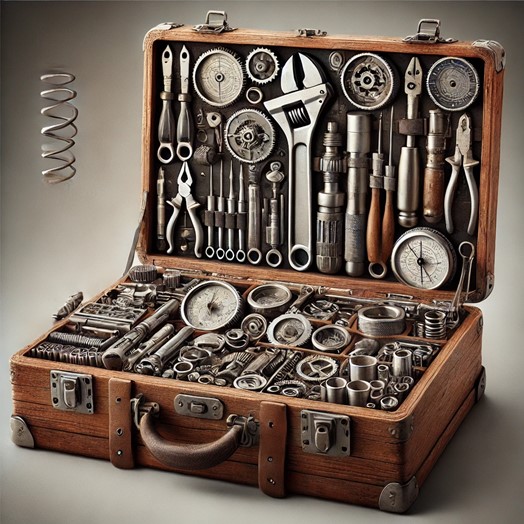
Lore: The Engineer’s Toolkit is a prized possession of skilled engineers, tinkerers, and inventors. Housed within a sturdy wooden case, it contains an assortment of precision tools, gears, springs, and measuring devices. The toolkit bears the marks of numerous repairs and modifications, a testament to its history of use by capable hands.
Use in the Game: The Engineer’s Toolkit is a versatile toolset that empowers the character with proficiency in tinkering and repairing mechanical devices. With this toolkit, the creature gains an in-depth understanding of the inner workings of machinery and mechanical systems, enabling them to fix broken devices, modify existing contraptions, and craft new mechanical creations.
The toolkit grants advantages on checks related to crafting, repairing, or modifying intricate machinery or devices. This advantage represents the character’s expertise and familiarity with the toolkit’s tools, allowing them to approach complex tasks with precision and efficiency.
Additionally, the Engineer’s Toolkit provides a +1 bonus to all Intelligence-based checks related to engineering, architecture, or mechanical traps. This bonus reflects the character’s acquired knowledge and expertise in these areas, granting them a deeper understanding of mechanical principles, the ability to analyze complex structures, and the capability to identify and disarm mechanical traps.
The Engineer’s Toolkit can be obtained through renowned engineering guilds, specialized tool shops, or as a reward for completing quests involving mechanical puzzles or challenges. It may also be inherited from a skilled engineer or discovered in forgotten workshops and ancient ruins. Possession of the toolkit signifies the character’s passion for mechanical craftsmanship and their ability to manipulate the physical world through their understanding of gears, levers, and intricate mechanisms. It becomes a symbol of their resourcefulness and skill, opening doors to new possibilities and allowing them to overcome challenges that rely on their engineering prowess.
The Engineer’s Toolkit can be found in various specialized shops across the world of Saṃsāra, each catering to the unique needs of engineers, tinkerers, and inventors. Below are descriptions of where and how this item might be bought and sold, along with the associated costs in different types of shops.
- Renowned Engineering Guilds
- Shop Type: Guild Artisan’s Emporium
- Location: Major cities, near industrial or academic districts
- Description: In the halls of esteemed engineering guilds, skilled craftsmen sell their wares to members and outsiders alike. These emporiums are known for their top-tier tools and exclusive items available only to those who have proven their expertise. The Engineer’s Toolkit is displayed with pride, often customized with the guild’s insignia, and only sold to those who have demonstrated proficiency in the craft.
- Cost: 250-300 gold pieces
- Acquisition: The toolkit is often sold as part of a membership package or after completing a significant project within the guild. Buyers may receive a discount if they are guild members or have contributed notable inventions or designs. The guild’s reputation ensures that each toolkit is of the highest quality, with optional customizations available.
- Specialized Tool Shops
- Shop Type: Precision Craftsmanship Outlet
- Location: Trade hubs, marketplaces, and workshops in large towns or cities
- Description: Specialized tool shops, often located in bustling marketplaces or industrial districts, offer a wide array of tools and equipment for professionals and hobbyists. These shops are known for their high-quality goods and knowledgeable staff, who can assist buyers in selecting the perfect toolkit for their needs. The Engineer’s Toolkit is prominently displayed among other fine tools, with each set meticulously organized in sturdy wooden cases.
- Cost: 200-250 gold pieces
- Acquisition: The toolkit is sold as a standard item, with prices reflecting the shop’s reputation and location. Buyers may be able to negotiate the price slightly or receive discounts during special sales events. The toolkit here is ideal for those who seek reliable, well-crafted tools that can handle a wide range of tasks.
- Forgotten Workshops and Ancient Ruins
- Shop Type: Relic Trader or Treasure Hunter’s Cache
- Location: Remote areas, hidden within ruins or ancient workshops
- Description: In the hidden corners of Saṃsāra, ancient workshops and ruins hold forgotten treasures. Relic traders or treasure hunters occasionally come across Engineer’s Toolkits left behind by master craftsmen of old. These toolkits, though weathered by time, often possess unique features or enhancements that modern sets lack. The cases are worn and bear the marks of countless repairs, adding to their mystique.
- Cost: 150-200 gold pieces (variable)
- Acquisition: These toolkits are often found rather than bought, discovered during quests or expeditions into the ruins of lost civilizations. Traders specializing in relics may sell these toolkits at a premium, emphasizing their rarity and historical value. The condition of the toolkit can vary, with some needing restoration before use, but they often come with unique modifications that make them desirable to collectors and engineers alike.
- Traveling Merchant Caravans
- Shop Type: Wandering Merchant’s Cart
- Location: Rural villages, cross-country roads, and trade routes
- Description: Traveling merchants, moving from town to town, often carry a diverse inventory of goods. Their carts are laden with tools, trinkets, and rare items acquired from across Saṃsāra. The Engineer’s Toolkit is kept securely within a chest, offered to those who show interest in mechanical crafts or who need reliable tools on their journeys.
- Cost: 180-220 gold pieces
- Acquisition: The toolkit can be purchased directly from the merchant, often after some haggling. Prices can vary depending on the merchant’s recent sales, the demand for such tools, and the rarity of the item in that region. These toolkits are often sold to adventurers, engineers traveling to remote locations, or those who simply appreciate fine craftsmanship.
- University Supply Shops
- Shop Type: Academic Supply Store
- Location: Near universities, academies, and colleges of engineering or magic
- Description: In the academic districts where aspiring engineers and inventors hone their skills, university supply shops cater to the needs of students and professors alike. These shops offer a range of educational materials, books, and tools, including the Engineer’s Toolkit. The sets sold here are often tailored to the needs of students, with durable designs meant to withstand rigorous use.
- Cost: 180-230 gold pieces
- Acquisition: The toolkit is available for purchase by students and faculty, often with discounts for those enrolled in engineering or related programs. These shops may offer different versions of the toolkit, from basic sets for beginners to more advanced kits for senior students and professional engineers. The focus here is on practicality and durability, ensuring that the tools can handle the demands of an academic environment.
These shops and locations across Saṃsāra offer the Engineer’s Toolkit with varying costs and unique qualities, each catering to the specific needs and backgrounds of engineers and craftsmen within the world.
The Engineer’s Toolkit is a versatile asset that can be creatively employed for both defensive and offensive purposes across a range of environments in Saṃsāra. Below are roleplay scenarios that illustrate how engineers, tinkerers, or inventors might use the toolkit in various settings to gain an advantage in combat or when defending a position.
- Urban and Cityscapes
- Environment: Cities, towns, and urban areas
- Defense: In densely populated urban environments, the Engineer’s Toolkit can be used to reinforce structures or create improvised defenses quickly. For example, an engineer might use the tools to fortify a building by reinforcing doors with metal braces, setting up barricades in alleyways, or rigging windows with tripwires that activate alarm systems or traps. Additionally, the toolkit’s precision tools could be used to disable or reprogram mechanical locks and security systems, making it harder for enemies to breach defenses.
- Offense: Offensively, the toolkit can be employed to sabotage urban infrastructure or enemy equipment. An engineer might use the toolkit to disable vehicles, such as removing key components from a steam-powered carriage or tampering with the gears of a clocktower to disrupt enemy plans. The toolkit could also be used to construct small, portable devices that can be hidden in the environment, such as noise-makers that create distractions or timed explosives that can disable key installations.
- Wilderness and Forested Areas
- Environment: Dense forests, jungles, and wilderness
- Defense: In the wilderness, the Engineer’s Toolkit can be used to set up defensive traps and fortifications using natural materials. An engineer might use the toolkit to create snares and pitfall traps, reinforcing them with mechanical components to ensure they trigger correctly. They could also build camouflaged barriers or spike traps using branches and vines, all constructed with the precision that the toolkit allows. The toolkit’s measuring devices can help in setting up these defenses with precision, ensuring they are both effective and difficult to detect.
- Offense: Offensively, the toolkit can be used to modify weapons or create makeshift devices from available resources. For example, an engineer could craft a simple crossbow from fallen branches and scavenged materials, or modify existing weapons with enhancements like extended range or improved accuracy. The toolkit could also be used to create traps designed to injure or disable enemies, such as rigging a spring-loaded branch to swing down and knock out a pursuer or setting up a tripwire that releases a hail of sharp objects.
- Underground and Subterranean
- Environment: Caves, tunnels, and dungeons
- Defense: In the confined and often unstable environments of caves and tunnels, the Engineer’s Toolkit can be invaluable for setting up secure defensive positions. The engineer might use the toolkit to reinforce tunnel walls with braces, preventing collapses or creating choke points that slow down enemies. They could also rig collapsible supports that can be triggered to cause cave-ins, blocking off passages or trapping enemies. The toolkit’s tools would allow for precise placement and timing, ensuring that these defenses are both effective and reliable.
- Offense: Offensively, the toolkit can be used to navigate and manipulate the subterranean environment to the engineer’s advantage. The engineer might use the tools to disarm or reset mechanical traps found in ancient dungeons, turning them against their original owners. The toolkit could also be employed to construct devices that enhance mobility, such as building a makeshift pulley system to navigate vertical shafts or modifying existing mining equipment to create tools for breaching barriers or ambushing enemies.
- Open Plains and Battlefields
- Environment: Open fields, plains, and large-scale battlefields
- Defense: On the open battlefield, the Engineer’s Toolkit can be used to quickly establish fortifications and battlefield obstacles. The engineer might construct barricades from available materials, reinforcing them with metal braces or spikes using the toolkit’s tools. They could also set up defensive emplacements, such as building temporary structures to shield archers or creating traps that trigger when enemies advance, such as concealed pits or mechanical caltrops that puncture the tires of enemy vehicles.
- Offense: Offensively, the toolkit can be used to sabotage enemy siege engines or create mobile contraptions to disrupt enemy formations. For instance, an engineer could rig an enemy catapult to misfire or modify a wagon to release a cloud of smoke or spikes as it rolls downhill toward enemy lines. The toolkit’s tools would also allow for the creation of portable, improvised devices such as a spring-loaded mechanism that launches projectiles or a crank-operated blunderbuss.
- Coastal and Aquatic
- Environment: Coastal regions, shores, and near bodies of water
- Defense: In coastal environments, the Engineer’s Toolkit can be used to fortify positions against both land and sea-based threats. The engineer might use the toolkit to reinforce docks and piers, making them more resistant to enemy boarding attempts or high tides. They could also rig traps along the shoreline, such as placing underwater snares that catch and disable approaching boats or setting up mechanical barriers that rise from the water to block passage. The toolkit’s measuring devices would be essential for ensuring these defenses function correctly in the fluctuating environment.
- Offense: Offensively, the toolkit can be used to sabotage enemy vessels or create aquatic devices. The engineer might use the tools to disable a ship’s rudder or modify the propulsion system of a small boat to give it an unexpected speed boost or a sudden jolt that causes it to capsize. The toolkit could also be used to construct underwater traps or devices, such as a spring-loaded harpoon launcher or a mechanical device that releases a net to entangle enemy divers or sea creatures.
These scenarios demonstrate the Engineer’s Toolkit’s versatility in a variety of environments, enabling characters to creatively apply their mechanical skills for both defense and offense. Whether in a city, forest, dungeon, battlefield, or along the coast, the toolkit empowers engineers to adapt and overcome challenges, turning their surroundings into opportunities for strategic advantage.
Perception of Activation:
- Sight:
- Perception: When the Engineer’s Toolkit is activated, a faint, ethereal blue glow emanates from the tools and components inside the case, illuminating the polished metal and intricate gears.
- Description: The glow is soft and steady, casting a calming light over the toolkit. The tools seem to shimmer slightly, as if imbued with a subtle magical energy that enhances their precision and effectiveness.
- Positives: The light can help the user see clearly in low-light conditions, making it easier to work on delicate mechanical tasks.
- Negatives: The glow might attract unwanted attention in dark environments, potentially revealing the user’s position to nearby observers.
- Sound:
- Perception: A quiet, rhythmic clicking sound accompanies the activation, reminiscent of a finely tuned clock or the steady ticking of gears in motion.
- Description: The sound is soothing, with a precise cadence that reflects the toolkit’s mechanical nature. It reinforces the sense of order and precision, helping the user focus on the task at hand.
- Positives: The rhythmic sound can be calming, providing a steady rhythm that aids concentration during complex operations.
- Negatives: In a silent environment, the ticking might be noticeable to others, potentially revealing the user’s activity or location.
- Touch:
- Perception: Upon activation, the tools within the set feel slightly warmer to the touch, as if charged with energy that flows into the user’s hands.
- Description: The warmth is gentle and reassuring, enhancing the user’s dexterity and making the tools feel as if they are an extension of their own hands. The metal surfaces are smooth, and the gears turn with perfect precision.
- Positives: The warmth can improve dexterity and reduce hand fatigue, allowing the user to work with greater precision and comfort.
- Negatives: In hot environments, the additional warmth might be uncomfortable, and the sensation of energy flowing through the tools could be unsettling for those not accustomed to magical devices.
- Smell:
- Perception: A subtle scent of oil and polished metal fills the air when the toolkit is activated, reminiscent of a well-maintained workshop.
- Description: The scent is clean and invigorating, evoking memories of freshly forged steel and the sharp tang of mechanical oil. It reinforces the user’s connection to the tools and their craft.
- Positives: The smell can be grounding, helping the user focus on their work and providing a sense of familiarity and comfort.
- Negatives: In enclosed spaces, the scent might become overpowering, especially for those sensitive to strong odors.
- Taste:
- Perception: While not directly tasted, the air around the activated toolkit carries a faint metallic tang, similar to the taste of tools in a workshop.
- Description: The taste is subtle and almost imperceptible, but it heightens the user’s awareness of the toolkit’s activation and the energy within it.
- Positives: The metallic tang can sharpen the senses, making the user more alert and focused during complex mechanical tasks.
- Negatives: The taste might be off-putting to some, causing a brief moment of distraction or discomfort.
- Extrasensory Perception:
- Perception: The activation of the Engineer’s Toolkit creates a subtle vibration in the surrounding air, almost like a harmonic resonance that can be felt by those attuned to mechanical energies.
- Description: For those with heightened senses, the set’s activation feels like a connection to a larger network of mechanical forces. The tools seem to resonate with the user’s intentions, enhancing their ability to manipulate and understand complex machinery.
- Positives: This connection can enhance the user’s precision and intuition, making even the most intricate tasks feel natural and fluid.
- Negatives: The resonance might be disorienting for those unfamiliar with such sensations, potentially leading to a sense of unease or confusion during the initial use.
- Overall Positives:
- Enhances focus, precision, and dexterity.
- Provides sensory feedback that reinforces the user’s connection to the tools.
- The subtle activation effects can assist in low-light or high-pressure situations.
- Overall Negatives:
- The glow, sound, and scent could attract unwanted attention.
- The warmth and metallic tang might cause discomfort in certain environments.
- The extrasensory perception could be overwhelming or unsettling for those not accustomed to it.
The activation of the Engineer’s Toolkit is a multi-sensory experience that deepens the user’s connection to their craft, while also presenting challenges that must be navigated in various environments.
Crafting Recipe: Engineer’s Toolkit
- Materials Needed:
- 1x Enchanted Oak Wood Plank: Sourced from a magical tree, this wood is used to craft the sturdy, durable case that houses the toolkit. The enchantment ensures the case is resistant to wear and tear.
- 5x High-Quality Metal Ingots: These should include steel for strength, copper for conductivity, and mithril or adamantine for magical properties. The ingots will be used to forge the precision tools within the set.
- 3x Precision Gear Components: These include miniature gears, springs, and other intricate mechanical parts. They should be forged with exacting standards to ensure smooth operation.
- 2x Vials of Alchemical Oil: A specially formulated oil that prevents rust and enhances the smooth operation of the tools.
- 1x Arcane Crystal Shard: A small shard infused with magical energy, to be embedded in the toolkit for its activation properties.
- 2x Spools of Enchanted Thread: Thread woven with magical fibers to reinforce the stitching of the leather straps and interior lining of the case, ensuring durability.
- Tools Required:
- Masterwork Forge: A high-quality forge with precise temperature control, necessary for shaping the metal components.
- Jeweler’s Tools: For engraving the arcane crystal and crafting the smaller, intricate parts of the toolkit.
- Woodworking Kit: For cutting, shaping, and assembling the enchanted oak into a durable and functional case.
- Enchanter’s Anvil: A specialized anvil that allows for the magical infusion of tools, ensuring they are capable of handling delicate mechanical work.
- Miniature Gear Press: A tool designed for creating small, precise gears and springs, essential for the internal components of the set.
- Skill Requirements:
- Advanced Woodworking (Expert Level): Required to craft the durable and enchanted oak case, ensuring it is both protective and flexible.
- Masterwork Metalworking (Expert Level): Necessary for forging and shaping the high-quality metal into the precise tools needed for the set.
- Arcane Engraving (Advanced Level): Needed to inscribe the arcane crystal and imbue the tools with minor enchantments that enhance their functionality.
- Mechanics (Advanced Level): To assemble and calibrate the gears, springs, and other components so that they function smoothly and reliably.
- Enchanting (Intermediate Level): Required to bind the magical properties of the arcane crystal and enchanted thread to the finished set.
- Crafting Steps:
- Prepare the Enchanted Oak Case:
- Use the Woodworking Kit to carefully cut and shape the enchanted oak plank into the panels for the toolkit’s case. Ensure the wood is precisely measured and cut to create compartments that will hold each tool securely.
- Assemble the panels into a sturdy case, using the Enchanted Thread to sew and reinforce the joints. The case should be designed to protect the tools from external damage while being easy to carry.
- Forge the Metal Tools:
- In the Masterwork Forge, melt and shape the High-Quality Metal Ingots into the desired tools, including screwdrivers, pliers, wrenches, and precision gauges. Each tool must be perfectly balanced and sized for fine mechanical work.
- Once forged, polish each tool and treat it with the Alchemical Oil to prevent rust and ensure smooth operation. The tools should be highly reflective, with a finish that highlights their craftsmanship.
- Craft and Assemble the Precision Gears:
- Using the Miniature Gear Press, forge the Precision Gear Components, ensuring each gear and spring is crafted to exact specifications.
- Assemble the gears and springs within the toolkit’s compartments, ensuring that they are properly aligned and functional. These components should be able to move and interact with each other seamlessly, aiding in the use of the tools.
- Engrave and Embed the Arcane Crystal:
- Using Jeweler’s Tools, carefully engrave runes of precision and activation onto the Arcane Crystal Shard. This crystal will provide the toolkit with its unique activation properties.
- Embed the crystal into the interior of the case, securing it within a central compartment. The crystal’s energy should be evenly distributed throughout the toolkit, allowing it to infuse each tool with a subtle magical charge.
- Final Enchantment and Calibration:
- Place the completed toolkit on the Enchanter’s Anvil and perform the final enchanting ritual, binding the magical properties of the Arcane Crystal and Enchanted Thread to the tools and case. This will allow the toolkit to activate and resonate with mechanical energies when in use.
- Calibrate each tool and component to ensure they function together harmoniously. This step may require several hours of testing and adjustment to achieve the perfect balance.
- Testing and Finishing:
- Test the functionality of the toolkit by using it to repair or create a small mechanical device. Ensure that the tools operate smoothly and that the gears move without friction or resistance.
- Apply a final coat of Alchemical Oil to the tools and internal components, and polish the oak case to a smooth finish, ensuring it is ready for long-term use.
- Prepare the Enchanted Oak Case:
Completion: Once all steps are meticulously followed, the Engineer’s Toolkit is complete. The set should now be a masterful collection of tools, housed in a durable, enchanted case, capable of performing delicate mechanical tasks and resonating with the mechanical energies of the world.
Tale of the First Toolbox of Wisdom
In the time before time, when the mountains still walked and the rivers sang their first songs, there was a person known by many names but remembered as the One-Who-Builds. The One-Who-Builds wandered the land, seeking knowledge of the world’s secrets and the ways of making things. With hands of skill and a mind of great thought, the One-Who-Builds crafted many wonders, but always sought the perfect tool—one that could make what was yet unmade, and fix what was yet broken.
One day, in a place where the sky touched the earth, the One-Who-Builds came upon a being ancient and wise, known as the Keeper-of-All-Things. The Keeper, with eyes of the stars and a voice like the wind, asked the One-Who-Builds, “Why do you seek what cannot be made, and fix what cannot be broken?”
The One-Who-Builds, with a heavy heart, answered, “I seek to understand the ways of the world, to make it better with my hands. But the tools I have are never enough—they break, they fail, and they do not know what I do not know.”
The Keeper, with a nod that made the mountains tremble, spoke: “Give me all that you have made, and I will give you what you seek. But know this—what you gain will be greater than what you give, but only if your heart remains true.”
The One-Who-Builds, trusting the Keeper’s words, laid down all tools, all creations, and all knowledge gained. In return, the Keeper handed over a simple wooden box, worn and plain, with no marks of greatness upon it.
The One-Who-Builds, confused but hopeful, opened the box. Inside, there were only small tools—gears and springs, hammers and screws, all in tiny size. Anger grew, and the One-Who-Builds cried out, “This is not what I asked for! This is not what I need!”
But the Keeper, with laughter like thunder, replied, “You ask for the perfect tool, but the tool is not perfect—it is you who must be perfect. This box is the Toolbox of Wisdom. In it, you will find what you need, when you need it, if you know how to ask the right questions. But beware, for the box does not know what you do not know.”
The One-Who-Builds, with new understanding, took the box and left the place where sky and earth meet. In time, the box proved its worth—tools that were small did great things, and the One-Who-Builds made many wonders. But with each creation, the weight of wisdom grew heavier, for the box required the mind to be as sharp as the tools within.
In the end, the One-Who-Builds became known across the lands, not for the tools used, but for the wisdom gained. The Toolbox of Wisdom, though simple, carried the weight of knowledge and the burden of thought. It was passed down through generations, each user finding their own path to greatness or folly.
Moral of the Story: The tool is only as wise as the hand that holds it. True creation comes not from the tool, but from the wisdom to use it well.
Suggested conversions to other systems:
Call of Cthulhu (7th Edition)
Name: Toolbox of Wisdom
- Description: An ancient and worn wooden box containing a collection of strange, precise tools. It is said to grant insight into the workings of any mechanical or occult device, though at the cost of the user’s sanity.
- Stat Block:
- Type: Mythos Artifact
- Skill Bonus: +15% to Mechanical Repair, Electrical Repair, and Cthulhu Mythos rolls when used to examine or repair devices of unknown origin.
- Sanity Cost: 1d6 Sanity points per use.
- Mythos Effects: Each use of the Toolbox requires a Sanity check. On a failure, the user gains a temporary obsession with the device they are working on, leading to a compulsion to disassemble or “perfect” it at all costs.
- Game Mechanics: The Toolbox of Wisdom allows the user to make repairs or modifications to devices, even those of alien or ancient origin, with an increased chance of success. However, prolonged use risks the user’s sanity, as the understanding of the unknown can drive them mad.
Blades in the Dark
Name: Toolbox of Wisdom
- Description: A finely crafted, well-worn box of tools that seem to know exactly what is needed for any given mechanical or alchemical task. It’s whispered that the box itself is somehow aware, guiding the user’s hand toward brilliance—or madness.
- Stat Block:
- Item Type: Fine Item
- Load: 2 (Compact but complete)
- Effect: Grants +1d to Tinker rolls when used for repairing, modifying, or creating devices. The tools adapt to the task at hand, seemingly of their own accord.
- Special Ability: Once per score, the user can take a Devil’s Bargain to automatically succeed on a Tinker roll, but they suffer 2 stress as the unnatural nature of the tools takes a toll on their mind.
- Game Mechanics: The Toolbox of Wisdom provides a significant boost to any engineering or tinkering task. However, its use can draw the attention of otherworldly forces or lead to unexpected consequences, making it a powerful but risky tool.
Dungeons & Dragons (5th Edition)
Name: Toolbox of Wisdom
- Wondrous Item, very rare (requires attunement)
- Stat Block:
- Weight: 5 lbs.
- Effect: The Toolbox of Wisdom grants a +2 bonus to Intelligence (Tinker’s Tools) checks when repairing, modifying, or creating mechanical or magical devices. The tools within seem to know exactly what is needed and guide the user’s hand accordingly.
- Attunement: Yes
- Special Ability: Once per long rest, the user can use the Toolbox to automatically succeed on a Tinker’s Tools check. However, each use beyond the first in a single day imposes a DC 15 Wisdom saving throw; on a failure, the user becomes obsessed with perfecting their work, suffering disadvantage on all Wisdom checks until they complete the task or are forcibly removed from it.
- Game Mechanics: This item is a powerful asset for any engineer or tinkerer, offering substantial bonuses and the ability to complete difficult tasks with ease. However, the risk of obsession introduces a challenge, balancing its power with potential drawbacks.
Knave
Name: Toolbox of Wisdom
- Description: A weathered, well-used box containing tools of unknown origin that seem to adapt to the user’s needs. The tools can repair or create anything mechanical, though they have a mind of their own.
- Stat Block:
- Item Slots: 2 (The box is compact but filled with an extensive array of tools.)
- Effect: Grants a +2 bonus to any Intelligence-based check related to mechanics or crafting. The tools can be used to repair, modify, or create mechanical devices with an eerie precision.
- Special Ability: Once per day, the user can automatically succeed on a repair or crafting check. However, after this use, the tools may begin to influence the user’s mind. Roll a d20; on a 1-3, the user becomes fixated on their work, unable to focus on anything else until it is completed.
- Game Mechanics: The Toolbox of Wisdom is a valuable resource for mechanically inclined characters, providing bonuses to crafting and repair tasks. The potential for the tools to affect the user’s mind adds a layer of risk, encouraging careful use.
Fate Core System
Name: Toolbox of Wisdom
- Aspect: “Tools of Insight and Obsession”
- Description: A well-worn box containing a collection of tools that seem to anticipate the user’s needs. These tools offer unparalleled precision but carry a risk of overwhelming the user’s mind.
- Stat Block:
- Type: Gear (Artifact)
- Invoke: The user can invoke the Toolbox’s aspect to gain a +2 bonus on any roll involving crafting, repairing, or modifying mechanical devices. The tools seem to guide the user’s hands with uncanny accuracy.
- Compel: The GM can compel the Toolbox’s aspect to cause the user to become fixated on their work, losing track of time or ignoring external dangers until the task is completed. This may lead to complications or stress.
- Game Mechanics: The Toolbox of Wisdom is a powerful tool for any mechanically inclined character, enhancing their ability to craft and repair with precision. However, the risk of obsession adds a narrative challenge, requiring the player to balance the benefits with potential drawbacks.
Numenera & Cypher System
Name: Toolbox of Wisdom
- Level: 6
- Description: An ancient and enigmatic toolkit containing tools that seem to resonate with the user’s thoughts, enabling them to repair or create devices with remarkable precision.
- Stat Block:
- Type: Artifact
- Effect: The Toolbox grants an asset (equivalent to a +1 bonus) to tasks involving crafting, repairing, or modifying mechanical devices. The tools seem to adapt to the user’s needs, making even complex tasks feel intuitive.
- Depletion: Roll 1d20 after each use. On a roll of 1-2, the Toolbox depletes, causing the tools to lose their adaptive properties until they can be recalibrated (which requires a full day of work).
- Special Ability: Once per day, the Toolbox allows the user to automatically succeed on a crafting or repair task. However, after using this ability, the user must make an Intellect defense roll (Difficulty 4). On a failure, they become obsessed with their work, suffering a temporary inability to focus on anything else until the task is completed.
- Game Mechanics: The Toolbox of Wisdom offers significant advantages for characters who rely on mechanical tasks, providing both mechanical and narrative benefits. The risk of depletion and obsession adds a layer of tension, encouraging careful use.
Pathfinder (2nd Edition)
Name: Toolbox of Wisdom
- Wondrous Item, rare (requires expert proficiency with Crafting)
- Stat Block:
- Usage: Worn, 1 bulk
- Effect: The Toolbox of Wisdom grants a +2 item bonus to Crafting checks when repairing, modifying, or creating mechanical devices. The tools within seem to know exactly what is needed, guiding the user with precision.
- Activate: (1 action) Once per day, the user can use the Toolbox to automatically succeed on a Crafting check involving a mechanical device. However, if the user activates this ability more than once per day, they must succeed on a DC 17 Will save or become obsessed with the task, suffering a -2 penalty to Perception checks until the task is completed.
- Game Mechanics: The Toolbox of Wisdom is an invaluable asset for any craftsman or engineer, offering a substantial boost to Crafting checks and the ability to succeed in difficult tasks. The potential for obsession introduces a challenge, making the user weigh the benefits against the risks.
Savage Worlds (Adventure Edition)
Name: Toolbox of Wisdom
- Description: A legendary toolkit passed down through generations, containing tools that seem to have a mind of their own. The tools provide unparalleled precision, but they may come at the cost of the user’s focus.
- Stat Block:
- Type: Gear
- Effect: The Toolbox of Wisdom grants a +2 to Repair rolls involving mechanical devices and a +1 to Crafting rolls. The tools within adapt to the user’s needs, allowing for quick and efficient work.
- Special Ability: Once per session, the user can automatically succeed on a Repair or Crafting roll involving a mechanical device. However, after using this ability, the user must make a Spirit roll (at -2) or become obsessed with their work, suffering a -2 penalty to Notice rolls for the remainder of the session.
- Game Mechanics: The Toolbox of Wisdom is a powerful tool for characters who specialize in crafting or repairing, offering significant bonuses and the ability to ensure success in critical moments. The risk of obsession adds a narrative element, making the player consider when to use the toolbox’s full potential.
Shadowrun (6th Edition)
Name: Toolbox of Wisdom
- Description: An ancient and mysterious toolkit, enhanced with nanotechnology and arcane energy, that seems to adapt to the user’s needs, offering unparalleled precision in mechanical and technical tasks.
- Stat Block:
- Type: Gear (Tool Kit)
- Device Rating: 6
- Effect: Grants a +3 dice pool bonus to Engineering, Hardware, or Mechanic checks when used to repair, modify, or create mechanical devices. The tools within the kit seem to anticipate the user’s intentions, making tasks easier and more efficient.
- Special Ability: Once per day, the user can automatically succeed on a Hardware or Engineering test. However, after using this ability, the user must make a Willpower + Logic (3) test. On a failure, the user becomes obsessed with perfecting their work, gaining a -2 dice pool penalty to Perception tests until the task is completed.
- Drawback: The kit requires 1 unit of power (or 1 battery) per 8 hours of use. If the power source is depleted, the tools lose their adaptive properties, reducing the bonus to +1 until recharged.
- Game Mechanics: The Toolbox of Wisdom is a valuable asset for any Shadowrunner dealing with complex mechanical or electronic systems. The kit’s benefits are balanced by the risk of obsession, adding a psychological element to its use.
Starfinder
Name: Toolbox of Wisdom
- Level: 8
- Description: A sophisticated toolkit filled with ancient tools that seem to resonate with the user’s thoughts, allowing for precise and efficient work on mechanical and electronic devices.
- Stat Block:
- Item Level: 8
- Type: Technological Item
- Price: 10,000 credits
- Capacity: 20 charges
- Usage: 1 charge/hour
- Effect: Provides a +3 enhancement bonus to Engineering checks when repairing, modifying, or crafting mechanical or electronic devices. The tools within the kit adapt to the task at hand, making complex projects easier to manage.
- Special Ability: Once per day, the user can reroll a failed Engineering check, taking the better result. However, after using this ability, the user must succeed on a DC 18 Will save or become obsessed with their work, taking a -2 penalty to Perception checks until the task is completed.
- Drawback: If the kit runs out of charges, it loses its special abilities and provides only a +1 bonus to Engineering checks until recharged. Additionally, the kit may cause minor glitches in nearby electronics when activated, adding an element of unpredictability.
- Game Mechanics: The Toolbox of Wisdom is an excellent tool for engineers and mechanics, providing significant bonuses and ensuring success in critical situations. The potential for obsession and electronic interference introduces strategic considerations for its use.
Traveller (Mongoose 2nd Edition)
Name: Toolbox of Wisdom
- Tech Level: 12
- Description: A highly advanced toolkit believed to be of ancient origin, containing tools that seem to possess an intelligence of their own, aiding the user in complex mechanical tasks.
- Stat Block:
- TL: 12
- Mass: 1.5 kg
- Cost: 100,000 credits
- Effect: Grants a +3 DM (Dice Modifier) to any Engineer (Mechanical) or Mechanic checks when repairing or modifying mechanical systems. The tools adapt to the user’s needs, making even the most intricate tasks feel intuitive.
- Special Ability: Once per session, the user can ignore a Mishap during a mechanical repair or maintenance task, as the tools automatically correct the user’s mistake. After using this ability, the user must make an Intellect check (Difficulty 10+) or become obsessed with their work, suffering a -1 DM to all non-engineering checks until the task is completed.
- Drawback: The toolkit requires regular maintenance and recalibration. After three uses without maintenance, the kit’s effectiveness is reduced to a +1 DM until recalibrated (taking 1 hour of downtime).
- Game Mechanics: The Toolbox of Wisdom is invaluable for starship engineers and mechanics, providing substantial bonuses and the ability to mitigate critical failures. The maintenance requirement and risk of obsession add depth and realism to its use.
Warhammer (Warhammer Fantasy Roleplay 4th Edition)
Name: Toolbox of Wisdom
- Description: A mysterious and ancient toolkit, revered by engineers and craftsmen, said to hold tools that guide the user’s hands with uncanny precision.
- Stat Block:
- Encumbrance: 1
- Availability: Very Rare
- Effect: Grants a +15 bonus to Trade (Engineer) checks when repairing or crafting mechanical devices. The tools within the kit seem to know exactly what is needed, leading to flawless execution.
- Special Ability: Once per adventure, the user can automatically succeed on a challenging Trade (Engineer) test. However, after using this ability, the user must make a Challenging (+0) Willpower Test. On a failure, the user becomes obsessed with their work, suffering a -10 penalty to all non-engineering tests until the task is completed.
- Drawback: The kit is delicate and must be handled with care. If used in chaotic or high-stress environments (such as during combat), the user must pass a Difficult (-10) Dexterity Test to avoid damaging the tools, reducing the bonus to +5 until the kit is repaired.
- Game Mechanics: The Toolbox of Wisdom is a powerful asset for any engineer, offering substantial bonuses and ensuring success in critical moments. The risk of obsession and potential for damage in stressful situations adds an element of challenge and realism, encouraging careful planning and use.
Comments
One response to “Engineers Toolkit”
[…] Engineer’s Toolkit: […]