
Lore
Within the bustling harbor counting-houses and maritime underwriting bureaus of the island country of Phoenicia, commerce and maritime transit are perpetually threatened by deep-sea leviathans, violent tidal surges, and unpredictable wild magic anomalies. While merchant cartels and the World Bank operated by the god of commerce established rigid ledger systems to track cargo loans, maritime expeditions frequently suffered catastrophic losses due to uncalculated navigational risks. Marine avatars serving as harbor evaluators, cargo surveyors, and salvage specialists needed a means to objectively assess danger before committing ships and caravans to perilous ocean lanes.
Crafted under registered workshop archive schema 572, these fin encasements were designed by an order of mercantile scholars and marine artificers seeking to integrate fiscal risk analysis directly into physical mobility. Utilizing supple aquatic membranes harvested from calculating, long-lived bottom-feeders and reinforced with slender baleen struts cured in alchemical brine, the artisans embedded a coin-sized Tier 1 magic crystal etched with foundational Divination and Abjuration weaves. The crystal acts as an intuitive numerical filter, translating pressure shifts, current velocities, and combat threats into quantifiable probability margins perceived through the wearer’s Mind’s Eye. Duplicate copies of this design quickly disseminated to mercantile centers across the 73 island countries, finding favor among risk assessors, estate appraisers, and pragmatic adventurers who refuse to stake their lives or coin on reckless gambles, preferring to navigate the lethal world of Saṃsāra through calculated margins and minimized physical liability.
Detailed Tier 1 Stats
* Item Name: Fins 572 of the Actuary
* Item Tier: Tier 1 (Common)
* Equipment Slot: Fins (specifically bound to or encasing biological caudal, pectoral, or dorsal fin anatomy)
* Armor Check: +1 AC (conforming strictly to the mandated threshold limit of 3 AC per item tier level)
* Item Hit Points: 10 hit points plus the avatar’s maximum hit points (derived from a base resilience of 10 multiplied by Tier 1, added to the wearer’s maximum health pool; possesses fixed mundane hit points of 10 when completely unequipped and unattuned)
* Physical Weight: 2 pounds (weighs 0 pounds if stored within an extradimensional pouch, bag, or storage crypt)
* Suggested Market Value: 42 silver coins (fluctuates widely based on local maritime access, regional merchant haggling formulas of 10% times the character’s tier level, local municipal taxes, and the prevailing conditions of a seller’s market where buyer beware applies)
* Attunement Requirement: Requires simple attunement taking exactly one full minute of uninterrupted focus while securely fastened to the avatar’s fin structures; cannot be attuned while kept inside extradimensional containers
* Mind’s Eye Signature: Registers under passive examination as an orderly, geometric grid of fine runes radiating a pale amber and slate-blue aura indicative of foundational Divination and Abjuration weaves
Skills Gained When Openly Worn
* Granted Temporary Skill Points: +2 temporary skill points to Investigation (Risk Analysis / Mathematical Accounting) and +1 temporary skill point to Perception (Environmental Hazard Appraisal) whenever the fins are fastened openly and visible upon the avatar’s body.
* Temporary Skill Constraints: These temporary points apply directly to skill check calculations (formula: 10 times character tier level, plus 1d20, plus the 1d4 tier die, plus trained and temporary skill levels), but do not count toward the character’s permanent training cap of 5 plus tier level. If the fins are removed, placed into a concealed storage pouch, or broken, these temporary skill points immediately dissipate.
Color
* Primary Membrane Shading: Deep ledger-ink slate blue overlaid with matte parchment-cream grid lines that subtlely shift opacity based on calculated threat levels.
* Structural Ribs and Stitching: Burnished copper-hued baleen stays fastened with dark bronze eyelets, edged in pale indigo trim that glimmers with a faint ultraviolet sheen under the gaze of true sight.
Multiple Passives Magic
* Mortality Probability Calculation: While the avatar is conscious, the Divination weave continuously analyzes the posture, trajectory, and weapon readiness of hostile entities within 30 feet, projecting subtle numerical variance indicators into the wearer’s Mind’s Eye that grant advantage on saving throws against area-of-effect hazards, traps, and environmental ambushes.
* Liability Cushion: When the avatar is subjected to falling damage, abrupt water-pressure concussions, or collision impacts from charging beasts, the Abjuration matrix instantly disperses the kinetic shock along the length of the baleen struts, reducing incoming physical collision damage by an amount equal to the character’s tier level plus 1 (2 points of damage mitigation at Tier 1).
* Current Variance Balance: The trailing edge of each fin automatically counter-flexes against erratic water undertows, tidal shifts, and turbulence, allowing the avatar to maintain stable footing on slick riverbeds or preserve an exact swimming depth without expending extra physical stamina.
Multiple Active Magics
* Calculated Risk Hedge: By spending one action during combat, the avatar conducts an instantaneous risk appraisal of the battlefield, dedicating their defensive profile against the single most statistically dangerous foe within 30 feet. Until the start of the avatar’s next turn, the avatar gains a +2 bonus to AC against all attacks made by that designated foe, while suffering a -1 penalty to AC against attacks made by secondary combatants.
* Actuarial Appraisal: As an action, the wearer focuses their Mind’s Eye upon an object, structure, commercial consignment, or defensive fortification for one full minute. The fins reveal hidden structural flaws, material wear, unexploded traps, or estimated repair costs, providing a +2 bonus to any subsequent skill check made to disable the mechanism, breach the obstacle, or appraise its economic salvage value.
* Liability Redistribution: When an adjacent party member within 5 feet is struck by an attack, the avatar can expend a prepared reaction to flare the fins outward, interposing an abjuration dampening field. The triggering damage is reduced by an amount equal to the roll of the avatar’s 1d4 Tier 1 die; the avatar absorbs half of the prevented damage directly into their own current hit point pool, effectively underwriting the ally’s physical loss to prevent an immediate fatal blow.
Tags
Fins, Aquatic, Actuary, Investigation, Common, Tier 1, Worn, Divination, Abjuration, Utility, Defense, Phoenicia, Accounting, Probability, Warding, Appraisal, Whalebone, Calculation, Mitigation, Underwriting, Ledger, Risk
Additional Information
* Structural Degradation and Maintenance: If Fins 572 of the Actuary sustains physical damage during an encounter and is reduced to 5 hit points or fewer, it enters the broken condition. While broken, its probability assessments cease, damage-mitigation passives fail, and the temporary skill points are suspended until the garment is restored to full health by a crafter utilizing ironwood sap harvested with a fluid collector and fine bone needles.
* Component Drops on Destruction: If targeted directly by a foe and reduced to 0 hit points, the item is completely destroyed and immediately drops its raw constituent components: two flexible baleen slats, two square feet of scrap ray-membrane, and an inert, coin-sized Tier 1 magic crystal shard.
* Rest Constraints: Avatars gain nothing from a short rest, meaning that any physical exhaustion, strain, or hit point loss incurred while performing strenuous actuarial calculations or diving through treacherous reefs can only be recovered through a full daily long rest, warm meals of at least twenty minutes in duration, or external healing items and potions.
* Avatar Possession and Death Behavior: If an avatar wearing these fins is defeated in battle, its physical vessel vaporizes into a cloud of purple sparks, dropping a Tier 1 soul crystal alongside Fins 572 of the Actuary onto the ground or seabed where it can be recovered by spending an action.
* Runic Advancement Pathway: Under the crafting conventions of Saṃsāra, this item can be elevated to a Tier 2 uncommon gear piece by commissioning an artisan with a skill level of 5 or higher to fuse an uncommon warding rune or higher-capacity divination catalyst into the copper bracket. The process incurs a service fee of 15% of the combined item value, advancing the fins to Tier 2, increasing item hit points to 20 plus avatar maximum health, and scaling its analytical features to higher-tier gameplay challenges.
Acquisition and Commerce of Fins 572 of the Actuary
How the Item Might Be Obtained
* Salvage from Underwriters, Cargo Surveyors, or Slain Marine Foes: Avatars may acquire this item by defeating hostile aquatic surveyors, sunken-wreck scavengers, or possessed privateer evaluators who wear the fins to calculate boarding margins and maritime salvage yields. When a non-possessed monster or creature wearing the fins is slain, its physical corpse remains in the water or upon the shore, permitting party members to search the body and unstrap the gear. If the defeated adversary was a possessed Tier 1 avatar, its mortal form vaporizes in a flash of purple sparks upon reaching zero health points, dropping a Tier 1 soul crystal alongside Fins 572 of the Actuary onto the ground or seabed where it can be claimed by spending an action.
* Commercial Maritime Guild and Underwriting Commissions: Merchant syndicates, harbor masters, and port adventuring guilds—especially those situated in high-commerce island nations like Phoenicia, Carthage, or Mycenaean—frequently commission independent adventurers to appraise hazardous trade routes, audit damaged wharf breakwaters, or evaluate reef-wreckage for cargo recovery. Guild masters or appointed military officials frequently offer surplus pairs of Tier 1 common actuarial gear as contracted payment or quest rewards for avatars who deliver certified damage assessments, balance port ledgers, or map emerging shoals.
* Recipe-Driven Crafting and Artisanal Construction: An avatar possessing the necessary proficiencies can manufacture Fins 572 of the Actuary during downtime away from active exploration. Assembly requires the documented crafting schema for series 572, cured rayskin or marine hide, flexible baleen stays softened in a steam press, pure binding sap extracted from ironwood trees using a fluid collector, and a coin-sized Tier 1 magic crystal taken from a slain creature that possessed innate divination or protective traits to power the analytical probability matrix.
* Direct Avatar Possession: When an unembodied character soul descends from the sky upon Saṃsāra to seek out a living vessel, it surveys candidate hosts across commercial ports, fishing villages, and canal districts. If the player targets a marine auditor, wharf tax-collector, or cargo assessor who already equips this gear, rolling an even number on a d4 conquers and possesses the candidate host. The character merges their consciousness with the vessel, gaining immediate control of the avatar along with all worn gear, acquiring Fins 572 of the Actuary without paying monetary sums or gathering reagents.
Types of Shops, Locations, and Commercial Transactions
* Harbor Counting-House Ateliers and Marine Supply Stalls: In the absence of massive chain stores or institutional department outlets, retail commerce across Saṃsāra is conducted entirely through small, family-owned mom-and-pop workshops and independent crafting stalls. In maritime cities and island port centers, shops handling this item are found in customs districts, counting-house wharfs, or dry-dock outfitter rows. These shops are maintained by veteran artisans who have worked in trade guilds for decades. Fins are displayed alongside brass slide-rules, wax ledger tablets, and navigational sextants on damp felt mats. Prospective buyers inspect the equipment using the passive function of their Mind’s Eye, viewing its intrinsic statistics, Tier 1 common rating, +1 AC contribution, and temporary investigation bonuses before opening discussions with the proprietor.
* Buying Protocol and Market Valuations: * Suggested Market Baseline: The standard suggested value for Fins 572 of the Actuary is 42 silver coins (equivalent to 4 gold and 2 silver, or 8 electrum and 2 silver). Under the world’s seller’s market and buyer beware conditions, the actual asking price fluctuates widely. In busy maritime trading capitals with plentiful aquatic supplies, the price stays near the 42-silver baseline; in inland, landlocked states such as Badarian or Archaic, scarcity drives the cost up to 80 or 90 silver coins. * Guild and Faction Discounts: If the purchasing avatar holds verified membership in a recognized crafters’ guild, merchant underwriter faction, or port trade guild, and openly displays their faction badge, they qualify for a merchant discount. The discount equals 10% of the item’s baseline value multiplied by the character’s tier level. For a Tier 1 character purchasing this 42-silver item, a 10% discount applies (10% times 1), reducing the price to 37 silver and 8 copper (or 37 silver, 1 nickel, and 6 copper). * World Bank Ledger Payment: In cities with populations exceeding five thousand residents, merchants conduct transactions through the World Bank operated by the god of commerce. The merchant debits the cost directly from the buyer’s bank account as viewed within their Mind’s Eye. The account holder is assessed the standard 1% transaction fee (rounded up to the nearest copper), and the item is handed over to the buyer.
* Selling Protocol and Merchant Haggling: * Haggling Variance: When an avatar attempts to sell this item to an NPC shopkeeper, the merchant will haggle down the payout by approximately 10% of the item’s valuation multiplied by the seller’s tier level. For a Tier 1 seller dealing with a 42-silver baseline, the merchant negotiates the payout down by 10%, offering approximately 37 silver and 8 copper, which is deposited directly into the character’s World Bank account. * Merchant Refusal Rights: Commercial shopkeepers are under no obligation to buy items offered by adventurers. If a shopkeeper currently lacks liquid coin, does not trade in aquatic or analytical gear, or already has an oversupply of surveying equipment, they can refuse the transaction entirely, forcing the avatar to seek out another independent shop or travel to a different port city. * Municipal Transaction Logging: Official merchants keep quasi-logs recording what items were bought from whom. Selling damaged or bloodstained gear recovered from naval battles or privateer wrecks may prompt questioning from municipal military officers or city guard patrols.
* Black-Market and Smuggler Wharf Transactions: * Black-Market Purchases: In the secluded under-piers, canal cellars, and unlicensed anchorages of island nations, black-market fences and illicit brokers stock salvaged, smuggled, or stolen gear. When buying from these dealers, avatars must pay full price or higher (often 50 to 65 silver), as black-market dealers do not honor guild discounts or faction affiliations. * Selling Illicit Stock: When selling to the black market, fences may match standard merchant rates or pay up to double the suggested value (up to 84 silver) if an illicit smuggling ring urgently needs underwater hazard appraisal gear to navigate unmonitored barrier reefs. Fences keep their mouths shut, logging no names with municipal officials. * Physical Coinage Requirement: Black-market transactions strictly prohibit the use of World Bank transfers or ledger balance adjustments. All payments must be rendered and received in physical coin—primarily standard minted gold, silver, or approved local non-metal tokens standardized by weight—which avatars must carry in coin purses or store weightlessly within extradimensional storage.
* Municipal Taxes, Tariffs, and Transit Fees: * Seaport and Gate Levies: Any avatar carrying this gear through a fortified city gate or seaport wharf must pay a transit fee of 1 silver coin per individual to the guarding military contingent. * Interstate Border Taxes: Transporting commercial shipments of these fins across a state border incurs a 5% ad valorem tax collected by state guards. If the transport route passes directly through an island nation’s neutral Central City, the transit tax is reduced to 1%. * Municipal Market Assessment: Goods brought into a city, town, or port to be sold at market are assessed a 3% local tax by the municipal tax collector or local warlord. If the cargo is merely passing through a city or town en route to another destination, the transit levy is reduced to 1%. Failure to pay assessed property, border, or market taxes results in immediate impoundment of the cargo by local authorities until all taxes are settled.
Actuarial and Tactical Application of Fins 572 of the Actuary Across Diverse Environments
Harbor Counting-Houses, Municipal Plazas, and Port Docks
* Defense: * Within crowded harbor quays, municipal customs plazas, and stone counting-house wharfs, conflicts often ignite over tax disputes, intercepted smuggling runs, or sudden raids by dockside gangs. The wearer relies on the Mortality Probability Calculation to track weapon draws, line-of-sight angles, and crossbow trajectories across crowded marketplaces, granting advantage on saving throws to avoid thrown alchemical vials, spring-loaded traps, or concealed caltrops scattered across the paving stones. * When targeted by an elite enforcer or loan collector, the avatar spends an action to initiate Calculated Risk Hedge, fixing their defensive profile entirely on the primary adversary. This grants a +2 bonus to AC against that principal attacker’s heavy strikes, letting the avatar parry or slip blade thrusts while deliberately accepting the minor liability of a -1 AC penalty against subordinate street ruffians. * If an adjacent ally negotiating at the customs counter is struck by an unexpected sneak attack or heavy truncheon blow, the avatar expends an immediate reaction to trigger Liability Redistribution. Flaring the fins outward to project an abjuration dampening field, the avatar reduces the incoming damage by their 1d4 Tier 1 die roll, taking half the absorbed damage directly into their own hit point pool to keep a vulnerable companion upright and conscious.
* Offense: * During urban negotiations or dockside standoffs, the avatar activates Actuarial Appraisal to study the structural integrity of the surrounding architecture. Spending one minute scanning with the Mind’s Eye reveals load-bearing structural stress points, rotting wharf pilings, or weakened crane ropes, granting a +2 bonus to checks made to collapse port cargo nets onto escaping smugglers or sunder barricades holding back municipal reinforcements. * In offensive melee skirmishes, the avatar uses probability indicators to guide party strikes, identifying which city guards possess damaged armor plates or compromised shields, calling out targeted vectors that maximize the efficiency of allied weapon swings. * When raiding an illicit harbor vault or corrupted guildhouse, the avatar evaluates mechanical lockboxes, floor-plate triggers, and reinforced iron doors, calculating failure probabilities to safely bypass traps or open reinforced vaults with a +2 bonus on mechanical manipulation checks.
Coastal Waters, Wharfs, and Barrier Reefs
* Defense: * Traversing shallow tidal channels, jagged coral reefs, and wave-battered breakwaters exposes avatars to sudden rip-currents, predatory reef sharks, and concealed harpoon lines. The Current Variance Balance automatically adjusts the trailing edge of each fin against erratic cross-currents and undertows, preventing the avatar from being tossed into jagged reef heads or losing control in heavy tidal backwashes. * When slammed by heavy surf or driven into submerged coral barriers by a charging aquatic beast, the Liability Cushion mitigates kinetic impact damage by 2 points (Tier 1 plus 1), absorbing the brunt of the collision through the reinforced baleen struts and preventing structural trauma to the avatar’s body. * The innate +1 AC from the cured rayskin membrane deflects grazing thrusts from barbed fishing spears and coral daggers, allowing the avatar to maintain their analytical footing on algae-covered rocks.
* Offense: * By applying Actuarial Appraisal to natural coral formations and submerged sea caves, the avatar pinpoints unstable reef overhangs and natural hollows, directing party attacks to trigger localized rockslides that pin or crush hostile amphibious raiders. * When engaging aquatic predators, the avatar uses Calculated Risk Hedge against the pack leader or largest beast, neutralizing the alpha’s primary biting lunges while party members systematically clear away smaller flankers. * The avatar leverages environmental appraisal to calculate safe navigation channels through unmapped shoals, leading merchant skiffs or strike parties safely through shallow coastal hazard zones while pursuing vessels run aground on hidden reefs.
Open Deep Ocean and Abyssal Trenches
* Defense: * In the crushing darkness of the open ocean and deep pelagic trenches, avatars face massive predatory sea beasts, extreme hydrostatic shifts, and sudden localized water-pressure shockwaves. When deep-sea monstrosities unleash concussive tail-strikes or water-hammer blasts, the Liability Cushion disperses the shockwave along the fin struts, reducing incoming kinetic concussive damage by 2 points. * Against solitary megafauna, the avatar engages Calculated Risk Hedge to maximize survivability against the creature’s crushing bite (+2 AC against the monster), relying on the passive +1 AC baseline to turn aside glancing tail sweeps. * If an allied deep diver is caught in a crushing tentacle squeeze or bite that threatens immediate death, the avatar expends a reaction for Liability Redistribution, rolling a 1d4 to mitigate the crushing damage and absorbing half into their own vitality pool to keep the party member from being bitten in two.
* Offense: * The avatar uses Actuarial Appraisal to analyze deep sunken ruins, submerged galleons, and abyssal trench wrecks, evaluating which hull timbers are stable enough to support salvagers and which are on the verge of catastrophic collapse, identifying prime entry vectors for artifact recovery. * In deep-sea combat, the probability weaves track the hydrodynamic wake of approaching pelagic beasts even in zero-visibility conditions, warning allies of incoming charge angles and coordinating focused counter-attacks with added 1d4 tier dice before the beast can slip back into the dark water. * The avatar pinpoints anatomical vulnerabilities on heavily armored deep-sea monstrosities—such as uncalcified gill slits, sensory organs, or joint membranes—guiding party strikes to bypass natural beast armor.
Rivers, Inland Canals, and Swamplands
* Defense: * In muddy river shallows, lock-gates, and murky mangrove swamps, visibility is severely obstructed by floating peat, silt, and rotting timber, creating ideal conditions for hidden snares and ambush predators. The Mortality Probability Calculation tracks subtle shifts in water displacement, alerting the avatar to submerged snapping turtles, bog constrictors, or shoreline snipers, providing advantage on saving throws against hidden traps and environmental hazards. * The Current Variance Balance counters swirling river eddies, canal sluice discharges, and muddy undertows, letting the avatar hold a stationary firing or spellcasting position without being swept downstream. * When colliding with hidden snags, submerged sunken logs, or rammed river craft, the Liability Cushion absorbs 2 points of collision damage, sparing the avatar from impact injuries.
* Offense: * At river checkpoint locks or fortified bridges operated by corrupt toll-masters, the avatar utilizes Actuarial Appraisal to evaluate the mechanical gearing, wooden winches, and sluice-gate chains. Finding the most stressed structural links, the avatar directs a single precise weapon strike or pry-bar check with a +2 bonus to shatter the mechanism, opening the waterway or dropping heavy iron grates onto enemy patrol skiffs. * In murky swamp skirmishes, the avatar uses probability readouts to calculate line-of-sight probabilities through dense reeds and fog banks, allowing the party to launch ranged attacks and spells into concealed positions without guessing blindly. * Against river pirate boarding parties, the avatar uses Calculated Risk Hedge against the enemy captain or heavy bruiser, holding the narrow gangplank with elevated defense while party allies secure the vessel’s cargo holds.
Underground Caverns and Flooded Ruin Complexes
* Defense: * Within subterranean aquifers, flooded tomb labyrinths, and submerged mineral sumps, falling stalactites, shifting rockfalls, and ancient magical pressure runes pose constant threats. The Mortality Probability Calculation registers tremors and falling debris arcs, granting advantage on saving throws to avoid collapsing cavern roofs, stone deadfall traps, and explosive pressure plate runes. * When blown backward by an underwater gas pocket detonation or thrown against jagged limestone walls by a subterranean aquatic beast, the Liability Cushion mitigates 2 points of physical impact damage, preventing broken bones or cracked carapaces. * If an allied scout triggers a tripwire in a submerged corridor, the avatar uses Liability Redistribution to absorb half the resulting dart or spear trap damage, underwriting the scout’s safety and preventing immediate casualty status during extended dungeon exploration.
* Offense: * Using Actuarial Appraisal on ancient sealed masonry, subterranean floodgates, and stone vault seals reveals the exact failure points of ancient mortar and pressure joints, giving a +2 bonus to breach dungeon chambers or drain flooded ruins without triggering catastrophic cave-ins. * In combat against subterranean aberrations, the avatar’s probability matrix calculates movement corridors and attack ranges, guiding allies to corner monsters into choke points where their size and reach work against them. * The avatar calculates mineral yields and structural integrity in flooded mining tunnels, allowing the party to extract precious ore veins or salvage ancient arcane relics without risking collapse.
Atmosphere, Surface Ships, and Floating Megacities
* Defense: * On the slick wooden decks of ocean warships, floating megacities, and high-altitude airships, avatars face high-velocity winds, boarding grappling lines, and dangerous falls from catwalks. If blown from a mast, thrown from an airship skiff, or knocked across a rolling deck, the Liability Cushion reduces the falling or collision impact by 2 points upon hitting the surface, significantly softening hazardous landings. * Amid the chaotic cross-fire of shipboard deck battles, the Mortality Probability Calculation provides early warning vectors against swinging rigging hooks, snapping cables, and incoming ballista bolts, granting advantage on saving throws to dive clear of sweeping deck hazards. * When targeted by an elite boarding captain, the avatar activates Calculated Risk Hedge to lock down the enemy champion (+2 AC against their attacks), holding the bridge or quarterdeck steps while accepting minor defensive trade-offs (-1 AC) against common deck sailors.
* Offense: * During naval or aerial ship actions, the avatar employs Actuarial Appraisal to inspect enemy vessels, evaluating mast tension, hull stress, rudder chains, or airship balloon seams. Identifying the single critical structural failure point, the avatar directs ballista fire or direct strikes with a +2 bonus to dismast the ship, snap its steering rudder, or rupture its lift envelope. * When boarding enemy vessels, the avatar assesses defensive deck layouts to calculate optimal breach points and retreat corridors, minimizing party exposure to concentrated swivel-gun fire and defensive crossbow volleys. * Because avatars gain nothing from a short rest, the actuary systematically tracks the party’s collective physical wear, consumable supplies, and armor damage across extended voyages, enforcing strict risk-managed tactical choices that prioritize objective completion over reckless engagements that waste irreplaceable health points before a long rest can be secured.
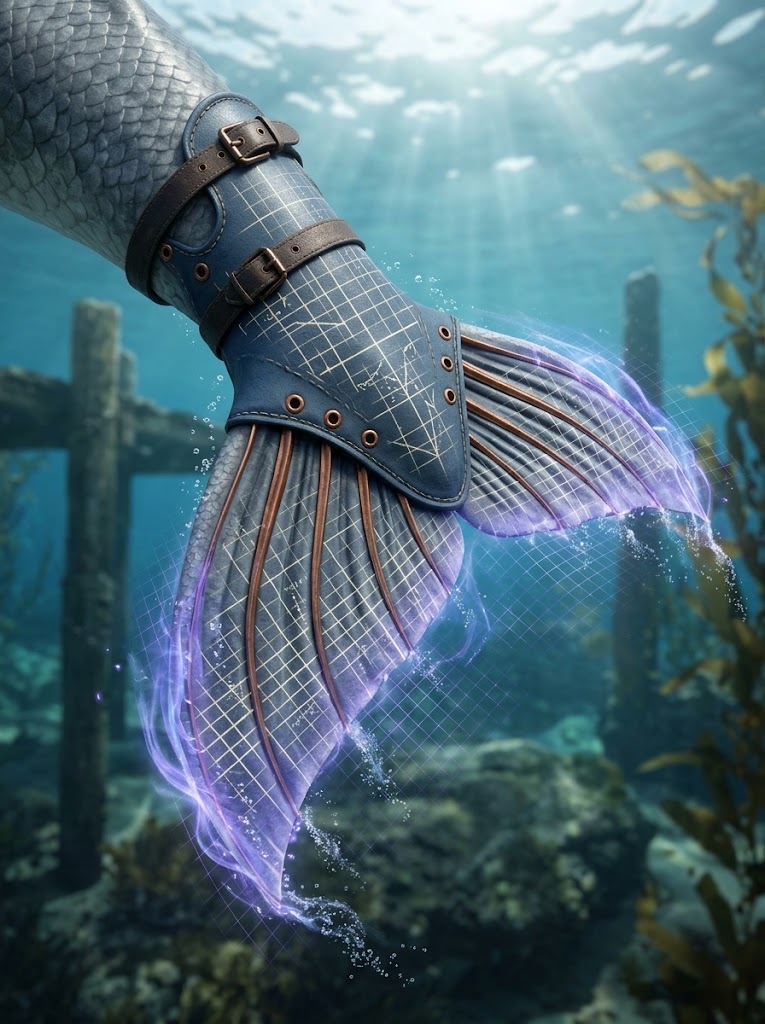
Perception of Activation:
* Normal Sight: * What is Perceived: A structured, luminous overlay of fine parchment-cream grid lines and pale indigo mathematical symbols glowing upon the slate-blue ray-skin membrane, accompanied by faint micro-sparks along the copper stays. * Description: Upon completing the full sixty seconds of deliberate attunement, the muted ledger fabric brightens as geometric lines and runic probability axes trace across the fin’s surface, projecting subtle geometric reflections into the surrounding water or air. * Positives: Gives immediate visual confirmation to the wearer and nearby allies that the divination and abjuration weaves are fully active and actively processing risk calculations. * Negatives: The glowing grid and runic patterns emit noticeable light in darkened conditions, making total visual concealment challenging when trying to remain unseen in pitch-black sumps or shadowy alleys.
* Auditory Perception: * What is Perceived: A rhythmic, metronomic clicking sound reminiscent of a brass counting machine, followed by a soft, low-frequency hum like a distant maritime tuning fork. * Description: Ambient acoustic noise is dynamically dampened; chaotic sounds such as rushing water, roaring crowds, or storm winds are perceived as distinct, measured sound intervals. * Positives: Helps the avatar isolate crucial auditory cues, such as the drawing of a bowstring, mechanical tripwire clicks, or subtle changes in a speaker’s vocal stress. * Negatives: The constant metronomic cadence in the background can be mentally grating during quiet, prolonged periods of downtime or stakeouts.
* Physical Touch and Somatosensory Perception: * What is Perceived: A firm, bracing pressure across the fin cartilage akin to a fitted orthopedic splint, followed by a light coolness across the scales. * Description: As the cured baleen stays align with the avatar’s skeletal framework, the fins lock into optimal hydrodynamic orientation, reducing muscular strain and stabilizing the caudal base. * Positives: Stabilizes posture against rough undertows and eliminates muscle fatigue during long hours of standing at customs counters or treading turbulent water. * Negatives: The rigid, stabilizing grip reduces spontaneous flexibility, making freeform, improvisational physical maneuvers feel slightly mechanical.
* Olfactory Perception: * What is Perceived: A clean, dry scent of dried vellum, iron-gall ledger ink, and ozone, cutting cleanly through ambient sea brine and muck. * Description: The alchemically treated binding resin and mineral dyes release a faint, sharp scent reminiscent of a municipal record hall whenever the crystal’s power matrix activates. * Positives: Provides a grounding, focusing sensory cue that aids mental clarity and clears the sinus passages of foul stagnant bog odors. * Negatives: The artificial ink and ozone smell is distinct from natural marine environments, potentially alerting beasts with keen scent tracking to an unnatural presence.
* True Sight (Extra-Sensory): * What is Perceived: A hovering three-dimensional lattice of ultraviolet grid planes radiating outward from the fin ribs, measuring physical distances and angles in real time. * Description: Through the ultraviolet spectrum, the avatar perceives the space surrounding them divided into quantifiable geometric sectors, revealing the exact boundaries of physical obstacles, active magical wards, and structural stress concentrations. * Positives: Instantly reveals hidden magical tripwires, structural fractures, and the perimeter lines of enemy abjuration or illusion barriers. * Negatives: The visual density of hovering ultraviolet grids can create visual clutter in complex architectural environments, requiring deliberate focus to look past the lines.
* Danger Sense (Extra-Sensory): * What is Perceived: Transient, floating numerical probability fractions and colored threat vectors hovering around hostile creatures and environmental hazards. * Description: The divination weave continuously measures velocity, weapon readiness, and trajectory, translating incoming threats into statistical likelihoods of impact directly within the avatar’s spatial awareness. * Positives: Provides early warning of incoming attacks, traps, and rockfalls, granting the statistical edge needed to maximize defense and dodge reflexes. * Negatives: In chaotic, multi-foe mass combats, the influx of overlapping threat numbers can cause cognitive strain if the avatar attempts to track every marginal liability at once.
* Structural Resonance (Extra-Sensory): * What is Perceived: Low-frequency acoustic vibrations pulsing up through the fin frame, conveying the load limits, material fatigue, and weight distribution of touched surfaces. * Description: By resting the fin against a wall, hull timber, or stone floor, the avatar senses the internal stress lines, dry rot, hollow cavities, or failing mortar within the material. * Positives: Allows immediate diagnosis of whether a bridge, wharf, or cave ceiling is safe to traverse, or exactly where to strike to cause a controlled breach. * Negatives: Sudden concussive impacts against the evaluated structure transmit sharp, jarring vibrations through the avatar’s joints.
* Mind’s Eye Resonance (Extra-Sensory): * What is Perceived: An instant numerical readout logging the gear’s exact operational status, structural health, and active modifier values into internal awareness. * Description: The Mind’s Eye registers the +1 AC rating, the 10 resilience hit points tied to the avatar’s health, and the +2 Investigation and +1 Perception temporary skill bonuses. * Positives: Guarantees absolute certainty regarding the item’s durability and alerts the wearer the instant the gear approaches its broken threshold. * Negatives: The sudden cognitive influx of structured ledger data demands a brief moment of mental reorientation to assimilate into ongoing tactical plans.
Crafting Recipe: Fins 572 of the Actuary
Materials Needed
* Reagent Base: 6 fluid ounces of unrefined ironwood tree sap combined with 2 fluid ounces of distilled brine to create a dense, vulcanizing binding resin. * Organic Structural Frame: 2 matched, steam-softened baleen struts harvested from a juvenile whale, deep-sea skimmer, or calculating bottom-feeder, measuring roughly 18 to 22 inches in length. * Hydrodynamic Membrane: 4 square feet of cured, deep-sea ray-skin or bottom-feeder hide, free of punctures and smoothed to receive geometric scribing. * Arcane Power Source: 1 coin-sized Tier 1 magic crystal harvested from a slain creature that exhibited innate divination, probability sensing, or abjuration shielding traits. * Mineral Pigments and Scribing Medium: 2 ounces of powdered cinnabar, powdered copper flakes, and mineral iron-gall suspension used to dye the hide slate-blue and ink the parchment-cream grid lines. * Sacrificial Component: 1 pair of mundane leather ledger covers, parchment risk scrolls, or measuring straps, completely consumed during the alchemical reduction to instill foundational properties of order, measurement, and structural resilience into the garment.
Tools Required
* Fluid Collector: A calibrated syringe-and-needle extraction tool utilized to harvest uncontaminated ironwood tree sap, alchemical distillates, and biological binding mediums without introducing foreign debris. * Steam Press Chamber: A pressure-tight, steam-driven vulcanizing chamber fitted with rotational valves and mechanical compression jacks to soften baleen struts and cure the organic resin. * Biological Bone Needle and Thread: Fine awls, biological needles carved from sea-beast bone, and treated sinew thread for sewing the hide around the baleen struts without disrupting arcane resonance. * Scribing Compass and Bronze Rule: Precision drafting tools used to measure exact geometric intervals and etch mathematical probability lines into the treated hide. * Ceramic Crucible and Stirring Rod: A heat-tempered earthenware melting pot used to dissolve the sacrificial parchment and blend the sap, mineral pigments, and binding agents over low heat.
Skill Requirements
* Alchemical Crafting: Minimum Skill Level 3 (Required to prepare the resin base, temper the mineral-pigment solution, and seat the Tier 1 divination crystal without fracturing its internal matrix). * Biological Weaving / Leatherworking: Minimum Skill Level 3 (Required to shape the baleen stays, tension the ray-skin membrane, and stitch interlocking seams that endure underwater pressure). * Arcane Mechanics / Mathematical Lore: Minimum Skill Level 2 (Required to calculate the geometric grid coordinates and scribe the divination and abjuration channeling pathways).
Crafting Steps
* Frame Shaping and Conditioning: * Secure the raw baleen struts inside the steam press chamber. * Subject the struts to elemental steam pressure for ninety minutes until the fibrous keratin becomes completely pliable. * Bend the softened stays over an arched forming jig calibrated to match the anatomical curvature of an avatar’s caudal or pectoral fin joints, then quench them in cold saltwater to set their rigid, spring-loaded tension.
* Alchemical Slurry Preparation and Sacrificial Reduction: * Place the 6 ounces of harvested ironwood sap, 2 ounces of distilled brine, and the mineral iron-gall suspension into the ceramic crucible. * Heat gently over a steady, low flame while stirring clockwise until the mixture forms a rich, slate-blue binding slurry. * Introduce the mundane leather ledger covers or parchment risk scrolls directly into the hot mixture, continuing to stir until the fibrous cellulose completely dissolves, bonding the physical stability and conceptual order of the records into the alchemical resin.
* Membrane Cutting, Dyeing, and Geometric Layout: * Lay out the cured ray-skin on a clean drafting table and cut two symmetrical fin panels according to the workshop schema 572 schematic. * Coat the exterior surfaces with the warm slate-blue slurry, allowing the hide to absorb the protective mineral varnish. * Using the scribing compass and bronze rule, etch precise parchment-cream coordinate grids and probability axes across both outer panels, applying powdered copper flakes into the etched channels to facilitate magical conductivity.
* Assembly and Interlocking Seaming: * Align the shaped baleen struts within the structural interior pockets of the prepared membrane panels. * Using the biological bone needle and treated sinew, stitch the outer seams closed using a double-interlocking stitch to prevent delamination under hydrodynamic shear. * Seal all needle perforations and seams with a liberal application of the remaining alchemical sap mixture, creating a watertight, pressure-resistant seal.
* Crystal Seating and Harmonic Pathway Etching: * Affix a burnished bronze or copper bracket to the central convergence point where the twin fin panels meet the mounting cuff. * Mount the coin-sized Tier 1 magic crystal securely within the bracket, ensuring its facets align with the primary structural stays. * Using a fine-point scribing awl, engrave linear conduits leading from the crystal bracket outward into the etched coordinate grids, bridging the divination matrix directly with the abjuration dampening lattice. * Direct a steady pulse of conscious focus into the crystal to activate the circuit, observing the grid until it illuminates with a pale amber and indigo glow under true sight.
* Vulcanization, Inspection, and Attunement Clearance: * Return the fully assembled fins to the steam press chamber at low heat for three hours to vulcanize the sap resin and lock all structural bonds into place. * Allow the finished piece to cool completely over one full day of downtime. * Examine the finished gear through the Mind’s Eye to verify that it registers as a Tier 1 Common item possessing 10 base resilience hit points, a +1 AC value, and the full suite of actuarial skills (+2 Investigation, +1 Perception) before clearing it for active attunement.
Tail-Grid and the Reckoning of the Drowned Grain
In the seventh cycle of the great counting, when the Mother whose teeth are rocks and whose belly is the night had not yet ceased from shaking the foundation of the world of Saṃsāra, the waters of the salt-chasm did obey the great gas-orb in the sky with much violence. At that epoch, the people who were born of woman did dwell upon the rock-shelf of Phoenicia, where the great trade-barges came to unload the dried beans, the wool of two-horned goats, and the jars of pitch. Because the water was deep and had within it many blind worms with jaws like mill-stones, the rich men of the counting-tables would not send their ships into the wave without making a writing upon sheepskin, promising that if the sea did swallow the wood, the World Bank of the market-god should pay forty parts for every hundred of the loss.
There was in that city a certain avatar whose soul had dropped out of the sky-hole in the year of the three red comets, having died in a former world beneath the wheels of an iron steam-engine. His name in the registers of the temple was Karn-of-the-Narrow-Eye. When Karn did awake in the wet skin of an avatar who possessed the tail and fins of a gray bottom-crawler, he suffered from the great fog of the mind which maketh all reincarnated souls to forget the faces of their mothers. Yet there remained within the marrow of his ribs a terrible habit of counting: he could not behold a basket of onions without reckoning how many would rot before the Sabbath, nor could he look upon a soldier without calculating how many thrusts of an iron spear the man’s breastplate could suffer before it split.
Because Karn was only of the first circle of power, which the people of that age called tier one, his flesh was tender and had no great armor, and his purse held only three copper tokens of low weight. When he did seek work at the wharf of the merchant prince, a man named Hanno-with-the-Fat-Ring, the master of the ships did spit upon Karn’s snout and say: “Thou art a slow-swimming dog of the mud. If I send thee down to measure the hull-leaks of my grain-ships, the teeth of the reef-sharks will divide thy liver before thou hast counted twelve boards. Get thee gone into the shallows where the old women wash tripe!”
Karn went away in great bitterness of soul. He walked—which is to say, he dragged his ventral scales across the wet mud of the ditch—until he arrived at the dwelling of an artisan of the family-guild, whose name was Ezra-the-Compass-Smith. Ezra was a carver of bone who had lived seventy winters upon the edge of the canal, possessing no electric devices nor fire-engines, for the Mother of the Moon permitted no such abominations; yet he had two long needles of copper called fluid-gatherers, wherewith he did draw the bitter resin from the hearts of the ironwood trees.
“Why dost thou bring thy dripping belly into my shop?” asked Ezra, holding a heavy mallet of river-stone. “The rule of the 73 kings is known to all who breathe: the seller asketh what he will, and the buyer must have two eyes in his head, lest his hide be taken for a rug. If thou hast no silver to write into my bank-ledger, I will set my water-dogs upon thy heels.”
Karn opened the window of his forehead, which the wise call the Eye of the Mind, and he beheld upon Ezra’s drying-rack two long bones taken from the jaw of a great whale, four square spans of thick ray-belly which were dyed the color of dark ledger-ink, and a small round stone of magic crystal, no broader than a thumbnail, taken from the neck of a swamp-lizard that had two heads.
“Make for my tail the garment of the five-hundred seventy-second schema,” said Karn, “for I have seen in my spirit that the merchant Hanno will send three galleys of barley to the island of Minoan, and if I have no armor upon my fins to measure the rocks, the ships will break and the world will have no bread.”
Ezra laughed until his beard shook like dry reeds: “The schema five hundred seventy-two is an ancient schema of Phoenicia, made for those who love neither glory nor blood, but only the counting of the dead. If I sew it for thee, thou must give me the leather book of numbers which thou didst bring out of the sky-fall, for its leaves are seasoned with the grease of a strange world.”
Karn had kept within his belt-pouch a small book of gray paper, wherein were written the interest-tables of an empire that had burned to ashes. He gave the book to the artisan. Ezra took the gray leaves and cast them into a pot of ironwood sap and bitter salt-brine, stirring the brew with a rod of green pine until the leaves melted into a thick, dark soup. The virtue of the numbers and the ancient paper went into the liquid, so that the soup smelled of iron-gall and dry vaults. Then Ezra took the whale-bones, boiled them in the hot steam of a bronze box until they bent like river-grass, and tied them around the dark ray-skin with stitches of dried beast-gut. With a sharp awl of bronze, he drew upon the skin many hundreds of little square cages, like the lines wherewith the tax-men divide a wheat-field, and in each corner he set a speck of copper-dust. At the place where the fin joins the flesh of the tail, he set the two-headed lizard’s crystal.
“Sit upon these flagstones for sixty ticks of the world-heart,” said the old maker, “and let thy soul-warmth flow into the copper lines, for if an avatar attuneth not his garment for one full minute, it is no better than dead tripe.”
Karn sat upon the wet stones while the sun called Helios went down behind the great smoke of the volcano. When sixty beats had passed, a great shudder went through his tail. He felt the baleen stays stiffen against his cartilage like the wooden splint wherewith a physician binds a broken thigh. In his nostrils there rose up the smell of dry scrolls and ink-pots, though he was sitting in the salt-rot of a fish-pier. When he looked inward through his Mind’s Eye, he saw the sign of ten hit-points of toughness added to his own life, and the mark of one shield-check against iron blades, and two points of cunning in the finding of hidden flaws.
On the next morning, the merchant Hanno was standing upon the great wharf of Phoenicia, shouting unto the sailors: “The sea is calm, and the sky-god shows no teeth! Put forth the three galleys of barley, for the price of grain in Minoan is seventy silver pieces for every ton, and he who arrives first shall have the market!”
Then Karn swam forth from the shadow of the stone pier. The skin of his tail was like dark ink, and the pale grid-lines upon his flukes did glow with a little blue light, like the eyes of a marsh-fox.
“Do not loose the ropes, Lord Hanno,” said Karn, speaking with the clear tongue of the garment. “Through the five-hundred seventy-second fin-skirt I have measured the depth of the water and the thickness of the clouds. There is an undertow coming from the south which has a weight of four hundred talents against the rudder. If thy galleys strike the Reef of the Three Sisters, the liability of the hull is ninety-four parts in a hundred, and thy barley will feed only the crabs.”
The sailors laughed, and the captain of the first galley, an avatar whose name was Bal-of-the-Iron-Axe, cursed Karn with twelve curses: “Who made this bottom-fish a judge over the sea? He wears upon his tail the skin of an accountant, which is good only for sitting in a dark cellar and stealing copper from widows! The wind is fair, and my axe is sharp!”
Bal commanded the three ships to row into the deep channel. Karn, desiring to see if his calculations were true in the flesh as they were in the numbers, swam behind the galleys, keeping his belly three fathoms beneath the keel.
When the three galleys had traveled five miles from the harbor-chain, the great gas-orb in the sky did drag upon the waters with a sudden double-pull, and the black storm which Karn had reckoned did rise up out of the sea like an army with spears. The first galley was lifted upon a mountain of green foam and dashed down upon the jagged coral of the Three Sisters. The oak timbers did split with a sound like thunder, and sixty sacks of barley floated upon the brine.
From the black hole of the reef there came forth a great beast of the abyss, a monster which the water-men call the Saw-Toothed Leviathan, whose head was five paces broad and whose teeth were like the sickles wherewith farmers reap the rye. The beast swam straight at Bal-of-the-Iron-Axe, who was struggling in the foam with his heavy mail-shirt pulling him down.
Bal cried out: “Save me, thou scribe of the ditch, and I will give thee five pieces of gold from my belt!”
Karn did not move with haste, for the fins upon his tail did whisper the odds of survival into his soul. His Mind’s Eye did trace a line of red light between the monster’s snout and the captain’s neck, showing that if the axe-man were struck, his hit-points would be zero in the space of one heart-beat. Therefore, Karn engaged the power which is called the Calculated Risk Hedge. He threw his own body between the beast and the drowning man, fixing his whole mind upon the jaws of the monster.
The great leviathan struck with its head, driving its snout like a battering-ram against Karn’s flank. Any other avatar of the first tier would have had his spine broken like a dry twig; but the baleen stays of the five-hundred seventy-second pattern did receive the blow and spread the shaking through all the square grid-lines of the skin. The Liability Cushion did drink up two measures of the blow’s fury, and the +1 AC did cause the sharp horn of the beast to glance aside into the water, so that Karn took only a little bruise upon his meat.
Then the monster, turning its belly, lashed with its tail at Bal-of-the-Iron-Axe, seeking to drag him under the weed. The blow was heavy enough to slay three oxen. Karn, seeing that his companion was about to perish, reached out with his tail-fin and flared the dark membranes in the act of Liability Redistribution. A blue light like a spider’s web fell over the drowning captain. When the monster’s tail struck Bal’s ribs, the divination weave did take four parts of the blow’s power away, and Karn felt two parts of the pain enter into his own belly, while Bal suffered only the cracking of a single small bone.
“Now let us strike the weak seam!” cried Karn to the captain. For through the Actuarial Appraisal, Karn’s eyes did behold a pale yellow spot upon the monster’s throat, where the scales were thin and had been scarred by an old harpoon. “Strike not at his head, Bal, for the bone is six inches thick; thrust thy iron point two spans beneath his left gill-slit, where the meat has no defense!”
Bal, who had been a butcher of men in three kingdoms, did not question the number. He lunged with his short seax through the foam, driving the iron three feet deep into the yellow spot which the fins had shown. The great worm of the chasm gave a terrible scream, vomiting black blood into the surge, and rolled upon its back, floating dead among the floating barley-casks.
Karn took the rope of the broken ship in his mouth, and using the Current Variance Balance of his tail-slats, he swam against the rip-tide without tiring his breath, dragging the captain and nine surviving oarsmen through the breakers until they reached the safe sand of the Phoenician beach.
When the merchant Hanno saw that his two other galleys had indeed been smashed to firewood upon the rocks, just as the avatar had written upon the sand, and when he saw that Karn had brought back the captain alive together with forty casks of grain which had been salvaged from the wreck, he fell upon his knees in the mud.
“I called thee a dog of the tripe-ditch,” wept the merchant, “yet thou hast saved forty silver pieces’ worth of barley, and the life of my best captain! Come now into my counting-house, and thou shalt have a seat of cedar-wood, and a World Bank account wherein shall be written five hundred silver tokens, and thou shalt be the Chief Underwriter of all the ships of Phoenicia!”
Karn did not smile, for he who wears the five-hundred seventy-second fin-garment has a heart that is cooled by the frost of numbers. He said only: “Write the silver into my account, Lord Hanno, but forget not to deduct the one part in a hundred for the tax of the market-god, for he who cheats the god of the ledger will surely find a leak in his bottom when the tide is high.”
And from that day until the day when his soul was called upward into the second tier of power, Karn sat upon the wharf of the great city, measuring the ships and the waves with his slate-blue tail. No captain sailed without his seal, and no merchant bought an adventure until Karn had looked through the square cages of his fin to see how many men would return alive. And though the poets of the court sang songs of brave knights who leaped into the dragon’s mouth with gold shields, the merchants of the 73 islands gave their bread and their daughters to the quiet avatar who wore the fins of the actuary, because they knew that the sword may win a castle, but only the ledger can keep it from falling into the sea.
The moral of the tale is that valor without arithmetic is only a swift road to the belly of the shark; for the fool rusheth into the wave with a loud shout and is drowned, while the wise man counteth the teeth of the reef before he untieth his boat, and so bringeth his cargo safely home to the market of the King.
Suggested conversions to other systems:
Call of Cthulhu (7th Edition)
Actuarial Hydrometric Vector-Rig
* System and Classification: Call of Cthulhu (7th Edition) Weird Science / Relic of Hyperborean Geometry.
* Physical Description: A set of articulated, slate-blue ray-skin swimming stabilizers mounted to curved whalebone stays. The skin is inscribed with an intricate grid of parchment-cream mathematical lines and pale indigo glyphs. A small, cut crystal at the dorsal bracket hums at a low metronomic frequency, measuring ambient hydraulic pressure and movement vectors.
* Equipment Slot and Bulk: Lower Torso / Caudal Appendage or Legs. Counts as 1 standard carry item (encumbrance of 1). Weight is approximately 2 pounds.
* Sanity Loss: 0 / 1 Sanity points upon first perceiving the apparatus spontaneously project hovering, three-dimensional geometric probability lines across surrounding surfaces and living creatures.
* Magic Point Cost: 2 Magic Points per activation of its active probability or defensive fields.
* Armor Rating: Provides 1 point of physical ballistic and impact armor protection to the investigator’s lower extremities against physical cutting, puncturing, or blunt trauma.
* Characteristic and Skill Modifiers: * Accounting and Science (Mathematics): +20% percentile bonus to all Accounting and Science (Mathematics) skill checks. * Spot Hidden: +10% percentile bonus to Spot Hidden checks made to detect mechanical traps, structural weaknesses, or ambush angles while the rig is openly worn. * Swim Skill: +10% percentile bonus to Swim checks due to the automated current-balancing stays.
* Specific Mechanics and Maneuvers: * Liability Cushion: The abjuration field disperses sudden kinetic shockwaves. The wearer reduces incoming falling, collision, or underwater concussive explosion damage by 2 points. * Calculated Risk Hedge: By expending 2 Magic Points and taking an action to focus on a primary adversary, the investigator gains one Bonus Die on all Dodge checks against attacks made by that designated enemy for 1 combat round. However, due to hyper-focused attention, any other enemy attacking the investigator during that round gains one Bonus Die on their attack roll. * Structural Appraisal: By taking 1 full minute to inspect an architectural barrier, vault lock, ship hull, or cavern ceiling, the investigator may spend 2 Magic Points to roll an immediate Science (Mathematics or Engineering) check with one Bonus Die. A success reveals hidden fault lines, sabotage, or the exact placement needed to force an entry or prevent a collapse. * Liability Redistribution: When an ally within 2 yards is struck by a physical attack, the wearer may spend 2 Magic Points as an immediate reaction to absorb part of the blow along the rig’s resonant field. Roll 1d4; reduce the damage dealt to the ally by that amount, while the wearer immediately suffers half of that mitigated damage (rounded up) to their own Hit Points.
* Structural Breakdown and Malfunction: If the investigator suffers a Major Wound, or rolls a Fumble (96–100) on an Accounting or Swim check while utilizing the rig, the internal crystalline focus fractures. All active and passive magical properties cease immediately, reducing the apparatus to a mundane set of fins until repaired by an artisan with Mechanical Repair (at 40% or higher) and Science (Mathematics or Physics at 30% or higher) over 1d4 days of labor. Remember that avatars gain nothing from a short rest, making prolonged sleep and medical care the only mundane means to recover lost vitality.
Blades in the Dark
The Actuary’s Calculating Flukes
* System and Classification: Blades in the Dark Specialized Analytical Gear / Sparkcraft Alchemy Apparatus.
* Quality and Tier: Tier I Quality gear item. Available to scoundrels operating within canal waterways, lock complexes, or counting-house vaults.
* Load: 1 Load (Light) when equipped over legs, diving chassis, or caudal anatomy.
* Primary Purpose: Threat analysis, trap detection, vault evaluation, and structural damage mitigation along urban canals and maritime installations.
* System Mechanics and Action Ratings: * Study and Survey Enhancements: The scoundrel takes +1d to Study or Survey action rolls when evaluating physical infrastructure, counting-house safes, structural stress points, or calculating environmental hazards and ambush likelihoods. * Position and Effect Adjustments: When navigating dangerous cross-currents, canal sluices, or collapsing timbers, the flukes’ automated hydro-balancing prevents position from falling to Desperate, establishing a baseline position of Risky with Standard effect.
* Special Functions and Stress Costs: * Calculated Hedge: The scoundrel may take 1 Stress to declare a calculated defensive hedge against a designated elite adversary or dangerous environmental threat during an engagement, gaining +1 Effect on defensive resistance rolls against that target, while suffering Limited effect against ancillary threats during the same exchange. * Underwriting Sacrifice: When a crewmate in the same location suffers physical harm, the scoundrel may take 1 Stress and tick their Armor box on their playbook sheet to reduce that crewmate’s harm by one level (e.g., from Level 2 to Level 1), absorbing the residual kinetic force into their own gear. * Liability Cushion: When suffering blunt impact, falling damage, or concussion trauma from collapsing structures or depths, the wearer can tick Armor to completely negate Level 1 physical impact harm.
* Complications and Clock Mechanics: * Analysis Paralysis: Over-relying on probability arrays can cause hesitation. If a Devil’s Bargain is accepted or a complication clock titled “Over-Calculation” fills (4 segments), the scoundrel suffers -1d to their next immediate Prowl or Finesse roll. * Structural Stress: Failing a resistance roll against crushing pressure or rolling a 1–3 on a Desperate Study roll cracks the baleen ribbing, disabling the item until repaired during Downtime with a Tinker roll filling a 4-segment clock.
Dungeons & Dragons (5th Edition / 2024 Revision)
Fin-Wraps of the Actuary
* System and Classification: Dungeons & Dragons (5th Edition / 2024 Revision) Wondrous Item.
* Item Rarity and Attunement: Common, requires attunement by a creature possessing fin structures, flippers, or lower limbs.
* Armor Class Modifier: Grants a +1 bonus to Armor Class against weapon attacks while the wearer is submerged in liquid, wet, or balancing on slippery docks and waterlogged structures.
* Core Passive Traits: * Analytical Mind: You gain a +1 bonus to Intelligence (Investigation) and Wisdom (Perception) checks. When analyzing structural weaknesses, spotting mechanical traps, or appraising commercial cargo, this bonus increases to +2. * Liability Cushion: You have resistance to non-magical bludgeoning damage caused by falling, water pressure shockwaves, or direct collisions with physical structures. * Current Variance Balance: You ignore difficult terrain caused by strong water currents, whirlpools, or algae-slick surfaces.
* Active Abilities and Actions: * Calculated Risk Hedge: As a Bonus Action on your turn, you designate one hostile creature within 30 feet that you can see. Until the start of your next turn, you gain a +2 bonus to AC against all attacks made by that designated creature, but attack rolls made against you by all other hostile creatures have advantage. You can use this bonus action twice per Long Rest. * Actuarial Appraisal: As an Action, you inspect a lock, mechanism, vehicle, or structural point within 10 feet for 1 minute. You learn the target’s Damage Threshold (if any), current Hit Points, and any damage vulnerabilities or resistances it possesses. You gain advantage on your next check to pick the lock, disable the device, or sunder the structure. * Liability Redistribution: When a friendly creature within 5 feet of you takes damage from a physical attack, you can use your Reaction to interpose an abjuration dampening field. Roll a 1d4; the triggering damage is reduced by the number rolled. You immediately take damage equal to half of the prevented amount (rounded up), which cannot be reduced in any way. You regain the use of this reaction when you finish a Long Rest. Remember that avatars gain nothing from a short rest.
* Durability and Statistics: * Structural Integrity: Armor Class 14, 15 Hit Points, immune to poison and psychic damage. If reduced to 0 hit points, the baleen stays fracture, leaving behind damaged ray-skin and an inert crystal shard.
Knave (2nd Edition)
Actuarial Ray-Flukes
* System and Classification: Knave (2nd Edition) Specialized Analytical and Defensive Gear.
* Item Slot and Encumbrance: Occupies 1 Item Slot (worn on lower extremities, feet, or tail).
* Item Quality and Durability: Quality 3 (can endure 3 breaks or direct sundering blows before being ruined).
* Armor Defense Contribution: +1 Armor Defense bonus (applies directly to the wearer’s total Armor Value, counting toward the maximum armor cap).
* Mechanical Traits and Analytical Stunts: * Hazard Appraisal: Grants a +2 bonus on all Intelligence and Wisdom checks made to detect traps, evaluate building stability, decipher cargo manifests, or calculate probabilities of environmental hazards. * Impact Buffer: Reduces all physical damage suffered from falling or collisions with hard surfaces by 2 points. * Calculated Defense: Once per combat encounter, the wearer can expend an action to focus entirely on hedging against the most dangerous opponent in reach. The wearer gains a +2 bonus to Armor Defense against that specific foe’s attacks for 1 round, but suffers a -1 penalty to Armor Defense against all other attackers during that same round. * Underwriting Shield: When an adjacent ally takes damage that would reduce them to 0 Hit Points, the wearer can declare an immediate reaction to absorb part of the blow. The ally’s incoming damage is reduced by 1d4 points, and the wearer takes half of that prevented damage directly to their own Hit Points. Doing so immediately ticks 1 point of Quality degradation on the flukes. When all 3 Quality boxes are ticked, the item is ruined and can only be salvaged for 10 copper pieces of scrap bone.
* Repair and Rest Constraints: Restoring a broken Quality point requires an artisan, 1 hour of workshop downtime, and materials costing 10% of the item’s purchase value per point restored. Characters recover lost Hit Points strictly through safe long rests, warm food, and restorative elixirs, as avatars gain nothing from a short rest.
Fate (Fate Condensed / Fate Core)
Actuarial Vector-Flukes
* System and Classification: Fate Core System / Fate Condensed Extra (Analytical and Defensive Gear).
* Aspects: * Function Aspect: Slate-Blue Geometric Ray-Flukes. * Flaw Aspect: Rigid Probability Matrix.
* Stunts: * Hazard Calculation: Gain a +2 bonus to Notice or Investigate when creating an advantage or overcoming obstacles related to structural faults, environmental traps, falling debris, or maritime navigational hazards. * Calculated Risk Hedge: Once per scene, spend a Fate point when entering combat to place the situation aspect Hedged Defensive Stance on yourself with two free invokes. While invoking this aspect for defense against a designated primary adversary, any other attacker who attacks you gains a +1 bonus to their roll. * Underwritten Liability: Once per scene, when an ally in your zone suffers a physical attack that would inflict a consequence, you can choose to invoke Slate-Blue Geometric Ray-Flukes as a free reaction. You take a 1-shift physical hit yourself, which reduces the shift value of the incoming attack on your ally by 2.
* Durability and Consequence Track: * Item Stress Track: The vector-flukes possess a dedicated 2-box physical stress track ([1], [2]). * Consequence Slot: Holds a single Mild Consequence slot (e.g., Cracked Coordinate Strut, Fractured Divination Grid). The user may absorb incoming physical damage targeting their lower body into the item’s stress or consequence track. If the mild consequence is filled, all analytical and hazard stunts are reduced to +1 until repaired during a quiet scene using Crafts.
Numenera & Cypher System
Probability-Tuned Scribe Flukes
* System and Classification: Cypher System / Numenera (Discovery & Destiny) Artifact.
* Level: Level 3 (Roll 1d6 to determine level on discovery; base level 3).
* Form: An articulated harness of slate-colored synth-leather and dense baleen-like struts etched with luminescent geometric axes, anchored by a ticking, cut cypher-crystal at the dorsal bracket.
* Depletion: 1 in 1d20 (Roll each time an active risk analysis or damage redistribution feature is triggered).
* Effect: * Passive Structural Assessment: The wearer is specialized in all Intellect tasks involving evaluating structural integrity, calculating machinery failure thresholds, spotting physical traps, and appraising raw materials. * Kinetic Liability Buffer: Reduces physical damage from falling, underwater concussion waves, or collisions by 1 point. * Armor Contribution: Adds +1 to the wearer’s Armor against physical attacks while in water or on slippery surfaces. * Calculated Risk Hedge (Active): Upon spending 1 Intellect point, the user designates one opponent within short range. All Speed defense tasks against attacks from that opponent are eased by two steps for 1 minute, but Speed defense rolls against all other attackers during that minute are hindered by one step. * Liability Redistribution (Active): When an adjacent ally within immediate range is struck by an attack, the wearer can spend 1 Speed point as a reactive task to interpose the abjuration field. The incoming damage is reduced by 3 points (or by an amount equal to the artifact’s level), and the wearer immediately absorbs 1 point of ambient damage directly into their Might Pool.
* Depletion Manifestation: When a 1 is rolled on the 1d20 depletion check, the crystal matrix fractures. The flukes go dark, losing all Armor, active easing, and liability reduction traits, functioning solely as mundane swimming appendages until repaired via an understanding numenera task during downtime.
Pathfinder (Second Edition / Remaster)
Actuary’s Calculating Fins
* System and Classification: Pathfinder Second Edition (Remaster Core) Item 2 (Abjuration, Divination, Water).
* Usage and Bulk: Worn fins (fastened to aquatic flippers, tail flukes, or lower feet); Bulk L.
* Price: 35 gp (Standard baseline market price in port cities and merchant trade stalls).
* Item Statistics: Hardness 5, Hit Points 20 (BT 10).
* Passive Benefit: * You gain a +1 item bonus to Perception and Recall Knowledge checks made to spot mechanical traps, evaluate structural stability, or appraise cargo and equipment. * You gain an item bonus of +1 to your AC against physical weapon attacks while in water, wet environments, or balancing on slick surfaces. * Kinetic Buffer: You reduce physical damage from falling or environmental collisions by an amount equal to your character’s level (minimum 1).
* Activate — Calculated Risk Hedge: * Action Cost: 1 Action (Concentrate). * Frequency: Once per hour. * Effect: You designate one creature within 30 feet that you can see. You gain a +1 circumstance bonus to AC against strikes from that creature until the start of your next turn. However, you take a -1 circumstance penalty to AC against all other hostile creatures during that same time.
* Activate — Structural Appraisal: * Action Cost: 2 Actions (Manipulate). * Frequency: Once per 10 minutes. * Effect: You inspect a door, mechanism, lock, or structural support within 10 feet. You immediately learn its Hardness, Broken Threshold, and any physical damage weaknesses. You gain a +2 circumstance bonus to your next check to Disable a Device or Force Open that object within 1 minute.
* Activate — Liability Redistribution: * Action Cost: Reaction. * Trigger: An ally within 5 feet of you takes physical damage from a Strike. * Effect: You flare the vector stays to create an abjuration shield. Roll 1d4; reduce the triggering damage by that amount. You take damage equal to half the prevented amount (rounded up), which bypasses resistances and cannot be mitigated.
Savage Worlds (Adventure Edition – SWADE)
Actuarial Probability Harness
* System and Classification: Savage Worlds Adventure Edition (SWADE) Minor / Major Arcane Device (Weird Science / Alchemy).
* Item Attributes: Weight: 2 lbs. Cost: $420.
* Minimum Strength: d4.
* Power Points: 10 Power Points (recharges at the rate of 1 point per hour).
* Innate Properties: * The wearer gains a +2 bonus to Notice and Research skill rolls made to spot mechanical traps, analyze architectural blueprints, evaluate cargo value, or predict physical hazards. * Kinetic Buffer: Falling damage and impact trauma from collisions are reduced by 2 points. * Parry Modifier: Grants a +1 Parry bonus while wet, swimming, or balancing upon wharf decking or waterlogged platforms.
* Embedded Powers: * Deflection (Calculated Hedge): * Power Points: 2. * Range: Self. * Duration: 5 rounds. * Effect: The wearer designates a primary threat upon activation. Attacks targeting the wearer made by that chosen target suffer a -2 penalty (-4 with a Raise). However, all attacks made against the user by other enemies gain a +1 bonus for the duration. * Protection (Liability Redistribution): * Power Points: 1. * Range: Touch / Adjacent. * Duration: Instant. * Effect: Used as an immediate Free Reaction when an adjacent ally is Shaken or Wounded by a physical attack. The damage dealt to the ally is reduced by 2 points (or 4 points with a Raise), and the wearer immediately suffers 1 point of fatigue or raw damage, absorbing the underwritten risk.
* Malfunction Rule: Rolling a Critical Failure on any Notice, Athletics, or Arcane Skill check while using the harness causes the analytical matrix to short-circuit. The user becomes Distracted, the device dumps all remaining Power Points, and all bonuses are suspended until repaired with a successful Science, Repair, or Weird Science check taking one hour of bench work during downtime. Avatars gain nothing from a short rest, making uninterrupted full nights of sleep and warm rations essential to recover vitality.
Shadowrun (Sixth World)
Actuarial Vector-Stabilizer Rig Schema 572
* System and Classification: Shadowrun Sixth World (SR6) Specialized Amphibious Gear / Sensor Armor Modification.
* Gear Placement: Mounted over lower extremities, aquatic cyber-limbs, or biological caudal appendages; occupies 1 Armor Modification Slot.
* Essence Cost: 0 (External Harness). If permanently integrated into an aquatic cyberleg chassis or grafted with bioware neural leads, Essence cost is 0.2.
* Availability and Cost: Availability 2 (Legal), suggested baseline cost 1,700 Nuyen (subject to fixer availability, street etiquette, harbor customs levies, and seller’s market price fluctuations).
* Defense Rating and Armor Contribution: * Adds +1 to the user’s Defense Rating against physical weapon attacks while operating in water, wet environments, or balanced on slippery docks. * Contributes +1 Armor against physical impact, blunt concussions, and falling debris targeting the lower torso.
* Skill Modifiers and Analytical Matrix: * Perception and Cracking/Electronics: Grants a +2 dice pool modifier to Perception and Engineering/Electronics tests made to spot structural stress fractures, evaluate building blueprints, detect mechanical tripwires, or calculate cargo salvage value. * Edge Generation: The user earns 1 point of Edge whenever they successfully avoid an environmental hazard, structural collapse, or trap during an infiltration, provided the hazard was within the sensor’s analytical sweep.
* Tactical Functions and Action Economy: * Kinetic Buffer: The integrated hydraulic baffles reduce physical damage suffered from falling, collisions, or underwater concussion shockwaves by 2 points. * Calculated Risk Hedge (Minor Action): The user dedicates the analytical array to track a single hostile entity within 20 meters. The user gains a +2 dice pool modifier to all Defense Tests made against attacks by that designated opponent until the start of the next combat round. However, due to hyper-focused telemetry, the user suffers a -1 dice pool penalty to Defense Tests against attacks made by any secondary opponents during that same interval. * Structural Assessment (Major Action): The user spends an action analyzing an architectural barrier, hull seam, or vault door within 5 meters. A successful Perception + Intuition (2) Test reveals its exact Damage Threshold, structural integrity boxes, and the single optimal demolition or breach point, granting a +2 dice pool bonus on subsequent checks to force or breach the barrier. * Liability Redistribution (Anytime Reaction): When an adjacent team member within 2 meters is struck by a physical attack, the user may spend an immediate Reaction and 1 point of Edge to intercept the kinetic discharge through the fin’s abjuration field. The incoming damage to the ally is reduced by an unresisted 1d4 value, and the user takes half of that prevented damage (rounded up) directly to their own Physical Condition Monitor.
* Glitch and Damage Hazards: * If an analytical or movement test results in a Glitch while utilizing the rig, the coordinate display strobes erratically, imposing a -2 dice pool penalty to Perception for 10 minutes. * A Critical Glitch shorts out the internal divination crystal, suspending all defensive bonuses, damage mitigation, and skill modifications until repaired with an Engineering + Logic (2) Extended Test taking 1 hour per interval during downtime. Remember that avatars gain nothing from a short rest, making uninterrupted full nights of sleep and proper medical rest the only mundane avenues to restore physical fatigue and condition tracks.
Starfinder (Second Edition)
Actuarial Hydrometric Vector-Fins
* System and Classification: Starfinder Second Edition Item 2 (Abjuration, Divination, Tech, Water).
* Usage and Bulk: Worn fins (fastened to aquatic flippers, caudal fins, or lower environmental suit framework); Bulk L.
* Suggested Market Value: 38 Credits (subject to station docking taxes, port authority levies, and regional trade restrictions).
* Structural Statistics: Hardness 5, Hit Points 20 (Broken Threshold 10). If reduced to 0 hit points, the item is destroyed, leaving behind shattered composite struts, torn synth-skin, and an inert sensor crystal shard.
* Passive Attributes: * Provides a +1 item bonus to Perception and Recall Knowledge checks made to evaluate architectural blueprints, calculate hull stress, spot mechanical traps, or appraise commercial salvage. * Armor Class Bonus: Grants a +1 item bonus to Armor Class against physical melee and projectile weapon strikes while the user is submerged, floating in fluid, or balancing upon slick platform plating. * Kinetic Buffer: Reduces physical damage taken from falling, hull decompression shifts, or environmental collisions by an amount equal to your level (minimum 1).
* Active Features and Abilities: * Calculated Risk Hedge (1 Action – Concentrate): The user designates one hostile creature within 30 feet that they can see. The user gains a +1 circumstance bonus to AC against strikes from that creature until the start of the user’s next turn. However, the user takes a -1 circumstance penalty to AC against attacks made by all other hostile creatures during that same time. * Structural Assessment (2 Actions – Manipulate): The user scans a door, airlock mechanism, lockbox, or structural bulkhead within 10 feet. The user immediately learns its Hardness, Broken Threshold, and any physical damage weaknesses. The user gains a +2 circumstance bonus to their next check to Disable a Device or Force Open that object within 1 minute. * Liability Redistribution (Reaction): * Trigger: An ally within 5 feet of the wearer takes physical damage from a Strike. * Effect: The user flares the vector stays to project an abjuration dampening shield. Roll 1d4; reduce the triggering damage by that amount. The user takes damage equal to half the prevented amount (rounded up), which bypasses temporary shields and cannot be mitigated.
Traveller (Mongoose 2nd Edition / 2022 Update)
Actuarial Probability Hydro-Flukes Model 572
* System and Classification: Mongoose Traveller (2nd Edition / 2022 Update) Specialized Survey & Defensive Equipment (Personal Gear).
* Tech Level: TL 10 (Advanced Sensor Weaving & Kinetic Dispersion Lattice).
* Mass and Encumbrance: Mass 1 kg (Negligible encumbrance when strapped over vacc-suits, dry-suits, or natural caudal anatomy).
* Standard Price: Cr 420 (Subject to planetary starport classification, local law level enforcement, and merchant price haggling).
* Skill Modifiers and Analytical Tasks: * Investigate and Electronics (Sensors): Grants a DM+2 bonus on all Investigate and Electronics (Sensors) checks made to evaluate structural fatigue, spot pressure traps, audit cargo manifests, or calculate navigational liability in hazardous waters. * Engineer (Any) and Mechanic: Grants a DM+1 bonus to Engineer or Mechanic checks made to locate structural stress points or repair breach points on vessels and habitats.
* Operational Mechanics and Maneuvers: * Kinetic Buffer: The internal hydraulic stays absorb kinetic shock, reducing damage suffered from falling or collisions with hard bulkheads by 2 points. * Armor Contribution: Provides +1 Armor against physical ballistic, piercing, and bludgeoning attacks to the lower extremities while in water or wet terrain. * Calculated Hedge: Once per combat encounter, the traveler may use a Minor Action to dedicate defensive processing toward a single enemy within 15 meters. The traveler gains DM+2 to dodge or parry attacks from that specific adversary for 1 round, but suffers DM-1 to defense checks against all other foes during that round. * Underwritten Shield (Reaction): When an adjacent ally within 2 meters is wounded by a physical attack, the traveler may declare an Underwriting reaction to interpose the dampening field. The ally’s damage is reduced by 1d4 points, and the traveler takes half of that prevented damage directly to their own Endurance characteristic.
* Power System and Malfunction: * Powered by a standard TL 10 micro-cell providing 48 hours of continuous sensor array operation. * If subjected to concussive blast damage or a failed skill roll with an Effect of -6 or worse, the sensor array slips out of calibration, suspending DM bonuses until repaired with an Electronics (Sensors) check taking 10 minutes of bench work. Avatars gain nothing from a short rest, making full uninterrupted downtime sleep and rations necessary to recover physical characteristics.
Warhammer Fantasy Roleplay (4th Edition)
The Actuary’s Baleen Flukes
* System and Classification: Warhammer Fantasy Roleplay 4th Edition (WFRP 4e) Specialized Trappings / Artisan’s Wonder.
* Trapping Category: Worn Trappings / Trade Wardrobe (Mounted over lower extremities, aquatic tails, or feet).
* Encumbrance: Encumbrance 0 (Encumbrance 1 if packed away dry in a merchant’s strongbox).
* Price and Availability: Exotic Availability (Found primarily in the merchant counting-houses of Marienburg, maritime guild docks of Bordeleaux, or dwarf harbor offices); suggested price 4 Gold Crowns and 4 Silver Shillings (subject to guild dues, port tolls, and haggling).
* Armor Points: 1 Armor Point (AP 1) protecting the Legs / Tail hit location against slashing, bludgeoning, and piercing attacks. This stacks with light clothing without adding encumbrance penalties.
* Skill Bonuses and Analytical Qualities: * Qualities: Fine, Practical, Rigid. * Evaluate and Lore (Mathematics/Trade): Grants a passive +10 bonus to all Evaluate, Lore (Mathematics), and Lore (Trade) Tests made when inspecting cargo, checking ledgers, or assessing structural masonry and ship timbers. * Perception: Grants a +10 bonus to Perception Tests made to spot mechanical traps, hidden fault lines, or environmental ambushes along riverbanks, quays, and flooded sumps.
* Combat Traits and Actuarial Maneuvers: * Kinetic Dissipation: Physical impact damage suffered from falling, cave-ins, or collision slams is reduced by 2 points. * Calculated Risk Hedge: The wearer may spend 1 Advantage to focus on an attacking champion or primary monster. Until the start of the wearer’s next turn, the wearer gains a +10 bonus to Melee (Basic) or Dodge Tests made against that chosen foe, but suffers a -10 penalty to defensive tests against all other attackers during that round. * Underwritten Liability (Reaction): When an ally within 2 yards is hit by a weapon attack that inflicts Wounds, the wearer may spend 1 Advantage as a Free Reaction to flare the abjuration grid. Roll 1d4; reduce the Wounds inflicted on the ally by that amount. The wearer immediately suffers half of that prevented damage (rounded up) as direct Wounds, bypassing armor.
* Wear and Fumble Consequences: * If the wearer rolls a Fumble (a roll of 96–100 or matching double digits resulting in failure) during an Evaluate, Perception, or Athletics Test while wearing the flukes, the delicate coordinate grid delaminates. The item gains 1 point of Damage, disabling all skill bonuses and active abjurations until repaired by an artisan or smith using ironwood resin and fine bone needles during downtime. * Avatars gain nothing from a short rest, making prolonged sleep, substantial meals lasting at least twenty minutes, and proper medical chirurgery the only mundane avenues to restore lost Wounds and alleviate physical fatigue.