
• The item originates among the coastal communities of several island nations where hybrid beasts from the early menagerie experiments continue to shed usable plumage along the reefs and near floating structures. Artisans in small family workshops collect these feathers during the Blooming and Buzzing weeks, layer them over a light woven frame of local plant fibers treated with minor magic flow, and bind them with strands that respond to the wearer’s natural movements. The resulting covering is intended for avatars who already possess a Feathers slot and who rely on precise body control rather than raw force. Traveling performers, scouts who move between garrisons, and messengers who cross short stretches of open water commonly acquire such pieces because the work can be completed without large crystals or group-powered facilities. The process leaves the feathers free to shift and spread, preserving their original role in insulation, limited flight assistance, and visual display while channeling ambient weave energy into controlled acrobatic support.
• Slot is Feathers. The covering is worn directly on or over the avatar’s existing feathers and occupies only that specialized slot. It does not interfere with other body slots and can be removed or adjusted in a single free action when the wearer is not under immediate pressure. Because it is openly worn, its effects remain active for as long as the feathers remain visible and unobstructed by heavy cloaks or armor that fully covers the plumage.
• Skills gained when openly worn consist of a temporary +2 to the Acrobatics skill. These points are supplied by the item itself and do not count against the character’s maximum trained skill level of 5 plus tier. The bonus applies to any check that involves balance, tumbling, leaping, controlled falling, or rapid changes of direction. When the item is covered or removed the temporary points cease immediately.
• Color is mottled sky-blue fading into soft gray along the vanes, with the tips showing a faint iridescent sheen that shifts under Helios at its highest point. The pattern remains visible at normal daylight distances and does not glow or emit light of its own.
• Passive magic includes a continuous adjustment of air resistance across the feather surfaces that grants advantage on any Acrobatics check made to keep footing or orientation during sudden stops, sharp turns, or movement across unstable surfaces such as wet decks, swaying ropes, or narrow ledges. A second passive provides modest insulation against brief exposure to temperature extremes, reducing the severity of fatigue or discomfort that would otherwise arise from rapid shifts between warm surface waters and cooler night air. A third passive allows the wearer to flare the outer feathers in a controlled display, creating a momentary visual distraction or signal that can be incorporated into performance or non-verbal communication without requiring an additional action beyond the movement itself.
• Active magic includes the ability, once per long rest, to extend the layered feathers fully as an action and convert a fall of no more than 40 feet into a controlled glide that ends with the wearer upright and able to move on the following turn. A second active permits the wearer, as a reaction when an attack or hazard would force an immediate balance check, to twist the body and feathers together, adding the tier-1 die result to the Acrobatics total before the outcome is determined. A third active, usable once between long rests, allows the wearer to perform a rapid series of short leaps and flips covering up to 20 feet of horizontal distance in a single action, provided the path remains clear of solid obstacles higher than the avatar’s own height. Each active draws on the ambient magic already present in the feathers and does not consume separate charges or require spoken components.
• Tags are Feathers, Acrobatics, Mobility, Common, Tier1, Worn, Magical, Insulation, Display, Coastal, Performance, Glide, Balance, Scout, Messenger, Reef, Weave-Channel, Family-Craft, Avian, Hybrid-Plumage, Coastal-Current, Performance-Aid
• Additional information states that the item is sized for any avatar possessing a functional Feathers slot and can be adjusted by the wearer or a nearby artisan in a few minutes of ordinary handling. It adds negligible weight and does not restrict ordinary movement when the feathers are kept close to the body. In regions where bird-like avatars or griffon traffic is common the piece appears frequently in small shops and is exchanged according to local availability and the buyer’s willingness to pay. The magic remains stable under normal magic-flow conditions and does not interact with group-powered devices or require attunement to function at the listed level, although an avatar may still choose to attune it if other worn items leave an open attunement slot. When the wearer is in an area of reduced magic flow the active uses remain available but the passive advantage on balance checks becomes an ordinary roll until the flow returns to ordinary levels. The feathers themselves show ordinary wear after prolonged use and can be repaired or replaced by any artisan familiar with avian gear without altering the magical properties.
Acquisition and Trade of Feathers 5729 of the Leaping Wind
• The item may be obtained when an avatar is successfully possessed if the previous host already wore or carried the covering among their gear. It may also appear as a reward from a completed task for a coastal guild or a local mayor who values messengers and scouts capable of moving quickly along roads or short stretches of open water. Combat against avian or hybrid beasts that have themselves been outfitted by others can leave the covering intact among the dropped items once the body is searched. An artisan with the proper skills and a supply of shed plumage can craft a new example by following an established recipe that consumes ordinary plant fibers and minor ambient magic rather than crystals.
• Shops that handle the item are almost always small family workshops or single-proprietor stalls rather than large institutional stores. These establishments sit in coastal towns or in the districts of larger cities that lie nearest the harbors and reefs where bird-like avatars and griffon traffic are common. The owners specialize in gear for mobility and display, changing the items they produce whenever local demand shifts. They hire a few local workers for the gathering of feathers during the Blooming and Buzzing weeks and for the final stitching, but the core binding of the weave remains the work of the family members who know the pattern. No central warehouse or guild-run emporium stocks large numbers of identical pieces; each shop keeps only what its current artisans have finished.
• Purchase occurs through ordinary face-to-face exchange inside the shop or at a nearby open stall. The buyer examines the feathers under ordinary light, tests the flex of the frame, and then haggles. An NPC merchant typically begins near the suggested local value and moves approximately 10 percent of that figure times the buyer’s tier. Membership in the local guild or a related faction grants a matching 10 percent reduction. Payment is accepted in gold or the local non-metal coinage of equivalent weight; the merchant may deposit the proceeds in the World Bank or keep a portion as coin. If the buyer lacks immediate funds the merchant may accept a short written note of future payment, though such notes are rare for common tier-1 pieces. Black-market stalls near the docks will sell the same item at full suggested value or higher and will accept only physical gold, remaining silent about prior owners.
• Sale of a worn or carried example follows the reverse path. The owner presents the item to a merchant who haggles downward from the suggested value by roughly 10 percent times the seller’s tier. The resulting gold is deposited directly into the seller’s World Bank account. Black-market buyers may offer the ordinary merchant price or, if they need the piece quickly for a performance or a short courier run, up to twice that amount, again in physical gold only. In either case the merchant keeps a quasi-log of the transaction that can later be examined by local officials if questions arise about the item’s origin.
• Cost is never fixed. In a coastal town with abundant shed plumage and several competing family workshops the piece may change hands for a quantity of silver equal to a few days of ordinary labor. In an inland central city where feathers must be carried by wagon or airship the same item may require several gold pieces because of the added cost of access and the lower number of artisans willing to work with the material. During weeks when magic flow is high and demand from traveling performers rises, buyers routinely pay more; when flow is low or when a recent shipment of similar coverings has arrived, sellers accept less. The final figure is always what the parties agree upon after haggling, with the buyer responsible for judging whether the price matches the local availability and the seller free to refuse any offer. Taxes on the transaction itself are collected by the city or state according to the ordinary rates for goods sold inside their boundaries, and the merchant handles that payment before the buyer leaves with the item.
Roleplay Applications of Feathers 5729 of the Leaping Wind in Defense and Offense Across Environments
• On the open decks of sailing vessels or along the wet stone of coastal wharfs the wearer keeps the feathers partially flared while moving. When an attacker lunges with a boarding pike or a thrown line the wearer twists at the hips as a reaction, the layered vanes catching the air and adding the tier die to the Acrobatics total so the body slides sideways along the railing rather than taking the full impact. The same motion carries the wearer behind a stack of crates or a coil of rope, turning the defensive shift into a position from which a short leap can close the remaining distance and bring a held weapon into range on the following action. The insulation passive keeps the damp chill of spray from stiffening the joints during the exchange.
• Inside the narrow streets and multi-level markets of a central city the covering stays close to the body until an opponent appears at an elevated window or along a rooftop walkway. The wearer uses the rapid-leap active to cross a gap between balconies in a single action, the feathers spreading just enough to stabilize the landing on the far side. Once across, the visual-display passive flares the outer edges for a heartbeat, drawing the opponent’s attention long enough for the wearer to drop to a lower ledge and circle behind. Defense comes from the continuous balance advantage that lets the wearer run along a rain-slicked awning or a clothesline without losing footing while arrows or thrown daggers pass underneath.
• In the forested hills or among the volcanic ridges that rise inland the wearer treats uneven ground and low branches as extensions of the leap active. An approaching beast that charges through undergrowth is met by a controlled flip over a fallen log; the reaction twist adds the die result and leaves the wearer standing on the log’s far side with a clear line for a return strike. When the terrain drops into a short ravine the glide active converts the fall into a shallow arc that ends on a stable outcrop, after which the wearer can immediately move again. The same feathers, kept partially open, brush against leaves and create a soft rustle that masks the sound of the wearer’s own steps until the moment of the offensive closing.
• Along the reefs and shallow coastal waters where the surface current runs east to west the wearer wades or swims short distances with the feathers held tight. When a larger aquatic form surges upward the balance passive and a reaction twist allow the body to pivot on one foot planted on a submerged rock, turning the force of the surge into a sideways slide that avoids the primary strike. From that new angle the wearer can use the short-leap active to bound from rock to rock, closing on a smaller target or reaching a dry ledge from which a ranged or melee attack can be delivered before the current pulls the opponent away. The insulation reduces the shock of colder deeper water when the wearer must briefly submerge to avoid a surface sweep.
• In the open atmosphere beneath a floating structure or while riding a griffon for a short courier run the feathers remain available for the glide active if the mount is forced down or the wearer is thrown clear. A defensive reaction twist stabilizes the body in the first moments of freefall so the subsequent glide can be aimed toward a lower cloud-bowl edge or a trailing airship cable. Once contact is made the wearer can immediately convert the remaining momentum into an offensive leap along the structure’s surface, using the balance advantage to stay upright while striking at whatever caused the fall. The display passive can be flared against the sky to signal other riders or to break the visual lock of a distant attacker before the next action begins.
• During periods of reduced magic flow, such as the edges of a magic lull or inside a deep cave system, the active uses remain possible but the passive advantage on balance checks reverts to an ordinary roll. The wearer therefore relies more on deliberate positioning—keeping near walls, ropes, or low obstacles—so that even a standard Acrobatics result still allows a defensive sidestep or an offensive closing leap. In areas of heightened flow the same motions feel lighter; the feathers respond more readily and the wearer can chain a reaction twist directly into a short leap without pausing, turning a single defensive evasion into an immediate offensive repositioning within the same turn sequence.
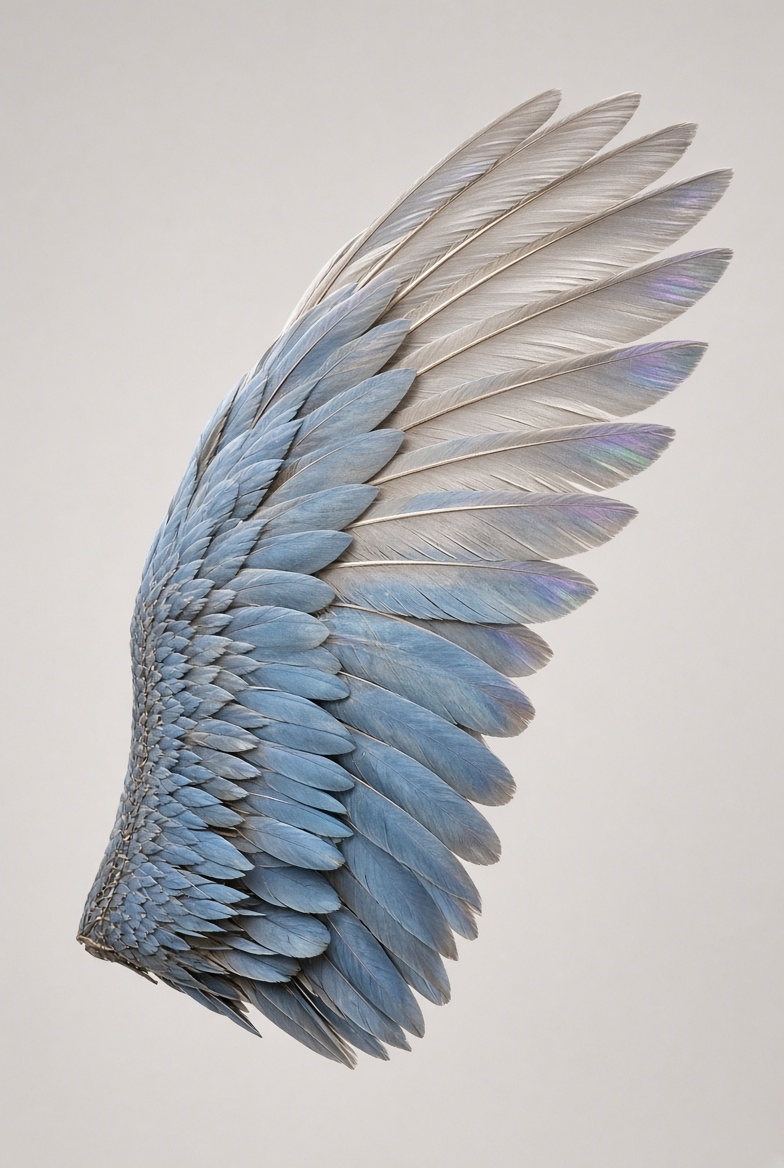
Perception of Activation:
• Normal sight registers the outer feathers flaring outward in a sudden controlled arc, the mottled sky-blue vanes shifting to expose more of the soft gray undersides while the iridescent tips catch and scatter ordinary daylight into brief moving highlights. The description is a rapid widening of the layered covering that lasts only as long as the chosen active continues, after which the feathers settle back against the body. Positives include a clear visual confirmation that the movement has begun and an immediate sense of increased surface area that helps the wearer judge distance during a glide or leap. Negatives include the temporary obstruction of peripheral vision on the side where the feathers spread farthest and the risk that the flash of iridescence draws unwanted attention from distant observers before the action completes.
• Touch registers a light tugging sensation along the attachment points where the woven frame meets the avatar’s own feathers, followed by a cool rush of air moving across the newly exposed surfaces. The description is a brief increase in pressure at the base of the covering that fades as soon as the feathers reach full extension, accompanied by the familiar texture of individual vanes brushing against one another. Positives include an immediate physical cue that the activation has succeeded and a heightened awareness of air currents that aids fine adjustments mid-motion. Negatives include a short moment of imbalance if the wearer was not already braced and a faint residual stiffness in the frame that lingers for several seconds after the feathers close again.
• Hearing registers a soft layered rustle that rises in pitch as the feathers spread and then drops when they fold, distinct from ordinary wind noise because of its even, mechanical rhythm. The description is a brief series of overlapping whispers produced by the vanes sliding past one another and against the supporting fibers. Positives include an auditory marker that lets the wearer confirm activation even when sight is limited and a sound quiet enough that it rarely carries beyond a few paces in open air. Negatives include the possibility that the rustle masks quieter nearby sounds for the duration of the motion and that the same sound can alert a close opponent who is already listening for movement.
• Darkvision registers the same flaring motion as a shift in gray-scale contrast, the sky-blue areas appearing slightly lighter against the gray while the iridescent tips remain nearly invisible. The description is a rapid change in edge definition along the outer feathers that resolves once the covering settles. Positives include continued clarity of the activation in low-light conditions without reliance on ordinary color. Negatives include reduced ability to judge the exact angle of the flare because the subtle color shifts that normally guide fine control are absent.
• True sight registers a faint ultraviolet shimmer that travels outward along the vanes at the moment of activation, brightest at the tips and fading toward the base. The description is a short-lived band of pale violet light that outlines the full spread of the feathers and then collapses inward as the motion ends. Positives include an immediate confirmation that ambient magic flow has been successfully channeled through the covering and a clear boundary that helps the wearer track the exact reach of a glide or leap. Negatives include a brief after-image that can overlap with other magical auras in the area and a slight delay in reacquiring ordinary detail once the shimmer fades.
• Blindsight registers a sudden expansion of the echo pattern returning from the feathers themselves, the layered surfaces producing a denser cluster of returns that briefly fills the space immediately around the wearer. The description is a momentary thickening of the acoustic field that matches the physical spread and then thins again. Positives include an accurate sense of the covering’s new outline even in total darkness or heavy obscurement and an early warning if the flare encounters an unexpected obstacle. Negatives include a short period in which more distant echoes are harder to separate from the closer returns and a mild disorientation if the wearer relies heavily on blindsight for navigation during the activation.
• Soul sight registers a subtle brightening of the personal aura along the feather edges, the color shifting toward the same pale tones already present in the plumage. The description is a soft pulse that travels the length of the covering once and then returns to the wearer’s baseline intensity. Positives include a clear internal marker that the item has accepted the direction of thought and begun its effect. Negatives include a fleeting sense of exposure if other beings capable of soul sight are nearby and a minor drain on concentration while the pulse is active.
• Mind’s Eye perception registers a brief overlay of the item’s known properties—slot, temporary skill bonus, and remaining active uses—superimposed on the physical feathers at the instant of activation. The description is a translucent set of familiar values that appears for less than a second and then recedes. Positives include instant verification that the correct active has been selected and that no unexpected condition is interfering. Negatives include a momentary distraction if the wearer is already tracking multiple other items or creatures and a slight delay in returning full attention to the external environment once the overlay vanishes.
Recipe for Feathers 5729 of the Leaping Wind
• Materials needed consist of twelve primary flight feathers shed by griffons or hybrid avian beasts during the Blooming or Buzzing weeks, each feather retaining its natural mottled sky-blue to soft gray coloration and intact iridescent tips. Four lengths of flexible plant fiber harvested from coastal reeds or similar resilient stalks that have grown near areas of ordinary magic flow. A small quantity of clear tree sap collected with a fluid collector from a living coastal tree within the past three days. One measure of fine mineral dust gathered from a reef-side rock face that has been exposed to both Helios and regular tidal spray. No magic crystals are required; the ambient weave present in the feathers and sap supplies the necessary binding.
• Tools required include a fluid collector for obtaining the sap, a pair of fine bone or hardened-wood needles sized for delicate stitching, a flat stone or wooden work surface large enough to lay the feathers in overlapping rows, a shallow bowl for mixing the sap with the mineral dust, and a length of ordinary cord for temporary alignment of the frame. All tools are mundane and commonly found in small family workshops that specialize in mobility gear.
• Skill requirements call for a trained skill level of at least 3 in a crafting skill focused on avian or flexible gear, plus a temporary or trained level of at least 2 in an alchemy or binding skill sufficient to mix and apply the sap without destroying the natural properties of the feathers. The crafter must also possess enough familiarity with Acrobatics-related items to judge the correct flex and spread of the finished covering. These levels may be met through ordinary downtime training or through openly worn faction badges that grant temporary points in the relevant skills.
• Crafting steps begin with the cleaning of each feather by gentle wiping to remove salt or debris while preserving the vane structure, followed by arranging the twelve feathers in two overlapping layers on the work surface so that the sky-blue sides face outward and the tips align along a gentle curve. The plant fibers are then soaked briefly in a mixture of the fresh sap and mineral dust until they become pliable, after which they are laid as a light internal frame beneath the feathers and stitched into place with the fine needles using a running pattern that allows the layers to shift. Once the frame is secure the remaining sap mixture is brushed lightly along the attachment points and the outer edges, then left to dry under ordinary daylight for the length of one After Noon period. The finished covering is tested by hand for even flare and return; any section that binds is gently loosened before the item is considered complete. The entire process consumes the listed materials and occupies the better part of a single day when performed by a single artisan in a coastal workshop. The resulting piece matches the slot, temporary skill bonus, passive adjustments, and active uses of the original when worn openly on an avatar that possesses a Feathers slot.
Feathers That Remembered the Wind
In the time before the counting of years that men now use there lived upon the edge of the great water a people who walked with feathers upon their backs. These feathers were not grown from their own flesh in the first days but were taken from the beasts that the mother of the world had shaped when she looked into other places and mixed the forms. The people gathered the fallen feathers when the plants opened and when the insects made their noise and they bound them with the soft threads of the shore plants so that the feathers would stay and move when the people moved.
One among them was called by a name that the later tongues could not hold and so is spoken only as the One Who Leapt. This one desired to cross the places where the water ran fast from the rising of the light to the setting of the light and also to rise above the low places where the ground broke. The One Who Leapt took many feathers and laid them in layers and bound them so that when the body turned the feathers would open and catch what moved in the air. The binding was done with the sap that came from the trees that stood where the water touched the land and with the dust that the waves left upon the stones. When the work was finished the feathers lay close until the thought of the wearer called them and then they spread.
The first time the feathers opened the One Who Leapt stood upon a high rock above the moving water. The body leaned and the feathers caught the air and the fall became a long slide that ended upon the far stones without the breaking of bone. Those who watched said the wind had been asked and had answered. The One Who Leapt tried again upon the narrow paths that ran between the houses of the shore and the feathers let the body turn aside from the reaching hands of others and then leap the open space to the next roof. The people began to ask for the same feathers so that their own young could learn the turning and the sliding.
Yet the feathers did not always answer in the same way. When the flow of the unseen power that moves through all things grew thin the opening of the feathers still happened but the body did not keep its place as surely and some who trusted too much fell upon the stones. When the flow grew strong the feathers opened farther than the wearer intended and the body was carried past the place that had been chosen. The One Who Leapt saw this and spoke to the people that the feathers remembered only what the air had taught them in the days of their first growing upon the beasts and that the wearer must also remember. The people did not all hear. Some wore the feathers and leapt from places too high when the flow was thin and their bodies struck the ground. Others wore them in the places where many watched and flared the feathers only to be seen and the watchers came with questions that could not be answered by leaping.
In the years that followed the feathers were made again and again in the small houses near the water. Each maker used the shed feathers of the mixed beasts and the sap and the dust and each covering was a little different in the way it opened. Some coverings let the wearer slide farther across the open air. Some let the wearer turn more sharply when another came near with a weapon or with hands that meant harm. The stories that were told of these coverings grew long. One story said that a wearer had crossed an entire arm of the great water by leaping from stone to stone while the feathers opened and closed with each bound. Another story said that a wearer had turned aside from the strike of a great beast of the deep that rose beside a reef and had then leapt upon the back of the beast before it sank again. These stories were repeated until the words changed and the names of the wearers were lost.
The One Who Leapt grew old and the feathers that had been made first began to fray at the edges. New feathers were added and the binding was renewed with fresh sap. The people asked whether the first feathers still held the memory of the wind or whether only the new feathers answered. The One Who Leapt answered that all the feathers held what they had been given when they grew and that the binding only let the wearer speak to that memory. When the One Who Leapt no longer walked the paths the coverings continued to be made. The small houses near the water kept the way of the work and the travelers who came from the inland places carried the coverings away and brought back tales of how the feathers had opened above the high ridges or along the roads that the soldiers kept clear.
In one season when the light stood long in the sky a wearer stood upon the edge of a floating place that the workers of magic had raised. The feathers opened and the body slid beneath the bowls that held the towers and came to rest upon a lower cable where others could not easily follow. Those who saw it from the ground said the feathers had become part of the cloud that always hung below the towers. In another season a wearer used the opening of the feathers to cross a gap in a broken bridge while arrows passed through the space where the body had been. The arrows struck only the air and the wearer reached the far side and continued. The people who kept the roads began to look for those who wore such feathers when they needed a message carried quickly between the coastal towns.
Not every use brought safety. A wearer once flared the feathers in a market so that all would look and in that moment a hand took the pouch that hung at the belt. Another wearer trusted the opening when the flow was thin and the body struck a low branch and the feathers tore. The torn covering was brought back to a small house and new feathers were set in the place of the broken ones and the sap was applied again. The covering worked once more but the wearer walked with care for many days. The stories that were told after these happenings said that the feathers gave the turning and the sliding only when the wearer also turned and slid with them and that the feathers alone could not choose the place where the body would stop.
Long after the first binding the coverings were still found in the stalls near the harbors. Travelers asked the makers how many feathers were needed and how long the sap must dry and the makers answered with the numbers that had been used since the early days. Some buyers paid with the small coins of silver and some paid with the larger coins of gold when the feathers had come from far places. The makers did not set one price for all days. When many feathers lay ready the covering left the stall for less. When few feathers could be gathered the covering stayed until more was offered. The people who bought them carried them to other islands and the way of making them spread though each new maker changed a small part of the binding.
In the time when the great ships moved more often between the islands a wearer stood upon the high deck while the vessel rolled. An enemy vessel came close and lines were thrown. The feathers opened and the body turned along the rail and leapt to a lower deck where the lines could not reach. From there the wearer moved among the coils and the stacked goods and came behind those who had boarded. The feathers closed again and the ordinary movement returned. Those who later spoke of the fight said the wearer had become hard to strike because the body and the feathers moved as one thing. Other fights were told in which the feathers did not open in time or opened too far and the wearer was carried over the side into the water. In the water the feathers grew heavy until they were closed and the wearer had to swim without their help.
The oldest of the coverings that still existed in the later years showed the places where new feathers had been set many times. The original sky-blue and gray remained only in small patches. Yet when a wearer called them the feathers still spread and the air still answered in the same way. The people who kept such a covering said it remembered every wind it had caught since the first binding. They did not know if this was true. They only knew that the covering continued to let the body turn and slide and leap when the thought was given and the flow was present.
Thus the tale was carried from the shore houses to the inland roads and from the inland roads back to the shore. Each telling added a new leap or a new fall and the words shifted as they passed through different tongues. The feathers themselves remained as they had been made: layers that opened when called, that caught what moved in the air, and that closed again when the motion ended. The people who wore them learned that the opening gave the chance to choose a different place to stand but did not choose the place for them.
Moral of the story: The feathers open when the wearer asks and the air answers as it has always answered, yet the place where the body stops is still the place the wearer must choose.
Suggested conversions to other systems:
Call of Cthulhu Seventh Edition Adaptation of the Covering Known as Plumage of the Shore Leap
• The item appears as a layered arrangement of mottled sky-blue and soft gray feathers with iridescent tips bound to a light frame of coastal plant fiber. It occupies the space of a worn garment that must remain visible to function and is treated as a minor magical artifact of common availability within the setting.
• When worn openly the investigator gains a bonus die on all Jump, Climb, and Dodge rolls that involve maintaining balance or changing direction suddenly. The bonus die is lost the moment the feathers are fully covered by another garment or removed.
• Once per day the wearer may spend a single action to flare the feathers and convert a fall of up to forty feet into a controlled descent that inflicts no damage and leaves the investigator standing. The same action may instead be used to cross a horizontal gap of up to twenty feet provided the path is clear.
• As a reaction when an opponent’s attack would force a Dodge roll the wearer may add one bonus die to that Dodge before the result is determined. This reaction may be used only once between periods of rest.
• The feathers provide a minor measure of protection against brief exposure to cold or heat, reducing any related CON roll penalty by one step for the duration of the exposure. Prolonged exposure still requires the normal roll.
• Sanity loss is not directly caused by the item. However an investigator who relies upon the flare in the presence of entities that perceive magical auras may draw unwanted attention, prompting the Keeper to call for a Sanity roll if the entity reacts.
• The item has 8 hit points. If reduced to half or fewer it becomes torn and the bonus die and active uses cease until repaired by someone with a relevant Craft or Art skill and access to replacement feathers and sap. Complete destruction at zero hit points leaves only mundane components.
Blades in the Dark Adaptation of the Covering Known as Vane-Bound Glide
• The item is a fine wearable of layered sky-blue and gray feathers on a reed frame that must be worn openly on the back or shoulders. It counts as a single item of load and is attuned to the wearer’s actions rather than requiring a separate ritual.
• While worn the character gains potency on all Prowl and Finesse actions that involve leaping, tumbling, or keeping footing on unstable surfaces. The potency is lost if the feathers are concealed.
• Once per score the wearer may push themselves to activate a controlled glide, ignoring harm from a fall of one or two stories or crossing a gap that would otherwise require a desperate roll. The activation is resolved as part of the action and does not itself generate additional stress beyond the push.
• As a reaction to an incoming attack or hazard the wearer may spend 1 stress to gain increased effect on a resistance roll made to avoid or reduce the harm, representing a sudden twist aided by the spreading feathers.
• The item can be used to create a brief visual distraction during a social or stealth action by flaring the iridescent tips, granting potency on a single Sway or Prowl roll made in the same moment.
• Quality is standard. If the item takes harm it becomes impaired until repaired during downtime with an appropriate Crafting or Tinkering action and access to fresh feathers. An impaired item loses its potency and reaction benefits.
• The covering does not provide armor. It functions only while the wearer remains able to move freely and is useless if the character is restrained or pinned.
Dungeons and Dragons Fifth Edition Adaptation of the Covering Known as Feathers of the Wind Step
• Wondrous item, common. The covering consists of layered mottled sky-blue and soft gray feathers with iridescent tips fixed to a light plant-fiber frame. It must be worn openly over an existing feathered or cloak-like space and requires attunement by a creature that possesses a comparable anatomical feature or is willing to treat the item as an extension of its own movement.
• While attuned and worn the creature gains a +2 bonus to all Dexterity (Acrobatics) checks. The bonus ends if the feathers are covered by another layer of clothing or armor that fully obscures them.
• As an action the wearer can flare the feathers to cast feather fall on themselves only. Once this property is used it cannot be used again until the wearer finishes a long rest. Alternatively the same action can be used to jump horizontally up to twenty feet without requiring a running start, provided the landing space is clear.
• When the wearer is forced to make a Dexterity saving throw to avoid falling prone or to keep balance the wearer may use a reaction to add 1d4 to the saving throw. This reaction can be used only once per short or long rest.
• The feathers grant advantage on Constitution saving throws made to resist the effects of extreme cold or heat for up to ten minutes of continuous exposure. After that period the advantage ends until the wearer rests.
• The item has AC 11 and 15 hit points. If reduced to 0 hit points it is destroyed and leaves only ordinary feathers and fiber. While it has at least 1 hit point but fewer than half its maximum it is damaged and the bonus to Acrobatics and the reaction property cease until repaired with mending or a short rest spent with appropriate tools and materials.
• The covering does not grant a fly speed. Any glide or leap ends at the conclusion of the movement and the wearer falls normally if still airborne.
Knave Second Edition Adaptation of the Covering Known as Bound Plumes of the Leap
• The item is a worn piece of gear consisting of layered sky-blue and gray feathers on a reed frame. It occupies one slot and must be worn openly to provide any benefit. It does not require a separate attunement step beyond being equipped.
• While worn the character adds +2 to all checks involving Acrobatics, balancing, or leaping. The bonus is lost if the item is covered or removed.
• Once per day the wearer may activate the feathers as part of a move action to ignore falling damage from a drop of up to forty feet or to cross a twenty-foot gap that would otherwise be impossible without a check. The activation replaces the normal movement for that action.
• When the character would be forced to make a check to avoid being knocked down or losing footing the character may spend a reaction to roll an additional d4 and add it to the check. This reaction may be used only once between rests.
• The item provides a +1 bonus to saves against environmental cold or heat for the first ten minutes of exposure. After that the bonus no longer applies.
• The covering has 10 item hit points. Damage to the item is tracked separately. At 5 or fewer hit points the bonuses cease until the item is repaired during downtime with a relevant crafting check and replacement materials. At 0 hit points the item is destroyed.
• The feathers do not grant any form of true flight. All movement assisted by the item ends when the action concludes and ordinary falling rules apply thereafter.
Fate Core Adaptation of the Covering Known as Aspect-Bound Vanes
• The item is a wearable extra consisting of layered mottled sky-blue and soft gray feathers with iridescent tips fixed to a light plant-fiber frame. It must be worn openly and is represented by the aspect “Feathers That Catch the Wind” which the character may invoke when the fiction supports leaping, twisting, or controlled falling.
• While the aspect is active the character gains a +2 bonus to Overcome or Create an Advantage actions that use Athletics to maintain balance, change direction, or cross unstable ground. The bonus is unavailable if the feathers are concealed by other gear.
• Once per session the character may invoke the aspect for free to perform a glide that negates falling damage from a height of up to two zones or to cross a single zone gap without an action roll, provided the landing zone is clear. This free invoke does not consume a fate point.
• As a defense against an attack or environmental hazard that would force a balance-related roll the character may spend a fate point to add +2 to the defense total, representing a sudden flare and twist of the feathers. This may be done only once per scene.
• The feathers can be used to Create an Advantage by flaring the iridescent tips, placing the aspect “Distracting Display” on a target or scene with a successful Athletics or Rapport roll. The advantage lasts until it is overcome or the scene ends.
• The item has no separate stress track. If the character takes a consequence that specifically damages worn gear the aspect becomes unavailable until the consequence is recovered and the feathers are repaired through a crafting-related milestone or downtime action.
• The covering grants no flight permission. Any glide or leap ends at the conclusion of the action and ordinary zone movement and falling rules apply afterward.
Numenera and the Cypher System Adaptation of the Covering Known as Aeroplume Binding
• The item is a cypher-level wearable artifact of common complexity that appears as layered sky-blue and gray feathers on a reed frame. It occupies one equipment slot and must be worn openly on the back or shoulders to function. Depletion occurs on a roll of 1 on 1d20 after each use of an active property.
• While worn the character reduces the difficulty of all Speed-based tasks involving jumping, balancing, or acrobatic movement by one step. The reduction ends if the feathers are covered.
• As an action the wearer may activate the binding to ignore damage from a fall of up to 40 feet or to leap horizontally up to a short distance without increasing the difficulty of the movement task. This use risks depletion.
• When the character must make a Speed defense roll to avoid being knocked down or losing footing the character may spend 1 Intellect point as a reaction to reduce the difficulty of that defense by one step. This reaction may be used only once per ten-minute rest.
• The feathers provide an asset on tasks to resist environmental cold or heat for up to ten minutes. After that period the asset no longer applies until the character rests.
• If depletion occurs the item becomes inert until repaired with a crafting task of difficulty 3 and access to replacement feathers and binding materials. An inert item provides no benefits.
• The binding does not grant the ability to fly. All assisted movement ends when the action resolves and normal falling rules apply if the character remains airborne.
Pathfinder Second Edition Adaptation of the Covering Known as Plumage of Sudden Step
• Item 1. The covering is a worn wondrous item of common rarity consisting of layered mottled sky-blue and soft gray feathers with iridescent tips on a plant-fiber frame. It must be worn openly and invested to provide its benefits. It has the magical and invested traits.
• While invested and worn the wearer gains a +1 item bonus to Acrobatics checks. The bonus is suppressed if the feathers are fully covered by other gear.
• Once per day the wearer can Interact to activate the feathers and gain the effects of feather fall for one round, or instead Stride up to 20 feet horizontally as part of the same action without needing a running start, provided the path is clear. This activation has the manipulate trait.
• When the wearer would be forced to make an Acrobatics check to Balance or to avoid falling prone the wearer may use a reaction to roll 1d4 and add the result to the check. This reaction can be used only once per day.
• The item grants a +1 circumstance bonus to saves against environmental cold or heat for the first 10 minutes of exposure. The bonus ends after that duration until the wearer rests for at least 10 minutes.
• The covering has Hardness 2 and 8 Hit Points. If reduced to 0 Hit Points it is destroyed. While it has fewer than half its Hit Points remaining the item bonus and reaction are suppressed until repaired with the Repair action or a relevant crafting activity.
• The item does not grant a fly Speed. Any movement provided by the activation ends at the conclusion of the action and the wearer falls normally if still in the air.
Savage Worlds Adventure Edition Adaptation of the Covering Known as Wind-Caught Plumes
• The item is a piece of worn gear with the magical quality that appears as layered sky-blue and gray feathers on a light frame. It occupies one slot on the torso or back and must be worn openly. It has no Power Points of its own and draws on the wearer’s actions.
• While worn the character gains a +1 bonus to all Athletics rolls made to balance, leap, or tumble. The bonus is lost if the feathers are concealed.
• Once per session the wearer may activate the plumes as a free action to ignore falling damage from a drop of up to 40 feet or to make a horizontal leap of up to 4 inches on the table without an Athletics roll, provided the landing area is clear.
• As a reaction when forced to make an Athletics roll to avoid being knocked prone or losing footing the character may add a wild die to that roll. This reaction may be used only once per encounter.
• The feathers grant a +1 bonus to Vigor rolls made to resist environmental cold or heat for the first five rounds of continuous exposure. After that the bonus no longer applies.
• The item has Toughness 4. If it takes a Wound it becomes damaged and the bonus and reaction cease until repaired with a Repair roll and appropriate materials during a rest. A second Wound destroys the item.
• The plumes do not grant the Flight ability. All assisted movement ends when the action concludes and ordinary falling rules apply thereafter.
Shadowrun Sixth World Adaptation of the Covering Known as Aeroplume Rig
• The item is a wearable piece of gear rated as an Availability 4R common magical focus that appears as layered mottled sky-blue and soft gray feathers with iridescent tips on a light synthetic-fiber frame. It must be worn openly on the back or shoulders and counts as a Force 1 sustaining focus for mobility-related effects.
• While worn and active the character receives a +2 dice pool bonus to all Athletics tests involving jumping, balancing, climbing, or sudden changes of direction. The bonus is lost if the feathers are covered by other clothing or armor.
• Once per day the wearer may take a Simple Action to flare the rig and negate falling damage from a drop of up to 12 meters or to make a horizontal leap of up to 6 meters without an Athletics test, provided the landing area is unobstructed. This use does not require Drain.
• As a Reaction when forced to resist being knocked down or losing footing the character may add 2 dice to the relevant Athletics or Reaction test. This reaction may be used only once between rests.
• The feathers provide 1 point of Cold Resistance and Heat Resistance for the first five minutes of continuous exposure. After that period the resistance no longer applies until the character rests.
• The item has a Barrier Rating of 2 and 6 Condition Boxes. If all Condition Boxes are filled it is destroyed. While it has 3 or more boxes filled the dice pool bonus and reaction are unavailable until repaired with an appropriate Engineering or Artificing test and replacement materials.
• The rig does not grant a flight movement rate. Any assisted leap or glide ends at the conclusion of the action and ordinary falling rules apply if the character remains airborne.
Starfinder Adaptation of the Covering Known as Vane-Linked Glider
• The item is a worn magic item of item level 1 that consists of layered sky-blue and gray feathers with iridescent tips fixed to a light polymer frame. It occupies the shoulders slot, must be worn openly, and requires attunement through a one-minute investment.
• While invested and worn the wearer gains a +2 enhancement bonus to Acrobatics checks. The bonus is suppressed if the feathers are fully covered.
• Once per day as a standard action the wearer can activate the glider to gain the benefits of feather fall for one round or to jump horizontally up to 20 feet without a running start or Acrobatics check, provided the path is clear.
• When the wearer must attempt an Acrobatics check to avoid falling prone or to maintain balance the wearer may use a reaction to add 1d4 to the check result. This reaction can be used only once per day.
• The item grants a +1 circumstance bonus to Fortitude saves against environmental cold or heat for up to 10 minutes. The bonus ends after that duration until the wearer rests for 10 minutes.
• The covering has hardness 2 and 10 hit points. If reduced to 0 hit points it is destroyed. While it has fewer than 5 hit points remaining the enhancement bonus and reaction are unavailable until repaired.
• The item does not grant a fly speed. Assisted movement ends when the action concludes and the wearer falls normally if still airborne.
Traveller Mongoose Second Edition Adaptation of the Covering Known as Plume Harness
• The item is a piece of personal equipment with the artistic and tool qualities that appears as layered mottled sky-blue and soft gray feathers on a light frame. It has negligible weight when worn openly on the back and costs the equivalent of a few hundred credits in most markets, varying by availability.
• While worn the character receives DM+1 on all Athletics (dexterity) checks made to balance, jump, or climb. The modifier is lost if the feathers are concealed.
• Once per day the wearer may take a significant action to flare the harness and ignore damage from a fall of up to 12 meters or to leap horizontally up to 6 meters without an Athletics check, provided the landing space is clear.
• When forced to make an Athletics check to avoid being knocked prone the character may use a reaction to add DM+1 to the check. This reaction may be used only once between periods of rest.
• The harness provides DM+1 on Endurance checks to resist environmental cold or heat for the first ten minutes of exposure. After that the modifier no longer applies.
• The item can be damaged. If it suffers a hit that would destroy ordinary clothing it becomes torn and all benefits cease until repaired with a Mechanic or Survival check and replacement feathers. Complete destruction leaves only scrap materials.
• The harness does not allow true flight. Any leap or controlled fall ends at the conclusion of the action and ordinary falling rules apply thereafter.
Warhammer Fantasy Roleplay Fourth Edition Adaptation of the Covering Known as Feathered Mantle of the Leap
• The item is a worn magical garment of common rarity that consists of layered sky-blue and gray feathers with iridescent tips bound to a reed frame. It occupies the back or cloak location, must be worn openly, and has an Encumbrance of 0.
• While worn the character gains a +10 bonus to all Athletics Tests involving leaping, balancing, or sudden changes of direction. The bonus is lost if the feathers are covered by other clothing or armor.
• Once per day the wearer may use an Action to flare the mantle and ignore Damage from a fall of up to 12 yards or to leap horizontally up to 6 yards without an Athletics Test, provided the landing area is clear.
• When the character must make an Athletics Test to avoid being knocked prone the character may use a Reaction to add +1 SL to the Test. This Reaction may be used only once per day.
• The mantle grants a +10 bonus to Endurance Tests made to resist environmental cold or heat for the first ten minutes of exposure. The bonus ends after that duration until the character rests.
• The item has 4 Wounds. If reduced to 0 Wounds it is destroyed. While it has 2 or fewer Wounds remaining the bonus and Reaction are unavailable until repaired with a relevant Trade Test and materials.
• The mantle does not grant the ability to fly. Assisted movement ends when the Action concludes and the character falls normally if still in the air.