
Lore
Among the civil halls, archive vaults, and traveling registries of Saṃsāra, there arose a need for order that did not rely on memory alone. The Quiet Ledger was first stitched by municipal clerks who discovered that chaos was not loud—it was cumulative. Ink misplaced, seals forgotten, forms misaligned. These slots were devised not for secrecy or speed, but for continuity. The magic within responds to intent to organize rather than intent to hide, rewarding calm diligence and methodical action.
Description
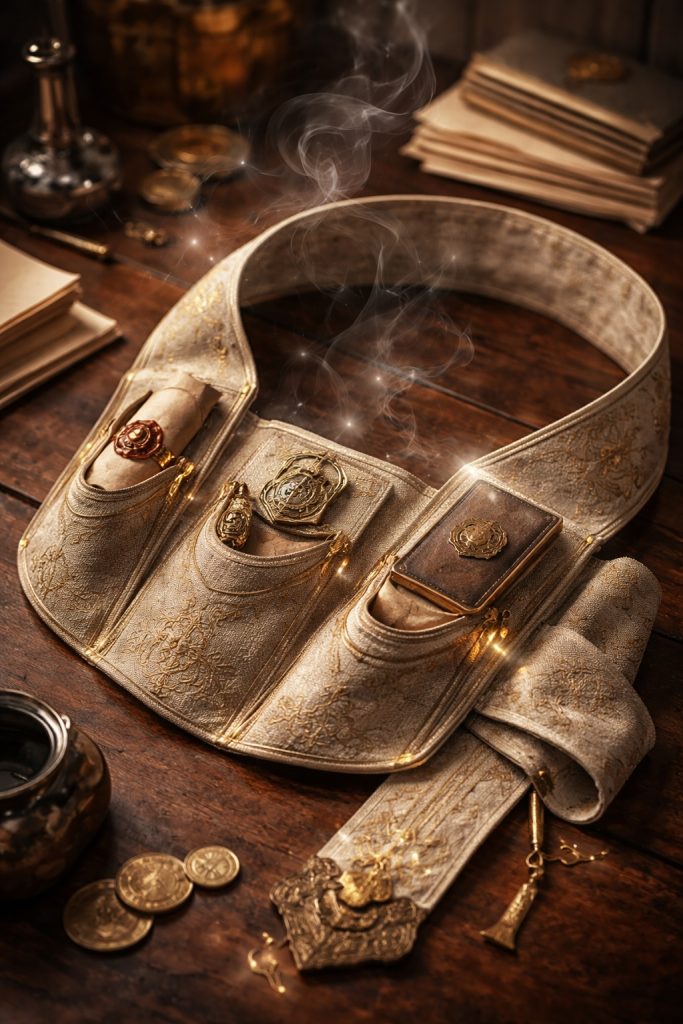
A modest administrative sash worn across the torso or waist, woven from neutral-toned fabric reinforced with thin, rune-threaded seams. Along its inner and outer faces are subtle stitched apertures that do not gape or bulge, each marked with a faint geometric stitch-sign only visible when the wearer pauses and focuses. When in use, the sash feels slightly warmer, like paper left in sunlight.
Stats (Tier 1, Common)
• Additional Slots: 3 administrative micro-slots
– Each slot may hold one small non-combat item: folded documents, signets, seals, tokens, ledger slips, writing tools, keys, or talismans of office
• Weight: Negligible
• Specific Slot: Worn (Sash / Administrative Wear)
Skills Gained While Openly Worn
• Administration: +1
• Appraisal (documents, permits, contracts): +1
• Organization (records, inventories, schedules): +1
Passive Magics
• Orderly Retention: Items placed into the slots remain neatly aligned, unfolded, and undamaged regardless of movement.
• Cognitive Indexing: The wearer always knows which slot contains which item without checking.
• Bureaucratic Calm: While performing administrative, clerical, or logistical tasks, minor stress or distraction effects are reduced.
• Misplacement Resistance: Items stored in the slots cannot be accidentally dropped or forgotten through mundane means.
Activable Magics
• Produce Record: Once per short rest, retrieve a stored item as part of the same action used to present, reference, or verify information.
• Seal of Continuity: Once per day, designate one slotted document or token; until removed, it cannot be altered, smudged, or magically tampered with by effects of equal or lower tier.
• Ledger Recall: Once per day, briefly sense whether a stored document is relevant to the current administrative situation (approval, denial, redundancy, or conflict), felt as a subtle tightening or loosening of the sash.
Tags
Administrative, Organizational, Bureaucratic, Utility, Non-Combat, Recordkeeping, Civic, Structured, Low-Magic, Slot-Granting, Clerical, Ledgerbound, Civic-Authority, Filingcraft, Contractual, Office-Worn, Documentation, Permit-Keeping, Logistical, Governance, Archive-Linked
Acquisition and Trade Context
How the Item Is Obtained
This administrative slot-item is most often obtained through civic service rather than adventuring conquest.
• Granted as a formal issue item to junior clerks, census-takers, quartermasters, tax assessors, port registrars, or archivists upon appointment to an official role
• Earned as a probationary reward after successfully completing a municipal audit, supply reconciliation, or dispute-resolution assignment
• Commissioned by guild administrators or magistrates for trusted aides who must carry seals, writs, permits, or symbolic insignia while remaining mobile
• Occasionally inherited from a predecessor who retires, is promoted, or disappears under unresolved paperwork
Types of Shops and Sale Environments
Civic Outfitters and Registry Furnishers
Located near courthouses, port authorities, city halls, or record towers. These shops sell standardized administrative gear, stamped and certified for legal use. Purchases require proof of appointment or a letter of authorization.
Cost: modest but regulated, typically affordable for a tier-1 avatar in service, equivalent to several weeks of clerk wages.
Guild Recorders and Contract Halls
Operated by merchant guilds, logistics syndicates, or trade federations. Items are sold alongside ledgers, seal kits, and document cases. Buyers are vetted for literacy and administrative competence.
Cost: slightly higher than civic outfitters due to customization for guild protocols and insignia.
Archive Adjacent Vendors
Small specialist stalls attached to libraries, record vaults, or census halls. These vendors sell quietly, often refurbishing or re-binding items to match institutional styles.
Cost: lower upfront, but often bundled with mandatory service fees, archival dues, or filing oaths.
Private Commission from Administrative Artisans
Rare but possible. A scribe-artificer or bureaucratic enchanter crafts the item to order, tailored to specific filing systems or jurisdictions.
Cost: highest among options, but still within reason for tier-1—often paid partially in service favors, notarized labor, or future filing priority.
Black-Market or Grey Registry Exchanges
In border cities or contested territories, unstamped versions circulate quietly among smugglers, false clerks, or shadow administrators. These lack official validation and may cause legal complications if discovered.
Cost: cheaper in coin, expensive in risk.
In Saṃsāra, such an item is rarely treated as a mere accessory. Its value lies not in spectacle but in legitimacy, trust, and the quiet authority of properly carried documentation.
Roleplay Applications Across Environments: Administrative Defense and Offense
Urban Civic Centers and Bureaucratic Districts
In dense administrative zones—courthouses, port authorities, tax halls, and record towers—the item serves as a defensive anchor of legitimacy. The avatar uses it to calmly present permits, seals, and insignia drawn from its additional slots, deflecting accusations, inspections, or detentions through proper procedure rather than force. Offensively, it becomes a tool of pressure: producing conflicting documents, citing procedural deadlines, or invoking jurisdictional authority to stall opponents, redirect guards, or legally obstruct hostile actions without ever raising a weapon.
Trade Hubs, Markets, and Caravan Yards
In commercial environments, defense is enacted through verification. The avatar uses the item to rapidly display licenses, manifests, and receipts, preventing seizure of goods or accusations of fraud. The additional slots allow quick transitions between documents, maintaining control of the narrative. Offensively, the avatar can exploit administrative leverage—challenging permits, questioning weights and tariffs, or issuing temporary holds that disrupt rivals’ operations, forcing them into compliance or retreat through paperwork alone.
Frontier Settlements and Border Checkpoints
At the edges of civilization, the item’s defensive role is authority projection. The avatar presents an unmistakable impression of sanctioned order, discouraging violence by invoking oversight from distant powers. Offensively, the item enables the avatar to impose structure where none exists—issuing provisional permits, requisition notices, or census marks that bind locals into temporary compliance, shifting power dynamics through imposed organization rather than arms.
Military Camps and Supply Lines
Within martial environments, defense takes the form of logistical credibility. The avatar uses the item to authenticate orders, requisitions, and supply claims, preventing summary punishment or expulsion. Offensively, the avatar can redirect resources, delay deployments, or reassign duties by producing stamped directives or inventory corrections, subtly influencing the flow of war through administrative control rather than combat.
Academic, Archival, and Monastic Institutions
In places of knowledge, defense is intellectual authority. The avatar uses the item to prove access rights, research clearance, or custodial responsibility, avoiding suspicion or expulsion. Offensively, the avatar can lock away records, issue review holds, or challenge citations and classifications, effectively neutralizing rivals by burying them under process and precedent.
Rural Villages and Informal Communities
Among non-bureaucratic populations, the item’s defensive role becomes symbolic. The visible order of the slots and documents reassures locals that the avatar represents stability, reducing hostility. Offensively, the avatar can introduce structure—land tallies, work records, or communal registries—that binds the community into agreements favoring the avatar’s objectives, turning soft administration into lasting influence.
High-Magic or Chaotic Zones
In unstable or magically distorted regions, defense relies on continuity. The item anchors the avatar’s sense of order, preventing confusion or manipulation through consistent record-keeping and procedural focus. Offensively, the avatar uses documentation as a reality-check—defining boundaries, ownership, or responsibility in places where chaos thrives, forcing adversaries to contend with imposed structure.
Across all environments, the item embodies a quiet but potent truth of Saṃsāra: authority does not always strike—it files, records, and persists until resistance collapses under its own disorder.
Perception of Activation:
User’s Perspective:
Sight: The additional slots briefly illuminate from within, thin lines of warm gold light tracing their seams as if invisible ledgers are being opened. The edges of each pocket sharpen visually, appearing more defined and deliberate, while faint sigil-ink patterns surface and fade across the material.
Hearing: A soft, orderly sound manifests—like distant pages being aligned or a stamp pressed onto parchment far away. It is not loud, but precise, rhythmic, and calming.
Touch: The item settles more firmly against the body, neither heavier nor tighter, but resolute, as though acknowledging responsibility. The fabric feels cooler at first contact, then gently warms to body temperature.
Smell: A faint scent of old paper, sealing wax, and polished wood briefly emerges before dissipating.
Taste: A dry, almost metallic aftertaste flickers at the back of the mouth, reminiscent of ink or coins, then fades.
Extra-Sensory Perception: A subtle mental clarity arises, forming a quiet internal sense of order. The user feels an awareness of what is stored where, not as a list, but as an intuitive spatial certainty. There is also a fleeting sensation of jurisdiction—as if invisible boundaries have been momentarily drawn around the user’s authority.
Observer’s Perspective:
Sight: Observers see a restrained glow pass over the item, localized and controlled, never flaring. The pockets appear momentarily deeper, as though capable of holding more than their size suggests.
Hearing: Those nearby may hear a barely perceptible hush, as if ambient noise briefly dampens, followed by a soft, indistinct sound like a ledger closing.
Atmosphere: The user’s posture often appears more composed after activation, with movements becoming deliberate and assured.
Positives:
The activation reinforces composure, confidence, and situational control. It provides immediate intuitive awareness of stored items, reducing fumbling or hesitation. Socially, the effect projects legitimacy and competence, discouraging impulsive challenges or aggression. Mentally, it promotes focus and procedural thinking.
Negatives:
The heightened sense of order can feel restrictive, making spontaneous or chaotic action momentarily uncomfortable. In emotionally charged situations, the calm precision may create a sense of emotional distance. Prolonged or repeated activation can lead to mental fatigue, expressed as stiffness of thought or difficulty improvising outside established structures.
Recipe: Binding of the Ordered Pockets
Materials Needed:
• Treated civic cloth or ledger-weave fabric, cut and measured with deliberate symmetry
• Fine brass or silver thread for structural stitching and sigil anchoring
• Ink of Registry (a stable ink infused with minor order-aligned magic)
• Waxed parchment fragments from expired permits or nullified records
• One small order-stone or archive crystal shard, uncharged
• Binding resin made from beeswax and ground slate
Tools Required:
• Precision tailoring kit with reinforced needles
• Runic scribing stylus or engraving needle
• Heated wax bowl or low flame for resin preparation
• Measuring frame or flat drafting surface
• Polishing cloth and seal press
Skill Requirements:
• Basic tailoring or leatherworking proficiency
• Administrative or clerical training (formal record-keeping knowledge)
• Minor magical flow manipulation or sigil familiarity
• Patience and attention to procedural detail
Crafting Steps:
• Prepare the fabric by laying it flat on the drafting surface and marking pocket boundaries with Ink of Registry, ensuring all measurements are precise and balanced.
• Stitch the pocket structures using brass or silver thread, maintaining even tension so each slot forms a defined, limited space.
• Warm the binding resin and lightly coat the interior seams of each pocket, sealing them while the resin is still pliable.
• Press fragments of waxed parchment into the resin at key junctions, symbolically anchoring the concept of record and authority.
• Set the order-stone or archive crystal shard into a concealed internal seam, allowing it to absorb ambient stability during the process.
• Using the runic stylus, inscribe minimal sigils of containment and organization along the inner edges of each slot; do not embellish.
• Allow the item to cool and rest undisturbed until the resin hardens and the ink fully sets.
• Finish by polishing the exterior and pressing a final seal to affirm completion, completing the binding of the additional slots.
The resulting item should feel balanced, restrained, and quietly deliberate, reflecting its purpose as a tool of structured carry and administrative order rather than excess or ornamentation.
Many-Pocket Law of Quiet One
Long ago, before the counting of years was straight and before lines were drawn clean upon maps, there was a place where rule was loud and order was shouted. In that time, many chiefs spoke at once, and their words fought like dogs in a narrow road. Nothing was written that stayed written. Nothing was kept where it was placed. People argued not because they wished to fight, but because memory slipped like rain from stone.
In those days lived a person whose name is broken in the telling. Some say the name was Il-Seren. Others say it was only a title, meaning The One Who Keeps. The old tablets disagree, and the translators argue, but all agree on this: the Quiet One did not raise a blade, and yet armies stepped aside.
The Quiet One walked with a plain garment, uncolored and without crest. It had pockets, but not many, and none were large. Each pocket was made with care. Each had a place and did not accept what did not belong. When the Quiet One reached into a pocket, the hand did not search. It knew.
When the cities quarreled over grain, the Quiet One walked between them. When the generals argued over supply, the Quiet One stood still. When merchants accused one another of lies, the Quiet One listened. From one pocket came a seal. From another, a record. From another, a mark of witness pressed long ago and not forgotten. The garment did not glow then, for glow was not yet a thing, but those who saw it said the air felt arranged.
There came a time of great confusion, when three rulers claimed the same river and sent soldiers to stand upon its banks. Each ruler brought banners and shouted proof. The Quiet One came last and stood where the water split around stone. From the garment came a folded thing, thin as a breath. It showed lines agreed upon before the rulers were born. No voice was raised. The soldiers lowered their weapons, because the argument had nowhere left to stand.
It is said that one ruler tried to seize the garment, thinking power lay in the cloth. But when the ruler reached, the pockets were empty to that hand. For the garment did not serve grasping. It served order. The ruler fell back, ashamed, and later learned to read.
In later years, the Quiet One taught others, but not quickly. “Too many pockets make chaos,” the old story says. “Too few make loss.” So the number was kept small, and each pocket was named. When the Quiet One finally walked into the hills and did not return, the garment was left behind. Some say it unraveled. Some say it was copied. Some say it waits in pieces, never all in one place.
But in every age where ink holds longer than anger, and where a calm voice stops a blow, the story is told again—poorly, with gaps and wrong turns—yet the meaning remains folded where it belongs.
Moral of the Story:
Order does not conquer by force; it endures by knowing where things belong.
Suggested conversions to other systems:
Call of Cthulhu (7th Edition)
Quiet Clerk’s Pocket-Order (Slots 1187 of the Quiet One)
Type: Enchanted Garment (Minor Artifact / Utility Ward)
Form Factor: Administrative sash-vest with limited specialized pockets (counts as worn equipment)
Mechanical Effect Summary
• Additional Slots: Grants 3 specialized micro-slots for tiny items only (seals, pins, trinkets, paper slips, chalk nub, charm). Each micro-slot holds 1 tiny item; items must be palm-sized or smaller.
• Reliability: The contents are not extradimensional; they are simply “always where you put them” unless the item is damaged or magic suppressed.
Stat Block
• Armor/Protection: None (no armor value)
• Sanity: No direct SAN benefit; repeated reliance can create compulsion (Keeper option).
• Skill Bonuses (while worn openly):
– +10% to Accounting
– +10% to Bureaucracy (or Credit Rating use-cases at Keeper discretion)
– +10% to Fast Talk when presenting documentation or procedural authority
– +10% to Sleight of Hand when palming/stowing tiny items in the micro-slots during a distraction
• Acrobatics Emphasis (Administrative agility):
– +10% to Dodge when you can justify that footwork/positioning is guided by “route planning,” “crowd-flow management,” or “keeping formation.” (Keeper adjudicates; does not apply to gunfire at long range.)
Passives (Always On While Worn)
- Pocket-Order: Retrieving or stowing a tiny item from the 3 micro-slots is always treated as “readied” (no fumbling). In time pressure, gain one bonus die on the relevant roll to produce the correct document/marker (Keeper may allow a Hard success to count as an Extreme for “having the right thing”).
- Procedural Calm: Once per scene, if you succeed on an Accounting or Bureaucracy roll, you may immediately negate 1 point of SAN loss from stress/futility (not from Mythos revelations).
- Inventory Certainty: If you pass an INT roll, you can state exactly which tiny items are in which micro-slot (even if distracted), unless the garment is at 0 HP or magic is suppressed.
Actives (Limited Use)
- Seal of Immediate Compliance (1/day): Present a stored seal/pin/charm and attempt Fast Talk. If the target is an ordinary civilian or low-level functionary, gain a bonus die; on a success, they comply with a minor procedural request for 1d10 minutes (no suicidal acts).
- Ledger-Step Reposition (1/day): Declare a “planned route” and immediately attempt Dodge as if you had a moment to prepare; on a success, you may move to nearby cover/through a crowd without provoking an additional opposed roll (Keeper discretion).
- Emergency Filing (1/day): When a tiny item would be dropped, lost, or confiscated in the moment, you may force a Luck roll; on a success it is instead in an empty micro-slot.
Drawbacks / Costs
• Over-Ordering: If you use 2 or more actives in a single session, make a POW roll. Failure: suffer a mild fixation (need to “organize”) imposing -10% to any roll that requires improvisation until you complete a calming routine (5 minutes).
• Visibility: Wearing it openly may draw attention from officials, auditors, or rivals.
Durability (Optional, if targeted)
• Hit Points: 8 HP. If reduced to 0 HP, all magic ceases until repaired.
Blades in the Dark
Tally-Sash of the Quiet One (Slots 1187 of the Quiet One)
Type: Fine Worn Gear (Common, Tier 1)
Load: 1 (worn)
Special Capacity: 3 micro-slots for tiny items (each holds 1 tiny item; not a normal inventory slot, but tracked on the item)
Passive Benefits
• Pocket-Order: When you need a tiny stored item at the right moment (seal, pin, chalk, note, charm), take +1d to the action roll if having that item matters to the fiction (especially Sway, Consort, Command, Study, Survey).
• Administrative Footwork: When moving through crowds, offices, queues, narrow halls, or bureaucratic chokepoints, you gain improved Position (Desperate → Risky, Risky → Controlled) once per score, if you narrate it as “route management” or “crowd control.”
Actives
- Produce the Correct Paper (1/score): Mark 1 stress to declare you have exactly the needed tiny document/marker/seal in a micro-slot (within reason). Gain +1 effect to the current social/administrative action.
- Stamp of Temporary Authority (1/score): Flash a stored seal; create an advantage: “Procedural Momentum” as a 4-segment clock in your favor. Completing it grants passage/access or compliance for the scene.
- Emergency Stow (1/score): When searched or when you’d lose a tiny item, you may Resist with Prowess; on a success, it’s in an empty micro-slot instead.
Drawbacks
• Audit Attention: Each time you use Stamp of Temporary Authority, add +1 Heat if the job involves officials, guilds, or institutions.
• Over-Ordering Clock: Start a 4-segment “Compulsion to Organize” clock; tick 1 each time you use an active. When filled, take level 1 harm “Distracted by Procedure” (or accept a Compel-style complication).
Durability (If your table tracks it)
• 2-segment clock “Ripped Seams.” When filled, magic is off until repaired during downtime with a simple Craft project (2 segments) and 1 coin for materials.
Dungeons & Dragons (2024 rules)
Slots 1187 of the Quiet One
Wondrous Item (worn), common (requires attunement)
Slot Type: Worn item (sash-vest / administrative harness)
Core Feature: Additional Slots (Specialized)
• Micro-Slots: While attuned and worn openly, you gain 3 specialized micro-slots. Each micro-slot can hold one Tiny object (examples: signet, pin, trinket, talisman, folded note, wax seal, chalk nub).
• Retrieval: Once per turn, you can draw or stow an item from these micro-slots as part of the same action you use it (no separate object interaction needed).
Stats / Bonuses (While Worn Openly)
• You gain a +1 bonus to Dexterity (Acrobatics) checks when navigating crowds, tight corridors, desks, cluttered offices, or formal spaces where posture and footwork matter.
• You gain a +1 bonus to Intelligence checks related to administration, record-keeping, logistics, scheduling, or procedures (DM adjudication).
• You have advantage on Charisma (Deception) or Charisma (Persuasion) checks made specifically to convince someone you have proper paperwork or official standing, provided you can present a plausible token/document from the micro-slots.
Passive Magics
- Order-Sense: You always know which of the three micro-slots contains which tiny item, even while distracted.
- Calm of Filing: You have advantage on saving throws against being frightened if the source is “social pressure,” “panic in a crowd,” or “bureaucratic intimidation” rather than supernatural terror (DM adjudication).
- Quiet Efficiency: If an effect would force you to drop a held Tiny object, you may instead stow it into an empty micro-slot (no action), once per short rest.
Active Magics
- Stamp of Momentary Authority (1/long rest): As a bonus action, present a token from a micro-slot and choose one creature you can see within 30 feet who can understand you. The creature must succeed on a Wisdom saving throw (DC = 8 + your proficiency bonus + your Intelligence modifier) or treat you as an authority figure for 1 minute (won’t attack you unless provoked; will answer simple procedural questions; will allow minor access). Hostile creatures have advantage.
- Route-Plan Step (1/short rest): As a reaction when you would be hit by an opportunity attack or you fail a Dexterity saving throw, you may add +1d4 to your AC against that one attack or to the saving throw result (your choice).
- Emergency Filing (1/long rest): If a Tiny object on your person would be found during a search, you may force the searcher to make an Investigation check against your Spell Save DC (as above). On a failure, they overlook one Tiny object, which is treated as being in a micro-slot.
Durability (If targeted)
• HP: 12. If reduced to 0 HP, the item’s magic is suppressed until repaired.
• Repair: A tailor’s kit plus a successful DC 12 Intelligence (Arcana) or Wisdom (Medicine) check over 1 hour restores functionality (materials cost at DM discretion).
Knave (2nd Edition style)
Quiet One’s Slot-Sash 1187
Type: Worn magical garment (common)
Item Slots (normal carry): Takes 1 slot to wear.
Additional Slots (Specialized Micro-Slots)
• Grants 3 micro-slots that can each hold 1 Tiny item (pin, seal, charm, trinket, folded note). These do not increase normal item slots for larger gear.
Effects (While Worn Openly)
• Administrative Poise: +1 on checks to negotiate, present paperwork, manage queues, organize supplies, or enforce procedure through social pressure.
• Acrobatics Through Order: +1 on checks to balance, tumble, or slip through tight spaces when you can plausibly describe it as “planned movement” (lines, aisles, corridors, crowded rooms).
• Pocket-Order: You may draw or stow a micro-slot item without spending your usual “free hand” allowance once per round.
Passives
- Always-Found: You always know which micro-slot holds which item.
- Quiet Nerves: Once per rest, ignore a morale/fear-style penalty caused by social intimidation or stressful oversight.
- Loss-Prevention: Once per rest, if you would drop or lose a Tiny item, it is instead in an empty micro-slot.
Actives
- Token of Authority (1/day): Present a seal/pin; one NPC of common rank hesitates and complies with a small request for 10 minutes unless directly endangered.
- Route-Plan Twist (1/day): Reroll one failed Acrobatics-related check made to move through a crowd or cluttered interior.
- Emergency Filing (1/day): During a search, the searcher must beat your check (DEX or INT, your choice) or they miss one Tiny item.
Durability (Optional)
• HP: 6. At 0 HP, magic is off until stitched and re-inked with simple materials (1 hour) and a successful check (INT 12 or DEX 12).
Fate Core System
Slots 1187 of the Quiet One — Ledger-Sash of Procedural Grace
Type: Extra (Worn Magical Item)
Scale: Personal, Narrative Utility
Aspects:
• Pockets Where Order Lives
• Authority Without a Raised Voice
• Movement by Planning, Not Speed
Stunts:
• Pocket-Order: Once per scene, you may declare that you have the exact small item needed (seal, note, pin, token) already on hand. Gain +2 on the roll where producing it matters.
• Administrative Footwork: Gain +2 to Overcome or Create an Advantage when moving through crowds, offices, queues, or confined interiors by planning routes or controlling flow rather than athletic exertion.
• Procedural Calm: Once per session, when facing social pressure, intimidation, or bureaucratic obstruction, you may ignore a compel related to panic, confusion, or loss of composure.
Special Rules:
• Additional Slots: The item grants three narrative micro-slots for Tiny items only. These slots justify declarations and advantages but do not bypass Fate’s fiction-first constraints.
• Drawback — Compulsion of Order: The GM may compel Authority Without a Raised Voice to delay you when improvisation or disorder would clearly be faster. Accepting the compel grants a Fate point.
Permissions:
• You may use administrative authority, documentation, and procedural confidence offensively (social pressure, exposure, denial of access) or defensively (stalling, defusing conflict, controlling space).
Numenera & Cypher System (Revised)
Slots 1187 of the Quiet One — Administrative Slot-Harness
Type: Artifact (Worn)
Level: 3
Form: Sash-vest with structured pockets and sigil-stitched seams
Artifact Properties:
• Additional Slots: Grants three specialized micro-slots for Tiny objects (tokens, seals, charms, folded notes). These do not count as inventory slots and cannot hold cyphers or weapons.
Passive Effects (While Worn Openly):
• Order-Sense: You always know which micro-slot contains which item. This eases tasks involving organization, logistics, or procedure by one step.
• Calm Bearing: Ease one task per scene involving resisting social pressure, confusion, or panic caused by authority, crowds, or administrative stress.
• Planned Motion: Ease Speed defense tasks by one step when evading through interiors, crowds, or structured environments (hallways, offices, markets) by planning routes rather than sprinting.
Active Abilities:
• Seal of Momentary Authority (1/day): As an action, present a stored token. One NPC of common status treats you as a legitimate authority for up to ten minutes unless you directly endanger them.
• Emergency Filing (1/day): When a Tiny item would be lost, confiscated, or dropped, it instead occupies an empty micro-slot.
• Route-Plan Shift (1/day): Reroll a failed Speed task related to repositioning in a structured environment.
Depletion: 1 in 1d20
Pathfinder Second Edition (Remastered)
Slots 1187 of the Quiet One
Item 3 | Common | Magical | Worn
Usage: worn; Bulk: L
Description:
A structured sash-vest fitted with discreet, reinforced pockets marked by faint sigils of containment and order.
Effects:
• Additional Slots: The item provides three specialized micro-slots. Each can hold one Tiny item such as a pin, signet, charm, folded document, or similar object. These slots do not increase normal carrying capacity.
Passive Benefits (While Worn Openly):
• You gain a +1 item bonus to Acrobatics checks made to Tumble Through or reposition in crowded or confined indoor spaces where movement is guided by planning or etiquette.
• You gain a +1 item bonus to Society checks involving bureaucracy, civic procedure, permits, or official protocol.
Activate — Stamp of Temporary Authority
• Frequency: once per day
• Action: one action (envision)
• Effect: Present a token from a micro-slot. One creature of your level or lower must attempt a Will save (DC 17). On a failure, the creature treats you as an authorized official for 1 minute, allowing reasonable access or compliance. This is a mental, emotion effect.
Activate — Emergency Filing
• Frequency: once per day
• Trigger: You would lose or drop a Tiny item
• Effect: The item is instead secured into an empty micro-slot.
Savage Worlds Adventure Edition
Slots 1187 of the Quiet One — Administrative Slot-Sash
Type: Worn Magical Gear (Common)
Weight: Negligible
Effects:
• Additional Slots: Grants three micro-slots for Tiny items. These items are always considered readied.
Passive Abilities:
• Procedural Poise: +1 to Persuasion and Common Knowledge rolls involving authority, records, logistics, or civic procedure.
• Planned Movement: +1 to Athletics or Agility rolls made to maneuver through crowds, interiors, or structured terrain where footwork and spacing matter.
• Calm Under Oversight: +2 to Spirit rolls to resist fear, panic, or intimidation caused by social pressure or authoritative presence.
Activated Abilities:
• Seal of Compliance (1/session): Present a stored token. One Extra must make a Spirit roll at −2 or comply with a reasonable administrative request for the scene.
• Emergency Filing (1/session): Negate the loss of a Tiny item by moving it into a micro-slot.
• Route-Plan Step (1/session): Reroll a failed Agility-based movement roll in a crowded or confined environment.
Drawback:
• Over-Administration: If two or more activations are used in a single session, the user suffers −1 to unstructured or improvised actions until they have time to reorganize or rest.
Shadowrun Sixth Edition
Slots 1187 of the Quiet One — Administrative Slot-Sash (SR6)
Type: Magical Apparel (Worn)
Availability: Low (Licensed Civic Gear)
Legality: Legal
Effects:
• Micro-Slot Array: Provides three dedicated micro-slots for Tiny items (tokens, RFID seals, physical permits, certified chips, charms). Items in these slots are always considered readied and immune to accidental loss.
• Procedural Authority: +2 dice to Con, Etiquette, or Negotiation tests when invoking bureaucracy, permits, or official process.
• Controlled Movement: +1 die to Gymnastics or Athletics tests made to maneuver through crowds, offices, checkpoints, or confined interiors using planning rather than speed.
Active Functions:
• Seal of Temporary Compliance (1/session): As a Major Action, present a stored token. One non-elite NPC must succeed on a Willpower + Logic test (threshold 3) or comply with a reasonable administrative request for the scene.
• Emergency Filing (1/session): When a Tiny item would be lost, confiscated, or dropped, it is instead secured into an empty micro-slot.
Drawback:
• Procedural Drag: If two or more active functions are used in a single scene, suffer −1 die to all tests involving improvisation or chaotic action until the scene ends.
Starfinder
Slots 1187 of the Quiet One — Ledger-Sash of Civic Order
Item Level: 3
Price: 1,200 credits
Slot: Worn (Accessory)
Effects:
• Micro-Slot Network: Grants three Tiny-item slots that do not count against carried bulk. Items stored are always accessible.
• Administrative Bearing: +1 circumstance bonus to Diplomacy and Culture checks involving law, contracts, logistics, or civic authority.
• Planned Footwork: +1 circumstance bonus to Acrobatics checks to move through threatened squares in structured environments (corridors, crowds, offices).
Activated Abilities:
• Credential Projection (1/day): As a move action, present a stored credential. One creature of CR equal or lower must succeed at a Will save (DC 14) or treat you as an authorized official for 1 minute.
• Rapid Filing (1/day): Instantly store or retrieve one Tiny item from a micro-slot as a swift interaction.
Traveller Mongoose 2e
Slots 1187 of the Quiet One — Administrative Slot-Harness
Equipment Type: Advanced Civil Apparel
TL: 10
Cost: Cr8,000
Weight: Negligible
Effects:
• Micro-Slot Capacity: Three Tiny-item slots. Items stored cannot be lost due to movement, crowds, or minor physical disruption.
• Bureaucratic Authority: DM+1 to Admin, Advocate, or Diplomat checks when invoking procedure, documentation, or institutional process.
• Orderly Movement: DM+1 to Athletics or Dex-based checks when navigating crowded or confined interiors calmly.
Special Use:
• Temporary Writ (1/day): Present a stored seal or credential to gain provisional authority in a civilian or port environment for 10 minutes, subject to later verification.
Warhammer Fantasy Roleplay 4e
Slots 1187 of the Quiet One — Sash of Ordered Burdens
Type: Enchanted Clothing
Availability: Scarce
Encumbrance: 0
Effects:
• Hidden Pockets of Office: Three Tiny items may be stored; they are always accessible and never dropped accidentally.
• Quiet Authority: +10 to Charm or Gossip Tests when invoking civic order, guild rules, or official process.
• Measured Step: +10 to Dodge or Athletics Tests when repositioning in crowds, courts, or interior spaces through planning rather than speed.
Enchantment — Seal of Compliance
• Frequency: once per session
• Effect: One NPC of lower Status must succeed on a Cool Test or comply with a reasonable administrative request for the scene.
Flaw:
• Weight of Procedure: If the wearer relies on this item repeatedly in a short time, the GM may impose Fatigued until the wearer has time to rest and reorganize their effects.