
Lore
This artifact traces its origin to early sky-surveyors who believed geometry was the language through which the world expressed balance. They observed that wind did not move randomly but followed invisible lines of proportion, angles, and ratios mirrored in natural stone formations and architectural designs. The Wind 819 of the Aerial Diagram was created as a teaching instrument for geometers who sought to understand space not as distance, but as relationship. It is said the first wearer mapped an entire floating valley by standing still and listening to how the air bent around unseen shapes.
Item Type and Slot
• Slot: Chest Harness or Upper Torso Mount
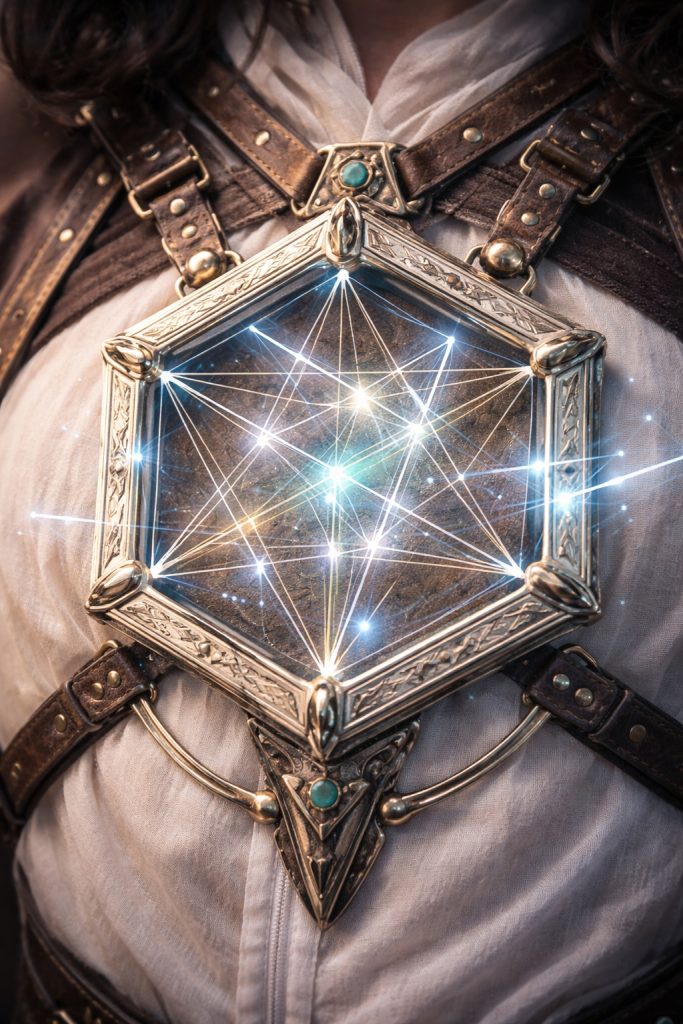
• Appearance: A hexagonal frame of pale alloy suspended over the sternum, holding a rotating lattice of thin crystal rods arranged in shifting geometric patterns. Faint lines of light trace angles between the rods as air flows through them.
• Rarity: Common
• Tier: 1
Base Stats
• Weight: Negligible when worn
• Attunement: Required
• Activation Type: Passive and Active
• Durability: Moderate
Skills Gained While Openly Worn
• +1 to spatial reasoning, mapping, or geometric interpretation
• +1 to navigation or route planning based on terrain shape
• +1 to architectural or structural analysis involving angles and balance
Passive Magical Effects
• Geometric Awareness: The wearer intuitively senses angles, symmetry, and proportional relationships in nearby space, gaining insight into stable vs unstable structures.
• Airflow Tracing: Subtle wind currents become visible as faint directional impressions, revealing paths of least resistance.
• Weight Alignment: The wearer’s balance subtly adjusts to maintain optimal posture and center of mass when moving or standing still.
Activatable Magical Effects
- Vector Step
Activation: Brief gesture and focused breath
Effect: For several seconds, the wearer’s movement aligns perfectly with local airflow, allowing precise steps across narrow surfaces or angled planes without loss of balance. - Spatial Lattice Read
Activation: Concentration for several breaths
Effect: The wearer perceives a mental overlay of geometric relationships in the surrounding area, revealing structural weak points, ideal paths, or areas of stress in buildings or terrain. - Levity Anchor
Activation: Reactive
Effect: The wearer becomes briefly weight-neutral, reducing the impact of falls or sudden drops and allowing controlled descent or repositioning without full levitation.
Tags
aerometric, geometric-focus, wind-aligned, spatial-reading, levity-assisted, structural-awareness, balance-engine, precision-movement, airflow-mapping, arcane-measurement, angle-bound, harmonic-spacing, vector-sense, lattice-aware, proportion-reading, airline-guided, equilibrium-tuned, spatial-attunement, measured-motion, form-resonant, trajectory-aware
How the Item Is Obtained
• Crafted Through Geometric Attunement
The most common origin of the Wind 819 of the Aerial Diagram is deliberate construction by geometers who specialize in wind-aligned architecture or navigational mathematics. The item cannot be mass-produced; each must be tuned to a specific geometric harmony. Creation requires access to steady airflow, a calibrated workspace, and someone capable of perceiving spatial ratios instinctively. Most are created during periods of stable atmospheric pressure, often at high elevation or within wind-temples built for study rather than worship.
• Earned Through Apprenticeship
Many geometers receive their first Wind 819 as a rite of passage. The item is given only after the apprentice successfully maps terrain without physical tools, relying solely on spatial intuition and airflow reading. These pieces often carry minor imperfections that reflect the student’s learning process.
• Recovered from Abandoned Survey Sites
Old aerial survey towers, suspended observatories, or collapsed levitation platforms sometimes contain dormant examples. These items are usually inactive until properly attuned, and many are mistaken for decorative instruments by those unfamiliar with their function.
• Commissioned by Builders and Navigators
In regions with floating roads, cliff cities, or suspended trade routes, guilds occasionally commission Wind 819 units for architects, engineers, or pathfinders. These are functional tools, not ceremonial pieces, and are valued for reliability rather than beauty.
Types of Shops and Where It Is Sold
• Geometer’s Studios
These are quiet workshops filled with drafting instruments, suspended weights, rotating frames, and wind channels. The Wind 819 is usually displayed mounted in open air rather than in cases.
The buyer is often tested by the shopkeeper, asked to interpret a shifting diagram or walk a balanced path before purchase.
Typical Cost: 9–14 silver, depending on calibration quality and crystal clarity.
• Windwright Foundries
Located near airship docks or high-altitude trade hubs, these workshops focus on airflow manipulation and levitation tools.
The item is sold as a navigational or stabilization device rather than a mystical artifact.
Typical Cost: 10–16 silver, higher if the internal lattice is finely balanced or recently tuned.
• Surveyor Guild Exchanges
Not open markets. Access requires sponsorship or proof of trade.
Here, the item may be exchanged for services rather than coin, such as terrain mapping, structural analysis, or wind-chart updates.
Equivalent Value: 7–12 silver.
• Architectural Supply Houses
In cities with floating districts or vertical construction, these shops carry practical tools for builders working at height.
The item is often mislabeled as a balance regulator or alignment aid.
Typical Cost: 12–18 silver, due to demand from professionals.
• Traveling High-Road Merchants
Caravans that move between sky-ports or cliff cities sometimes carry a few units. These are often older models or slightly misaligned but still functional.
Typical Cost: 6–10 silver, though quality varies.
How It Is Bought and Sold
• Sales are almost always done in person, as the item’s function must be demonstrated.
• Buyers are encouraged to walk, turn, or stand on angled surfaces while wearing it.
• Prices fluctuate based on altitude, terrain danger, and local reliance on levitation-based infrastructure.
• A well-tuned Wind 819 is rarely sold twice by the same owner unless they have advanced beyond its usefulness.
Cultural Perception
The item is seen as a practical tool rather than a status symbol. Among geometers, it is respected as a learning instrument rather than a weapon. Among travelers, it is considered a mark of someone who understands the world’s shape rather than someone who seeks to dominate it.
Roleplay in different environments:
• Mountain Ridges and High Terrain
Defense:
The wearer instinctively aligns their posture with prevailing wind vectors. Loose footing becomes manageable as the lattice compensates for shifts in balance. Sudden gusts that would normally knock someone over are dispersed through the device, turning violent wind into controlled pressure. Rockslides or shifting gravel feel “slow,” giving the wearer time to move rather than react in panic.
Offense:
The user can step where others cannot, gaining elevation advantage. Attacks launched from angled or unstable ground become more precise because the wearer’s body remains aligned with the terrain. Enemies attempting to rush uphill or across broken stone find themselves overextended while the wearer remains perfectly balanced.
• Urban and Architectural Environments
Defense:
In cities, especially vertical or layered ones, the item allows the wearer to move across rooftops, scaffolding, and collapsed structures with confidence. Sudden drops or broken stairways are mitigated by momentary levitation, preventing fatal falls. The wearer senses structural strain before collapse, allowing evasive movement.
Offense:
Combat becomes three-dimensional. The wearer can reposition rapidly, stepping across gaps, angling attacks from unexpected elevations, or forcing opponents into unstable footing. In tight spaces, they use geometry to control distance, forcing enemies into narrow lines or awkward angles.
• Caverns, Ruins, and Subterranean Zones
Defense:
The medallion hums softly when pressure changes occur, alerting the wearer to cave-ins or weak ceilings. It subtly redistributes weight to prevent triggering collapses. Even when stone falls, the levitation effect reduces impact and allows controlled movement through debris.
Offense:
The wearer can exploit structural weaknesses by striking or moving in ways that destabilize the environment without endangering themselves. Enemies unfamiliar with the terrain may be trapped, slowed, or forced into poor footing while the wearer navigates cleanly through chaos.
• Open Plains and Wind-Heavy Regions
Defense:
High winds become an ally rather than a hindrance. The wearer’s stance adjusts automatically, preventing knockdowns or fatigue. Dust storms and pressure shifts are easier to endure, as the item maintains balance and orientation.
Offense:
The wearer can move directly against or across wind currents, closing distance when others cannot. Their attacks come from unexpected vectors, as their footing remains stable while others struggle to maintain position.
• Aerial Platforms and Floating Structures
Defense:
On airships, floating bridges, or levitated terrain, the medallion stabilizes the wearer against sudden altitude changes. The wearer does not suffer vertigo or panic from height or motion.
Offense:
The user can maneuver confidently during aerial combat, stepping onto tilting platforms or shifting decks without hesitation. They can also anticipate sudden drops or tilts, striking at moments when opponents are off-balance.
• Psychological and Tactical Roleplay Impact
The wearer moves with calm certainty, as if the world subtly adjusts to accommodate them. This creates an unsettling effect on enemies, who may perceive the wearer as unnaturally grounded or impossible to dislodge.
The item encourages a style of combat based on patience, positioning, and spatial awareness rather than brute force. The wearer rarely rushes. They wait for geometry to favor them, then act with precise intent.
In roleplay, the character often pauses before movement, subtly tilting their head or shifting weight as if listening to something unseen. Their confidence comes not from strength, but from knowing exactly where the world will support them next.
Perception of Activation:
User’s Perspective:
• The moment the device activates, the avatar feels a subtle pressure shift across the chest, as if gravity itself briefly recalibrates.
• Breath becomes measured and deliberate, each inhale aligning with a faint internal rhythm that mirrors airflow patterns.
• The world seems to gain invisible edges and angles; distances feel quantifiable, slopes feel readable, and empty space feels structured rather than void.
• A cool, weightless sensation spreads outward from the sternum, as though the body’s center of mass has been gently lifted and stabilized.
• The avatar perceives faint geometric impressions layered over reality—intersecting lines, planes, and arcs that indicate balance, tension, and motion.
• Extra-sensory perception manifests as an intuitive awareness of spatial relationships: how far one can step safely, where a jump will land, and which direction offers the least resistance.
• There is a quiet mental clarity, like standing in still air before a storm, where motion feels predictable and calm.
Observer’s Perspective:
• The crystal lattice begins rotating in smooth, deliberate patterns, shifting angles as though tracking unseen currents.
• Thin lines of light flicker between the rods, tracing geometric shapes that subtly change with the environment.
• The wearer’s posture straightens unconsciously, movements becoming fluid and precise.
• Dust, loose cloth, or hair near the device drifts in gentle, controlled arcs rather than random motion.
• A faint harmonic hum can be heard when the wearer moves, like air passing through a distant structure.
• The device appears to “float” slightly off the wearer’s body, never fully resting against them.
Positives:
• Heightened spatial awareness and balance.
• Increased confidence when navigating complex terrain or vertical environments.
• Reduced fear response when dealing with heights, drops, or unstable surfaces.
• Improved precision in movement, making deliberate actions feel effortless.
• Enhanced perception of environmental structure and flow.
Negatives:
• Prolonged activation can cause disorientation when returning to flat, static environments.
• Overexposure may lead to sensory overload, making crowded or chaotic spaces uncomfortable.
• The constant geometric awareness can make stillness feel unnatural or oppressive.
• Sudden deactivation may briefly disrupt balance, causing a momentary stumble or vertigo.
• Users may become overly reliant on the item’s guidance, dulling natural instinct if used continuously.
Recipe Title: The Aerial Diagram Harness
Materials Needed:
• One hexagonal plate of pale alloy or sky-forged bronze, thin but rigid
• Six slender rods of clear or lightly tinted crystal, evenly cut and polished
• A core shard of levitation-tuned crystal, no larger than a coin
• Fine silver or air-aspected wire for lattice binding
• Powdered quartz mixed with trace amounts of wind-essence residue
• A small vial of condensed high-altitude air or wind-captured vapor
• Treated leather or flexible harness strapping
• Binding resin derived from sap exposed to sustained airflow
• Ash from stone burned in a high, open place
Tools Required:
• Precision metalworking tools for shaping and engraving
• Fine crystal-cutting and polishing tools
• A balancing frame or suspension rig
• A low-temperature forge or arcane kiln
• Engraving stylus for airflow channels
• Weights and plumb lines for alignment testing
• A steady wind source or elevated open-air workspace
Skill Requirements:
• Competence in fine metalwork and crystal shaping
• Understanding of wind or levitation magic principles
• Ability to sense or measure balance and spatial alignment
• Steady hand and controlled breathing
• Familiarity with ritual timing and attunement cycles
• Basic knowledge of geometry or proportional design
Crafting Steps:
• Shape the pale alloy into a hexagonal frame, engraving shallow geometric lines that represent balance, angle, and flow. These must be continuous and symmetrical.
• Cut and polish the crystal rods so they are identical in length and weight. Even a minor imbalance will prevent proper rotation.
• Suspend the central crystal shard within the frame using fine wire or resin threads, ensuring it never touches the metal directly.
• Arrange the crystal rods into a rotating lattice around the core, securing them loosely enough to allow motion but tightly enough to prevent drift.
• Dust the inner surfaces with the quartz mixture and lightly heat the assembly so the particles bond into the engraved channels.
• Expose the unfinished device to steady airflow while suspended in the balancing rig. Allow it to rotate freely until it settles into a stable pattern.
• During this phase, the crafter must remain nearby, breathing slowly and evenly, guiding the airflow with deliberate movement.
• Once the lattice begins rotating on its own in response to ambient air, apply the binding resin to lock the structure in place without restricting motion.
• Attach the harness straps, adjusting them so the device rests naturally over the sternum without pressing against the body.
• Perform final attunement by walking controlled paths—inclines, steps, and uneven ground—allowing the device to synchronize with the wearer’s movement patterns.
When properly crafted, the Aerial Diagram Harness responds immediately to changes in air pressure and spatial orientation, subtly guiding the wearer through balance rather than force.
Measure That Walked
In the age before names were held fast, when the wind still argued with the stone about who had been there first, there lived a people who believed that the world could be understood if one only learned how to listen to its angles. They did not measure distance by steps, nor height by falling, but by the way air bent itself around edges and how silence gathered in corners of the earth.
Among them was a figure remembered only as The Counter of Sides.
The old tablets say this one was not a builder, nor a priest, nor a ruler, but a watcher. They stood where cliffs met sky and where valleys narrowed into breathless seams. They watched how birds turned without flapping, how sand slid but did not fall, and how clouds paused when crossing invisible lines in the air.
The Counter of Sides believed that the world was written in shapes too subtle for the eye. Angles that existed only while moving. Curves that vanished when touched. A language of balance that could not be spoken, only felt.
It is said that one day the Counter climbed a mountain that had never known a footstep. The wind there did not howl or whisper, but pressed sideways, as though testing all who approached. At the summit, the Counter laid out rods of crystal and rings of pale metal, aligning them with the unseen forces that passed through the peak.
For seven cycles of sun and shadow, the Counter stood without sleep, adjusting the angles, turning the frame, listening not with ears but with weight. When the final piece was placed, the air itself grew quiet, as if startled.
Then the device moved.
Not by hand, nor by magic spoken aloud, but by recognition. The lattice turned. The crystal floated. The wind bent itself to pass cleanly through the form.
And in that moment, the Counter understood that the world was not held up by strength, but by agreement.
They fastened the device to their chest and took a single step forward.
They did not fall.
The mountain, it is said, leaned slightly to meet them.
With the device, the Counter walked places no one had walked before. They crossed broken ridges without slipping. They descended into hollows without sinking. They stood on edges that should have cut the air and yet held firm. Those who followed said it looked as if the land itself was guiding their feet.
But pride came, as it always does.
The Counter began to believe they had mastered the geometry of the world. They stepped faster. They stopped listening. They trusted the device more than the silence that had taught it to exist.
One day, the wind shifted.
The lattice spun too quickly. The angles no longer aligned. The Counter stepped forward where no agreement remained between air and stone.
The fall was long.
The device did not break. It simply drifted, settling gently upon a ledge far below, still humming, still listening.
The body was never found.
Later generations recovered the artifact and tried to copy it. Many succeeded in form, few in function. Those who listened learned. Those who commanded fell.
And so the old stories say that the device does not guide the wearer.
It listens for whether the wearer is willing to be guided.
Moral of the story:
The world does not yield to those who impose their will upon it, but it will carry those who learn how to stand within its balance.
Suggested conversions to other systems:
—
Call of Cthulhu (7th Edition)
Aerial Diagram Harness, Wind 819
Item Type: Enchanted Harness Focus (Spatial Geometry / Wind-Vector Balance)
Slot: Worn over sternum (openly)
Rarity/Availability: Uncommon to civilians; commonly issued by surveyors, architects, and sky-route mappers (Keeper treats as a minor talisman)
Core Effects (while openly worn)
• Vector Sense: Gain +10% to Navigate when planning routes by terrain shape, skyline, exposure, or structural layout.
• Measured Space: Gain +10% to Spot Hidden when “noticing by geometry” (odd angles, unnatural spacing, misaligned masonry, hidden gaps, false walls, trapped floors).
• Balanced Movement: Gain +10% to Climb, Jump, or other Dexterity-based movement rolls in vertical, narrow, or unstable environments.
Passive Magical Perceptions
• Angle Awareness: You feel spatial relationships as pressure lines across the chest and throat; you can tell when a surface is level, when a corridor bends, and when open air lies nearby.
• Airflow Tracing: Drafts and micro-currents register as instinctive “arrows” in your mind, indicating paths of least resistance.
Activated Abilities
• Vector Step
– Cost: 1 Magic Point
– Time: 1 round of deliberate movement
– Effect: For 1d6 rounds, gain a bonus die on one movement roll per round (balancing, leaping, climbing, squeezing through) if the action follows a plausible “line” of motion. Keeper may also allow you to avoid a slip or reduce falling damage from a short drop. Not flight.
– Use: Once per day.
• Spatial Lattice Read
– Cost: 1 Magic Point
– Time: 1 round of stillness and controlled breathing
– Effect: For 10 minutes, gain a bonus die on one roll to analyze a structure or space (hidden routes, weak supports, load-bearing points, safest passage). Provides strong intuition, not precise measurements.
– Use: Once per day.
• Levity Anchor
– Cost: 1 Magic Point
– Time: Reaction (when you begin to fall or are shoved)
– Effect: You become briefly weight-neutral, reducing fall/collision damage (Keeper reduces by 1d6 or one severity step) and you may land standing if it makes sense.
– Use: Once per day.
Drawbacks / Risks
• Over-Geometry: If you use two activations in the same day, make a CON roll. Failure causes vertigo and fixation: penalty die on Listen and Dex-based tasks for 1d10 minutes.
• Crowded Angles: In dense crowds or chaotic movement, the constant spatial impressions can distract (roleplay; situational penalties at Keeper discretion).
—
Blades in the Dark
Aerial Diagram Harness (Wind 819)
Item: Arcane Implements (Load 1, worn)
Keywords: Spatial Lattice, Vector Balance, Levity Catch, Draft Sense
Always-On (when worn openly)
• You have potency on Survey to read spaces, angles, and structural truths (hidden doors, load-bearing points, routes).
• You have potency on Prowl or Finesse when traversing vertical terrain, narrow ledges, rooftops, scaffolds, or shifting platforms.
• Once per score, you may declare you “kept the line” to reduce the severity of a fall-related complication.
Special Uses (activate in the fiction)
• Vector Step
– Spend 0 stress to gain improved position on a climb/leap/roof-run if you can describe the clean “line” you follow.
– Spend 1 stress to negate harm from a fall once, if the fiction supports a levity catch.
• Spatial Lattice Read
– Spend 0 stress to ask one clear question about the space: “Where is the weakest support?” “What path is safest?” “What’s hidden by misalignment?” GM answers honestly.
– Spend 1 stress to create an advantage: “Mapped Angles,” “Clean Vector,” or “Load-Bearing Marked,” with one free invocation.
• Levity Anchor
– Spend 1 stress as a reaction to reduce harm from a shove, collision, or sudden drop by one level.
Limits and Consequences
• Using two activations in one score starts or ticks a 4-segment clock: Vertigo. When filled, take level 1 harm “Dizzy” until you rest.
—
Dungeons & Dragons (5e compatible)
Wind 819, Aerial Diagram Harness
Wondrous Item (common), requires attunement
Slot/Use: Chest harness; must be worn openly to function
Passive Benefits (while attuned and openly worn)
• Angle Sense: You always know whether you are on level ground and can’t be disoriented by mundane slopes or turns.
• Measured Space: You have advantage on Wisdom (Perception) checks to notice structural oddities (misaligned stone, uneven spacing, hidden seams, trapped floors).
• Vector Balance: You have advantage on Strength (Athletics) and Dexterity (Acrobatics) checks made to climb, balance, jump, or cross narrow/unstable surfaces.
Activated Features
• Vector Step (1/day)
– As a bonus action, for 1 minute you move with perfect vector alignment. During this time, you have advantage on Athletics and Acrobatics checks for movement, and difficult terrain caused by rubble, slopes, or broken flooring doesn’t cost you extra movement. This does not allow movement across empty air.
• Spatial Lattice Read (1/day)
– As an action, you read the surrounding geometry for 10 minutes. You can’t be surprised by nonmagical structural collapses or traps that rely on misalignment or hidden seams in your immediate area, and you have advantage on checks to locate the safest route through the space.
• Levity Anchor (1/day)
– As a reaction when you would take falling damage, reduce that damage by 1d6 + your proficiency bonus, and you may land on your feet if you are not incapacitated.
Drawbacks
• If you use two different features before finishing a long rest, you must succeed on a DC 10 Constitution saving throw or suffer vertigo for 1 minute (disadvantage on Dexterity checks).
—
Knave (latest edition compatible)
Wind 819, Aerial Diagram Harness
Type: Worn harness (chest)
Slots: 1 slot
While Worn (openly)
• Angle Sense: You always know if you are level and can’t be lost by ordinary turns and slopes.
• Measured Space: You have advantage on checks to notice misalignments, hidden seams, false walls, or trap floors.
• Vector Balance: You have advantage on checks to climb, jump, balance, and cross narrow or unstable surfaces.
Activations
• Vector Step (1/day)
– For one combat or exploration turn, you move in a perfect line: advantage on movement checks and you ignore difficult terrain from rubble/slope.
• Spatial Lattice Read (1/day)
– For one exploration turn, you gain clear intuition of safe paths and weak points in nearby structures; advantage on related checks.
• Levity Anchor (1/day)
– Reaction: reduce falling damage and avoid being knocked prone if it makes sense.
Costs / Risks
• If you use two activations in the same day, you suffer “Vertigo” until a long rest: disadvantage on balance and delicate footing.
—
Fate Core / Fate Condensed
Wind 819 – Aerial Diagram Harness
Item Type: Worn Relic (Spatial Calibration Focus)
Slot: Chest Harness
Aspects
• “The World Reveals Its Angles”
• “I Walk the Line Between Balance and Fall”
Permissions
• You may justify actions involving movement, balance, navigation, or structural analysis using spatial awareness and airflow perception.
• You may treat vertical or unstable terrain as narratively manageable if you describe how the geometry supports your movement.
Passive Benefits
• +2 to Notice when detecting misalignment, unstable footing, hidden gaps, or unusual spatial relationships.
• +2 to Athletics when climbing, balancing, or traversing narrow or shifting terrain.
• You may ignore one situational penalty related to awkward footing per scene.
Activated Stunts
Vector Step
Once per scene, spend 1 Fate point.
• Gain a free invoke on an aspect such as “Perfect Line of Travel,” “Balanced on the Invisible,” or “Following the Angle.”
• You may reduce or negate a fall-related consequence if fictionally appropriate.
Spatial Lattice Read
Once per session, spend 1 Fate point.
• Ask the GM one question about structural stability, safest path, or hidden spatial features.
• The answer is truthful but impressionistic.
Levity Anchor
Once per session, spend 1 Fate point as a reaction.
• Reduce the severity of a fall, impact, or forced movement consequence by one step.
Drawbacks
• The GM may compel sensory overload in chaotic environments.
• In featureless or sealed spaces, the item provides no benefit.
—
Numenera / Cypher System
Wind 819 – Aerial Diagram Harness
Level: 3
Type: Wearable Artifact (Spatial-Vector Regulator)
Slot: Chest
Passive Effects
• Asset on all tasks involving climbing, balance, or movement across unstable terrain.
• Asset on perception tasks related to structural integrity or spatial awareness.
• You always know which direction is “down,” even in unusual environments.
Activated Abilities
Vector Step
Cost: 1 Intellect
Action
Effect: For 1 minute, reduce movement difficulty by one step and reduce falling damage by one step.
Spatial Lattice Read
Cost: 2 Intellect
Action
Effect: For 10 minutes, gain an asset on all tasks involving navigation, structural analysis, or safe route selection.
Levity Anchor
Cost: 1 Intellect
Reaction
Effect: Reduce damage from a fall or sudden impact by one level.
Depletion
• 1 in 1d20 if two abilities are used in the same day.
GM Intrusions
• Over-stimulation causes vertigo or false spatial readings.
• Strong magical interference disrupts the lattice briefly.
—
Pathfinder Second Edition
Wind 819 – Aerial Diagram Harness
Item Level: 1
Item Type: Wondrous Item (Invested)
Usage: Worn (chest)
Bulk: L
Passive Effects
• +1 item bonus to Athletics checks involving climbing, jumping, or balance.
• +1 item bonus to Perception checks to detect unstable terrain or structural flaws.
• You always know which direction is downhill.
Activated Abilities
Vector Step
Frequency: Once per day
Activation: 1 action
Effect: For 1 minute, gain a +2 circumstance bonus to Athletics checks and reduce falling damage by half.
Spatial Lattice Read
Frequency: Once per day
Activation: 1 action
Effect: For 10 minutes, gain a +2 circumstance bonus to Survival and Perception checks involving terrain and structures.
Levity Anchor
Frequency: Once per day
Reaction
Effect: Reduce falling or collision damage by 1d6 + your level.
Drawback
• Using two abilities before daily preparations causes Fatigued for 10 minutes.
—
Savage Worlds Adventure Edition
Wind 819 – Aerial Diagram Harness
Item Type: Minor Relic
Slot: Worn (Chest)
Passive Effects
• +1 to Athletics and Notice when dealing with terrain, balance, or vertical movement.
• Ignore up to 1 point of movement penalty caused by unstable or broken ground.
Activated Powers
Vector Step
Power Points: 1
Activation: Action
Effect: For 3 rounds, gain +2 to Athletics and ignore difficult terrain caused by elevation or debris.
Spatial Lattice Read
Power Points: 2
Activation: Action
Effect: For one scene, gain +2 to Notice and Survival when interpreting terrain or structure.
Levity Anchor
Power Points: 1
Activation: Reaction
Effect: Reduce falling or impact damage by half.
Limitations
• Using more than one ability in a scene requires a Vigor roll or the user becomes Fatigued.
• The harness provides no benefit in zero-gravity or sealed environments.
—
Shadowrun (Sixth Edition)
Wind 819 – Aerial Diagram Harness
Item Type: Magical Focus (Environmental / Spatial Control)
Availability: Low–Moderate (restricted to surveyors, engineers, and licensed windwrights)
Bond Cost: 1 Karma
Slot: Worn (chest harness)
Passive Effects
• +1 die to Athletics tests involving climbing, balancing, or movement across unstable terrain.
• +1 die to Perception tests related to spatial layout, elevation changes, or structural instability.
• The wearer always knows true vertical orientation unless in a mana-null zone.
Activated Effects
Vector Step
Activation: Simple Action
Cost: 1 Stun Drain
Effect: For 1 Combat Turn, the wearer reduces falling damage by half and gains +2 dice to Movement-related tests (Climbing, Gymnastics, or Balance).
Spatial Lattice Read
Activation: Simple Action
Cost: 1 Stun Drain
Effect: For up to 5 minutes, gain +2 dice on Navigation or Engineering tests to assess terrain, structural integrity, or safest routes.
Levity Anchor
Activation: Reaction
Cost: 1 Stun Drain
Effect: When forced to fall or knocked back, reduce damage by one step and avoid being knocked prone if physically possible.
Limitations
• Using two abilities in the same scene causes vertigo: –1 die to Physical actions for the remainder of the scene.
• The harness does not function in vacuum or zero-air environments.
—
Starfinder
Wind 819 – Aerial Diagram Harness
Item Level: 1
Item Type: Hybrid Magic Item
Usage: Worn (chest)
Bulk: L
Passive Effects
• +1 insight bonus to Athletics and Survival checks involving terrain, balance, or movement.
• Always aware of gravitational orientation and slope.
• Reduce falling damage by 5 feet.
Activated Abilities
Vector Step
Usage: 1/day
Action: Swift
Effect: For 1 minute, gain a +2 enhancement bonus to Athletics checks and ignore the first 10 feet of falling damage.
Spatial Lattice Read
Usage: 1/day
Action: Move
Effect: For 10 minutes, gain a +2 insight bonus to Perception and Survival checks related to terrain and structural layout.
Levity Anchor
Usage: 1/day
Reaction
Effect: Reduce falling or collision damage by half.
Special
• In zero-G environments, the harness grants orientation but not propulsion.
• Repeated use in short succession may cause disorientation at GM discretion.
—
Traveller (Mongoose 2nd Edition)
Wind 819 – Aerial Diagram Harness
Item Type: Environmental Assistance Device
Tech Level Equivalent: TL10 (Magitech)
Slot: Worn
Passive Effects
• DM+1 to Athletics (Dexterity) checks involving climbing, balance, or difficult footing.
• DM+1 to Recon or Survival checks when assessing terrain or structural safety.
• Always aware of gravity direction and slope.
Activated Functions
Vector Step
Activation: Minor Action
Effect: Reduce falling damage by half and gain DM+2 to movement-related checks for one round.
Usage: Once per scene.
Spatial Lattice Read
Activation: Minor Action
Effect: Gain advantage on one Navigation or Survival check within the next 10 minutes.
Levity Anchor
Activation: Reaction
Effect: Reduce impact damage and prevent being knocked prone.
Limitations
• Ineffective in sealed or artificial-gravity-only environments.
• Extended use causes mild vertigo (DM–1 to Dex-based checks for 1d6 minutes).
—
Warhammer Fantasy Roleplay (4th Edition)
Wind 819 – Aerial Diagram Harness
Item Type: Enchanted Trinket
Rarity: Scarce
Encumbrance: 0
Worn Location: Chest or Harness
Passive Effects
• +10 to Athletics (Climb) Tests involving height or unstable footing.
• +10 to Outdoor Survival Tests related to terrain, slope, or elevation.
• Always aware of direction of slope and balance.
Activated Effects
Vector Step
Frequency: Once per day
Effect: Gain +10 to Agility Tests for one round and halve falling damage.
Spatial Lattice Read
Frequency: Once per day
Effect: For 10 minutes, gain +20 to Navigation Tests and ignore penalties from unstable terrain.
Levity Anchor
Frequency: Once per day
Reaction
Effect: Reduce damage from falling or collapsing structures by one Damage Level.
Drawbacks
• Using more than one ability in a day causes Fatigued for 10 minutes.
• The harness loses effectiveness in enclosed or magically static environments.