
Lore
This device is said to originate from early geomancers who studied not stone alone, but the way land wants to move. They observed how cliffs fracture, how dunes migrate, how valleys are carved not by force but by patient guidance of air and weight. The Wind 742 of the Shaped Horizon was created as a teaching instrument, allowing its wearer to feel the slow dialogue between wind, mass, and terrain. It is not a tool of flight, but of understanding—granting awareness of how land rises, falls, and yields beneath invisible pressure.
Slot
• Waist, harness, or lower torso mount
Appearance
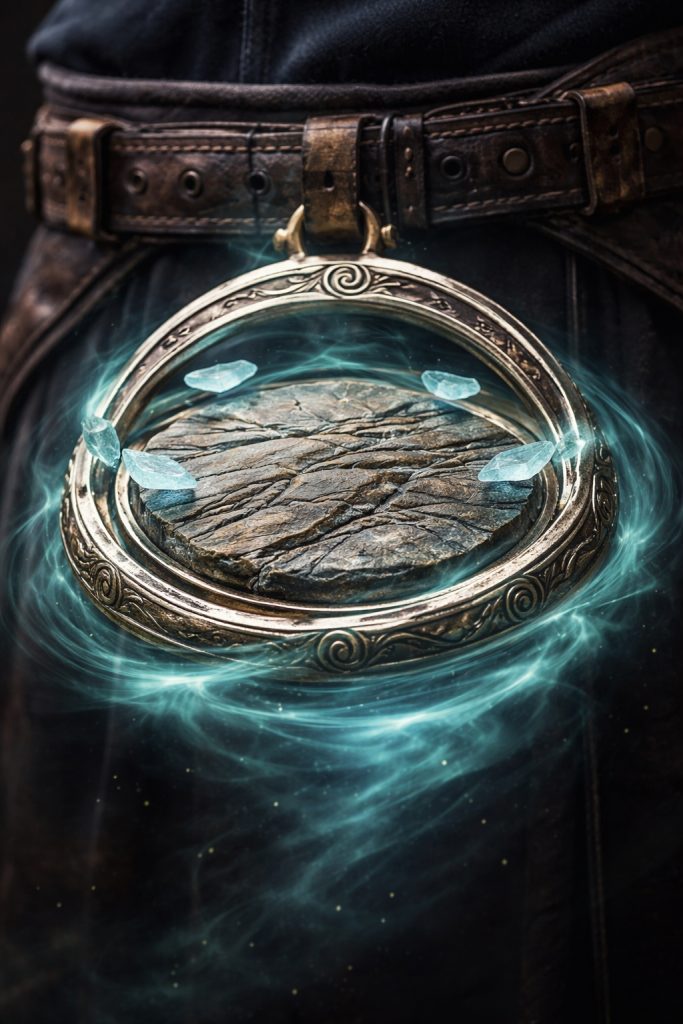
A layered disk of dull stone-veined alloy suspended within a ring of pale metal. Thin channels carved across its face resemble erosion lines and fault ridges. Small translucent plates float just above the surface, subtly shifting position as air pressure or elevation changes. When active, the device emits a low, steady hum like wind moving through a canyon.
Stats
• Rarity: Common
• Tier: 1
• Attunement: Required
• Weight: Light
• Durability: High for non-combat equipment
Skills Gained While Openly Worn
• Enhanced terrain reading and slope awareness
• Improved judgment of ground stability
• Improved navigation through uneven or shifting environments
• Increased awareness of elevation change and subsurface voids
Passive Magical Effects
• The wearer always knows the direction of downhill and the angle of surrounding terrain.
• Minor reduction in fatigue when traversing hills, rubble, sand, or broken ground.
• Grants subtle feedback when standing on unstable surfaces, loose stone, or hollow ground.
• Wind pressure against the body is perceived as directional guidance rather than force.
Activable Magical Effects
Gravimetric Sense
• Activation: Focused breath and grounding stance
• Effect: For several minutes, the wearer can sense underground shifts, weak rock layers, and recent terrain changes within a short radius.
• Useful for detecting sinkholes, fault lines, or unstable cliffs.
Levity Glide
• Activation: Short gesture and forward movement
• Effect: Briefly reduces the wearer’s effective weight, allowing them to descend steep slopes, leap down elevations, or avoid injury from short falls.
• Does not allow true flight or ascent.
Wind-Line Mapping
• Activation: Stillness and concentration
• Effect: Reveals dominant wind paths and pressure currents in the area, allowing the wearer to predict erosion patterns or choose optimal routes through terrain.
Tags
geomantic, wind-attuned, terrain-sense, levitation-assisted, pathfinding, erosion-aware, balance-focused, environmental, exploratory, low-altitude, resonance-based, faultline-aware, slope-reading, subsurface-sense, airflow-tracing, ground-resonant, pressure-adaptive, terrain-calibrated, drift-stable, landform-attuned, stability-seeking, erosion-sensitive
How it may be obtained:
• Commissioned Creation
The most common way to obtain a Wind 742 of the Shaped Horizon is through commission. A geomorphically trained artisan, often called a wind-wright or ground-listener, constructs it after observing the intended wearer walking terrain for several days. The item is tuned during this observation period so its floating plates respond correctly to the wearer’s gait, weight distribution, and sense of balance. This method is favored by surveyors, road builders, and cliff-route guides.
• Inheritance or Trade from Survey Guilds
Many early versions of this item were issued to expedition mappers and stone-readers during the expansion of trade routes between island nations. These tools sometimes resurface through guild liquidation, inheritance, or quiet resale when a survey house closes or merges with another.
• Ritual Crafting in Wind-Hallowed Terrain
Some versions are created only in areas where wind and land interact strongly, such as canyon mouths, cliff ridges, or desert escarpments. In these cases the creator performs a low-tier levitation ritual while the medallion is half-buried in soil, allowing the land itself to “teach” the object its function.
• Salvage from Ruined Infrastructure
Collapsed sky-roads, abandoned levitation platforms, and failed air-bridge anchors sometimes contain fractured versions of this item. When carefully repaired, they retain enough structure to function at tier 1.
Types of Shops and Trade Context:
• Windwright Forges
These are specialist workshops run by craftspeople trained in wind manipulation and spatial tuning. They tend to be located near cliffs, highlands, or trade routes that cross dangerous terrain.
Cost Range:
– Typically valued at the high end of tier 1 pricing
– Usually exchanged for silver coin or equivalent barter
– Often require proof of practical use rather than wealth alone
• Surveyor and Cartographer Guild Halls
Guild halls that support explorers, mappers, or civil planners sometimes sell or lease such items. They are considered professional tools rather than weapons.
Cost Range:
– Moderate tier 1 pricing
– Discounts may apply to registered members or those undertaking sanctioned expeditions
• Sky-Trade Markets and Floating Ports
In cities with airship docks or levitated districts, these items appear among navigation instruments and altitude gear. These markets price by demand rather than rarity.
Cost Range:
– Variable; often inflated during travel seasons or major construction projects
– Payment may include services or mapped routes instead of coin
• Rural Stonewright Circles
In remote regions, the item may be bartered for labor, geological knowledge, or access to rare stone. These versions are often less ornate but functionally identical.
Cost Range:
– Low coin cost
– High time or service commitment
• Private Resale
Occasionally sold quietly between travelers, climbers, or caravan guides. These transactions usually occur without documentation and rely on trust.
Cost Range:
– Highly variable
– Often influenced by the condition of the item and the seller’s urgency
Economic Position in Saṃsāra
The Wind 742 of the Shaped Horizon is considered a practical professional tool rather than a luxury or weapon. Its value comes from utility, reliability, and safety rather than power. It is commonly owned by:
• Terrain scouts
• Caravan route planners
• Quarry overseers
• Cliff settlement builders
• Geological researchers
• Wind-touched monks and wayfarers
Because it does not grant flight or combat superiority, it is widely legal and rarely restricted, making it one of the most socially accepted levitation-based devices in circulation.
Roleplay Use by Environment – Defense and Offense
Mountainous and Cliff Environments
Defense
• The wearer instinctively feels shifts in stone and wind pressure, allowing them to brace before rockfalls or ledge collapses occur.
• When attacked near edges, the device subtly redistributes weight, preventing forced shoves or slips from becoming fatal falls.
• The wearer can position themselves where unstable ground favors them, letting enemies lose footing while they remain steady.
Offense
• The user can bait opponents into unstable footing by retreating along slopes or scree fields that the device predicts will fail.
• Subtle changes in weight allow controlled downhill lunges, increasing momentum for strikes or tackles without losing balance.
• In narrow passes, the wearer can force enemies into terrain that collapses or shifts under pressure, using gravity as a weapon.
Desert and Sandy Terrain
Defense
• The device stabilizes footing on dunes and loose sand, preventing sinking or sudden slides.
• Wind pressure awareness allows the wearer to anticipate sand gusts and brace before visibility drops.
• The levitation effect slightly lightens the body, reducing exhaustion from trudging through soft terrain.
Offense
• The wearer can advance while others struggle, closing distance efficiently.
• Attacks can be timed with shifting sand, causing opponents to stumble as strikes land.
• Dust and sand stirred by controlled movement can be used to obscure vision without disorienting the wearer.
Urban or Ruined Structures
Defense
• Detects hollow floors, cracked stone, or weak support beams before collapse.
• Allows safe traversal of rooftops, broken stairways, and damaged walkways.
• Reduces impact when forced to drop through floors or leap between structures.
Offense
• Enables vertical maneuvering in tight urban spaces, letting the wearer strike from angles others cannot reach.
• Can lure enemies onto compromised surfaces and trigger collapse through movement alone.
• Provides superior control in fights involving elevation changes, ladders, or narrow platforms.
Underground or Cavern Environments
Defense
• The wearer senses pressure changes in cave walls and ceilings, warning of imminent cave-ins.
• Helps maintain footing on damp stone or mineral dust.
• The hum of the device subtly counters vertigo in deep or enclosed spaces.
Offense
• Allows precise movement through uneven tunnels while opponents struggle.
• Enables controlled use of falling debris by positioning enemies beneath unstable rock.
• Enhances ambush potential by exploiting vertical drops and narrow passages.
Open Plains and Rolling Hills
Defense
• Detects subtle changes in terrain slope, allowing optimal defensive positioning.
• Helps the wearer maintain balance during high winds or stampedes.
• Prevents tripping or exhaustion over long travel distances.
Offense
• Allows momentum-based charges using terrain contours.
• Helps guide enemies into low ground or unstable earth.
• Improves pursuit or retreat by minimizing energy loss during movement.
Aerial or Elevated Platforms
Defense
• Stabilizes the wearer on floating structures, airships, or suspended walkways.
• Reduces panic or missteps caused by height or shifting air currents.
• Allows controlled descent instead of uncontrolled falls.
Offense
• Enables sudden drops or lateral movement without loss of control.
• Makes aerial combat safer by maintaining orientation when struck.
• Allows tactical use of gravity without requiring true flight.
Roleplay Summary of Use
The Wind 742 of the Shaped Horizon does not make its wearer stronger or faster in a direct sense. Instead, it makes them correct. It aligns movement with terrain, reduces error, and turns the environment into a cooperative force rather than an obstacle.
In roleplay, it is most often described as:
• A quiet guiding pressure against the body
• A subtle correction in posture or stance
• A sensation of “knowing where the land wants you to stand”
Defensively, it prevents disaster.
Offensively, it allows the wearer to let the world itself do the work.
Perception of Activation:
User’s Perspective
• A sudden sensation of lightness spreads upward from the waist, as if gravity loosens its grip without fully releasing it.
• The hum of the device becomes audible internally, more felt in the bones than heard, like wind passing through a canyon far below.
• The ground seems to “tilt” in the mind’s awareness, even if physically flat, revealing invisible slopes, pressure lines, and weight gradients.
• Air pressure becomes tactile — currents brush against the skin in clear directional flows.
• Balance sharpens dramatically; micro-adjustments to posture occur without conscious effort.
• A faint sensation of vertical alignment settles in the spine, as though the body has found a perfect center of mass.
Extra-Sensory Perception (User)
• Awareness of subsurface density differences, such as hollow stone, packed earth, or unstable layers.
• Intuitive understanding of how wind will move over terrain within several body lengths.
• Subtle awareness of elevation change even when blindfolded or in darkness.
• Momentary perception of “safe paths” across uneven ground, perceived as instinct rather than vision.
Observer’s Perspective
• The device emits a low, steady harmonic hum, barely audible unless close.
• Thin motes of dust or mist around the wearer shift into slow spirals, subtly aligning with the medallion’s floating plates.
• The wearer’s stance becomes unnaturally stable, even in strong wind or unstable footing.
• The floating crystal plates rotate smoothly, as if measuring invisible angles in the air.
• The wearer’s movements appear deliberate and grounded, as though guided by unseen rails.
Positives
• Greatly enhanced balance and terrain awareness.
• Reduced risk of falling, slipping, or misjudging elevation.
• Increased confidence when navigating cliffs, ruins, slopes, or unstable ground.
• Improved control over movement during descent or sudden shifts in terrain.
• Heightened environmental awareness without overwhelming sensory input.
Negatives
• The constant perception of slope and pressure can become mentally fatiguing over long periods.
• Flat, featureless terrain may feel disorienting or subtly nauseating due to lack of geomorphic feedback.
• The wearer may become overly reliant on the device, hesitating when it is inactive.
• Strong magical winds or unstable mana fields can cause sensory overload, producing vertigo or brief disorientation.
• Emotional stress can interfere with interpretation of terrain signals, leading to hesitation or misjudgment.
Shaped Horizon Gyro-Medallion
Materials Needed
• One disk of stone-veined alloy (a blend of bronze, iron, and powdered basalt)
• Three to five translucent levicrystal slivers, naturally fractured rather than cut
• Fine-threaded pale metal ring (silvered brass or sky-iron alloy)
• Trace amounts of wind-aspected crystal dust
• A palm-sized fragment of naturally eroded stone taken from a high place
• Binding resin derived from tree sap exposed to high winds
• Clean water gathered from rainfall or mountain runoff
Tools Required
• Precision metalworking tools suitable for delicate engraving
• Stone-carving chisels with fine tips
• Wind-tuned tuning fork or resonant chime
• Low-heat forge or alchemical kiln
• Suspension rig or frame to hold components during levitation alignment
• Polishing cloths treated with mineral oil
• Inscribing stylus for etching geomorphic channels
Skill Requirements
• Basic metal shaping and finishing
• Stone carving or lapidary skill
• Familiarity with wind or levitation magic
• Ability to sense balance, pressure, or airflow
• Steady hand and patient focus
• Knowledge of geomorphic patterns and erosion behavior
Crafting Steps
- Form the Core Disk
Shape the stone-veined alloy into a flat disk. Carve shallow channels across its surface following natural erosion patterns rather than symmetrical designs. These lines must feel organic and uneven, mimicking wind-worn rock. - Prepare the Levicrystal Plates
Select translucent crystal fragments that naturally fracture along uneven lines. Polish only their edges, leaving their faces imperfect. These imperfections allow the crystals to respond to airflow rather than resist it. - Construct the Suspension Ring
Forge the pale metal ring thin and light. It must be strong enough to hold the disk yet flexible enough to resonate. Embed micro-grooves along the inner rim to allow the crystals to hover without contact. - Assemble the Floating Array
Suspend the crystal fragments inside the ring using levitation magic. The crystals must never touch the metal or stone directly. Adjust their position until they respond visibly to breath or ambient air movement. - Bind the Core
Apply the wind-infused resin to secure the disk within the ring. While the resin sets, gently strike the tuning fork nearby to encourage harmonic alignment. This step determines the sensitivity of the final item. - Engrave the Geomorphic Channels
Using the stylus, etch additional fine lines into the metal while focusing on terrain memory: slopes, ridges, fault lines, and erosion paths. This imprints geomorphological awareness into the item. - Activation Alignment
Place the completed medallion on natural ground. Activate a minor levitation effect while exposing it to open air for several minutes. The crystals should begin slow, self-guided rotation. If they wobble or stop, recalibrate. - Final Attunement
The intended wearer must hold or wear the item while standing on uneven ground. Their breathing and stance will finalize the device’s sensitivity. Once attuned, the medallion will respond primarily to that individual.
The result is a Wind 742 of the Shaped Horizon, tuned to perceive terrain, weight, and motion as a single flowing system. Each crafted piece is subtly unique, shaped as much by the land as by the maker.
The Moral of the Craft
The land does not resist movement. It teaches how to move.
Stone That Learned to Listen
In the age before roads were cut and before cliffs bore scars of rope and iron, when the wind still wandered as it pleased and the mountains had not yet learned the weight of footsteps, there lived a people who did not build upon the land but asked it where to stand. Their names are lost, or perhaps they never had names, for they believed that to name oneself was to step away from the shape of the world.
Among them was a wanderer whose name has been broken by time and retold in many mouths. Some say it was Aruun. Others say it was Vel. In the oldest telling, the name is only a sound of breath, like wind moving through hollow stone.
This wanderer wished to cross the Shifting Reach, a land where hills walked slowly and valleys forgot their place. Travelers vanished there, not because of beasts or storms, but because the ground itself changed its mind beneath their feet. Many had tried to conquer it with tools, with maps, with force. None had succeeded.
The wanderer did not fight the land. Instead, they listened.
For many seasons they sat at the edge of the Reach, watching dust roll uphill, watching stones lean as if listening to something beneath the soil. They learned that the wind did not merely pass over the land—it spoke to it. They learned that weight was not fixed, that even mountains could be persuaded to bear more or less if approached with patience.
At last, the wanderer took a fragment of stone from a cliff that had never fallen, and a ring of metal softened by long years of wind, and they bound them together not with force, but with stillness. They placed within it shards of clear crystal, not cut, but broken by chance, for chance knew the world better than any hand.
When the work was done, the object did not glow. It did not sing. It only hummed faintly, as though remembering a song once sung by the earth itself.
The wanderer fastened it at their waist and stepped into the Shifting Reach.
Where others sank, they stood.
Where others slipped, they leaned.
Where others fell, they were gently guided downward, as if the land itself wished them no harm.
It is said they crossed the Reach in seven days, though others took years or never returned. Along the way, the wanderer did not carve paths or build bridges. Instead, the land bent slightly beneath their steps, learning their weight as they learned its patience.
When the wanderer reached the far side, they did not claim victory. They removed the device and set it upon a stone, where it slowly lifted and turned in the wind, listening.
They left it there for another to find.
In later ages, those who uncovered the object tried to use it to command the land. These people fell. The device would not answer them. It only stirred for those who moved with care, who did not demand, who accepted that the world was not meant to be mastered.
Thus the object came to be known not as a tool of power, but as a lesson given form.
And so the old story ends, as it always does, in the same fractured words passed down through broken tongues:
The land does not serve the walker.
The walker must learn to move as the land moves.
Moral of the story:
Those who try to force the world to yield will fall with it. Those who listen will be carried.
Suggested conversions to other systems:
—
Call of Cthulhu (7th Edition)
Wind 742 – Girdle-Medallion of the Shaped Horizon
Item Type: Enchanted Talisman (Terrain Pressure / Erosion Sense / Minor Levity)
Slot: Worn at waist, harness, or lower torso (openly)
Rarity/Availability: Common among surveyors, cliff-guides, and quarry overseers (Keeper treats as a minor talisman)
Core Effects (while openly worn)
• Slope Sense: Gain +10% to Navigate when choosing routes across broken ground, ridges, dunes, rubble, or steep inclines.
• Ground-Truth: Gain +10% to Spot Hidden when noticing hollow ground, unstable stone, sinkholes, hidden voids, or “wrong” erosion patterns.
• Sure Footing: Gain +10% to Climb, Jump, or Dexterity-based movement rolls in unstable terrain (scree, loose stone, soft sand, shattered masonry).
Passive Magical Perceptions
• Downhill Certainty: You always know the “true down-slope” direction within nearby terrain, even in darkness.
• Pressure Whisper: Within a short distance, you sense differences in density (packed earth vs. void) as subtle inner-ear pressure.
• Wind-Trace: Drafts feel like directional nudges, indicating paths of least resistance across terrain.
Activated Abilities
• Gravimetric Sense
– Cost: 1 Magic Point
– Time: 1 round to plant feet and exhale slowly
– Effect: For 10 minutes, gain a bonus die on one roll to assess subsurface instability (fault slips, weak strata, sinkholes, undermined floors). Provides impressions, not a map.
– Use: Once per day.
• Levity Glide
– Cost: 1 Magic Point
– Time: Reaction (when you begin to fall or must descend quickly)
– Effect: Reduce fall/collision damage from a short drop (Keeper reduces by 1d6 or one severity step) and you may land standing if it makes sense. Not flight.
– Use: Once per day.
• Wind-Line Mapping
– Cost: 1 Magic Point
– Time: 1 round of stillness, feeling air on the face
– Effect: For 10 minutes, gain a bonus die on one roll to predict local wind paths, erosion exposure, or safest approach across dunes/ridges/ruins.
– Use: Once per day.
Drawbacks / Risks
• Overwhelm: If you use two activations in the same day, make a CON roll. Failure causes vertigo and ground-sickness: penalty die on Dex-based tasks for 1d10 minutes.
• Flatland Nausea: In featureless, perfectly flat spaces, the lack of geomorphic “signal” can be unsettling (roleplay; Keeper may impose situational distraction).
—
Blades in the Dark
Wind 742 – Shaped Horizon Girdle
Item: Arcane Implements (Load 1, worn)
Keywords: Terrain Whisper, Sinkhole Sense, Levity Catch, Windline Read
Always-On (when worn openly)
• You have potency on Survey when reading terrain stability, erosion signs, hollows, and safe footing.
• You have potency on Prowl or Finesse when traversing rubble, dunes, cliffs, ruined stairs, or unstable platforms.
• Once per score, you may declare you “felt the shift” to avoid a slip or reduce a fall complication.
Special Uses (activate in the fiction)
• Gravimetric Sense
– Spend 0 stress to ask one clear question: “Where is the hollow?” “What will collapse?” “Which ridge is stable?” GM answers honestly, impressionistically.
– Spend 1 stress to create an advantage: “Stable Line,” “Void Marked,” or “Firm Footing,” with one free invoke.
• Levity Glide
– Spend 0 stress to gain improved position for a descent, slide, or controlled drop.
– Spend 1 stress as a reaction to reduce harm from a fall or collapse by one level.
• Wind-Line Mapping
– Spend 0 stress to gain improved position on a traverse through dunes/ridge-winds/ruins by predicting exposure.
– Spend 1 stress to negate a wind-driven complication once.
Limits and Consequences
• If you use two activations in one score, start or tick a 4-segment clock: Vertigo. When filled, take level 1 harm “Dizzy” until you rest.
—
Dungeons & Dragons (5e compatible)
Wind 742, Girdle-Medallion of the Shaped Horizon
Wondrous Item (common), requires attunement
Slot/Use: Worn at waist or harness; must be worn openly to function
Passive Benefits (while attuned and openly worn)
• Downhill Sense: You always know the direction of the nearest downward slope within 60 feet, even in darkness.
• Ground-Truth: You have advantage on Wisdom (Perception) checks to notice unstable ground, sinkholes, undermined floors, loose scree, or hollow stone.
• Sure Footing: You have advantage on Strength (Athletics) and Dexterity (Acrobatics) checks made to climb, jump, balance, or move across rubble, dunes, or broken terrain.
Activated Features
• Gravimetric Sense (1/day)
– As an action, you attune to the ground for 10 minutes. During this time, you have advantage on checks to assess terrain stability and you can’t be surprised by nonmagical sinkholes or sudden collapses in your immediate area.
• Levity Glide (1/day)
– As a reaction when you would take falling damage, reduce that damage by 1d6 + your proficiency bonus and you may land on your feet if you aren’t incapacitated. This does not prevent damage from extreme falls.
• Wind-Line Mapping (1/day)
– As an action, for 10 minutes you read wind exposure and terrain flow. Difficult terrain caused by loose sand, rubble, or steep slopes doesn’t cost you extra movement, and you have advantage on checks to navigate or avoid wind-driven hazards.
Drawbacks
• If you use two different features before finishing a long rest, make a DC 10 Constitution saving throw. On a failure, you suffer vertigo for 1 minute (disadvantage on Dexterity checks).
—
Knave (latest edition compatible)
Wind 742 – Shaped Horizon Girdle
Type: Worn medallion (waist/harness)
Slots: 1 slot
While Worn (openly)
• Downhill Sense: You always know the direction of down-slope.
• Ground-Truth: You have advantage on checks to detect hollow ground, sinkholes, weak stone, or collapse risk.
• Sure Footing: You have advantage on checks to climb, jump, balance, and cross rubble, dunes, and broken ground.
Activations
• Gravimetric Sense (1/day)
– For one exploration turn, you can read subsurface weakness and safe lines; advantage on relevant checks.
• Levity Glide (1/day)
– Reaction: reduce fall/collision damage from a short drop and avoid being knocked prone if it makes sense.
• Wind-Line Mapping (1/day)
– For one exploration turn, you predict exposure and safe traverse; ignore difficult terrain from sand/rubble/slope.
Costs / Risks
• If you use two activations in the same day, you suffer “Vertigo” until a long rest: disadvantage on balance and careful footing.
—
Fate Core / Fate Accelerated
Wind 742 of the Shaped Horizon
Aspect
• The Land Knows Where I Should Stand
High Concept
• Geomantic Wind-Guide Medallion
Trouble
• The World Never Stops Speaking
Other Aspects
• Reads the Weight of the Earth
• Guided by Invisible Slopes
• Balance Before Force
Stunts
• Sure-Footed Traveler
Gain +2 when Overcoming obstacles related to unstable terrain, steep slopes, rubble, sand, or shifting ground.
• Wind-Read Path
Once per scene, you may Create an Advantage related to terrain, elevation, or wind flow without rolling if you take a moment to observe the environment.
• Levity Catch
Once per session, you may negate or reduce the consequences of a fall or forced movement by one step, describing how the wind cushions or redirects you.
• Ground Whisper
You may use Notice instead of Investigate when sensing hidden voids, sinkholes, or unstable ground.
Limitations
• If you invoke more than two stunts in a scene, you gain the temporary aspect Disoriented by the World’s Motion until the scene ends.
—
Numenera / Cypher System
Wind 742 – Horizon-Shaping Medallion
Level
• Level 2 Artifact
Wearable Slot
• Waist or harness
Depletion
• 1 in 1d20
Constant Effect
• The wearer has an asset on any task involving balance, navigating unstable terrain, judging slopes, or sensing unsafe footing.
Activation: Gravimetric Sense
• Cost: 1 Intellect point
• Effect: For ten minutes, the wearer gains an asset on all tasks involving detecting structural weakness, erosion, or hidden voids beneath surfaces.
Activation: Levity Glide
• Cost: 2 Intellect points
• Effect: Reduce falling or impact damage by 3 points and ignore being knocked prone.
Activation: Wind-Line Mapping
• Cost: 2 Intellect points
• Effect: For one scene, difficult terrain caused by rubble, slopes, sand, or loose stone does not increase movement cost.
GM Intrusion Suggestions
• Sudden vertigo from conflicting terrain signals
• Wind currents mislead the wearer into a dangerous route
• The medallion hums loudly, attracting attention
—
Pathfinder (2nd Edition Compatible)
Wind 742 of the Shaped Horizon
Item Level: 1
Item Type: Wondrous Item
Usage: Worn; Invested
Passive Effects
• You gain a +1 item bonus to Acrobatics checks made to Balance, Tumble Through, or navigate difficult terrain.
• You gain a +1 item bonus to Survival checks to avoid natural hazards related to terrain or elevation.
Activated Abilities
Gravimetric Sense
• Activation: 1 action
• Frequency: Once per day
• Effect: For 10 minutes, you gain a +2 status bonus to Perception checks to detect unstable ground, hidden voids, or collapse risks.
Levity Glide
• Activation: Reaction
• Frequency: Once per day
• Trigger: You fall or would take falling damage
• Effect: Reduce falling damage by half and land on your feet if able.
Wind-Line Mapping
• Activation: 2 actions
• Frequency: Once per day
• Effect: For 10 minutes, you ignore difficult terrain caused by uneven or shifting ground.
Drawback
• If two abilities are used in the same hour, you become flat-footed for 1 round from disorientation.
—
Savage Worlds (Adventure Edition)
Wind 742 – Medallion of the Shaped Horizon
Type
• Worn Arcane Item
Power Points
• 10 PP total, regenerates normally
Passive Effects
• +1 to Agility rolls involving balance, climbing, or unstable terrain
• Ignore the first level of difficult terrain caused by slopes, rubble, or loose ground
Powers
Gravimetric Sense (1 PP)
• Detects unstable terrain, voids, or collapse risk within a few yards
• Grants +2 to Notice or Survival rolls related to terrain for 5 minutes
Levity Glide (2 PP)
• Reaction
• Reduce falling damage by one die type and negate being Shaken from the fall
Wind-Line Mapping (2 PP)
• For one scene, gain +1 to Pace and ignore movement penalties from natural terrain
Drawbacks
• On a Critical Failure while using the item, the user is Distracted for one round due to vertigo
• Using more than two powers in a scene causes Fatigue (can be recovered normally)
—
Shadowrun (Sixth World Edition)
Wind 742 of the Shaped Horizon
Item Type: Enchanted Utility Focus
Availability: Low–Moderate (legal in most regions)
Bonding: Required
Slot: Worn (waist harness or torso mount)
Description
A geomantically attuned medallion that interprets airflow, gravity, and terrain density, translating them into subtle physical guidance for the wearer. The device does not generate lift but alters local mana-pressure to stabilize movement and anticipate environmental instability.
Mechanical Effects
Passive Effects
• Gain +1 Edge on tests involving movement over unstable terrain, climbing, balance, or traversal of rubble, slopes, or broken structures.
• Ignore minor environmental penalties caused by wind, uneven footing, or loose terrain.
• Gain +1 dice pool bonus to Perception tests involving terrain hazards or structural instability.
Activated Effects
Gravimetric Sense
• Action: Minor Action
• Cost: 1 Edge
• Duration: 1 minute
• Effect: The user gains an additional +2 dice to detect structural weakness, unstable ground, hidden sinkholes, or unsafe footing.
Levity Glide
• Action: Reaction
• Cost: 2 Edge
• Trigger: Falling or being knocked from a ledge
• Effect: Reduce falling damage by half (rounded up) and negate the Prone condition if landing space is available.
Wind-Line Mapping
• Action: Major Action
• Cost: 1 Edge
• Duration: One combat scene
• Effect: Ignore movement penalties from difficult terrain and gain +1 dice on movement-based tests.
Limitations
• Using more than two activated effects in a scene causes disorientation, imposing –1 dice to physical actions until the next turn.
• Does not function in vacuum or complete null-magic zones.
—
Starfinder
Wind 742 of the Shaped Horizon
Item Level: 2
Slot: Armor Upgrade (Hybrid Tech/Magic)
Usage: Worn (integrated)
Bulk: L
Description
A compact gravitic–aeromantic stabilizer that subtly manipulates local airflow and gravitational bias, assisting movement and terrain analysis.
Passive Benefits
• +1 enhancement bonus to Acrobatics checks involving balance, jumping, or unstable surfaces.
• Ignore the first square of difficult terrain caused by rubble, slopes, or uneven ground.
Activated Abilities
Gravimetric Sense
• Activation: Move action
• Frequency: 1/day
• Effect: Gain blindsense (terrain only) 10 ft. for 1 minute, detecting unstable ground, hollow spaces, or collapsible surfaces.
Levity Glide
• Activation: Reaction
• Frequency: 1/day
• Effect: Reduce falling damage by 1d6 per 2 item levels (minimum 1d6).
Wind-Line Mapping
• Activation: Standard action
• Frequency: 1/day
• Effect: Gain +2 insight bonus to movement and navigation checks for 10 minutes.
Drawbacks
• If activated twice in one minute, the wearer becomes off-target until the end of their next turn.
—
Traveller (Mongoose 2e Compatible)
Wind 742 of the Shaped Horizon
Equipment Type: Environmental Navigation Aid
Tech Level: 10–11
Mass: 0.5 kg
Power: Internal, passive
Effects
Passive
• DM +1 to Athletics (Dexterity) checks involving climbing, balance, or unstable footing.
• DM +1 to Recon checks involving terrain assessment or route planning.
Activated
Gravimetric Sense
• Time: 1 round
• Effect: Reveals unstable terrain, sinkholes, or structural weakness within 10 meters.
• Duration: 10 minutes
Levity Glide
• Triggered on fall
• Reduces falling damage by one die step
• Prevents prone result if landing area is stable
Wind-Line Mapping
• Duration: 10 minutes
• Effect: Ignore movement penalties from rough or broken terrain
Limitations
• Prolonged use causes mild vertigo (–1 DM to physical checks for 10 minutes if used twice consecutively).
—
Warhammer Fantasy Roleplay (4th Edition)
Wind 742 of the Shaped Horizon
Type: Enchanted Trinket
Encumbrance: 0
Availability: Uncommon
Lore: Heavens / Metal
Passive Effects
• +10 to Athletics tests involving climbing, balancing, or traversing rough terrain.
• Automatically succeeds at Routine tests to detect unstable ground or dangerous footing.
Activated Effects
Gravimetric Sense
• Activation: Half Action
• Uses: 1/day
• Effect: For 1 minute, gain +20 to Perception tests to detect structural weakness, sinkholes, or shifting terrain.
Levity Glide
• Activation: Reaction
• Uses: 1/day
• Effect: Reduce falling damage by half and negate the Prone condition if a test is passed.
Wind-Line Mapping
• Activation: Half Action
• Uses: 1/day
• Effect: Ignore movement penalties from difficult terrain for one encounter.
Drawback
• After two activations in a day, the user suffers Mild Vertigo (–10 to Agility-based tests) until resting.