
Lore
The Wild 477 of the Endless Abrasion is said to have originated in the grinding halls beneath an ancient city where stone was shaped for centuries without rest. There, millers and stonecutters worked so long that the rhythm of their labor bled into the ambient magic of the world. When a particularly violent surge of wild magic swept through the region, it did not shatter tools or collapse walls. Instead, it remembered the act of grinding itself.
From that moment forward, certain grinding implements—wheels, stones, rings, and bracers—began to respond not to force, but to repetition. They learned the language of friction, pressure, and patience. The Wild 477 does not hasten work through power; it rewards persistence. It is favored by smiths, alchemists, gem-cutters, cooks, tanners, and anyone whose craft depends on steady abrasion over time.
Item Type and Slot
• Worn item
• Slot: Hands (glove, wrist-wrap, or palm-plate)
• Tier: 1
• Rarity: Common
• Attunement: Required
Appearance
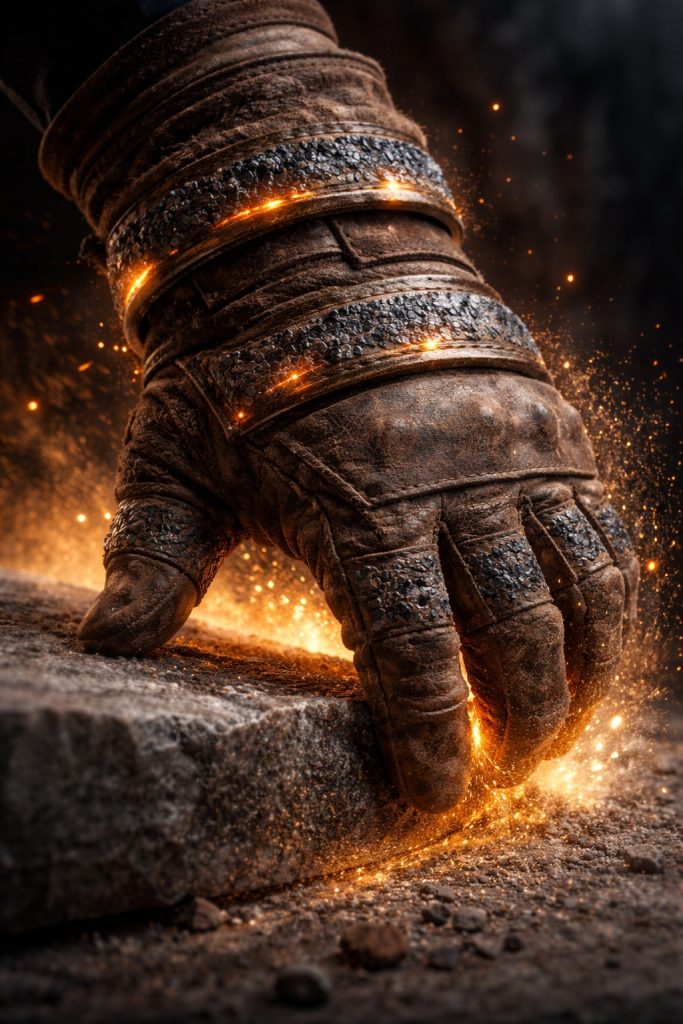
A rough-textured band or glove threaded with dark mineral grains that shimmer faintly when moved in circular motion. When active, the surface hums softly and sheds microscopic sparks of dust that vanish before settling.
Skills Gained While Openly Worn
• Material Processing: Improved ability to grind, polish, crush, or refine materials
• Tool Control: Greater consistency when using grindstones, files, mills, or mortars
• Endurance Focus: Reduced fatigue during repetitive manual labor
• Surface Awareness: Instinctive sense of smoothness, coarseness, and readiness
Passive Magical Effects
• Friction Memory: Repetitive grinding actions become smoother and more efficient over time
• Even Wear: Tools used while worn degrade more slowly
• Material Feedback: Subtle vibrations indicate when material is ready or overworked
• Wild Stabilization: Grinding actions resist magical distortion or interruption
Activatable Magical Effects
• Accelerated Grind
Activation: Action
Effect: For a short duration, grinding actions become faster and more precise, reducing time needed to refine materials without reducing quality.
Limitation: Cannot be used to create material faster than physically possible; only improves efficiency.
• True Edge
Activation: Action
Effect: The next grinding or sharpening action produces an unusually clean finish, granting improved effectiveness or quality to the result.
Side Effect: The item emits a low grinding hum audible nearby.
• Abrasive Pulse
Activation: Reaction
Trigger: A grinding, polishing, or crushing task would fail
Effect: The task instead succeeds at minimal quality, preventing waste or total failure.
Limitation: Cannot improve outcome beyond basic success.
Wild Behavior and Limits
• Does not work on living creatures
• Ineffective without physical contact and motion
• Overuse may numb the hands temporarily
• The item becomes warm after prolonged activation
• Wild magic may cause faint grinding sounds even at rest
Roleplay Emphasis – Grinding
This item rewards patience, persistence, and effort. It is not flashy, not fast, and not destructive. It thrives in workshops, camps, kitchens, and forges—anywhere progress is made through repetition. It embodies the philosophy that improvement is earned one motion at a time.
Tags
wild magic, grinding, abrasion, endurance, crafting, refinement, persistence, tier1, tool-focused, tactile, attuned, repetitive-motion, material-processing, surface-refinement, durability, steady-work, labor-enhancing, tactile-feedback, precision-crafting, friction-based, workmanlike, incremental-progress
How the Wild 477 of the Endless Abrasion Is Obtained
• Emergence Through Repetition
Most Wild 477 items come into being not through deliberate enchantment, but through prolonged, repetitive labor performed in areas where ambient magic fluctuates. Millstones, whetstones, mortar bowls, hand files, or even leather gloves used for years in grinding tasks can slowly absorb the rhythm of motion. When wild magic passes through such a space, it does not explode outward—it settles into the pattern already present. The item awakens not with power, but with habit.
• Inheritance from Long-Worked Trades
Many examples are passed down through families of millers, gemcutters, alchemists, tanners, or smiths. The item is rarely recognized as magical at first; it is simply known as “the good one,” the tool that never seems to dull or slip. Only when compared to others does its unusual reliability become clear.
• Accidental Creation During Magical Weather
In regions where magical storms or ley surges occur, grinding tools left in use during such events may become infused. These items often awaken mid-task, when the operator feels the motion suddenly become smoother, quieter, or more efficient without any visible cause.
• Salvage from Ancient Workshops
Ruined grinding halls, abandoned quarries, and collapsed artisan districts sometimes contain tools that still hum faintly when turned. These are among the most stable examples, having endured centuries of repetitive use before being forgotten.
• Deliberate but Rare Craft
Some master craftsmen attempt to create these items intentionally by grinding continuously during periods of magical instability. Success requires patience rather than precision, and many attempts fail simply because the crafter stops too soon.
Where and How It Is Bought or Sold
• Smithies and Craft Forges
These are the most common places where a Wild 477 might appear. It is rarely labeled as magical; instead, it is sold as a “seasoned” or “well-set” tool.
Cost Range
Low to moderate. Affordable to working artisans, but priced above ordinary tools due to reliability.
• Millhouses and Processing Guilds
Grain mills, stone-cutting houses, and alchemical processors sometimes trade these quietly among trusted workers. They are valued for consistency rather than power.
Cost Range
Moderate. Often sold alongside bulk materials or as part of a contract rather than for coin alone.
• Alchemical and Crafting Supply Shops
Specialized suppliers occasionally recognize the item’s nature and sell it as a minor enchanted tool. These shops tend to emphasize its endurance and stability rather than its magical origin.
Cost Range
Moderate to moderately high, depending on the shop’s knowledge and reputation.
• Salvage Dealers and Ruin Traders
Recovered from collapsed workshops or buried industrial sites, these versions may be worn, chipped, or unstable. Some are genuine; others are merely well-used tools mistaken for enchanted ones.
Cost Range
Low to moderate, highly variable based on condition and seller honesty.
• Private Exchange Between Craftspeople
The most common method of transfer. Often traded for favors, training, materials, or long-term work agreements rather than currency.
Cost Range
Negotiated personally; often worth more in labor than coin.
General Cost Expectations in Saṃsāra
The Wild 477 of the Endless Abrasion is valued for reliability rather than spectacle. It is rarely considered a “magic item” in the traditional sense, and many owners do not realize it is enchanted at all.
Its value increases if:
• It shows consistent performance over long periods
• It resists wear noticeably better than normal tools
• It produces uniform results with minimal effort
• It has a known history of long use
Its value decreases if:
• The grinding effect feels uneven
• It causes hand fatigue or vibration
• It emits sound or heat when not in use
• Its origin is unclear or unstable
How It Is Usually Sold
• Quietly, without ceremony
• Often demonstrated rather than explained
• Rarely advertised as magical
• Sometimes sold with a warning like “don’t rush it”
• Frequently passed along when a craftsperson retires or changes trades
Those who sell it often say something similar, regardless of region:
“It doesn’t make the work faster.
It makes the work truer.”
Roleplay Use of the Wild 477 of the Endless Abrasion
Defense and Offense by Environment
This item does not behave like a weapon or shield. It alters process, not outcome. Its power expresses itself through persistence, resistance, and the inevitability of wear. Roleplay with it emphasizes patience, positioning, and attrition rather than bursts of force.
────────────────────────
WORKSHOPS, FORGES, AND CRAFTING SPACES
────────────────────────
Defense
• The avatar uses the item to stabilize tools, surfaces, or footing during chaotic events such as collapsing shelves, shaking floors, or magical fluctuations.
• Incoming force is redirected into grinding resistance rather than impact, causing blows to glance or lose momentum.
• The avatar may brace against tables, walls, or machinery and let the item absorb vibration and stress.
• Environmental hazards such as sparks, slipping tools, or unstable platforms are mitigated through controlled friction and contact.
Offense
• Objects can be worn down deliberately over time: weakening hinges, softening metal edges, dulling enemy equipment through repeated contact.
• The avatar can use sustained pressure to break defenses indirectly, such as grinding through restraints, armor seams, or structural weak points.
• In a prolonged confrontation, the avatar’s steady motions gradually degrade the opponent’s gear or footing rather than striking directly.
Roleplay Tone
Methodical. Calm. Relentless.
The avatar does not rush. They outlast.
────────────────────────
CAVES, TUNNELS, AND UNDERGROUND ENVIRONMENTS
────────────────────────
Defense
• The item stabilizes footing on loose stone, gravel, or shifting terrain.
• Falling debris loses some of its impact as the grinding magic bleeds force away.
• The avatar can brace against cave-ins or collapsing supports long enough to escape or assist others.
• Tremors are felt early through vibration feedback, giving warning before danger strikes.
Offense
• Repeated grinding against stone weakens supports or collapses tunnels deliberately.
• The avatar can grind footholds into rock for allies while making pursuit more difficult for enemies.
• Enemy movement is slowed as terrain subtly degrades under repeated pressure.
Roleplay Tone
Patient erosion.
The cave yields not to strength, but to persistence.
────────────────────────
URBAN AND STRUCTURAL ENVIRONMENTS
────────────────────────
Defense
• The avatar can grind surfaces to increase traction, preventing slips or forced movement.
• Doors, gates, and barricades can be braced and reinforced through continuous pressure.
• In street conflicts, the avatar resists being pushed, knocked aside, or thrown off balance.
Offense
• Locks, hinges, and structural joints can be weakened through steady abrasion.
• The avatar may slowly compromise enemy cover or obstacles while remaining defended.
• Weapons that rely on sharpness or precision lose effectiveness when subjected to prolonged grinding contact.
Roleplay Tone
Quiet control.
The environment becomes a tool through repetition.
────────────────────────
WILDERNESS AND NATURAL TERRAIN
────────────────────────
Defense
• Movement across rock, sand, or uneven ground becomes safer and more controlled.
• Slips, slides, and falls are resisted through continuous friction feedback.
• The avatar can endure long marches without equipment degradation.
Offense
• The item allows gradual wearing of natural obstacles: bark, bone, horn, stone.
• Creatures relying on claws or armor suffer diminished effectiveness over time.
• Traps based on tension or balance are easier to disrupt or disarm.
Roleplay Tone
Endurance over dominance.
Nature is not fought, only outlasted.
────────────────────────
COMBAT SCENARIOS
────────────────────────
Defense
• Incoming force is diffused rather than blocked.
• Repeated impacts become less effective as the item absorbs micro-stress.
• The avatar remains standing when others would stumble or fatigue.
Offense
• Damage is cumulative rather than explosive.
• The avatar excels in prolonged engagements where equipment degradation matters.
• Over time, opponents find their weapons dulled, footing compromised, or stamina failing.
Roleplay Tone
Attrition.
The enemy does not lose suddenly — they wear away.
────────────────────────
MAGICAL OR CHAOTIC ENVIRONMENTS
────────────────────────
Defense
• Wild magic fluctuations are stabilized through repeated motion and grounding.
• The item resists sudden surges by converting instability into friction.
• The avatar feels when magical pressure is building before it erupts.
Offense
• Magical constructs and unstable effects can be weakened through sustained contact.
• Spell effects relying on precision or balance degrade faster.
• The avatar can disrupt magical processes without dispelling them outright.
Roleplay Tone
Persistence against chaos.
The world frays, but the grind continues.
────────────────────────
ROLEPLAY SUMMARY WITHOUT SUMMARIZING
This item does not win fights.
It finishes them.
It does not strike first.
It remains when others falter.
It is not loud, fast, or dramatic.
It is inevitable.
Where others rely on strength, the wielder relies on repetition.
Where others act, the wielder endures.
And when the dust settles, what remains is not power —
but the quiet certainty that everything, given enough time, wears down.
Perception of Activation:
User’s Perspective
• A low vibration travels up the arm or through the hands, not painful but persistent, like a distant machine turning.
• The surface being touched feels more “present,” its texture magnified—every grain, flaw, and resistance clearly defined.
• A steady warmth builds where contact is made, similar to friction heat but deeper, as though the motion itself is being remembered.
• The rhythm of motion becomes instinctive; the body naturally finds an efficient pace without conscious thought.
• The sound of grinding becomes muffled and steady, losing sharpness as the action smooths out.
• Time feels slightly compressed, as if repeated motion blurs moments together.
Observer’s Perspective
• Fine sparks or dust appear briefly at the point of contact, glowing faintly before fading.
• The motion of the avatar becomes methodical and unwavering, almost hypnotic to watch.
• Materials being worked appear to wear evenly, without chips or sudden breaks.
• The air near the item seems to shimmer subtly, as if vibrating from constant motion.
• Repetitive movement produces a soft, rhythmic hum rather than harsh noise.
Extra-Sensory Perceptions
• The avatar senses resistance as a gradient rather than a barrier, knowing intuitively how much pressure to apply.
• The material being worked feels “tired” when it is close to completion.
• Minute shifts in density or weakness become apparent through touch alone.
• Magical interference feels dampened, as though absorbed into the grinding motion.
• The act of repetition becomes mentally grounding, suppressing distraction or panic.
Positives
• Increased precision and consistency during repetitive tasks
• Reduced physical strain over time
• Greater awareness of material quality and readiness
• Improved control during long or delicate work
• A calming, meditative effect during extended use
Negatives
• Hands or arms may feel heavy after prolonged activation
• Overuse can cause temporary numbness or stiffness
• The steady rhythm may dull awareness of surroundings
• Sudden interruptions feel jarring and disorienting
• Extended activation can induce fatigue rather than exhaustion
When activated, the item does not feel powerful.
It feels patient.
As though the world itself has agreed to be worn down—
one careful motion at a time.
Recipe Title: The Rite of Enduring Friction
Materials Needed
• One dense grinding surface or tool head (stone, iron, hardened ceramic, or basalt)
• A fist-sized chunk of naturally worn stone taken from a riverbed, cliff base, or mill floor
• Fine abrasive dust (sand, pumice, or powdered bone)
• A binding strip of leather, cord, or metal wire
• Ash collected from a long-burning fire
• Clean water drawn from a slow-moving source
• A small amount of raw mana residue or crystal dust
• A personal item used regularly during labor (glove, ring, tool handle fragment)
Tools Required
• Grinding wheel or flat stone
• Mortar and pestle
• Heat source capable of maintaining low, steady warmth
• Polishing cloth or smooth hide
• Etching tool or rough chisel
• Stable work surface that will not shift during use
Skill Requirements
• Practical knowledge of grinding or surface refinement
• Ability to maintain repetitive motion without rushing
• Physical stamina
• Familiarity with handling materials over long periods
• Basic awareness of ambient magical flow
• Patience and focus
Crafting Steps
- Preparing the Core
Select the grinding surface or tool head that will become the heart of the item. It must show signs of wear but not damage. Clean it with water only. Do not polish it yet. Let it dry naturally. - Conditioning Through Motion
Grind the stone against another surface for a full cycle of steady motion. Do not rush. The goal is rhythm, not progress. Continue until the motion feels automatic and the sound becomes even. - Infusing the Abrasive Layer
Mix ash and abrasive dust together. Rub the mixture into the surface using circular motion. This embeds the memory of friction into the material. Continue until the surface feels warm to the touch. - Anchoring the Wild Influence
Sprinkle a small amount of mana dust across the working surface. Do not force it in. Let it settle naturally as you continue grinding. If the dust vibrates or sinks slightly, the infusion has begun correctly. - Binding the Tool
Attach the leather, cord, or wire securely. This binding represents continuity and endurance. The knot or fastening should be simple, functional, and unornamented. - Personal Imprint
Hold the item while performing a slow, repetitive motion for several minutes. Focus on consistency, not effort. Allow the personal item to remain in contact during this phase to establish sympathetic resonance. - Heat Setting
Warm the item gently over low heat until it is warm but not hot. Do not quench. Let it cool naturally while resting on stone or earth. - Final Conditioning
Polish lightly by hand. The surface should feel smoother than expected but not slick. If done correctly, the item will feel subtly heavier than its size suggests.
Outcome
A successful item will respond to repetition, growing smoother and more efficient the longer it is used. It will resist sudden force but thrive under steady pressure. The magic settles into the pattern of motion itself rather than the material.
Failure States
• Rushing the process causes instability or uselessness
• Excessive heat deadens the magical resonance
• Uneven motion results in erratic behavior
• Impatience prevents proper attunement
A properly crafted piece does not feel enchanted.
It feels worked.
As though time itself has agreed to lend it strength.
Stone That Learned to Wait
In the age before tools were named and before hands knew their own strength, there was a valley where nothing grew straight. The wind there moved in circles, and the rain never fell where it meant to. The people who lived at the edge of this place did not build high, for what rose too fast would not remain.
Among them lived a worker whose name has been lost to the breaking of tongues. In the oldest telling he is called “He Who Turns,” though later mouths shortened it to something that no longer means anything at all. He was not a leader. He did not speak much. He was the one who ground grain, shaped stone, smoothed bone, and wore through tools until others would have cast them aside.
He believed nothing was finished until it could no longer resist the hand.
The elders said the valley was cursed. They said the ground shifted because the world there was unfinished, that the stone remembered being liquid and wished to be so again. When tools broke or walls crumbled, they blamed the sky, or spirits, or ancient wrongs.
The grinder blamed none of these.
He said only, “It is not done yet.”
One year the tremors worsened. The mills cracked. The wheels seized. Grain could not be ground, and the people feared hunger more than falling stone. They begged the grinder to leave, to go where the ground held still. He refused.
Instead, he carried a heavy stone to the lowest place in the valley, where dust never settled and footsteps never stayed. There he sat, and he ground the stone against the earth.
Day after day he worked. Not to shape it. Not to break it. Only to wear it.
The valley groaned. The wind screamed. The ground shuddered as if offended. But the grinder did not stop. His hands bled. His tools dulled. He wrapped them and continued.
They say that on the seventh day the magic of the world noticed him.
Not because he was strong.
Not because he was clever.
But because he did not stop.
The wild currents that bent the valley flowed into the rhythm of his motion. They did not explode. They did not burn. They settled. They learned the pattern of resistance and repetition.
The stone grew warm. Then heavy. Then calm.
When the grinder stood, the ground beneath him stilled. Not everywhere. Only where he stood. Only where his hands had worked. The valley did not obey him—but it listened.
He tied the stone to himself and walked.
Where he stepped, the ground steadied. Where he leaned, walls stopped trembling. Where he worked, things slowly became as they should have been all along. He never moved quickly. He never forced anything.
And so the people began to bring him broken things.
A cracked wheel.
A bent tool.
A door that would not close.
He ground them. Slowly. Patiently. And they held.
Years passed. The grinder aged. His hands became knotted, his back bent. One day, he did not rise. They found him seated, the stone resting against his side, his hand still touching it.
They tried to move the stone.
It would not move.
Not because it was heavy.
But because it had learned to stay.
The valley quieted after that. The tremors lessened. The people built again, slowly, carefully. The stone was eventually carried away by those who did not know its story. They thought it was only a weight. Only a tool.
But those who listen say that when it is used—truly used—it hums. Not loudly. Not proudly.
Patiently.
As if reminding the world that nothing breaks all at once.
Moral of the story:
Power that strikes fades.
Power that endures remains.
Suggested conversions to other systems:
—
Call of Cthulhu 7th Edition
Wild 477: The Endless Abrasion
Item Type
• Occult grinding-wrap (worn; hands/wrists)
• Bond: requires the wearer to complete a full hour of uninterrupted grinding, polishing, crushing, or sharpening while wearing it
While Worn Openly
• +10% to Art/Craft (Sharpening), Art/Craft (Stonework), or Art/Craft (Metalwork)
• +10% to Mechanical Repair when the task involves filing, shaping, deburring, or fitting parts
• +10% to Science (Chemistry) when preparing powders, reagents, or refined materials via grinding
• –10% to Listen if you are actively grinding (the hum masks sound; only during the task)
Passive Magical Effects
• Friction Memory: repeated motion becomes steadier; Keeper may grant a bonus die on extended grinding tasks after the first successful roll in the same work session
• Even Wear: tools used while you wear it dull more slowly; minor tool breakage becomes less likely during normal use
• Material Feedback: you feel subtle vibration changes when a material is “ready,” “overworked,” or hiding a flaw (Keeper gives a clear tactile impression)
• Wild Damping: minor magical interference that would smear powders, skew polish, or warp delicate grinding is reduced within arm’s reach
Activated Effects
• Accelerated Grind (Action; costs 1 Magic Point)
– For the next several minutes, reduce the time needed for a grinding/refining task by roughly half without lowering quality (Keeper adjudicates; cannot exceed physical feasibility).
• True Edge (Action; costs 1 Magic Point)
– The next sharpening or finishing task gains a bonus die; if it succeeds, the result is exceptionally clean and consistent.
– Side effect: a low grinding hum is audible within a short distance.
• Abrasive Pulse (Reaction; costs 1 Magic Point; trigger: you would fail a grinding/polishing/crushing task)
– Convert a failure into a minimal success (usable result, but plain; no extra quality).
Wild Magic Drift (whenever you activate, roll 1D6)
• 1: Numb Hands—penalty die on the next DEX-based action requiring fine touch.
• 2–3: Harmless dust-spark shimmer.
• 4–5: Sound Carry—your hum travels farther than expected; attention risk.
• 6: Over-Polish—your result becomes slightly “too smooth” or “too rounded,” imposing a small complication (Keeper chooses).
—
Blades in the Dark
Wild 477: Abrasion Wrap
Type
• Arcane craft-wrap (worn; hands)
Load
• 1 Load
When Worn Openly
• You have potency when you Tinker to grind, polish, file, deburr, fit, or refine materials.
• You have potency when you Study an object by touch, reading flaws, stress points, and readiness through vibration.
• When you attempt speed at the expense of care, the GM may reduce effect (the wrap rewards repetition, not rushing).
Activated Uses (each use: mark 1 tick on a 4-segment clock “Friction Debt”)
• Accelerated Grind (Action)
– Take +1 effect on a refining or repair task that relies on grinding/polishing.
• True Edge (Action)
– Add +1d to a single roll to sharpen/finish; on success, the result is notably clean and reliable.
– Also creates a minor complication: audible hum or visible dust-spark.
• Abrasive Pulse (Reaction)
– When you would suffer a “ruined materials / broken tool” consequence, cancel it and replace with a lesser complication (extra time, noise, hand fatigue, attention).
Friction Debt Clock (4 segments)
• When filled, the GM introduces a complication: numbness, loud resonance, over-smoothed result, or a fine dust plume that gives away your position.
• Clear at end of scene, or by resting hands and cleaning the wrap in quiet for a few minutes.
—
Dungeons & Dragons (revised 5th edition, 2024 core)
Wild 477: Endless Abrasion Wrap
Wondrous Item (gloves/wrist-wraps), common (requires attunement)
Passive Properties (while worn openly)
• You gain proficiency with one of the following tools: smith’s tools, mason’s tools, alchemist’s supplies, or cook’s utensils. If you already have that proficiency, you instead add double your proficiency bonus to checks you make with it when the work involves grinding, polishing, filing, or sharpening.
• You have advantage on Intelligence checks to assess metal/stone/ceramic readiness (too brittle, too soft, hairline flaws, uneven grain) by touch during a minute of handling.
• Your tools resist wear: once per long rest, when a tool would break, dull, or become unusable during a task you are performing, it instead remains usable (it may still show cosmetic wear).
Activated Properties
• Accelerated Grind
– Action; once per short or long rest
– For the next 10 minutes, you have advantage on ability checks made with relevant artisan’s tools when grinding/polishing/refining, and you can complete a task in roughly half the normal time (DM decides what qualifies).
• True Edge
– Action; once per long rest
– Choose one nonmagical weapon, tool edge, or implement you can touch. For 1 hour, it is exceptionally finished; the next time it would suffer a penalty from dullness, poor quality, or minor damage, that penalty is ignored.
– Side effect: a faint audible hum accompanies the finishing work.
• Abrasive Pulse
– Reaction; once per long rest; trigger: you fail an ability check made with artisan’s tools involving grinding/polishing/refining
– You reroll the check and must use the new roll. If the reroll succeeds, the result is serviceable but plain; if it fails, the DM may introduce a minor complication (hand numbness, noise, dust plume).
Wild Magic Quirk
• The first time each day you use an activated property, roll 1d6:
– 1: Hand Numbness—disadvantage on your next Dexterity check requiring fine manipulation.
– 2–5: Cosmetic dust-spark only.
– 6: Over-Polish—your work comes out slightly too smooth or rounded, creating a small drawback the DM chooses.
—
Knave (Second Edition)
Wild 477: Endless Abrasion
Slot and Carry
• Worn (hands/wrists); takes 1 item slot
While Worn Openly
• Advantage on checks to grind, polish, sharpen, file, crush, mill, or refine materials.
• Advantage on checks to feel flaws, hairline cracks, uneven grain, or “readiness” by touch.
• Tools used during these tasks degrade more slowly; the GM is less likely to rule a tool ruined from ordinary use.
Activation: Accelerated Grind
• Once per day, complete a grinding/refining task in about half the time, without losing quality (GM decides what qualifies).
Activation: True Edge
• Once per day, your next sharpening/finishing task produces an unusually clean result; gain advantage on the roll and the result is notably reliable. A low hum may be heard nearby.
Activation: Abrasive Pulse
• Once per day, when a grinding/polishing/crushing task would fail, it instead succeeds at minimal quality (usable, plain, no bonus).
Wild Drift (each activation, roll 1d6)
• 1: Numb Hands—disadvantage on the next roll requiring fine touch.
• 2–3: Harmless dust-spark shimmer.
• 4–5: Sound Carry—attention risk.
• 6: Over-Polish—minor complication: too smooth, too rounded, or dust plume.
—
Fate Core / Fate Condensed
Wild 477: The Endless Abrasion
Item Type
• Enchanted Work-Tool (Worn; Hands or Wrists)
Aspects
• “Nothing Yields All at Once”
• “Worn Smooth by Patience”
• “The Work Continues”
Permissions
• Allows the character to treat grinding, polishing, shaping, or refining as meaningful narrative actions.
• Justifies resisting failure through persistence rather than speed or force.
Stunts
• Friction Knows Best
Once per scene, gain +2 when Overcoming an obstacle involving wear, erosion, shaping, or gradual reduction of material.
• Steady Hands
Once per scene, ignore a negative aspect or complication related to fatigue, poor tools, or imperfect materials while performing a repetitive task.
• The Work Goes On
When you fail a roll related to crafting or refining, you may succeed at a cost without invoking a Fate point. The cost must involve time, noise, exhaustion, or unwanted attention.
Drawback
• When compelled, the item encourages slow, methodical action even when speed is required.
Narrative Role
The Endless Abrasion is a tool of persistence. It rewards patience, endurance, and the belief that steady effort outlasts sudden brilliance.
—
Numenera / Cypher System
Wild 477: Endless Abrasion Wrap
Level
• 3
Form
• Worn tool-wrap or grinding glove
Depletion
• 1 in 1d20
Constant Effects
• Asset on tasks involving grinding, polishing, sharpening, crushing, or refining materials
• Asset on Intellect or Might tasks made to assess material quality by touch
Activated Abilities
• Accelerated Grind (Action)
Reduce the time required for a crafting or refining task by one step without reducing quality.
• True Edge (Action)
Gain an asset on the next task involving tool sharpening or surface finishing. The result is unusually consistent.
• Abrasive Pulse (Reaction)
When a crafting or refining task would fail, downgrade the failure to a minor complication instead.
GM Intrusions
• Hands grow numb, imposing a hindrance on the next delicate task
• Dust or vibration reveals the character’s position
• The material becomes too smooth or brittle for its intended use
Design Role
A stability-focused cypher that rewards repetition, patience, and material knowledge rather than raw power.
—
Pathfinder Second Edition
Wild 477: Endless Abrasion Wrap
Item Level
• 3
Item Type
• Worn Item (Invested)
Traits
• Magical
• Transmutation
• Tool
Passive Effects
• +1 item bonus to Crafting checks involving grinding, polishing, or shaping
• You ignore the first instance of tool degradation or material waste each day
Activated Abilities
• Accelerated Grind
Frequency: once per hour
Effect: Reduce the time required for a Crafting activity involving abrasion by half.
• True Edge
Frequency: once per day
Effect: Grant a +2 circumstance bonus to a Crafting check to sharpen or finish an item. If successful, the result is unusually consistent and durable.
• Abrasive Pulse
Frequency: once per day
Reaction: When you fail a Crafting check involving grinding or polishing, treat the result as a success with a minor flaw.
Drawback
• Overuse causes hand fatigue. If two activations are used within 10 minutes, you become Fatigued for 1 round.
Roleplay Emphasis
A craftsman’s tool that rewards persistence, careful repetition, and respect for materials.
—
Savage Worlds (Adventure Edition)
Wild 477: Endless Abrasion Wrap
Item Type
• Arcane Tool (Minor)
Passive Effects
• +1 to Repair or Common Knowledge (Craft) rolls involving grinding, shaping, or finishing
• Tools used while wearing the item are less likely to break or dull
Powers
• Accelerated Grind
Power Points: 1
Effect: Halve the time required for a crafting or repair task involving abrasion.
• True Edge
Power Points: 1
Effect: Gain +2 to a single Repair or crafting roll; if successful, the result is notably durable.
• Abrasive Pulse
Power Points: 1
Effect: When a crafting task would fail, reroll once and take the better result. A complication may still occur.
Backlash
• On a critical failure, the user becomes Fatigued as the constant vibration numbs their hands.
Narrative Role
The Endless Abrasion is a tool of labor, not combat. It shines in long-term projects, battlefield repairs, and situations where persistence outweighs speed or strength.
Its magic is not dramatic.
It is dependable.
And in Saṃsāra, that makes it dangerous in the long run.
—
Shadowrun Sixth Edition
Wild 477: Endless Abrasion Wrap
Item Type
• Minor Magical Focus (Crafting / Material Manipulation)
• Availability: Legal (Industrial / Artisan Circles)
• Bond Cost: 3 Karma
Description
A dense, grit-lined wrap worn around the hands or forearms. It resonates with repetitive motion, stabilizing tools and materials through subtle wild-magic feedback.
Passive Effects
• Gain +1 Edge on tests involving Crafting, Engineering, or Repair when the task involves grinding, polishing, filing, or abrasion
• Reduce threshold by 1 for extended tests involving material refinement
• Tools used while wearing the wrap ignore the first instance of wear or damage per scene
Activated Effects
Accelerated Grind
• Action: Minor
• Cost: 1 Edge
• Effect: Reduce time required for a crafting or repair task by one interval without reducing quality
True Edge
• Action: Major
• Cost: 1 Edge
• Effect: Gain +2 dice to a single Crafting or Repair test involving sharpening or surface refinement
Abrasive Pulse
• Reaction
• Cost: 1 Edge
• Effect: Convert a failed crafting test into a partial success with a minor complication
Backlash
• If two activations occur in one scene, the user suffers –1 to Agility-based tests for the remainder of the scene due to hand fatigue
—
Starfinder
Wild 477: Endless Abrasion Module
Item Level
• 3
Item Type
• Hybrid Worn Item (Tool Augment)
• Usage: 1 charge
• Capacity: 10 charges
Passive Effects
• +2 insight bonus to Engineering checks involving shaping, grinding, or material refinement
• Reduce tool wear; tools do not degrade on failed checks once per day
Activated Abilities
Accelerated Grind
• Action: Standard
• Cost: 1 charge
• Effect: Halve time required for a crafting or repair task
True Edge
• Action: Standard
• Cost: 1 charge
• Effect: Gain +2 to next Engineering check involving sharpening or finishing
Abrasive Pulse
• Reaction
• Cost: 1 charge
• Effect: When a crafting check fails, treat it as a success with no additional benefits
Overuse Effect
• If reduced to 0 charges, user takes –2 to Dexterity-based checks for 1 minute
—
Traveller (Mongoose 2e)
Wild 477: Endless Abrasion Tool
Tech Level
• TL 10–11
Item Type
• Worn Tool Enhancement
Passive Effects
• DM+1 to Mechanics or Engineer checks involving grinding, shaping, or polishing
• Reduces time required for long-term crafting projects by 25%
Activated Effects
Accelerated Grind
• Action: Significant
• Effect: Complete one stage of a crafting task instantly
True Edge
• Action: Significant
• Effect: Gain DM+2 to a single Craft or Repair check
Abrasive Pulse
• Reaction
• Effect: Convert a failed crafting check into a success with reduced quality
Limitation
• After two activations, user suffers DM–1 to Dexterity checks until rested
—
Warhammer Fantasy Roleplay 4th Edition
Wild 477: The Endless Abrasion
Type
• Enchanted Item (Minor)
• Availability: Scarce
• Encumbrance: 0
Traits
• Magical
• Practical
• Subtle
Passive Effects
• +10 to Trade (Smith, Mason, Engineer, or similar) when grinding or polishing
• Ignore first instance of tool degradation per session
Activated Abilities
Accelerated Grind
• Action: Half Action
• Effect: Reduce time for a crafting or repair task by half
True Edge
• Action: Half Action
• Effect: Gain +20 to a single Trade test involving refinement or sharpening
Abrasive Pulse
• Reaction
• Effect: When a Trade test fails, treat it as a success with one minor flaw
Miscast Consequence
• On a Critical Failure, the user gains the Fatigued condition as vibrations numb the hands
Roleplay Emphasis
The Endless Abrasion is not a weapon but a lesson in endurance. It rewards persistence, punishes haste, and turns labor into inevitability. In the hands of a patient worker, it becomes as reliable as time itself.
Comments
One response to “Wild 477 of the Endless Abrasion”
[…] Wild 477 of the Endless Abrasion: The grit-lined foundational gauntlet. […]