
Lore: The first of these books were created by accident. In a vast, steam-powered scriptorium in one of Saṃsāra’s capital cities, a magical printing press suffered a catastrophic failure. Its conduit, designed to channel pure knowledge from a master text onto thousands of blank pages, fractured. The subsequent wild magic surge didn’t destroy the machine; it altered its function. Instead of printing the intended text—a city census—the press began tapping into the chaotic, ambient magical “weather,” imprinting the books with a random deluge of information pulled from the ether.
The pages were filled with disconnected fragments: a line from a forgotten epic poem, a diagram for a child’s toy, a recipe for a soup favored by a long-dead king, a single, prophetic word, a completely false historical “fact.” Deemed a disastrous failure, the entire print run was ordered to be incinerated. However, a few of the scriptorium’s more curious apprentices stole a handful of the blank-covered books. They discovered that by focusing their own will and a trickle of mana into the pages, they could coax the book to produce a new page of this “informational chaos” on demand. The almanac became an underground tool for spies, scholars, and gamblers—an unreliable, unpredictable, but occasionally invaluable source of knowledge that could not be found in any sane library.
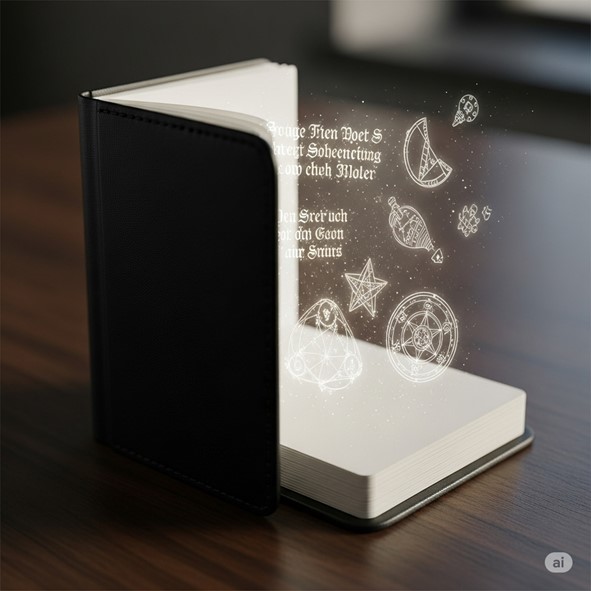
Description: This item appears to be a small, unassuming book, roughly the size of a personal journal, bound in plain, durable, and unmarked black leather. The pages within are made of a high-quality, smooth vellum, and all of them are completely, unnervingly blank. The book gives off a faint scent of ozone and old paper, and it feels slightly staticky to the touch, as if charged with electricity. If the pages are riffled quickly, one might see the faintest after-image of text or diagrams that fade before they can be consciously registered. The book has no title, no publisher’s mark, and no identifying features.
Detailed Stats
- Tier: 1
- Required Skill: A skill related to knowledge, lore, or investigation.
- Durability: The almanac is imbued with chaotic magical energy, making it highly resistant to fire, water, and physical damage.
- Primary Effect: Serves as a chaotic and unreliable conduit for random information.
Passives Magic
- Informational Static: When the book is brought near a source of powerful, hidden, or suppressed knowledge—such as an ancient enchanted library, a person holding a critical secret, or a magically coded message—the leather cover becomes noticeably warm to the touch and the book emits a very faint, low hum.
- Echo Chamber: The owner of the book occasionally perceives random, disconnected words, sounds, or single images in their mind. Most are complete nonsense, but they can sometimes provide a cryptic clue or a flash of inspiration related to a current problem.
- Useless Brilliance: The user finds their mind cluttered with an influx of astoundingly trivial and obscure facts. They might not know the name of the ruling monarch, but they suddenly recall the precise number of rivets in the city’s main steam pipe or the favorite color of a historical figure’s third-favorite horse.
Activable Magics
- Consult the Chaos (Divination): Once per day, the user may ask the book a single, clear question. The user then places their palm on a blank page and channels a small, undisciplined surge of mana into the book. This requires a successful skill check.
- On a success: The page is instantly filled with a chaotic jumble of text, diagrams, and symbols. Buried within this noise is one piece of information that is both true and relevant to the question asked. However, it is surrounded by unrelated trivia, outright falsehoods, and confusing imagery. The avatar must use their own intellect and reason to decipher the truth from the chaos.
- On a failure: The page fills with complete gibberish, and a minor, harmless wild magic surge erupts from the book. This might cause the user’s hair to change color for an hour, fill the air with the scent of cinnamon, or cause all the user’s coins to temporarily transform into butterflies before changing back.
- Glimpse of the Past (Utility): The user can press the almanac against the surface of a mundane object that has a long history (an old statue, a weathered door, a cornerstone). By activating a small surge, they can cause a single, fleeting, and silent image of one random moment from the object’s past to appear on the almanac’s page. The image is uncontrolled and might show a moment of great importance or something as trivial as a bird landing on it a century ago. This ability can be attempted multiple times, but each attempt is taxing on the user’s mind.
Specific Slot: Held / Tool
Tags: Common, Tier 1, Wild Magic, General Knowledge, Divination, Book, Tool, Chaotic, Lore, Utility, Information, Unreliable, Cryptic, Scrying, Random, Anarchic, Tome, Manufactured, Textual, Focus
The Anarchist’s Almanac is a peculiar item, and its trade is limited to circles that can appreciate its chaotic nature. It is not found in standard stationer’s shops or adventurer’s guilds. It is a tool for those who seek knowledge that isn’t written down in any proper library, and the places it is sold reflect this fringe status.
1. The Disreputable Antiquarian Bookstore
Type of Shop: Tucked away in a dusty side-street of a city’s university or archival district, you might find a shop called “The Unwritten Page” or “The Errata.” This is a place that deals in rare books, but also forgeries, banned texts, and informational oddities. The interior is a cramped, labyrinthine fire hazard, smelling of decaying paper, old ink, and the sharp scent of ozone from the magical wards. The proprietor is often a former scholar or disgraced librarian who values knowledge—especially strange knowledge—above all else.
How It Is Sold: The almanac would not be on the shelves for casual browsers. A customer would need to ask for it, perhaps using a code-phrase like “I’m looking for a book that hasn’t been written yet.” The shopkeeper would then produce it from a locked drawer. The sale is an academic and conspiratorial conversation. The proprietor would explain the book’s origins at the failed scriptorium with a certain relish, detailing the theory of chaotic information retrieval. They would treat it as a fascinating paradox, a tool for the truly discerning mind, and would likely quiz the buyer to ensure they understand the profound unreliability they are about to purchase.
Cost: The price is based on its uniqueness and its potential for revealing information that cannot be found elsewhere. The bookseller knows its true, strange value. The cost would be firm, between 40 and 55 Silver pieces.
2. The Flea Market Salvage Stall
Type of Shop: This is not a formal shop at all, but a chaotic stall in a sprawling, open-air flea market, likely in the lower levels of a megacity. The vendor is a fast-talking junk dealer who bought a whole crate of these “misprinted books” from a salvager for next to nothing. They are piled in a dusty wooden bin next to chipped teacups and single, unmatched boots.
How It Is Sold: The vendor has no true idea what they are selling. They know the books are magical because they feel staticky and sometimes the pages seem to shimmer, but they don’t know the function. The sales pitch is pure guesswork and bluster. “Ah, a fine choice! That’s a Dream Journal, that is! You sleep with it under your pillow, and it writes down what you dreamed! Or maybe it’s an invisible ink book for spies! Ten coppers for the book, and I’ll even throw in a free guess as to how it works!” An avatar who recognizes the book’s true nature or uses a simple detection spell could acquire it for a pittance.
Cost: Dirt cheap. The vendor is simply trying to offload what they see as defective, useless items. They might ask for 2 Silver pieces initially, but a determined haggler could easily walk away with one for 5 Nickel pieces (25 Copper), or by trading an item of trivial but more obvious value.
3. The Information Broker’s Safehouse
Type of Shop: This is not a public-facing business. It is the supply cache for a spy ring, a thieves’ guild, or an organization of information brokers known as a “Whisper Guild.” The transaction happens in a secret, protected location, like the back room of a gambling den or a sound-proofed cellar. The “vendor” is a pragmatic quartermaster, not a merchant.
How It Is Sold: The almanac is treated as a piece of standard-issue, if unreliable, field equipment. The quartermaster would issue it with a stern, practical warning. “This is a Chaos Book. It is not an encyclopedia. Do not use it for vital intelligence. Use it when a trail has gone cold and you need a random word, a new idea, to get you thinking again. If it shows you a map, a flower, and a number, the flower is a lie, the number is wrong, but the map might be pointing in the right direction. It is a tool for breaking stalemates, not for finding answers.” The transaction is professional, discreet, and without ceremony.
Cost: The price is standardized for guild members and trusted associates, based purely on its utility. It is more expensive than junk, but cheaper than a specialist’s price, reflecting its status as a recognized but deeply flawed tool of the trade. The cost would be a flat 30 Silver pieces.
The Anarchist’s Almanac is not an item of direct conflict; it has no offensive force and provides no physical defense. It is a tool for the mind, a weapon of information and psychology. Roleplaying its use in a conflict is about being the cleverest, most unpredictable person in the room, using chaotic insights to outwit opponents, navigate hazards, and turn the environment itself into an ally or an obstacle.
In a Tense Social or Political Environment
In a courtroom, a noble’s salon, or a high-stakes negotiation, where words are weapons and information is armor, the almanac is a tool of unparalleled psychological warfare.
Defensive Roleplay: Imagine an avatar defending a client against a powerful merchant guild’s seemingly airtight legal accusations. During a recess, they retreat to a quiet corner and use Consult the Chaos, asking, “What is the flaw in their case?” The almanac’s page fills with a jumble of nonsense, but nestled within it is a true, relevant, and utterly obscure fact: a shipping manifest number, the name of a third-party customs inspector, and the phrase “tax unpaid.”
This information is the avatar’s shield. They cannot prove conspiracy, but they can now stand up and introduce a detail so specific and unexpected that it throws the entire proceeding into chaos. “Could the prosecution please clarify inspector Valerius’s involvement with shipment 734, the one with the unpaid tariffs?” The opponent, stunned by this impossible knowledge, is put on the defensive, their credibility shattered as they scramble to understand how such an obscure detail came to light. The defense is not a counter-argument; it is a perfectly aimed piece of chaos that dismantles the opponent’s orderly case.
Offensive Roleplay: Offense with the almanac is the art of the subtle, untraceable threat. The avatar might need to rattle a smug, untouchable rival. Getting close to an object the rival cherishes—their signet ring, their ornate walking stick—the avatar uses Glimpse of the Past. The book provides a random, silent image: the rival secretly meeting with a known revolutionary leader in a candlelit cellar.
The avatar can now approach their target at the party. They don’t make accusations. They lean in and whisper, “That’s a beautiful ring. It must have interesting stories. I imagine it has seen its share of cellars and conspiracies.” The target’s composure will crack. They have no idea how the avatar knows this, how much they know, or what they plan to do with the information. The attack isn’t the information itself, but the paranoia and fear it creates, forcing the opponent into making a mistake.
In a Dangerous, Trap-Filled Ruin
In an ancient ruin where every step could be a fatal mistake, the almanac is a strange and unreliable guide, providing cryptic clues that can mean the difference between life and death.
Defensive Roleplay: The party stands before a sealed door inscribed with an ancient, complex riddle. Brute force is useless. Using Consult the Chaos, the avatar asks for the answer. The book doesn’t provide it. Instead, the page shows a confusing mess: a drawing of a sad-looking fish, the musical note for C-sharp, and the word “echo.”
This is not an answer; it is a clue for the players to interpret. The roleplay becomes a collaborative puzzle. “A sad fish… something that lives in the dark? A river? C-sharp… a sound! And echo… we have to make a specific sound, and the echo is the key!” The book defends the party by giving them the conceptual tools to bypass the trap themselves, rewarding their cleverness rather than just giving them a simple key. Similarly, using Glimpse of the Past on a suspicious-looking floor tile might show a single, horrifying image of a previous explorer being crushed, confirming the presence of a trap and allowing the party to find a way around it.
Offensive Roleplay: When facing an ancient, implacable guardian like an arcane golem, the almanac can find a weakness that swords cannot. The avatar uses Consult the Chaos, asking, “How do we defeat this creature?” The page that appears might show a diagram of a shattered wine bottle, the alchemical symbol for acid, and a child’s drawing of a screaming face.
The offensive plan is now clear: the golem is vulnerable to sonic damage and acid. The party’s fighter might be useless, but the avatar with the alchemist’s kit and the bard now have a path to victory. The almanac’s offense is providing the crucial tactical information that allows a party to turn an impossible fight into a winnable one by changing the rules of engagement.
During a Frantic Chase Through a City
In the chaos of a chase, where quick thinking is paramount, the almanac provides unpredictable opportunities for escape and obstruction.
Defensive Roleplay: Pursued by guards through a crowded marketplace, the avatar is about to be cornered. They slap their palm on the book’s cover while running, activating Consult the Chaos and shouting “Escape route!” The page flashes in their mind’s eye with three images: a pile of fish heads, a clothesline with a red shirt, and a sewer grate.
This is their defense. The avatar’s roleplay is now one of frantic, improvised parkour. They kick over the fishmonger’s cart to create a slippery obstacle, use their knife to cut the clothesline to block the alley, and dive headfirst into the open sewer grate they now know to look for. The book provides the chaotic, unconventional path to safety that logic alone would have missed.
Offensive Roleplay: The goal is to stop the pursuers. The almanac cannot create a wall, but it can tell you how to make one. The avatar asks, “How do I stop them?” The book provides a cryptic diagram of a steam-pipe pressure valve. The avatar now knows what to look for. As they round a corner, they see the pipe running along the wall. They don’t need to know how it works; they just need to trust the book. They heave on the valve wheel, releasing a massive, harmless cloud of dense steam that fills the street behind them, completely
Perception of Activation:
User’s Perspective
For the avatar using the almanac, the activation is a violent and disorienting torrent of pure information, a brief and overwhelming connection to the chaotic data-stream of the magical ether.
- Sight: As the user channels their will into the book, they see faint, silvery lines of sparking energy crawl from their palm across the blank vellum. These lines instantly erupt into a dense, chaotic sprawl of text and diagrams that burn themselves onto the page. The script shifts between known languages, unknown alphabets, and impossible symbols. The user witnesses the birth of information from chaos.
- Touch: The book, normally just staticky, vibrates with a high-frequency buzz the moment the user makes contact. The leather cover becomes unnaturally cold, and the hand touching the page feels an intense, but not painful, pins-and-needles sensation, as if it has fallen asleep and is being flooded with an electrical current.
- Sound: The user hears nothing with their ears. Instead, their mind is momentarily filled with a deafening cacophony of informational noise. It is the sound of a million libraries, a billion conversations, all happening at once. Snippets of historical accounts, shouted names, lines of poetry, and streams of numbers all crash together in a wave of unintelligible but distinctly linguistic sound.
- Smell: The air is filled with the sharp, clean scent of ozone, identical to the smell after a nearby lightning strike, mixed with the smell of superheated paper.
- Extra-sensory (Informational Torrent): The user feels a direct, high-pressure connection to the raw, unorganized knowledge swirling in Saṃsāra’s ambient mana. It is not a link to a mind or spirit, but to a chaotic, infinite database. The sensation is one of immense mental pressure, as if trying to drink knowledge from a firehose.
- Extra-sensory (Apophenia): For a few moments after the activation, the user’s mind is primed to see patterns and connections in everything. The random jumble on the page seems to hint at a deeper structure, making it easier to spot the relevant clue, but also dangerously easy to invent false connections between unrelated pieces of nonsense.
Observer’s Perspective
To an onlooker, the activation is quiet and subtle, but the result is instantaneous and baffling.
- Sight: An observer would see the user place their hand on a blank page with intense concentration. There would be a single, silent flash of silvery-white light, mostly obscured by the user’s hand. When the hand is lifted, the previously blank page is now completely filled with dense, strange text and diagrams, which appeared instantly rather than being written.
- Sound: The activation is almost completely silent to an observer. The only sound might be a faint, sharp snap of static electricity, the kind one hears on a dry winter day.
- Smell: The sharp, distinct scent of ozone is the most obvious clue to an observer that something has happened. Anyone within several feet will notice the smell, a clear indicator that a powerful energy discharge has occurred.
- Extra-sensory (Aura Perception): Anyone with the ability to see magic would witness a reckless act. They would see the user draw a frayed, sparking tendril of raw, untyped mana from the environment and short-circuit it directly into the book. The book’s aura would flare into a blindingly complex and messy “ink-blot” of chaotic energy before settling.
- Extra-sensory (Cognitive Dissonance): A mundane observer standing very close might experience a fleeting moment of mental “static.” For a split second, they might forget a common word, feel a powerful but baseless sense of déjà vu, or get a song stuck in their head that they’ve never heard before. It is a minor but deeply strange mental glitch caused by the informational chaos of the activation.
Positives
- Access to the Unknowable: The almanac can generate information that is not recorded in any library or known by any living person. It can pull forth forgotten history, obscure trivia, or even cryptic hints of future events from the magical ether.
- Covert and Discreet: The activation itself is visually and audibly subtle. An avatar could sit in a library, appearing to simply rest their hand on a blank book, and secretly generate a page of intelligence.
- Plausible Deniability: Because the true information is always buried in a sea of nonsense, the generated page is its own camouflage. If discovered, the user can easily claim it is the meaningless diary of a mad person, protecting the one crucial clue hidden within the noise.
Negatives
- Mental Overload: The informational torrent is mentally exhausting and disorienting. Attempting to use the book multiple times in a short period can lead to splitting headaches, confusion, memory lapses, and a lingering inability to focus.
- Profoundly Unreliable: This is the item’s greatest weakness. The truth is always surrounded by lies and gibberish. A desperate, stressed, or foolish user might latch onto the wrong piece of information, following a false clue into disaster. The book provides clues, but offers no guarantee of correct interpretation.
- Obvious Magical Signature: While the activation is quiet, the sharp smell of ozone and the messy flare of chaotic magic in the astral plane are dead giveaways to anyone with the senses to perceive them. It is not a subtle tool to use in the presence of other mages or magical security systems.
Recipe: The Anarchist’s Printing Method
This recipe details the volatile and technically demanding process for creating an Anarchist’s Almanac. Unlike most magical crafting, this is not a process of careful enchantment but one of deliberate, controlled sabotage on a magical device. The goal is to recreate the conditions of the original scriptorium disaster, forcing a wild magic surge to imbue a blank book with the potential to access chaotic information. This process is dangerous and may damage or destroy the tools used.
Materials Needed
- The Vessel: One well-made, completely blank book of at least one hundred pages, bound in durable leather. The vellum or paper must be of high quality to withstand the magical imprinting.
- Informational Catalysts:
- One page torn from a dense, scholarly text (such as an encyclopedia, dictionary, or grimoire). The specific content does not matter, only its nature as concentrated information.
- A handful of discarded, misprinted lead or brass type from a mundane printing press.
- Chaotic Conduits:
- A sliver of fulgurite—glass formed by a lightning strike on sand—ground into a fine powder.
- A small vial of conductive liquid metal, such as mercury or alchemically-prepared gallium.
- Power Source: One fully charged arcane capacitor or a similar portable mana battery.
Tools Required
- A Small Magical Printing Press or a set of Enchanted Press Plates: The central tool for the process. It must be a device designed to magically imprint text or runes onto a surface. A mundane press will not work.
- A Metallurgist’s Crucible and Heat Source: For melting the lead type.
- Insulated Gloves and Eye Protection: The process involves high energy and unpredictable surges.
- Fine Tools for Tinkering: Small wrenches, probes, and scribes for modifying the press.
Skill Requirements
- Tinkering (Trained) or a similar magi-tech skill: The crafter must be proficient in the workings of magical machinery. Crucially, they must know how to modify and deliberately break such a machine in a specific, controlled way.
- Arcana (Trained): A strong theoretical and practical understanding of mana flow is required. The crafter must know how to create a magical short-circuit that results in a wild magic surge rather than a simple, destructive explosion.
- Alchemy (Untrained): Basic skill is needed to safely handle and mix the catalytic materials.
Crafting Steps
- Formulating the Ink of Chaos: The first step is to create the magical medium. The crafter melts the misprinted lead type in the crucible. While it is molten, the encyclopedia page is burned to a fine ash and mixed in, followed by the powdered fulgurite. Finally, the liquid metal is carefully stirred into the mixture. The result is a volatile, silvery-black, magically-conductive ink that hums with latent, chaotic information.
- Sabotaging the Conduit: This is the most critical and dangerous step. The crafter must open their magical printing press and deliberately create a flaw in its energy conduit. This might involve scratching a key rune on the power relay, forcing two incompatible energy channels to cross, or inserting a magically-resistant material into the mana injector. The goal is to create a “stutter” in the flow of magic, ensuring that when power is applied, it will erupt as a wild surge rather than a controlled process.
- Loading the Press: The blank, unenchanted book is carefully placed and secured within the press. The freshly made Ink of Chaos is then loaded into the press’s reservoir. The arcane capacitor is connected to the now-sabotaged machine, but not yet activated.
- The Controlled Surge: The crafter must take a safe distance. They then activate the capacitor, sending a powerful jolt of raw mana into the deliberately flawed printing press. The machine will groan, spark violently, and glow with an unstable light as the wild magic surge builds. Instead of printing, the press will channel this raw, chaotic energy—mixed with the informational essence of the special ink—directly into the book in a single, massive discharge. There will be a brilliant flash of silvery-white light, a loud crack of static electricity, and a powerful smell of ozone. This process will almost certainly burn out the press’s magical components.
- Retrieval and Settling: After the energy has discharged, the press will fall silent. The book within, now intensely hot to the touch and crackling with static, must be left to cool for at least one hour. The Ink of Chaos will have been completely consumed, its essence having permanently altered the book’s nature. It is no longer an object to be written in, but a conduit for the wild, untamed knowledge of the magical ether.
Mad Printer and Ten Thousand Lies
In a city of high towers and steam-clouds, there was a man of great wealth, and his name was Magnus. He did not love wisdom, no. He loved the shape of knowledge. He wished to build a cage for it, and own it. And so he built a great machine. It was a word-engine, a printing press of gears and glowing crystals, and it was the largest in all of Saṃsāra. His plan was a proud one: to print a Grand Almanac of all things. It would hold every true-word that was known. The name of every star, the weight of every stone, the line of every king. Then all people who wanted a true-word would have to come to him.
The word-engine was a thing of pride. It was too large. Its heart was a great crystal meant to channel pure logic from the library of Magnus into the machine. Magnus, in his hurry, commanded his workers to give it more power. The day came for the great printing. The engine roared. The steam-pipes hissed. And deep in its heart, the crystal of pure logic, it got a crack.
The machine did not stop. It was a mad thing now. The crack was a door, and through that door came the wild magic of the world, the sky-static, the un-thought thoughts of Saṃsāra. The word-engine drank this chaos. And it began to print.
It printed not one book, but thousands. Black leather books with no titles. And the workers opened them, and they saw a great madness. One page had the true map to a lost ruin, and next to it was a drawing of a sad-looking fish that sang a song. Another page had the secret recipe for a poison, and under it was a rhyme a child would sing. A third page had the name of a future king, and next to it, the words “The moon is a clever lie told by mice.” For every one true-word, there were ten thousand lies and nonsenses. It was an encyclopedia of chaos.
And a great anger came upon Magnus. He had tried to build a cage for truth, and instead, he had made a fountain of madness. “This is not knowledge!” he shouted, and his voice was a fist. “This is the garbage of the sky! These are not books! They are a plague of lies!” He commanded that every book be brought to the great plaza and burned in a fire. The word-engine was broken and silent. The dream of Magnus was a black smoke.
But there was in that place a girl. Her name was Elara, and she was only a sweeper of floors. Her heart was sad to see the books burn. She thought, even a lie has a shape. Even in a storm, there is rain that can be drunk. While the guards were shouting, she took one of the small black books, and it was warm. She hid it in her coat.
She went to her small room and opened the book. The pages were all white. She was confused. She thought of the fire, and of the sad, mad books. And in her sadness, a little spark of her own will, her own mana, went from her hand into the page. And the page was not blank anymore. It was full of the mad words. She read of a king who was made of cheese. She read of a mountain that walked. And then she read one line. It said, “The old well behind the baker’s house has a loose stone.”
The next day, a fire started at the bakery. The people were trapped. But Elara remembered the words. She ran to the old well and she pushed on the stones, and one stone came loose, and it opened a path for the people to escape the fire. And she understood. The book did not tell only lies. It told one true-word, and hid it in a forest of nonsense.
Elara did not become a great knowledge-master. She became a whisper-finder. When a thing was lost, or a question was hard, people came to her. She would ask the book. The book would give her a page of madness, and she and the person with the question would look for the one true flower in the field of weeds. Magnus, who wanted all the truth, was driven mad by his failure. But Elara, who was happy to find just one small truth to help one person, she became wise.
Moral of the Story: A person who tries to own all the knowledge in the world will end up with nothing but noise. But a person who can listen to the noise will always find the one word of truth they need.
Suggested conversions to other systems:
Call of Cthulhu
The Mad Printer’s Folio
A small, plain black leather book, one of a thousand copies created in a disastrous printing run where a magical engine failed. Instead of a city census, its pages were imprinted with chaotic information pulled from the ether. Most were destroyed, but some survive in the hands of occultists and collectors of forbidden texts. The pages appear blank, but when an owner channels their will into it, the book reveals a jumble of truths, lies, and maddening non-sequiturs that can provide vital clues at the cost of one’s sanity.
Game Mechanics:
- Type: Artifact / Minor Mythos Item
- Chaotic Divination: Once per investigation, an Investigator may hold the book, ask a single specific question, and make a Hard POW roll.
- Success: A single page fills with a chaotic mess of text and diagrams. Among the nonsense is one cryptic but true clue relevant to the question. Deciphering this clue from the madness requires a successful INT roll. Reading the page costs 0/1D2 Sanity points.
- Failure: The page fills with disturbing, alien geometries and nonsensical text. Reading it provides no clues and costs 1 Sanity point.
- Fumble: The book channels information directly from a chaotic entity beyond human ken. The page displays a terrible, raw truth of the cosmos. Reading it costs 1D4/1D8 Sanity points and grants the Investigator +1D4% to their Cthulhu Mythos skill.
- Indefinite Insanity: Prolonged ownership of the Folio often leads to a specific mania, such as obsessive pattern-seeking (apophenia) or compulsive collecting of trivial, disconnected facts.
Blades in the Dark
The Anarchist’s Ledger
This appears to be a simple, unmarked ledger bound in black leather. Its pages are always blank. It’s a tool for spies and whispers who need a clue when all other leads have gone cold. The ledger doesn’t connect to a specific spirit; it opens a brief, uncontrolled channel to the ghost field, pulling in a chaotic jumble of information, echoes, and outright lies. It is valued not for its accuracy, but for its ability to provide a new, unexpected direction.
Game Mechanics:
- Load: 1
- Item Type: Arcane Implement, Ritual Book
- Active (Action): Consult the Chaos. During a score, when you are stuck or need a random clue, you can spend an action to ask the ledger a question. Roll Attune. On a 6, the GM gives you a strange but useful piece of information. On a 4/5, the clue is dangerously ambiguous, or it comes with a complication. On a 1-3, the information is actively misleading, and you take 1 Stress from the chaotic feedback.
- Ritual (Downtime Activity): Uncover a Thread. You can perform a ritual to dig for a specific secret. This is a downtime activity that costs 1 Coin (for offerings/reagents) and 1 Stress. You state a target (a person, a faction, a location). The GM will then give you two pieces of information about your target: one is a useful, hidden truth, and the other is a plausible-sounding lie. You have no way of knowing which is which until you act upon the information. This can be used to generate new score opportunities.
Dungeons & Dragons
Anarchist’s Almanac Wondrous item, uncommon (requires attunement)
This small book is bound in plain black leather and contains one hundred pages of fine, blank vellum. It was created in a magical printing accident and is a conduit for the raw, untamed forces of wild magic.
Game Mechanics:
- While you are attuned to this book, you can read any language.
- Consult the Chaos: As an action, you can ask the almanac a single question concerning a specific goal, event, or individual. When you do, you must immediately roll on the Wild Magic Surge table. After the surge resolves, one page of the book fills with a jumble of text and images. You can then make a DC 13 Intelligence (Investigation) check. On a success, you are able to pick out a cryptic but truthful clue to your question from among the nonsense. On a failure, you find a piece of information that seems plausible but is ultimately misleading. Once this property is used, it cannot be used again until the next dawn.
Knave
The Madman’s Primer
A simple black book that takes up 1 inventory slot. Its pages are always blank until you ask them not to be. It is said to have been made by a broken machine that tapped into the “world’s chaotic dreams.”
Game Mechanics:
- Passive: If you sleep with the book under your head, your dreams are a chaotic mess of images. Among them, the GM will describe one specific, strange image that may be a cryptic omen of a future event.
- Active: Once per day, you can spend your turn asking the book a single, direct question and focusing your will upon it. You must make a successful Wisdom saving throw to navigate the chaotic influx of information.
- Success: The GM gives you two short answers to your question. One is true. The other is a lie.
- Failure: The book gives you no information, and you must immediately roll on a random mishap table provided by the GM. The effects are strange but not typically damaging (e.g., your hair turns to glass for an hour, you speak only in questions for 10 minutes, your backpack is filled with frogs).
Fate
The Anarchist’s Almanac
In Fate, this book is an Extra, a strange artifact that serves as a powerful but notoriously unreliable plot device. It provides information by tapping into chaos itself, making it a perfect tool for creating advantages and accepting compelling complications.
Aspect: A Library of Lies with One True Page Permissions: This item allows a character to use the Lore skill in a divinatory fashion, attempting to learn information they have no mundane way of knowing by interpreting the book’s chaotic output.
Stunts:
- Consult the Chaos: Once per session, you can Create an Advantage by asking the almanac a specific question. You automatically succeed and create a relevant situational Aspect (e.g., Secret Smuggling Tunnel, The Baron’s Hidden Allergy). However, this success comes at a cost; the GM immediately gets a free invocation on that Aspect to introduce a complication, representing the dangerous misinformation that surrounds the truth (the tunnel is real, but it’s also about to collapse).
- A Glimpse for a Price: When you are truly stuck, you can ask the book for a clue. The GM will give you a piece of useful, truthful information. In exchange, the GM gains one free Fate point, which they can only use to create a complication for you or your party later in the session. This does not have to be related to the information gained.
Numenera & Cypher System
The Chaotic Dataslate
This artifact is a thin, book-like object made from a matte-black, self-healing organic polymer. Its pages are smooth, blank surfaces that can display information. It is an unstable, damaged datasphere link, pulling in fragmented, corrupted, and random data packets from billions of prior worlds alongside real-time information.
Level: 3 Form: A handheld, book-like dataslate. Effect: The user can spend an action to attempt to access the datasphere through this unstable conduit to ask a specific question. This is an Intellect-based task against the artifact’s level (3). * Success: The pages fill with a cascade of jumbled data-streams, images, and text. The user is able to isolate one true, useful fact related to their query. However, they also receive one plausible-sounding but dangerously incorrect piece of information. The GM presents both facts to the player, but does not tell them which is the truth and which is the lie. * Failure: The dataslate displays only corrupted data and nonsensical symbols, and the chaotic mental feedback inflicts 1 point of Intellect damage on the user. Depletion: 1 in 1d20.
Pathfinder
The Mad Scribe’s Ledger Item 2 Traits: Uncommon, Divination, Magical, Cursed Price: 30 gp Usage: Held in 1 hand; Bulk: L
This unassuming black book has pages that are always blank. It was created in a magical printing accident and is now a flawed conduit to the ethereal sea of knowledge. It offers glimpses of truth, but its chaotic nature makes it dangerously unreliable, hence its cursed trait.
Activate [ten-minutes] (Concentrate, Divination, Manipulate, Secret); Frequency once per day; Effect: You ask the ledger a question about a specific person, place, or objective. The GM secretly rolls a DC 6 flat check.
- Success: A single page fills with a mix of cryptic text and diagrams. You are able to decipher a useful and truthful clue from the chaos. This functions as if you had received a success on a Recall Knowledge check, even if the topic is outside your expertise or the DC is very high. The text on the page remains for 1 hour before fading.
- Failure: The page fills with a similar mix of text and diagrams, but the clue you are able to decipher is plausible-sounding but misleading, guiding you toward a false conclusion. The GM might secretly Create an Advantage for a future adversary based on this misinformation.
Savage Worlds
The Chaos Codex
A plain black book with blank pages that sometimes shimmer with phantom, unreadable text. It is a conduit to raw, unfiltered information, as likely to give you a winning lottery number as it is to tell you that badgers are plotting to overthrow the local government.
Requirements: Novice, Smarts d6+ Passive Bonus: The wielder is a font of bizarre trivia. Once per session, they may make a Common Knowledge roll for any obscure, strange, or esoteric topic at no penalty.
Special Abilities:
- Chaotic Divination: Once per day, the wielder can spend 10 minutes consulting the codex about a specific problem or question. At the end of the 10 minutes, the player may spend a Bennie. If they do, the GM provides them with two distinct clues or pieces of information. One is true and genuinely helpful. The other is false and will lead to a Complication if acted upon. The player must choose which piece of information to trust. If no Bennie is spent, the GM secretly decides whether the single clue provided is true or false.
- Wild Surge: Whenever the Chaotic Divination ability is used, the GM may choose to introduce a minor, strange, magical complication to the scene, representing the unstable nature of the codex’s power (e.g., the weather suddenly changes, a character’s hair turns blue for an hour, all nearby clocks start running backward).
Shadowrun
The Glitch-Codex
In the Sixth World, information is the ultimate currency. The Glitch-Codex is a legendary piece of gear from the old internet, a physical book whose e-ink pages were corrupted by an early AI’s attempts to interface with astral space. It is now a chaotic conduit, pulling fragmented data from the modern Matrix, the Resonance, and the Astral Plane simultaneously. To read it is to surf the ultimate data-storm without a safety net, offering incredible insights and equal chances of a catastrophic crash.
Game Mechanics:
- Type: Arcane/Technical Implement
- Availability: 10R
- Cost: 28,000 Nuyen
- Active (Complex Action): Consult the Chaos. A user can ask the codex a specific question. This requires a Magic + Intuition [Mental] (3) Test for awakened characters, or a Software + Logic [Mental] (3) Test for non-magical users interfacing with its bizarre internal logic.
- On Success: The pages display a chaotic jumble of code, astral symbols, and text. The user can decipher one true, useful clue related to their question. However, the uncontrolled data access is risky. If the user is on the grid, their Overwatch Score immediately increases by 1d6. If the user is awakened, the astral noise attracts the attention of a random, local spirit (GM’s discretion).
- On a Glitch: The clue provided is dangerously misleading. On a Critical Glitch, the book also deals 2d6 unresisted Stun damage to the user as psychic feedback and fries a random, non-hardened piece of their electronic gear.
Starfinder
The Azlanti Anarchist’s Primer Level 5 Price 3,200 credits Bulk L Category Hybrid Item
This small, black book is made of an unknown, self-healing material that feels like leather. Its blank pages are advanced, flexible display screens that were once part of a damaged divinatory device from the Azlanti Star Empire. It no longer functions as intended; instead, it taps into chaotic dimensions and the echoes of history, displaying a jumble of true, false, and purely theoretical information.
Game Mechanics:
- Passive: You can read and understand any written language, but only when the text is viewed through the book’s pages (by laying a page over the foreign text).
- Chaotic Divination (Active): Once per day, you can spend 10 minutes concentrating on a single question and holding the primer. At the end of this time, a page fills with a chaotic stream of information. You can attempt a DC 14 Mysticism check to interpret the data.
- Success: You gain the benefit of a divination spell related to your question.
- Failure: You are unable to find a clear answer in the noise and become staggered for 1 round by the disorienting psychic feedback.
- If you fail by 5 or more: The book triggers a random, uncontrolled magical effect, as if you had triggered a paradigm shift from the witchwarper class feature, but the effect is centered on you and determined by the GM.
Traveller
Corrupted Precursor Data-Slab TL 16
This artifact is a book-sized slab of a smooth, black, indestructible material. Its “pages” are featureless surfaces that remain blank. It is believed to be a damaged library or universal communication device left by the Ancients. When activated, it attempts to connect to a defunct, hyperspace-based information network, pulling in random, fragmented, and often dangerously corrupted data packets from across millennia.
Game Mechanics:
- Nature: This is a unique artifact; its value is incalculable. It cannot be purchased.
- Data Retrieval (Active): Activating the slab requires a successful Average (8+) Electronics (computers) check and takes one minute.
- Success: The user may ask one question. A single “page” displays a relevant data fragment. This fragment is always true but is also incomplete. For example, it might provide a star map to a hidden system but be missing the temporal data (is the map from now or a million years ago?), or it might provide the technical specs for a weapon but omit the details of its unstable power source. The Effect of the roll determines the clarity and completeness of the data fragment.
- Failure: The slab displays only corrupted data or alien symbols. There is a 2-in-6 chance that the feedback overloads a random piece of the user’s personal electronic equipment (comm, scanner, etc.), rendering it useless until repaired (a Formidable task).
Warhammer Fantasy Roleplay
The Tome of Jumbled Truths
A small, unassuming book bound in plain black leather. Its pages are always blank. This is no mere book; it is a minor unholy relic of Tzeentch, the Chaos God of change, knowledge, and plots. It is a direct conduit to the chaotic whispers of the Great Deceiver. To consult it is to invite madness, for while it may offer invaluable truths, the price is always paid in sanity and soul.
Game Mechanics:
- Qualities: Magical, Unholy (Tzeentch), Dangerous, Corrupting
- Consult the Changer (Active): Once per day, a character may hold the book, ask a single question, and make a Challenging (+0) Lore (Chaos) Test. Non-literate characters cannot use this item.
- Success: The character finds a single, undeniably true, and incredibly useful clue appear on the page. However, the chaotic and blasphemous nature of the surrounding information is a direct assault on the mind; the character gains 1 Corruption point and must pass a Challenging (+0) Cool Test or gain 1 Insanity point.
- Failure: The page fills with taunts, lies, and false promises. The character gains no useful information and must pass a Difficult (-10) Cool Test or gain 1 Insanity point.
- Fumble: The character’s mind is laid bare to the Changer of Ways. They gain 1d5 Insanity points and the GM should note that a powerful daemonic entity is now aware of them, which will certainly lead to future complications.