
Lore: Among the first souls to arrive in Saṃsāra from the world known as Earth were practitioners of the Vodou faith from Haiti. One such soul was a revered Manbo named Celestine, whose specialty was not in crafting charms for love or war, but in healing the afflictions of the belly and spirit. In her tradition, the stomach was the seat of much of a person’s life force and intuition, and sickness within it was often a sign of spiritual imbalance or attack. She understood that what a person consumed could feed their body or poison their spirit.
In Saṃsāra, she found a world teeming with strange new flora and fauna, exotic foods, and unknown magical sicknesses. To continue her work, she took a simple calabash gourd, carving it into a small cup. She used this cup in all her diagnostic rituals, placing small samples of food, drink, or herbs into it and making offerings to the Gede, the spirits of life, death, and healing who shepherded the souls of the dead. She would taste the offerings and, through the Gede’s guidance, interpret the spiritual state of her patients’ insides.
Over decades of constant use and offerings of strong rum, black coffee, and spiced peppers, the cup became saturated with the Gede’s playful yet potent energy. It was no longer just a gourd but a conduit to the spirits, a tool for looking into the core of a living being. Though Celestine eventually passed on, her methods and the practice of creating these Tasting Cups spread quietly among healers. They are not powerful artifacts, but common, indispensable tools for those who understand that the health of the gut and the health of the soul are one and the same.
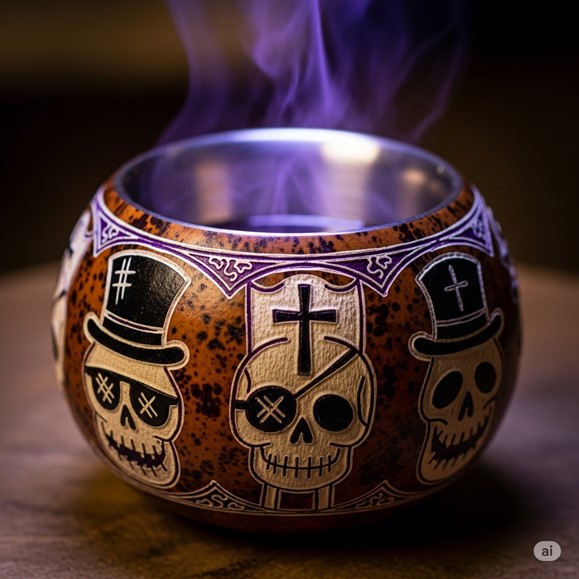
Description: The item is a small, shallow drinking cup, light enough to be held in the palm of one hand. It appears to be fashioned from the hollowed-out shell of a dark, mottled calabash gourd, polished smooth on the inside from countless sips and ritual rinsings. The exterior is rougher and covered in intricate, hand-carved symbols associated with the Gede: stylized top hats, sunglasses with one lens missing, crosses, and grinning skulls. These carvings are filled with faint traces of black and purple paint. The cup perpetually carries a faint, complex aroma of black coffee, sweet rum, and a hint of something fiery like chili peppers. When held, it feels surprisingly dense and imparts a neutral, almost organic temperature to the skin.
Detailed Stats
- Tier: 1
- Required Skill: Medicine (Untrained) or Alchemy (Untrained)
- Durability: The cup is imbued with spiritual energy, making it highly resistant to cracks, chips, and mundane decay.
- Primary Effect: The cup serves as a focus for diagnosing ailments of a digestive or spiritual nature related to consumption.
Passives Magic
- Sympathetic Palate: The wielder develops an unnaturally keen sense of taste and smell for impurities. When holding the cup, they can more easily detect the faint tang of spoilage, common poisons, or the bitter residue of malevolent magic in any food or drink they examine.
- Gut Intuition: The cup acts as a spiritual barometer for gastric health. When the wielder is near another individual suffering from a significant internal ailment (from a magical curse to severe food poisoning), the cup grows faintly cold to the touch. This provides a subtle, non-specific warning that something is wrong within the other person’s core.
- Baron’s Fortitude: The wielder’s own digestive system becomes more resilient. They gain a minor, favorable circumstance bonus to any checks made to resist the effects of ingested mundane poisons, diseases, or irritants.
Activable Magics
- Ritual Tasting (Diagnosis): Once per hour, the user can perform a diagnostic ritual. They must place a tiny sample of a substance (a food or drink, a medicinal herb, or even a drop of a patient’s saliva or blood) into the cup. The user then adds a drop of strong alcohol as an offering and focuses their intent, asking the Gede for insight. The user receives a strong, intuitive impression of the substance’s effect on the body or the patient’s internal state. This is not a scientific analysis but a spiritual one, yielding feelings or single-word concepts like “Fire,” “Ice,” “Blockage,” “Parasite,” “Balance,” or “Poison.”
- Gede’s Blessing (Soothing): Once per day, the user can fill the cup with clean water and spend one minute quietly chanting a request for the Gede to bless the contents. The water shimmers with a faint, purple light for a moment before returning to normal. This blessed water, if consumed by someone suffering from mundane digestive distress (such as indigestion, nausea, or cramping), provides immediate, temporary relief from the symptoms for one hour. It does not cure any underlying disease or poison but soothes the system enough to allow for rest or travel.
Specific Slot: Held (One Hand) / Tool
Tags: Common, Tier 1, Gastroenterology, Voodoo, Spirit Magic, Tool, Roleplay, Healing, Diagnostic, Gourd, Medicinal, Alchemical, Purification, Ritualistic, Offering, Ancestral, Sympathetic, Analysis, Hand-Crafted, Restorative
In the world of Saṃsāra, acquiring a specialized spiritual tool like the Vodou 919 of the Baron’s Tasting Cup is not as simple as visiting a general store. Its sale and trade are confined to niche establishments where its unique purpose—a blend of spiritual healing and gastroenterological diagnosis—is understood, or at the very least, preserved. The manner of its sale and its cost are deeply influenced by the nature of the vendor.
1. The Community Apothecary & Spiritualist
Type of Shop: This is less a formal shop and more the front room or workspace of a community healer, often a Manbo or Houngan practicing within a close-knit neighborhood descended from the first Haitian souls. Located in the winding streets of a port city or a quiet island town, the establishment would be marked only by chalk symbols on the door or the scent of brewing herbs and strong coffee. The air inside is thick with incense and the smell of drying roots. Shelves are lined not with mass-produced goods, but with hand-labeled jars, bundles of herbs, colored candles, and other ritualistic items.
How It Is Sold: The Baron’s Tasting Cup would not be on open display. One would have to seek it out specifically or come to the healer with an ailment that requires its use. The transaction is a personal interview. The healer would ask the prospective buyer about their intentions, their knowledge of the spirits, and why they need such a tool. Selling the cup is an act of entrustment, placing a piece of their tradition in another’s hands. The healer would provide detailed instructions on its use, care, and the absolute necessity of making offerings to the Gede, treating the sale as a lesson.
Cost: The price is not based on market value but on accessibility and the worthiness of the buyer. It would be kept low to ensure it remains within the community. The cost would be approximately 15 to 25 Silver pieces. Often, the healer would prefer partial payment in the form of a trade—a bottle of high-quality rum, rare herbs, or even a sworn promise to perform a service for the community in the future.
2. The Alchemist’s Guild Supplier
Type of Shop: Found in the sterile, academic quarters of a major metropolis or a guild-run trading post, this establishment, perhaps named “The Internal Alchymia” or “The Gilded Mortar,” caters to professional alchemists, physicians, and the bodyguards of paranoid nobles. The shop is clean, organized, and smells of antiseptic solutions and strange chemical reagents. Items are displayed in glass cases, cataloged with detached, technical descriptions of their magical properties.
How It Is Sold: Here, the spiritual nature of the cup is downplayed and its function medicalized. It would be sold as a “Sympathetic Resonance Diagnostic Vessel.” The proprietor, a learned alchemist, would describe its ability to detect bio-spiritual toxins and imbalances in the digestive tract. They would demonstrate its use in a scientific manner, ignoring the ritualistic elements as mere “folk trappings.” The transaction is swift, professional, and impersonal. A receipt might be issued on stamped parchment.
Cost: The price reflects the item’s proven utility as a reliable, reusable diagnostic tool in a world full of strange and potentially poisonous substances. It is sold as premium equipment. The cost would be firm, with no room for haggling, typically between 50 and 65 Silver pieces.
3. The Traveling Curio Merchant
Type of Shop: This vendor has no fixed location. They might be found with a large, steam-powered wagon at a crossroads trading meet, on the deck of an inter-island cargo hauler, or in the transient markets of a floating city. The merchant is often an ancient soul themselves, a collector of the strange and forgotten things that wash up in Saṃsāra. Their collection is a chaotic jumble of cultural artifacts, strange technological bits, and minor magical items.
How It Is Sold: The Baron’s Tasting Cup would likely be one of many strange items in their inventory, perhaps acquired in a trade or from an adventurer’s estate sale. The merchant might have an inkling of its true purpose but will almost certainly embellish the story to make a better sale. “Ah, the Gourd of the Laughing Devil! From a lost jungle temple, they say! One sip and you can taste a man’s lies… or the poison in his wine!” The sale is a performance, a battle of wits and stories. Haggling is not just expected; it is the entire point of the interaction.
Cost: The price is entirely subjective. The merchant will start with an inflated figure based on what they think the buyer can pay, perhaps asking for as much as 1 Gold piece and 1 Electrum coin. A clever buyer who can see through the theatrics, or who can trade an equally interesting item, could potentially walk away with the cup for as little as 20 Silver pieces. The final cost depends entirely on the buyer’s roleplaying and negotiation skills.
The Baron’s Tasting Cup is not a weapon of offense like a sword, nor a shield for defense. Its power in conflict is subtle, intimate, and deeply tied to its purpose: the analysis and balancing of the body’s core. An avatar using this tool for defense and offense is not a warrior, but a cunning strategist, a poisoner, a saboteur, or an information broker who understands that the truest battles are often fought within the body.
In a Tense Social or Urban Environment
In the parlors, banquet halls, and back-alley taverns of Saṃsāra’s great cities, the cup becomes a tool of unparalleled social espionage and psychological warfare.
Defensive Roleplay: At a noble’s feast where intrigue hangs heavier than the tapestries, the avatar can use the cup defensively to navigate a web of potential threats. Casually holding the cup while mingling, the Gut Intuition passive acts as an early warning system. As the avatar approaches a rival courtier, they might feel the cup grow unnaturally cold in their hand—a silent, personal alert that this person is afflicted, either physically ill or spiritually corrupt. This allows the avatar to steer conversations away from dangerous individuals or identify a victim in a poisoning plot.
When presented with food or drink, the Sympathetic Palate provides another layer of defense. The avatar would raise the cup to their lips as if to politely inhale the aroma of the wine. To them alone, the scent might carry a bitter, chemical undertone or the faint, coppery tang of a magical poison, allowing them to gracefully refuse the drink without raising overt suspicion. The roleplay is one of perfect etiquette masking a state of high alert, trusting the cup’s subtle feedback over the host’s pleasantries.
Offensive Roleplay: Offense with the cup is an act of subtle sabotage. To discredit a rival, the avatar might secure a drop of their target’s wine. In the feigned act of cleaning a smudge, they perform the Ritual Tasting. The cup might grant them a vision of “spiritual rot” or a feeling of “consuming jealousy.” They cannot prove the rival is a traitor, but they can now act with certainty.
The avatar could then approach a guard captain and whisper, “The Baron Feng seems unwell. His spirit churns. Be wary of what he offers.” This plants a seed of suspicion. Or, more directly, they could approach the target, lean in, and say, “That vintage doesn’t seem to agree with your constitution. The Baron’s spirits are restless tonight.” This is not a physical attack, but a precise, psychological strike, using magically-gained knowledge to create paranoia and expose the target’s intentions by watching their reaction.
In a Wild and Untamed Environment
In the swamps, jungles, and alien wildernesses of the island nations, the cup is a vital tool for survival, and offense is a matter of turning the environment against its own inhabitants.
Defensive Roleplay: When the party is low on supplies, the cup is their primary defense against the natural dangers of consumption. Before drinking from a stream, the avatar would first scoop a small amount into the Baron’s Cup. The Sympathetic Palate would immediately inform them of any wrongness—a metallic taste indicating heavy mineral deposits, or a slimy texture imperceptible to others that hints at microbial contamination. They are not just tasting water; they are tasting its history and health.
If a companion falls ill after eating a strange fruit, the avatar can use Ritual Tasting on a leftover piece. The cup might give them a vision of “burning nerves” or a feeling of “paralyzing cold,” providing a crucial clue for what kind of antidote or remedy is needed. The roleplay is that of a wilderness guide and folk healer, using the cup as their diagnostic guide to keep the party safe.
Offensive Roleplay: Against a monstrous beast of the jungle, direct confrontation is suicide. The cup offers another way. The avatar would become a hunter of weaknesses. By finding the beast’s scat or the remains of its last meal, they can perform the Ritual Tasting. The Gede might grant them an impression of the creature’s digestive system: perhaps it is a creature of intense internal fire that cannot abide cold, or it has a weakness to a specific acidic berry.
Armed with this knowledge, the “attack” is prepared. The avatar gathers the specific herbs or berries that would wreak havoc on the creature’s unique biology. They prepare a bait, not with deadly poison, but with a potent, targeted irritant. They leave this offering for the beast. The goal is not to kill it outright, but to inflict such a severe case of indigestion, cramps, or nausea that the powerful creature becomes sick, weak, and focused on its own misery, allowing the party to bypass it or forcing it to retreat from its territory.
In a Confined, Hostile Lair
Inside a monster’s den, a dungeon’s barracks, or a bandit’s cave, the cup becomes a tool for biological warfare and tactical assessment.
Defensive Roleplay: Within a troll’s cave, the air is foul and everything is a potential source of disease. The Gut Intuition passive would keep the cup perpetually cold, but it would become intensely, painfully cold near specific areas—the troll’s larder of rotting meat, its fetid water source, its nest. This guides the avatar, telling them which areas are merely dirty and which are centers of virulent sickness, allowing them to navigate the space without succumbing to the overwhelming filth. They can identify the most dangerous zones of contagion and avoid them.
Offensive Roleplay: The most potent use of the cup in such a setting is to turn the enemy’s own sustenance against them. The lair is a treasure trove of potential biological weapons. The avatar can use Ritual Tasting on various cave fungi, slimy molds, or stagnant pools of water. The cup acts as a bio-prospecting tool, giving them visions of their effects: “Violent Purge,” “Deep Slumber,” “Maddening Itch,” “Muscle Spasm.”
After identifying the most useful substance, the avatar’s offensive action is silent and deadly. They can contaminate the enemy’s food supply or poison their water barrel with a debilitating, non-lethal substance. This weakens the entire enemy force before a single blow is struck. They might introduce a powerful soporific to the bandits’ wine cask, or a gut-wrenching irritant to the trolls’ stew-pot. The fight is won not with steel, but with a quiet, ritualistic act of sabotage guided by the spirits of the Baron’s Tasting Cup.
Perception of Activation:
User’s Perspective
For the avatar who wields the cup, its activation is an intimate and overwhelming sensory ritual. The experience is centered on receiving a spiritual diagnosis, a process that bypasses the physical senses to deliver information directly to the user’s consciousness.
- Taste and Smell: The moment the ritual offering is made, the user is struck by two phantom sensations. First, the smell of the offering (strong black coffee, spiced rum, a fiery pepper) becomes intensely, impossibly sharp, dominating all other aromas. Immediately following, a symbolic taste manifests on the user’s tongue, even though they have not drunk from the cup. This taste directly represents the ailment being diagnosed: the acrid bitterness of bile for a poison, the cloying sweetness of rot for a necrotic curse, the metallic tang of blood for an internal wound, or a complete and terrifying lack of taste for a life-force draining affliction.
- Touch: The gourd cup, normally neutral in temperature, becomes cool and slightly damp in the user’s hand, like stone from a deep well. It begins to vibrate with a low, steady thrum, a feeling less like a heartbeat and more like the purr of a large, unseen cat—a sensation that is both calming and deeply unnerving.
- Sight: The activation is focused within the cup itself. Any liquid placed inside darkens, and a thin, oily vapor, deep purple in color, rises slowly and dissipates within moments. The hand-carved symbols on the cup’s exterior seem to darken and gain depth, as if the shadows within the carvings are momentarily alive.
- Sound: The user hears a chorus of faint, dry whispers that seem to emanate directly from the cup. The sounds are not distinct words but a layered murmur, like a crowded room heard through a thick wall. Over this din, a single, low, amused chuckle sometimes manifests, sounding as if it is coming from just over the user’s shoulder.
- Extra-sensory (Diagnostic Vision): The core of the activation is a flash of psychic insight. The user receives a symbolic vision that represents the internal state of the subject. This is not a medical image but a spiritual metaphor: a knot of writhing snakes for a parasitic infection, a smoldering fire in a dark room for an ulcer or inflammation, a thick, sticky tar for a blockage, or a pale, translucent leech attached to a coil of rope for a spiritual parasite draining vitality.
- Extra-sensory (Spiritual Presence): The user feels the barrier between worlds thin around them. They feel the focused attention of the Gede—not as a single entity, but as a crowd of curious, rowdy, and ancient spirits jostling to peer through the keyhole the cup has created. They feel their collective amusement, their deep and ancient knowledge of the body’s frailties, and their judgment upon the ailment being observed.
Observer’s Perspective
To an onlooker, the activation is subtle and deeply strange, characterized more by the user’s reaction than by any grand magical display.
- Sight: The observer would see the user become intensely still, their gaze fixed upon the small cup in their hands. The most distinct visual effect is the wisp of purple vapor that rises from the cup and vanishes almost immediately. It is quick enough to be dismissed as a trick of the light. The most telling sign is the involuntary change in the user’s expression—a slight grimace, a flicker of understanding, or a moment of revulsion—as they receive the internal vision.
- Sound: An observer would hear nothing of the whispers or the chuckle. The process is almost entirely silent to the outside world, save for any quiet words the user might speak as part of their ritual.
- Smell: If standing very close and downwind, an onlooker might be confused by a sudden, powerful, and out-of-place scent of rum or hot peppers, which vanishes as quickly as it arrives.
- Extra-sensory (Aura Perception): One trained to perceive magic with their Mind’s Eye would witness a complex event. They would see the user’s own life-force flare, then become enveloped by a chaotic, multi-layered spiritual energy, primarily deep purples and blacks. It would not look like a single entity but like dozens of spiritual signatures all converging on the cup, like moths to a strange flame.
- Extra-sensory (Sense of Presence): A mundane observer would feel the atmosphere in the immediate vicinity grow heavy and crowded. A sudden chill might run through them, and they would be overcome with the distinct, prickling sensation of being watched by many unseen eyes. It is the disconcerting feeling of a private moment being subjected to the scrutiny of a hidden audience.
Positives
- Covert Operation: The activation is exceptionally discreet. It allows the user to perform a deep spiritual and medical diagnosis in a public setting without creating a scene or revealing the extent of their magical abilities.
- Profound Insight: The information gained, while symbolic, is incredibly potent. It bypasses physical symptoms to reveal the spiritual or root cause of an ailment, offering clues that no mundane examination could ever provide.
- Psychological Edge: The subtle but creepy atmospheric effects can unnerve onlookers. The palpable sense of being watched by unseen forces can deter questions and give the user an air of mystique and authority.
Negatives
- Disturbing Feedback: The symbolic tastes and visions are often grotesque, invasive, and mentally taxing. A user unprepared for the visceral taste of spiritual decay or the sight of a symbolic parasite could become nauseated or psychologically shaken.
- Ambiguous Interpretation: The information is purely symbolic and requires careful interpretation. A vision of “fire” could mean a fever, an infection, an inflammatory disease, a poison that causes a burning sensation, or a spiritual curse related to anger. A misinterpretation could be fatal for the patient.
- Spiritual “Noise”: Connecting with the Gede is not like consulting a quiet sage. The user must contend with the chaotic, demanding, and boisterous nature of a whole family of spirits at once. Maintaining focus to extract the correct information from the spiritual din is a significant challenge.
Recipe: The Baron’s Gourd
This crafting process details the creation of a ritual diagnostic cup, a tool for communing with the spirits of life and death to understand the ailments of the living. The creation is a meditative act, blending physical craft with spiritual offerings, requiring respect for the materials and the powerful spirits being invoked.
Materials Needed
- The Vessel: One mature, dried calabash gourd of a size suitable for a hand-held cup. It must be harvested from a plant that was grown in or near a graveyard, or at a crossroads where offerings are frequently left.
- Spiritual Conduits:
- A handful of darkly roasted, unsweetened coffee beans.
- A small flask of dark, spiced rum of high potency.
- Three whole, dried chili peppers, known for their intense heat.
- A pinch of ash from a cremated, non-magical but toxic plant (such as hemlock or nightshade), representing the understanding of poison.
- Finishing Components:
- Beeswax for polishing and sealing.
- Natural pigments for creating black and purple paint (soot, charcoal, and crushed dark berries or specific minerals are ideal).
- A single strand of the crafter’s own hair.
- A single strand of hair from a person who has successfully recovered from a severe, life-threatening illness.
Tools Required
- Carving Kit: A set of fine, sharp knives and curved gouges suitable for delicate work on a gourd.
- Mortar and Pestle: For grinding the coffee beans and pigments.
- Small Ritual Brazier: A fire-proof bowl for the safe burning of offerings.
- Fine-haired Brush: For the detailed application of the paints.
Skill Requirements
- Alchemy (Trained): The crafter must possess a working knowledge of sympathetic magic, understanding how substances can represent and influence the body and spirit.
- Crafting (Untrained) or Woodworking (Untrained): The crafter needs the basic dexterity and patience to hollow out and carve the gourd without shattering it.
- Medicine (Trained): A genuine understanding of the body’s internal workings, diseases, and the nature of health is paramount. This knowledge is used to focus the crafter’s intent during the ritual.
- Spirit Magic (Untrained): The crafter must have a fundamental ability to sense spiritual presences and make offerings with sincere respect. No great power is needed, only the ability to open a door and politely invite a spirit to look through.
Crafting Steps
- Hollowing the Vessel: The process begins with carefully cutting open the top of the gourd and hollowing out the dried pulp and seeds. This must be done slowly and deliberately. With each scoop, the crafter should meditate on the concept of purification and the removal of sickness. The interior is then sanded until it is perfectly smooth.
- The First Offering: A small, clean fire is lit in the brazier. The crafter grinds the dark coffee beans in the mortar and pestle while focusing their thoughts on clarity, diagnosis, and the ability to see what is hidden. The ground coffee is then offered to the fire, its potent, dark smoke serving as the first call to the spirits, an announcement that a serious work is being undertaken.
- Sympathetic Polishing: The crafter takes the pinch of toxic ash and mixes it with a small amount of beeswax. This mixture is used to polish the interior of the cup. The intent is not to make the cup poisonous, but to attune it to the very nature of toxins, creating a sympathetic link that will allow it to recognize poisons in the future.
- The Ritual of Carving: This step should be performed at night. The crafter begins to carve the symbols of the Gede—skulls, crosses, top hats—onto the exterior of the gourd. With each completed symbol, the crafter must take a small sip of the rum, not to become intoxicated, but to open their own spirit to the Gede’s influence and to show respect for their boisterous, life-and-death nature.
- The Binding of Hairs: The crafter takes the strand of their own hair (representing the healer) and the hair from the recovered patient (representing the healed). They twist these two strands together into a single thread. This thread is then carefully inlaid into one of the main carved lines on the cup and sealed in place with a drop of warm beeswax, binding the concepts of sickness and recovery into the tool’s very essence.
- Painting the Symbols: Using the prepared natural pigments, the crafter meticulously paints the black and purple details into the carvings. This act visually dedicates the cup to the Gede and finalizes its appearance as a ritual tool.
- The Final Blessing: The finished cup is placed upright on a clean surface. The crafter places the three fiery chili peppers inside it, representing the heat of life and the fire of fever. They then pour the remaining rum over the peppers, filling the cup. The cup must be left this way, undisturbed, for one full night, allowing the spirits to “taste” the potent offering and imbue the vessel with their blessing. The next morning, the contents are poured out onto the earth at a crossroads as a final thank you. The cup is now complete and spiritually awake.
Chief with a Serpent in His Belly
In the age after the Great Arrival, when souls were new seeds in the soil of Saṃsāra, there was a village. The village was of people who held hands when they fell from the sky-that-was-not-a-sky, and so they did not scatter. Their Chief was a man of great size, and his heart was a strong drum that made all others brave.
And then a sickness came to the Chief. It was not a sickness of the skin, for his skin was clear. It was not a sickness of the breath, for his lungs drew air. It was a sickness in his stomach-house, a coldness deep in his core. He would not eat. The food turned to ash in his mouth. He grew thin, and the beat of his heart-drum grew quiet. The village healers came, and they made teas of herbs, and they sang songs of health. But the sickness did not move. They said, “There is a cold serpent coiled in his belly. It drinks his life, and we cannot see it to kill it.” And so it was.
The oldest man in the village was Jacquot. He was the one who remembered the spirits best. He remembered the Laughing Ones who loved the smell of smoke and the taste of strong drink, the ones who walked at the crossroads of life and death. He saw the Chief, and his spirit was full of sorrowful water, for he knew the serpent was not made of flesh. It was a spiritual poison, an invisible thorn. He told the people, “My eyes cannot see this serpent. I have no tool to look inside a man’s soul.”
So Jacquot went away from the village. He walked to the garden where they had buried their dead since coming to this new world. He saw a gourd vine, and this vine had grown over the grave of the first woman to die among them. From this vine hung one perfect, dark calabash. He knew this was a thing of meaning. For seven days, he sat by the grave and hollowed the gourd with his fingernails and with prayer. He carved the signs of the Laughing Ones on its skin. He made a cup.
He took this cup to the dying Chief. He took a drop of spit from the Chief’s tongue and placed it in the empty cup. He prayed to the spirits. He asked them to show him the serpent. He waited. Nothing happened. The cup was wood. The spit was spit. The Chief groaned, and the serpent in his belly twisted. Jacquot understood then. A question is not a gift. The spirits were hungry, and he had offered them nothing.
Jacquot went to his own hut. His heart was a dry seed. He took from his hiding place his last treasures from the green island he had lost. A small leather pouch of black coffee beans, and a stone flask of rum in which many hot peppers had slept. He did not weep. He took the coffee and ground it to dust. He took the rum and he poured it in the gourd cup, and he mixed the coffee dust into the rum. The smell was of memory and fire and home. He held the cup up. He did not ask for a thing. He said, “A fine drink for the Laughing Ones. A taste of home for the Hungry Folk. I give this to you to show my respect. Your thirst is great.”
And the air in his hut grew cold. The smell of his offering was joined by a new smell, of cigar smoke and damp earth and dry flowers. A shadow fell where no man stood. A voice spoke that was not a voice, but a rattling in the bones of Jacquot’s own body. It said, “This is a fine gift. The smell of home. The taste of fire. You have paid a great price. Now, tell me why.”
Jacquot knew who this was. It was their leader, the Baron, the Great Lord of Graves and Guffaws. Jacquot did not look at the shadow. He looked into the cup. “The Chief of my people has a serpent in his belly. It eats his life. I wished to see it, but I was a fool with an empty cup.”
The voice of the Baron was a dry chuckle, like stones falling on a coffin lid. “All bellies are my garden. All sickness is a pretty flower that blooms for me. The serpent in your Chief’s belly is a fine flower indeed. Why should I show you how to pluck it?”
Jacquot thought. He said, “Because even the Lord of the Garden must pull weeds, so the fine flowers have room to grow. My Chief is a fine flower. The serpent is a weed.”
There was a long quiet. Then the chuckle came again, louder this time. “A good answer. A clever answer. You are not a fool, Old Man Jacquot. You are a gardener. I will help you. I will not kill the serpent, no. The killing is your work. But I will teach your cup to see.”
And the great shadow breathed into the gourd cup. The breath was cold and smelled of the grave. The dark liquid inside swirled, and a purple vapor rose up. Then all was still. The Baron was gone.
Jacquot returned to the Chief. He again took a drop of spit and let it fall into the potent brew in the cup. This time, when it touched the liquid, a vision exploded in Jacquot’s head. He saw the Chief, happy, at a feast a month ago. He saw a rival from another village give the Chief a piece of dried meat. And hidden in the meat, Jacquot saw a tiny sliver of dark metal, a metal that looked like a serpent’s tooth. And he knew. It was not a spirit-serpent. It was poison.
Knowing the truth, Jacquot knew the cure. He made a poultice of river clay and special leaves to draw the poison out. He made a bitter tea for the Chief to drink to soothe the stomach-house. Slowly, the Chief recovered. The serpent was dead. The cup had shown the truth. And so it was that the cup became a tool not to cure, but to understand.
Moral of the Story: You cannot fight a shadow until you have given it a name. The first step to any cure is a true diagnosis, and a true diagnosis can only be bought with a worthy offering.
Suggested conversions to other systems:
Call of Cthulhu
The Baron’s Diagnostic Cup
A small, shallow cup carved from what appears to be a mottled gourd, though it is as hard as stone. The exterior is covered in crudely carved symbols of skulls and crosses, while the interior is polished unnaturally smooth. It is an object of Haitian folk magic, a ritual tool used by bokors and healers who bargain with the spirits of the dead (the Ghede) to diagnose poisons and illnesses, both mundane and otherworldly. To use it is to invite these capricious, mocking spirits to pass judgment on the living and the dead.
Game Mechanics:
- Skills: Provides one bonus die (roll 2d10, take the lower result for the tens digit) on any Medicine or Science (Pharmacy/Toxicology) roll made to diagnose an illness or identify a poison, provided a sample can be used.
- Ritual of Diagnosis: To analyze a substance or a person’s affliction, the Investigator must place a small sample (a drop of blood, a crumb of food, etc.) into the cup and add a drop of strong alcohol as an offering. This requires 1 Magic Point and a successful POW x5 roll.
- Success: The Investigator receives a fleeting, nauseating, symbolic vision of the ailment’s nature (e.g., seeing the subject’s insides crawling with spiders for a parasitic infection, or feeling the phantom bitterness of arsenic on their own tongue). This grants a +20% bonus to a subsequent skill roll to devise a treatment or antidote. Witnessing this insight costs 0/1D2 Sanity points.
- Failure: The offering is ignored. No insight is gained.
- Fumble: The vision is tainted by the Cthulhu Mythos, revealing the biological ailment as a microcosm of some cosmic horror. The Investigator gains no useful information and loses 1/1D4 Sanity points.
Blades in the Dark
The Spirit-Apothecary’s Gourd
A dark, hollowed-out gourd, intricately carved with leering skulls and occult symbols. It is cool to the touch and always smells faintly of strong rum and bitter herbs. These gourds are rare but sought after by apothecaries and physickers in Duskvol who deal with the strange spiritual maladies that plague the city’s elite. It is said the cup allows a user to “taste” the spirit of a sickness, diagnosing ghostly infections or exotic poisons with uncanny accuracy.
Game Mechanics:
- Load: 1
- Item Type: Alchemical Apparatus, Ritual Tool
- Passive: You have a “gut feeling” about consumables. When you are about to eat or drink something, the GM will tell you if it is tainted by common poison or disturbed spiritual energies. This does not identify the specific threat.
- Active (Action): Perform a Diagnosis. When you have a sample of a substance or from a person, you can use an action to analyze it. Roll Wreck (if you are a Leech) or Attune (if you are a Whisper). On a 6, you understand its true nature perfectly. On a 4/5, you learn a key detail but it’s incomplete or confusing. On a 1-3, you misinterpret the results or the spiritual backlash inflicts level 1 harm (“Shaken” or “Chilled”). The information gained can be used to create an advantage or will grant +1d to a future roll to treat or exploit the affliction.
- Ritual (Downtime Activity): Brew a Panacea. You may perform a ritual using the gourd as a focus. This costs 1 Coin worth of rare ingredients. You brew a single dose of a potent tonic. A character who drinks this may clear 2 Stress, or downgrade their most severe penalty from harm by one level for the duration of the next score (e.g., from -1d to no penalty).
Dungeons & Dragons
Gourd of Visceral Revelation Wondrous item, uncommon (requires attunement)
This small, shallow cup is fashioned from a dark, mottled calabash gourd. Its exterior is covered in intricate carvings of skulls and crosses, while its interior is polished to a glassy sheen. The cup feels cool to the touch and allows its attuned user to analyze afflictions by presenting a sample to the spirits connected to the item.
Game Mechanics:
- While attuned to this gourd, you have advantage on Wisdom (Medicine) checks to diagnose diseases and on saving throws against becoming poisoned by an ingested substance.
- The gourd has 3 charges and regains 1d3 expended charges daily at dusk. You can expend charges to gain the following benefits:
- Diagnostic Tasting (1 Charge): As a 1-minute ritual, you can place a tiny amount of a substance or a drop of a creature’s blood into the gourd. You instantly learn if the sample contains poison or carries a disease. If it does, you learn the name and effects of one specific poison or disease present.
- Baron’s Blessing (1 Charge): As an action, you can touch the gourd to a non-magical drink. For the next hour, that liquid is blessed. Any creature who consumes the blessed liquid has advantage on the next saving throw they make against disease or poison within the next 8 hours.
Knave
Poison-Taster’s Gourd
A small, dark cup made from a hollowed-out gourd. Strange skulls and symbols are carved into the outside. It is surprisingly durable and takes up 1 inventory slot.
Game Mechanics:
- Passive: If you are about to knowingly consume food or drink that is poisoned or diseased (non-magically), the gourd, if it is on your person, will vibrate gently, providing a subtle warning.
- Active:
- Ritual Diagnosis: You may spend 10 minutes performing a ritual with a small sample of a substance (food, drink, blood, etc.). You must make a successful Wisdom saving throw. On a success, the GM will give you a short, accurate description of any ailment, disease, or poison present (e.g., “Sleeping potion,” “Causes gut-fire,” “Drains strength”). On a failure, the result is inconclusive.
- Soothing Tonic: Once per day, you can fill the gourd with water and leave a valuable offering beside it (a ration of food, a silver piece) for one hour. The water becomes a tonic. Anyone who drinks it may immediately attempt a new saving throw, if applicable, against one ongoing disease or poison effect they are suffering from. This has no effect on magical or instantaneous afflictions.
Fate
The Gourd that Tastes the Soul
In Fate, this item is best treated as an Extra that provides your character with narrative permissions and specific, potent Stunts. It represents a deep, spiritual connection to the world through the act of consumption and diagnosis.
Aspect: The Gourd that Tastes the Soul Permissions: This item grants the character the right to use their Skills in supernatural ways. You can use Investigate to diagnose spiritual sickness, Empathy to feel the internal state of another person through a sample, or Provoke to create fear by revealing knowledge of someone’s internal corruption.
Stunts:
- Sympathetic Diagnosis: When you use the Create an Advantage action by performing a ritual tasting on a sample (a drop of blood, a crumb of food), you get a +2 bonus to your Investigate roll. If you succeed, you create a very specific situational Aspect on the target, such as Belly full of Burning Rage, Poisoned with Kings-Bane, or Spiritually Hollowed Out.
- The Baron’s Libation: Once per session, you may perform a short ritual over a serving of clean water or other simple drink. When a character (including yourself) consumes it, they may immediately begin recovery from a minor physical consequence, or they may clear a mild or moderate consequence at the end of the session, provided the consequence was related to sickness or poison.
- Taste of Truth: You can spend a Fate Point while performing a Sympathetic Diagnosis to ask the GM one direct, yes-or-no question about the spiritual or physical state of the sample’s source (e.g., “Is this poison the work of the Ash-Veil cult?”). The GM must answer truthfully from the perspective of the spirits.
Numenera & Cypher System
Bio-Divining Vessel
This artifact is a cup fashioned from a polished, gourd-like xenomorphic seed pod. Its interior is lined with a smooth, silvery material that interfaces with organic matter on a nano-cellular level. It is a piece of ancient biotechnology designed for field analysis of alien ecosystems.
Level: 3 Form: A light, one-handed cup or shallow bowl. Effect (Passive): The wielder gains an asset on any task related to identifying poisons, diseases, or the properties of unknown organic substances. (The difficulty of the task is decreased by one step). Effect (Active): The silvery interior of the vessel glows with a soft purple light. * Function 1 – Biochemical Analysis: You can place a small organic sample (flesh, blood, plant matter, etc.) into the vessel. After one minute, the vessel transmits a report directly to your mind. This is an Intellect-based task; success means you learn the full properties of the sample, including any toxins, diseases, or unusual energy signatures it may contain. * Function 2 – Metabolic Soother: You can fill the vessel with water and activate it for one minute. The water becomes infused with dormant, medically-programmed nanites. A creature who drinks the water can immediately make a recovery roll without it counting toward their one-action, ten-minute, or one-hour recovery limit for the round/day. This function is more taxing on the device. Depletion: 1 in 1d20 for Function 1. 1 in 1d10 for Function 2.
Pathfinder
The Soul-Sieve Gourd – Item 2 Traits: Uncommon, Alchemical, Divination, Healing, Magical Price: 30 gp Usage: Held in 1 hand; Bulk: L
This small cup is carved from a dark, mottled gourd. Its exterior is etched with symbols of skulls and crosses, while the interior is polished to a glass-like sheen. Those who are trained in medicine or alchemy can use it to analyze and soothe the body’s internal humors.
Passive: You gain a +1 item bonus to Medicine checks to Treat Disease and Treat Poison.
Activate [one-action] (Interact); Frequency once per hour; Effect: You place a small, non-magical sample of a food or drink into the gourd. The gourd vibrates gently in your hand if the sample is tainted with a poison or disease whose level is 2 or lower.
Activate [ten-minutes] (Interact, Manipulate); Frequency once per day; Effect: You conduct a lengthy ritual over the gourd, using a drop of a willing or unconscious creature’s blood as a focus. At the end of the ritual, you learn the name and stage of one disease or poison of level 2 or lower that is currently afflicting the creature. You can then immediately attempt a Medicine check to Treat that specific affliction.
Activate [one-action] (Interact); Frequency once per day; Effect: You fill the gourd with water and whisper a prayer, creating a soothing tonic. A creature who drinks the tonic gains 5 temporary Hit Points that last for 1 hour.
Savage Worlds
The Gut-Checker
A rustic but supernaturally durable cup carved from a gourd. It is covered in hand-etched symbols of laughing skulls and crosses. It always feels slightly cool and smells faintly of strong coffee and spice, no matter how many times it is cleaned.
Requirements: Novice, Healing d6+ or Faith d6+ Passive Bonus: The wielder gains a +1 bonus to any Vigor rolls made to resist ingested poisons or diseases.
Special Abilities:
- Ritual Diagnosis: The wielder can spend one minute analyzing a sample (food, drink, blood, etc.). This requires a Healing or Faith roll.
- Success: The wielder identifies if any mundane poison or disease is present.
- Raise: The wielder identifies the specific poison or disease and gains a +2 bonus on their next roll to treat that affliction.
- Soothing Draught (Power): The wielder can use this item to cast the Relief power on a target suffering from Fatigue (from any source) or a power with a Sickness trapping. This is done by having the target drink blessed water from the cup and requires a Faith roll at -1. This use does not cost Power Points but can only be attempted once per hour.
Shadowrun
The Baron’s Taster
In the sprawl, where designer toxins and magical diseases are just another business expense, a tool that can reliably analyze what’s about to go into your body is worth more than gold. The Baron’s Taster is a ritual tool that has survived the ages, updated with modern materials. It appears as a stylish, self-cleaning cup made from a matte-black polymer composite, with the interior lined by a bio-reactive smart material. Practitioners of the Vodou tradition and high-end corporate food tasters alike use these to detect threats, both mundane and magical.
Game Mechanics:
- Type: Alchemical Focus (Tool, Rating 3)
- Attunement: This focus must be bonded by a character with the Magic or Alchemy skill, costing 3 Karma. Its use is most intuitive to those of a Vodou or similar life/death/ancestor tradition.
- Passive: The bonded user gains a +1 dice pool bonus to Biotechnology, Arcana, or Perception Tests to identify a toxin, disease, or the properties of an organic substance by sight or smell.
- Active (Complex Action): Ritual Tasting. The user can place a small sample of a substance into the cup and make a Magic + Intuition (3) Test. Each net hit provides one piece of key information about the substance’s effect on a metahuman body (e.g., “paralytic,” “hallucinogenic,” “carcinogenic,” “nutritious,” “carries a FAB-III strain”).
- Active (Alchemical Preparation): The cup can be used as a focus when creating a single preparation with the Health descriptor (such as an antidote or healing potion). When used this way, the alchemist can increase the preparation’s Potency by 1 without increasing the Drain Value of the formula. This can only be done once per day.
Starfinder
Psychopomp’s Chalice Level 3 Price 1,450 credits Bulk L Category Hybrid Item
This vessel is carved from the psychoactive wood of a rare Eoxian flora, and its interior is lined with a silvery, bio-reactive alloy that glows faintly. Cultists of Pharasma and xenobiologists use these chalices to analyze unknown organic matter and diagnose strange, alien afflictions by interfacing with the spiritual echoes inherent in all living and once-living things.
Game Mechanics:
- Passive: The wielder gains a +3 insight bonus on Medicine checks to treat poison or disease, and on Mysticism checks to identify curses or magical afflictions related to consumption.
- Biochemical Analysis (Active): Once per day, you can place a small organic sample into the chalice. After 1 minute of concentration, the chalice provides a full analysis, identifying any non-magical diseases, poisons, or beneficial properties. This functions as if you had taken 20 on a Life Science check to identify the properties of the sample.
- Restorative Draught (Active): By expending 1 charge from a standard battery connected to the chalice, you can fill it with any liquid and speak a command word. The liquid is purified of all mundane toxins and becomes a healing tonic. A creature who drinks it regains 1d8 Hit Points.
Traveller
Xenomedical Analysis Cup (Artifact) TL 15
This object is a lightweight cup made of a seamless, matte-black material that feels like ceramic but is immune to all forms of damage and corrosion. Its interior is lined with a softly glowing, silvery substance that shifts and swirls when organic matter is introduced. Believed to be a Precursor or Ancient artifact, it is a highly advanced, portable medical laboratory. Such a device would be priceless and a subject of intense interest for the Imperium, Zhodani, and any megacorporation.
Game Mechanics:
- Nature: The device performs a complete chemical, biological, and radiological analysis of any organic sample. Finding one would be the focus of a major adventure or patron request.
- Function 1 (Analysis): When a small organic sample (blood, tissue, plant matter) is placed in the cup, the silvery lining reconfigures itself. After one minute, a simple, language-free holographic display emanates from the cup, showing the sample’s complete properties. A successful Difficult (10+) Science (biology or xenobiology) or Medic check is required to interpret the display. A successful interpretation reveals any toxins, diseases (including viral and bacterial agents), nutritional values, genetic markers, and other significant biological properties with 100% accuracy.
- Function 2 (Antidote Synthesis): If the device analyzes a toxin or pathogen of TL 14 or lower, the user can then fill it with up to 250ml of purified water. The device will use the water as a base material to synthesize a single dose of a perfect, targeted antidote or antibiotic. This process takes one hour. Using this function has a 1-in-6 chance of depleting the device’s internal power source, rendering it inert until it can be recharged at a TL 15+ facility.
Warhammer Fantasy Roleplay
Shallya’s Mercy Cup
A humble but miraculously preserved wooden cup, said to have been carved from the bough of a weeping willow that grew in one of Shallya’s oldest, most sacred groves. It is always clean and feels warm and pure to the touch. It is a holy relic entrusted to the high priests and priestesses of the goddess of mercy and healing. They use it to diagnose the plagues and poxes of the Old World without succumbing to the contagions themselves.
Game Mechanics:
- Qualities: Blessed (Shallya), Magical, Holy
- Passive: The wielder is immune to contracting any non-magical disease from patients they are actively treating. Furthermore, they gain a +10 bonus to Cool Tests made to resist fear or intimidation when confronting plagues or horribly afflicted individuals.
- Active (The Merciful Gaze): By placing a single tear or drop of blood from a sick person into the cup and passing a Challenging (+0) Pray Test, the wielder receives a divine insight from Shallya. This insight perfectly identifies one disease or poison affecting the patient. This also removes any doubt or mystery about the affliction, and the wielder automatically knows the proper mundane treatment, if one exists.
- Active (The Soothing Draught): Once per day, the wielder may fill the cup with clean water and spend a minute in quiet prayer. The water begins to glow with a soft, white light. A sick or wounded person who drinks it is considered to be under the Extended Care of a skilled physician for the next 24 hours for recovery purposes. Additionally, the drinker is immediately cured of any one Blight or Festering Wound symptom they may be suffering from, though the underlying condition remains.
Comments
One response to “Vodou 919 of the Barons Tasting Cup”
[…] Vodou 919 of the Baron’s Tasting Cup (Tier 1) […]