
Lore: In the archipelago nations where stories are not written in books but carved into war canoes, tattooed onto skin, and etched into the posts of great halls, the artisan is a sacred historian. A sect of these artisans, known as the “Pattern-Keepers,” followed a philosophy rooted in the traditions of Tapa. They believed that every symbol and every line held a spark of the mana, the spiritual power, of the story it represented. To etch a pattern was to give that spirit a new home. A poorly carved line was not just an error, but a disrespect to the story’s soul.
The Pattern-Keeper’s Wraps were created for apprentices to bridge the gap between their hands and their heart. The master artisans would beat the inner bark of the mulberry tree, not with paints, but with carved wooden mallets, embedding the fundamental symbols of their culture directly into the texture of the tapa cloth. When an apprentice wore the wraps, their hands would be guided by the spirits of those ancient patterns. The wraps were not armor, but a tool of focus, ensuring that the etcher’s hand was steady, their mind was clear, and their work was not just a physical copy, but a true and spiritually resonant telling of the tale.
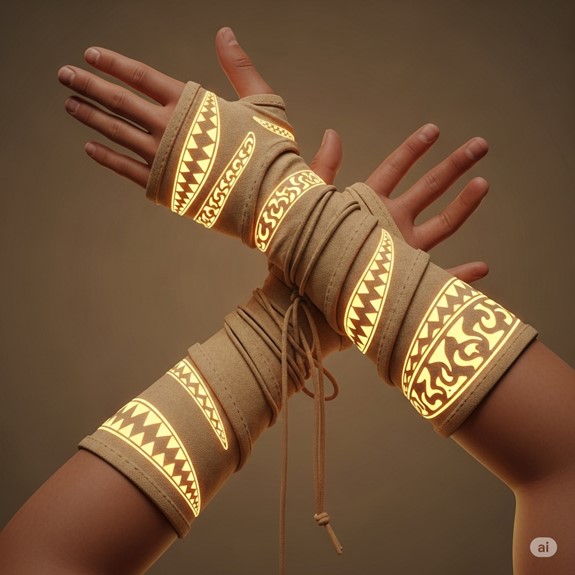
Description: A pair of soft, yet surprisingly tough and supportive, hand-and-forearm wraps made from a single, continuous piece of light tan tapa cloth. The surface is not decorated with inks or dyes, but possesses a rich, tactile quality. Intricate, traditional designs—representing sharks’ teeth for strength, flowing waves for continuity, and turtle shells for wisdom and longevity—are subtly beaten into the very fabric, creating a raised, textured pattern that can be felt with the fingertips. The wraps are wide enough to cover the palm and wrist before spiraling up the forearm, secured by simple cords made from the same durable bark fiber. When worn, they emanate a faint, soothing warmth.
Slot: Handwraps
Detailed Stats
- Dexterity: +3
- Cunning: +3
Passive Magics
- Hands of the Ancestors: The wraps magically support the wearer’s tendons and steady their nerves, granting them exceptional fine motor control. This passive effect drastically reduces involuntary muscle spasms or tremors, preventing accidental slips when performing delicate work like etching, engraving, or calligraphy. Lines are carved truer and curves are formed more perfectly.
- Symbolic Intuition: By wearing the wraps, the wearer’s mind becomes attuned to the language of symbols. When observing a complex pattern—be it a family crest, a tribal tattoo, an architectural diagram, or ancient glyphs—they gain an intuitive understanding of its general meaning and emotional weight. They might not understand the specific words, but they can grasp the core concepts, such as “royalty and dominion,” “a story of a great sea voyage,” or “a warning against poison.”
Activable Magics
- Transfer Pattern: The wearer can press their wrapped palms against a non-magical pattern or set of symbols on a surface (a relief carving, a tattoo, a drawing) and concentrate for one minute. The tapa wraps absorb a perfect, detailed memory of the design. For the next hour, the wearer can etch this pattern onto a new surface with supernatural precision, their hands guided by the memory stored in the wraps as if tracing an invisible stencil. The wraps can only hold one pattern at a time, and absorbing a new one erases the old.
- Etching with Intent: While carving or etching, the wearer can channel their own Qi through the wraps, down their arms, and into their working tool (a needle, chisel, or burin). For the next 10 minutes, the lines they etch are imbued with a faint alchemical and spiritual essence. The finished etching is slightly more resistant to wear and erosion than the base material should be. Furthermore, any sentient being who touches the finished etching will feel a faint, psychic echo of the primary emotion the etcher focused on during its creation (e.g., reverence for a holy symbol, sorrow for a memorial, fury for a declaration of war).
Tags: Tapa, Handwraps, Magical, Common, Tier 1, Artisan, Utility, Enchanting, Information, Buff, Worn, Etching, Carving, Symbolism, Focus, Memory, Crafting, Support, Qi-Based, Haptic
In the world of Saṃsāra, where artistry is a form of history and magic, a tool like the Tapa 7 of The Pattern-Keeper’s Wraps is a treasure for any serious artisan. It is not found where weapons are sold, but in the dedicated halls of craft, the salt-sprayed workshops of the coast, and the quiet stalls of tradition-keepers.
The Artisan’s Guild Hall Supplier
In the bustling artisan’s quarter of any major metropolis, the Guild Hall stands as a testament to creation. The air is a cacophony of smells—of fresh sawdust from the woodworkers, hot metal from the jewelers, ozone from the magi-steam engineers, and clay from the potters. Within this hall is a supply shop, open only to guild members and those they sponsor. It is a place of function over form, with sturdy shelves laden with high-quality, specialized tools: rare wood blanks, ingots of curious alloys, and enchanted implements designed to aid the crafting process.
How it is Sold: The Pattern-Keeper’s Wraps would be displayed in a locked glass case alongside other common-tier magical tools, such as ever-sharp chisels or a smith’s hammer that strikes with perfect rhythm. The shopkeeper, a retired master artisan with calloused hands and a keen eye, would recognize a potential buyer’s craft from their posture and attire. They would present the wraps as a professional tool, explaining, “They steady the hand, to be sure, but more than that, they quiet the mind. Lets you see the pattern behind the pattern.” The transaction is a straightforward exchange between professionals.
Cost to Buy: The price is set by the guild for its members, representing a worthy investment in one’s craft. The wraps would cost a respectable 1 Gold coin. Value to Sell: The guild supplier would buy back such a useful tool to keep it in circulation for other members. They would offer 7 Silver coins, a fair price for a guaranteed resale.
The Shipwright’s Workshop
Along the bustling docks of a port city, amid the creak of ropes and the cry of gulls, are the vast, open-air workshops of the shipwrights. The air here tastes of salt and smells of tar and cedar shavings. Master carvers and their apprentices spend their days shaping the immense ribs of ships and etching intricate, protective symbols onto the prows of great ocean-faring canoes. These are not mere decorations; they are prayers to the sea, and every line must be perfect.
How it is Sold: The wraps would not be for public sale. An avatar would likely see a master carver wearing a well-used pair and inquire about them. The master, initially reluctant to part with a sacred tool of their trade, might be persuaded if the avatar demonstrates a true artist’s spirit. They might agree to craft a new pair, a process that would take weeks of ritual and work, in exchange for a significant service—perhaps the acquisition of a rare, salt-resistant ironwood log from a dangerous, uncharted island, or the retrieval of their family’s ancestral carving tools from a sunken vessel.
Cost to Buy: The cost here is measured in deeds more than coin. If a monetary value were to be placed on such a special commission, the shipwright would charge 1 Gold coin and 5 Silver coins, a price that reflects the sanctity of their craft and the time taken from their other duties. Value to Sell: A shipwright would not buy such an item for coin, as they can make their own. They would, however, hold a craftsman who possesses such a tool in high regard and might be more willing to trade other goods or services with them.
The Cultural Antiquarian & Tattooist
In a city’s quiet, historic district, nestled between a library and a museum, one might find this shop. It is a serene and respectful space, smelling of old paper, herbal ointments, and the faint, earthy scent of tapa cloth. The walls are hung with framed rubbings of ancient petroglyphs, and glass cases display cultural artifacts from the breadth of the 73 island nations. The proprietor is both a scholar of history and a practicing tattoo artist, using traditional hand-tapping methods to inscribe sacred patterns onto the skin of their clients.
How it is Sold: The Pattern-Keeper’s Wraps would be treated as a genuine cultural artifact. The proprietor would know the specific meanings of the symbols beaten into the cloth and would share this history with a potential buyer. The sale would be a quiet, reverent conversation, with the owner seeking to place the item with someone who understands and respects its heritage—another artist, a historian, or a dedicated student of cultural symbolism.
Cost to Buy: The price reflects the item’s historical and cultural significance. The antiquarian would ask for 1 Gold coin and 3 Silver coins, a price that is firm and non-negotiable. Value to Sell: The antiquarian would be very interested in acquiring such a piece for their collection, especially if it has a noteworthy history. They would offer 8 Silver coins for a well-preserved pair.
The Island Family’s Market Stall
In the vibrant, chaotic, open-air markets of the outer islands, where the scent of tropical fruit and roasting fish hangs heavy in the air, a single family might have a stall dedicated to their craft: tapa making. The stall is a canvas of color, draped with large, beautifully painted tapa cloths. Behind the stall, one can hear the constant, rhythmic thump-thump-thump of the women of the family beating mulberry bark into cloth on a long wooden anvil.
How it is Sold: This is the most direct and authentic source. The wraps would be part of a small pile of utilitarian tapa goods—belts, pouches, and the wraps themselves. The sale would be a warm, friendly interaction with the artisans who made the item. An elder woman, her hands stained with natural dyes, would smile and explain, “For your hands. They help you remember the old stories when you carve.”
Cost to Buy: Here, the price is free from the influence of urban merchants and collectors. The family sells their goods for what they need to live. They would ask for 6 Silver coins for a pair of wraps and would be overjoyed at the sale. Value to Sell: One would not typically sell such an item back to its creators, but if an avatar needed to trade, the family would likely offer goods of equivalent value—perhaps a beautiful decorative tapa cloth, a meal, and a pouch of rare herbs—rather than coin.
The Tapa 7 of The Pattern-Keeper’s Wraps are not a warrior’s weapon, but an artist’s soul made manifest. Their use in conflict is a game of intellect and spirit, where offense is the art of forgery and psychological warfare, and defense is the wisdom of understanding the language written on the world itself.
In an Ancient Ruin or Dungeon
In the silent, forgotten places of the world, the wraps become a key to understanding the past and manipulating the present.
Defensive Roleplay:
The avatar becomes the party’s expert interpreter of ancient dangers. Confronted with a magically sealed door covered in complex glyphs, the party is unsure if it’s a passage or a prison.
- The avatar would run their wrapped hands over the carvings. Through Symbolic Resonance, they would announce, “I do not know this specific language, but the patterns feel wrong. They do not speak of ‘opening’ or ‘welcome.’ They tell a story of ‘binding,’ ‘hunger,’ and ‘eternal waiting.’ This is not a door to be opened; it is a cage to be left shut.” This insight defends the party from releasing a bound horror.
To navigate a confusing, labyrinthine ruin, the avatar can create their own guideposts.
- “At each intersection,” the avatar would explain, “I will use my chisel to make a small mark on the stone floor.” Activating Etch with Intent, they continue, “I will pour the feeling of ‘safety’ and ‘return’ into this mark. If we become lost or separated, touch the symbols. The one that feels like coming home will lead you back the way we came.”
Offensive Roleplay:
Offense is a matter of turning the dungeon’s own logic against its inhabitants. The party needs to funnel a group of mindless constructs down a hallway filled with traps.
- The avatar finds a section of wall carved with runes of warning. Using Transfer Pattern, they absorb the design. They then sneak down the other, “safe” hallways. Using Etch with Intent, they perfectly replicate the warning runes at the entrance of these safe passages. “I will carve these ‘danger’ glyphs here,” they would whisper, “And I will fill them with the feeling of ‘imminent dread.’ The constructs, programmed to avoid such warnings, will be herded down the only path that appears clear—right into our ambush.”
The party discovers a dormant, powerful guardian golem, inert because the activation symbol on its forehead has worn away.
- From a faded tapestry or a broken tablet elsewhere in the ruin, the avatar finds the complete symbol. They use Transfer Pattern to memorize it perfectly. Climbing onto the golem, they use their tools and Etch with Intent to re-carve the symbol. “As I carve,” they would narrate, “I am not thinking of power or destruction. I am focusing all my Qi on the feeling of ‘unwavering loyalty’ to the person who woke you.” With the final line cut, the golem’s eyes would glow, and it would turn to the avatar, awaiting its first command as a new, powerful ally.
In a Bustling City of Intrigue
In the city, where contracts, seals, and reputation are everything, the wraps become a tool of immense political and economic power.
Defensive Roleplay:
The avatar is asked to verify a peace treaty on behalf of their patron. The document bears the royal seal and appears perfect.
- The avatar would lay their wrapped hands near the parchment. Using Symbolic Resonance, they would study the intricate pattern of the wax seal. “The design is flawless,” they might report, “It speaks of ‘strength’ and ‘authority.’ But the mana behind it, the feeling… it’s hollow. There is no royal intent here. This seal was not made with the King’s signet ring; it is a masterful but spiritually empty copy. The treaty is a forgery.”
To protect their own secret messages, the avatar eschews normal ciphers.
- Using Etch with Intent, they write a letter in a series of seemingly random geometric patterns. To a normal person, it is meaningless decoration. But the avatar imbues each symbol with a specific emotional echo—”urgency,” “betrayal,” “opportunity.” Only the recipient, who knows the emotional key, can read the true meaning by touching the parchment and feeling the sequence of emotions.
Offensive Roleplay:
Offense is sabotage through perfect forgery. The avatar must ruin the reputation of a corrupt merchant guild master.
- They acquire a document with the guild master’s signature. Using Transfer Pattern, they absorb the signature perfectly. They then draft a letter, seemingly from the guild master, confessing to smuggling illegal goods and bribing city officials. They use Etch with Intent to apply the copied signature to the bottom of the letter, pouring the feeling of “gloating pride” into the signature itself. When the document is “discovered,” other master scribes will find the signature physically flawless and psychically consistent with the arrogant guild master, leading to his swift downfall.
In a Tribal Village in the Wilderness
Among cultures that live and breathe symbolism, the wraps allow the avatar to speak the local language of the soul.
Defensive Roleplay:
The party is attempting to negotiate passage through the lands of a reclusive, potentially hostile tribe. The chief is covered in intimidating tattoos.
- The avatar uses Symbolic Resonance to understand their meaning. “Do not be fooled by the fangs and claws in his tattoos,” the avatar would advise the party. “The underlying pattern is a turtle shell, a symbol of ‘wisdom’ and ‘protection of one’s people.’ He is not aggressive; he is defensive. Approach with respect for his role as a guardian, not with fear or aggression.” This insight can turn a violent confrontation into a peaceful negotiation.
Offensive Roleplay:
Offense is not about causing physical harm, but spiritual and psychological disruption. To demoralize a rival tribe known for their worship of a great beast, the avatar would embark on a dangerous mission.
- They would hunt and slay a lesser creature of the same species. Using Transfer Pattern, they would copy the intricate patterns of the beast’s scales or hide. They would then find a sacred offering stone near the rival village and, using Etch with Intent, carve a scene depicting the great beast being slain, using the perfectly replicated scale-patterns. They would imbue the carving with a powerful emotional echo of “fear” and “mortality.” When the tribe’s shaman finds this blasphemous carving, the perfect detail and the palpable aura of fear would be taken as a terrible omen, shattering the tribe’s morale before any battle is joined.
Perception of Activation:
Activation: Transfer Pattern
This is a subtle, meditative process where the user absorbs a visual design into the wraps for perfect replication later.
User’s Perspective
- Sight: As you press your wrapped hands onto the source pattern, the raised, textured symbols on your own wraps seem to momentarily flatten and fade. The design you are touching might appear to shimmer with a faint, silvery light. When you lift your hands away, the patterns on your wraps slowly re-emerge over a few seconds, but they now contain a faint, ghostly afterimage of the new design, visible only to you.
- Sound: You hear a faint, dry, rustling sound, like old, sun-bleached parchment being unrolled. It is a sound that seems to occur inside your own mind rather than in the air.
- Smell: A distinct, dry scent of sun-baked clay and ancient, petrified wood, as if you are inhaling the dust of the original artisan’s workshop.
- Touch: The wraps feel strangely cool as you press them against the source pattern. As the minute of concentration passes, you feel a peculiar sensation of “lifting,” as if the design is a decal being gently peeled from its surface and absorbed into the palms of your hands. It is a feeling of tactile memory.
- Taste: A fleeting, dry taste of chalk or mineral dust.
- Extra-Sensory Perception (Qi Absorption): You feel your own Qi, your life force, flowing out from your palms. It is not a forceful projection, but a gentle, inquisitive current that maps the source pattern and draws its spiritual essence and geometric truth into the tapa cloth.
- Extra-Sensory Perception (Imprinted Memory): The design is burned into your mind’s eye. You can close your eyes and see a perfect, eidetic image of every line, curve, and flaw. When you later go to etch it, your hands already know the path they must take.
Positives: The process grants you a perfect, flawless copy of any non-magical design, allowing for replication far beyond your normal skill level. The mental imprint makes the subsequent act of crafting intuitive and removes any guesswork.
Negatives: The process requires one minute of complete, uninterrupted physical contact with the source and deep concentration. This leaves you stationary and vulnerable. If the original pattern was created with a strong emotional intent, you might feel a distracting psychic “echo” from its creator.
Observer’s Perspective
- Sight: An observer sees you place your hands flat against a surface and stand perfectly still for one minute, your eyes closed or unfocused in concentration. If they are watching very closely, they may see a faint, silvery shimmer of light pass from the source pattern into your handwraps at the very end of the process.
- Sound: An observer would hear nothing. The activation is completely silent.
- Smell: An observer perceives no scent.
- Touch: An observer perceives no tactile sensation.
- Taste: An observer perceives no taste.
- Extra-Sensory Perception (Aura Tracing): A magically-aware observer would see your aura, your Qi, extend from your hands in a series of thin, harmless tendrils of light. These tendrils would meticulously trace the target pattern, mapping it completely before retracting the information back into the wraps.
Positives: The activation is exceptionally discreet. To most onlookers, it appears as though you are simply admiring or studying a piece of art, making it an excellent way to copy sensitive information in plain sight.
Negatives: Your stationary, absorbed posture for a full minute can look suspicious in a guarded area. Unknowing allies may become impatient or mistake your concentration for inaction in a tense situation.
Activation: Etch with Intent
This activation channels your spirit into your work, imbuing a newly created etching with a faint magical and emotional essence.
User’s Perspective
- Sight: This is the primary perception. As you begin to work, the raised patterns on your wraps begin to glow with a soft, warm, golden light. This light seems to flow down your arms and into your etching tool, causing the tip of the tool itself to glow. The lines you carve into the material—be it wood, stone, or metal—also glow with this same golden light for a few seconds before fading, leaving behind a physically and magically perfected mark.
- Sound: A low, pleasant, resonant hum vibrates up your arms, a sound audible only to you. The physical sound of your tool working the material—the scrape of a needle, the tap of a chisel—sounds preternaturally clear and musically “correct.”
- Smell: A clean, warm, and pleasant scent emanates from your work, like fresh sawdust from a sacred tree or honeyed mead.
- Touch: You feel a perfect, uninterrupted connection between your mind, your hands, your tool, and the material you are working. The tool seems to become an extension of your own finger, gliding with unnatural ease and precision. A gentle, warm pulse emanates from the wraps, synchronizing with your own heartbeat and guiding your rhythm.
- Taste: There is no taste associated with this activation.
- Extra-Sensory Perception (Qi Projection): You feel your own life force and a chosen emotion flowing from your spiritual center, down your arms, and being focused by the wraps into the tip of your tool. It is a tangible, focused projection of your spirit being permanently carved into the physical world.
- Extra-Sensory Perception (Emotional Feedback Loop): As you pour your chosen emotion (e.g., “courage,” “sorrow,” “joy”) into the work, you feel that same emotion amplified within yourself. This creates a powerful feedback loop of creative and emotional energy, making the work deeply personal and potent.
Positives: The creative process becomes a sublime, effortless joy. The resulting work is not just physically perfect but is spiritually resonant, a true masterpiece that bears a fragment of your own soul and can be felt by others.
Negatives: The process is emotionally draining. Pouring a strong emotion into an object for ten minutes can leave you feeling mentally and spiritually “hollowed out” afterward. Choosing to imbue a negative emotion like “fear” or “anger” can be psychologically taxing, forcing you to dwell within that dark feeling for the duration of the work.
Observer’s Perspective
- Sight: An observer would see the user enter a state of deep, trance-like focus. The patterns on their handwraps and the tip of their etching tool would glow with a steady, warm, golden light. Each line they carve into the material would also glow for a moment before fading. The user’s movements would be unnaturally smooth and precise.
- Sound: If they are very close, an observer might hear a faint, pleasant humming sound emanating from the user.
- Smell: A faint, pleasant scent like warm wood or honey might be noticeable in the user’s immediate vicinity.
- Touch: If an observer were to touch the newly carved etching, they would feel the intended emotional echo—a flash of courage, a pang of sorrow, a jolt of fear—radiating from the lines.
- Taste: An observer perceives no taste.
- Extra-Sensory Perception (Aura of Creation): A magically-aware observer would witness a beautiful display. They would see the user’s aura brighten and flow down their arms. The tapa wraps would act like spiritual lenses, focusing the energy into a brilliant point of light at the tool’s tip, which is then transferred into the object being crafted.
Positives: The process is visibly magical and awe-inspiring to watch. The tangible result of the emotional echo is undeniable proof of the user’s skill and the item’s unique power.
Negatives: The glowing tool and hands are an obvious sign of active magic. This could draw unwanted attention in any situation where discretion is required or where magic is viewed with suspicion.
Artisan’s Path: The Formula of the Keeper’s Wraps
This text describes the traditional, labor-intensive ritual for creating a pair of Pattern-Keeper’s Wraps. The process is a physical meditation, where the artisan’s own spiritual energy and respect for tradition are beaten directly into the fibers of the cloth, transforming a simple material into a tool of profound skill.
Materials Needed
- The Foundation: One (1) bolt of raw, undyed Tapa Cloth, properly soaked and softened but not yet beaten to its final thickness. It must be a continuous, unblemished sheet of mulberry bark fiber.
- The Ancestral Wisdom: A small, dried piece of “Artisan’s Root,” a rare, gnarled root that grows only in the soil near the tombs of master craftsmen and is believed to carry an echo of their skill.
- The Ocean’s Heart: A single large bowl of saltwater, collected from a place where a freshwater river flows into the sea. This represents the meeting of different paths and the strengthening of the whole.
- The Pattern-Carved Mallets: A set of three (3) ike, or wooden tapa mallets. Each must be carved from a different sacred wood and bear the raised patterns for one of the three core symbols: shark’s teeth (strength), flowing waves (continuity), and turtle shells (wisdom).
- The Binding Cords: Several long, durable fibers drawn from the same batch of mulberry bark as the main cloth.
Tools Required
- Tapa Anvil (Kua): A long, smooth, heavy wooden anvil that provides the resonant surface required for beating the cloth. Its surface must be perfectly polished.
- Alchemical Stone Basin: A wide, shallow basin carved from a single piece of river rock, large enough to submerge the entire bolt of tapa cloth.
- Herbalist’s Mortar and Pestle: For grinding the delicate Artisan’s Root without damaging its spiritual properties.
- Qi Focusing Crystal: A small, clear quartz crystal, held in the non-dominant hand during the beating process to help the crafter maintain focus and channel their energy without exhaustion.
- Meditation Mat: Essential for the preparatory and final stages of the ritual.
Skill Requirements
- Alchemy (Novice): A basic understanding of how to create spiritual infusions and handle magically potent organic materials.
- Tapa Craft (Basic): The crafter must be proficient in the physical act of beating tapa cloth, understanding the rhythms and pressures needed to expand the fibers without tearing them.
- Meditation: The ability to enter a state of deep, rhythmic focus for many hours at a time is paramount.
- Qi Control (Novice): The crafter must be able to channel their internal energy into a repetitive, physically demanding task without becoming depleted.
- Symbolism (Basic): A foundational respect for and understanding of the symbols being imparted is necessary for the magic to take hold.
Crafting Steps
- The Preparatory Soak: The unwrapped bolt of tapa cloth is placed within the Alchemical Stone Basin. The saltwater is poured over it until it is completely submerged. The crafter must then sit in meditation beside the basin for one hour, focusing on cleansing the cloth of any prior intent, making it a pure and receptive vessel.
- The Ancestral Infusion: The dried Artisan’s Root is ground to a fine powder in the mortar and pestle. This powder is then slowly stirred into the saltwater in the basin, turning it into a cloudy, potent infusion. The tapa cloth must remain soaking in this mixture for one full day and night, absorbing the echo of ancestral skill.
- The Rhythmic Imbuement: This is the heart of the ritual and can take an entire day. The damp, infused cloth is laid out upon the Tapa Anvil. The crafter, holding the Qi Focusing Crystal in one hand, begins the long, rhythmic process of beating the cloth with the Pattern-Carved Mallets. This is not a random beating. It is a meditative dance. They must cycle through the three mallets, striking the cloth in a steady, hypnotic rhythm—thump-thump-thump—that mimics a slow, powerful heartbeat. With every strike, they must focus their Qi, flowing from their core, through the crystal, down their arm, and into the mallet, physically impressing the symbol into the cloth’s texture while spiritually imbuing it with its meaning.
- The Sun-Baking Attunement: The newly beaten and patterned cloth, now at its final thickness, must be carefully stretched on a wooden frame. It is then placed in direct, unobstructed sunlight for a full day, from sunrise to sunset. The sun’s energy bakes the patterns into the fabric and stabilizes the infused Qi, making the enchantments permanent.
- The Cutting and Binding: Once fully dry, the crafter must carefully measure and cut the cloth into two identical long strips suitable for wrapping the hands and forearms. The leftover fibers are tightly spun to create the durable cords used to tie off the wraps.
- The First Wrapping: The final step is the personal attunement. The crafter must sit on their meditation mat and, for the first time, wrap their own hands with the new creations. As they wind the cloth around their palms, wrists, and forearms, they must enter a meditative state, speaking or thinking a vow to honor the traditions and to use their hands to create works of meaning and spirit. This act awakens the wraps’ powers and binds them to the soul of the artisan.
Unsteady Hand and Speaking Cloth
In a time before our fathers’ fathers, there was a village that held its stories not in books, but in wood. Great poles of ironwood stood in the center of the village, and on them were carved the histories of the people, the deeds of their ancestors, and the faces of their gods. The man who carved these stories was the most honored. He was the Master of Straight Lines, for his hand was so steady that every cut was perfect.
There was in this village a young apprentice. His name was Manu, but he was known as the Boy with Unsteady Hands. His heart was good. He loved the old stories very much. He could feel the truth in them. But when he picked up a chisel, his hands would shake. His lines were not straight. His circles were not round. The Master of Straight Lines would look at Manu’s work and say a hard thing. “The story is a sacred shape. Your hand makes the shape ugly. You shame the story.” And the other apprentices, whose hands were steady, would laugh.
One day, a great storm came from the sea. A bolt of sky-fire struck the oldest story-pole, the one that told the founding of the village. The pole was split and burned. The story was broken. The people felt a great sadness. Their past was gone.
The Master of Straight Lines stood before the apprentices. “The story must be re-carved!” he said with a loud voice. “You will all take a new log of ironwood. You will all carve the great founding story. The one whose carving is the most perfect, whose lines are the most true, will be the next Master. You have one moon to do this work.”
Manu’s chest-feeling was of despair. He knew his hand was not steady. He knew he could not make a perfect carving. He went away from the others. He went to the edge of the village, where the oldest woman lived. She was not a carver. She was the Woman Who Beats the Wood-Skin. She still practiced the old art of making tapa cloth. The other artisans thought her work was simple, not great like their carvings.
The old woman saw Manu’s sad face. “The Master wants a perfect story,” Manu said. “My hands can only make a crooked one.”
The woman looked at his hands. “A story is not a straight line,” she said, her voice like the rustle of dry leaves. “A story is a feeling in the chest. You feel the stories more than any of them. That is your truth. Let us put your feeling into your hands.”
For many days, Manu did not carve wood. He helped the old woman. They took the inner bark of the mulberry tree. She showed him how to beat it on the great wooden anvil. She had three mallets. They were carved with the old patterns: shark teeth for strength, waves for long journeys, and the turtle for wisdom. She taught him the rhythm of the beating. Thump-thump-thump. “With each strike,” she said, “breathe your feeling into the cloth. Do not think of straight lines. Think of the strength of our first ancestor. Feel it.”
Manu beat the cloth. With the first mallet, he thought of strength, and his unsteady hands grew strong. With the second, he thought of the long journey across the sea, and his arms moved with the endurance of the waves. With the third, he thought of the wisdom of their first chief, and his mind grew clear and calm. When they were done, the cloth was not painted, but the patterns were beaten into it, a story that could be felt. The old woman cut the cloth into long strips. “Wrap your hands,” she said. “Now your hands know the story. Go and tell it.”
Manu returned to his work. He wrapped his hands in the new tapa cloth. He picked up his chisel. His hands still shook a little. But as he began to carve, something was different. The wraps were warm on his skin. He did not think of making perfect lines. He thought only of the story. He felt the courage of the ancestors as he carved their faces. He felt the hunger of their long journey as he carved the waves on their canoe. He poured his chest-feeling into the wood.
At the end of the moon, the apprentices brought their story-poles before the Master. The first pole was beautiful. Its lines were perfect and straight. The second was also perfect. The Master of Straight Lines was pleased. Then Manu brought his pole. The other apprentices laughed. Manu’s carvings were not perfect. The faces were simpler. The lines were not as straight.
“You have failed,” the Master said, his voice hard. “This is a crooked story.”
“Please, Master,” Manu said, his voice quiet. “Touch it.”
The Master was angry, but he was an honorable man. He reached out and placed his hand on Manu’s carving. And a great shock went through him. His eyes grew wide. For when he touched the wood, he did not just see the story. He felt it. He felt the splash of the salt water. He felt the fear of the great storm they had faced. He felt the joy of their first step on the new land. The wood was speaking, not to his eyes, but to his spirit.
He called the other villagers forward. Each one who touched the pole gasped. They felt the memories of their people. They began to weep, not from sadness, but from a great feeling of truth. The other poles were beautiful, but they were silent. Manu’s pole was alive.
The Master of Straight Lines turned to Manu. There were tears in his old eyes. He looked at the wraps on Manu’s hands. “Your lines are not straight,” the Master said. “But your story is true. And that is the greater skill.” Manu became the new Master, and the Speaking Cloth, as it was called, was kept and copied for all future apprentices, so they would remember the moral of the story.
Moral of the Story: The lesson is taught: A line that is perfect may be admired by the eye. But a line that is true is felt by the heart. A good hand must first serve a good heart.
Suggested conversions to other systems:
Call of Cthulhu (7th Edition)
The Wraps of the Forgotten Symbol
A pair of hand-and-forearm wraps made from a strange, fibrous cloth of a type unknown to modern textiles. The patterns beaten into them are geometric and unsettlingly ancient. They feel warm to the touch, as if from a low, persistent fever. Scholars who have examined similar artifacts speculate they originate from a pre-human culture in the Pacific, used by artist-priests to carve their terrible histories.
Game Mechanics:
- Steady Hands, Unsteady Mind: The wraps guide the wearer’s hands with unnatural precision. The Investigator gains a bonus die on any Art/Craft or Sleight of Hand roll that requires fine, delicate work.
- Symbolic Resonance: The wearer has an intuitive, often unwelcome, grasp of symbolism. When viewing a strange symbol or piece of art, they may make an Occult roll. On a success, the Keeper provides a one-word description of the symbol’s core meaning (e.g., ‘power,’ ‘imprisonment,’ ‘transformation’). If the symbol is related to the Mythos, this glimpse into alien thought costs 0/1 Sanity points.
- Pattern Scribe: By placing their wrapped hands on a non-magical pattern or symbol for one minute, the wearer can absorb it. For the next hour, they can reproduce the design perfectly, granting a bonus die on any skill roll made to forge or replicate it. The wraps can only hold one pattern at a time.
- Imbue with Intent: The Investigator can spend 10 minutes creating a drawing or etching. By spending 1 Magic Point and succeeding on a POW x5 roll, they can imbue the work with a specific, powerful emotion (fear, calm, awe, sorrow). Anyone touching the finished symbol must make a POW x5 roll or be overwhelmed by that emotion for one minute. Fumbling the roll to imbue the work costs the Investigator 1d4 Sanity points as the emotion rebounds upon them.
Blades in the Dark
The Forger’s Tapa Wraps
A set of surprisingly durable handwraps made from a fibrous bark cloth originating from the Dagger Isles. The raised patterns are comforting to the touch and are said to focus the mind and guide the hands of an artist, allowing them to replicate any work with startling accuracy. They are a highly prized tool among the city’s forgers, tattooists, and anyone else who deals in the art of the perfect copy.
Item Type: Artisan, Occult, Worn
Game Mechanics:
- A Master’s Touch: When you Tinker to create a forgery or a piece of fine art, or when you Finesse to create a delicate tattoo, take +1d to your roll.
- Read the Mark: When you Survey a location or person, you can ask “What symbol here tells the biggest story?” The GM will identify a key piece of heraldry, a tattoo, a maker’s mark, or a piece of art and explain its general significance and reputation in the city.
- Flawless Copy: Once per score, you may take a moment to study a piece of writing, a drawing, or a maker’s mark. For the rest of the score, you can reproduce it perfectly from memory. When you use this to create a forgery, gain +1 effect.
- Ghost-Touch Etching: When you have downtime, you can spend one of your activities to create a work of art (a carving, a tattoo, a drawing). You can imbue it with a specific emotional quality (e.g., intimidating, trustworthy, inspiring, sorrowful). This creates a fine item and, when you use it as part of a social action, it can grant you increased effect or Potency at the GM’s discretion.
Dungeons & Dragons (5th Edition)
Wraps of the Mindful Hand Wondrous item, uncommon (requires attunement)
These soft, light tan handwraps are made of a tough, fibrous cloth. Intricate, traditional patterns are beaten into the fabric, creating a raised, tactile surface that feels warm and supportive when worn.
To attune to these wraps, you must be proficient with at least one type of artisan’s tool.
- Artisan’s Grace. While wearing these wraps, you have advantage on any ability check you make using an artisan’s tool with which you are proficient.
- Symbolic Insight. You have advantage on any Intelligence (History) or Intelligence (Investigation) check made to determine the meaning, origin, or authenticity of symbols, heraldry, or works of art.
- Pattern of Memory (1/day). As an action, you can press your wrapped hands to a non-magical image, pattern, or piece of writing for 1 minute to absorb it into the wraps. For the next 8 hours, you can magically transfer a perfect copy of this pattern onto any surface you touch with the wraps, provided you have the space. The transfer takes 1 minute to complete. Once you use this property, you can’t use it again until the next dawn.
- Imbue with Emotion. The wraps have 3 charges. When you complete the creation of a tiny or small non-magical object using artisan’s tools, you can expend 1 charge to imbue the object with an emotional echo. Choose one: courage, despair, joy, or fear. The first creature to touch the object within the next 24 hours must succeed on a DC 13 Wisdom saving throw or feel that emotion for 1 minute. The wraps regain all expended charges daily at dawn.
Knave (2nd Edition)
Artisan’s Tapa Wraps
Inventory Slot: 1 (worn on hands, does not prevent holding items)
A pair of tough, yet soft, bark-cloth handwraps with raised, symbolic patterns. They are always warm to the touch.
- Passive – Perfect Hand: You cannot fail saves related to dexterity and fine motor control (e.g., keeping your hand steady during an earthquake). Any item you create is always considered to be of masterful quality.
- Passive – Read the Symbol: You intuitively understand the general meaning and purpose of any non-magical symbol, heraldic crest, or maker’s mark you see.
- Active – Memorize Pattern: You can touch a pattern or symbol to perfectly memorize it. For the next 24 hours, you can replicate it without needing to make a check or save. You can only hold one pattern in memory at a time.
- Active – Imbue Emotion: If you spend one hour creating an artistic work (a drawing, carving, etc.), you can imbue it with a single, strong emotion (e.g., fear, calm, awe, lust). Any creature who views the work must save versus spell or be overcome by that emotion.
Fate Core System
The Wraps of Ancestral Memory
In Fate, a tool that enhances a character’s core identity is best represented as a stunt. This item would be perfect for a character with an aspect like The Last Story-Carver or My Hands Remember the Old Ways.
Stunt: Wraps of Ancestral Memory Because you wear these tapa wraps, beaten with the patterns of the ancestors, your hands move with a wisdom that is not entirely your own.
- A Steady Hand: You gain a +2 bonus when you use Crafts to create a work of fine detail or to repair a delicate object.
- The Story in the Stone: You can use Investigate to learn the general emotional meaning or purpose of a piece of symbolic art, a heraldic crest, or an ancient carving, not just to find physical clues.
- Absorb the Pattern: Once per session, you can declare that you have taken a perfect mental “rubbing” of a pattern or symbol you have physically touched. You can Create an Advantage called Flawless Recreation with one free invocation when you later try to reproduce it.
- The Artist’s Intent: When you create an object, you can spend a Fate Point to infuse it with an emotional aspect, such as A Deeply Sorrowful Aura, Inspires Unshakeable Loyalty, or Exudes an Unsettling Dread. This aspect can be invoked by others who interact with the object.
Numenera & Cypher System
The Artisan’s Replication Gauntlets
This artifact from a prior world appears to be a pair of soft, fibrous handwraps, but is in fact a sophisticated fabrication and data-replication tool. The textured surface is a network of haptic sensors and nano-scale fabricators that guide the user’s hands and can alter the surface of other objects.
Level: 1d6+2 (Artifact) Form: A pair of conformal, textured hand-and-forearm wraps. Effect: The device assists the user in all manner of delicate, creative, and replicative tasks.
- Passive – Haptic Stabilization: The gauntlets provide constant, subtle micro-corrections to the user’s movements. The wearer gains an asset on all tasks requiring fine motor control, including delicate repair, surgery, or creating art.
- Passive – Semiotic Analyzer: The gauntlet’s sensors can analyze symbolic data. The difficulty of all tasks to understand the meaning or intent behind non-linguistic symbols, pictograms, or heraldry is decreased by one step.
- Active – Pattern Scan & Projection: The user can press their hands to a 2D pattern or image for one round. The gauntlets scan and store the pattern in a temporary buffer. Later, the user can command the gauntlets to project a faint light-based template of the stored pattern onto a new surface, allowing for flawless manual replication.
- Active – Emotional Resonance Imprint: While creating or repairing an object, the user can activate the gauntlets. They can choose a simple, specific emotion (like calm, fear, joy, or trust). The gauntlets will then generate a low-level psychic resonance and embed it into the object’s structure. Anyone holding the object will feel a faint, subconscious echo of that emotion.
Depletion: 1 in 1d20 (Each time one of the Active abilities is used, the user rolls a d20. If the roll is a 1, the gauntlets’ delicate nano-fabricators burn out.)
Pathfinder (2nd Edition)
Etcher’s Handwraps Item 3 [Uncommon] [Invested] [Magical] [Worn] Usage worn hands; Bulk —
These soft but durable handwraps are made from tapa cloth, with ancient symbols of strength, wisdom, and continuity beaten into the fabric. They feel warm to the touch and seem to guide an artisan’s hands.
- Investment You must be trained in the Crafting skill to invest this item.
- Passive: While wearing these handwraps, you gain a +1 item bonus to Crafting checks. This bonus increases to +2 for checks to create forgeries or detailed works of art. You cannot be forced to drop an item you are holding due to a critical failure on a Crafting check.
- Activate [One-Action] (concentrate, divination) Frequency once per hour; Effect You touch a non-magical pattern, symbol, or script no larger than one square foot. The wraps perfectly memorize the image. For the next hour, you can reproduce it from memory as if you were looking directly at it, gaining the benefits of the Impeccable Crafter feat for that specific task.
- Activate [Three-Actions] (concentrate, enchantment, manipulate) Frequency once per day; Effect You spend one minute performing the final touches on an item you have just finished Crafting. You imbue the item with an emotional echo. Choose one emotion: awe, dread, joy, or sorrow. The next time a creature handles the object, it must attempt a DC 17 Will save. On a failure, it feels a strong wave of the chosen emotion for one minute. On a critical failure, it is also fascinated by the object for one minute.
Savage Worlds Adventure Edition (SWADE)
The Story-Teller’s Wraps
A pair of soft but tough handwraps made from the beaten bark of a sacred island tree. The patterns beaten into them seem to shift and guide the wearer’s hands, helping them turn raw materials into masterworks of story and art.
Requirements: Novice, an art-related skill (e.g., Repair, Healing) at d6+
- Steady as a Rock: The wearer’s hands are supernaturally steady. They gain a +2 bonus to any skill roll that requires extremely fine motor control (such as Repairing a watch, performing delicate surgery via the Healing skill, or any specific Crafting roll at the GM’s discretion).
- The Heart of the Symbol: The wearer has an intuitive grasp of art and symbols. They gain a +2 bonus to any Common Knowledge or Academics roll made to understand the meaning of cultural art, heraldry, or esoteric symbols.
- The Perfect Copy: The wraps can be used to cast the boost Trait Power, but it may only be used to boost a skill related to crafting, artistry, or forgery (e.g., Repair, Performance, Persuasion when forging documents). The wraps have 10 Power Points which recharge daily.
- Heart of the Craft: Once per session, when the hero successfully creates an item (through a Repair roll or other crafting skill), they can choose to imbue it with a powerful emotional echo. The first person to handle the finished object is automatically made Distracted by the overwhelming feeling (joy, sorrow, etc.) unless they succeed on a Spirit roll.
Shadowrun, Sixth World
The “Pattern-Scribe” Artisan Focus
A piece of specialized gear that blurs the line between a tool and a focus. These synth-tapa handwraps are interwoven with micro-thin fiber optics and orichalcum threads. The raised patterns act as a tactile bio-feedback system, interfacing with the user’s nervous system to steady their movements. They are highly sought after by elite forgers, magical tattooists, and corporate R&D teams involved in replicating prototype technology.
Type: Skill Focus (Artisan) Rating: 2 Availability: 8R Cost: 12,000 nuyen
Game Mechanics:
- Skill Focus: While this focus is active, it adds its Rating (2) to the user’s dice pool for a single chosen Artisan-type skill (such as Armorer, Chemistry, or Forgery) at the time of bonding.
- Symbolic Analysis: The wraps contain a micro-database of common corporate and magical symbols. The user gains a +2 dice pool bonus on any Knowledge skill test made to interpret logos, symbols, or magical formulae.
- Digital Transfer: The wraps can be connected to a commlink or cyberdeck via a skinlink. By touching a physical pattern or image for one round, the user can make an Electronics + Logic (2) test to create a perfect, high-fidelity digital file of the image, ready for editing or replication.
- Emotional Imprint: The wraps can be used as a Talisman when creating alchemical preparations. The user can create a Contact-vector alchemical compound that, when touched, gives the target a mild, fleeting sensation of a chosen emotion (such as confidence, fear, or trust). This can be used to provide a situational Edge in social interactions.
Starfinder Roleplaying Game
The Stylus of Ancestral Patterns
These handwraps are a piece of hybrid technology, blending the traditional tapa cloth artistry of a pre-spaceflight culture with modern nanofabrication. The ancient symbols woven into the fabric are now laced with micro-actuators and magical conduits that actively guide the user’s hands, ensuring perfect precision in any crafting or artistic endeavor.
Item Level: 2 Price: 950 Bulk: L System: Worn hybrid item, hands slot
Game Mechanics:
- While wearing these wraps, you gain a +2 insight bonus to Culture checks to understand or interpret symbols and a +2 insight bonus on any skill check made to Craft or repair an item (such as Engineering or Mysticism).
- Pattern Scan (1/day). As a standard action, you can press your hands against a 2-dimensional image, pattern, or section of text. The wraps scan and store it in a memory buffer. For the next hour, you can cause the wraps to project a faint laser-outline of the stored pattern onto a new surface, allowing you to trace it. This grants you advantage on any skill check made to replicate the pattern.
- Emotional Imprint. When you successfully use a skill to craft an item, you can imbue it with a subtle emotional resonance. The next creature to hold or wear the item must succeed at a DC 13 Will save or feel a strong flash of a single emotion you chose during its creation (such as awe, dread, comfort, or trust) for one round.
Traveller (Mongoose 2nd Edition)
The ‘Artisan’ Haptic-Feedback Gloves (TL 11)
A high-tech tool for engineers, artists, and technicians who require extreme precision. These are thin, comfortable gloves made from a smart-fabric. The surface is textured with a network of haptic actuators that provide real-time feedback to steady the user’s hands against micro-tremors and assist in replicating fine details. They typically interface with a personal comm or datapad via a wireless link.
Mass: 0.25 kg Cost: Cr 25,000 Power: Power Pack (120 hours of continuous use)
Game Mechanics:
- Stabilization Field: The gloves provide constant micro-corrections to the user’s movements, negating the effects of an unsteady environment (like a vibrating ship or unstable ground). This grants DM+2 on any skill check requiring fine motor control, such as Engineer, Mechanic, Medic (for surgery), or Art.
- Symbol Database Interface: The gloves can be linked to a computer with a relevant data library (e.g., corporate logos, naval insignia). The user gains DM+1 on any check to identify or understand such symbols, provided they have access to the correct database.
- Optical Scanner & Projector: The gloves have a built-in high-resolution optical scanner in the palm. The user can perform a scan of any 2D image or object, which is then stored as a file on their comm. The gloves can then project a faint laser-grid outline of the stored image onto a new surface, allowing for perfect replication.
- The “Imbue with Intent” ability is purely magical and has no equivalent in Traveller’s technology.
Warhammer Fantasy Roleplay (4th Edition)
The Guildsman’s Steadying Wraps
A prized tool passed down from master to apprentice within the artisans’ guilds of Altdorf and Nuln. These handwraps are made from a tough, fibrous cloth that never seems to stain or fray. The patterns beaten into them are a mix of guild marks and traditional sigils of good fortune and precision. They are always warm to the touch and smell faintly of good oak and dwarven polish.
Encumbrance: 1 Qualities: Magical, Trade Tool
Game Mechanics:
- Hand of the Master: The wearer’s hands are blessed with supernatural steadiness. They gain a +10 bonus to all Trade (any Artisan) or Sleight of Hand (any) skill tests that involve delicate work. They automatically pass any Cool or Toughness Test required to keep their hands steady under pressure or in a bad environment.
- Read the Maker’s Mark: The owner has an innate eye for quality and detail. They gain a +1 SL on any Perception or Trade Test made to identify a craftsman’s personal mark, a guild symbol, or to spot a forgery.
- The Mind’s Eye Copy: Once per day, the user may spend 10 minutes studying a non-magical pattern, symbol, or piece of script. For the rest of the day, they may attempt to replicate it from memory as if they were looking directly at it, removing all penalties for working from memory.
- Spirit of the Craft: When the wearer creates a new item, they may make a Challenging (+0) Pray Test to their craft’s patron deity (or to Sigmar, if they are so inclined). On a success, the item is imbued with a small piece of the maker’s spirit. The first person to use the item gains a +5 bonus on their first skill Test using it, as it feels preternaturally “right” in their hands.